
Aviation Maintenance Management Starting Out Introduction u u

- Slides: 26
Aviation Maintenance Management Starting Out
Introduction u u u u The Flight Line is a business Approx 1 billion will travel by end of decade Commerce, mail, defense and logistics by air 20% of every revenue dollar is maintenance Early days one person knew all systems Today systems very complex and interdependent Competing priorities and dwindling resources require expert management
Management u u u Given Task to perform; Resources to make it happen; Time to accomplish Task Strike harmony in the variables so that the end result is achieved Align the personnel characteristics with the organization – which is the most regulated industry in the world and you have an extreme challenge
Key Elements u Flying is the safest mode of transportation l u 28 million refuse to fly and another 25 % of those that do fly experience apprehensive behavior After a major air disaster, regulatory changes often take effect l Impacts maintenance practices and flight revenues
Managerial Challenges u u u Schedule pressures, parts shortages, equipment deficiencies, regulatory and agency compliance inspections, union pressures etc. . Technology advancements and diverse equip require perpetual training Parts issues – no parts, cannibalization, aircraft on ground, weather conditions Personnel issues – financial, family, substance abuse, late, no-show, vacations, trng, meetings – impact (touch labor) Unscheduled Maintenance
Managerial Challenges u Aircraft out of service impacts – l l l u u crew training and readiness Lost of revenue (no passengers – and maint/labor costs) Loss of customer loyalty (customer is price based) Intent of course not to make you an expert maintenance manager but to expose you to the various influences and the functions and techniques of the job Knowledge is power
Aviation Maintenance Management u u u Early Days of Aviation Inspections Early Evolution of Aircraft Maintenance Post World War II Aircraft Maintenance Modern Day Aircraft Maintenance Summary
Introduction u Aviation in the Beginning l u Today’s aircraft cargo holds are longer & sit higher than the Wright Brother’s first flight § Flight – 120 ft in 12 sec with an altitude of 10 ft § 747 freighter – 150 ft inside & sits 16 ft off the deck Safest Mode of travel l l Walking is far more dangerous than flying or driving, per mile traveled: 0. 16 deaths per 100, 000 miles aboard an airplane. 1. 4 deaths per 100, 000 miles in a car. Almost 50 deaths per 100, 000 miles walked.
Which type of flying is safer? Type of Flight Fatalities per million flight hours Airliner (Scheduled and nonscheduled Part 121) 4. 03 Commuter Airline (Scheduled Part 135) 10. 74 Commuter Plane (Nonscheduled Part 135 - Air taxi on demand) 12. 24 General Aviation (Private Part 91) 22. 43 Sources: NTSB Accidents and Accident Rates by NTSB Classification 1998 -2007
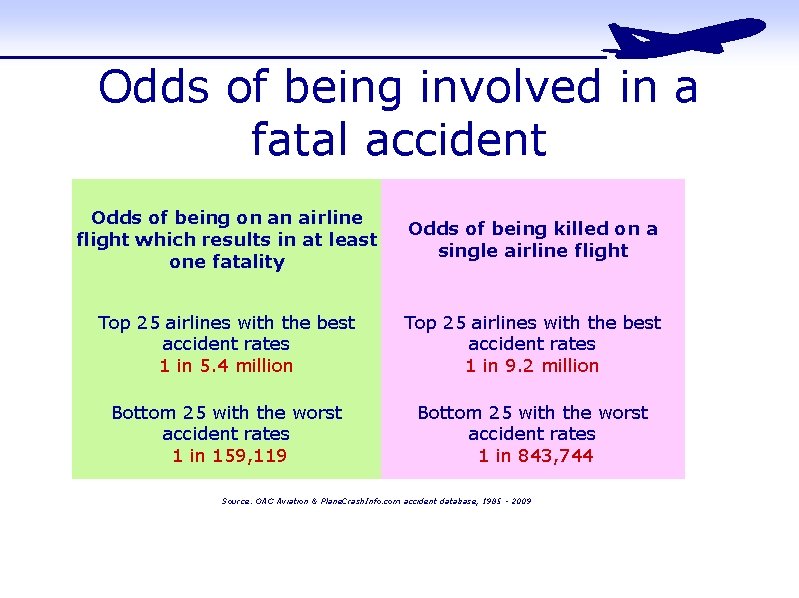
Odds of being involved in a fatal accident Odds of being on an airline flight which results in at least one fatality Odds of being killed on a single airline flight Top 25 airlines with the best accident rates 1 in 5. 4 million Top 25 airlines with the best accident rates 1 in 9. 2 million Bottom 25 with the worst accident rates 1 in 159, 119 Bottom 25 with the worst accident rates 1 in 843, 744 Source: OAG Aviation & Plane. Crash. Info. com accident database, 1985 - 2009
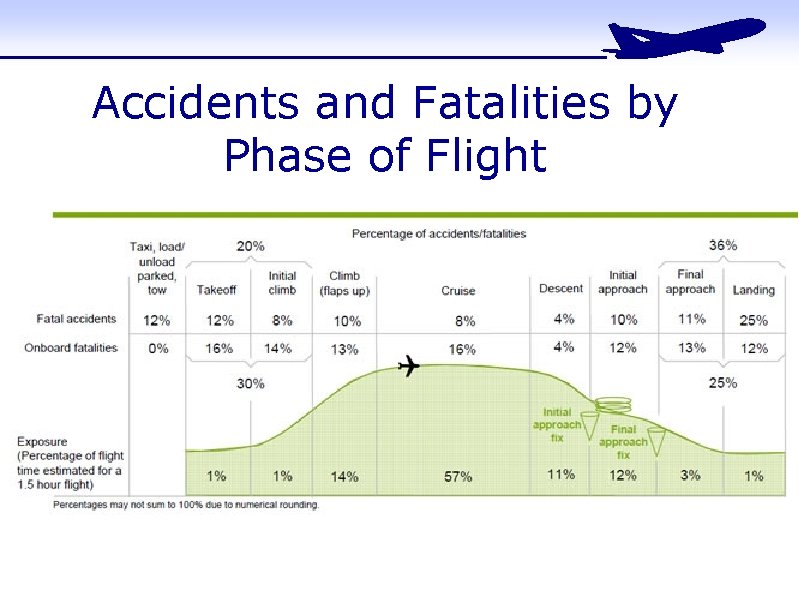
Accidents and Fatalities by Phase of Flight
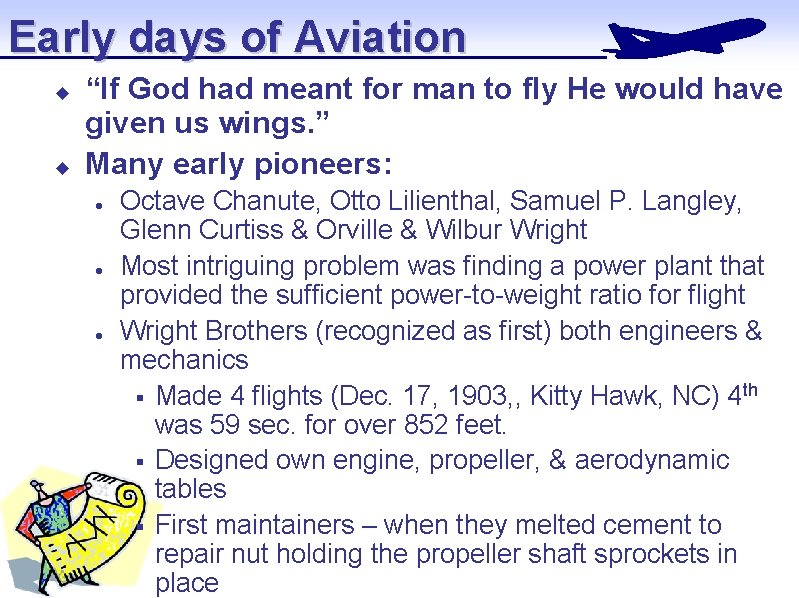
Early days of Aviation u u “If God had meant for man to fly He would have given us wings. ” Many early pioneers: l l l Octave Chanute, Otto Lilienthal, Samuel P. Langley, Glenn Curtiss & Orville & Wilbur Wright Most intriguing problem was finding a power plant that provided the sufficient power-to-weight ratio for flight Wright Brothers (recognized as first) both engineers & mechanics § Made 4 flights (Dec. 17, 1903, , Kitty Hawk, NC) 4 th was 59 sec. for over 852 feet. § Designed own engine, propeller, & aerodynamic tables § First maintainers – when they melted cement to repair nut holding the propeller shaft sprockets in place
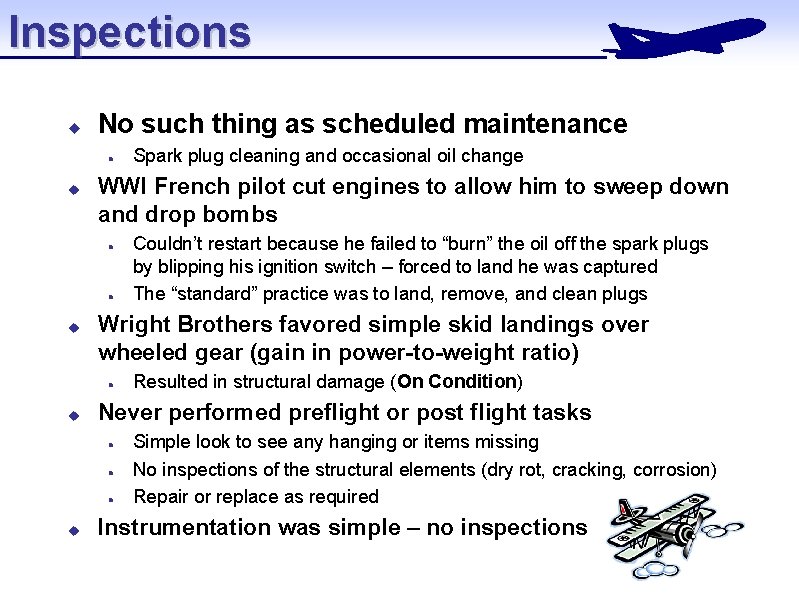
Inspections u No such thing as scheduled maintenance l u WWI French pilot cut engines to allow him to sweep down and drop bombs l l u Resulted in structural damage (On Condition) Never performed preflight or post flight tasks l l l u Couldn’t restart because he failed to “burn” the oil off the spark plugs by blipping his ignition switch – forced to land he was captured The “standard” practice was to land, remove, and clean plugs Wright Brothers favored simple skid landings over wheeled gear (gain in power-to-weight ratio) l u Spark plug cleaning and occasional oil change Simple look to see any hanging or items missing No inspections of the structural elements (dry rot, cracking, corrosion) Repair or replace as required Instrumentation was simple – no inspections
Promotion of Flight u First airline in US carried passengers from St. Petersburg to Tampa (Jan – Mar 1914) l u Carried only 1 passenger at a time After WWI, airmail service began – if room, a passenger may sit upon the mail § § § US Gov’t encouraged operators to use bigger planes & carry more passengers so they wouldn’t have to rely on mail contracts to stay in business Early days – no navigational aids (only roads, railways), could not fly at night unless bonfires lit along the route By 1929, 10, 000 miles of lighted airways, 275 lighted airports, 1352 navigational beacons
Promotion of Flight u u Monetary prizes for aviation accomplishments WWI used aircraft as observation platforms § § u Migrated to pistols, shotguns and rifles with limited success First machine guns mounted on upper wing of bi-plane Pilot had to stand to fire and still try to pilot aircraft Fuselage mounted to fire through propeller – led to prop damage until invention of the interrupter gear WWII brought massive surge in production l l l Increased complexity brought potential failure Inspired preventive maintenance Material breakthroughs and powerplant advances influenced maintenance programs
Promotion of Flight u Scheduled Maintenance Programs l l l u Periodic inspections of structure and components and component change-outs Periodic inspection was preventive Component change out or Time Change Item (TCI) was to remove item before failure Unscheduled Maintenance was massive § § Operating environment, battle damage and tactics stressed airframe beyond design limits, and accumulated flight hours Mass production impacted reliability and maintainability – Took 117 days from contract to first flight – No thought for maintainer accessability or inspection – Components went where they could fit
Promotion of Flight u u u 1927 – 18, 679 flew; 1931 – 385, 000 flew After WWII, US has fostered the jet age Maintenance Inspection became a discipline l l l 1954, F-86 D delivered to Korean theater of war Required 50 -hr Periodic, 25 -hr HPO (Hourly Post Flight), and a preflight By definition - unsafe to fly after 50 flt hrs
Promotion of Flight u 50 -hr periodic inspection: l l l u u Items that never failed were checked and rechecked resulting in maintainer induced failures (fasteners on panels); TCI components changed out – with no failures Resulting in waste of man-hours and dollars Inspection changed to 100 -hr and items for inspection reduced No balance of aircraft usage to inspection requirements Assumptions more inspections safer aircraft
Promotion of Flight u u Safety includes redundant systems Also includes: l l u Failure and damage tolerant designs Safety for flight loads Normal and emergency systems Interconnected electrical systems Reliability is: l “A measure of the probability that an item will survive to a specified operating age or time, under specified operating conditions, without a failure”
Promotion of Flight u From periodic inspection to phased inspection l u u Isochronal Inspection based on number of days not flight hours (28 days, 180 day 365 day, etc) Military provided insight into maintenance preventive maintenance, & inspection concepts l l u Simply put same amount of items inspected just in increments ¼ now, ¼ next time etc. Civilian – “A” check; “B” check; “C” check and “D” check General Aviation – 100 -hr; Time Before Overhaul (TBO), calendar inspections, time-in-service inspection Key is aircraft require preventive or corrective maintenance at frequent intervals l Kind of operation; environmental conditions; storage facilities avail; age and construct of aircraft
Modern Day Aircraft Maintenance u u u Since deregulation it has become “survival of the fittest” Cost of ownership – fuel, wash, oil, tires etc… Scheduled maintenance l l u Design Manufacturer can help reduce costs l u Goal is to correct any deficiency before it occurs Checks cost money – labor and parts, fluids costs and loss of passenger revenue when not flying Through before design specification of PBL (Performance Based Logistics) Total up all Maintenance associated costs subtract from revenue from aircraft and you get profit or loss
Design & Role of Manufacturers u Maintenance Man-hours per Flying hour (MMH/FH) l u Cost to maintain a particular type of aircraft We can design perfect systems on paper but we can not build perfect systems in the “real” world l Nothing is perfect
Design & Role of Manufacturers u u u Cost of Ownership and scheduled maintenance are 2/3 of equation Unscheduled Maintenance – random failures Reliability studies have led to MTBF (Mean Time Between Failure) – components / system guesstimated reliability factor Induced failures – FOD, damage from servicing vehicles, maintenance malpractices Inherent failures – delamination of composites, substandard bearings, inefficient seals etc. No defect – A-799 or fault within tech data limits (require expenditure of maintenance resources)
Design & Role of Manufacturers u Present all data with respect to MMH/FH to manufacturer l l l u u u Scheduled Maint – Unscheduled Maint – Cost of Ownership – Good, Fast, Cheap Allocate Unscheduled MMH/FH by system A design engineer may be limited from making the perfect system by technology or the state of the art within any facet of the design effort l l Limited by ability, technique or economics Economics may force a redesign with reduced tolerances, cheaper materials & gap between: § perfect & “ perfect” realism
Role of the Mechanic u For the mechanic the gap between “perfect” & “perfect” realism always changes & predominantly for the worse l l u u Components or systems tend to wear out from use or lack there of (time or environmentally related) Misuse may cause premature deterioration or degradation of the system or even outright damage The engineer’s responsibility is to design the system with as high degree of perfection within reasonable limits/constraints The mechanic’s responsibility is to combat the gap between ideal & realism during the operational lifetime of the equipment
Summary u u The purpose of aircraft maintenance is to ensure the aircraft will remain airworthy throughout its operational life Inspections & modifications to aircraft help ensure the programs are getting closer to “perfection” within the inherent limits possible