
AVIAN MUSCLE INTRODUCTION q Most birds have approximately
AVIAN MUSCLE
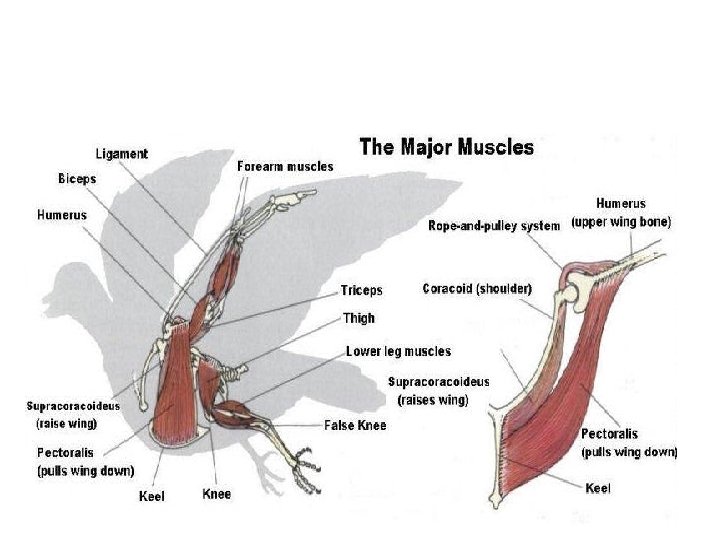
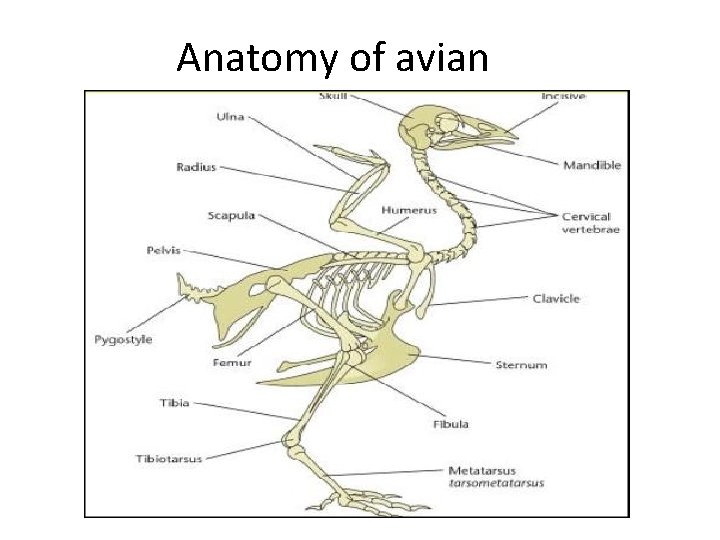
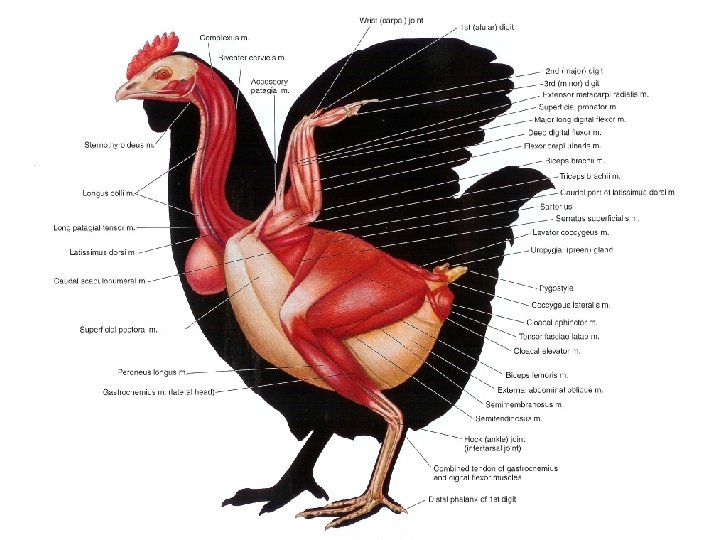
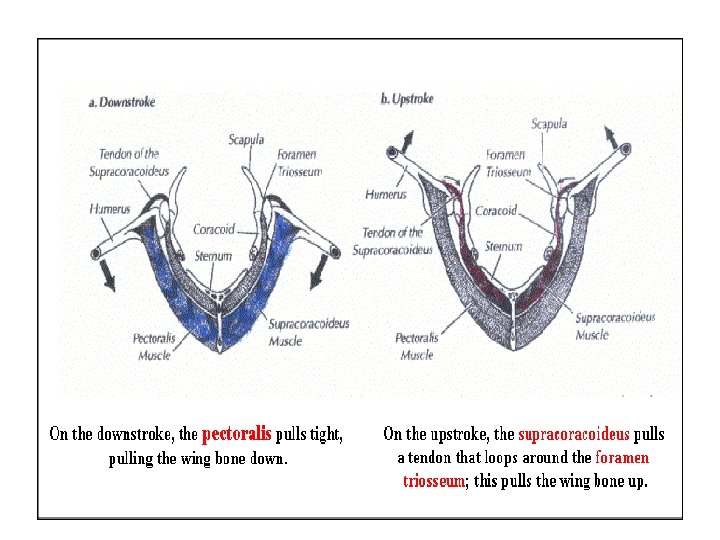
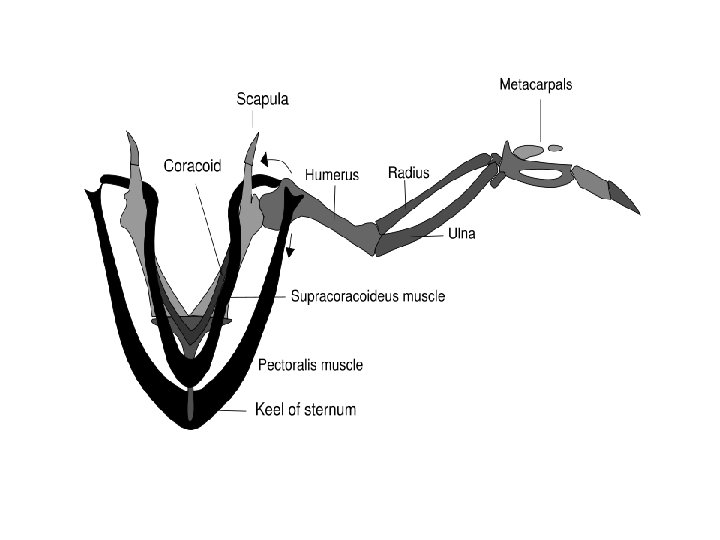
INTRODUCTION q. Most birds have approximately 175 different muscles, mainly controlling the wings, skin, and legs. q The largest muscles in the bird are the pectorals, or the breast muscles, which control the wings and make up about 15 - 25% of a flighted bird’s body weight. They provide the powerful wing stroke essential for flight. q The muscle ventral (underneath) to the pectorals is the supracoideus. It raises the wing between wingbeats. q The supracoideus and the pectorals together make up about 25 – 35% of the bird's full body weight. q. The skin muscles help a bird in its flight by adjusting the feathers, which are attached to the skin muscle and help the bird in its flight maneuvers. q. There are only a few muscles in the trunk and the tail, but they are very strong and are essential for the bird. q The pygostyle controls all the movement in the tail and controls the feathers in the tail. This gives the tail a larger surface area which helps keep the bird in the air.
AVIAN MUSCLE
Anatomy of avian
MUSCLES • • ORIGIN INSERTION INNERVATION ACTION
UNIQUE MUSCLE CONFIGURATIONS • Pectoralis major • Supracoideus • Wing mechanics
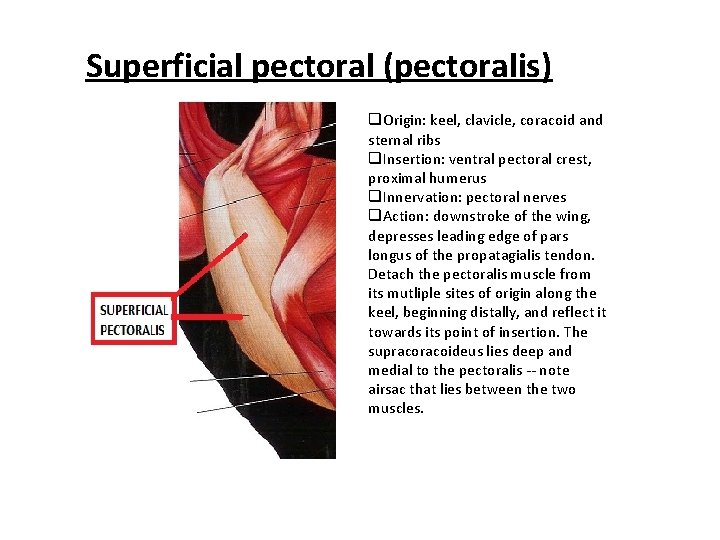
Superficial pectoral (pectoralis) q. Origin: keel, clavicle, coracoid and sternal ribs q. Insertion: ventral pectoral crest, proximal humerus q. Innervation: pectoral nerves q. Action: downstroke of the wing, depresses leading edge of pars longus of the propatagialis tendon. Detach the pectoralis muscle from its mutliple sites of origin along the keel, beginning distally, and reflect it towards its point of insertion. The supracoideus lies deep and medial to the pectoralis -- note airsac that lies between the two muscles.
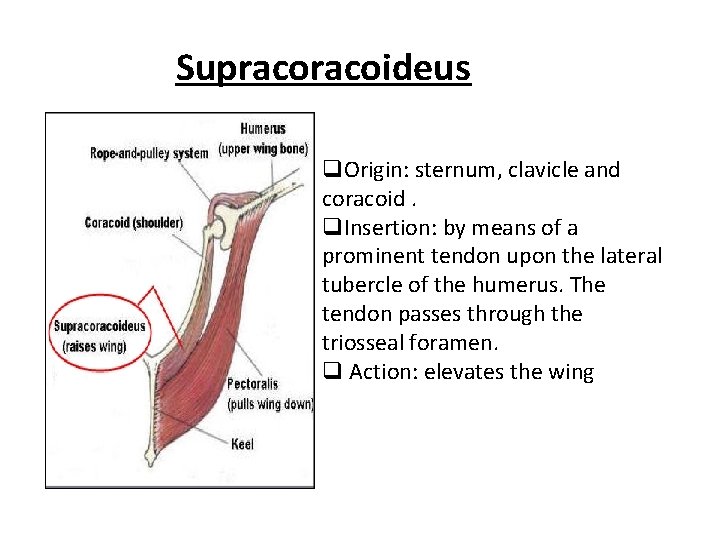
Supracoideus q. Origin: sternum, clavicle and coracoid. q. Insertion: by means of a prominent tendon upon the lateral tubercle of the humerus. The tendon passes through the triosseal foramen. q Action: elevates the wing
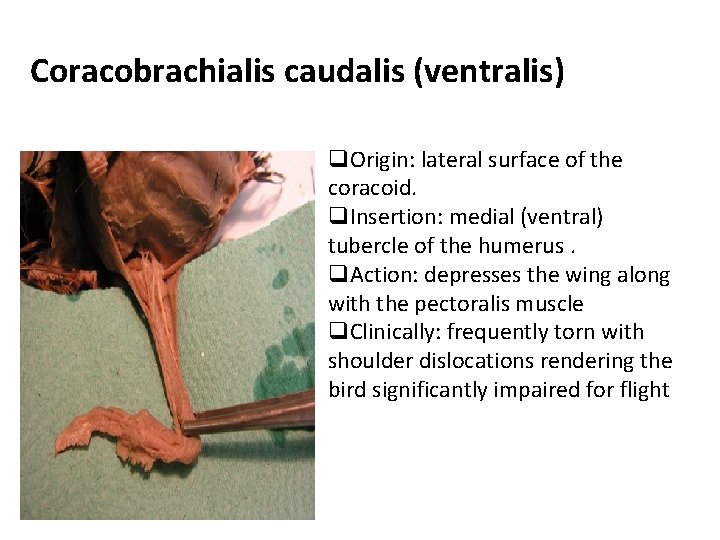
Coracobrachialis caudalis (ventralis) q. Origin: lateral surface of the coracoid. q. Insertion: medial (ventral) tubercle of the humerus. q. Action: depresses the wing along with the pectoralis muscle q. Clinically: frequently torn with shoulder dislocations rendering the bird significantly impaired for flight
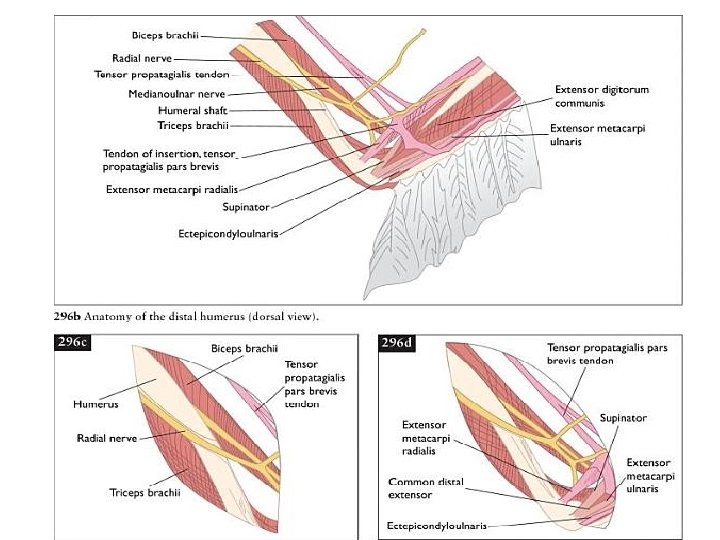
Propatagialis (pars brevis and pars longus) q. Origin: Distal end of the coracoid bone q. Insertion: 2 parts 1. Pars longus: inserts on the carpo-metacarpus and forms the leading edge of the wing. The patagium is attached to it. 2. Pars brevis: attaches to apeunerosis arising from dorsal musculature in the proximal 1/3 of the antebrachium. q. Actions: -Tenses the patagium (elastic web) -Extends the carpus -Serves as a check ligament to prevent overextension of the elbow joint.
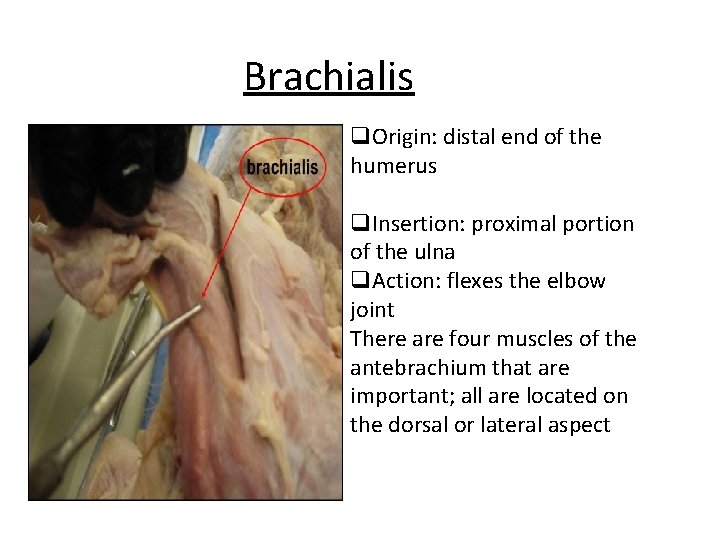
Brachialis q. Origin: distal end of the humerus q. Insertion: proximal portion of the ulna q. Action: flexes the elbow joint There are four muscles of the antebrachium that are important; all are located on the dorsal or lateral aspect
Muscle of Pectoral Limb qmodifications for flight. qcomprise 35% of the body weight. qshifted craniad under the center of lift have long tendons reaching distally to the portion of the limb controlled by them
MUSCULATURE OF PECTORAL LIMBS : HUMERUS q. Biceps q. Triceps q. Deltoid
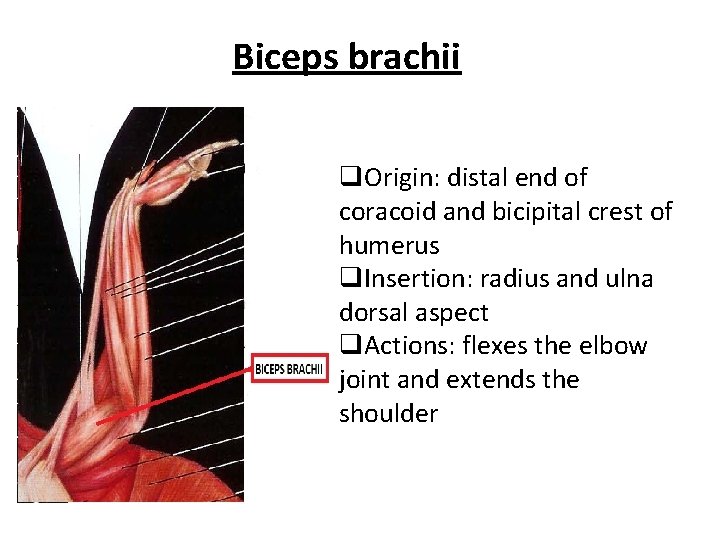
Biceps brachii q. Origin: distal end of coracoid and bicipital crest of humerus q. Insertion: radius and ulna dorsal aspect q. Actions: flexes the elbow joint and extends the shoulder
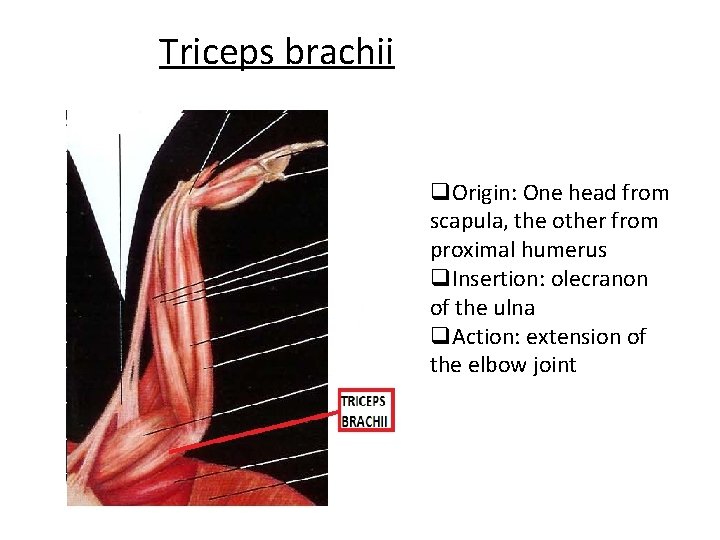
Triceps brachii q. Origin: One head from scapula, the other from proximal humerus q. Insertion: olecranon of the ulna q. Action: extension of the elbow joint
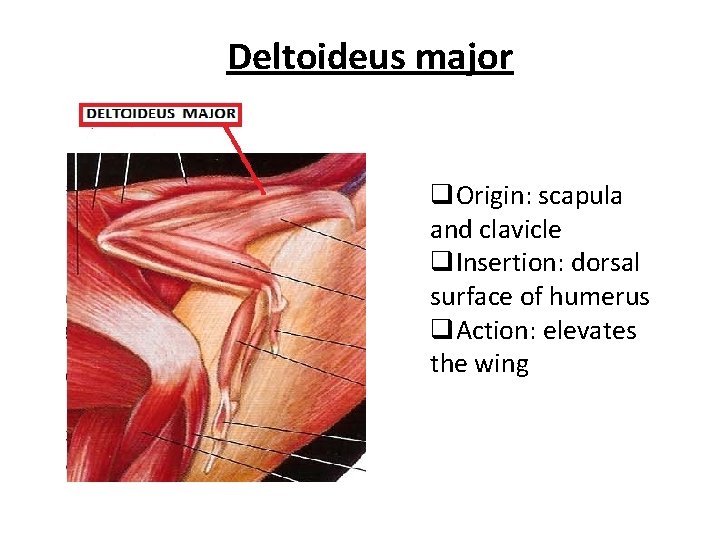
Deltoideus major q. Origin: scapula and clavicle q. Insertion: dorsal surface of humerus q. Action: elevates the wing
MUSCULATURE OF PECTORAL LIMB : ANTEBRACHIUM • Extensor carpi radialis • Common digital extensor • Extensor metacarpi ulnaris • Supinator
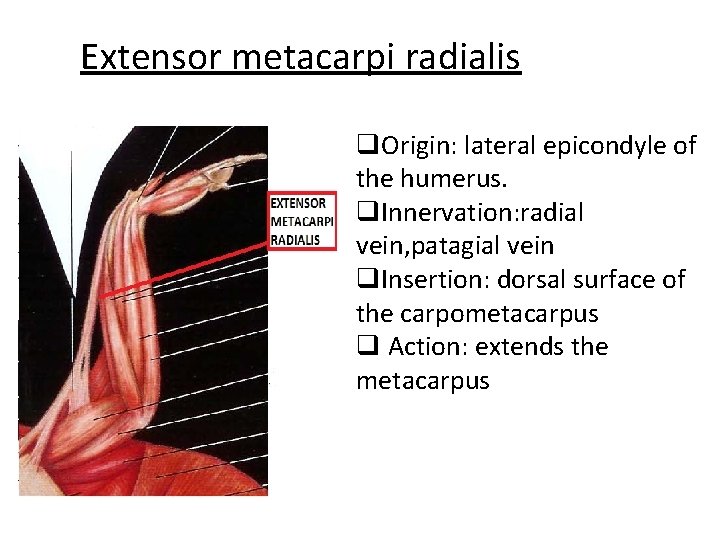
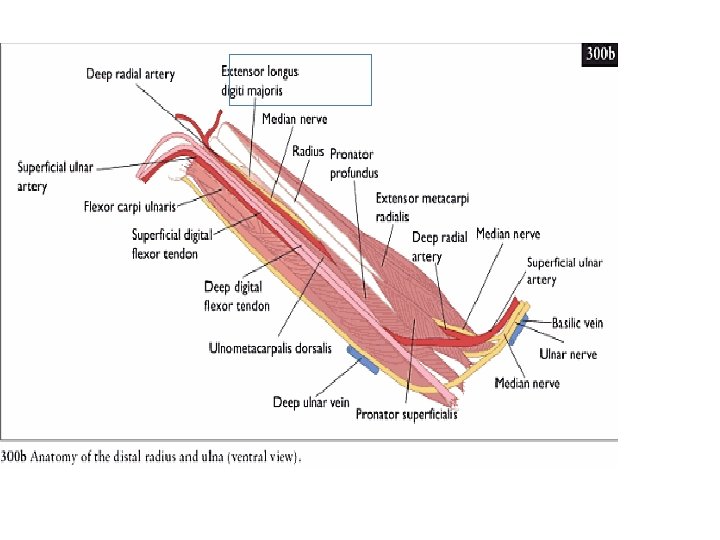
Extensor metacarpi radialis q. Origin: lateral epicondyle of the humerus. q. Innervation: radial vein, patagial vein q. Insertion: dorsal surface of the carpometacarpus q Action: extends the metacarpus
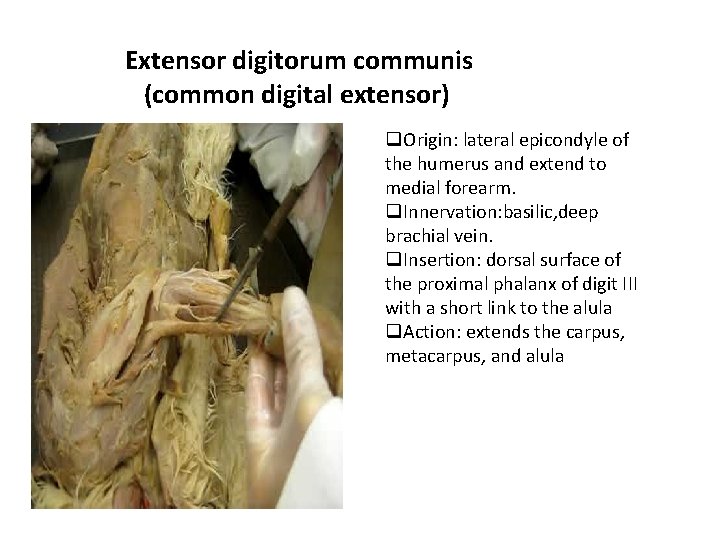
Extensor digitorum communis (common digital extensor) q. Origin: lateral epicondyle of the humerus and extend to medial forearm. q. Innervation: basilic, deep brachial vein. q. Insertion: dorsal surface of the proximal phalanx of digit III with a short link to the alula q. Action: extends the carpus, metacarpus, and alula
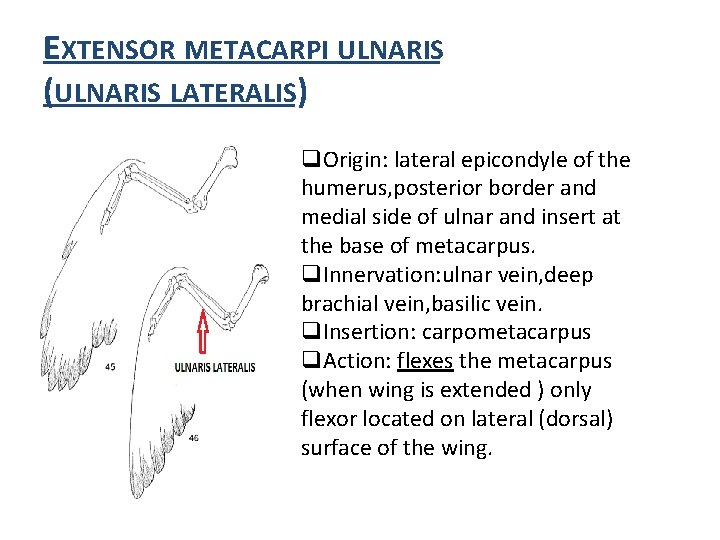
EXTENSOR METACARPI ULNARIS (ULNARIS LATERALIS) q. Origin: lateral epicondyle of the humerus, posterior border and medial side of ulnar and insert at the base of metacarpus. q. Innervation: ulnar vein, deep brachial vein, basilic vein. q. Insertion: carpometacarpus q. Action: flexes the metacarpus (when wing is extended ) only flexor located on lateral (dorsal) surface of the wing.
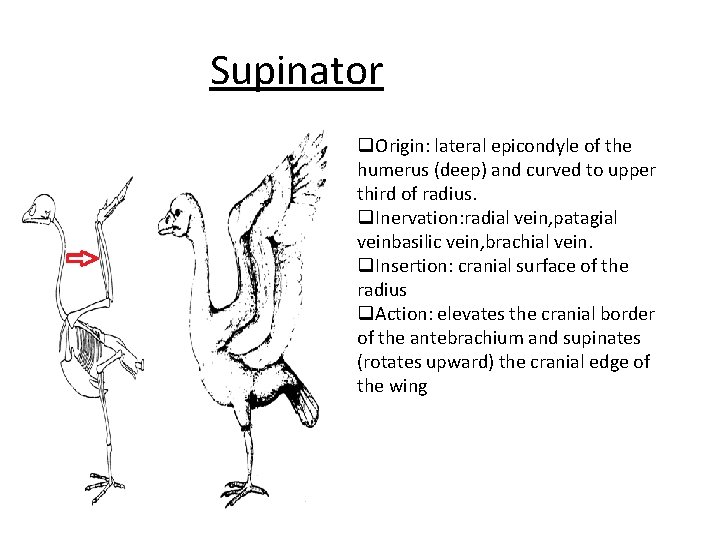
Supinator q. Origin: lateral epicondyle of the humerus (deep) and curved to upper third of radius. q. Inervation: radial vein, patagial veinbasilic vein, brachial vein. q. Insertion: cranial surface of the radius q. Action: elevates the cranial border of the antebrachium and supinates (rotates upward) the cranial edge of the wing
PELVIC LIMB • Pelvic Limb Myology: • Movement to center of mass with long tendons going to extemities; tendons are often ossified.
MUSCULATURE OF PELVIC LIMB : HIP & FEMUR q. Quadriceps equivalent 1. Iliotibialis cranialis 2. Iliotibialis lateralis q Iliofibularis q Femerotibialus externus
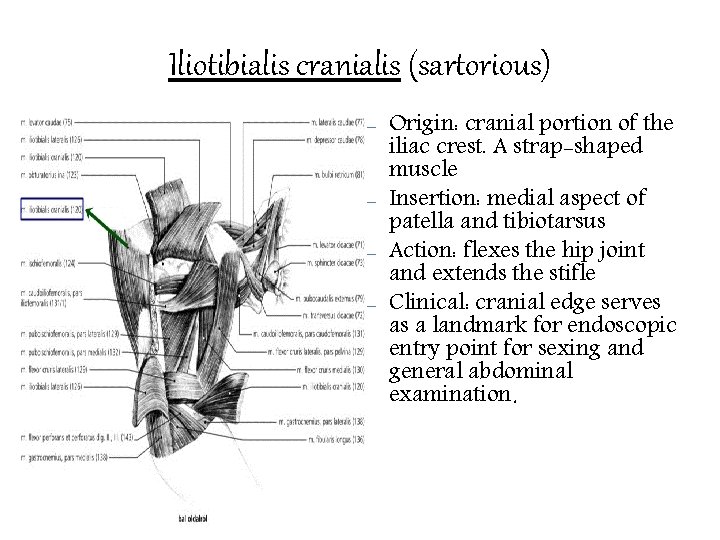
Iliotibialis cranialis (sartorious) – – Origin: cranial portion of the iliac crest. A strap-shaped muscle Insertion: medial aspect of patella and tibiotarsus Action: flexes the hip joint and extends the stifle Clinical: cranial edge serves as a landmark for endoscopic entry point for sexing and general abdominal examination.
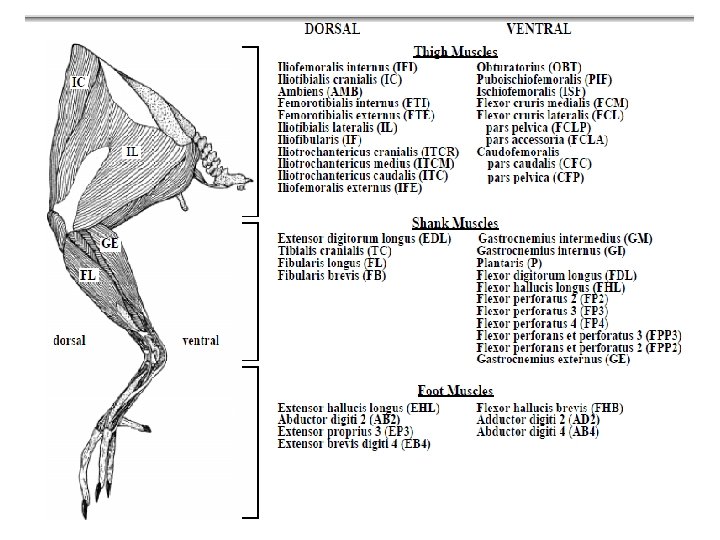
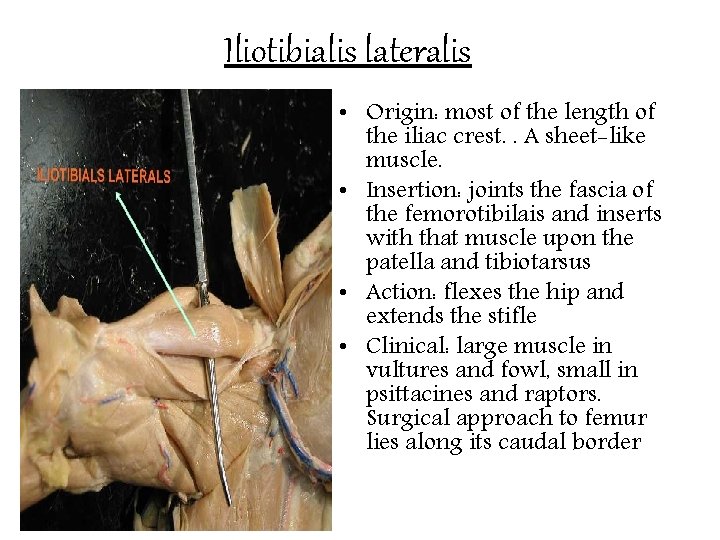
Iliotibialis lateralis • Origin: most of the length of the iliac crest. . A sheet-like muscle. • Insertion: joints the fascia of the femorotibilais and inserts with that muscle upon the patella and tibiotarsus • Action: flexes the hip and extends the stifle • Clinical: large muscle in vultures and fowl, small in psittacines and raptors. Surgical approach to femur lies along its caudal border
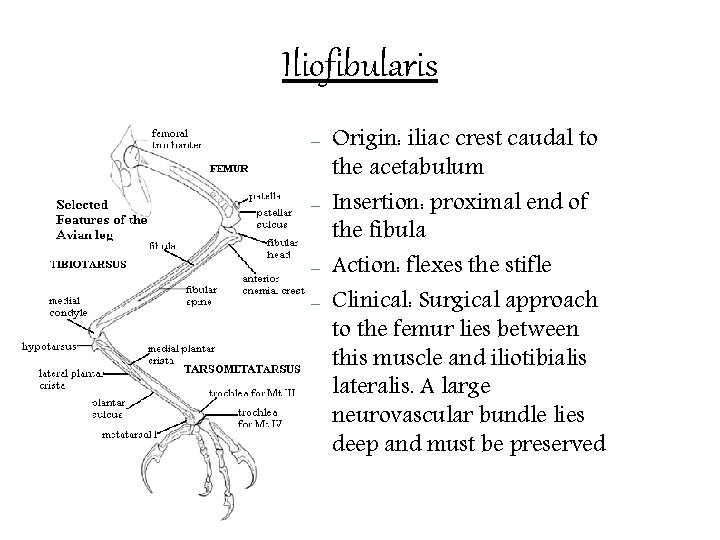
Iliofibularis – – Origin: iliac crest caudal to the acetabulum Insertion: proximal end of the fibula Action: flexes the stifle Clinical: Surgical approach to the femur lies between this muscle and iliotibialis lateralis. A large neurovascular bundle lies deep and must be preserved
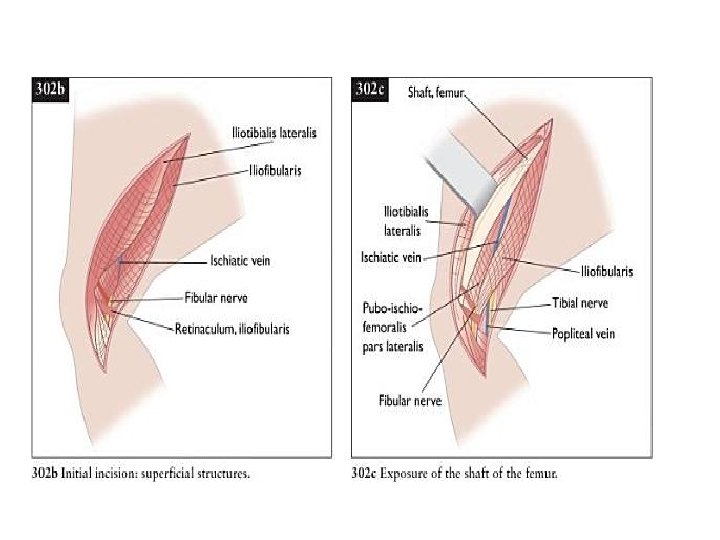
Femorotibialis externus • Origin: adherent to most of the length of the craniolateral femur • Insertion: patella and proximal tibiotarsus • Action: extends the stifle • Clinical: typically needs to be periosteally elevated from shaft of femur during surgical approaches.
MUSCULATURE OF PELVIC LIMB : TIBIOTARSAL REGION • Gastronemius – 3 heads • Fibularis longus • Tibialis cranialis • Extensor digitorum longus
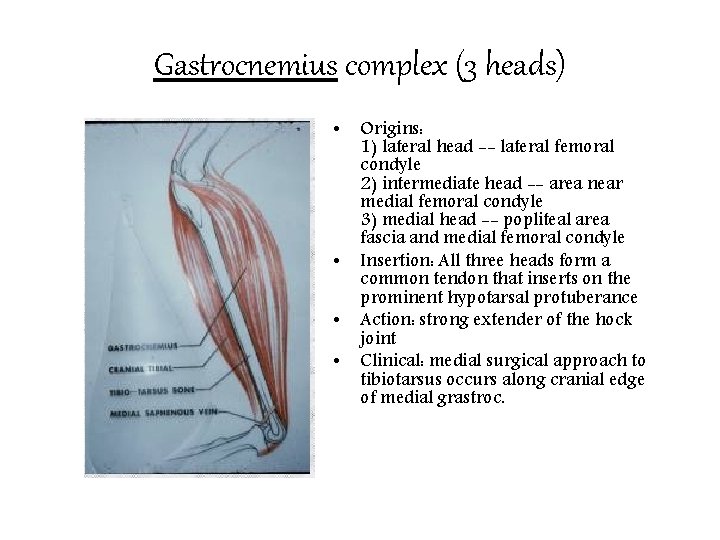
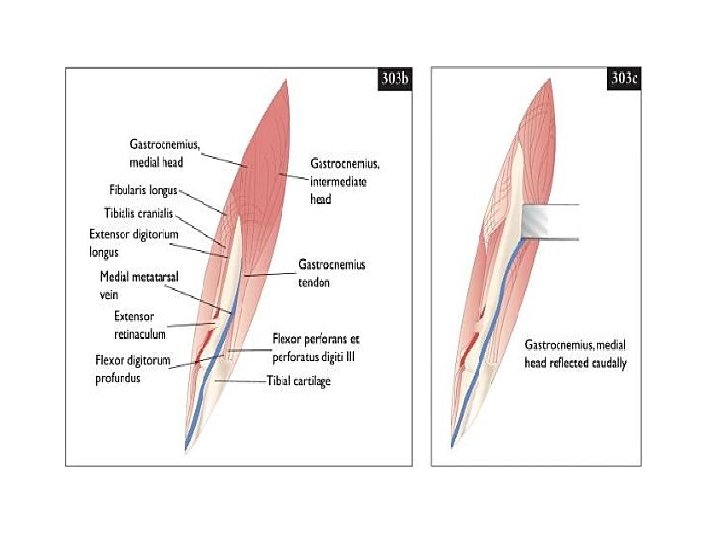
Gastrocnemius complex (3 heads) • • Origins: 1) lateral head -- lateral femoral condyle 2) intermediate head -- area near medial femoral condyle 3) medial head -- popliteal area fascia and medial femoral condyle Insertion: All three heads form a common tendon that inserts on the prominent hypotarsal protuberance Action: strong extender of the hock joint Clinical: medial surgical approach to tibiotarsus occurs along cranial edge of medial grastroc.
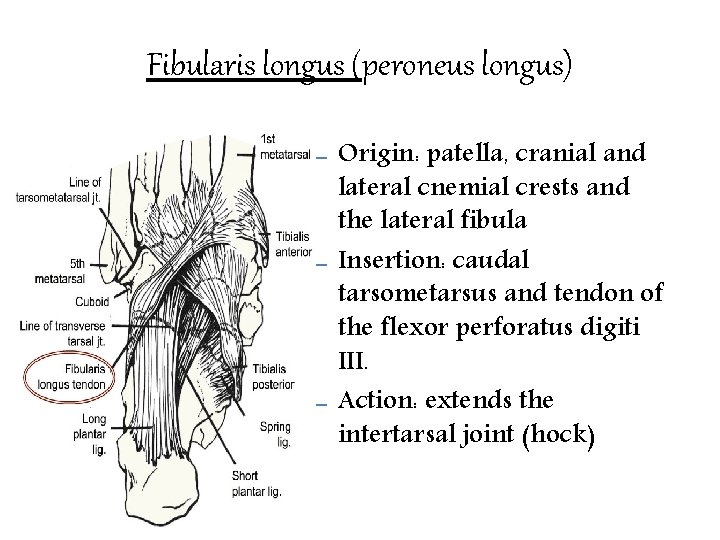
Fibularis longus (peroneus longus) – – – Origin: patella, cranial and lateral cnemial crests and the lateral fibula Insertion: caudal tarsometarsus and tendon of the flexor perforatus digiti III. Action: extends the intertarsal joint (hock)
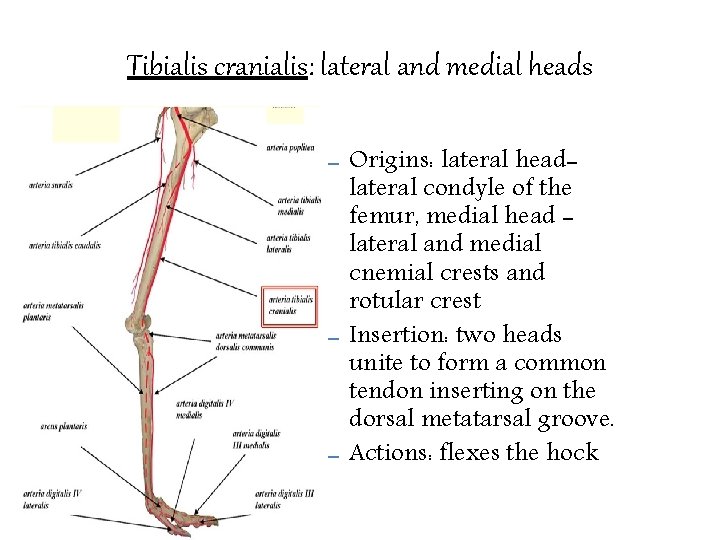
Tibialis cranialis: lateral and medial heads – – – Origins: lateral headlateral condyle of the femur, medial head lateral and medial cnemial crests and rotular crest Insertion: two heads unite to form a common tendon inserting on the dorsal metatarsal groove. Actions: flexes the hock
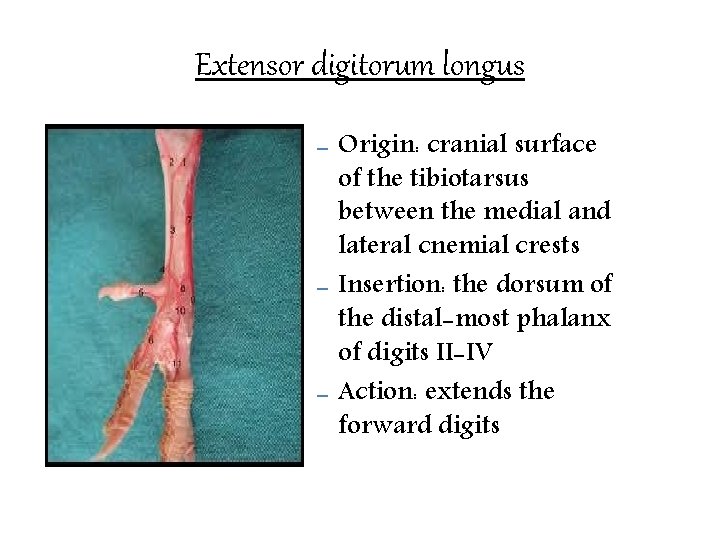
Extensor digitorum longus – – – Origin: cranial surface of the tibiotarsus between the medial and lateral cnemial crests Insertion: the dorsum of the distal-most phalanx of digits II-IV Action: extends the forward digits
- Slides: 42