
AVERAGE INTERNAL RATE OF RETURN AIRR The AIRR







- Slides: 12
AVERAGE INTERNAL RATE OF RETURN (AIRR) The AIRR is a more appropriate formulation of the notion of rate of return than the traditional IRR approach. Most of the difficulties associated with IRR can be bypassed by adopting the AIRR. The AIRR is an important contribution to the financial literature and the practice of finance. Gordon Hazen, Northwestern University – Associate Editor of Management Science (1989 -1994), Operations Research (1994 -2005) and Decision Analysis (2003 to present) 1
AIRR – An introduction • The Average Internal Rate of Return (AIRR) is a method developed by Prof. Carlo Alberto Magni from the Department of Economics “Marco Biagi” at the University of Modena and Reggio Emilia to better assess the rate of return of an investment • The AIRR addresses the several shortcomings of the Internal-Rate-of-Return (IRR) method widely used today • In particular, the AIRR places at the center of the analysis the actual capital values deployed for the investment and the investor’s cost of capital, instead of the assumed capital values derived from the project’s cash-flow in the IRR methodology without taking into account the cost of capital • With the AIRR, the correct rate of return is identified as the ratio of the aggregate income generated by the project to the aggregate capital invested in the project – an investment is worth undertaking if and only if the AIRR is greater than the investor’s cost of capital • Unlike the IRR methodology, the AIRR is also internally consistent with the investment’s Net Present Value (NPV) calculation 2
AIRR - Publications The AIRR methodology has been presented in several publications (some of which are listed below). In particular, the publication “Magni C. A. 2010. Average Internal Rate of Return and investment decisions: a new perspective. The Engineering Economist, 55(2), 150‒ 181. ” has received the “Eugene L. Grant” award granted by the Engineering Economy Division of the American Society for Engineering Education (ASEE) • Magni C. A. 2010. Average Internal Rate of Return and investment decisions: a new perspective. The Engineering Economist, 55(2), 150‒ 181. • Altshuler D. , Magni C. A. 2012. Why IRR is not the rate of return on your investment: Introducing the AIRR to the Real Estate community. Journal of Real Estate Portfolio Management, 18(2), 219‒ 230. • Magni C. A. 2013. The Internal-Rate-of-Return approach and the AIRR paradigm: A refutation and a corroboration. The Engineering Economist, 58(2), 73‒ 111. • Magni C. A. 2013. Generalized Makeham’s formula and economic profitability. Insurance: Mathematics and Economics. 53(3) (November), 747‒ 756. • Guerra M. L. , Magni C. A. , Stefanini L. 2014. Interval and fuzzy Average Internal Rate of Return for investment appraisal. Fuzzy Sets and Systems, 257, 217‒ 241. • Magni C. A. 2014. Mathematical analysis of average rates of return and investment decisions: The missing link. The Engineering Economist, 59(3), 175‒ 206. • Magni C. A. 2014. Arithmetic returns for investment performance measurement. Insurance: Mathematics and Economics. 55 (March), 291‒ 300. • Magni C. A. 2015. Investment, financing and the role of ROA and WACC in value creation. European Journal of Operational Research, 244(3) (August), 855‒ 866. • Magni C. A. 2016. Capital depreciation and the underdetermination of rate of return: A unifying perspective. Journal of Mathematical Economics, 67 (December), 54 -79. • Magni C. A. , Veronese P. , Graziani R. 2017. Chisini means and rational decision-making: Equivalence of investment criteria. Mathematics and Financial Economics, 12(2), • 193 -217. Marchioni A. , Magni C. A. 2018. Investment decisions and sensitivity analysis: NPV-consistency of rates of return, European Journal of Operational Research. 268(1) (July), 361 -372. The technical problem of evaluation of investments is, at the same time, crucial and controversial. The improper use of the IRR has often hidden the right solution. The AIRR approach overcomes these problems and provides all us with an efficient tool to drive investment decisions. A highly recommended point of view. Lorenzo Peccati, “Bocconi” University – editor of the European Journal of Operational Research (2002 -2014) 3
AIRR – Financial model for an investment in an industrial project The sample model highlights the AIRR method for a capital project investment financed by a mix of equity and debt The equity’s cost of capital and the debt’s cost will be used in the AIRR calculation 4
Calculation of Equity AIRR • The Equity AIRR is the ratio of Aggregate Net Income to Aggregate Equity committed during the project Net Income is determined in the Income Statement 5
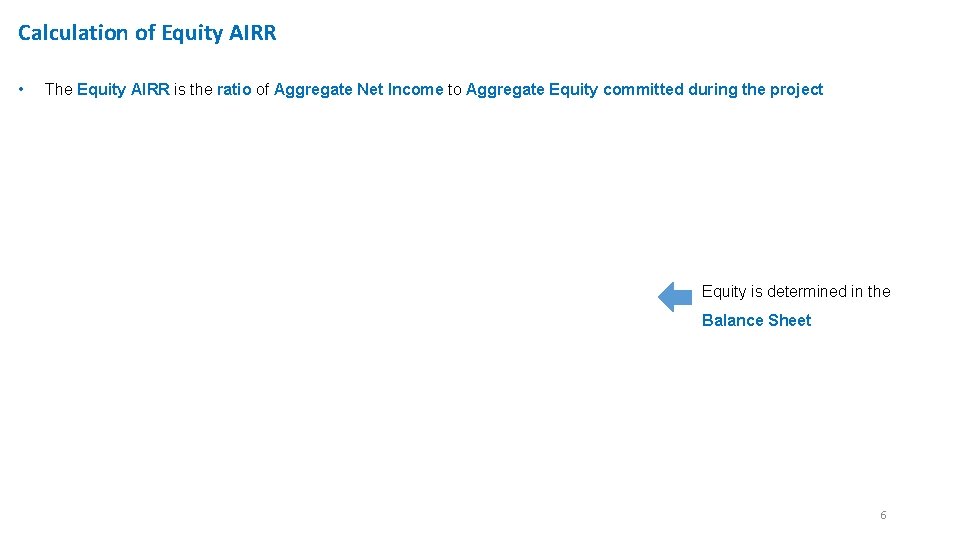
Calculation of Equity AIRR • The Equity AIRR is the ratio of Aggregate Net Income to Aggregate Equity committed during the project Equity is determined in the Balance Sheet 6
Calculation of Equity AIRR • The Equity AIRR is the ratio of aggregate Net Income to aggregate Equity committed during the project The Present Value of Net Income during the life of the project is calculated using the Equity’s COC The Present Value of Equity committed during the life of the project is also calculated using the Equity’s COC The ratio of aggregate (i. e. , total) Net Income to aggregate Equity (instantaneous return) is multiplied by the Equity Cost of Capital i. e. the present value of the excess return earned on Equity above the Equity COC 7
Calculation of Project AIRR • The Project AIRR is the ratio of Aggregate Project Income to Aggregate Project Assets during the project Project Income is determined as : EBIT – Income tax + Interest Earned on Liquid Assets (i. e. net income excluding debt interest cost) The Present Value of Project Income and Project Assets is calculated using the Project’s Cost of Capital 8
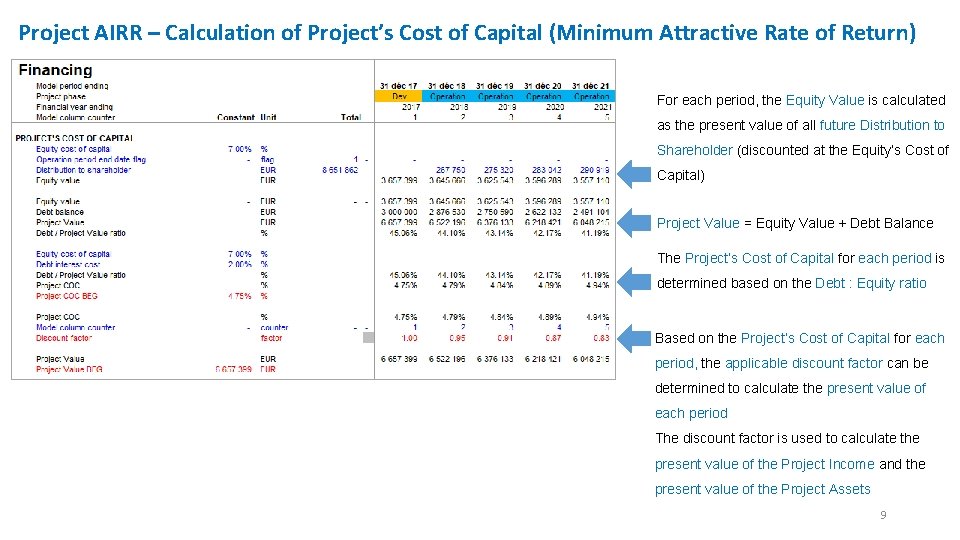
Project AIRR – Calculation of Project’s Cost of Capital (Minimum Attractive Rate of Return) For each period, the Equity Value is calculated as the present value of all future Distribution to Shareholder (discounted at the Equity’s Cost of Capital) Project Value = Equity Value + Debt Balance The Project’s Cost of Capital for each period is determined based on the Debt : Equity ratio Based on the Project’s Cost of Capital for each period, the applicable discount factor can be determined to calculate the present value of each period The discount factor is used to calculate the present value of the Project Income and the present value of the Project Assets 9
Project AIRR – Calculation of Project’s AIRR 10
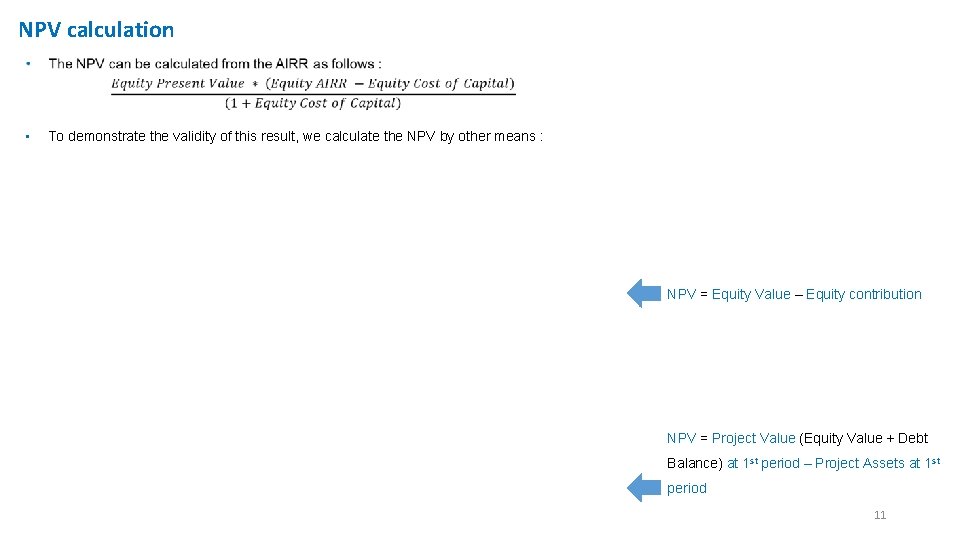
NPV calculation • To demonstrate the validity of this result, we calculate the NPV by other means : NPV = Equity Value – Equity contribution NPV = Project Value (Equity Value + Debt Balance) at 1 st period – Project Assets at 1 st period 11
Thank you 12