
Autumn 1 Knowledge Organiser Year 9 Unit 2
- Slides: 6
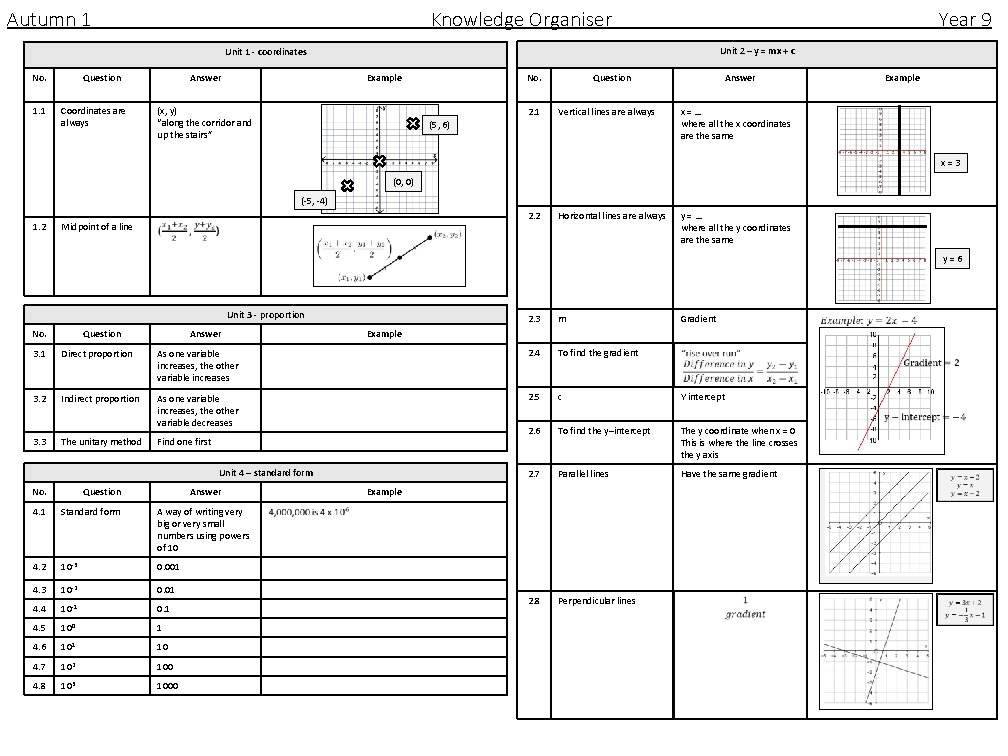
Autumn 1 Knowledge Organiser Year 9 Unit 2 – y = mx + c Unit 1 - coordinates No. 1. 1 Question Coordinates are always Answer Example (x, y) “along the corridor and up the stairs” No. 2. 1 Question Vertical lines are always (5, 6) Answer Example x=… where all the x coordinates are the same x=3 (0, 0) (-5, -4) 1. 2 2. 2 Midpoint of a line Horizontal lines are always y=… where all the y coordinates are the same y=6 Unit 3 - proportion No. Question Answer 2. 3 m Gradient Example 3. 1 Direct proportion As one variable increases, the other variable increases 2. 4 To find the gradient 3. 2 Indirect proportion As one variable increases, the other variable decreases 2. 5 c Y intercept 3. 3 The unitary method Find one first 2. 6 To find the y–intercept The y coordinate when x = 0 This is where the line crosses the y axis 2. 7 Parallel lines Have the same gradient 2. 8 Perpendicular lines Unit 4 – standard form No. Question Answer 4. 1 Standard form A way of writing very big or very small numbers using powers of 10 4. 2 10 -3 0. 001 4. 3 10 -2 0. 01 4. 4 10 -1 0. 1 4. 5 100 1 4. 6 101 10 4. 7 102 100 4. 8 103 1000 Example
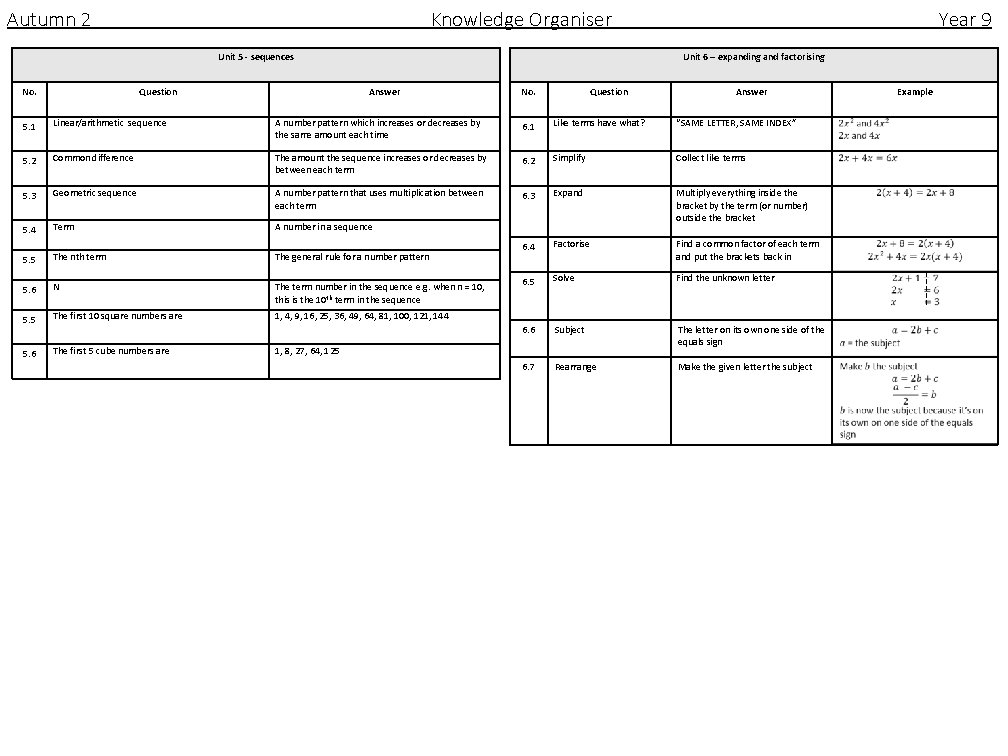
Autumn 2 Knowledge Organiser Unit 5 - sequences No. Question Year 9 Unit 6 – expanding and factorising Answer No. Question Answer 5. 1 Linear/arithmetic sequence A number pattern which increases or decreases by the same amount each time 6. 1 Like terms have what? “SAME LETTER, SAME INDEX” 5. 2 Common difference The amount the sequence increases or decreases by between each term 6. 2 Simplify Collect like terms 5. 3 Geometric sequence A number pattern that uses multiplication between each term 6. 3 Expand 5. 4 Term A number in a sequence Multiply everything inside the bracket by the term (or number) outside the bracket 6. 4 Factorise Find a common factor of each term and put the brackets back in 6. 5 Solve Find the unknown letter 6. 6 Subject The letter on its own one side of the equals sign 6. 7 Rearrange Make the given letter the subject 5. 5 The nth term The general rule for a number pattern 5. 6 N The term number in the sequence e. g. when n = 10, this is the 10 th term in the sequence 5. 5 The first 10 square numbers are 1, 4, 9, 16, 25, 36, 49, 64, 81, 100, 121, 144 5. 6 The first 5 cube numbers are 1, 8, 27, 64, 125 Example
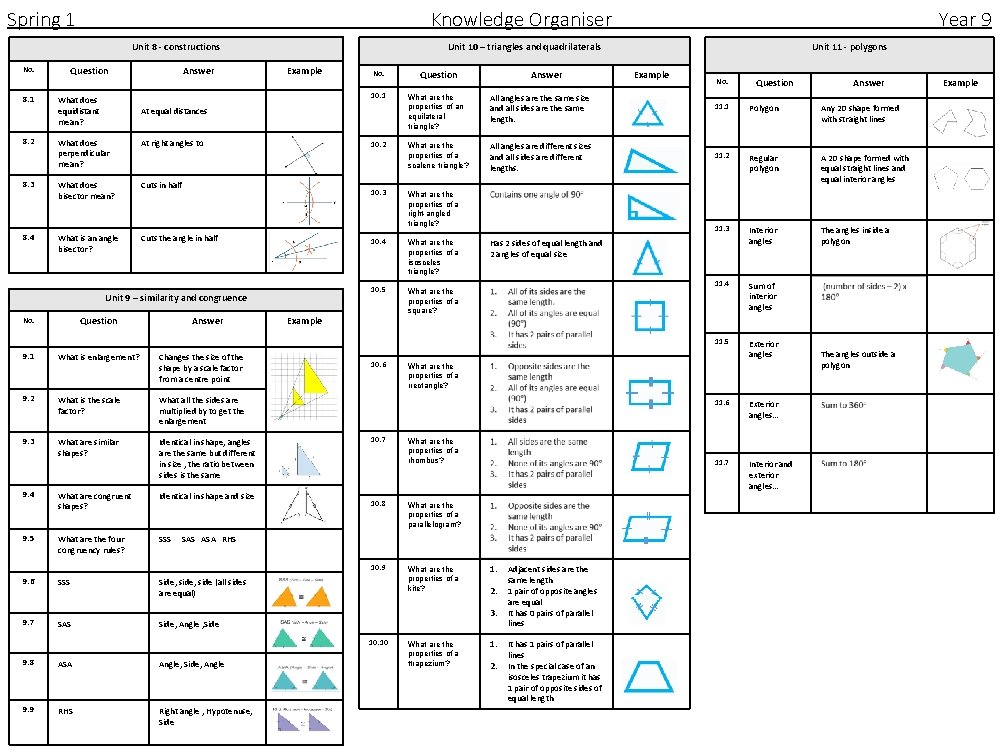
Spring 1 Knowledge Organiser Unit 10 – triangles and quadrilaterals Unit 8 - constructions No. 8. 1 8. 2 8. 3 8. 4 Question Answer Example At equal distances What does perpendicular mean? At right angles to What does bisector mean? Cuts in half What is an angle bisector? Cuts the angle in half 10. 2 10. 3 Unit 9 – similarity and congruence Question No. 9. 1 Answer What is enlargement? Changes the size of the shape by a scale factor from a centre point 9. 2 What is the scale factor? What all the sides are multiplied by to get the enlargement 9. 3 What are similar shapes? Identical in shape, angles are the same but different in size , the ratio between sides is the same What are congruent shapes? Identical in shape and size What are the four congruency rules? SSS 9. 4 9. 5 No. 10. 1 What does equidistant mean? Question Answer SSS Side, side (all sides are equal) 9. 7 SAS Side, Angle , Side Angle, Side, Angle 9. 9 RHS Right angle , Hypotenuse, Side No. Question Answer 11. 1 Polygon Any 2 D shape formed with straight lines What are the properties of a scalene triangle? All angles are different sizes and all sides are different lengths. 11. 2 Regular polygon A 2 D shape formed with equal straight lines and equal interior angles 11. 3 Interior angles The angles inside a polygon 11. 4 Sum of interior angles 11. 5 Exterior angles What are the properties of a right-angled triangle? 10. 4 What are the properties of a isosceles triangle? 10. 5 What are the properties of a square? Has 2 sides of equal length and 2 angles of equal size Example 10. 6 10. 7 What are the properties of a rrectangle? What are the properties of a rhombus? 10. 8 What are the properties of a parallelogram? 10. 9 What are the properties of a kite? 10. 10 ASA Example All angles are the same size and all sides are the same length. 1. 2. 3. 9. 8 Unit 11 - polygons What are the properties of an equilateral triangle? SAS ASA RHS 9. 6 Year 9 What are the properties of a ttrapezium? 1. 2. Adjacent sides are the same length 1 pair of opposite angles are equal It has 0 pairs of parallel lines It has 1 pairs of parallel lines In the special case of an isosceles trapezium it has 1 pair of opposite sides of equal length 11. 6 Exterior angles… 11. 7 Interior and exterior angles… The angles outside a polygon Example
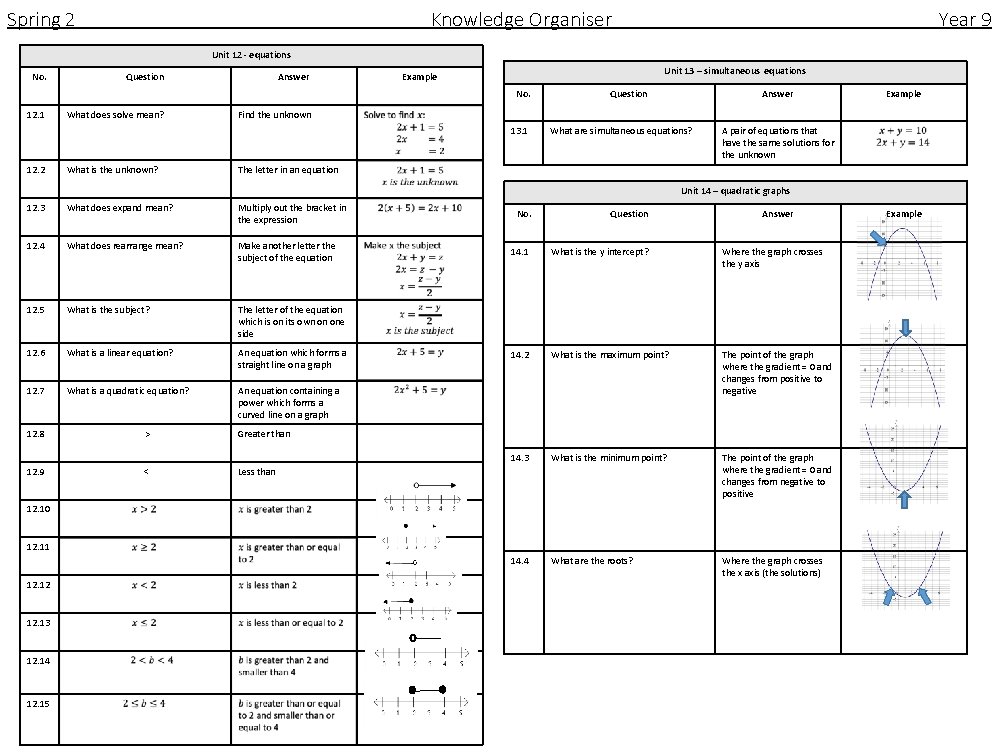
Spring 2 Knowledge Organiser Year 9 Unit 12 - equations No. Question Answer Unit 13 – simultaneous equations Example No. 12. 1 What does solve mean? What is the unknown? Answer Example Find the unknown 13. 1 12. 2 Question What are simultaneous equations? A pair of equations that have the same solutions for the unknown The letter in an equation Unit 14 – quadratic graphs 12. 3 What does expand mean? Multiply out the bracket in the expression 12. 4 What does rearrange mean? Make another letter the subject of the equation 12. 5 What is the subject? The letter of the equation which is on its own on one side 12. 6 What is a linear equation? An equation which forms a straight line on a graph 12. 7 What is a quadratic equation? An equation containing a power which forms a curved line on a graph 12. 8 > Greater than 12. 9 < Less than No. Question Answer 14. 1 What is the y intercept? Where the graph crosses the y axis 14. 2 What is the maximum point? The point of the graph where the gradient = 0 and changes from positive to negative 14. 3 What is the minimum point? The point of the graph where the gradient = 0 and changes from negative to positive 14. 4 What are the roots? Where the graph crosses the x axis (the solutions) 12. 10 12. 11 12. 12 12. 13 12. 14 12. 15 Example
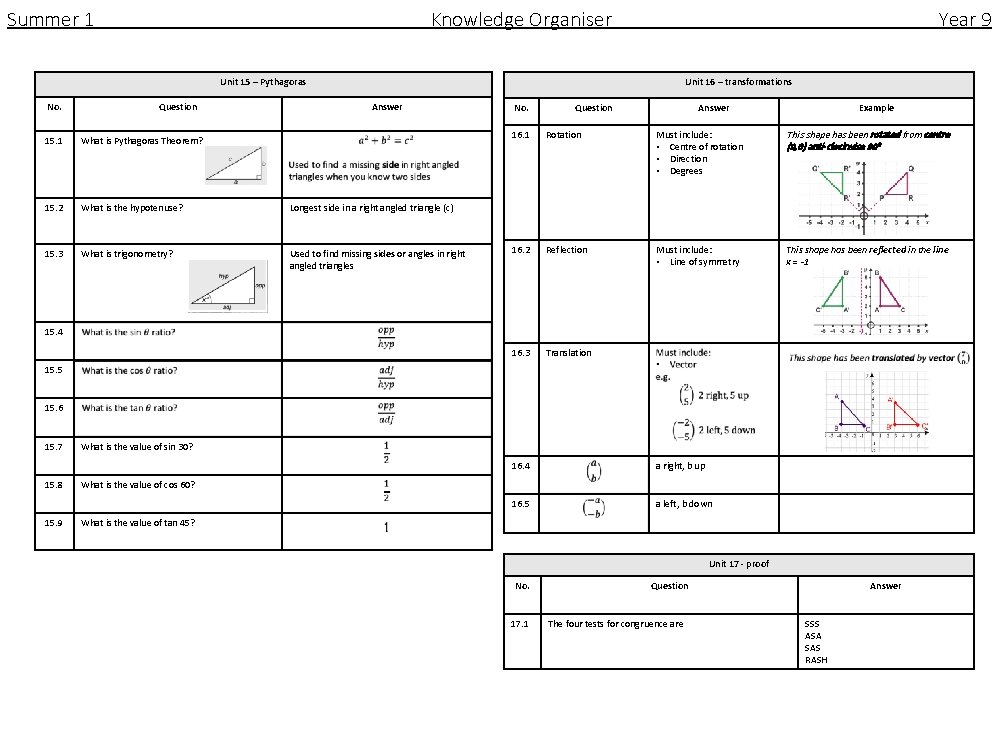
Summer 1 Knowledge Organiser Year 9 Unit 16 – transformations Unit 15 – Pythagoras No. Question Answer 15. 1 What is Pythagoras Theorem? 15. 2 What is the hypotenuse? Longest side in a right angled triangle (c) 15. 3 What is trigonometry? Used to find missing sides or angles in right angled triangles No. Question Answer Example 16. 1 Rotation Must include: • Centre of rotation • Direction • Degrees This shape has been rotated from centre (0, 0) anti-clockwise 90⁰ 16. 2 Reflection Must include: • Line of symmetry This shape has been reflected in the line x = -1 16. 3 Translation 15. 4 15. 5 15. 6 15. 7 15. 8 15. 9 What is the value of sin 30? 16. 4 a right, b up 16. 5 a left, b down What is the value of cos 60? What is the value of tan 45? Unit 17 - proof No. 17. 1 Question The four tests for congruence are Answer SSS ASA SAS RASH
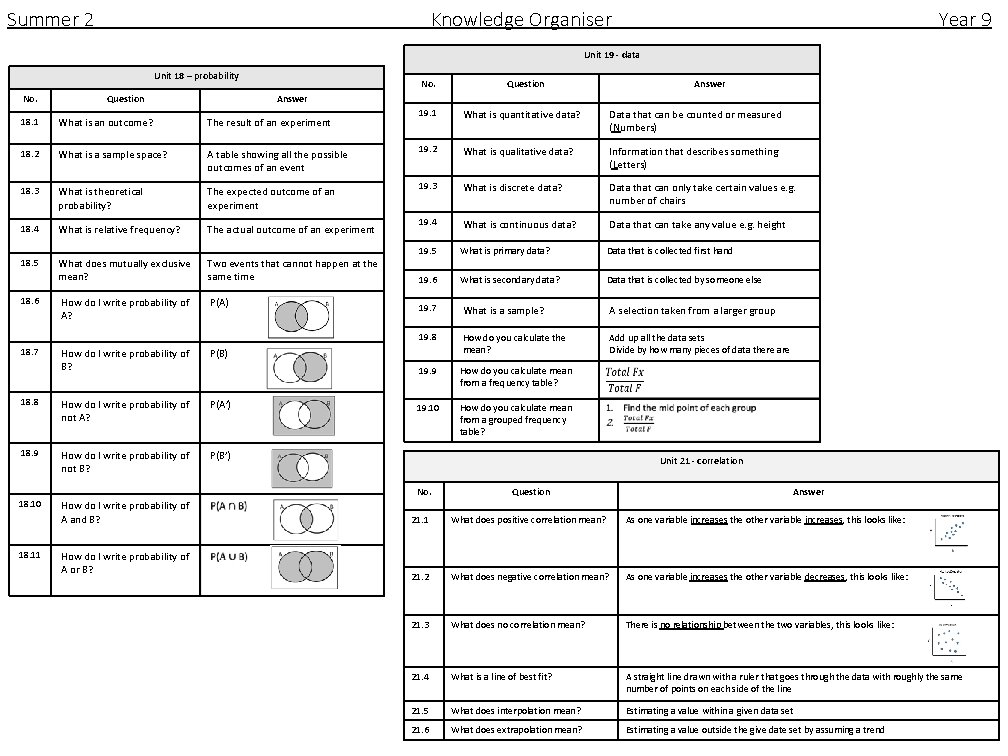
Summer 2 Knowledge Organiser Year 9 Unit 19 - data Unit 18 – probability No. Question No. What is an outcome? The result of an experiment 18. 2 What is a sample space? A table showing all the possible outcomes of an event 18. 3 What is theoretical probability? The expected outcome of an experiment 18. 4 What is relative frequency? The actual outcome of an experiment 18. 5 What does mutually exclusive mean? Two events that cannot happen at the same time How do I write probability of A? P(A) 18. 7 How do I write probability of B? P(B) 18. 8 How do I write probability of not A? P(A’) 18. 9 How do I write probability of not B? P(B’) 18. 10 18. 11 19. 1 What is quantitative data? Data that can be counted or measured (Numbers) 19. 2 What is qualitative data? Information that describes something (Letters) 19. 3 What is discrete data? Data that can only take certain values e. g. number of chairs 19. 4 What is continuous data? Data that can take any value e. g. height 19. 5 What is primary data? Data that is collected first hand 19. 6 What is secondary data? Data that is collected by someone else 19. 7 What is a sample? A selection taken from a larger group 19. 8 How do you calculate the mean? Add up all the data sets Divide by how many pieces of data there are 19. 9 How do you calculate mean from a frequency table? 19. 10 How do you calculate mean from a grouped frequency table? Unit 21 - correlation No. How do I write probability of A and B? How do I write probability of A or B? Answer 18. 1 18. 6 Question Answer 21. 1 What does positive correlation mean? As one variable increases the other variable increases, this looks like: 21. 2 What does negative correlation mean? As one variable increases the other variable decreases, this looks like: 21. 3 What does no correlation mean? There is no relationship between the two variables, this looks like: 21. 4 What is a line of best fit? A straight line drawn with a ruler that goes through the data with roughly the same number of points on each side of the line 21. 5 What does interpolation mean? Estimating a value within a given data set 21. 6 What does extrapolation mean? Estimating a value outside the give date set by assuming a trend