
Autumn 1 Knowledge Organiser Year 8 Unit 1
- Slides: 6
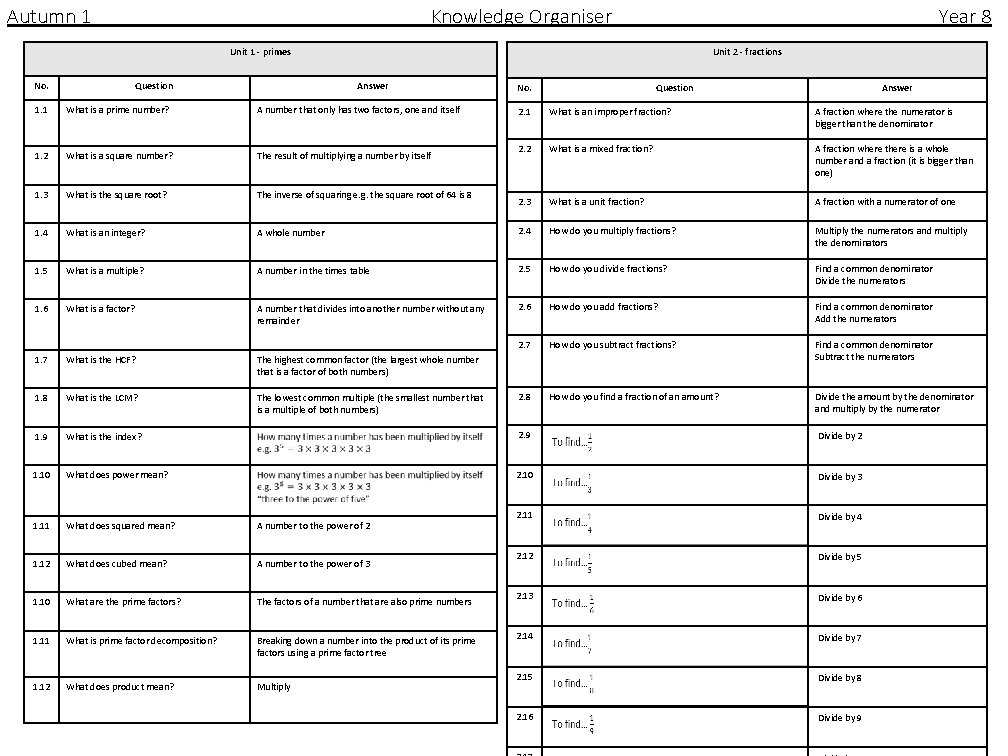
Autumn 1 Knowledge Organiser Year 8 Unit 1 - primes No. Question Unit 2 - fractions Answer 1. 1 What is a prime number? A number that only has two factors, one and itself 1. 2 What is a square number? The result of multiplying a number by itself 1. 3 What is the square root? The inverse of squaring e. g. the square root of 64 is 8 1. 4 What is an integer? 1. 5 1. 6 No. Question Answer 2. 1 What is an improper fraction? A fraction where the numerator is bigger than the denominator 2. 2 What is a mixed fraction? A fraction where there is a whole number and a fraction (it is bigger than one) 2. 3 What is a unit fraction? A fraction with a numerator of one A whole number 2. 4 How do you multiply fractions? Multiply the numerators and multiply the denominators What is a multiple? A number in the times table 2. 5 How do you divide fractions? Find a common denominator Divide the numerators What is a factor? A number that divides into another number without any remainder 2. 6 How do you add fractions? Find a common denominator Add the numerators 2. 7 How do you subtract fractions? Find a common denominator Subtract the numerators 2. 8 How do you find a fraction of an amount? Divide the amount by the denominator and multiply by the numerator 1. 7 What is the HCF? The highest common factor (the largest whole number that is a factor of both numbers) 1. 8 What is the LCM? The lowest common multiple (the smallest number that is a multiple of both numbers) 1. 9 What is the index? 2. 9 Divide by 2 1. 10 What does power mean? 2. 10 Divide by 3 1. 11 What does squared mean? A number to the power of 2 2. 11 Divide by 4 1. 12 What does cubed mean? A number to the power of 3 2. 12 Divide by 5 1. 10 What are the prime factors? The factors of a number that are also prime numbers 2. 13 Divide by 6 1. 11 What is prime factor decomposition? Breaking down a number into the product of its prime factors using a prime factor tree 2. 14 Divide by 7 1. 12 What does product mean? Multiply 2. 15 Divide by 8 2. 16 Divide by 9
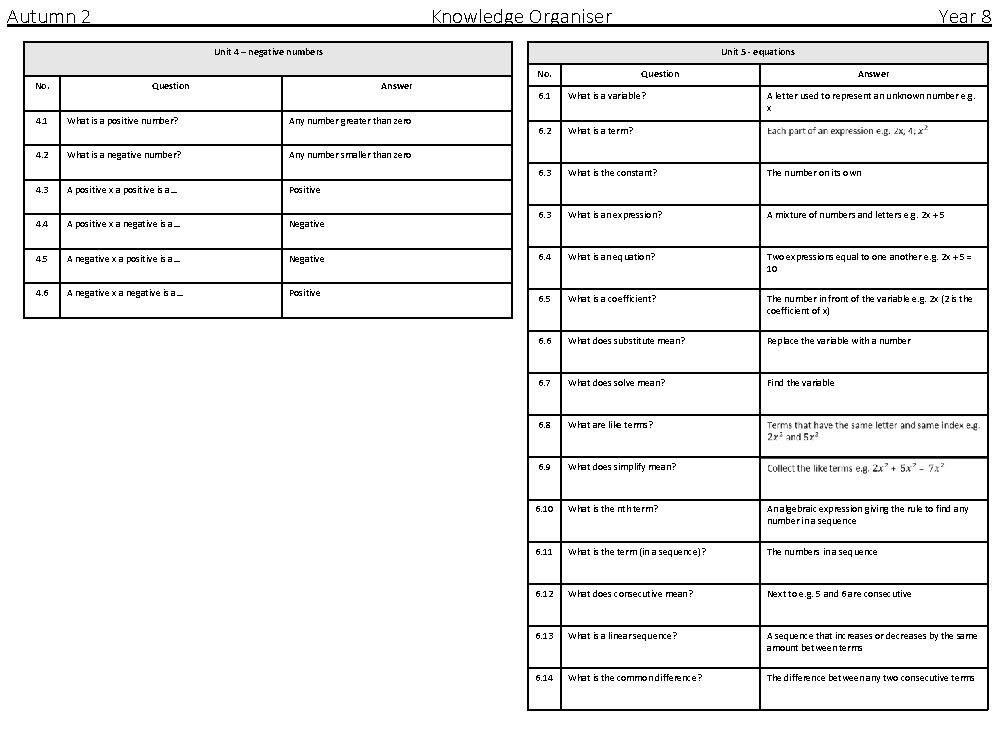
Autumn 2 Knowledge Organiser Year 8 Unit 4 – negative numbers Unit 5 - equations No. Question Answer 4. 1 What is a positive number? Any number greater than zero 4. 2 What is a negative number? Any number smaller than zero 4. 3 A positive x a positive is a… Positive 4. 4 A positive x a negative is a… Negative 4. 5 A negative x a positive is a… Negative 4. 6 A negative x a negative is a… Positive Question Answer 6. 1 What is a variable? A letter used to represent an unknown number e. g. x 6. 2 What is a term? 6. 3 What is the constant? The number on its own 6. 3 What is an expression? A mixture of numbers and letters e. g. 2 x + 5 6. 4 What is an equation? Two expressions equal to one another e. g. 2 x + 5 = 10 6. 5 What is a coefficient? The number in front of the variable e. g. 2 x (2 is the coefficient of x) 6. 6 What does substitute mean? Replace the variable with a number 6. 7 What does solve mean? Find the variable 6. 8 What are like terms? 6. 9 What does simplify mean? 6. 10 What is the nth term? An algebraic expression giving the rule to find any number in a sequence 6. 11 What is the term (in a sequence)? The numbers in a sequence 6. 12 What does consecutive mean? Next to e. g. 5 and 6 are consecutive 6. 13 What is a linear sequence? A sequence that increases or decreases by the same amount between terms 6. 14 What is the common difference? The difference between any two consecutive terms
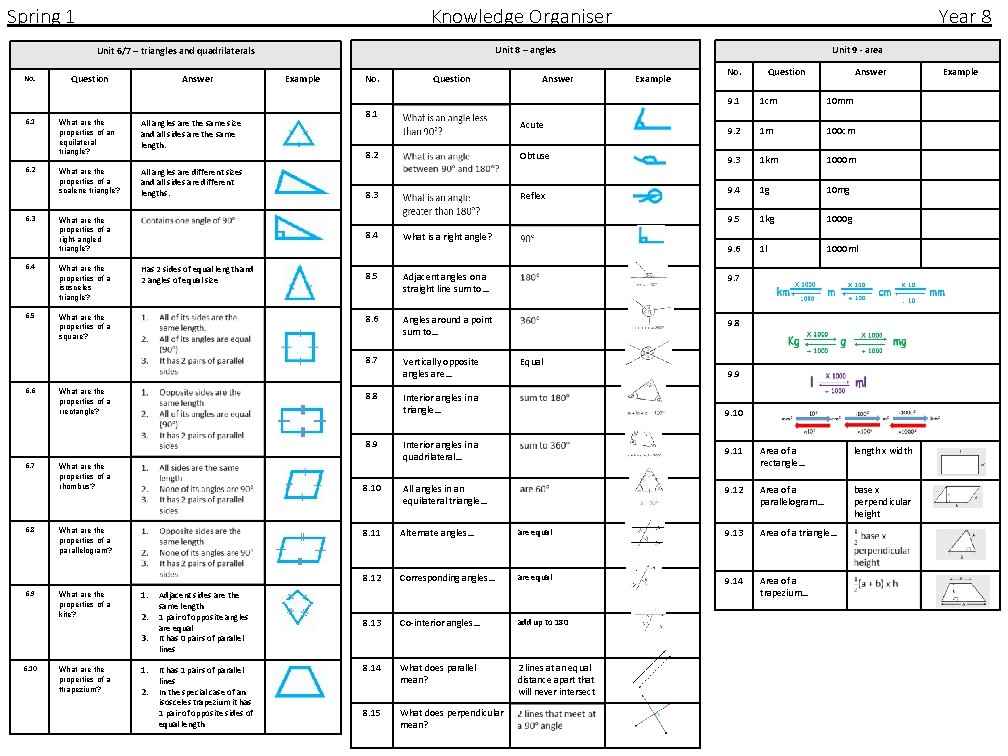
Spring 1 Knowledge Organiser Unit 8 – angles Unit 6/7 – triangles and quadrilaterals No. 6. 1 6. 2 6. 3 Question What are the properties of an equilateral triangle? All angles are the same size and all sides are the same length. What are the properties of a scalene triangle? All angles are different sizes and all sides are different lengths. What are the properties of a right-angled triangle? 6. 4 What are the properties of a isosceles triangle? 6. 5 What are the properties of a square? 6. 6 6. 7 6. 8 6. 9 Answer What are the properties of a rrectangle? What are the properties of a parallelogram? 1. 2. 3. 6. 10 What are the properties of a ttrapezium? No. 1. 2. Adjacent sides are the same length 1 pair of opposite angles are equal It has 0 pairs of parallel lines It has 1 pairs of parallel lines In the special case of an isosceles trapezium it has 1 pair of opposite sides of equal length Question 8. 1 Answer Acute 8. 2 Obtuse 8. 3 Reflex What is a right angle? Unit 9 - area Example No. 10 mm 9. 2 1 m 100 cm 9. 3 1 km 1000 m 9. 4 1 g 10 mg 9. 5 1 kg 1000 g 9. 6 1 l 1000 ml 9. 7 8. 6 Angles around a point sum to… 9. 8 8. 7 Vertically opposite angles are… Interior angles in a triangle… 8. 9 Interior angles in a quadrilateral… 8. 10 All angles in an equilateral triangle… 8. 11 Alternate angles… 8. 12 Answer 1 cm Adjacent angles on a straight line sum to… Equal Question 9. 1 8. 5 8. 8 What are the properties of a rhombus? What are the properties of a kite? Example 8. 4 Has 2 sides of equal length and 2 angles of equal size Year 8 9. 9 9. 10 9. 11 Area of a rectangle… length x width 9. 12 Area of a parallelogram… base x perpendicular height are equal 9. 13 Area of a triangle… Corresponding angles… are equal 9. 14 Area of a trapezium… 8. 13 Co-interior angles… add up to 180 8. 14 What does parallel mean? 2 lines at an equal distance apart that will never intersect 8. 15 What does perpendicular mean? Example
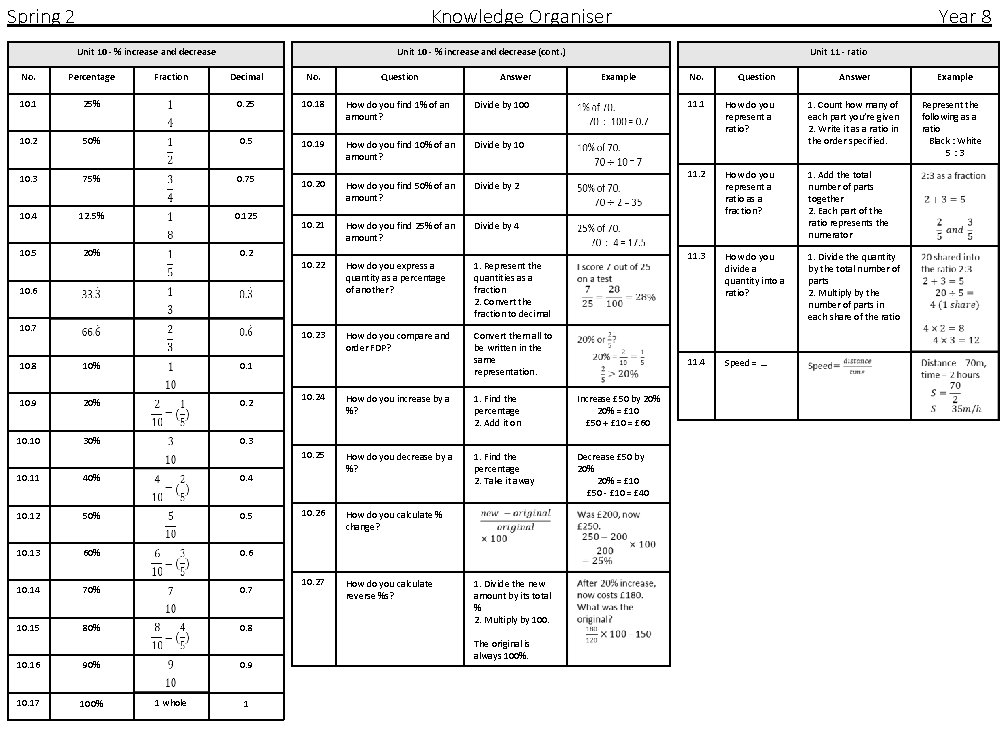
Spring 2 Knowledge Organiser Unit 10 - % increase and decrease (cont. ) Decimal No. Question 25% 0. 25 10. 18 How do you find 1% of an amount? Divide by 100 10. 2 50% 0. 5 10. 19 How do you find 10% of an amount? Divide by 10 10. 3 75% 0. 75 10. 20 How do you find 50% of an amount? Divide by 2 10. 4 12. 5% 0. 125 10. 21 How do you find 25% of an amount? Divide by 4 10. 5 20% 0. 2 10. 22 How do you express a quantity as a percentage of another? 1. Represent the quantities as a fraction 2. Convert the fraction to decimal 10. 23 How do you compare and order FDP? Convert them all to be written in the same representation. No. Percentage 10. 1 Fraction 10. 6 10. 7 10. 8 10% 0. 1 10. 9 20% 0. 2 10. 10 30% 0. 3 10. 11 40% 0. 4 10. 12 50% 0. 5 10. 13 60% 0. 6 10. 14 70% 0. 7 10. 15 80% 0. 8 10. 16 90% 10. 17 100% 0. 9 1 whole Year 8 1 Answer Unit 11 - ratio Example 10. 24 How do you increase by a %? 1. Find the percentage 2. Add it on Increase £ 50 by 20% = £ 10 £ 50 + £ 10 = £ 60 10. 25 How do you decrease by a %? 1. Find the percentage 2. Take it away Decrease £ 50 by 20% = £ 10 £ 50 - £ 10 = £ 40 10. 26 How do you calculate % change? 10. 27 How do you calculate reverse %s? 1. Divide the new amount by its total % 2. Multiply by 100. The original is always 100%. No. Question Answer 11. 1 How do you represent a ratio? 1. Count how many of each part you’re given 2. Write it as a ratio in the order specified. 11. 2 How do you represent a ratio as a fraction? 1. Add the total number of parts together 2. Each part of the ratio represents the numerator 11. 3 How do you divide a quantity into a ratio? 1. Divide the quantity by the total number of parts 2. Multiply by the number of parts in each share of the ratio 11. 4 Speed = … Example Represent the following as a ratio Black : White 5: 3
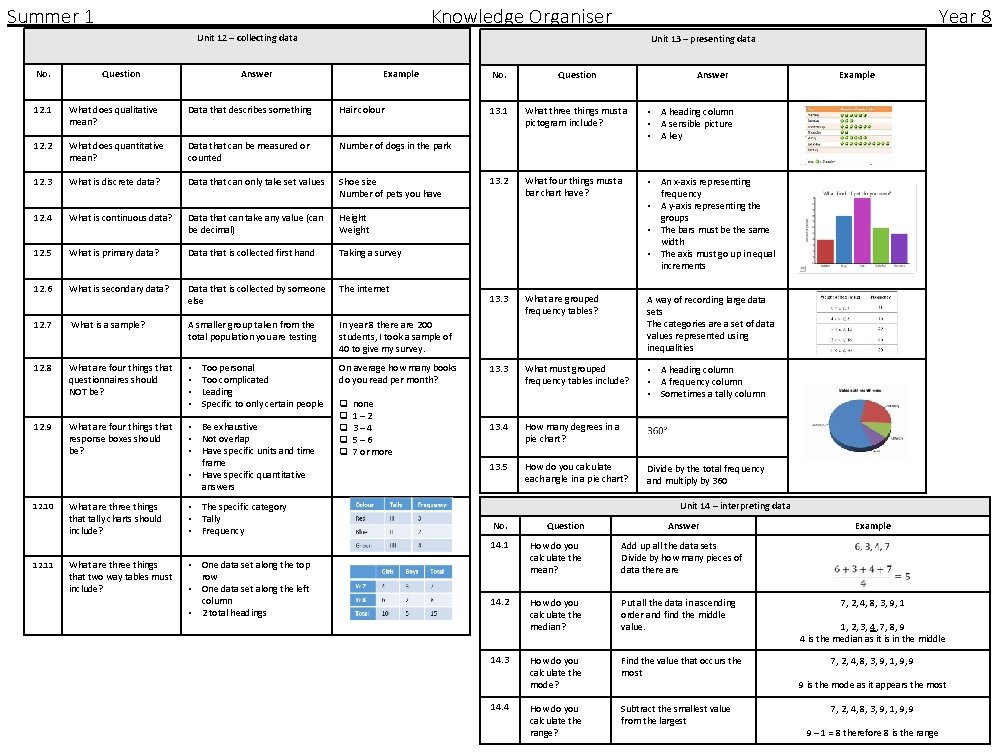
Summer 1 Knowledge Organiser Year 8 Unit 12 – collecting data No. Question Unit 13 – presenting data Answer Example 12. 1 What does qualitative mean? Data that describes something Hair colour 12. 2 What does quantitative mean? Data that can be measured or counted Number of dogs in the park 12. 3 What is discrete data? Data that can only take set values Shoe size Number of pets you have 12. 4 What is continuous data? Data that can take any value (can be decimal) Height Weight 12. 5 What is primary data? Data that is collected first hand Taking a survey 12. 6 What is secondary data? Data that is collected by someone else The internet 12. 7 What is a sample? A smaller group taken from the total population you are testing In year 8 there are 200 students, I took a sample of 40 to give my survey. 12. 8 What are four things that questionnaires should NOT be? • • What are four things that response boxes should be? • Be exhaustive • Not overlap • Have specific units and time frame • Have specific quantitative answers 12. 9 12. 10 12. 11 What are three things that tally charts should include? What are three things that two way tables must include? Too personal Too complicated Leading Specific to only certain people • The specific category • Tally • Frequency • One data set along the top row • One data set along the left column • 2 total headings On average how many books do you read per month? q q q none 1– 2 3– 4 5– 6 7 or more No. Question Answer 13. 1 What three things must a pictogram include? • A heading column • A sensible picture • A key 13. 2 What four things must a bar chart have? • An x-axis representing frequency • A y-axis representing the groups • The bars must be the same width • The axis must go up in equal increments 13. 3 What are grouped frequency tables? A way of recording large data sets The categories are a set of data values represented using inequalities 13. 3 What must grouped frequency tables include? • A heading column • A frequency column • Sometimes a tally column 13. 4 How many degrees in a pie chart? 13. 5 How do you calculate each angle in a pie chart? Example Divide by the total frequency and multiply by 360 Unit 14 – interpreting data No. Question 14. 1 How do you calculate the mean? Add up all the data sets Divide by how many pieces of data there are 14. 2 How do you calculate the median? Put all the data in ascending order and find the middle value. How do you calculate the mode? Find the value that occurs the most How do you calculate the range? Subtract the smallest value from the largest 14. 3 14. 4 Answer Example 7, 2, 4, 8, 3, 9, 1 1, 2, 3, 4, 7, 8, 9 4 is the median as it is in the middle 7, 2, 4, 8, 3, 9, 1, 9, 9 9 is the mode as it appears the most 7, 2, 4, 8, 3, 9, 1, 9, 9 9 – 1 = 8 therefore 8 is the range
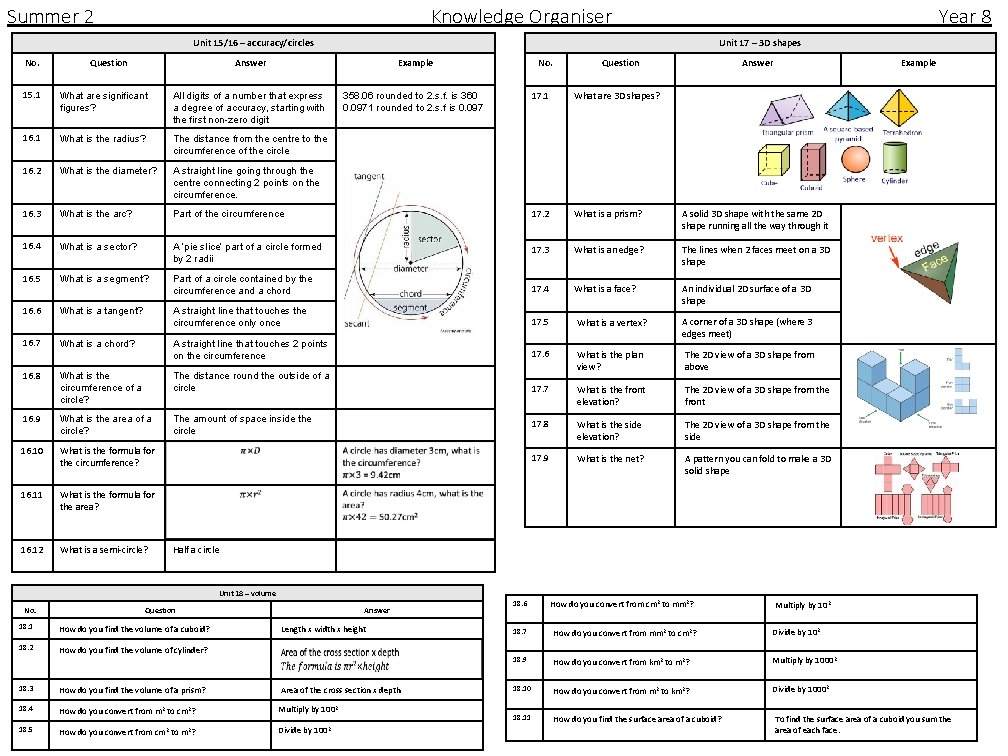
Summer 2 Knowledge Organiser Year 8 Unit 15/16 – accuracy/circles No. Question Unit 17 – 3 D shapes Answer Example 358. 06 rounded to 2. s. f. is 360 0. 0971 rounded to 2. s. f is 0. 097 15. 1 What are significant figures? All digits of a number that express a degree of accuracy, starting with the first non-zero digit 16. 1 What is the radius? The distance from the centre to the circumference of the circle 16. 2 What is the diameter? A straight line going through the centre connecting 2 points on the circumference. 16. 3 What is the arc? 16. 4 No. Question Answer Example 17. 1 What are 3 D shapes? Part of the circumference 17. 2 What is a prism? A solid 3 D shape with the same 2 D shape running all the way through it What is a sector? A ‘pie slice’ part of a circle formed by 2 radii 17. 3 What is an edge? The lines when 2 faces meet on a 3 D shape 16. 5 What is a segment? Part of a circle contained by the circumference and a chord 17. 4 What is a face? 16. 6 What is a tangent? A straight line that touches the circumference only once An individual 2 D surface of a 3 D shape 17. 5 What is a vertex? A corner of a 3 D shape (where 3 edges meet) 16. 7 What is a chord? A straight line that touches 2 points on the circumference 17. 6 16. 8 What is the circumference of a circle? The distance round the outside of a circle What is the plan view? The 2 D view of a 3 D shape from above 17. 7 What is the front elevation? The 2 D view of a 3 D shape from the front 16. 9 What is the area of a circle? The amount of space inside the circle 17. 8 What is the side elevation? The 2 D view of a 3 D shape from the side 16. 10 What is the formula for the circumference? 17. 9 What is the net? A pattern you can fold to make a 3 D solid shape 16. 11 What is the formula for the area? 16. 12 What is a semi-circle? Half a circle Unit 18 – volume No. Question 18. 1 How do you find the volume of a cuboid? 18. 2 How do you find the volume of cylinder? Answer Length x width x height 18. 3 How do you find the volume of a prism? 18. 4 How do you convert from m 2 to cm 2? Multiply by 1002 18. 5 How do you convert from cm 2 to m 2? Divide by 1002 Area of the cross section x depth 18. 6 How do you convert from cm 2 to mm 2? Multiply by 102 18. 7 How do you convert from mm 2 to cm 2? Divide by 102 18. 9 How do you convert from km 2 to m 2? Multiply by 10002 18. 10 How do you convert from m 2 to km 2? Divide by 10002 18. 11 How do you find the surface area of a cuboid? To find the surface area of a cuboid you sum the area of each face.