
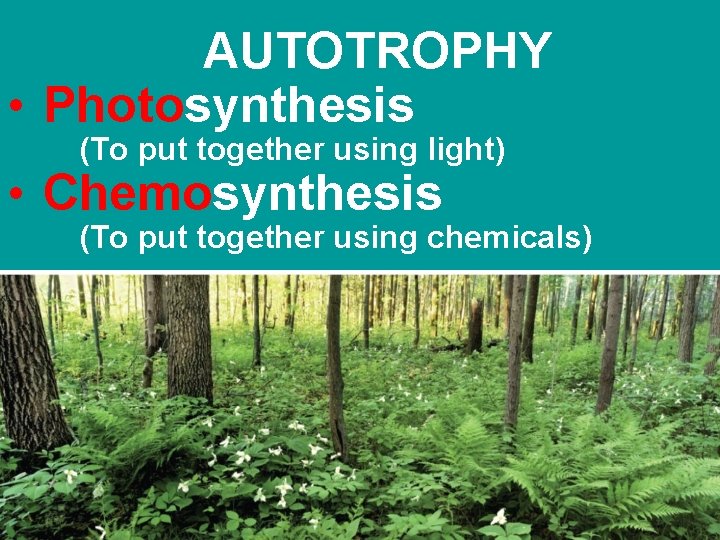
AUTOTROPHY Photosynthesis To put together using light Chemosynthesis
- Slides: 36
AUTOTROPHY • Photosynthesis (To put together using light) • Chemosynthesis (To put together using chemicals)
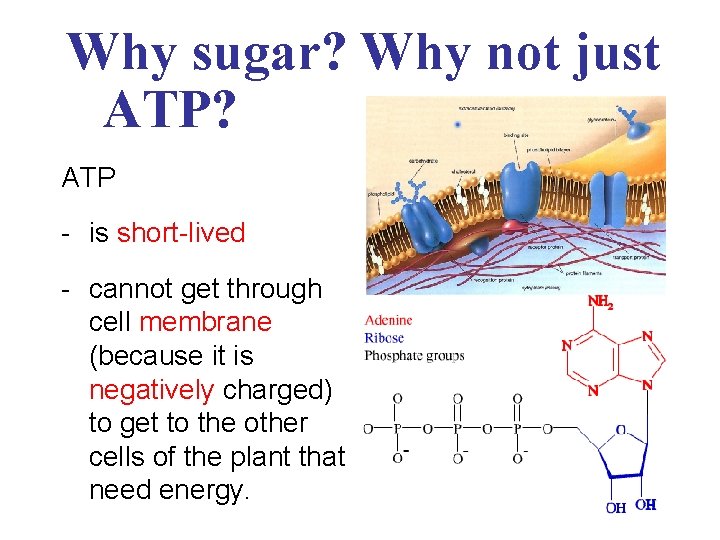
Why sugar? Why not just ATP? ATP - is short-lived - cannot get through cell membrane (because it is negatively charged) to get to the other cells of the plant that need energy.
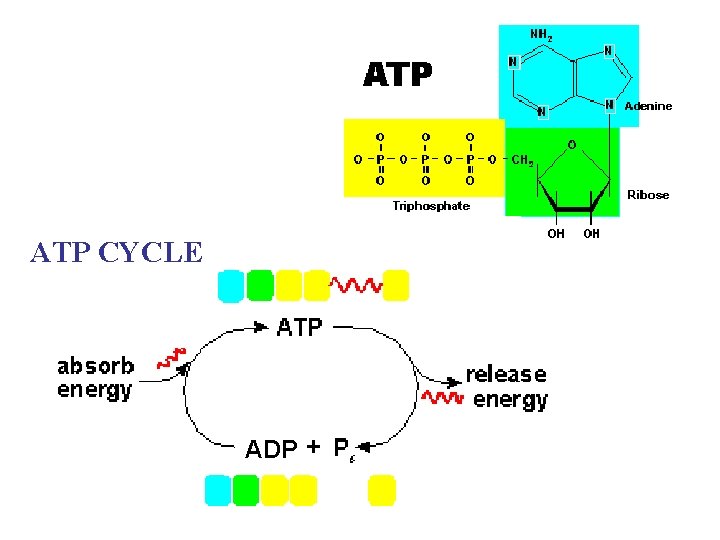
ATP CYCLE ADP
• Autotrophs – Feed themselves and most of the living world (the heterotrophs, or consumers). They are the “living bridge” between the sun and life on earth…the supermarket that feeds most of the living world. – Are producers, producing organic molecules from CO 2 – Two kinds: • Chemoautotrophs, use energy of inorganic molecules to make organic molecules from CO 2. • Photoautotrophs, using the energy of sunlight to make organic molecules from H 2 O and CO 2
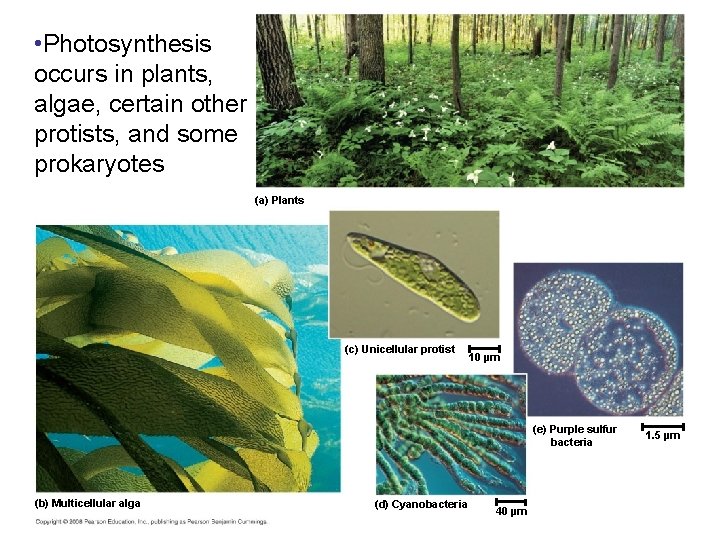
• Photosynthesis occurs in plants, algae, certain other protists, and some prokaryotes (a) Plants (c) Unicellular protist 10 µm (e) Purple sulfur bacteria (b) Multicellular alga (d) Cyanobacteria 40 µm 1. 5 µm
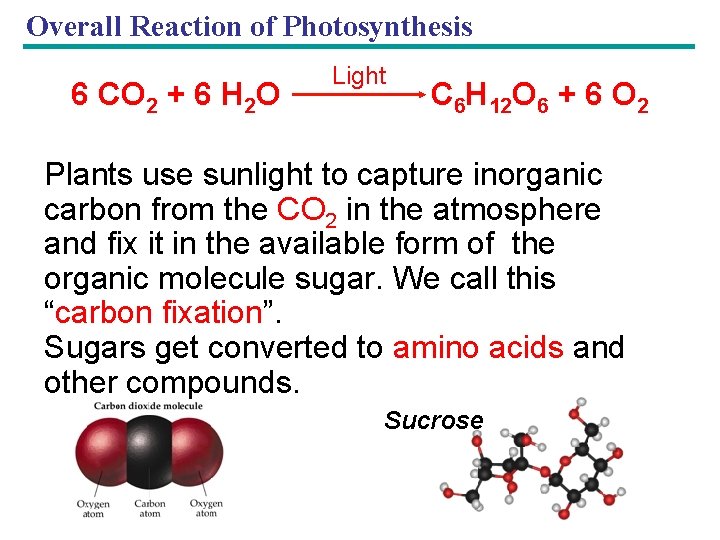
Overall Reaction of Photosynthesis 6 CO 2 + 6 H 2 O Light C 6 H 12 O 6 + 6 O 2 Plants use sunlight to capture inorganic carbon from the CO 2 in the atmosphere and fix it in the available form of the organic molecule sugar. We call this “carbon fixation”. Sugars get converted to amino acids and other compounds. Sucrose
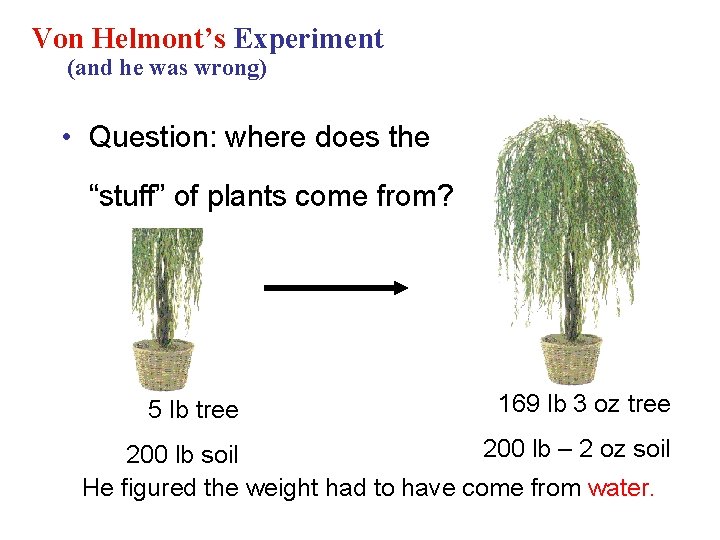
Von Helmont’s Experiment (and he was wrong) • Question: where does the “stuff” of plants come from? 5 lb tree 169 lb 3 oz tree 200 lb – 2 oz soil 200 lb soil He figured the weight had to have come from water.
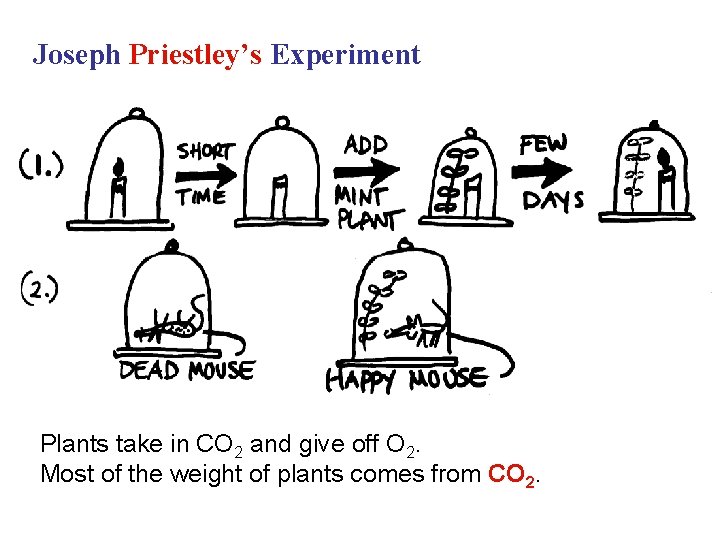
Joseph Priestley’s Experiment Plants take in CO 2 and give off O 2. Most of the weight of plants comes from CO 2.
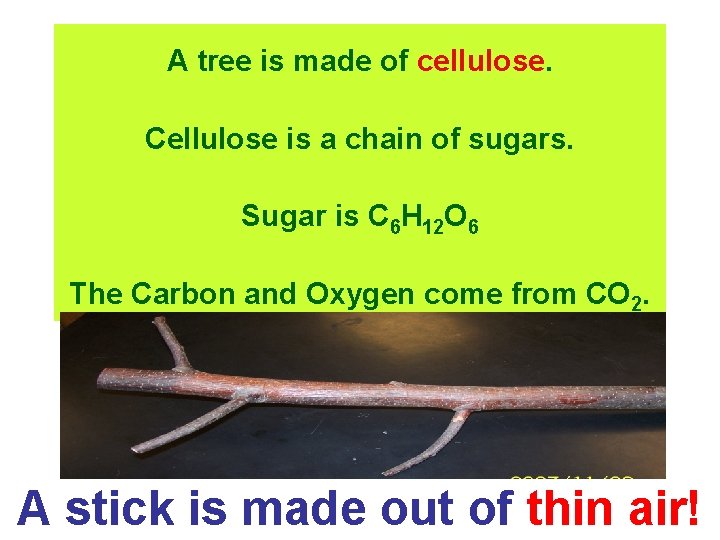
A tree is made of cellulose. Cellulose is a chain of sugars. Sugar is C 6 H 12 O 6 The Carbon and Oxygen come from CO 2. A stick is made out of thin air!
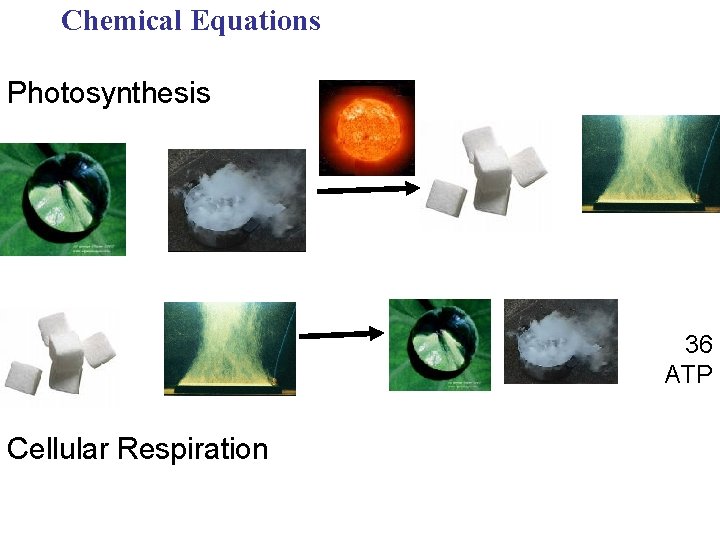
Chemical Equations Photosynthesis 36 ATP Cellular Respiration
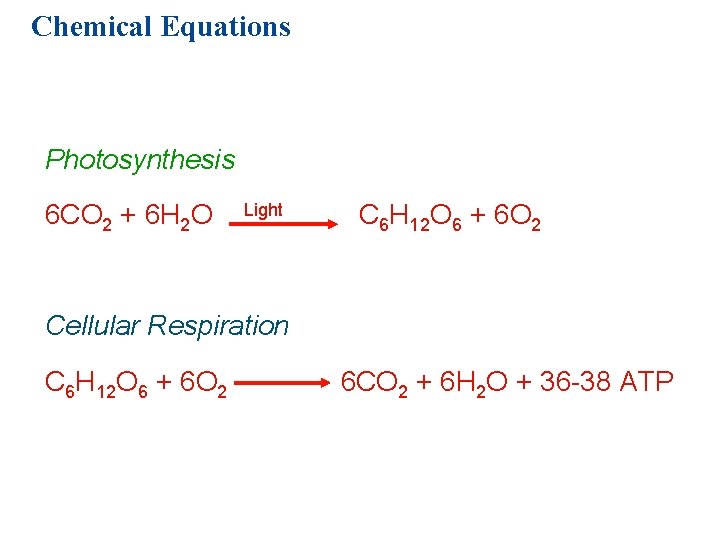
Chemical Equations Photosynthesis 6 CO 2 + 6 H 2 O Light C 6 H 12 O 6 + 6 O 2 Cellular Respiration C 6 H 12 O 6 + 6 O 2 6 CO 2 + 6 H 2 O + 36 -38 ATP
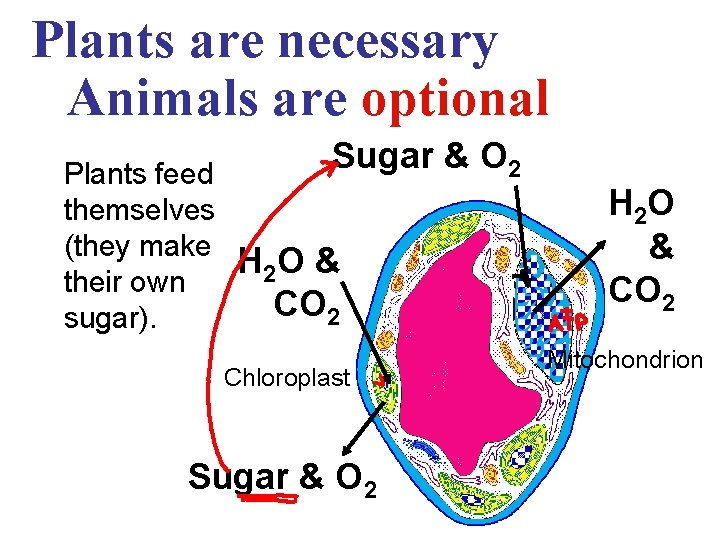
Plants are necessary Animals are optional Plants feed themselves (they make their own sugar). Sugar & O 2 H 2 O & CO 2 Chloroplast Sugar & O 2 H 2 O & CO 2 Mitochondrion
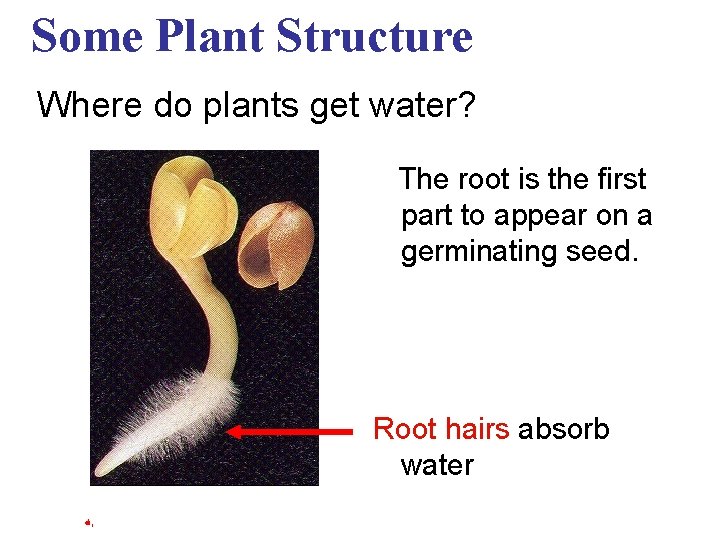
Some Plant Structure Where do plants get water? The root is the first part to appear on a germinating seed. Root hairs absorb water
Functions of Roots • Anchor • Absorb dissolved minerals via active transport • Absorb water (which is following the high concentration of minerals) • Some store food (potato) • Some develop into new plants (vegetative reproduction)
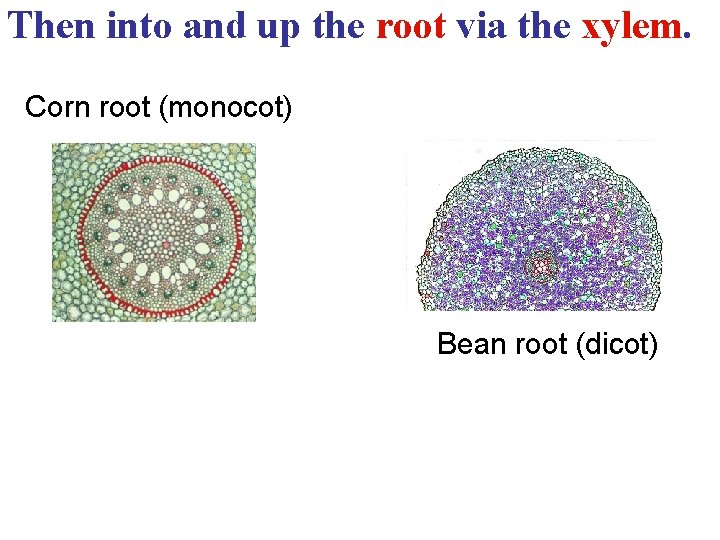
Then into and up the root via the xylem. Corn root (monocot) Bean root (dicot)
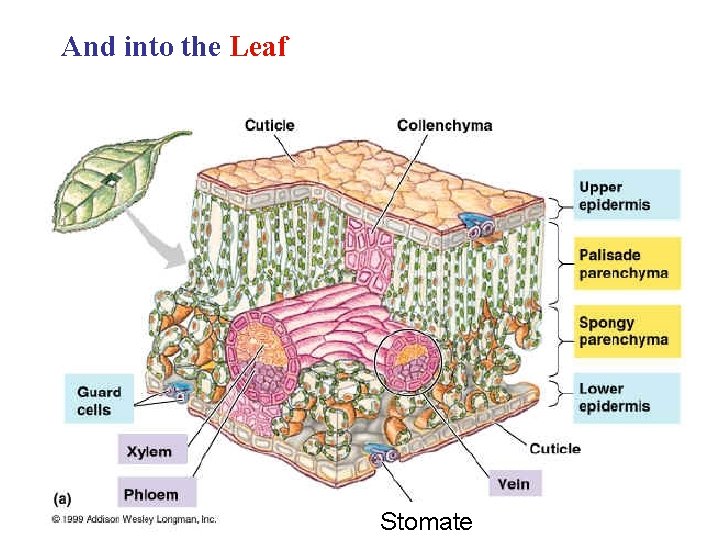
And into the Leaf Stomate
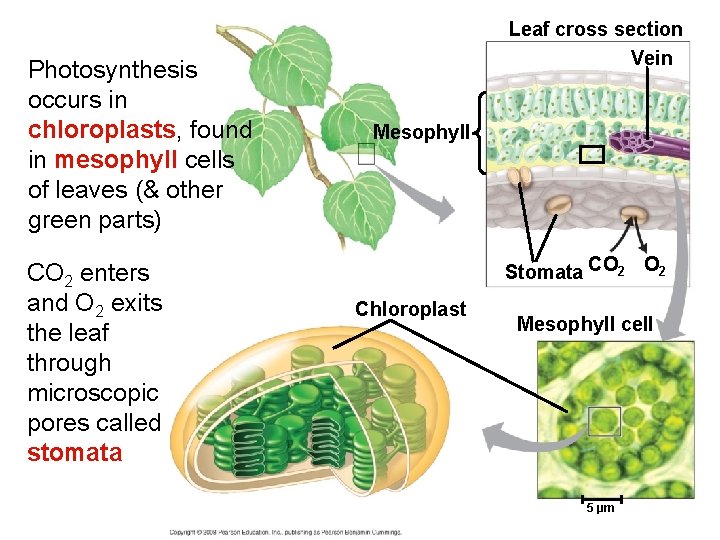
Photosynthesis occurs in chloroplasts, found in mesophyll cells of leaves (& other green parts) CO 2 enters and O 2 exits the leaf through microscopic pores called stomata Leaf cross section Vein Mesophyll Stomata CO 2 Chloroplast Mesophyll cell 5 µm
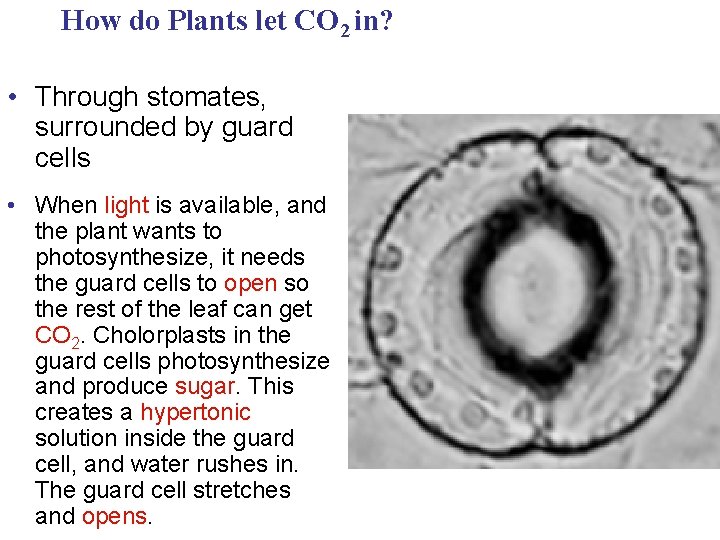
How do Plants let CO 2 in? • Through stomates, surrounded by guard cells • When light is available, and the plant wants to photosynthesize, it needs the guard cells to open so the rest of the leaf can get CO 2. Cholorplasts in the guard cells photosynthesize and produce sugar. This creates a hypertonic solution inside the guard cell, and water rushes in. The guard cell stretches and opens.
Photosynthetic Pigments: The Light Receptors • Pigments are substances that absorb visible light • Different pigments absorb different wavelengths • Wavelengths that are not absorbed are reflected or transmitted • Leaves appear green because chlorophyll reflects and transmits green light Animation: Light and Pigments Copyright © 2008 Pearson Education, Inc. , publishing as Pearson Benjamin Cummings
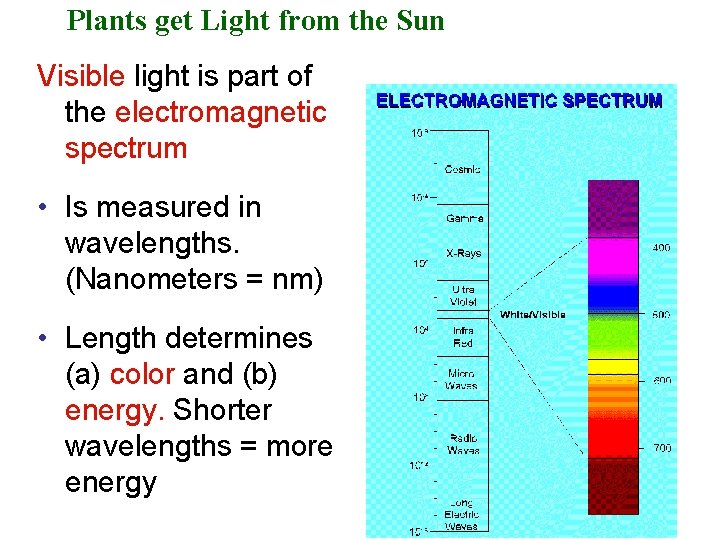
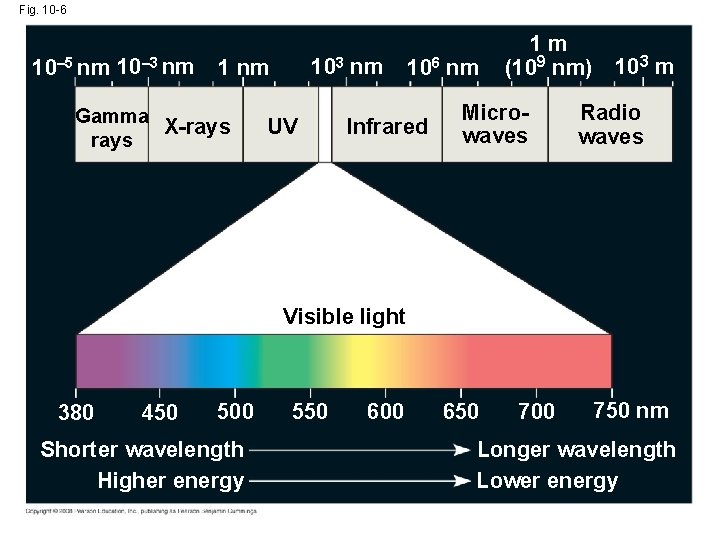
Plants get Light from the Sun Visible light is part of the electromagnetic spectrum • Is measured in wavelengths. (Nanometers = nm) • Length determines (a) color and (b) energy. Shorter wavelengths = more energy
Fig. 10 -6 10– 5 nm 10– 3 nm 103 nm 1 nm Gamma X-rays UV 106 nm Infrared 1 m (109 nm) Microwaves 103 m Radio waves Visible light 380 450 500 Shorter wavelength Higher energy 550 600 650 700 750 nm Longer wavelength Lower energy
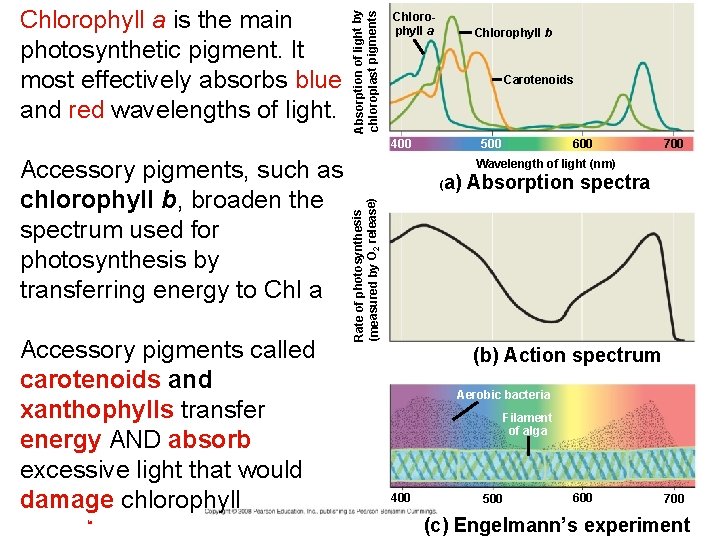
Absorption of light by chloroplast pigments Chlorophyll a is the main photosynthetic pigment. It most effectively absorbs blue and red wavelengths of light. Chlorophyll a Chlorophyll b Carotenoids 400 Accessory pigments called carotenoids and xanthophylls transfer energy AND absorb excessive light that would damage chlorophyll 600 700 Wavelength of light (nm) ( a) Absorption spectra Rate of photosynthesis (measured by O 2 release) Accessory pigments, such as chlorophyll b, broaden the spectrum used for photosynthesis by transferring energy to Chl a 500 (b) Action spectrum Aerobic bacteria Filament of alga 400 500 600 700 (c) Engelmann’s experiment
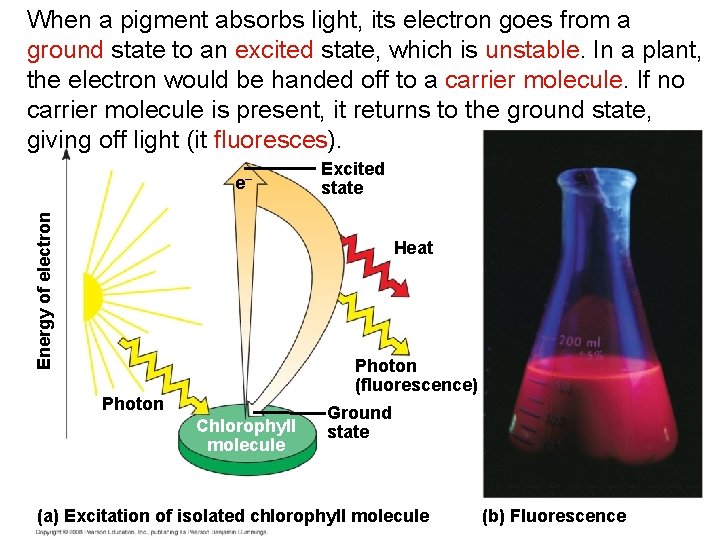
When a pigment absorbs light, its electron goes from a ground state to an excited state, which is unstable. In a plant, the electron would be handed off to a carrier molecule. If no carrier molecule is present, it returns to the ground state, giving off light (it fluoresces). Energy of electron e– Excited state Heat Photon (fluorescence) Photon Chlorophyll molecule Ground state (a) Excitation of isolated chlorophyll molecule (b) Fluorescence
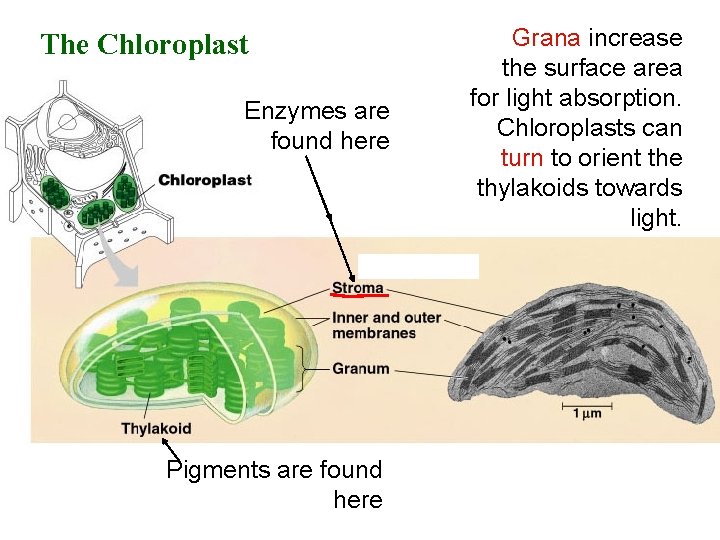
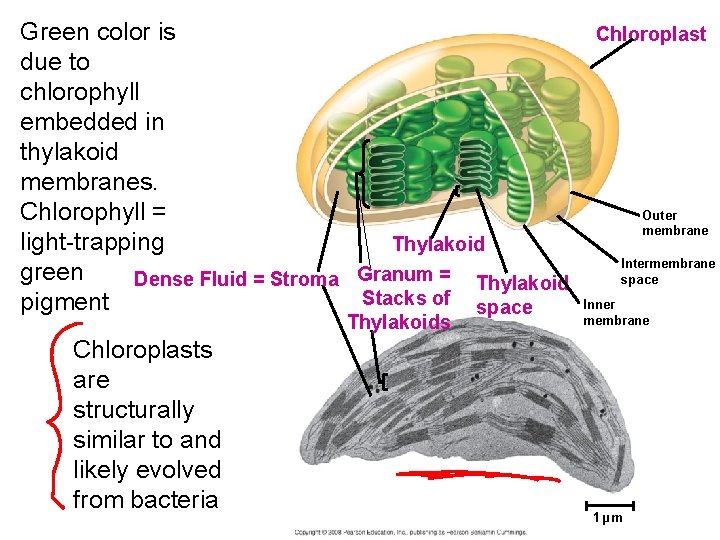
The Chloroplast Enzymes are found here Pigments are found here Grana increase the surface area for light absorption. Chloroplasts can turn to orient the thylakoids towards light.
Green color is due to chlorophyll embedded in thylakoid membranes. Chlorophyll = light-trapping green Dense Fluid = Stroma pigment Chloroplasts are structurally similar to and likely evolved from bacteria Chloroplast Outer membrane Thylakoid Granum = Stacks of Thylakoids Thylakoid space Intermembrane space Inner membrane 1 µm
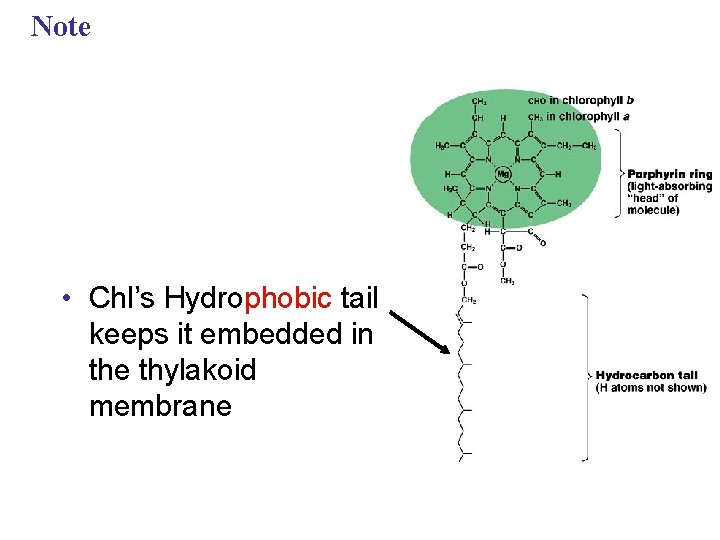
Note • Chl’s Hydrophobic tail keeps it embedded in the thylakoid membrane
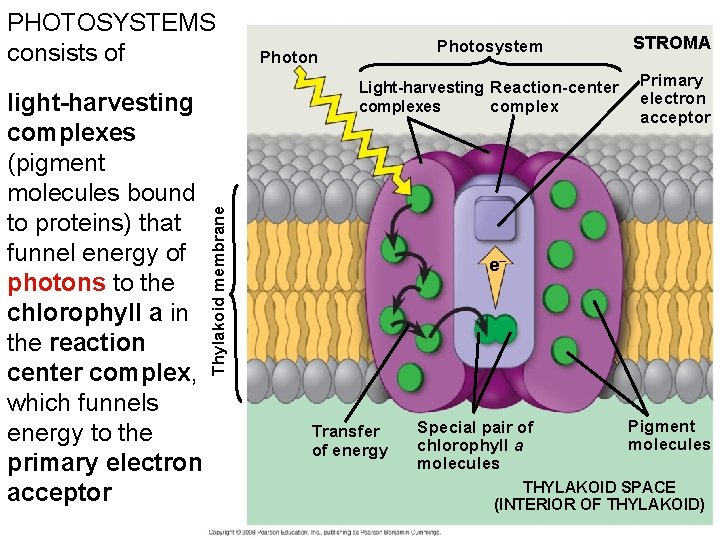
light-harvesting complexes (pigment molecules bound to proteins) that funnel energy of photons to the chlorophyll a in the reaction center complex, which funnels energy to the primary electron acceptor Photosystem STROMA Light-harvesting Reaction-center complexes Primary electron acceptor Photon Thylakoid membrane PHOTOSYSTEMS consists of e– Transfer of energy Special pair of chlorophyll a molecules Pigment molecules THYLAKOID SPACE (INTERIOR OF THYLAKOID)
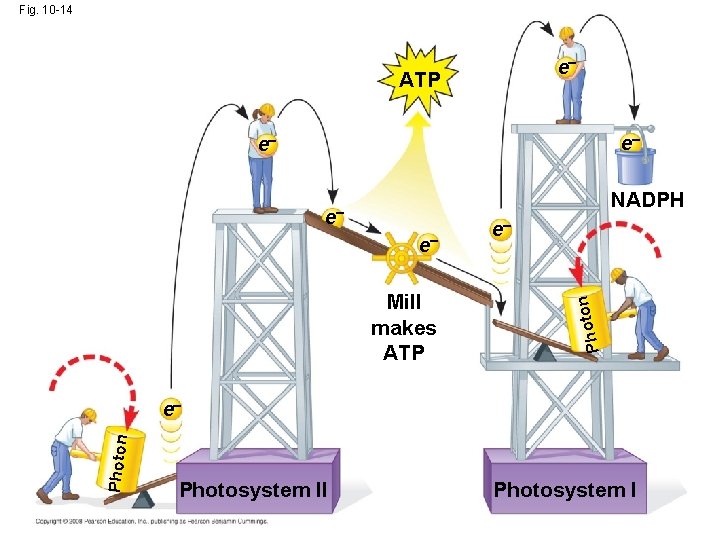
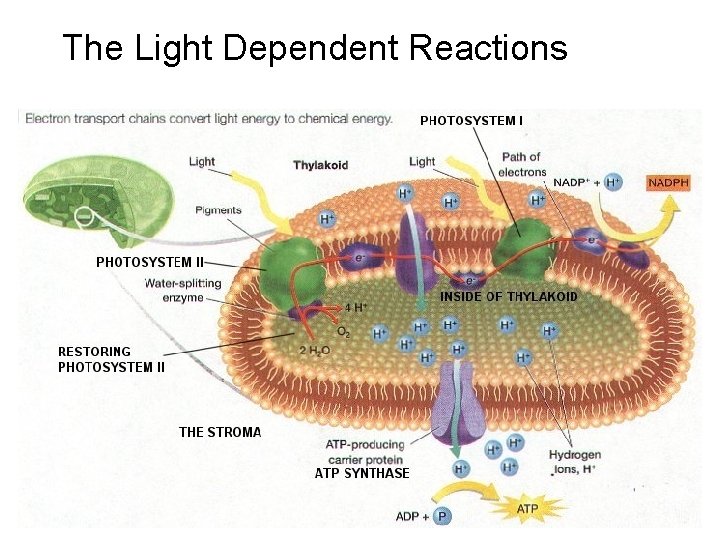
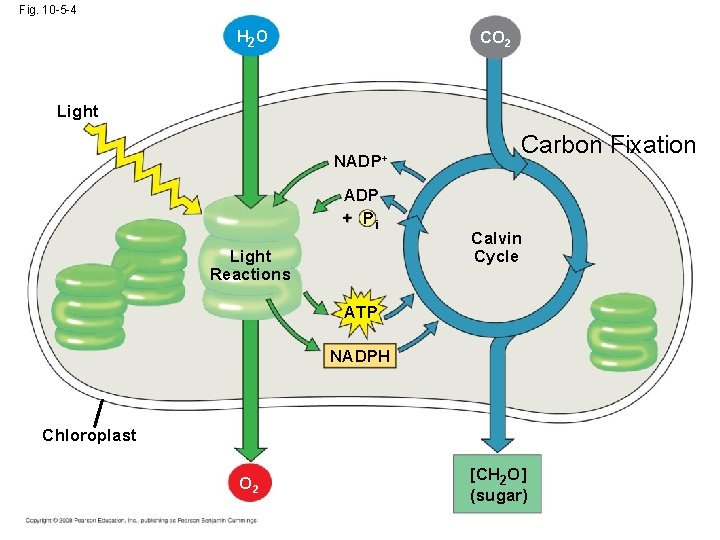
The Two Stages of Photosynthesis: Photosynthesis consists of the Light Dependent Reactions (the photo part) and Light Independent Reaction…aka the Calvin cycle (the synthesis part) • The light dependent reactions (in the thylakoids): – Light absorbed by Chl – Enzyme splits 2 H 2 O and releases waste O 2. Electrons are handed off to chlorophyll. H+ increase inside thylakoid. – Electrons go through the electron transport chain, pumping H+ in as they go. NADP+ accepts electrons and is reduced to NADPH at end of electron transport system. – ATP is generated from ADP and Pi when H+ diffuses through the ATP synthase.
Fig. 10 -14 e– ATP e– e– NADPH Mill makes ATP n e– e– Photon e– Photosystem II Photosystem I
The Light. Reaction Dependent Reactions
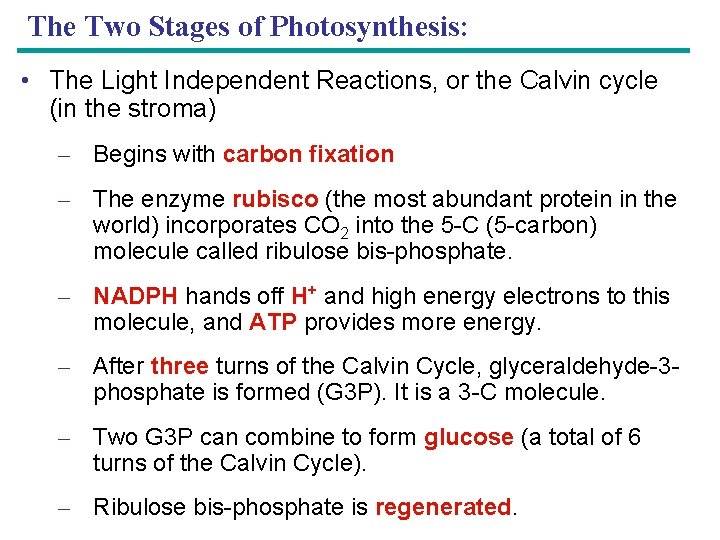
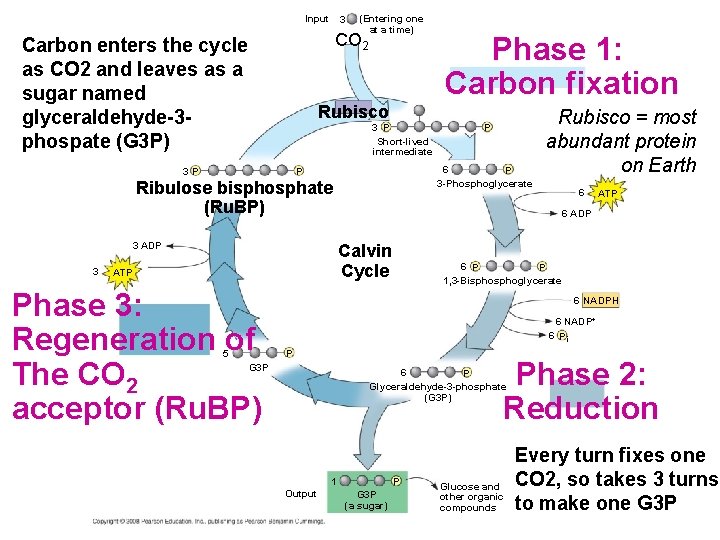
The Two Stages of Photosynthesis: • The Light Independent Reactions, or the Calvin cycle (in the stroma) – Begins with carbon fixation – The enzyme rubisco (the most abundant protein in the world) incorporates CO 2 into the 5 -C (5 -carbon) molecule called ribulose bis-phosphate. – NADPH hands off H+ and high energy electrons to this molecule, and ATP provides more energy. – After three turns of the Calvin Cycle, glyceraldehyde-3 phosphate is formed (G 3 P). It is a 3 -C molecule. – Two G 3 P can combine to form glucose (a total of 6 turns of the Calvin Cycle). – Ribulose bis-phosphate is regenerated.
Input 3 (Entering one at a time) CO 2 Carbon enters the cycle as CO 2 and leaves as a sugar named glyceraldehyde-3 phospate (G 3 P) Rubisco 3 P Short-lived intermediate 3 P 3 ADP Phase 3: Regeneration of The CO 2 acceptor (Ru. BP) 5 Rubisco = most abundant protein on Earth 6 ATP 6 ADP Calvin Cycle ATP P 6 P 3 -Phosphoglycerate P Ribulose bisphosphate (Ru. BP) 3 Phase 1: Carbon fixation 6 P P 1, 3 -Bisphoglycerate 6 NADPH 6 NADP+ 6 Pi P Phase 2: Reduction G 3 P 6 P Glyceraldehyde-3 -phosphate (G 3 P) 1 Output P G 3 P (a sugar) Glucose and other organic compounds Every turn fixes one CO 2, so takes 3 turns to make one G 3 P
Fig. 10 -5 -4 CO 2 H 2 O Light NADP+ Carbon Fixation ADP + Pi Light Reactions Calvin Cycle ATP NADPH Chloroplast O 2 [CH 2 O] (sugar)
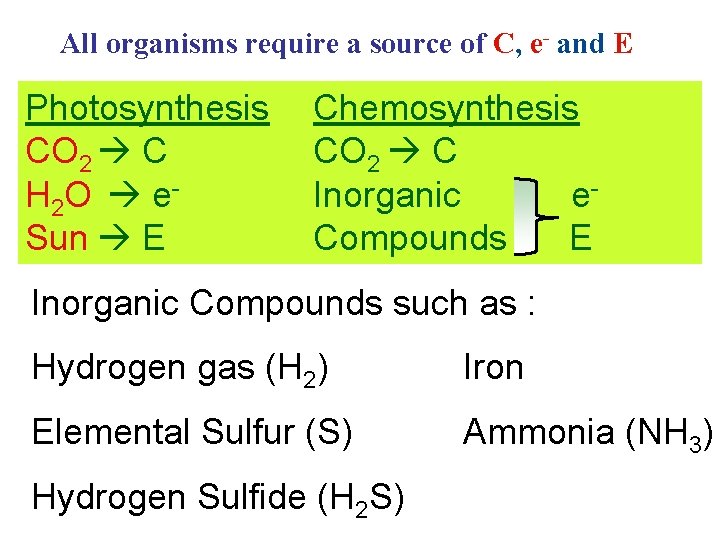
All organisms require a source of C, e- and E Photosynthesis CO 2 C H 2 O e Sun E Chemosynthesis CO 2 C Inorganic e. Compounds E Inorganic Compounds such as : Hydrogen gas (H 2) Iron Elemental Sulfur (S) Ammonia (NH 3) Hydrogen Sulfide (H 2 S)
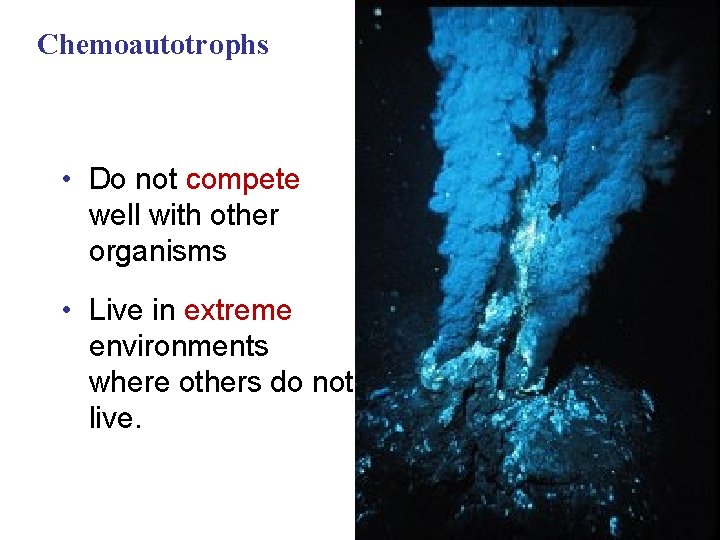
Chemoautotrophs • Do not compete well with other organisms • Live in extreme environments where others do not live.
Life is like a battery that runs on water. To understand photosynthesis and cellular respiration, follow the electrons from water. 1. Strip electrons away from water. 2. Hand them to chlorophyll. 3. Sunlight energizes them enough to leave. 4. They pass them from chemical to chemical, through photosynthesis (making sugar) then cellular respiration (using sugar to make ATP), sucking off a little bit of energy at a time. 5. Electrons end up back in water in the end.