
Autonomous Vehicle Platform Background The goal of this
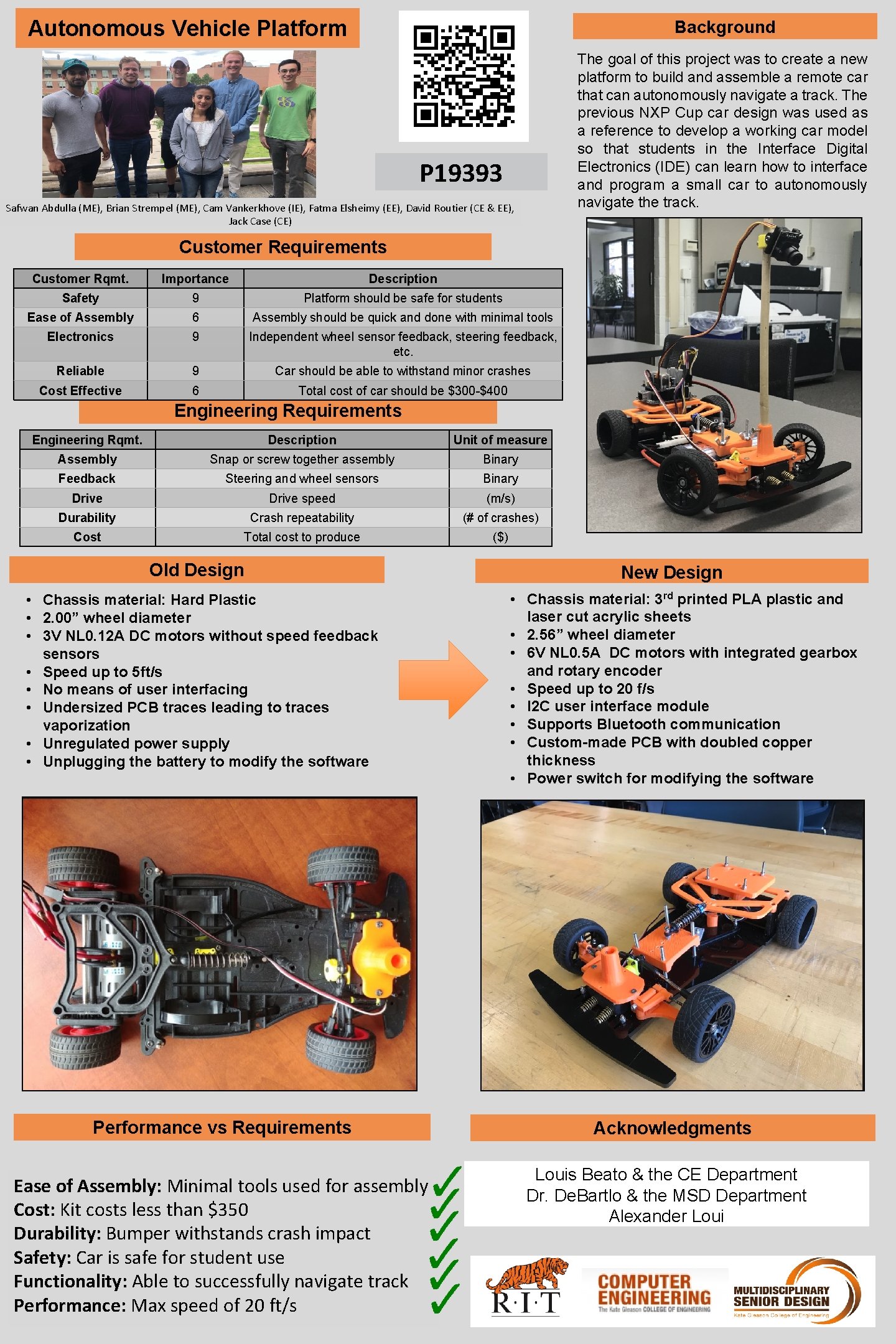
Autonomous Vehicle Platform Background The goal of this project was to create a new platform to build and assemble a remote car that can autonomously navigate a track. The previous NXP Cup car design was used as a reference to develop a working car model so that students in the Interface Digital Electronics (IDE) can learn how to interface and program a small car to autonomously navigate the track. P 19393 Safwan Abdulla (ME), Brian Strempel (ME), Cam Vankerkhove (IE), Fatma Elsheimy (EE), David Routier (CE & EE), Jack Case (CE) Customer Requirements Customer Rqmt. Importance Description Safety 9 Platform should be safe for students Ease of Assembly 6 Assembly should be quick and done with minimal tools Electronics 9 Independent wheel sensor feedback, steering feedback, etc. Reliable 9 Car should be able to withstand minor crashes Cost Effective 6 Total cost of car should be $300 -$400 Engineering Requirements Engineering Rqmt. Description Unit of measure Assembly Snap or screw together assembly Binary Feedback Steering and wheel sensors Binary Drive speed (m/s) Durability Crash repeatability (# of crashes) Cost Total cost to produce ($) Old Design • Chassis material: Hard Plastic • 2. 00” wheel diameter • 3 V NL 0. 12 A DC motors without speed feedback sensors • Speed up to 5 ft/s • No means of user interfacing • Undersized PCB traces leading to traces vaporization • Unregulated power supply • Unplugging the battery to modify the software Performance vs Requirements Ease of Assembly: Minimal tools used for assembly Cost: Kit costs less than $350 Durability: Bumper withstands crash impact Safety: Car is safe for student use Functionality: Able to successfully navigate track Performance: Max speed of 20 ft/s New Design • Chassis material: 3 rd printed PLA plastic and laser cut acrylic sheets • 2. 56” wheel diameter • 6 V NL 0. 5 A DC motors with integrated gearbox and rotary encoder • Speed up to 20 f/s • I 2 C user interface module • Supports Bluetooth communication • Custom-made PCB with doubled copper thickness • Power switch for modifying the software Acknowledgments Louis Beato & the CE Department Dr. De. Bartlo & the MSD Department Alexander Loui
- Slides: 1