
Autonomous Ultrasound Probe Place and Photoacoustic Needle Tracking
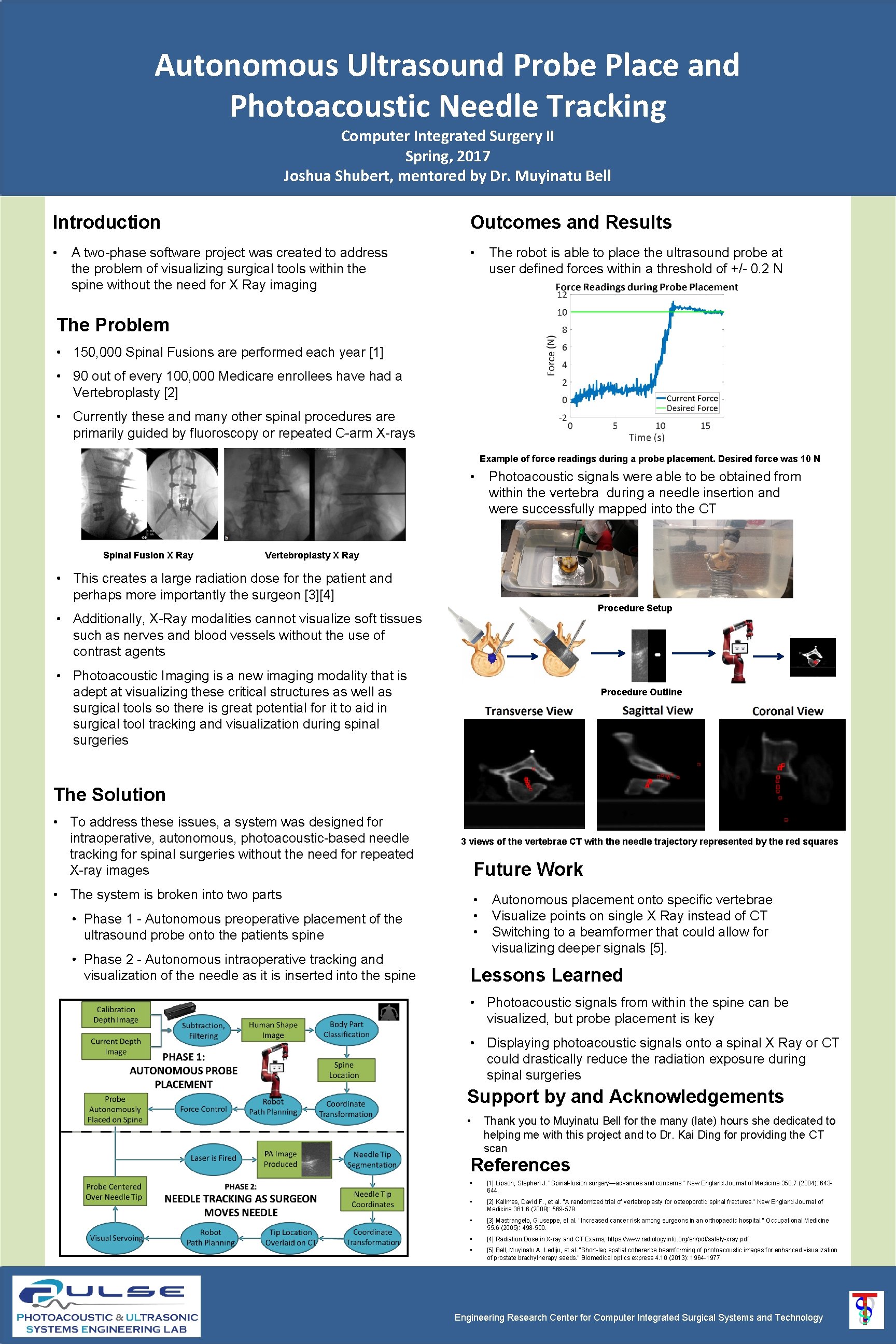
Autonomous Ultrasound Probe Place and Photoacoustic Needle Tracking Computer Integrated Surgery II Spring, 2017 Joshua Shubert, mentored by Dr. Muyinatu Bell Introduction Outcomes and Results • • A two-phase software project was created to address the problem of visualizing surgical tools within the spine without the need for X Ray imaging The robot is able to place the ultrasound probe at user defined forces within a threshold of +/- 0. 2 N The Problem • 150, 000 Spinal Fusions are performed each year [1] • 90 out of every 100, 000 Medicare enrollees have had a Vertebroplasty [2] • Currently these and many other spinal procedures are primarily guided by fluoroscopy or repeated C-arm X-rays Example of force readings during a probe placement. Desired force was 10 N • Spinal Fusion X Ray Photoacoustic signals were able to be obtained from within the vertebra during a needle insertion and were successfully mapped into the CT Vertebroplasty X Ray • This creates a large radiation dose for the patient and perhaps more importantly the surgeon [3][4] Procedure Setup • Additionally, X-Ray modalities cannot visualize soft tissues such as nerves and blood vessels without the use of contrast agents • Photoacoustic Imaging is a new imaging modality that is adept at visualizing these critical structures as well as surgical tools so there is great potential for it to aid in surgical tool tracking and visualization during spinal surgeries Procedure Outline The Solution • To address these issues, a system was designed for intraoperative, autonomous, photoacoustic-based needle tracking for spinal surgeries without the need for repeated X-ray images 3 views of the vertebrae CT with the needle trajectory represented by the red squares Future Work • The system is broken into two parts • Phase 1 - Autonomous preoperative placement of the ultrasound probe onto the patients spine • • Phase 2 - Autonomous intraoperative tracking and visualization of the needle as it is inserted into the spine Lessons Learned Autonomous placement onto specific vertebrae Visualize points on single X Ray instead of CT Switching to a beamformer that could allow for visualizing deeper signals [5]. • Photoacoustic signals from within the spine can be visualized, but probe placement is key • Displaying photoacoustic signals onto a spinal X Ray or CT could drastically reduce the radiation exposure during spinal surgeries Support by and Acknowledgements • Thank you to Muyinatu Bell for the many (late) hours she dedicated to helping me with this project and to Dr. Kai Ding for providing the CT scan References • [1] Lipson, Stephen J. "Spinal-fusion surgery—advances and concerns. " New England Journal of Medicine 350. 7 (2004): 643644. • [2] Kallmes, David F. , et al. "A randomized trial of vertebroplasty for osteoporotic spinal fractures. " New England Journal of Medicine 361. 6 (2009): 569 -579. • [3] Mastrangelo, Giuseppe, et al. "Increased cancer risk among surgeons in an orthopaedic hospital. " Occupational Medicine 55. 6 (2005): 498 -500. • [4] Radiation Dose in X-ray and CT Exams, https: //www. radiologyinfo. org/en/pdf/safety-xray. pdf • [5] Bell, Muyinatu A. Lediju, et al. "Short-lag spatial coherence beamforming of photoacoustic images for enhanced visualization of prostate brachytherapy seeds. " Biomedical optics express 4. 10 (2013): 1964 -1977. Engineering Research Center for Computer Integrated Surgical Systems and Technology
- Slides: 1