
Autonomous Onboard Near Earth Object Detection NASA Early
Autonomous On-board Near Earth Object Detection NASA Early Stage Innovations, Grant # NNX 14 AB 04 G Detection, Tracking and Identification of Asteroids through On-board Image Analysis Purnima Rajan Graduate Student, Laboratory for Computational Sensing and Robotics Johns Hopkins University
Research Objectives & Results Objectives Ø Develop asteroid detection, identification, and tracking algorithms that can be hosted on a spacecraft Ø Implement the algorithms on the flight-like environment to demonstrate feasibility of on-board asteroid detection Ø Apply machine learning techniques to minimize false positives Results Ø Detection algorithm can fit on a MCP-750 (233 MHz) Ø Developed a tool suite that enables instrument and spacecraft design trades 2
Outline • Algorithm Description • Algorithm Performance and Analysis • Ongoing / Future Work 3
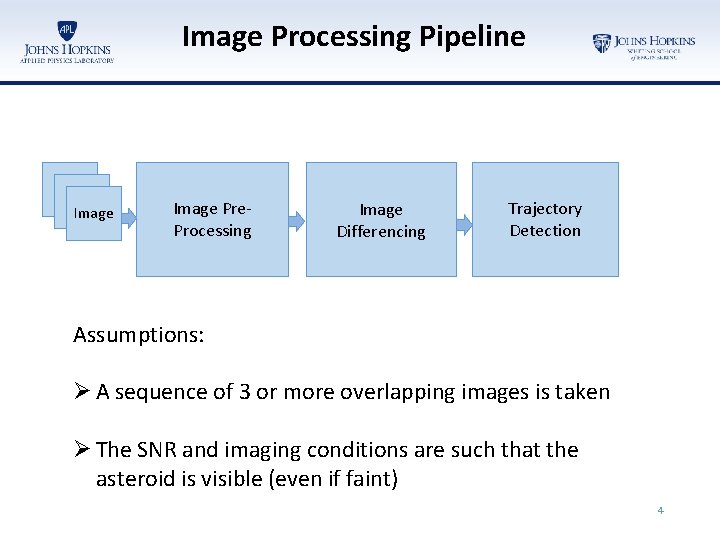
Image Processing Pipeline Image Pre. Processing Image Differencing Trajectory Detection Assumptions: Ø A sequence of 3 or more overlapping images is taken Ø The SNR and imaging conditions are such that the asteroid is visible (even if faint) 4
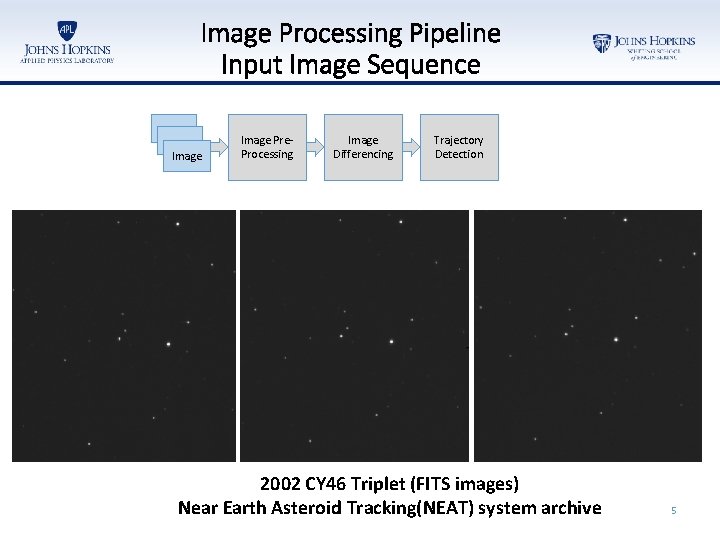
Image Processing Pipeline Input Image Sequence Image Pre. Processing Image Differencing Trajectory Detection 2002 CY 46 Triplet (FITS images) Near Earth Asteroid Tracking(NEAT) system archive 5
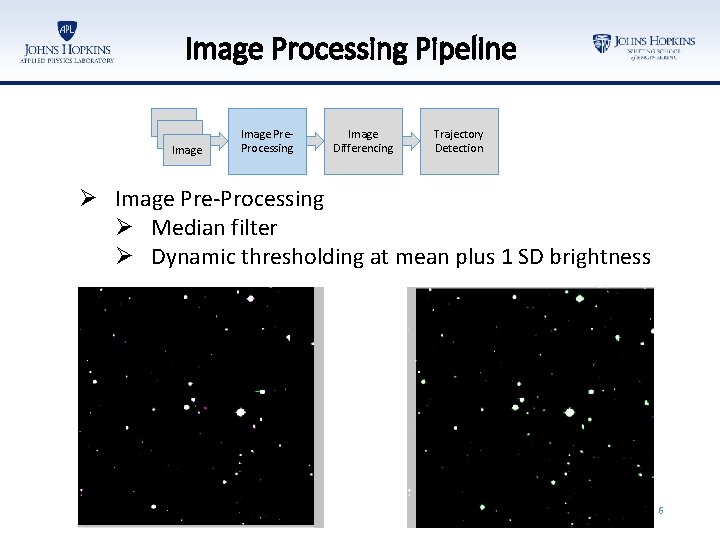
Image Processing Pipeline Image Pre. Processing Image Differencing Trajectory Detection Ø Image Pre-Processing Ø Median filter Ø Dynamic thresholding at mean plus 1 SD brightness 6
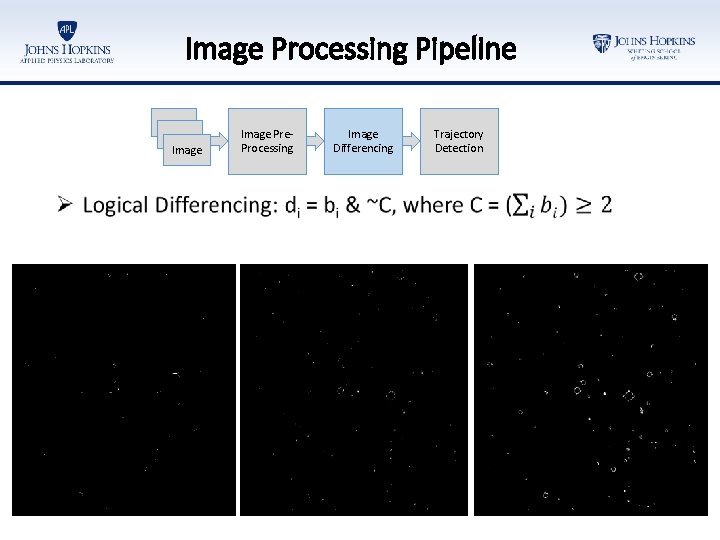
Image Processing Pipeline Image Pre. Processing Image Differencing Trajectory Detection 7
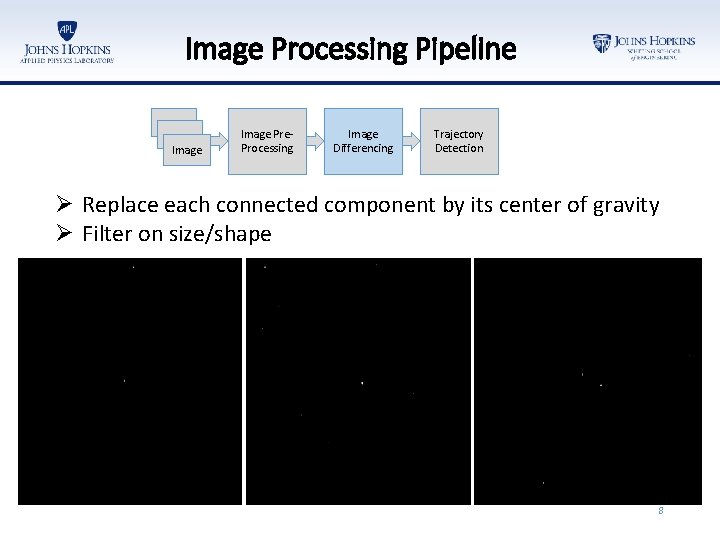
Image Processing Pipeline Image Pre. Processing Image Differencing Trajectory Detection Ø Replace each connected component by its center of gravity Ø Filter on size/shape 8
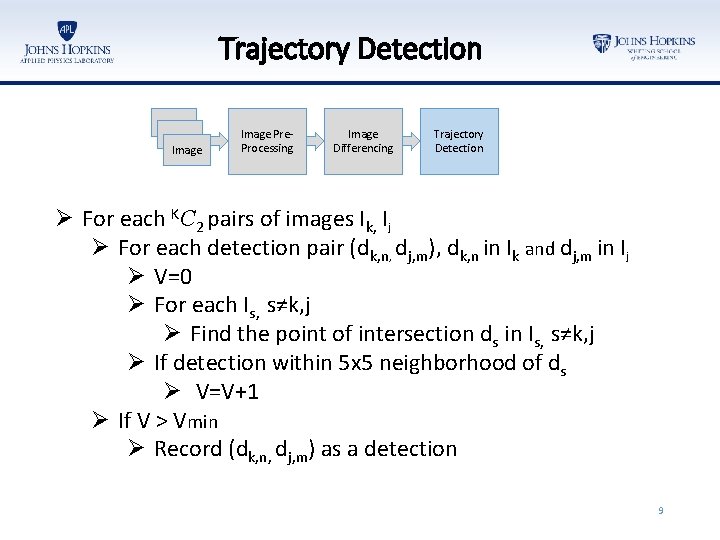
Trajectory Detection Image Pre. Processing Image Differencing Trajectory Detection Ø For each KC 2 pairs of images Ik, Ij Ø For each detection pair (dk, n, dj, m), dk, n in Ik and dj, m in Ij Ø V=0 Ø For each Is, s≠k, j Ø Find the point of intersection ds in Is, s≠k, j Ø If detection within 5 x 5 neighborhood of ds Ø V=V+1 Ø If V > Vmin Ø Record (dk, n, dj, m) as a detection 9
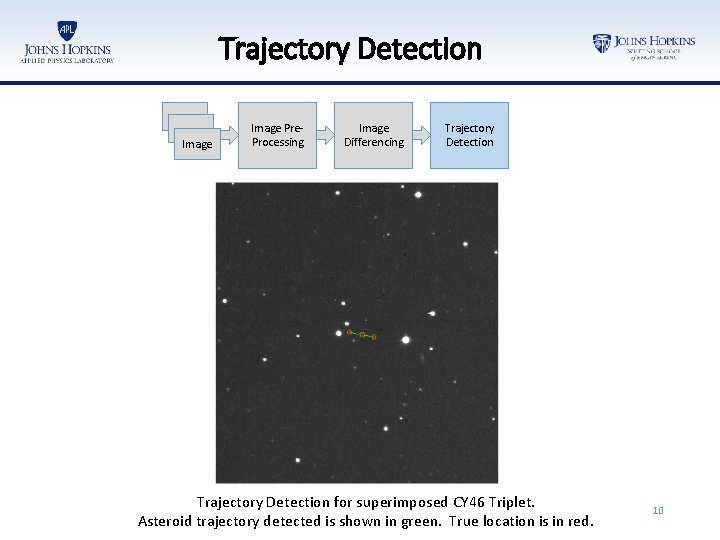
Trajectory Detection Image Pre. Processing Image Differencing Trajectory Detection for superimposed CY 46 Triplet. Asteroid trajectory detected is shown in green. True location is in red. 10
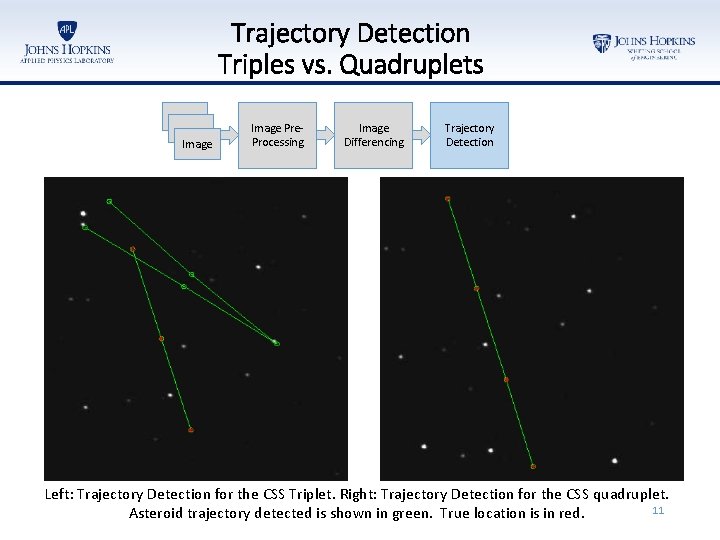
Trajectory Detection Triples vs. Quadruplets Image Pre. Processing Image Differencing Trajectory Detection Left: Trajectory Detection for the CSS Triplet. Right: Trajectory Detection for the CSS quadruplet. 11 Asteroid trajectory detected is shown in green. True location is in red.
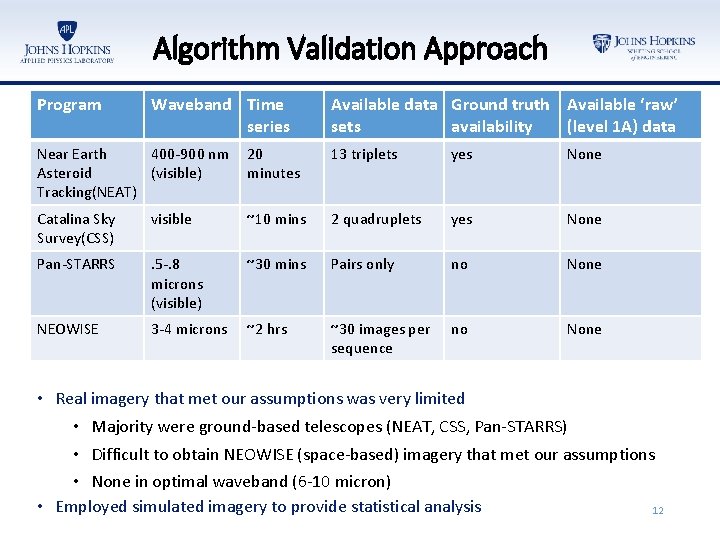
Algorithm Validation Approach Program Waveband Time series Available data Ground truth Available ‘raw’ sets availability (level 1 A) data Near Earth 400 -900 nm Asteroid (visible) Tracking(NEAT) 20 minutes 13 triplets yes None Catalina Sky Survey(CSS) visible ~10 mins 2 quadruplets yes None Pan-STARRS . 5 -. 8 microns (visible) ~30 mins Pairs only no None NEOWISE 3 -4 microns ~2 hrs ~30 images per sequence no None • Real imagery that met our assumptions was very limited • Majority were ground-based telescopes (NEAT, CSS, Pan-STARRS) • Difficult to obtain NEOWISE (space-based) imagery that met our assumptions • None in optimal waveband (6 -10 micron) • Employed simulated imagery to provide statistical analysis 12
Outline • Algorithm Description • Image Simulation • Algorithm Performance and Analysis • Recommendations • Ongoing / Future Work 13
Performance Analysis Ø Extensive testing as a function of telescope parameters and asteroid characteristics Ø Chose 0. 5 m aperture as best tradeoff of detection vs. size Ø ROC curves Ø True Positives per sequence is the mean number of true asteroid detections in each image in the sequence. Ø False Positives per sequence is the mean number of false detections in each image in the sequence. 14
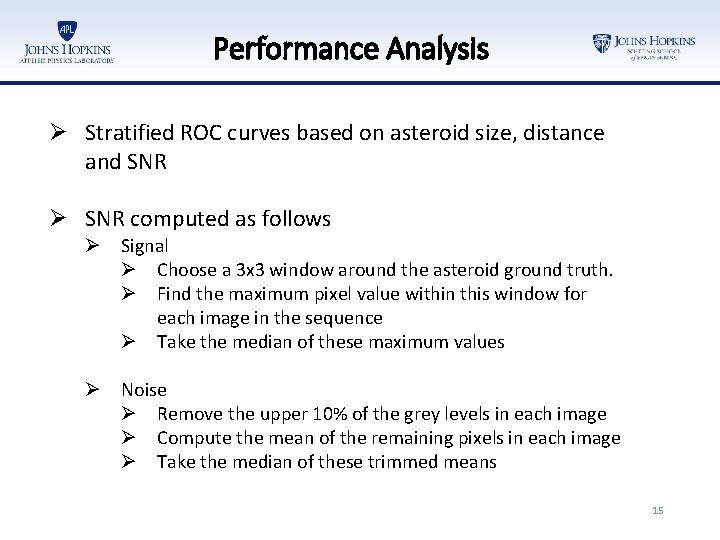
Performance Analysis Ø Stratified ROC curves based on asteroid size, distance and SNR Ø SNR computed as follows Ø Signal Ø Choose a 3 x 3 window around the asteroid ground truth. Ø Find the maximum pixel value within this window for each image in the sequence Ø Take the median of these maximum values Ø Noise Ø Remove the upper 10% of the grey levels in each image Ø Compute the mean of the remaining pixels in each image Ø Take the median of these trimmed means 15
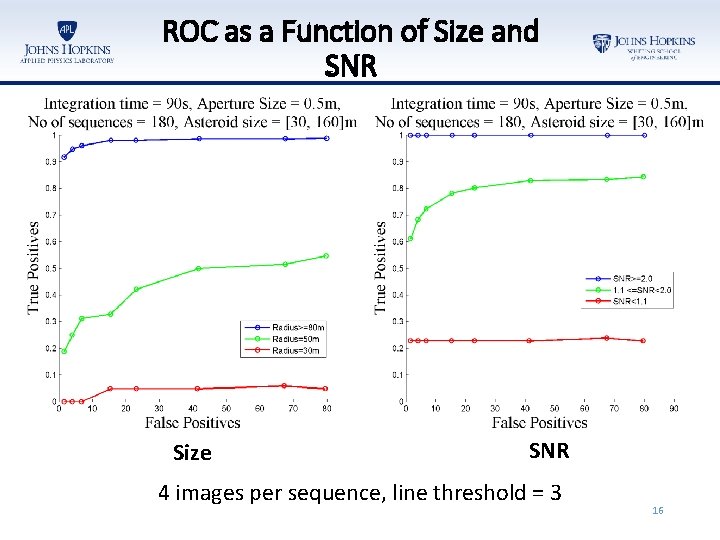
ROC as a Function of Size and SNR Size SNR 4 images per sequence, line threshold = 3 16
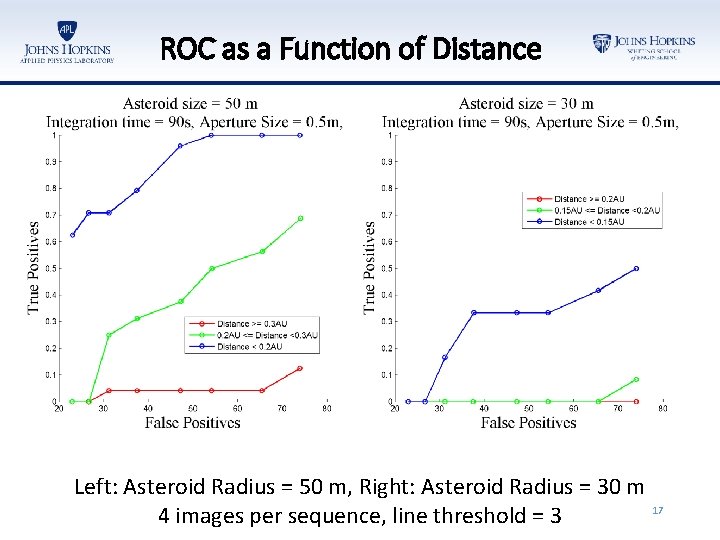
ROC as a Function of Distance Left: Asteroid Radius = 50 m, Right: Asteroid Radius = 30 m 17 4 images per sequence, line threshold = 3
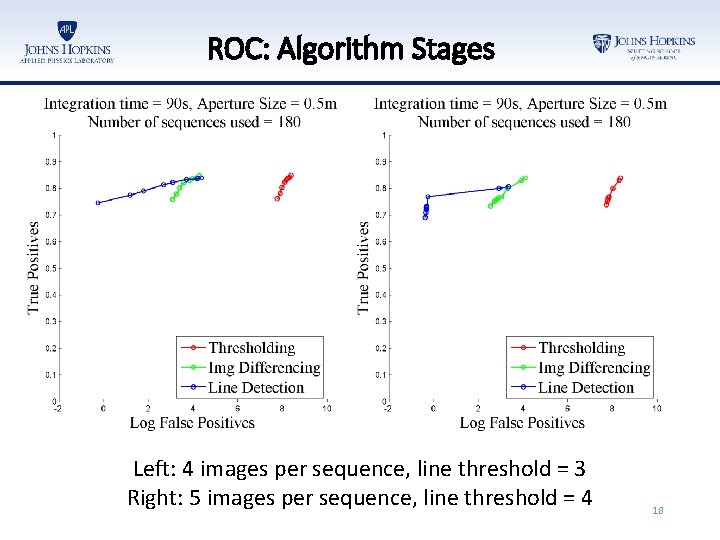
ROC: Algorithm Stages Left: 4 images per sequence, line threshold = 3 Right: 5 images per sequence, line threshold = 4 18
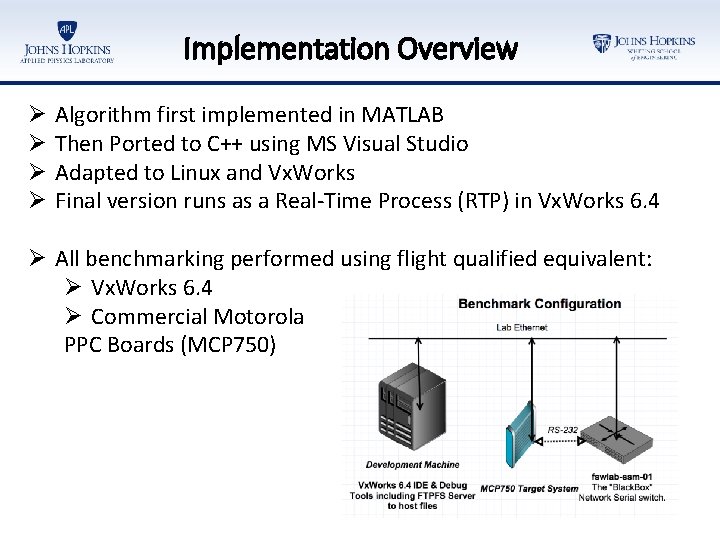
Implementation Overview Ø Ø Algorithm first implemented in MATLAB Then Ported to C++ using MS Visual Studio Adapted to Linux and Vx. Works Final version runs as a Real-Time Process (RTP) in Vx. Works 6. 4 Ø All benchmarking performed using flight qualified equivalent: Ø Vx. Works 6. 4 Ø Commercial Motorola PPC Boards (MCP 750)
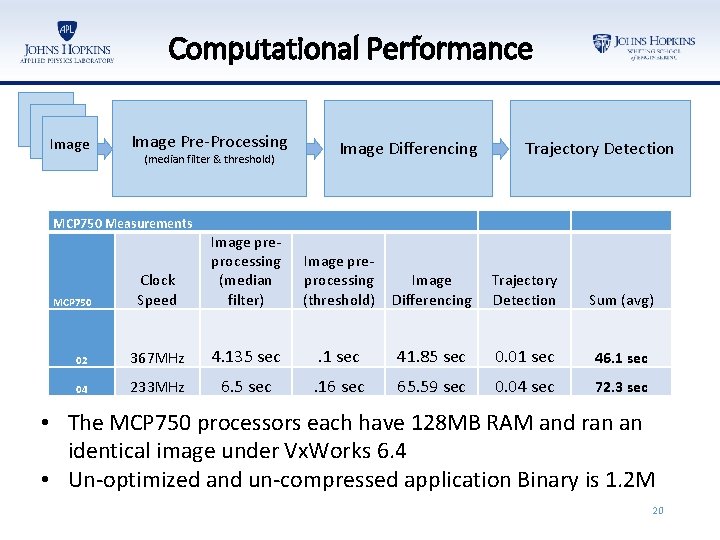
Computational Performance Image Pre-Processing (median filter & threshold) MCP 750 Measurements Image Differencing Clock Speed Image preprocessing (median filter) 02 367 MHz 4. 135 sec . 1 sec 04 233 MHz 6. 5 sec . 16 sec MCP 750 Image preprocessing Image (threshold) Differencing Trajectory Detection Sum (avg) 41. 85 sec 0. 01 sec 46. 1 sec 65. 59 sec 0. 04 sec 72. 3 sec • The MCP 750 processors each have 128 MB RAM and ran an identical image under Vx. Works 6. 4 • Un-optimized and un-compressed application Binary is 1. 2 M 20
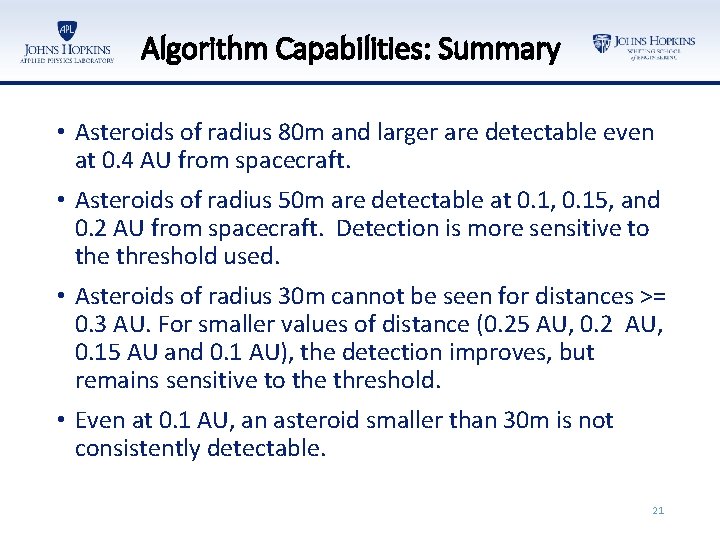
Algorithm Capabilities: Summary • Asteroids of radius 80 m and larger are detectable even at 0. 4 AU from spacecraft. • Asteroids of radius 50 m are detectable at 0. 1, 0. 15, and 0. 2 AU from spacecraft. Detection is more sensitive to the threshold used. • Asteroids of radius 30 m cannot be seen for distances >= 0. 3 AU. For smaller values of distance (0. 25 AU, 0. 2 AU, 0. 15 AU and 0. 1 AU), the detection improves, but remains sensitive to the threshold. • Even at 0. 1 AU, an asteroid smaller than 30 m is not consistently detectable. 21
Ongoing/Future Work • False positive reduction • Use additional images in sequence • Use Machine Learning to detect “good” vs. “bad” triplets • Trajectory validation to filter known asteroids 22
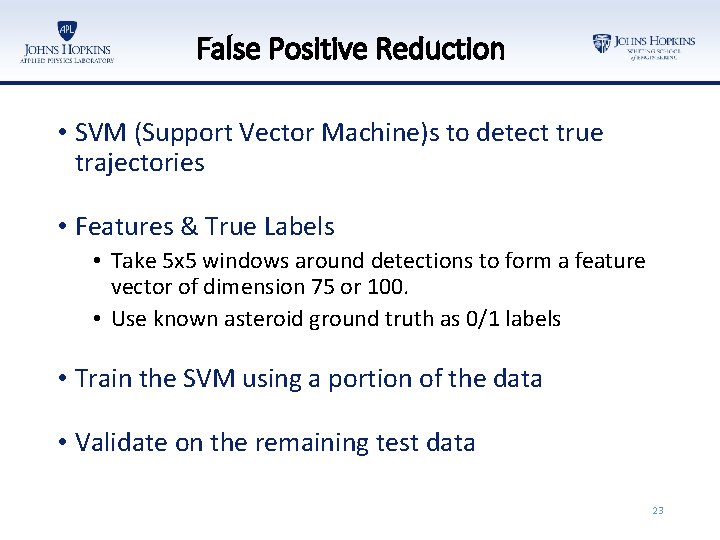
False Positive Reduction • SVM (Support Vector Machine)s to detect true trajectories • Features & True Labels • Take 5 x 5 windows around detections to form a feature vector of dimension 75 or 100. • Use known asteroid ground truth as 0/1 labels • Train the SVM using a portion of the data • Validate on the remaining test data 23
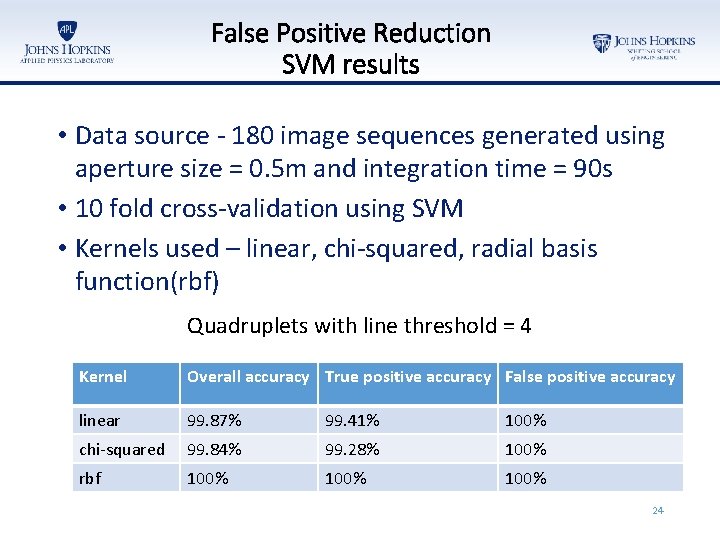
False Positive Reduction SVM results • Data source - 180 image sequences generated using aperture size = 0. 5 m and integration time = 90 s • 10 fold cross-validation using SVM • Kernels used – linear, chi-squared, radial basis function(rbf) Quadruplets with line threshold = 4 Kernel Overall accuracy True positive accuracy False positive accuracy linear 99. 87% 99. 41% 100% chi-squared 99. 84% 99. 28% 100% rbf 100% 24
Ongoing/Future Work • False positive reduction • Use additional images in sequence • Use Machine Learning to detect “good” vs. “bad” triplets • Trajectory validation to filter known asteroids • Validation against space based imagery • Validation against known asteroids • Algorithm optimization to more refined flight characteristics • Other parameter tuning/optimization • Use linear regression to find the optimal threshold for a given set of telescope parameters 25
Thanks! This work was supported by an Early Stage Innovations grant from NASA’s Space Technology Research Grants Program NNX 14 AB 04 G. We gratefully acknowledge E. Christensen for providing the CSS data. Team Members and Affiliations: · Gregory Hager, Ph. D. , Professor at Johns Hopkins University (PI) · Michelle Chen, JHU/Applied Physics Laboratory · Phillipe Burlina, Ph. D. JHU/APL and Associate Research Professor, Johns Hopkins University, Department of Computer Science · Avigyan Sinha, doctoral student at Johns Hopkins University · Bruno Jedynak, Ph. D. Associate Research Professor at Johns Hopkins University · Andy Rivkin, Ph. D. JHU/Applied Physics Laboratory · Justin Atchison, Ph. D. JHU/Applied Physics Laboratory · Nishant Mehta, JHU/Applied Physics Laboratory · Zach Fletcher, JHU/Applied Physics Laboratory · David Edell, JHU/Applied Physics Laboratory · Christopher Krupiarz, JHU/Applied Physics Laboratory 26
- Slides: 26