
Autonomous Mobile Robots Chapter 6 6 Planning and
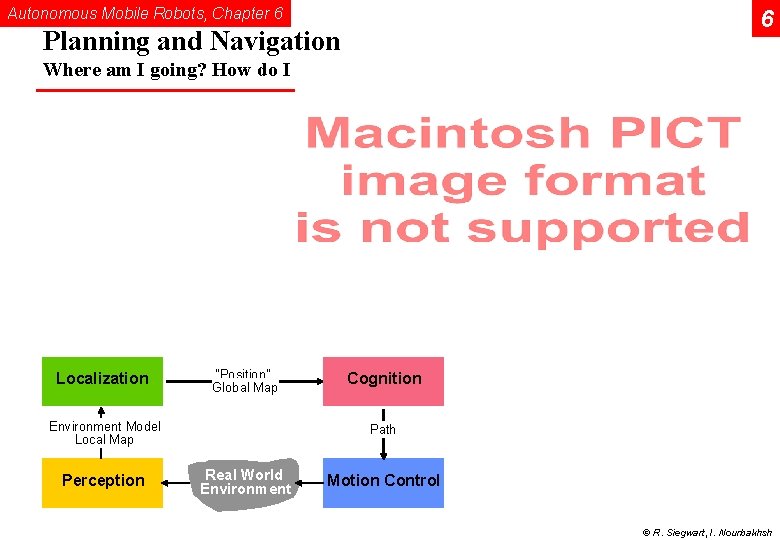
Autonomous Mobile Robots, Chapter 6 6 Planning and Navigation Where am I going? How do I get there? Localization "Position" Global Map Environment Model Local Map Perception Cognition Path Real World Environment Motion Control © R. Siegwart, I. Nourbakhsh
Autonomous Mobile Robots, Chapter 6 6. 2 Competencies for Navigation I • Cognition / Reasoning : Ø is the ability to decide what actions are required to achieve a certain goal in a given situation (belief state). Ø decisions ranging from what path to take to what information on the environment to use. • Today’s industrial robots can operate without any cognition (reasoning) because their environment is static and very structured. • In mobile robotics, cognition and reasoning is primarily of geometric nature, such as picking safe path or determining where to go next. Ø already been largely explored in literature for cases in which complete information about the current situation and the environment exists (e. g. sales man problem). © R. Siegwart, I. Nourbakhsh
Autonomous Mobile Robots, Chapter 6 6. 2 Competencies for Navigation II • However, in mobile robotics the knowledge of about the environment and situation is usually only partially known and is uncertain. Ø makes the task much more difficult Ø requires multiple tasks running in parallel, some for planning (global), some to guarantee “survival of the robot”. • Robot control can usually be decomposed in various behaviors or functions Ø e. g. wall following, localization, path generation or obstacle avoidance. • In this chapter we are concerned with path planning and navigation, except the low lever motion control and localization. • We can generally distinguish between (global) path planning and (local) obstacle avoidance. © R. Siegwart, I. Nourbakhsh
Autonomous Mobile Robots, Chapter 6 6. 2. 1 Global Path Planing • Assumption: there exists a good enough map of the environment for navigation. Ø Topological or metric or a mixture between both. • First step: Ø Representation of the environment by a road-map (graph), cells or a potential field. The resulting discrete locations or cells allow then to use standard planning algorithms. • Examples: Ø Visibility Graph Ø Voronoi Diagram Ø Cell Decomposition -> Connectivity Graph Ø Potential Field © R. Siegwart, I. Nourbakhsh
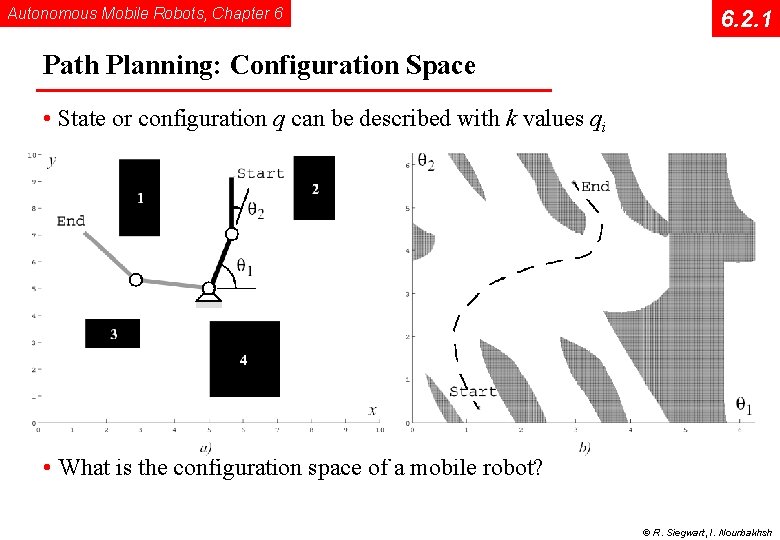
Autonomous Mobile Robots, Chapter 6 6. 2. 1 Path Planning: Configuration Space • State or configuration q can be described with k values qi • What is the configuration space of a mobile robot? © R. Siegwart, I. Nourbakhsh
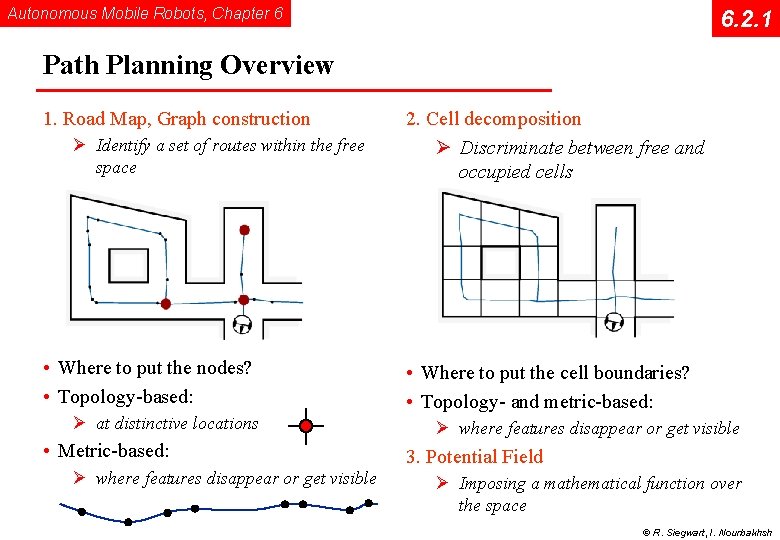
Autonomous Mobile Robots, Chapter 6 6. 2. 1 Path Planning Overview 1. Road Map, Graph construction Ø Identify a set of routes within the free space • Where to put the nodes? • Topology-based: Ø at distinctive locations • Metric-based: Ø where features disappear or get visible 2. Cell decomposition Ø Discriminate between free and occupied cells • Where to put the cell boundaries? • Topology- and metric-based: Ø where features disappear or get visible 3. Potential Field Ø Imposing a mathematical function over the space © R. Siegwart, I. Nourbakhsh
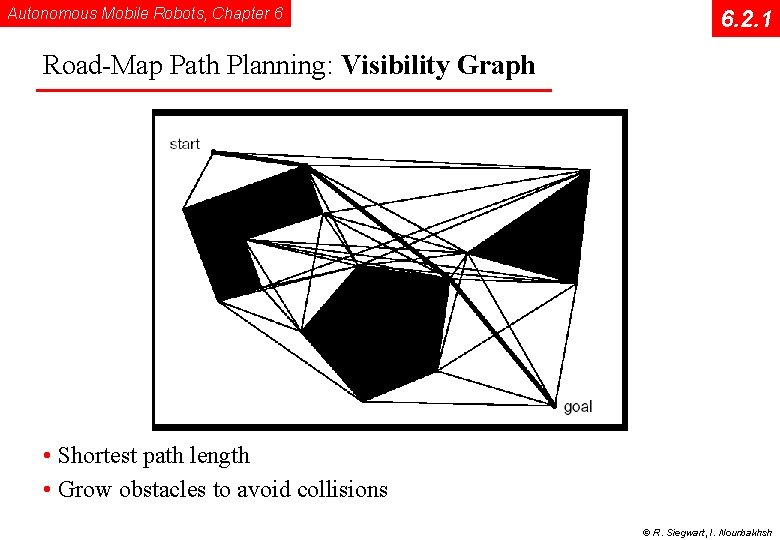
Autonomous Mobile Robots, Chapter 6 6. 2. 1 Road-Map Path Planning: Visibility Graph • Shortest path length • Grow obstacles to avoid collisions © R. Siegwart, I. Nourbakhsh
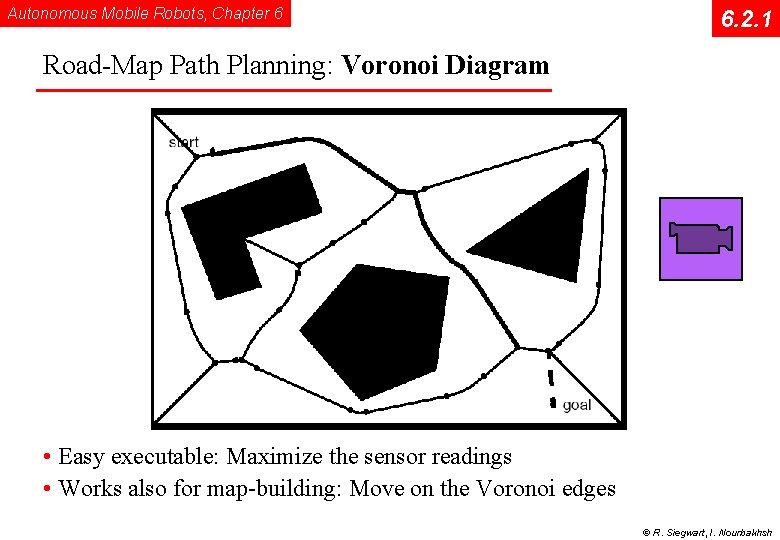
Autonomous Mobile Robots, Chapter 6 6. 2. 1 Road-Map Path Planning: Voronoi Diagram • Easy executable: Maximize the sensor readings • Works also for map-building: Move on the Voronoi edges © R. Siegwart, I. Nourbakhsh
Autonomous Mobile Robots, Chapter 6 6. 2. 1 Road-Map Path Planning: Voronoi, Sysquake Demo © R. Siegwart, I. Nourbakhsh
Autonomous Mobile Robots, Chapter 6 6. 2. 1 Road-Map Path Planning: Cell Decomposition • Divide space into simple, connected regions called cells • Determine which open sells are adjacent and construct a connectivity graph • Find cells in which the initial and goal configuration (state) lie and search for a path in the connectivity graph to join them. • From the sequence of cells found with an appropriate search algorithm, compute a path within each cell. Ø e. g. passing through the midpoints of cell boundaries or by sequence of wall following movements. © R. Siegwart, I. Nourbakhsh

Autonomous Mobile Robots, Chapter 6 6. 2. 1 Road-Map Path Planning: Exact Cell Decomposition © R. Siegwart, I. Nourbakhsh
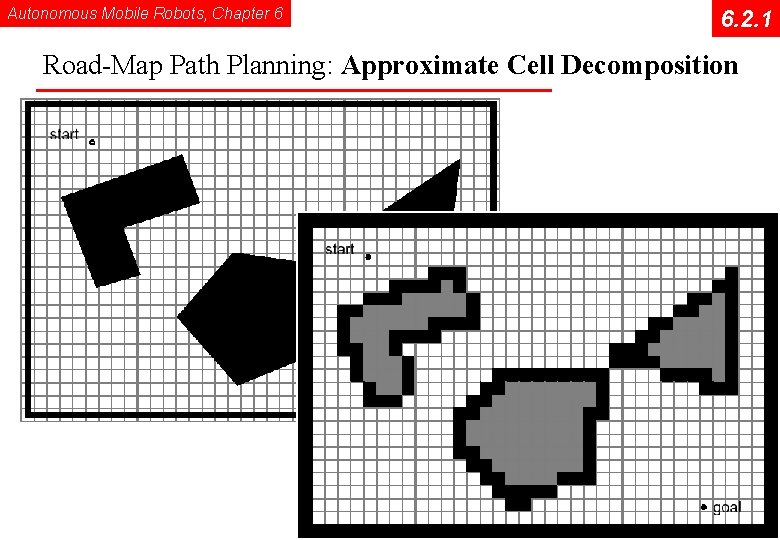
Autonomous Mobile Robots, Chapter 6 6. 2. 1 Road-Map Path Planning: Approximate Cell Decomposition © R. Siegwart, I. Nourbakhsh
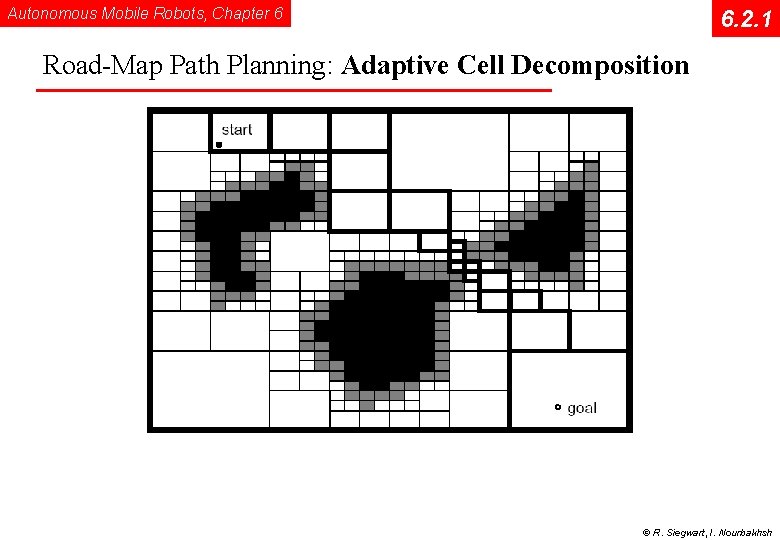
Autonomous Mobile Robots, Chapter 6 6. 2. 1 Road-Map Path Planning: Adaptive Cell Decomposition © R. Siegwart, I. Nourbakhsh
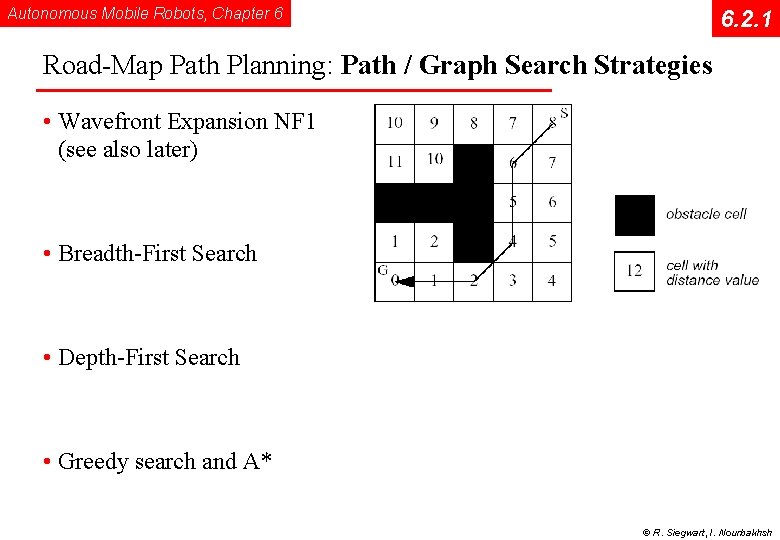
Autonomous Mobile Robots, Chapter 6 6. 2. 1 Road-Map Path Planning: Path / Graph Search Strategies • Wavefront Expansion NF 1 (see also later) • Breadth-First Search • Depth-First Search • Greedy search and A* © R. Siegwart, I. Nourbakhsh
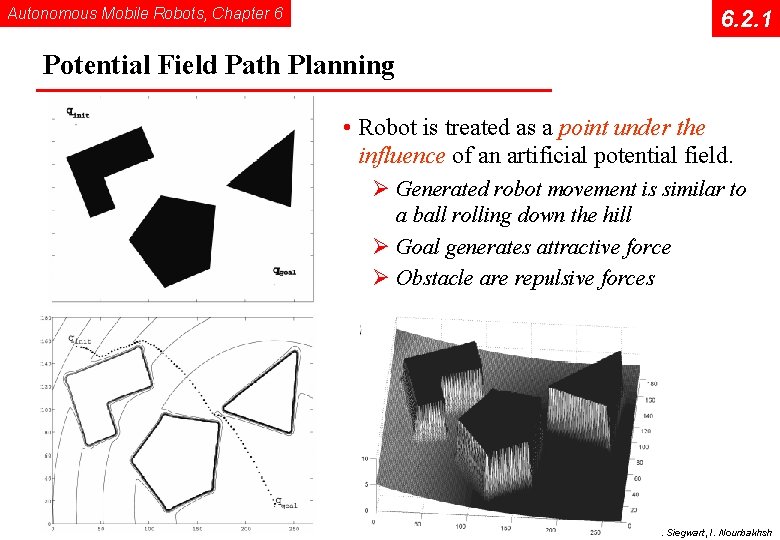
Autonomous Mobile Robots, Chapter 6 6. 2. 1 Potential Field Path Planning • Robot is treated as a point under the influence of an artificial potential field. Ø Generated robot movement is similar to a ball rolling down the hill Ø Goal generates attractive force Ø Obstacle are repulsive forces © R. Siegwart, I. Nourbakhsh
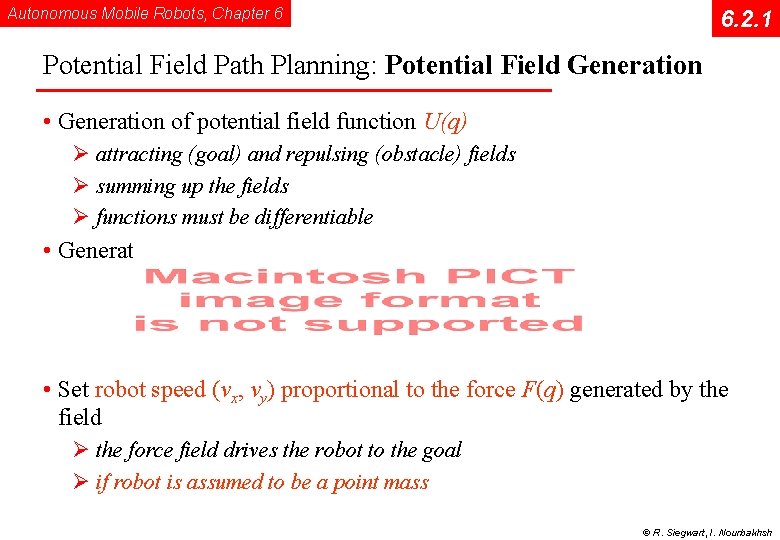
Autonomous Mobile Robots, Chapter 6 6. 2. 1 Potential Field Path Planning: Potential Field Generation • Generation of potential field function U(q) Ø attracting (goal) and repulsing (obstacle) fields Ø summing up the fields Ø functions must be differentiable • Generate artificial force field F(q) • Set robot speed (vx, vy) proportional to the force F(q) generated by the field Ø the force field drives the robot to the goal Ø if robot is assumed to be a point mass © R. Siegwart, I. Nourbakhsh
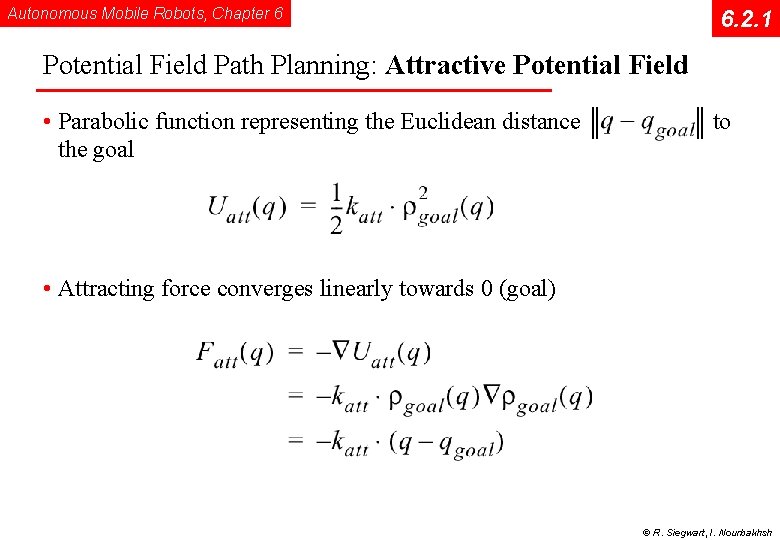
Autonomous Mobile Robots, Chapter 6 6. 2. 1 Potential Field Path Planning: Attractive Potential Field • Parabolic function representing the Euclidean distance the goal to • Attracting force converges linearly towards 0 (goal) © R. Siegwart, I. Nourbakhsh
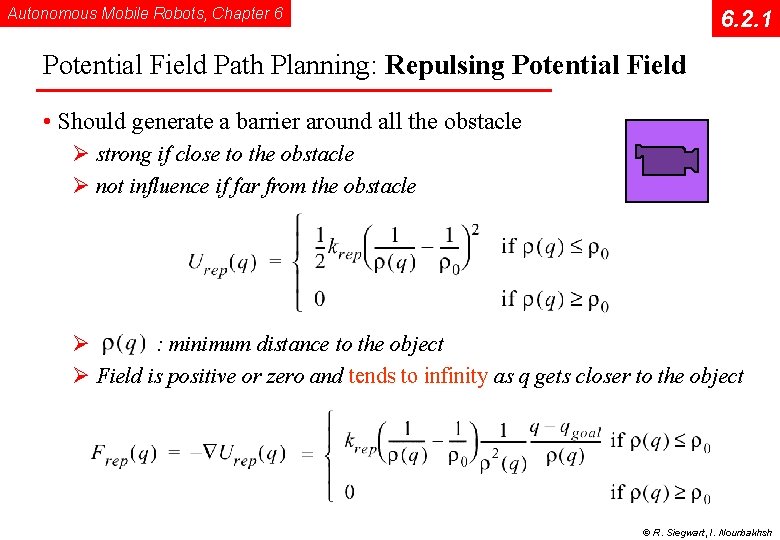
Autonomous Mobile Robots, Chapter 6 6. 2. 1 Potential Field Path Planning: Repulsing Potential Field • Should generate a barrier around all the obstacle Ø strong if close to the obstacle Ø not influence if far from the obstacle Ø : minimum distance to the object Ø Field is positive or zero and tends to infinity as q gets closer to the object © R. Siegwart, I. Nourbakhsh
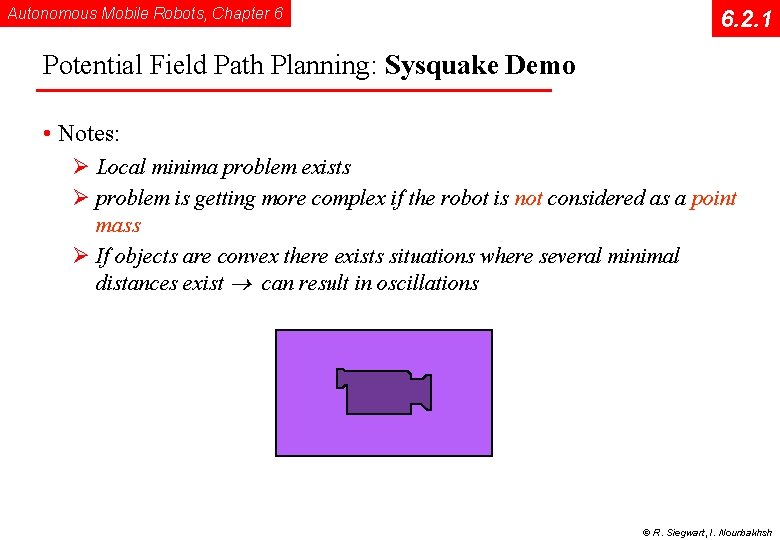
Autonomous Mobile Robots, Chapter 6 6. 2. 1 Potential Field Path Planning: Sysquake Demo • Notes: Ø Local minima problem exists Ø problem is getting more complex if the robot is not considered as a point mass Ø If objects are convex there exists situations where several minimal distances exist ® can result in oscillations © R. Siegwart, I. Nourbakhsh
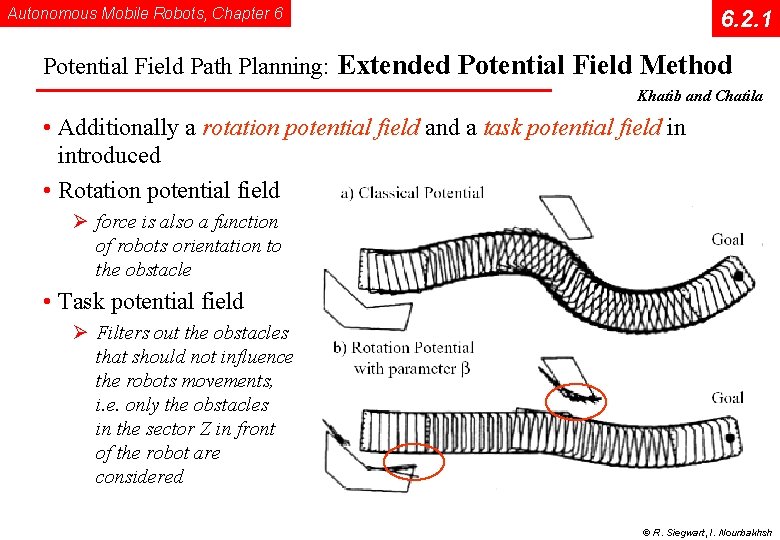
Autonomous Mobile Robots, Chapter 6 6. 2. 1 Potential Field Path Planning: Extended Potential Field Method Khatib and Chatila • Additionally a rotation potential field and a task potential field in introduced • Rotation potential field Ø force is also a function of robots orientation to the obstacle • Task potential field Ø Filters out the obstacles that should not influence the robots movements, i. e. only the obstacles in the sector Z in front of the robot are considered © R. Siegwart, I. Nourbakhsh
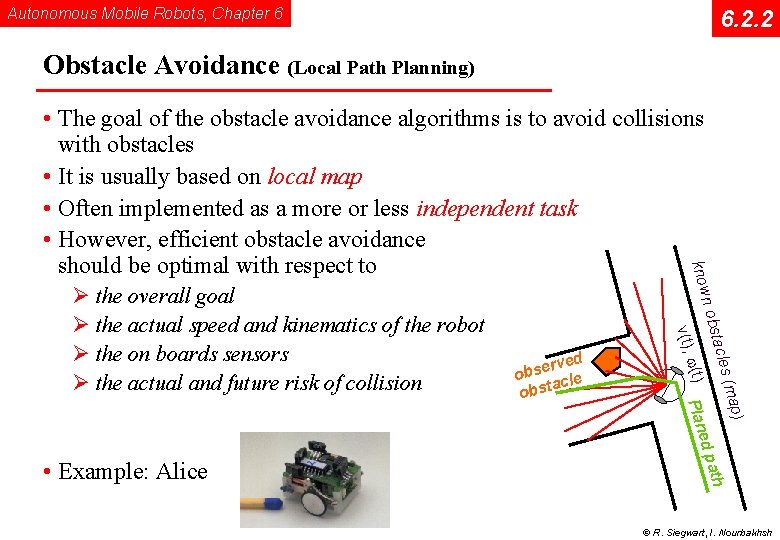
Autonomous Mobile Robots, Chapter 6 6. 2. 2 Obstacle Avoidance (Local Path Planning) n obs s tacle ) Plan (map w(t) ath ed p • Example: Alice rved e s b o acl e o b st v(t), Ø the overall goal Ø the actual speed and kinematics of the robot Ø the on boards sensors Ø the actual and future risk of collision know • The goal of the obstacle avoidance algorithms is to avoid collisions with obstacles • It is usually based on local map • Often implemented as a more or less independent task • However, efficient obstacle avoidance should be optimal with respect to © R. Siegwart, I. Nourbakhsh
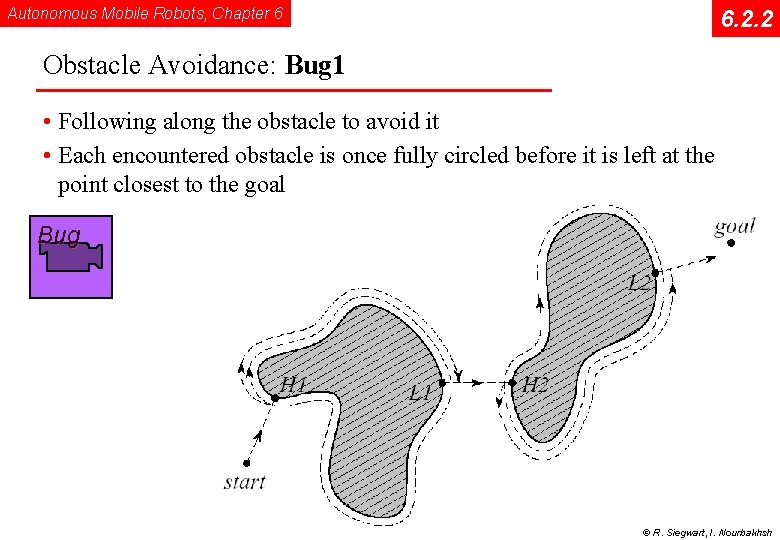
Autonomous Mobile Robots, Chapter 6 6. 2. 2 Obstacle Avoidance: Bug 1 • Following along the obstacle to avoid it • Each encountered obstacle is once fully circled before it is left at the point closest to the goal Bug © R. Siegwart, I. Nourbakhsh
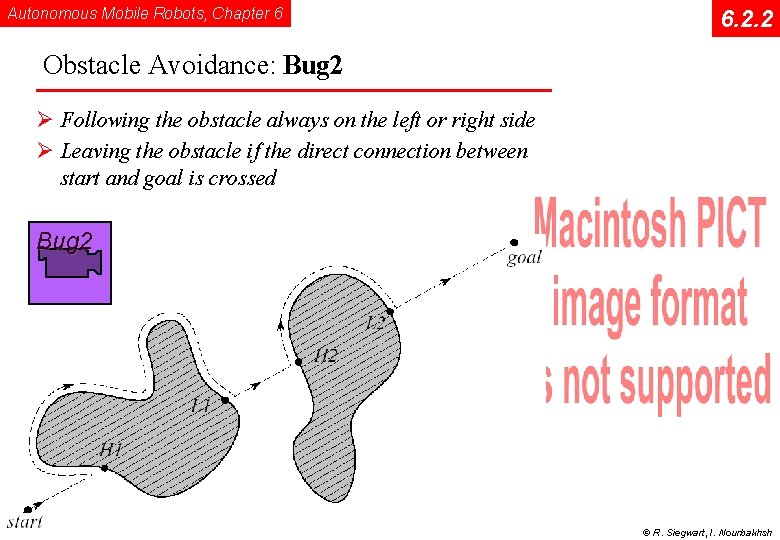
Autonomous Mobile Robots, Chapter 6 6. 2. 2 Obstacle Avoidance: Bug 2 Ø Following the obstacle always on the left or right side Ø Leaving the obstacle if the direct connection between start and goal is crossed Bug 2 © R. Siegwart, I. Nourbakhsh
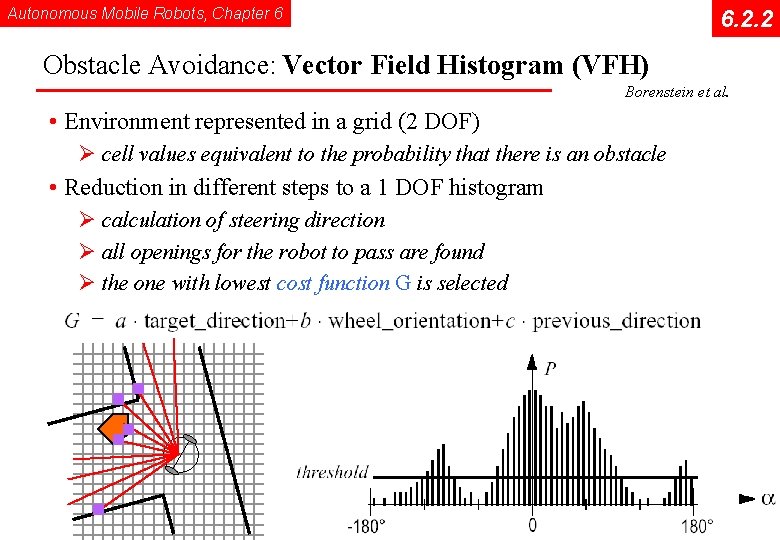
Autonomous Mobile Robots, Chapter 6 6. 2. 2 Obstacle Avoidance: Vector Field Histogram (VFH) Borenstein et al. • Environment represented in a grid (2 DOF) Ø cell values equivalent to the probability that there is an obstacle • Reduction in different steps to a 1 DOF histogram Ø calculation of steering direction Ø all openings for the robot to pass are found Ø the one with lowest cost function G is selected © R. Siegwart, I. Nourbakhsh
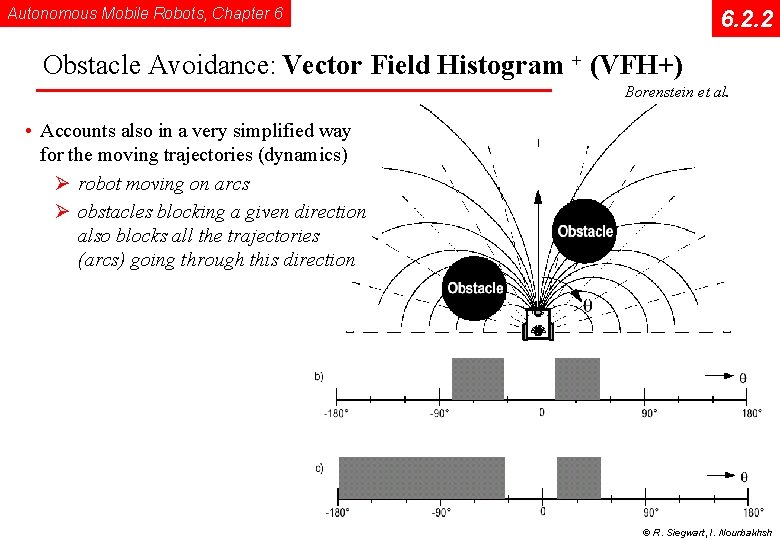
Autonomous Mobile Robots, Chapter 6 6. 2. 2 Obstacle Avoidance: Vector Field Histogram + (VFH+) Borenstein et al. • Accounts also in a very simplified way for the moving trajectories (dynamics) Ø robot moving on arcs Ø obstacles blocking a given direction also blocks all the trajectories (arcs) going through this direction © R. Siegwart, I. Nourbakhsh
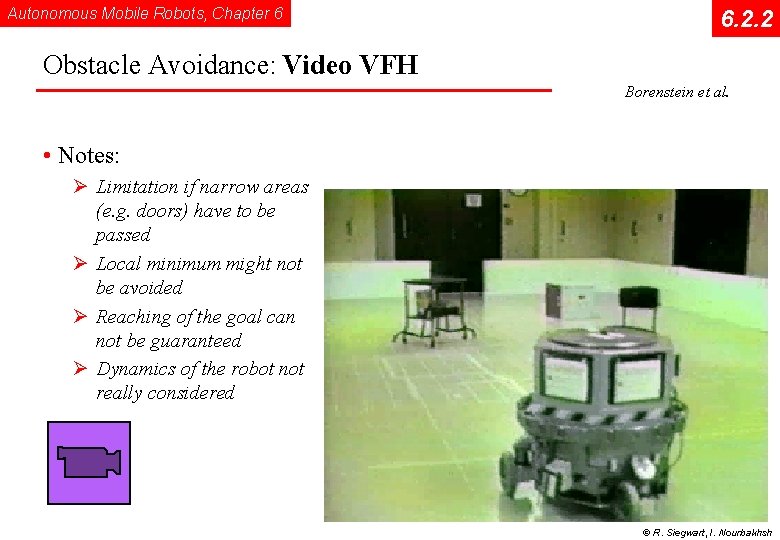
Autonomous Mobile Robots, Chapter 6 6. 2. 2 Obstacle Avoidance: Video VFH Borenstein et al. • Notes: Ø Limitation if narrow areas (e. g. doors) have to be passed Ø Local minimum might not be avoided Ø Reaching of the goal can not be guaranteed Ø Dynamics of the robot not really considered © R. Siegwart, I. Nourbakhsh
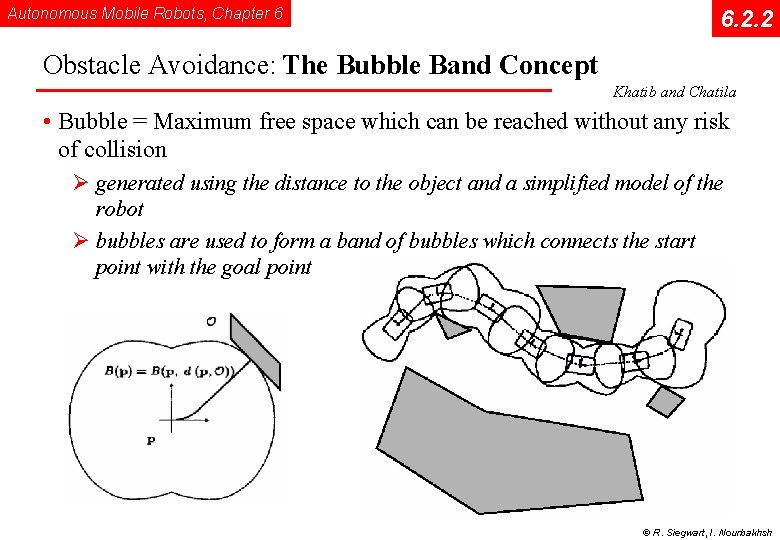
Autonomous Mobile Robots, Chapter 6 6. 2. 2 Obstacle Avoidance: The Bubble Band Concept Khatib and Chatila • Bubble = Maximum free space which can be reached without any risk of collision Ø generated using the distance to the object and a simplified model of the robot Ø bubbles are used to form a band of bubbles which connects the start point with the goal point © R. Siegwart, I. Nourbakhsh
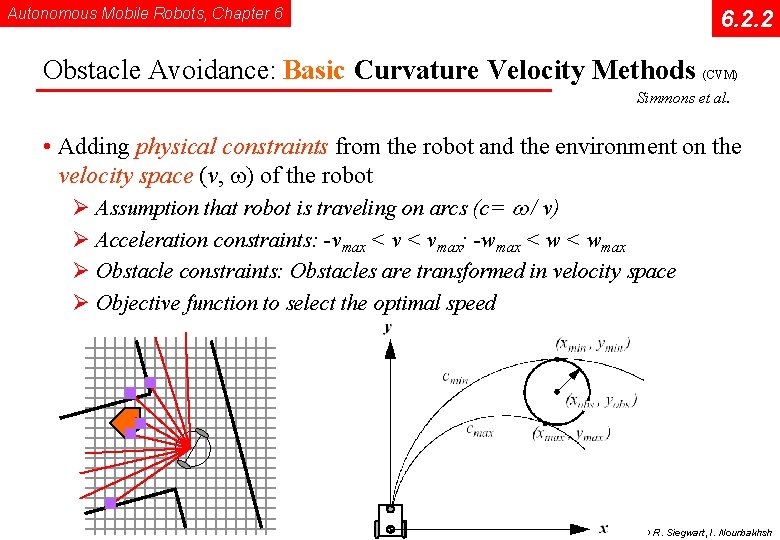
Autonomous Mobile Robots, Chapter 6 6. 2. 2 Obstacle Avoidance: Basic Curvature Velocity Methods (CVM) Simmons et al. • Adding physical constraints from the robot and the environment on the velocity space (v, w) of the robot Ø Assumption that robot is traveling on arcs (c= w / v) Ø Acceleration constraints: -vmax < vmax; -wmax < wmax Ø Obstacle constraints: Obstacles are transformed in velocity space Ø Objective function to select the optimal speed © R. Siegwart, I. Nourbakhsh
Autonomous Mobile Robots, Chapter 6 6. 2. 2 Obstacle Avoidance: Lane Curvature Velocity Methods (CVM) Simmons et al. • Improvement of basic CVM Ø Not only arcs are considered Ø lanes are calculated trading off lane length and width to the closest obstacles Ø Lane with best properties is chosen using an objective function • Note: Ø Better performance to pass narrow areas (e. g. doors) Ø Problem with local minima persists © R. Siegwart, I. Nourbakhsh
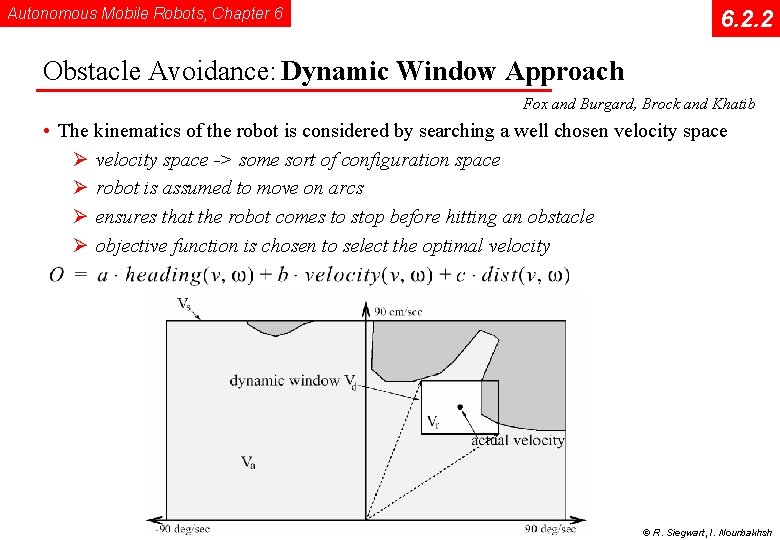
Autonomous Mobile Robots, Chapter 6 6. 2. 2 Obstacle Avoidance: Dynamic Window Approach Fox and Burgard, Brock and Khatib • The kinematics of the robot is considered by searching a well chosen velocity space Ø velocity space -> some sort of configuration space Ø robot is assumed to move on arcs Ø ensures that the robot comes to stop before hitting an obstacle Ø objective function is chosen to select the optimal velocity © R. Siegwart, I. Nourbakhsh
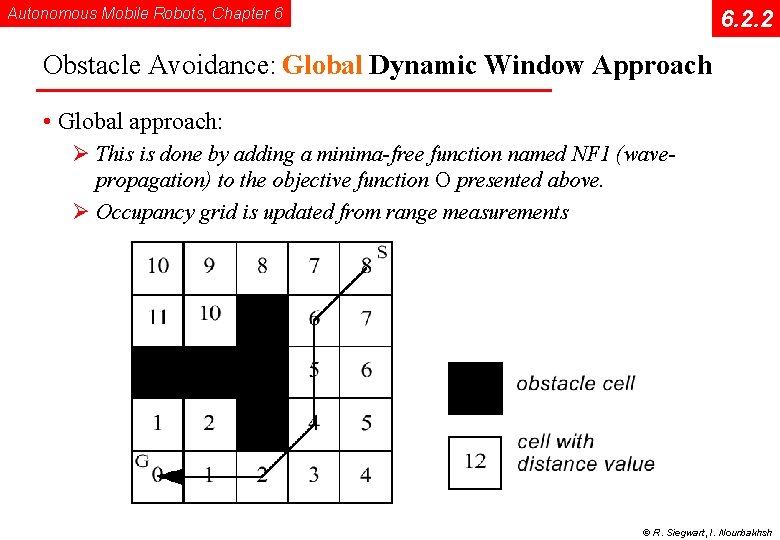
Autonomous Mobile Robots, Chapter 6 6. 2. 2 Obstacle Avoidance: Global Dynamic Window Approach • Global approach: Ø This is done by adding a minima-free function named NF 1 (wavepropagation) to the objective function O presented above. Ø Occupancy grid is updated from range measurements © R. Siegwart, I. Nourbakhsh
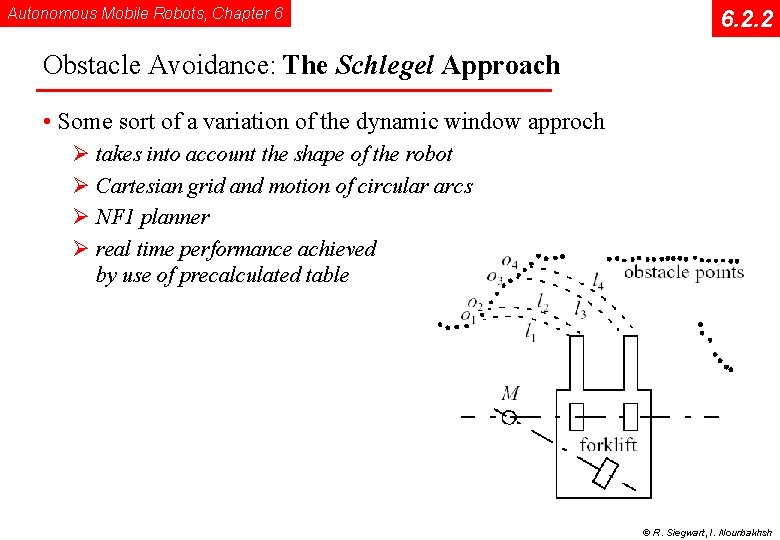
Autonomous Mobile Robots, Chapter 6 6. 2. 2 Obstacle Avoidance: The Schlegel Approach • Some sort of a variation of the dynamic window approch Ø takes into account the shape of the robot Ø Cartesian grid and motion of circular arcs Ø NF 1 planner Ø real time performance achieved by use of precalculated table © R. Siegwart, I. Nourbakhsh
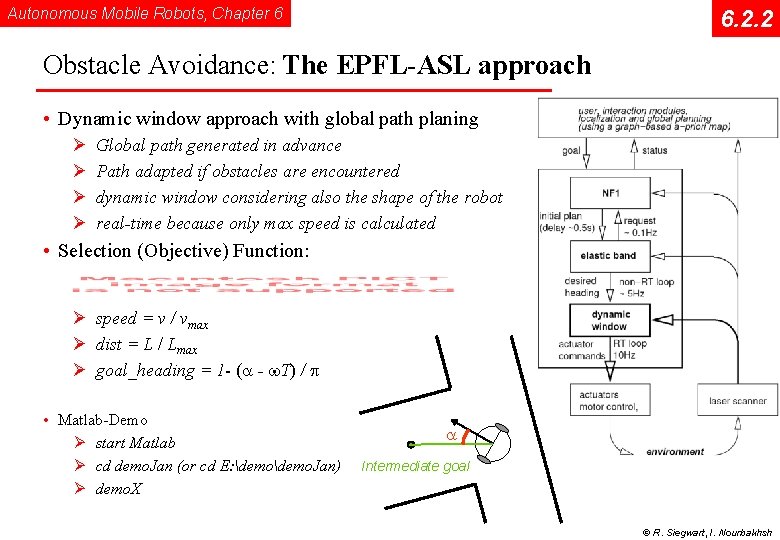
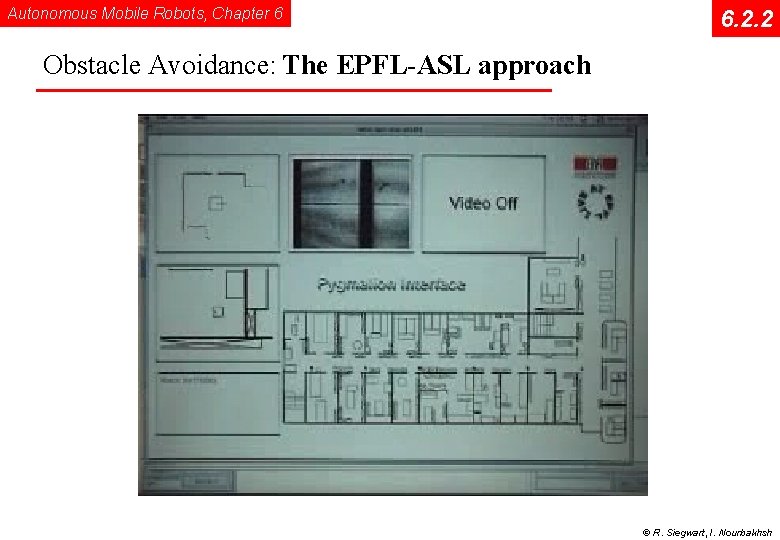
Autonomous Mobile Robots, Chapter 6 6. 2. 2 Obstacle Avoidance: The EPFL-ASL approach • Dynamic window approach with global path planing Ø Ø Global path generated in advance Path adapted if obstacles are encountered dynamic window considering also the shape of the robot real-time because only max speed is calculated • Selection (Objective) Function: Ø speed = v / vmax Ø dist = L / Lmax Ø goal_heading = 1 - (a - w. T) / p • Matlab-Demo Ø start Matlab Ø cd demo. Jan (or cd E: demo. Jan) Ø demo. X a Intermediate goal © R. Siegwart, I. Nourbakhsh
Autonomous Mobile Robots, Chapter 6 6. 2. 2 Obstacle Avoidance: The EPFL-ASL approach © R. Siegwart, I. Nourbakhsh
Autonomous Mobile Robots, Chapter 6 6. 2. 2 Obstacle Avoidance: Other approaches • Behavior based Ø difficult to introduce a precise task Ø reachability of goal not provable • Fuzzy, Neuro-Fuzzy Ø learning required Ø difficult to generalize © R. Siegwart, I. Nourbakhsh
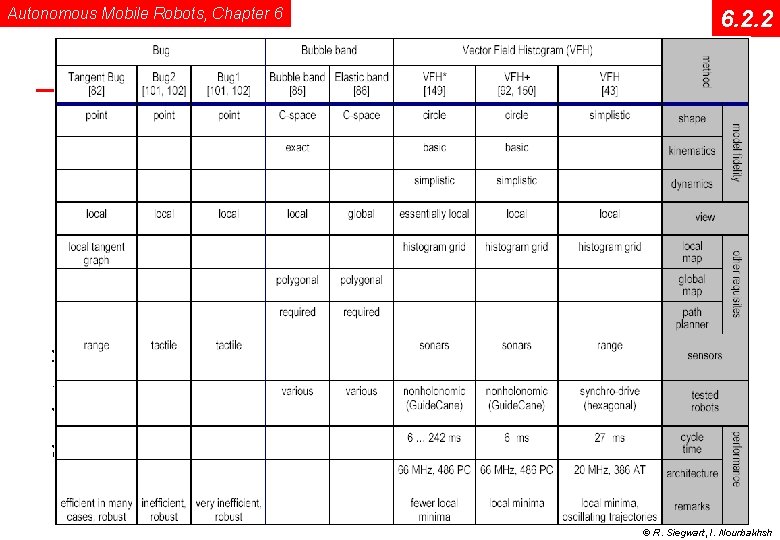
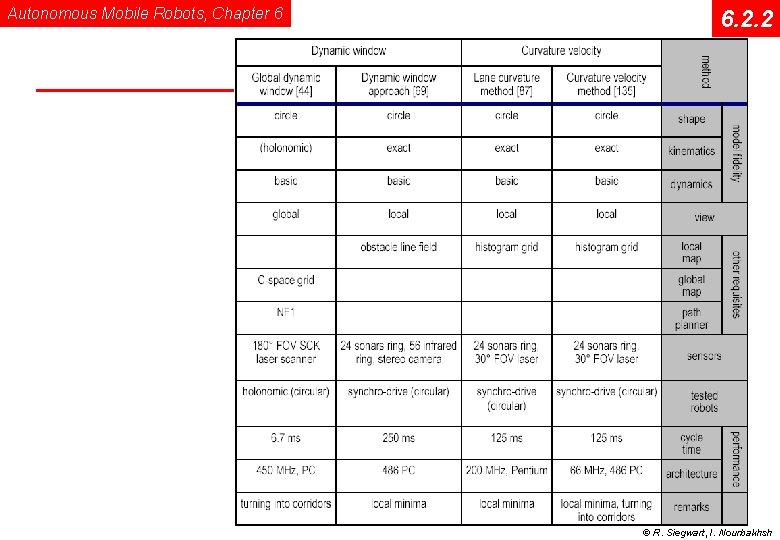
Comparison Obstacle Avoidance Autonomous Mobile Robots, Chapter 6 6. 2. 2 Acrobat Document © R. Siegwart, I. Nourbakhsh
Autonomous Mobile Robots, Chapter 6 6. 2. 2 © R. Siegwart, I. Nourbakhsh
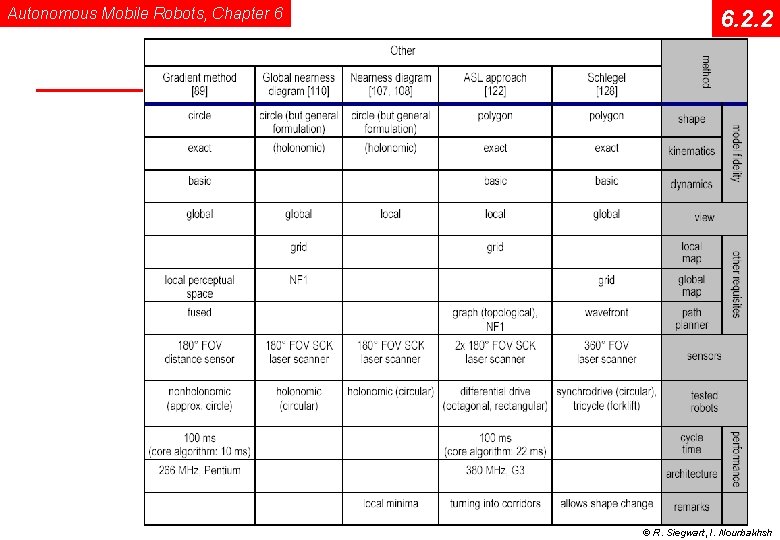
Autonomous Mobile Robots, Chapter 6 6. 2. 2 © R. Siegwart, I. Nourbakhsh
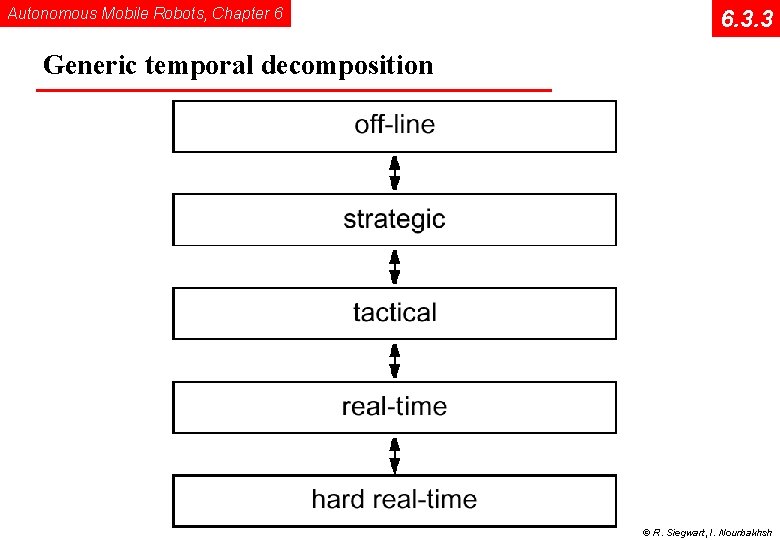
Autonomous Mobile Robots, Chapter 6 6. 3. 3 Generic temporal decomposition © R. Siegwart, I. Nourbakhsh
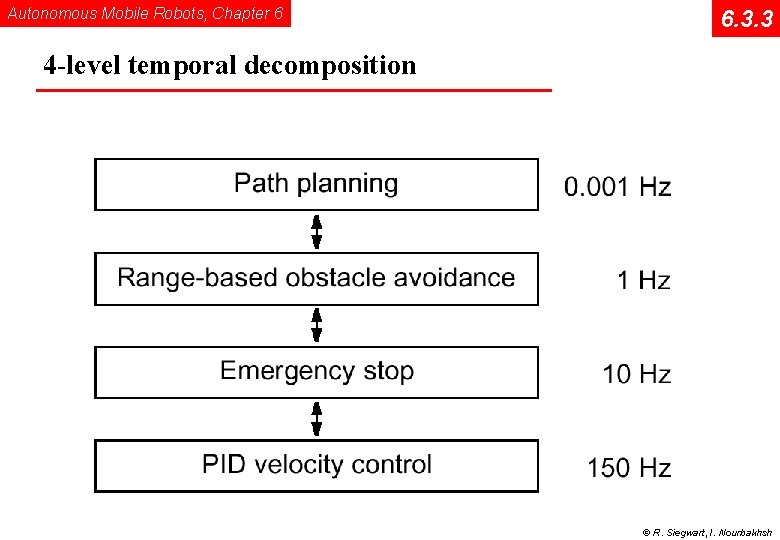
Autonomous Mobile Robots, Chapter 6 6. 3. 3 4 -level temporal decomposition © R. Siegwart, I. Nourbakhsh
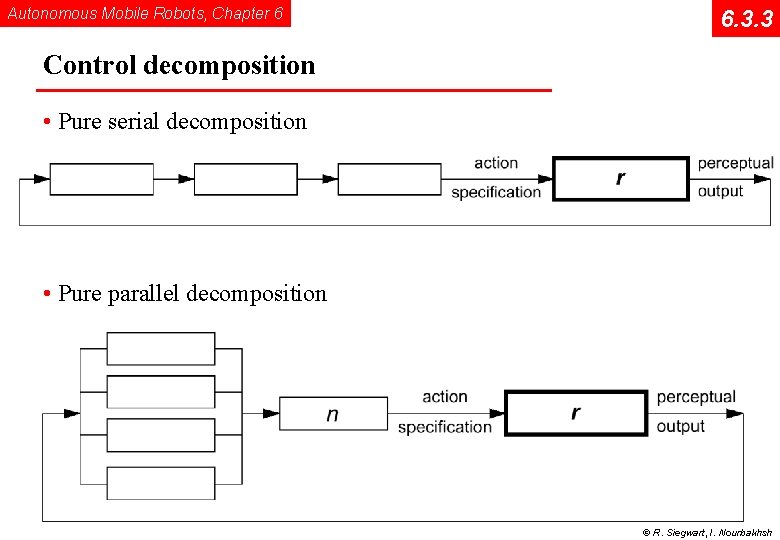
Autonomous Mobile Robots, Chapter 6 6. 3. 3 Control decomposition • Pure serial decomposition • Pure parallel decomposition © R. Siegwart, I. Nourbakhsh
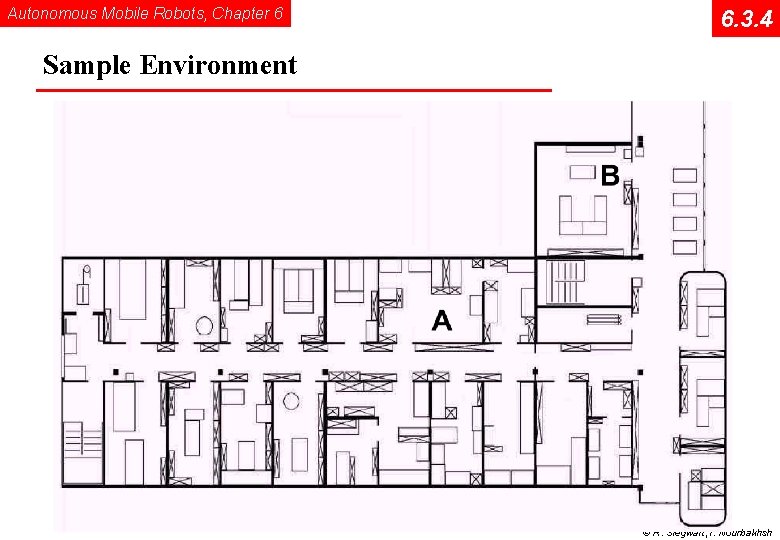
Autonomous Mobile Robots, Chapter 6 6. 3. 4 Sample Environment © R. Siegwart, I. Nourbakhsh
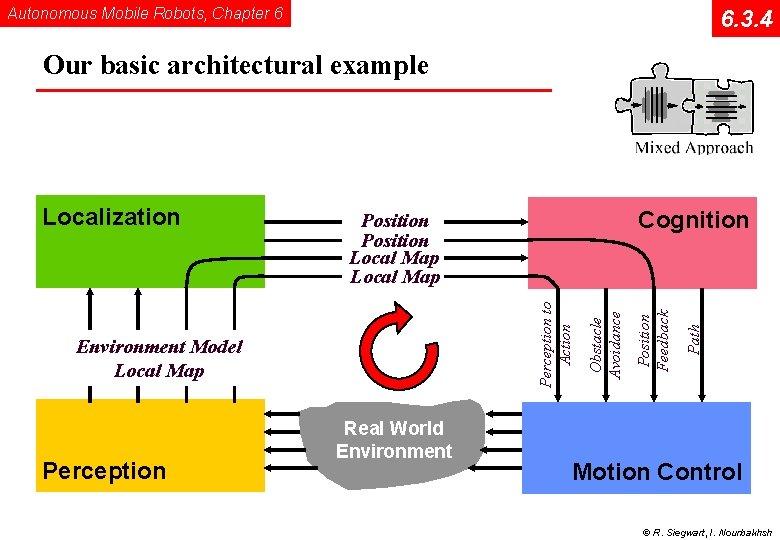
Autonomous Mobile Robots, Chapter 6 6. 3. 4 Our basic architectural example Real World Environment Path Position Feedback Obstacle Avoidance Environment Model Local Map Perception Cognition Position Local Map Perception to Action Localization Motion Control © R. Siegwart, I. Nourbakhsh
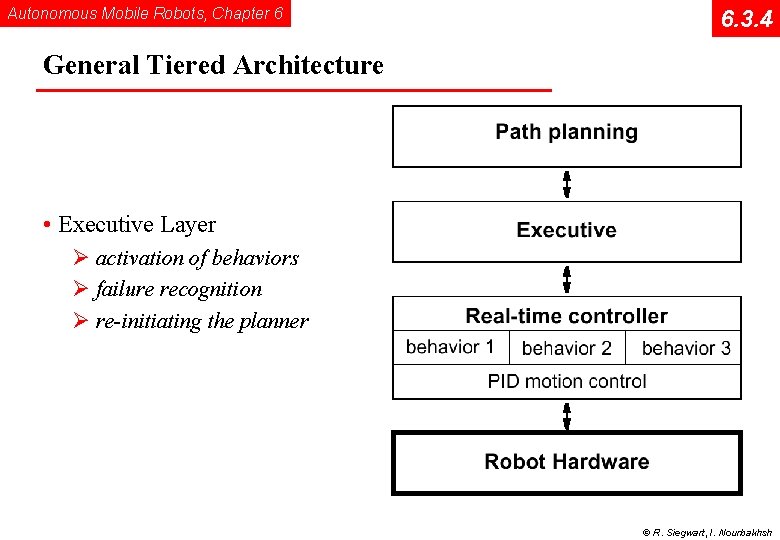
Autonomous Mobile Robots, Chapter 6 6. 3. 4 General Tiered Architecture • Executive Layer Ø activation of behaviors Ø failure recognition Ø re-initiating the planner © R. Siegwart, I. Nourbakhsh
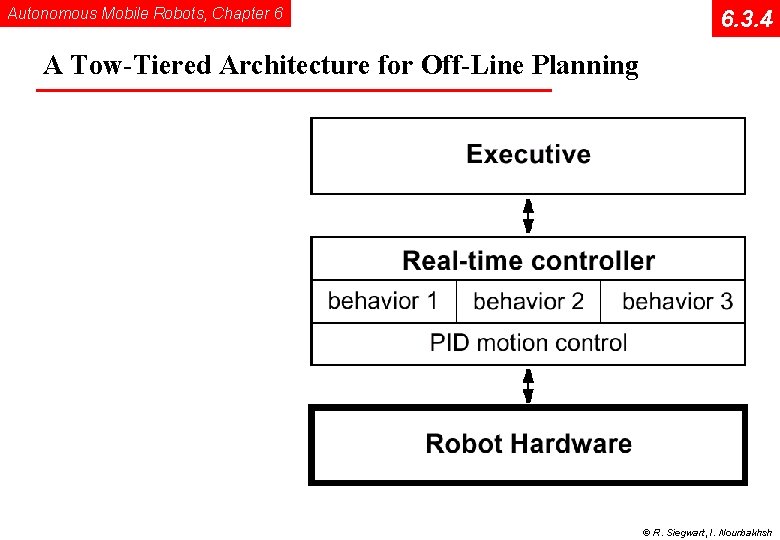
Autonomous Mobile Robots, Chapter 6 6. 3. 4 A Tow-Tiered Architecture for Off-Line Planning © R. Siegwart, I. Nourbakhsh
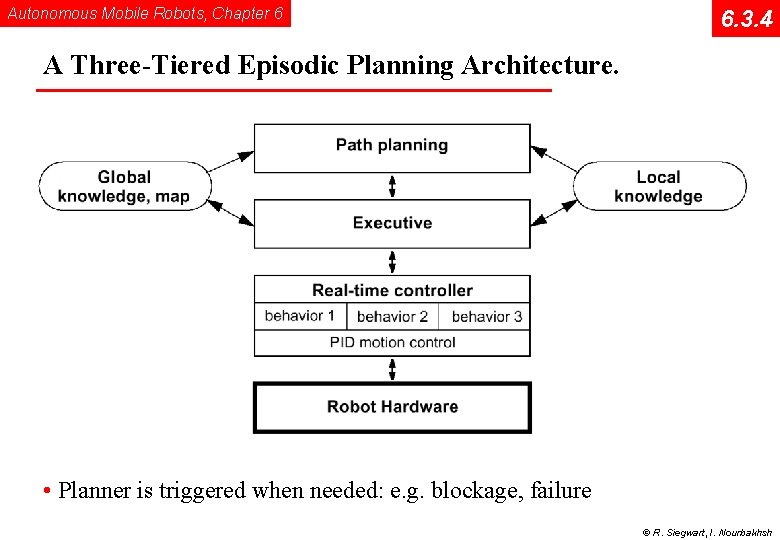
Autonomous Mobile Robots, Chapter 6 6. 3. 4 A Three-Tiered Episodic Planning Architecture. • Planner is triggered when needed: e. g. blockage, failure © R. Siegwart, I. Nourbakhsh
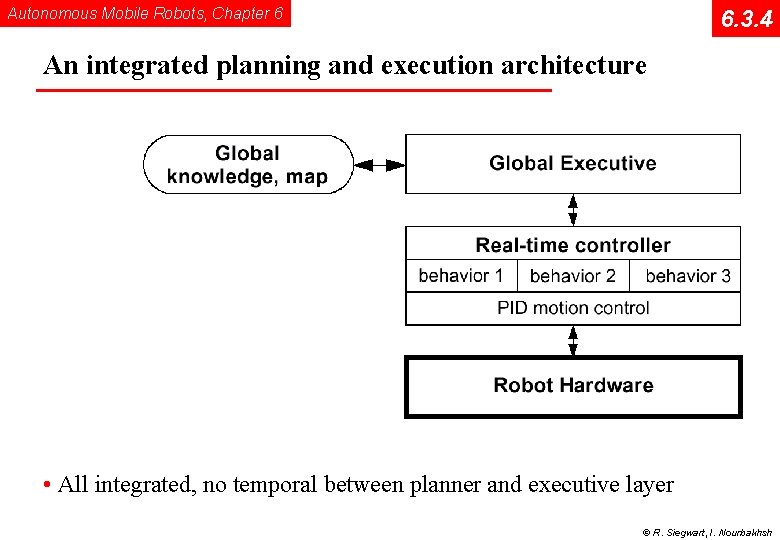
Autonomous Mobile Robots, Chapter 6 6. 3. 4 An integrated planning and execution architecture • All integrated, no temporal between planner and executive layer © R. Siegwart, I. Nourbakhsh
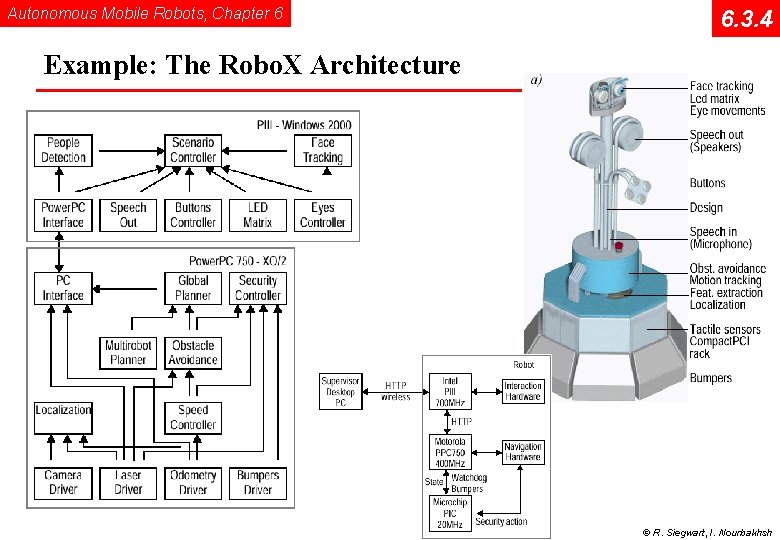
Autonomous Mobile Robots, Chapter 6 6. 3. 4 Example: The Robo. X Architecture © R. Siegwart, I. Nourbakhsh
Autonomous Mobile Robots, Chapter 6 6. 3. 4 Example: Robo. X @ EXPO. 02 © R. Siegwart, I. Nourbakhsh
- Slides: 49