
Autonomous Integrated Power System Operation Control Dionysios Aliprantis
- Slides: 15
Autonomous Integrated Power System Operation & Control Dionysios Aliprantis (ISU) & Sakis Meliopoulos (GIT) 1
Observations Technologies are Being Developed for the Smart Grid Power Devices with Converter Interfaces to the Power Grid on the Rise – Unique Protection and Control Issues and Opportunities (ancillary services) Distribution Systems with Generation and “Smarts” (Renewables and Load Management) The Issue of Model Accuracy
Observations The “Robotics” Community Has Made Substantial Progress on Automated and Intelligent Operation of Complex Systems – why not borrow this technology towards “autonomous operation of power systems” The Do. E m. GRID has Introduced the Concept of “Plug and Play” Power Devices. Why not expand the concept of “Plug and Play” to all power devices?
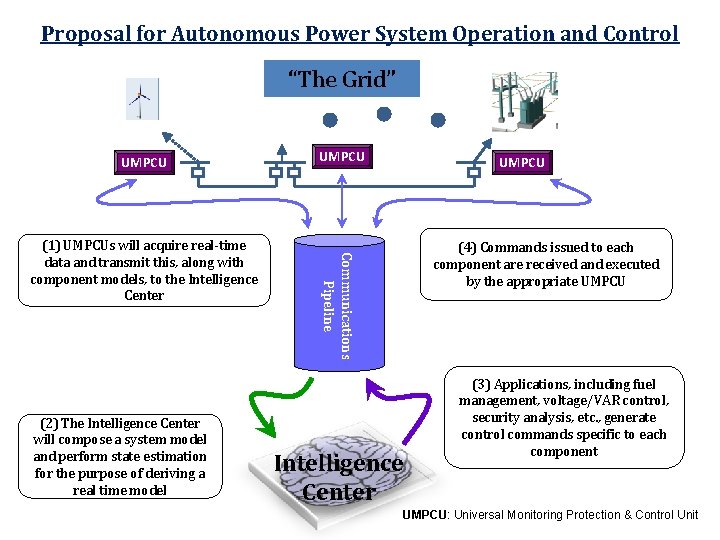
Proposal for Autonomous Power System Operation and Control “The Grid” UMPCU (2) The Intelligence Center will compose a system model and perform state estimation for the purpose of deriving a real time model UMPCU (4) Commands issued to each component are received and executed by the appropriate UMPCU Communications Pipeline (1) UMPCUs will acquire real-time data and transmit this, along with component models, to the Intelligence Center UMPCU Intelligence Center (3) Applications, including fuel management, voltage/VAR control, security analysis, etc. , generate control commands specific to each component UMPCU: Universal Monitoring Protection & Control Unit
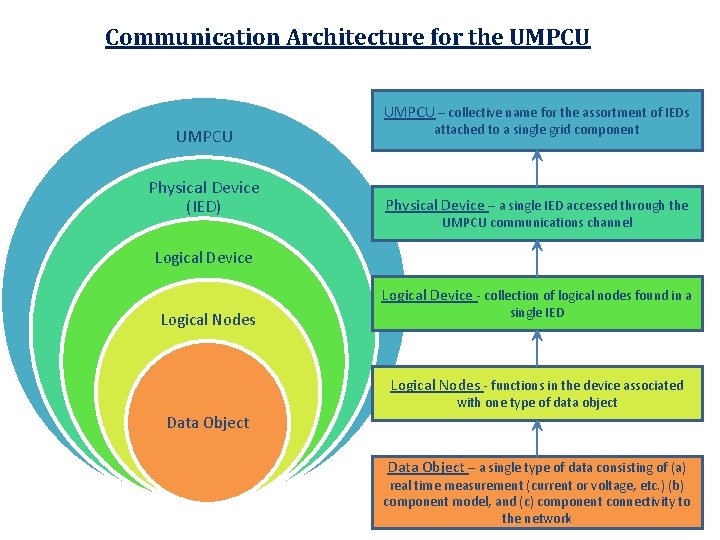
Communication Architecture for the UMPCU – collective name for the assortment of IEDs UMPCU Physical Device (IED) attached to a single grid component Physical Device – a single IED accessed through the UMPCU communications channel Logical Device - collection of logical nodes found in a Logical Nodes single IED Logical Nodes - functions in the device associated with one type of data object Data Object – a single type of data consisting of (a) real time measurement (current or voltage, etc. ) (b) component model, and (c) component connectivity to the network
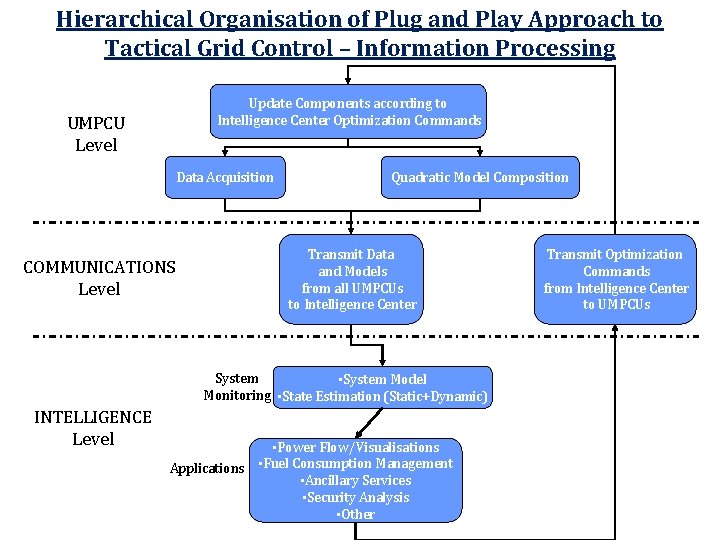
Hierarchical Organisation of Plug and Play Approach to Tactical Grid Control – Information Processing Update Components according to Intelligence Center Optimization Commands UMPCU Level Data Acquisition COMMUNICATIONS Level Quadratic Model Composition Transmit Data and Models from all UMPCUs to Intelligence Center System • System Model Monitoring • State Estimation (Static+Dynamic) INTELLIGENCE Level • Power Flow/Visualisations Applications • Fuel Consumption Management • Ancillary Services • Security Analysis • Other Transmit Optimization Commands from Intelligence Center to UMPCUs
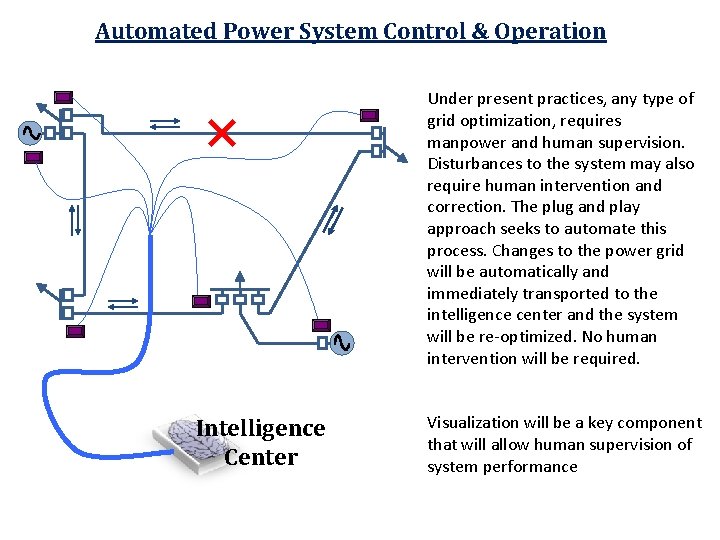
Automated Power System Control & Operation Under present practices, any type of grid optimization, requires manpower and human supervision. Disturbances to the system may also require human intervention and correction. The plug and play approach seeks to automate this process. Changes to the power grid will be automatically and immediately transported to the intelligence center and the system will be re-optimized. No human intervention will be required. Intelligence Center Visualization will be a key component that will allow human supervision of system performance
Applications Smart Substation Micro Grids Distribution Systems (Renewables and Load Management)
Proposal - Challenge Laboratories of scaled power systems that will operate, control and protect autonomously should be developed in several PSERC schools. These laboratories can be used as test-beds for further developments.
System-Based Approach for In-Situ Protective System Reliability Testing 10
Observations Today’s Protective Relays and Intelligent Electronic Devices in General are Becoming More Powerful and More Complex Modern Substations have Multiple Protection Layers that Are Manually Coordinated by Experts in the Art The Number of Experienced Protection Engineers is Decreasing Relative to the Needs Protection System Reliability is at Risk
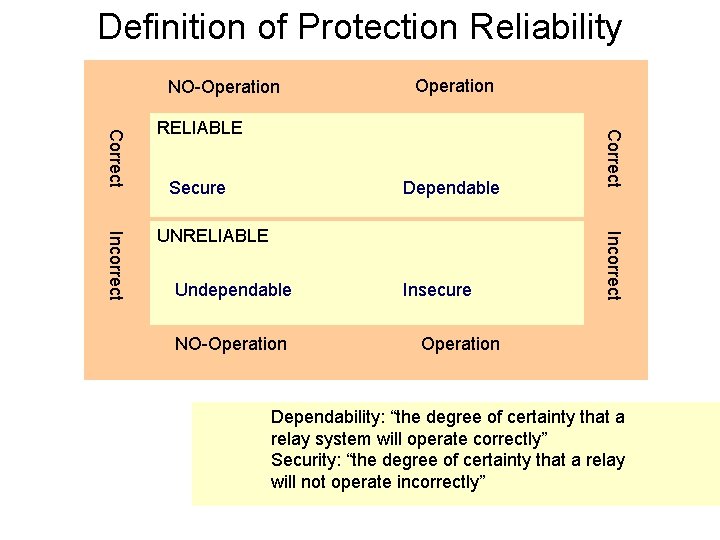
Definition of Protection Reliability NO-Operation Secure Dependable Undependable NO-Operation Insecure Incorrect UNRELIABLE Correct RELIABLE Operation Dependability: “the degree of certainty that a relay system will operate correctly” Security: “the degree of certainty that a relay will not operate incorrectly”
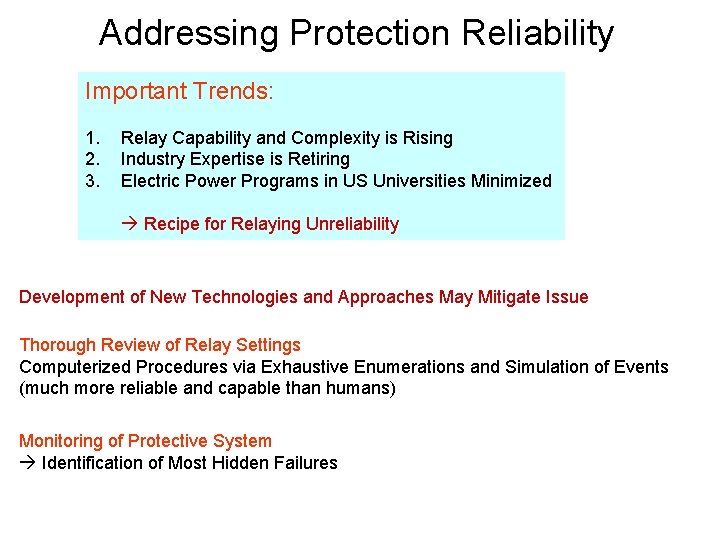
Addressing Protection Reliability Important Trends: 1. 2. 3. Relay Capability and Complexity is Rising Industry Expertise is Retiring Electric Power Programs in US Universities Minimized Recipe for Relaying Unreliability Development of New Technologies and Approaches May Mitigate Issue Thorough Review of Relay Settings Computerized Procedures via Exhaustive Enumerations and Simulation of Events (much more reliable and capable than humans) Monitoring of Protective System Identification of Most Hidden Failures
Observations There is a Need for Automated Testing of Relay Coordination and Reliability – “Elimination of Human Errors”
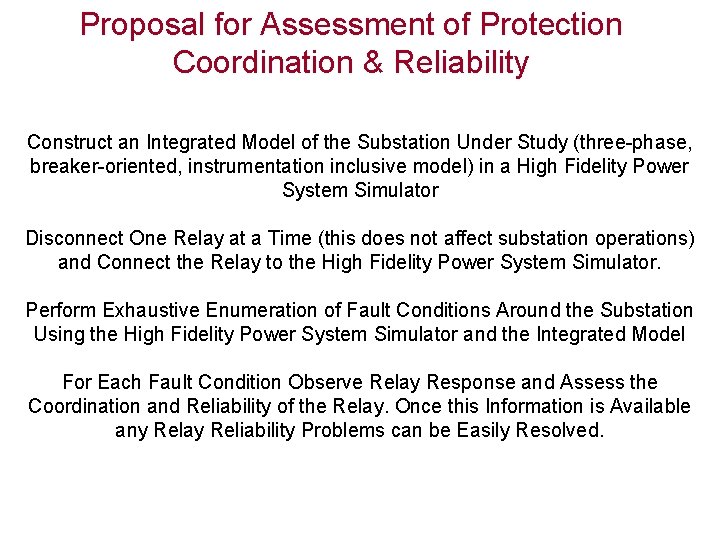
Proposal for Assessment of Protection Coordination & Reliability Construct an Integrated Model of the Substation Under Study (three-phase, breaker-oriented, instrumentation inclusive model) in a High Fidelity Power System Simulator Disconnect One Relay at a Time (this does not affect substation operations) and Connect the Relay to the High Fidelity Power System Simulator. Perform Exhaustive Enumeration of Fault Conditions Around the Substation Using the High Fidelity Power System Simulator and the Integrated Model For Each Fault Condition Observe Relay Response and Assess the Coordination and Reliability of the Relay. Once this Information is Available any Relay Reliability Problems can be Easily Resolved.