
Autonomous CyberPhysical Systems Timed Models Dynamical System Models
Autonomous Cyber-Physical Systems: Timed Models & Dynamical System Models Spring 2019. CS 599. Instructor: Jyo Deshmukh Acknowledgment: Some of the material in these slides is based on the lecture slides for CIS 540: Principles of Embedded Computation taught by Rajeev Alur at the University of Pennsylvania. http: //www. seas. upenn. edu/~cis 540/ USC Viterbi School of Engineering Department of Computer Science
Timed Models USC Viterbi School of Engineering Department of Computer Science 2
Summary of Models seen and to be seen Synchronous Reactive Components Event-triggered SRCs Asynchronous Processes Timed Model Like Asynchronous models, but with explicit time information Can make use of global time for coordination Continuous-time models/Dynamical system models Like Synchronous, but time evolves continuously Hybrid Dynamical Models USC Viterbi School of Engineering Department of Computer Science 3 [1] Nicolescu, Gabriela; Mosterman, Pieter J. , eds. (2010). Model-Based Design for Embedded Systems. Computational Analysis, Synthesis, and Design of Dynamic Systems. 1. Boca Raton: CRC Press.
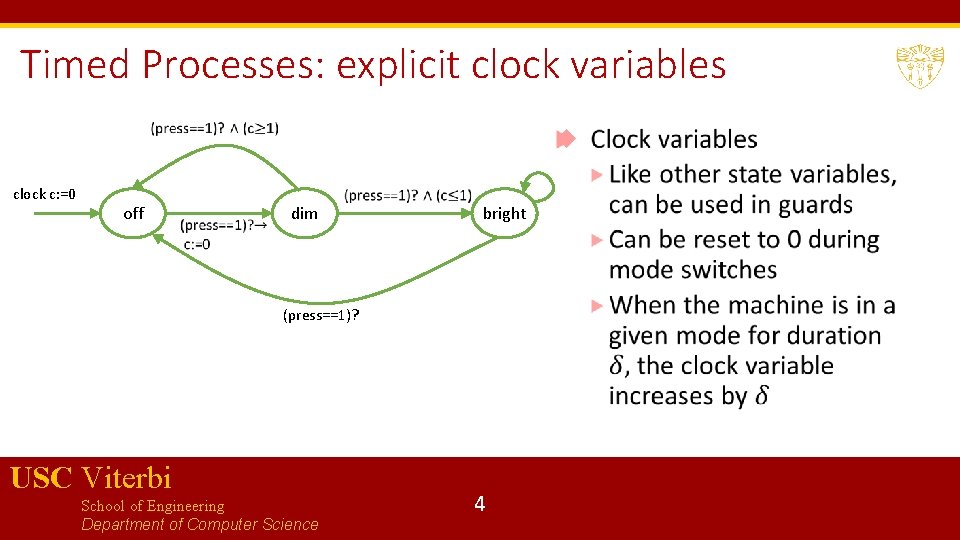
Timed Processes: explicit clock variables clock c: =0 off dim bright (press==1)? USC Viterbi School of Engineering Department of Computer Science 4
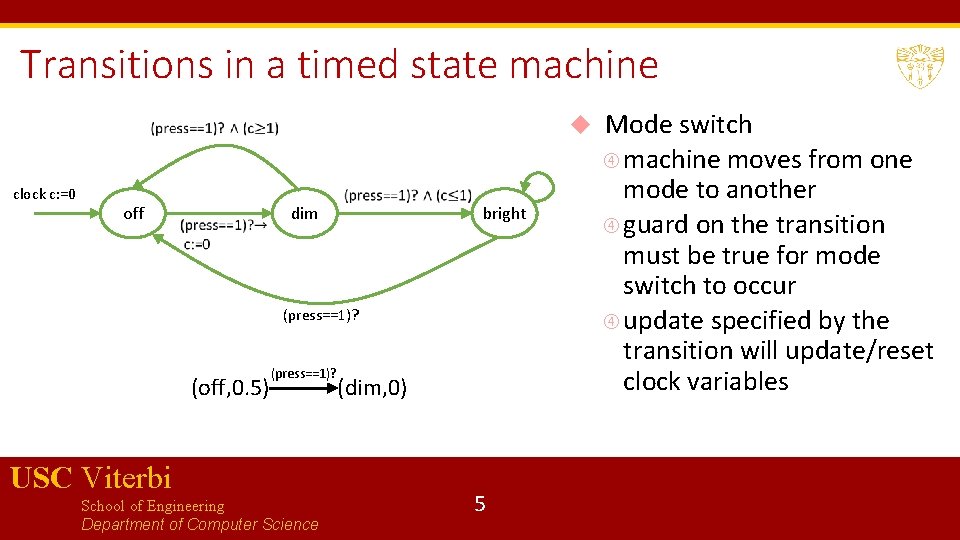
Transitions in a timed state machine clock c: =0 off dim bright (press==1)? (off, 0. 5) (press==1)? USC Viterbi School of Engineering Department of Computer Science (dim, 0) 5 Mode switch machine moves from one mode to another guard on the transition must be true for mode switch to occur update specified by the transition will update/reset clock variables
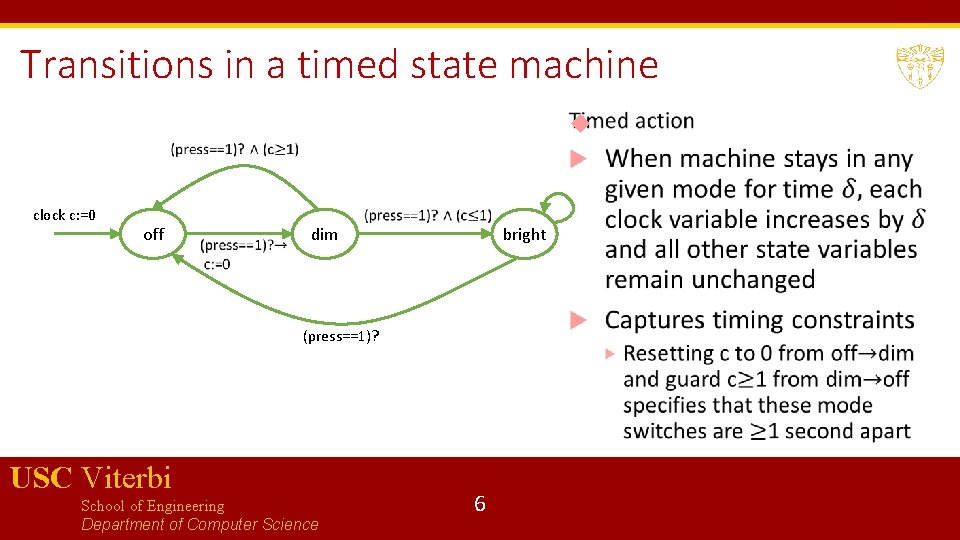
Transitions in a timed state machine clock c: =0 off dim bright (press==1)? USC Viterbi School of Engineering Department of Computer Science 6
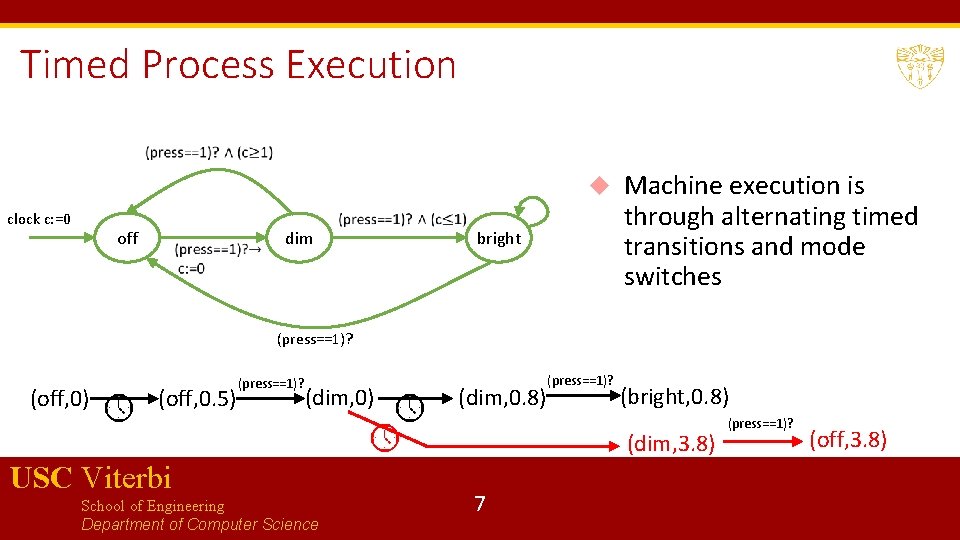
Timed Process Execution clock c: =0 off dim bright Machine execution is through alternating timed transitions and mode switches (press==1)? (off, 0) (off, 0. 5) (press==1)? (dim, 0) (dim, 0. 8) (press==1)? (bright, 0. 8) (dim, 3. 8) USC Viterbi School of Engineering Department of Computer Science 7 (press==1)? (off, 3. 8)
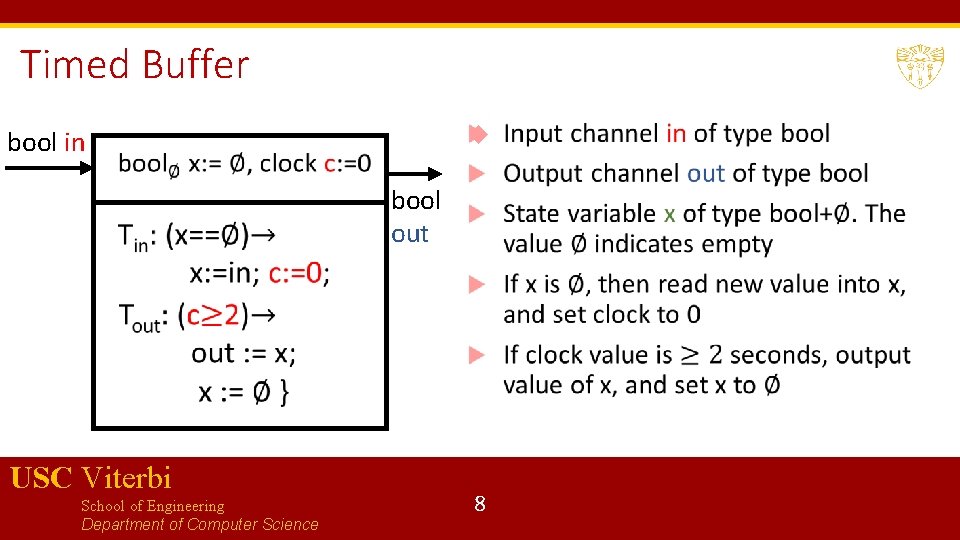
Timed Buffer bool in bool out USC Viterbi School of Engineering Department of Computer Science 8
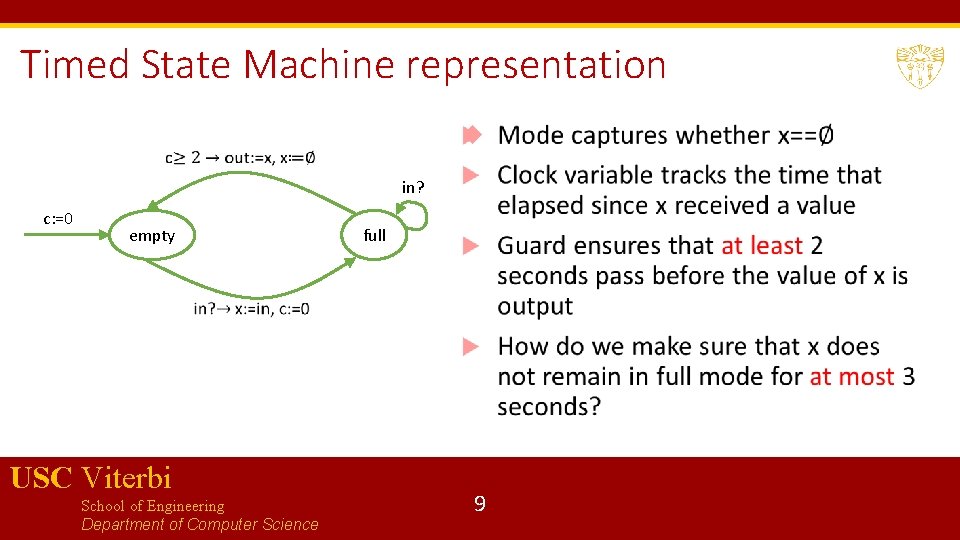
Timed State Machine representation in? c: =0 empty USC Viterbi School of Engineering Department of Computer Science full 9
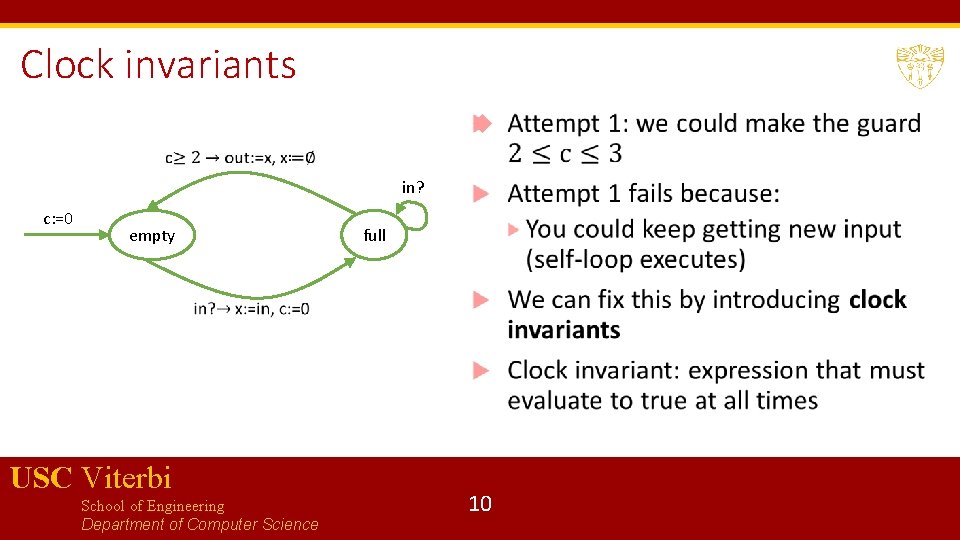
Clock invariants in? c: =0 empty USC Viterbi School of Engineering Department of Computer Science full 10
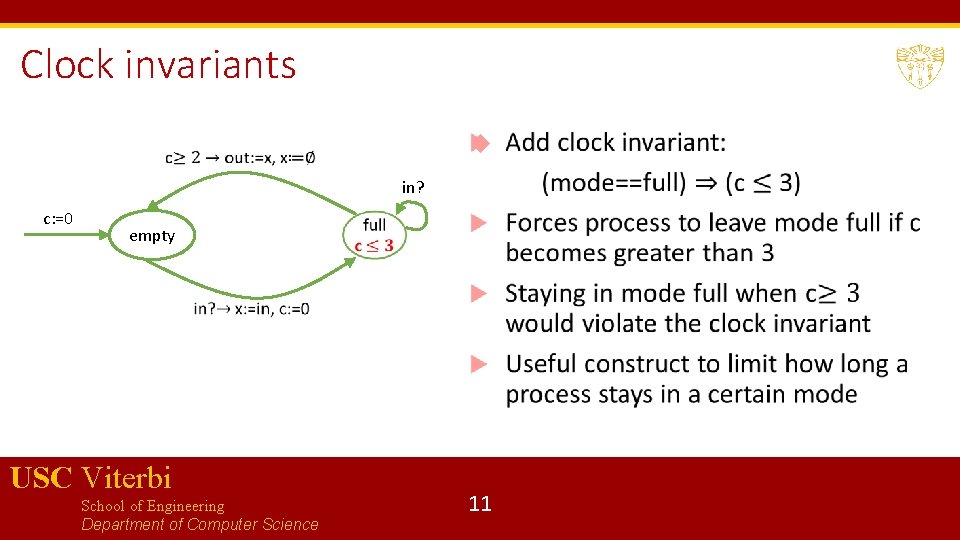
Clock invariants in? c: =0 empty USC Viterbi School of Engineering Department of Computer Science 11
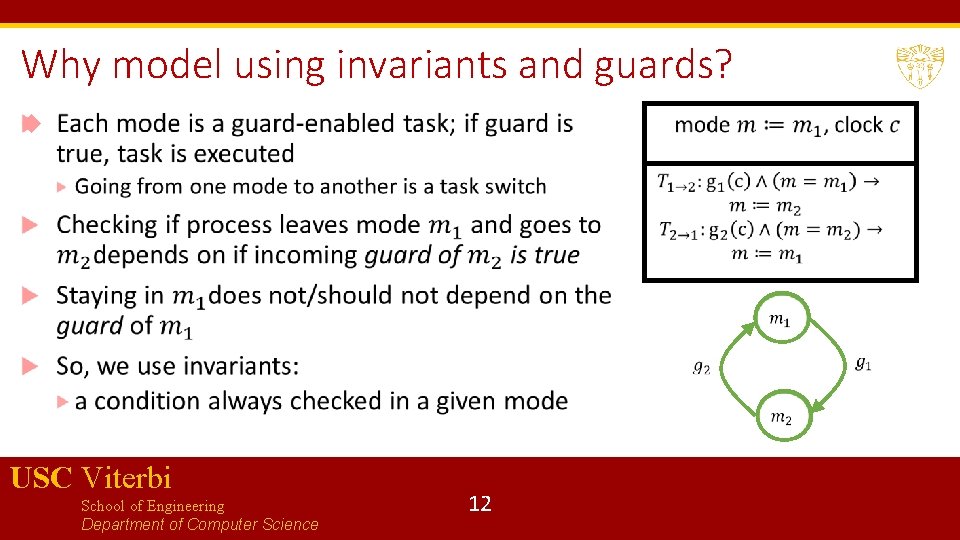
Why model using invariants and guards? USC Viterbi School of Engineering Department of Computer Science 12
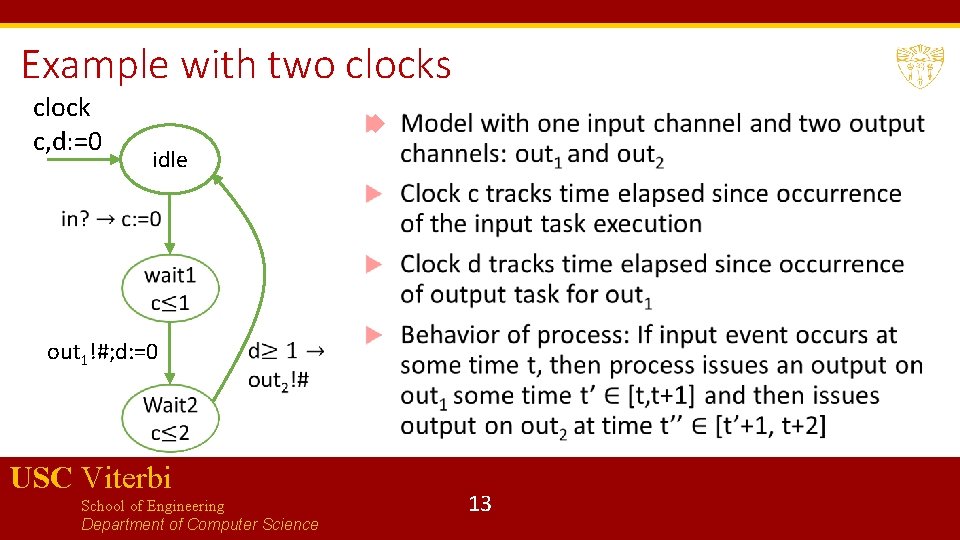
Example with two clocks clock c, d: =0 idle out 1!#; d: =0 USC Viterbi School of Engineering Department of Computer Science 13
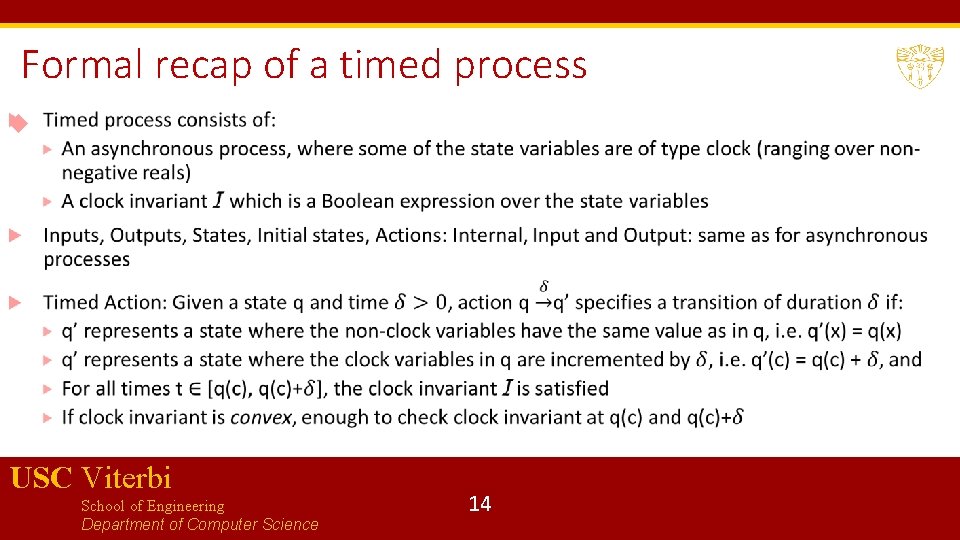
Formal recap of a timed process USC Viterbi School of Engineering Department of Computer Science 14
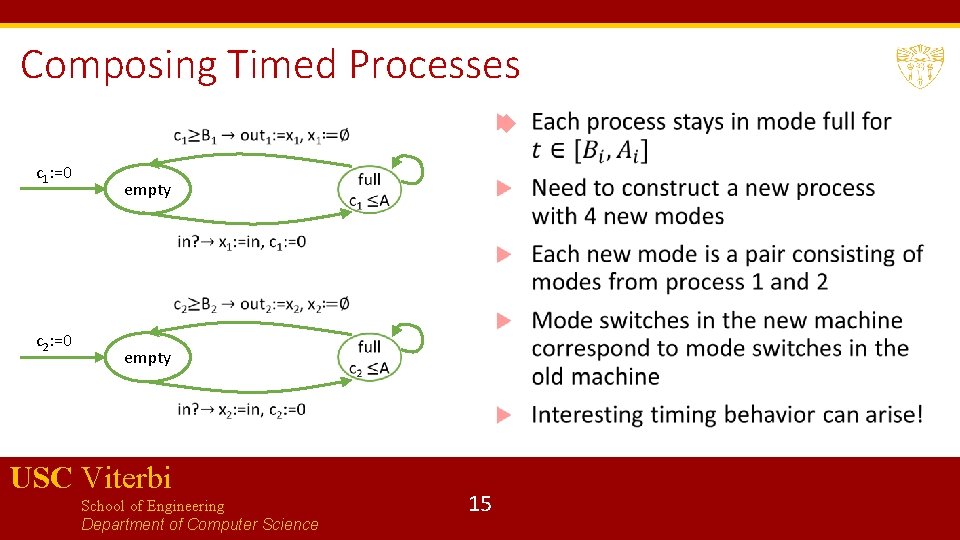
Composing Timed Processes c 1: =0 c 2: =0 empty USC Viterbi School of Engineering Department of Computer Science 15
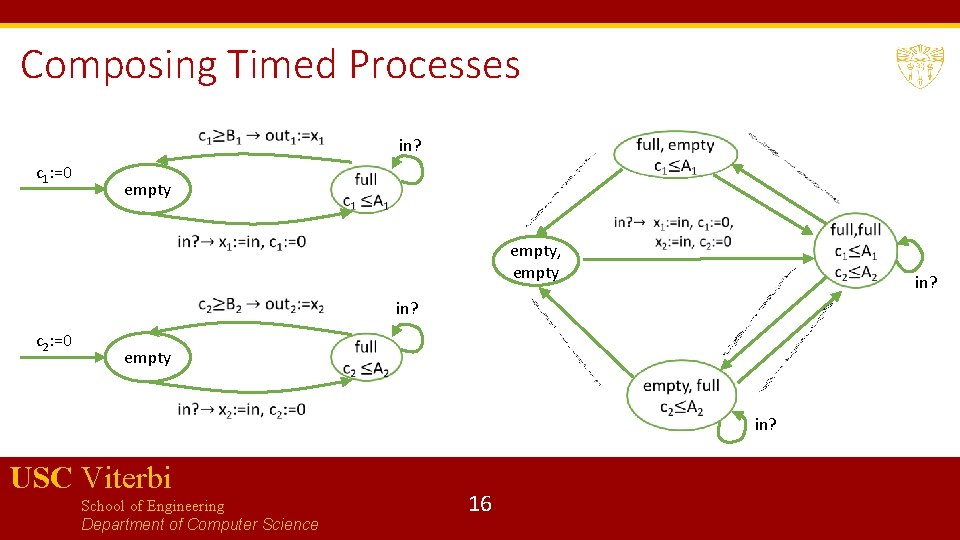
Composing Timed Processes in? c 1: =0 empty, empty in? c 2: =0 empty in? USC Viterbi School of Engineering Department of Computer Science 16
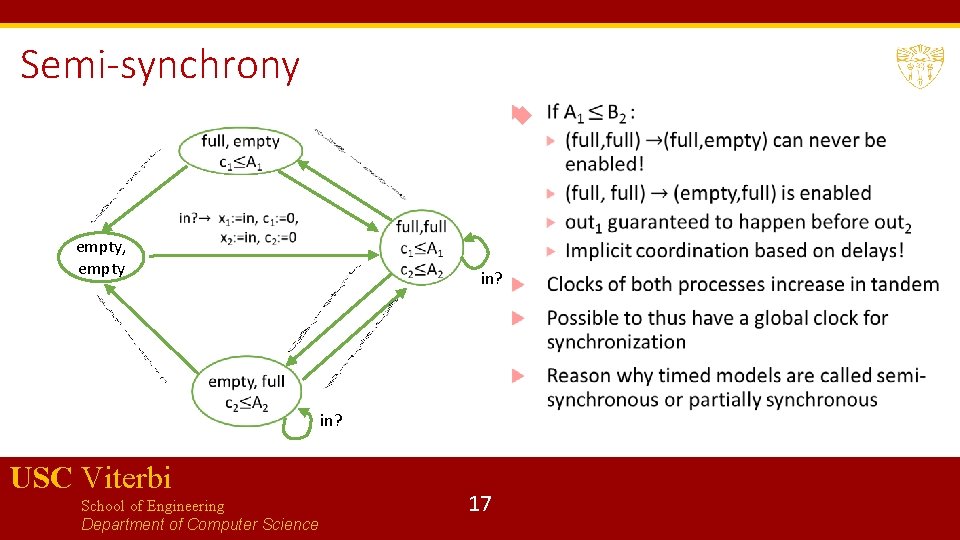
Semi-synchrony empty, empty in? USC Viterbi School of Engineering Department of Computer Science 17
Pacemaker Modeling as a Timed Process Most material that follows is from this paper: Z. Jiang, M. Pajic, S. Moarref, R. Alur, R. Mangharam, Modeling and Verification of a Dual Chamber Implantable Pacemaker, In Proceedings of Tools and Algorithms for the Construction and Analysis of Systems (TACAS), 2012. The textbook has detailed descriptions of some other pacemaker components USC Viterbi School of Engineering Department of Computer Science 18
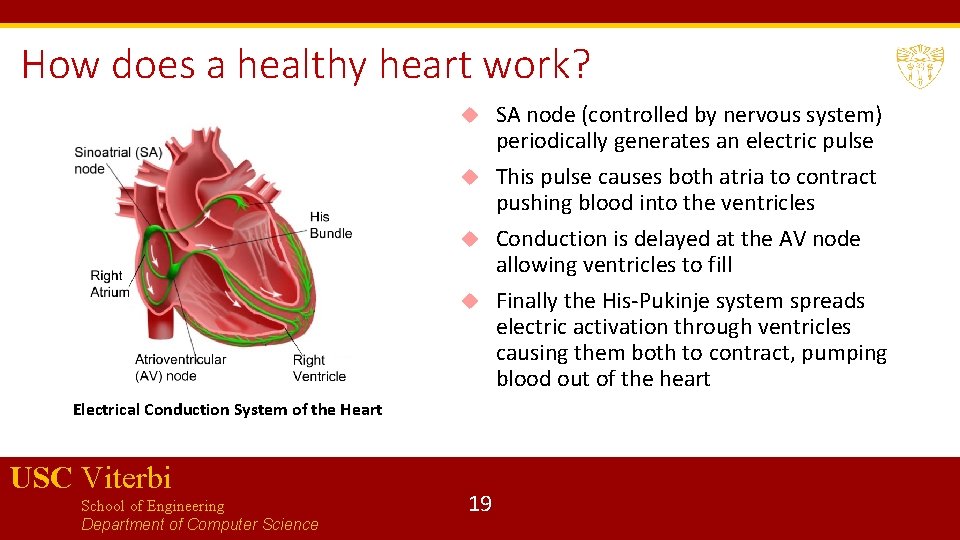
How does a healthy heart work? SA node (controlled by nervous system) periodically generates an electric pulse This pulse causes both atria to contract pushing blood into the ventricles Conduction is delayed at the AV node allowing ventricles to fill Finally the His-Pukinje system spreads electric activation through ventricles causing them both to contract, pumping blood out of the heart Electrical Conduction System of the Heart USC Viterbi School of Engineering Department of Computer Science 19
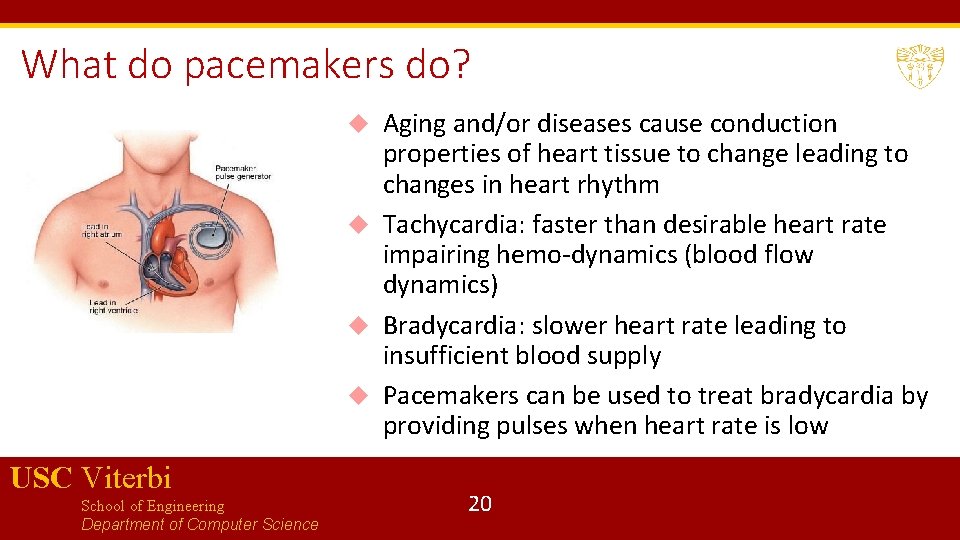
What do pacemakers do? Aging and/or diseases cause conduction properties of heart tissue to change leading to changes in heart rhythm Tachycardia: faster than desirable heart rate impairing hemo-dynamics (blood flow dynamics) Bradycardia: slower heart rate leading to insufficient blood supply Pacemakers can be used to treat bradycardia by providing pulses when heart rate is low USC Viterbi School of Engineering Department of Computer Science 20
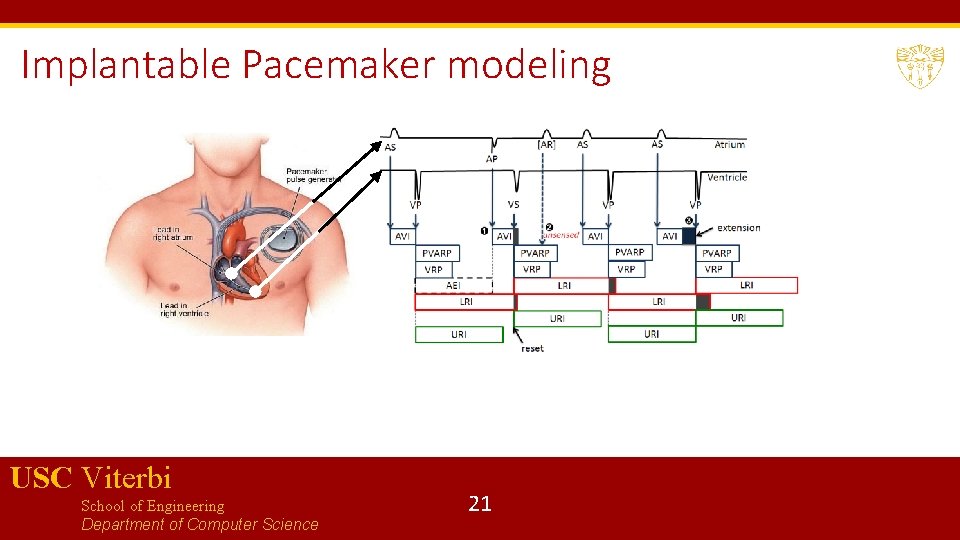
Implantable Pacemaker modeling USC Viterbi School of Engineering Department of Computer Science 21
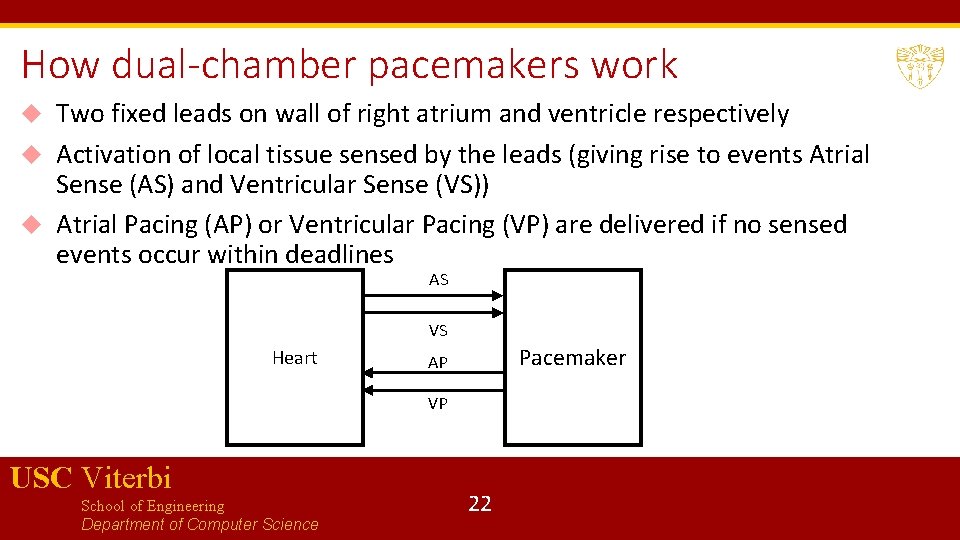
How dual-chamber pacemakers work Two fixed leads on wall of right atrium and ventricle respectively Activation of local tissue sensed by the leads (giving rise to events Atrial Sense (AS) and Ventricular Sense (VS)) Atrial Pacing (AP) or Ventricular Pacing (VP) are delivered if no sensed events occur within deadlines AS VS Heart Pacemaker AP VP USC Viterbi School of Engineering Department of Computer Science 22
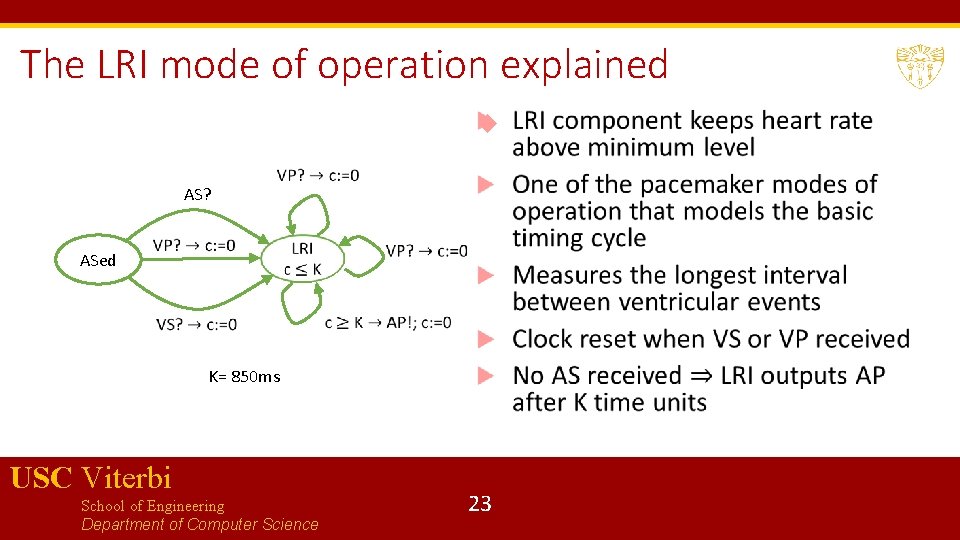
The LRI mode of operation explained AS? ASed K= 850 ms USC Viterbi School of Engineering Department of Computer Science 23
Finite State Automata: A 3 -slide introduction USC Viterbi School of Engineering Department of Computer Science 24
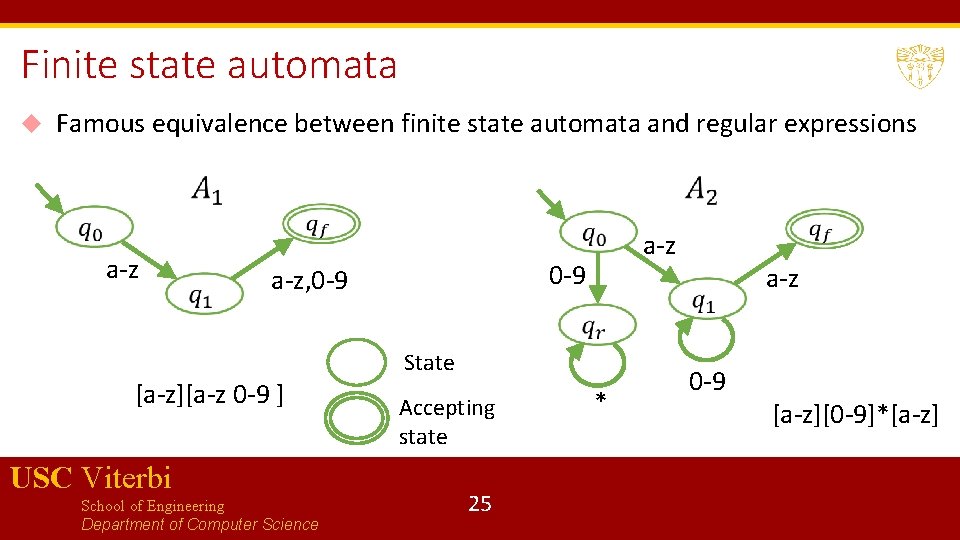
Finite state automata Famous equivalence between finite state automata and regular expressions a-z 0 -9 a-z, 0 -9 [a-z][a-z 0 -9 ] USC Viterbi School of Engineering Department of Computer Science a-z State Accepting state 25 * a-z 0 -9 [a-z][0 -9]*[a-z]
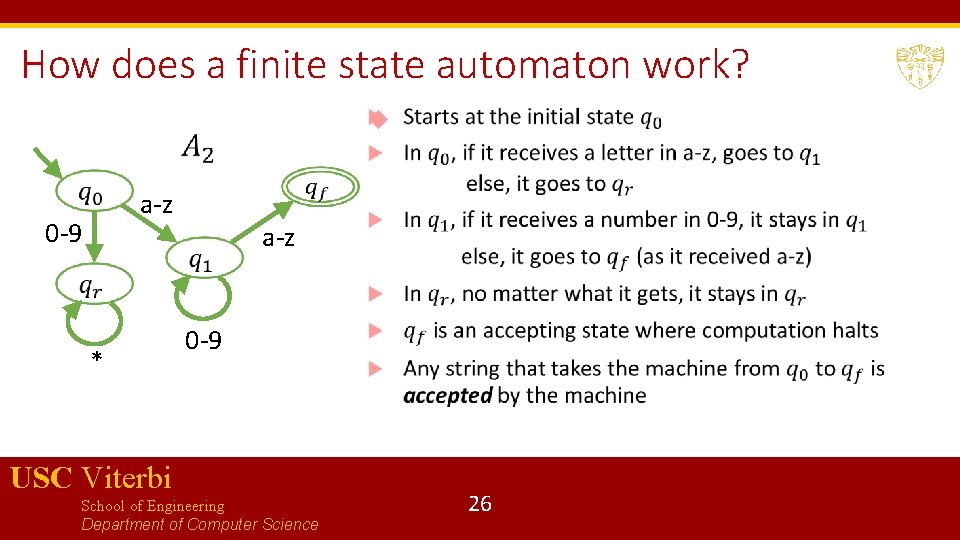
How does a finite state automaton work? a-z 0 -9 * a-z 0 -9 USC Viterbi School of Engineering Department of Computer Science 26
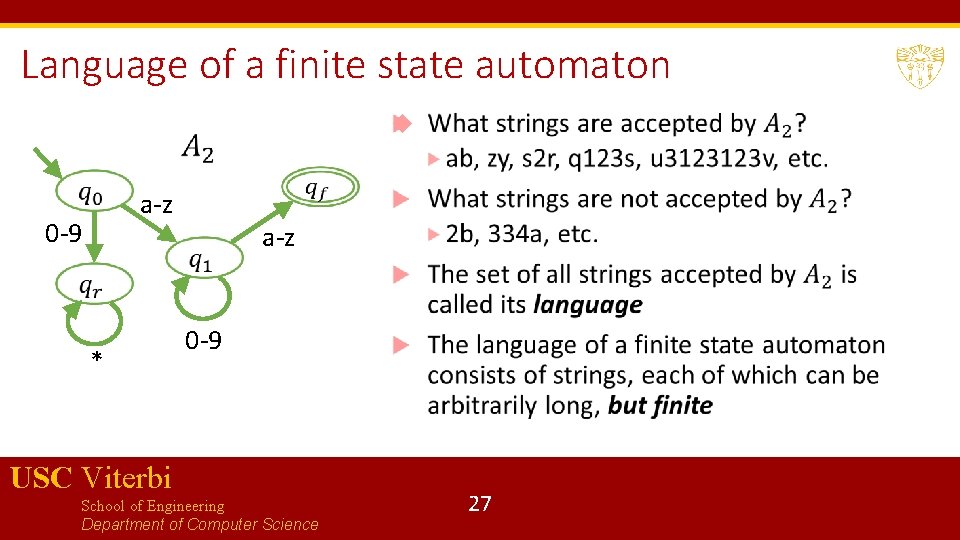
Language of a finite state automaton a-z 0 -9 * a-z 0 -9 USC Viterbi School of Engineering Department of Computer Science 27
Timed Automata Useful tool to do timing analysis and explore properties of timed processes State-space of timed automata is infinite (clocks can become arbitrarily large!) But some questions about timed automata behavior can still be answered exactly Does the automaton accept any string? (also known as emptiness problem) Reachability of a particular configuration USC Viterbi School of Engineering Department of Computer Science 28
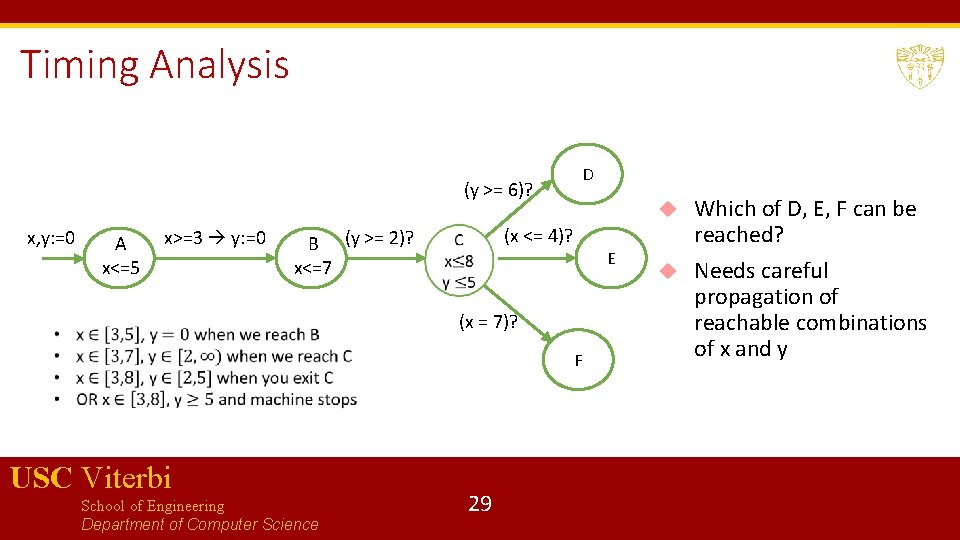
Timing Analysis (y >= 6)? x, y: =0 A x<=5 x>=3 y: =0 D (x <= 4)? B (y >= 2)? x<=7 E (x = 7)? F USC Viterbi School of Engineering Department of Computer Science 29 Which of D, E, F can be reached? Needs careful propagation of reachable combinations of x and y
How is such analysis done? The key challenge is that if the automata has loops, then how do we know that our procedure for propagation of symbolic clock constraints will terminate? The key insight by first papers on timed automata was that there is only a finite number of regions in the clock-space that can be visited This gives a “pumping lemma” style argument* Allows abstracting a finite timed automaton to an automaton where modes/states represent the regions This was expensive, and improved by using zone-based constructions (zones are a uniform representation of constraints that arise during analysis) USC Viterbi School of Engineering Department of Computer Science 30
Dynamical System Models USC Viterbi School of Engineering Department of Computer Science 31
Dynamical Systems Most natural model for describing most physical systems Continuous/discrete systems that continuously evolve over time Convenient to model such systems with differential equations Typically consist of physical quantities modeled as state variables Pressure, Temperature, Velocity, Acceleration, Current, Voltage, etc. Could include algebraic relations between state variables Execution semantics similar to synchronous models, but with continuoustime semantics instead of discrete-time USC Viterbi School of Engineering Department of Computer Science 32
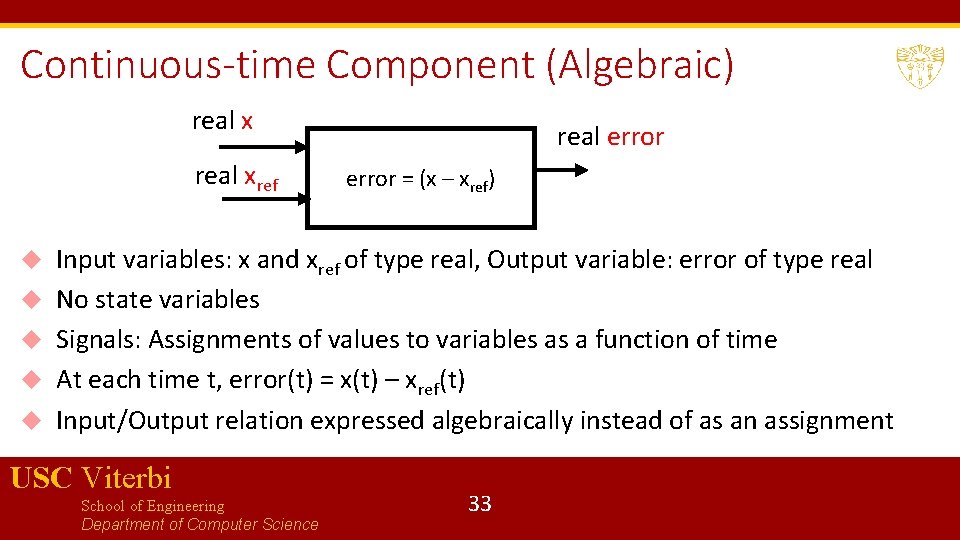
Continuous-time Component (Algebraic) real xref real error = (x – xref) Input variables: x and xref of type real, Output variable: error of type real No state variables Signals: Assignments of values to variables as a function of time At each time t, error(t) = x(t) – xref(t) Input/Output relation expressed algebraically instead of as an assignment USC Viterbi School of Engineering Department of Computer Science 33
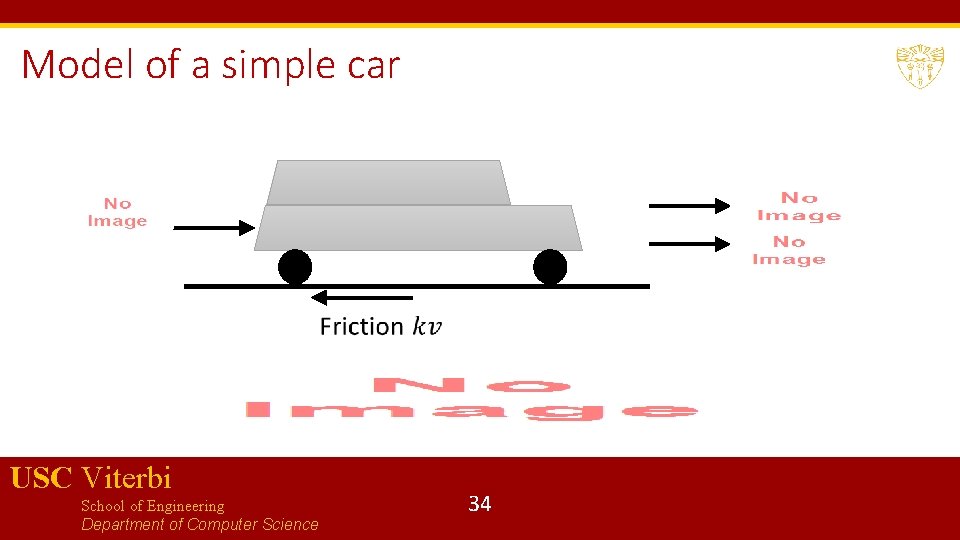
Model of a simple car USC Viterbi School of Engineering Department of Computer Science 34
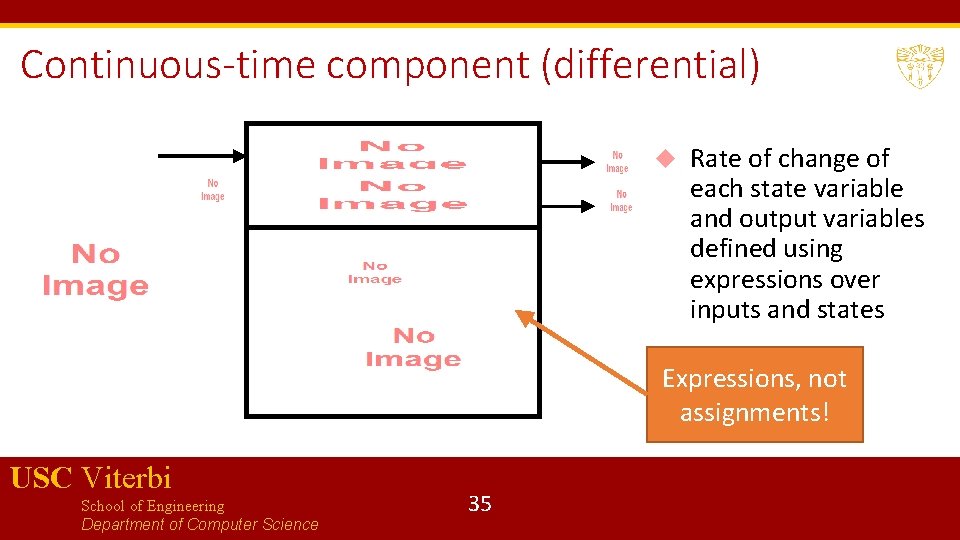
Continuous-time component (differential) Rate of change of each state variable and output variables defined using expressions over inputs and states Expressions, not assignments! USC Viterbi School of Engineering Department of Computer Science 35
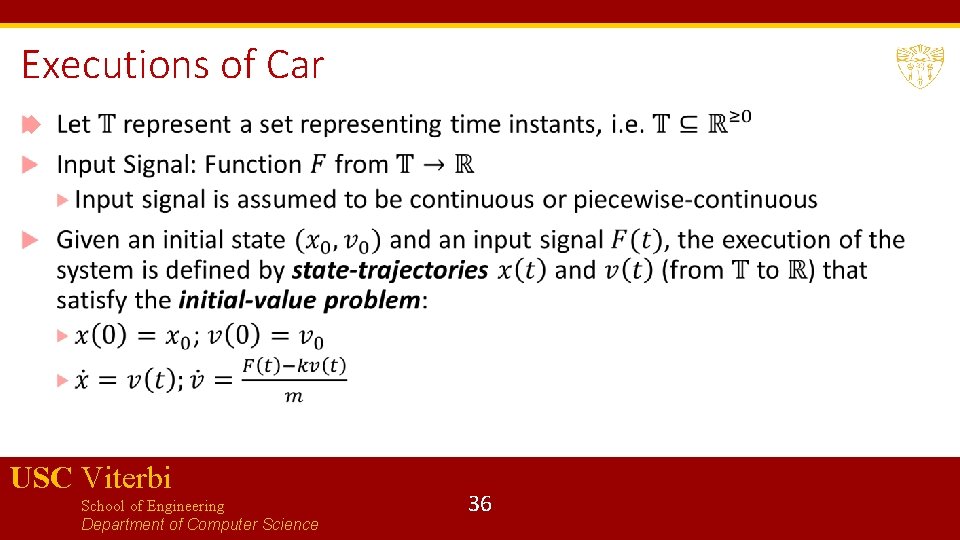
Executions of Car USC Viterbi School of Engineering Department of Computer Science 36
Sample Execution of Car USC Viterbi School of Engineering Department of Computer Science 37
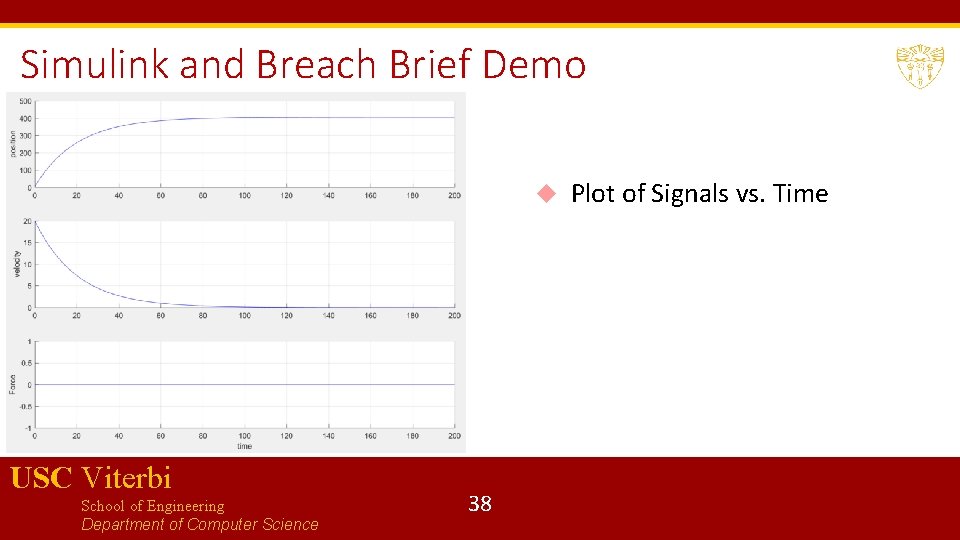
Simulink and Breach Brief Demo USC Viterbi School of Engineering Department of Computer Science 38 Plot of Signals vs. Time
Simulink and Breach Demo USC Viterbi School of Engineering Department of Computer Science 39
Sample Execution of Car with constant force USC Viterbi School of Engineering Department of Computer Science 40
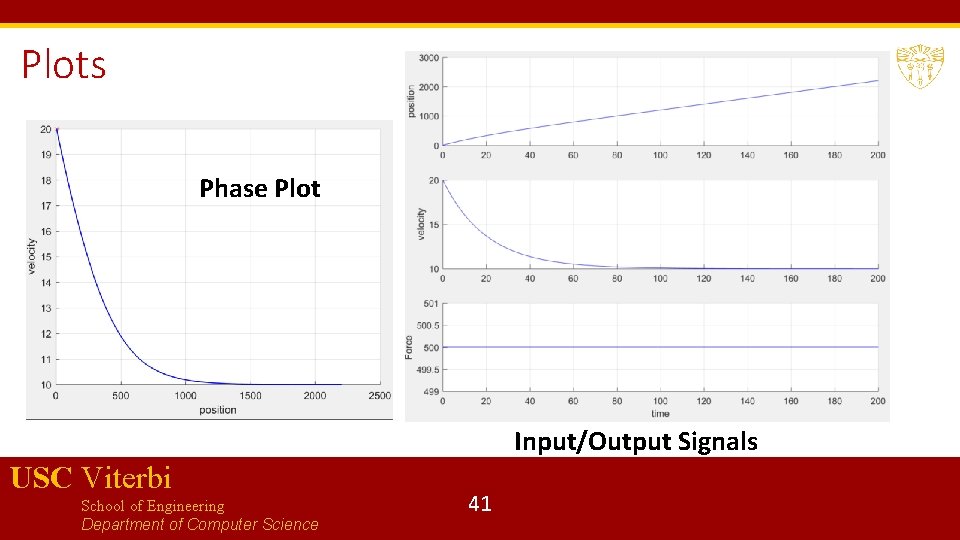
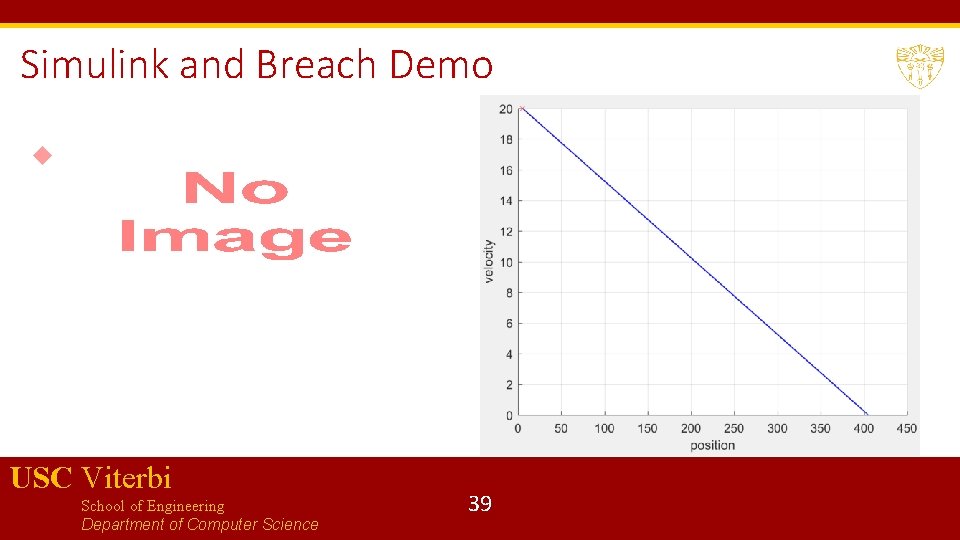
Plots Phase Plot Input/Output Signals USC Viterbi School of Engineering Department of Computer Science 41
Continuous-Time Component Definition USC Viterbi School of Engineering Department of Computer Science 42
Execution Definition USC Viterbi School of Engineering Department of Computer Science 43

Existence and Uniqueness of Solutions USC Viterbi School of Engineering Department of Computer Science 44

Existence USC Viterbi School of Engineering Department of Computer Science 45

Uniqueness USC Viterbi School of Engineering Department of Computer Science 46
What do Matlab/Simulink do? Allow modeling arbitrarily complex functions: even functions with unbounded discontinuities May not be even possible to check for Lipschitz conditions for what’s implemented in a Matlab function/Simulink model Rely on numerical integration schemes/solvers to obtain solutions ode 45, ode 23, ode 15, etc. We assume that any continuous component model we will use can be numerically simulated by Matlab/Simulink USC Viterbi School of Engineering Department of Computer Science 47
Linear Systems USC Viterbi School of Engineering Department of Computer Science 48
Linear Components USC Viterbi School of Engineering Department of Computer Science 49
Solutions to Linear Systems USC Viterbi School of Engineering Department of Computer Science 50
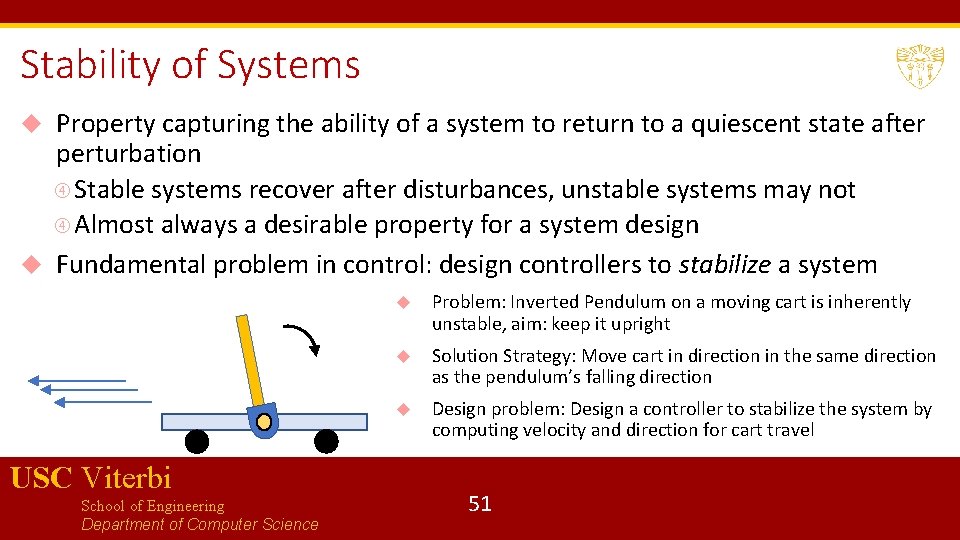
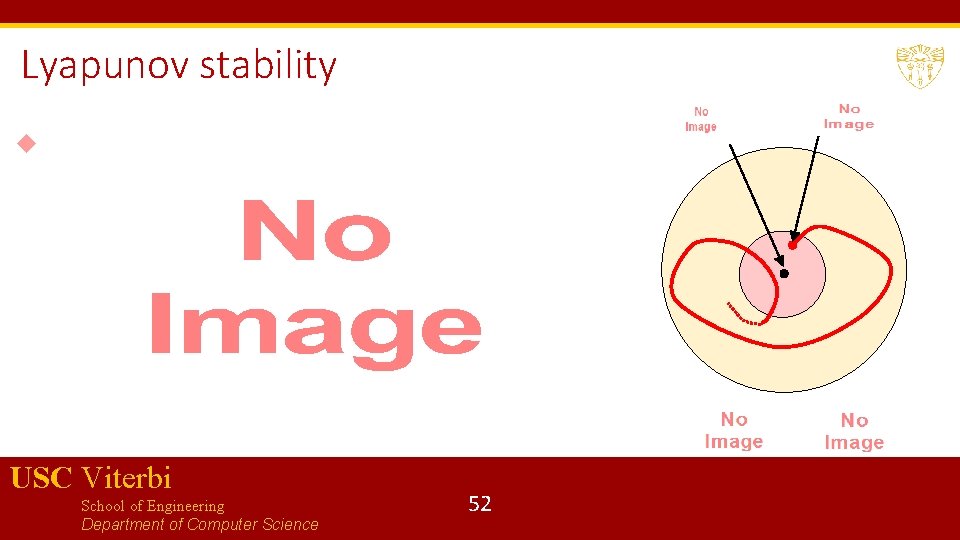
Stability of Systems Property capturing the ability of a system to return to a quiescent state after perturbation Stable systems recover after disturbances, unstable systems may not Almost always a desirable property for a system design Fundamental problem in control: design controllers to stabilize a system USC Viterbi School of Engineering Department of Computer Science Problem: Inverted Pendulum on a moving cart is inherently unstable, aim: keep it upright Solution Strategy: Move cart in direction in the same direction as the pendulum’s falling direction Design problem: Design a controller to stabilize the system by computing velocity and direction for cart travel 51
Lyapunov stability USC Viterbi School of Engineering Department of Computer Science 52
Asymptotic + Exponential Stability USC Viterbi School of Engineering Department of Computer Science 53
What do these definitions all mean? USC Viterbi School of Engineering Department of Computer Science 54
Analyzing stability for linear systems USC Viterbi School of Engineering Department of Computer Science 55
Next lecture Basics of linear control Nonlinear control USC Viterbi School of Engineering Department of Computer Science 56
- Slides: 56