
Autonomous CyberPhysical Systems Requirements Linear Temporal Logic Fall
Autonomous Cyber-Physical Systems: Requirements, Linear Temporal Logic Fall 2020. CS 513. Instructor: Jyo Deshmukh USC Viterbi School of Engineering Department of Computer Science
Where we are in the course Done with Macro-Module 1! Module 1: Models of Computation + Control Module 2: Formal Specification, Verification, Testing USC Viterbi School of Engineering Department of Computer Science 2
Module 2 : Formal Specification, Verification, Testing Formal Requirements/Specifications Requirements-based Testing Safety Verification USC Viterbi School of Engineering Department of Computer Science 3
Requirements Requirements: describe desirable properties of system behaviors High assurance/safety-critical, or mission-critical systems must use formal requirements Behavioral requirements: requirement can be evaluated on individual system behaviors Requirements met by system if all behaviors satisfy requirements There needs to be a clear separation between requirements (what needs to be implemented) and the design (how should it be implemented) Unfortunately, this is not often obeyed USC Viterbi School of Engineering Department of Computer Science 4
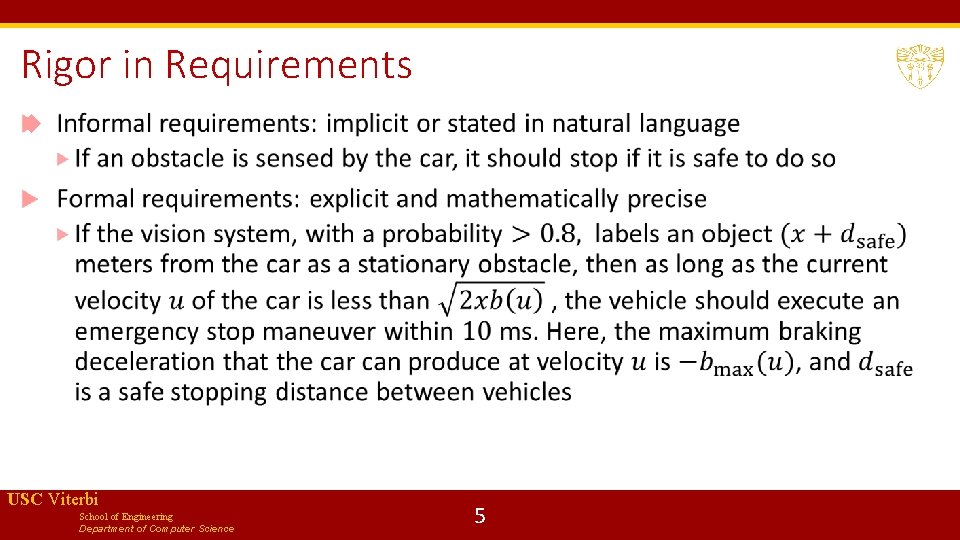
Rigor in Requirements USC Viterbi School of Engineering Department of Computer Science 5
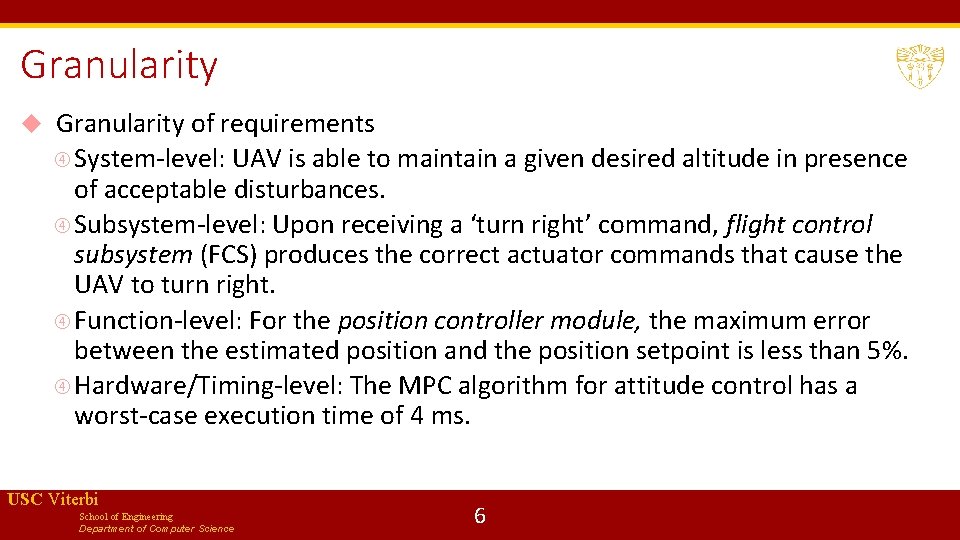
Granularity of requirements System-level: UAV is able to maintain a given desired altitude in presence of acceptable disturbances. Subsystem-level: Upon receiving a ‘turn right’ command, flight control subsystem (FCS) produces the correct actuator commands that cause the UAV to turn right. Function-level: For the position controller module, the maximum error between the estimated position and the position setpoint is less than 5%. Hardware/Timing-level: The MPC algorithm for attitude control has a worst-case execution time of 4 ms. USC Viterbi School of Engineering Department of Computer Science 6
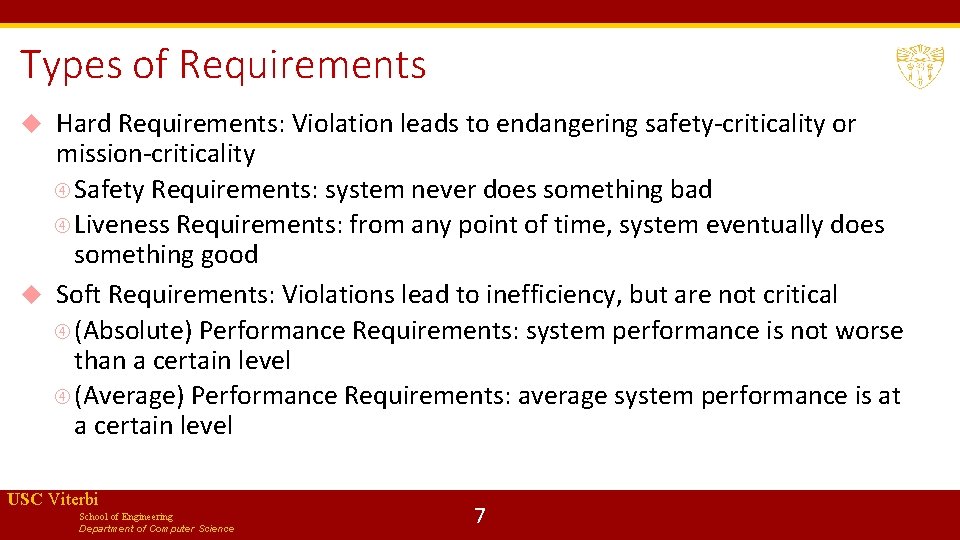
Types of Requirements Hard Requirements: Violation leads to endangering safety-criticality or mission-criticality Safety Requirements: system never does something bad Liveness Requirements: from any point of time, system eventually does something good Soft Requirements: Violations lead to inefficiency, but are not critical (Absolute) Performance Requirements: system performance is not worse than a certain level (Average) Performance Requirements: average system performance is at a certain level USC Viterbi School of Engineering Department of Computer Science 7
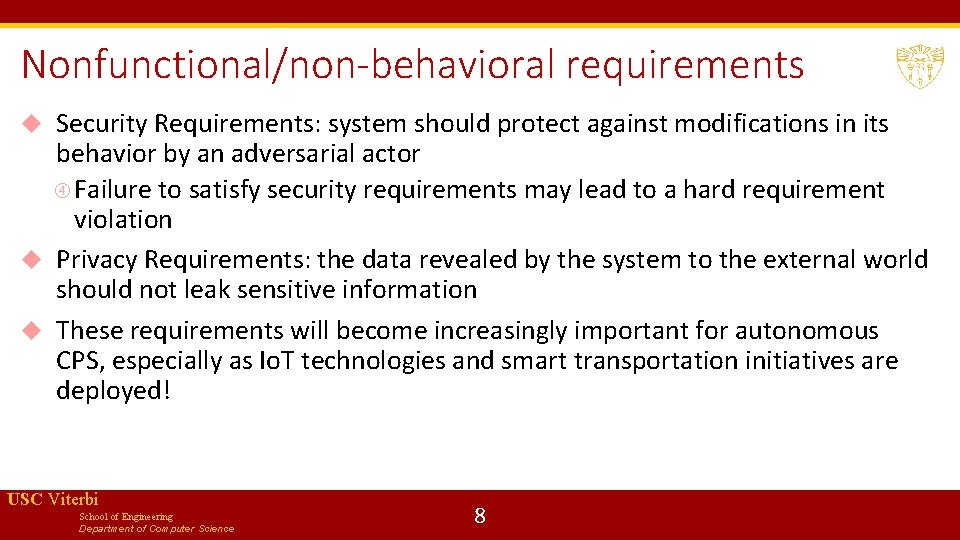
Nonfunctional/non-behavioral requirements Security Requirements: system should protect against modifications in its behavior by an adversarial actor Failure to satisfy security requirements may lead to a hard requirement violation Privacy Requirements: the data revealed by the system to the external world should not leak sensitive information These requirements will become increasingly important for autonomous CPS, especially as Io. T technologies and smart transportation initiatives are deployed! USC Viterbi School of Engineering Department of Computer Science 8
Requirement Formalisms Languages and Logics to describe requirements in a mathematically precise fashion Examples: Automata, State Machines Propositional Logic, Temporal Logic, Regular Expressions Structured language/grammar-based requirements USC Viterbi School of Engineering Department of Computer Science 9
Detour to automata and formal languages Most programmers have used regular expressions Formally, regular expressions specify acceptable sequences of finite length Example: [a-z][a-z 0 -9] : strings starting with a lowercase letter (a-z) followed by one lowercase letter or number [a-z][0 -9]*[a-z] : strings starting with a lowercase letter, followed by finitely many numbers followed by a lowercase letter USC Viterbi School of Engineering Department of Computer Science 10
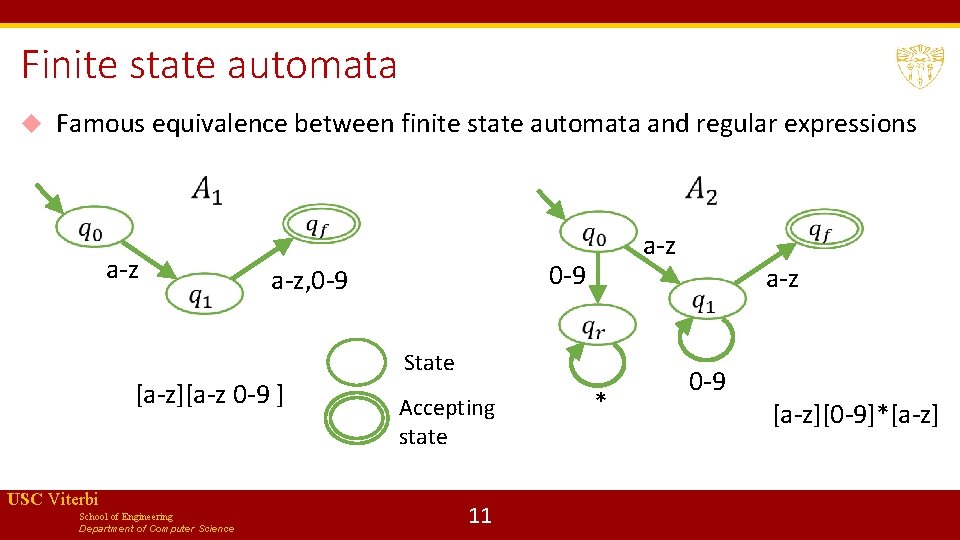
Finite state automata Famous equivalence between finite state automata and regular expressions a-z USC Viterbi School of Engineering Department of Computer Science 0 -9 a-z, 0 -9 [a-z][a-z 0 -9 ] a-z State Accepting state 11 * a-z 0 -9 [a-z][0 -9]*[a-z]
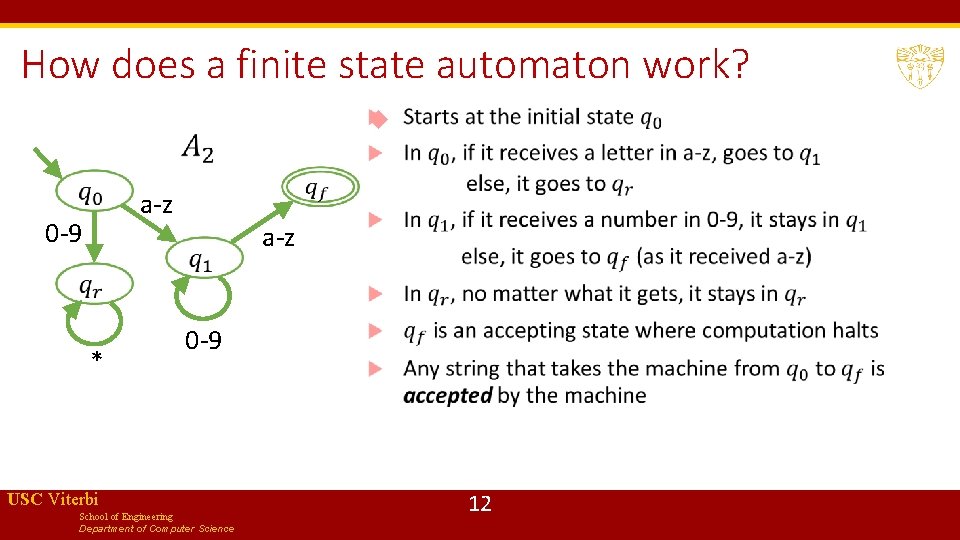
How does a finite state automaton work? a-z 0 -9 * a-z 0 -9 USC Viterbi School of Engineering Department of Computer Science 12
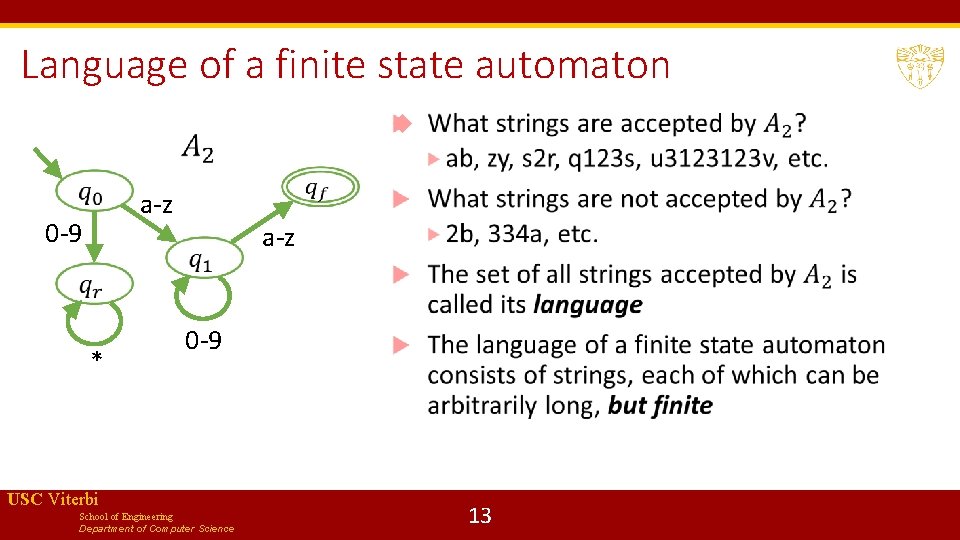
Language of a finite state automaton a-z 0 -9 * a-z 0 -9 USC Viterbi School of Engineering Department of Computer Science 13
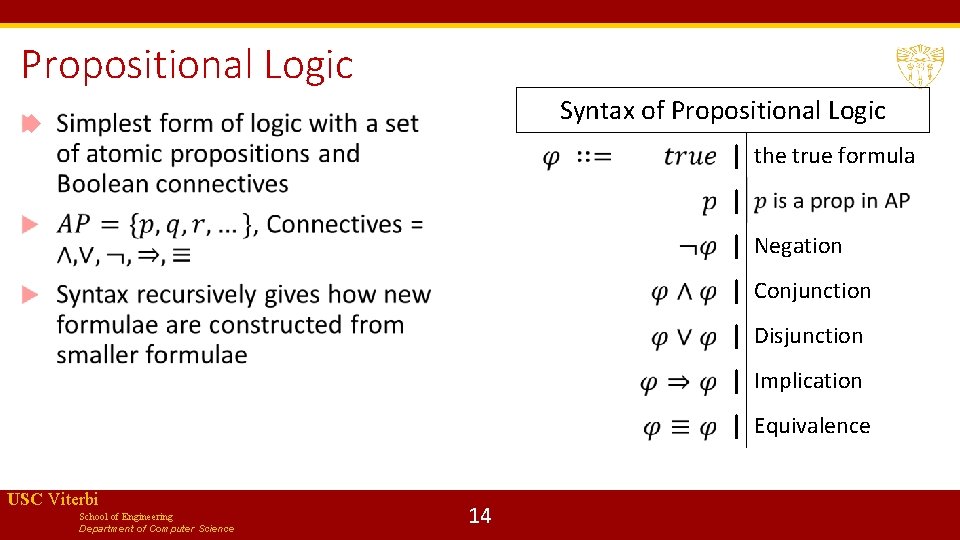
Propositional Logic Syntax of Propositional Logic | the true formula | | Negation | Conjunction | Disjunction | Implication | Equivalence USC Viterbi School of Engineering Department of Computer Science 14
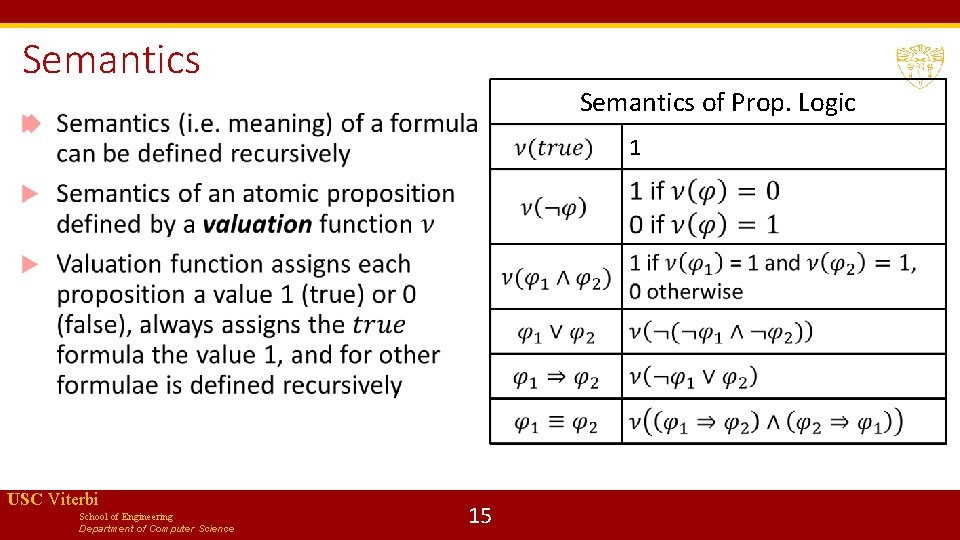
Semantics of Prop. Logic 1 USC Viterbi School of Engineering Department of Computer Science 15
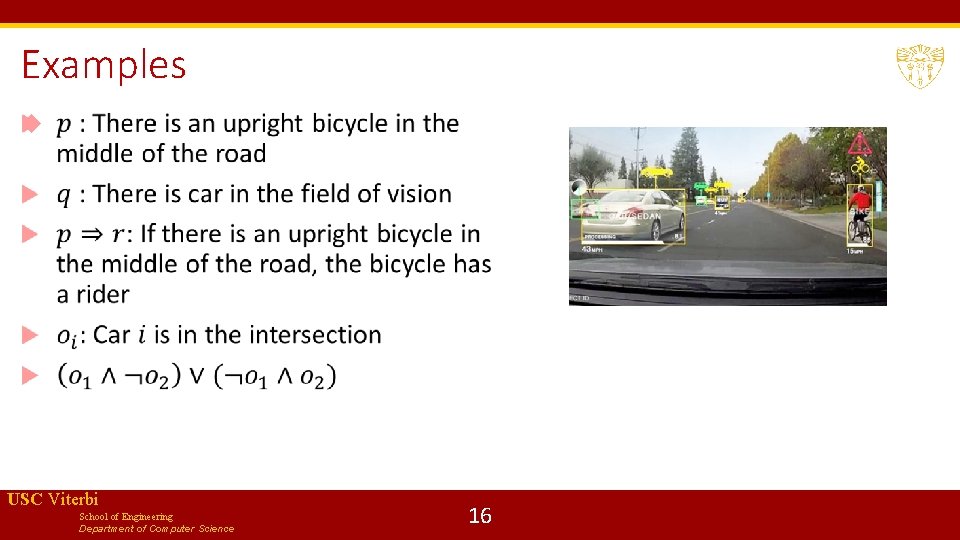
Examples USC Viterbi School of Engineering Department of Computer Science 16
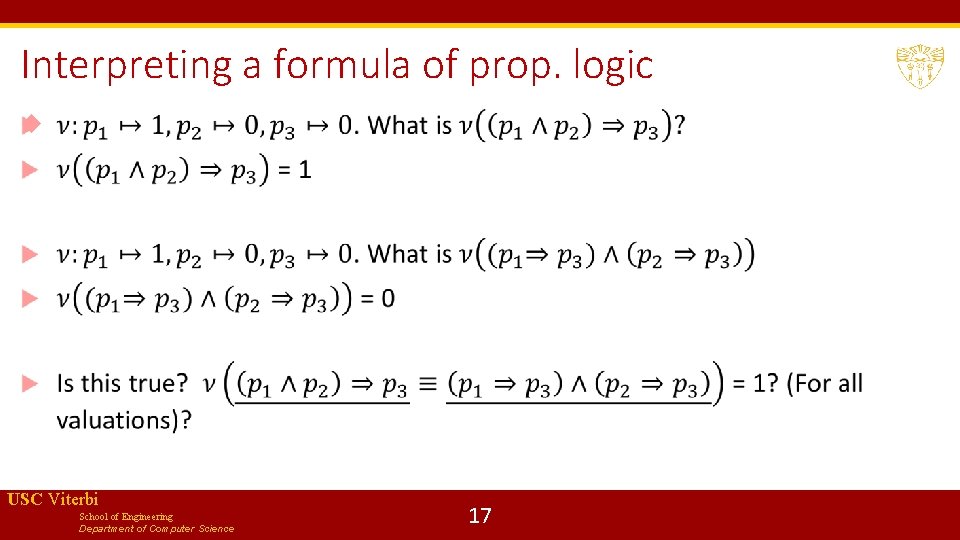
Interpreting a formula of prop. logic USC Viterbi School of Engineering Department of Computer Science 17
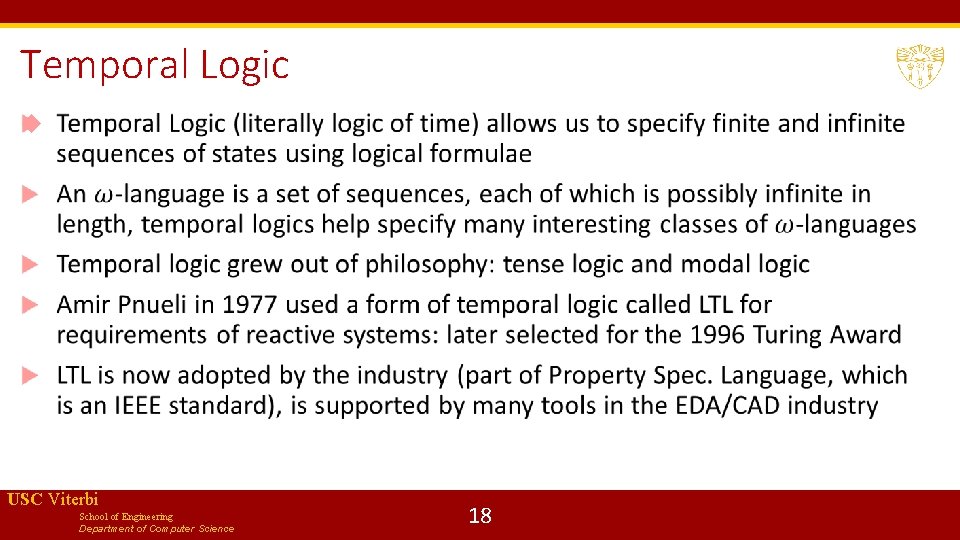
Temporal Logic USC Viterbi School of Engineering Department of Computer Science 18
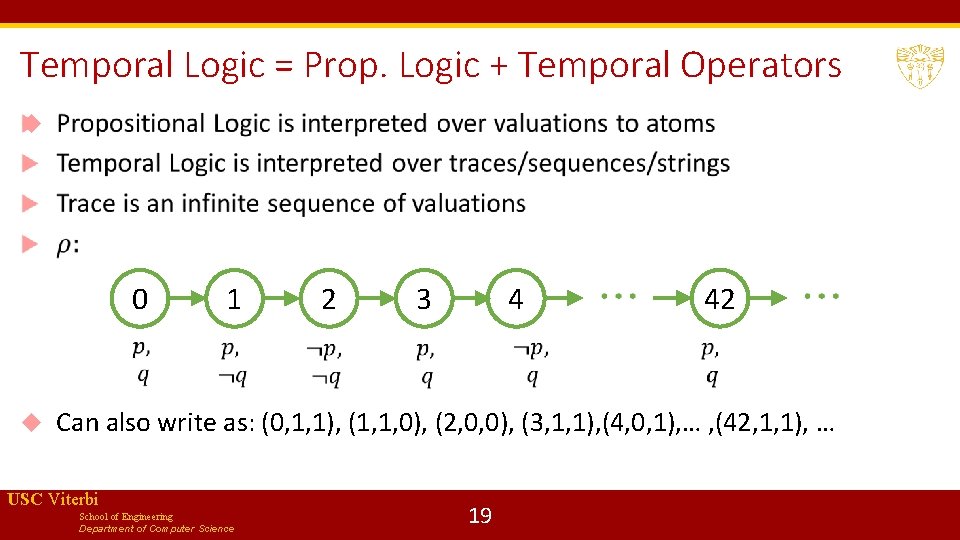
Temporal Logic = Prop. Logic + Temporal Operators 0 1 2 4 3 42 Can also write as: (0, 1, 1), (1, 1, 0), (2, 0, 0), (3, 1, 1), (4, 0, 1), … , (42, 1, 1), … USC Viterbi School of Engineering Department of Computer Science 19
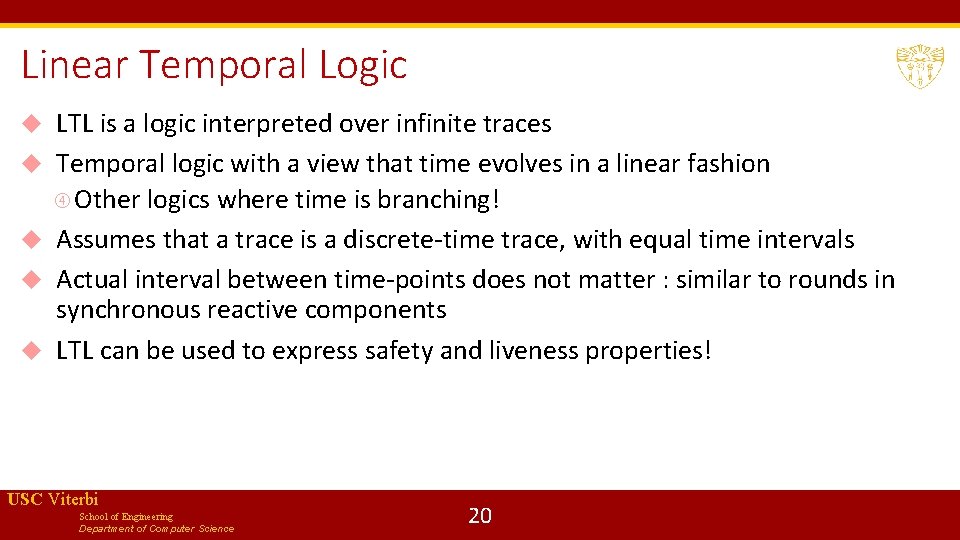
Linear Temporal Logic LTL is a logic interpreted over infinite traces Temporal logic with a view that time evolves in a linear fashion Other logics where time is branching! Assumes that a trace is a discrete-time trace, with equal time intervals Actual interval between time-points does not matter : similar to rounds in synchronous reactive components LTL can be used to express safety and liveness properties! USC Viterbi School of Engineering Department of Computer Science 20
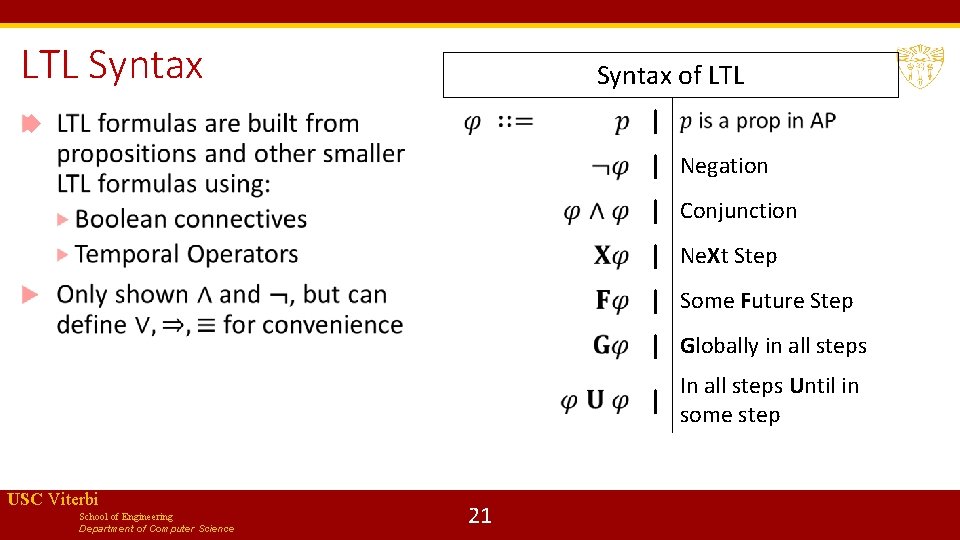
LTL Syntax of LTL | | Negation | Conjunction | Ne. Xt Step | Some Future Step | Globally in all steps In all steps Until in | some step USC Viterbi School of Engineering Department of Computer Science 21
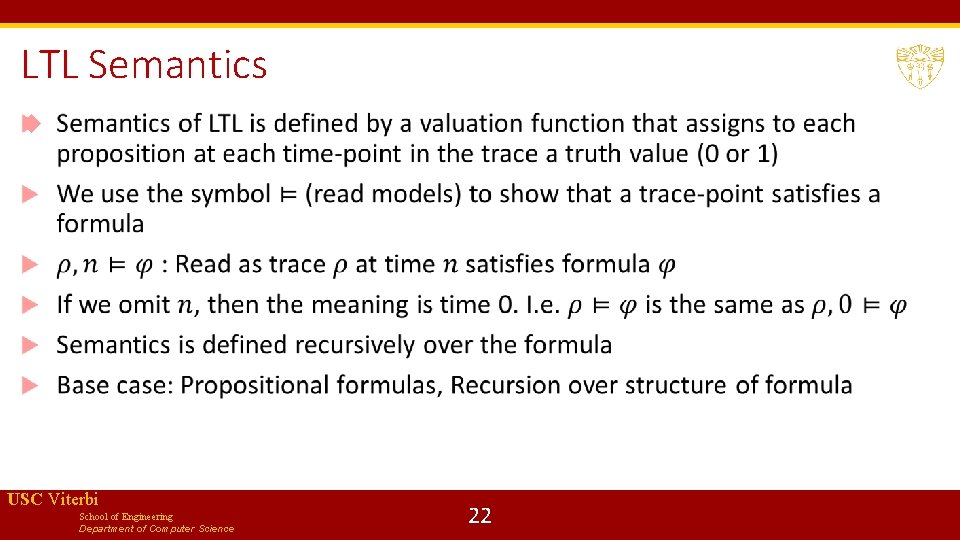
LTL Semantics USC Viterbi School of Engineering Department of Computer Science 22
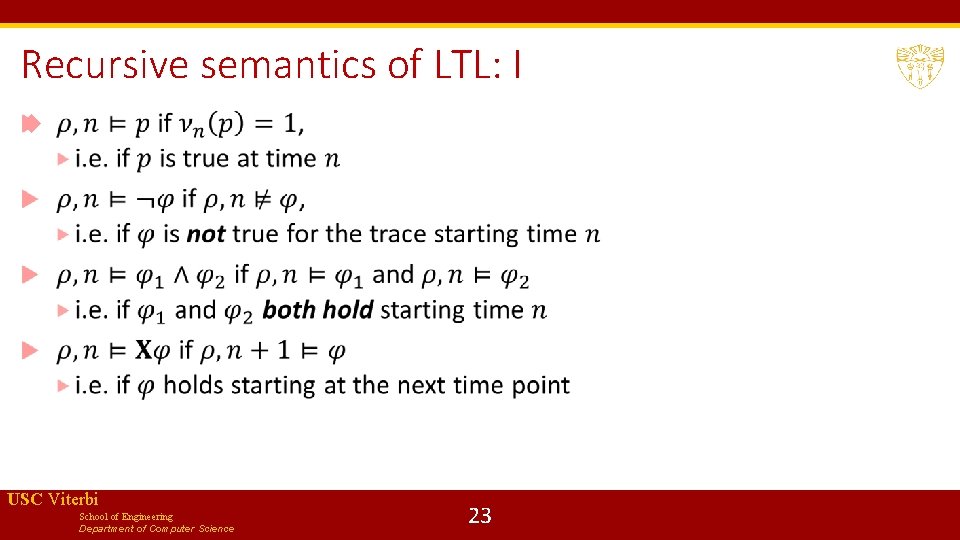
Recursive semantics of LTL: I USC Viterbi School of Engineering Department of Computer Science 23
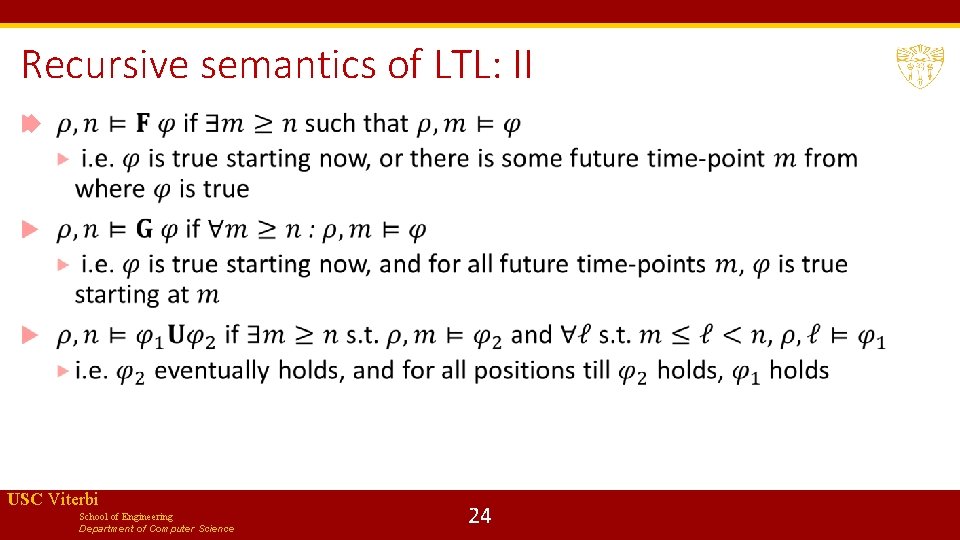
Recursive semantics of LTL: II USC Viterbi School of Engineering Department of Computer Science 24
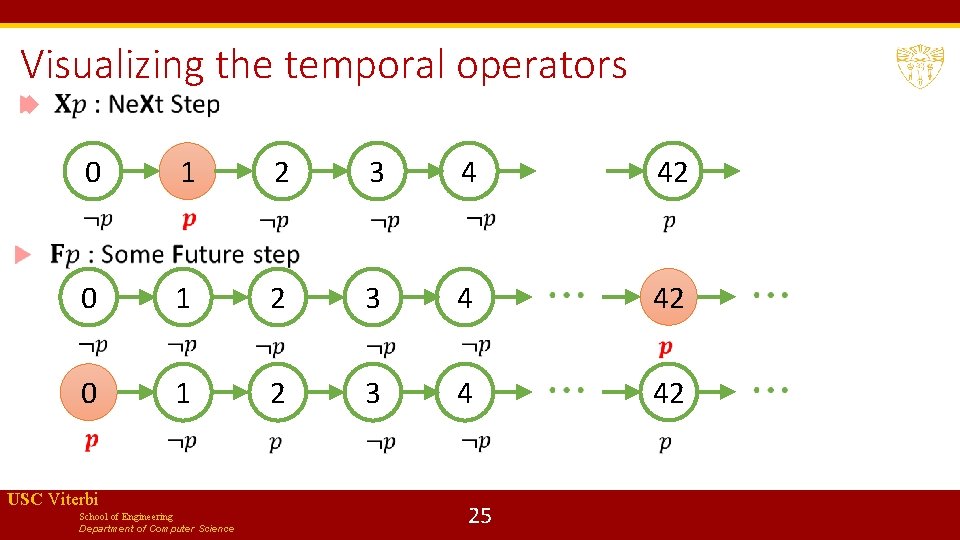
Visualizing the temporal operators 0 1 2 3 4 42 USC Viterbi School of Engineering Department of Computer Science 25
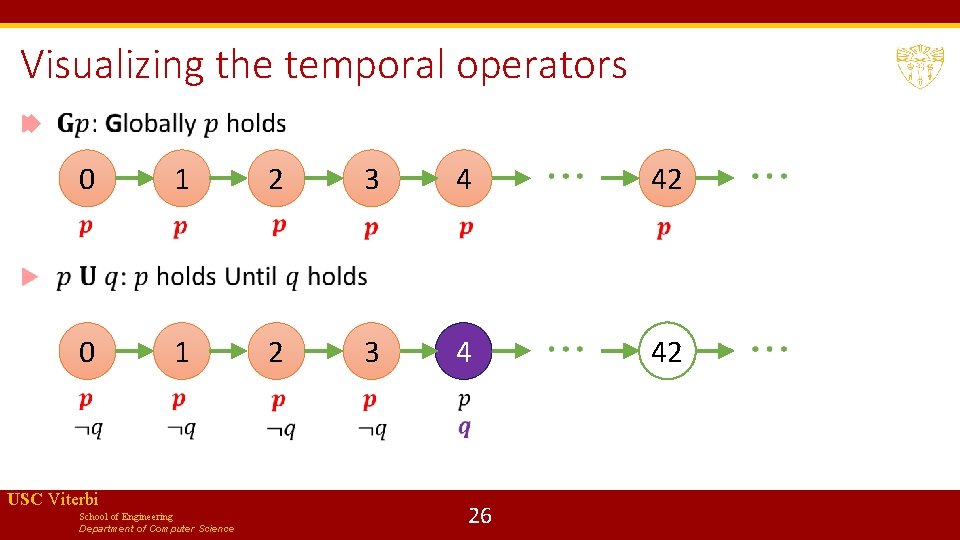
Visualizing the temporal operators 0 1 2 3 4 42 USC Viterbi School of Engineering Department of Computer Science 26
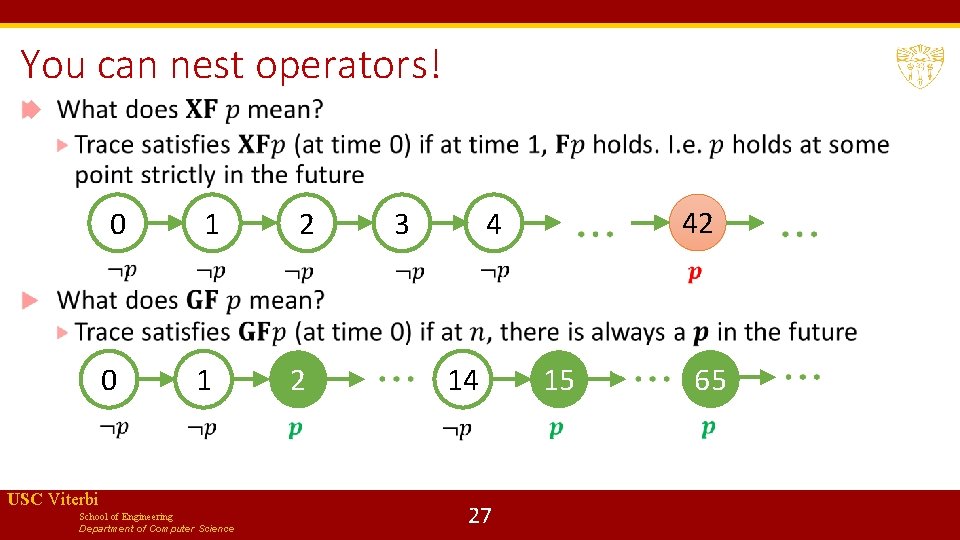
You can nest operators! 0 1 2 USC Viterbi School of Engineering Department of Computer Science 42 4 3 14 27 15 65
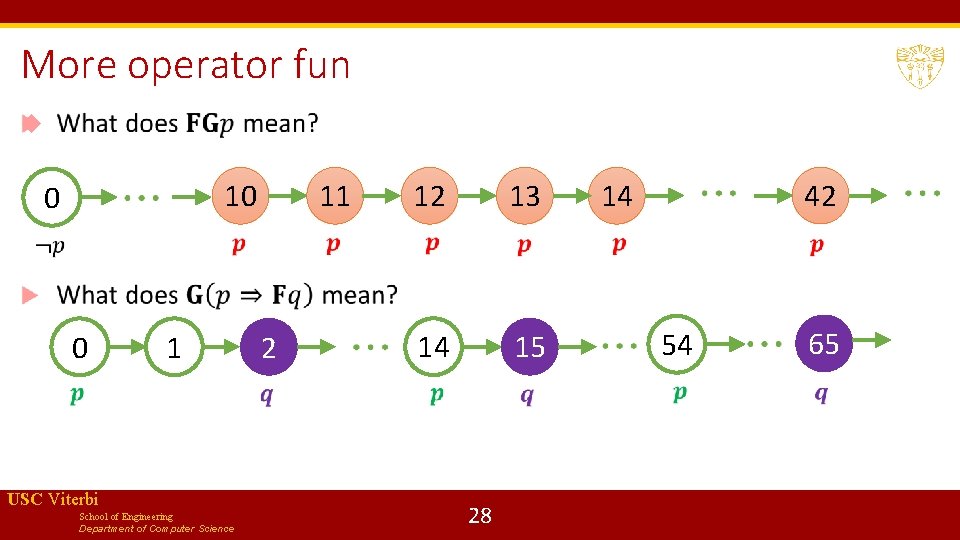
More operator fun 10 0 0 1 USC Viterbi School of Engineering Department of Computer Science 11 2 12 13 14 15 28 42 14 54 65
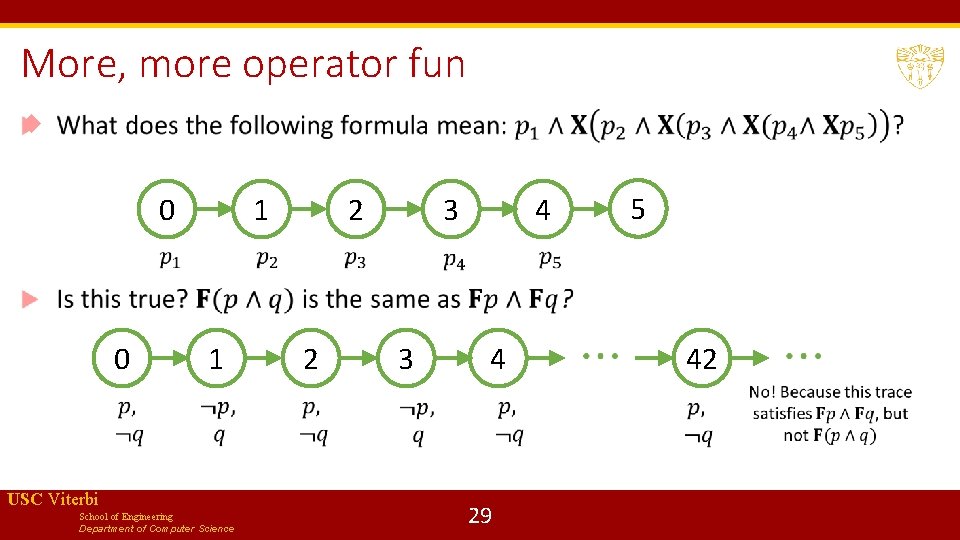
More, more operator fun 0 0 1 USC Viterbi School of Engineering Department of Computer Science 2 4 3 2 1 3 4 29 5 42
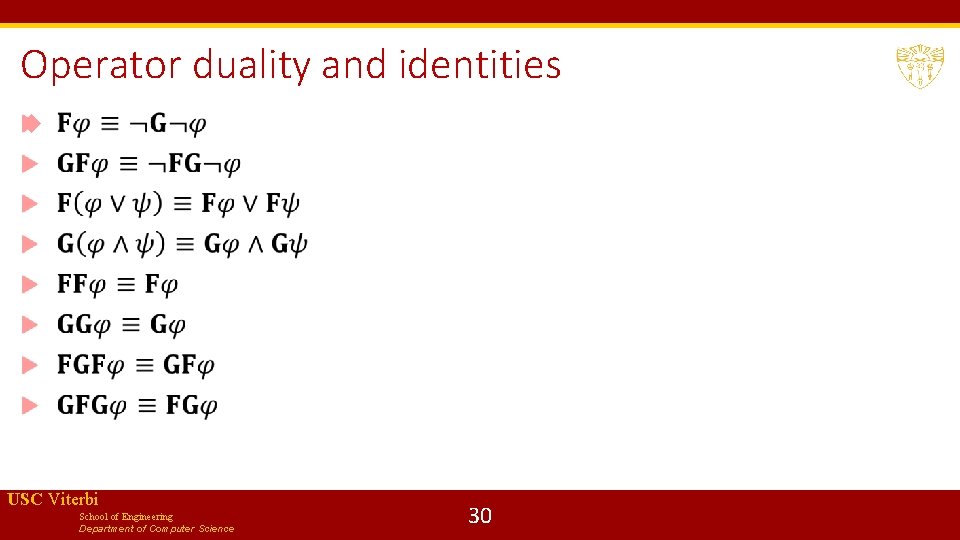
Operator duality and identities USC Viterbi School of Engineering Department of Computer Science 30
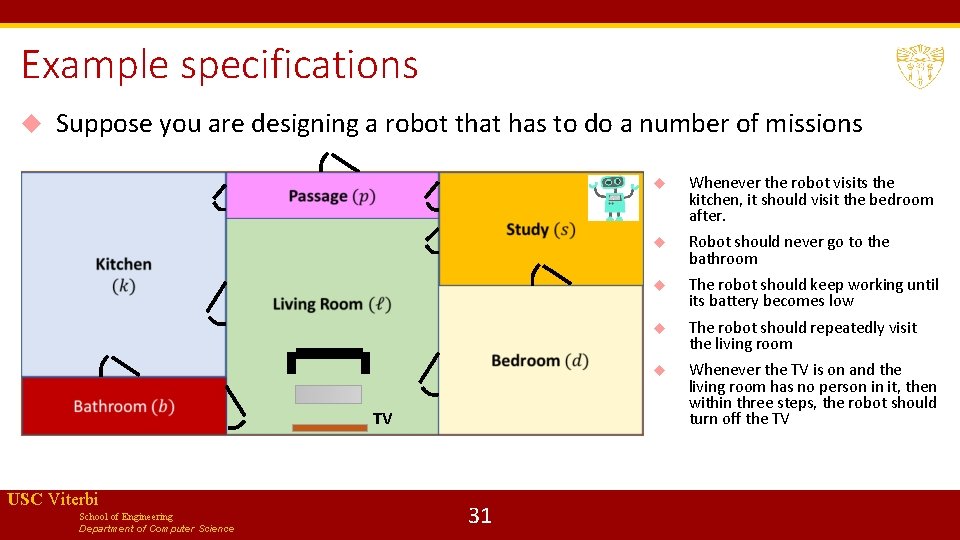
Example specifications Suppose you are designing a robot that has to do a number of missions TV USC Viterbi School of Engineering Department of Computer Science 31 Whenever the robot visits the kitchen, it should visit the bedroom after. Robot should never go to the bathroom The robot should keep working until its battery becomes low The robot should repeatedly visit the living room Whenever the TV is on and the living room has no person in it, then within three steps, the robot should turn off the TV
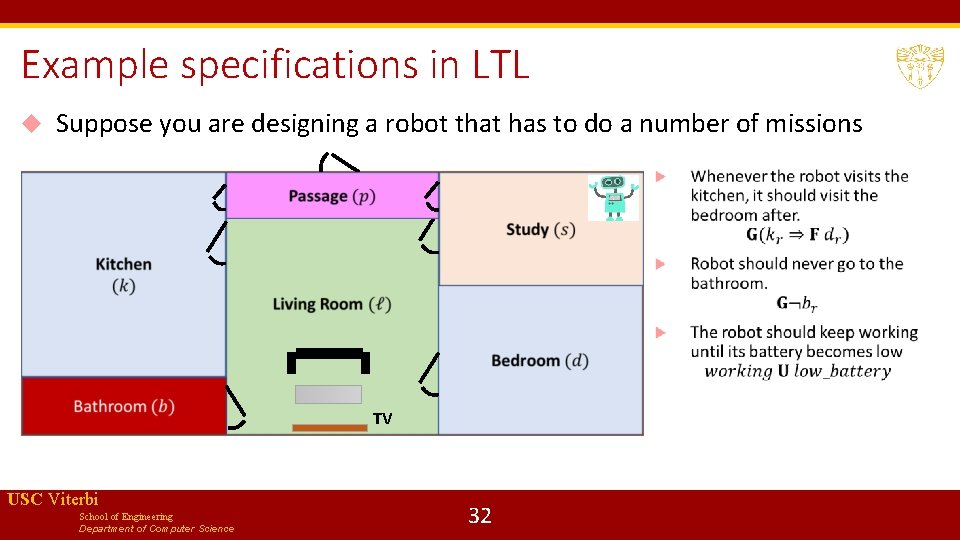
Example specifications in LTL Suppose you are designing a robot that has to do a number of missions TV USC Viterbi School of Engineering Department of Computer Science 32
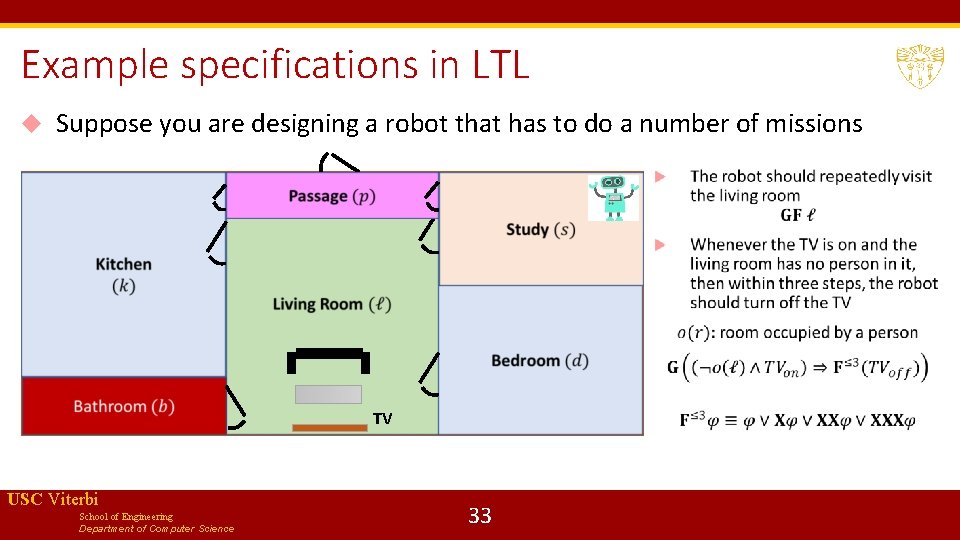
Example specifications in LTL Suppose you are designing a robot that has to do a number of missions TV USC Viterbi School of Engineering Department of Computer Science 33
- Slides: 33