
Autonomous CyberPhysical Systems Reinforcement Learning for Planning Spring
Autonomous Cyber-Physical Systems: Reinforcement Learning for Planning Spring 2018. CS 599. Instructor: Jyo Deshmukh USC Viterbi School of Engineering Department of Computer Science
Overview Reinforcement Learning Basics Neural Networks and Deep Reinforcement Learning USC Viterbi School of Engineering Department of Computer Science 2
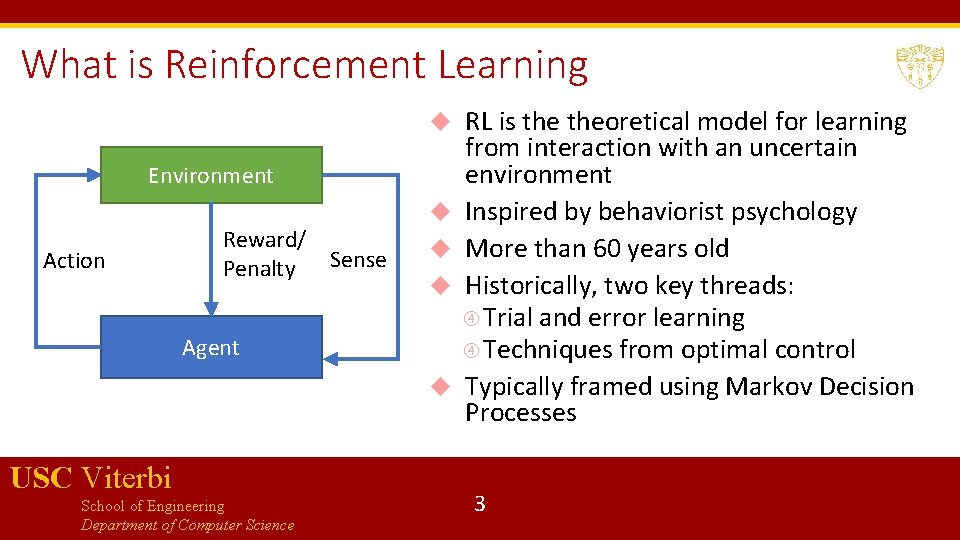
What is Reinforcement Learning Environment Action Reward/ Penalty Sense Agent USC Viterbi School of Engineering Department of Computer Science RL is theoretical model for learning from interaction with an uncertain environment Inspired by behaviorist psychology More than 60 years old Historically, two key threads: Trial and error learning Techniques from optimal control Typically framed using Markov Decision Processes 3
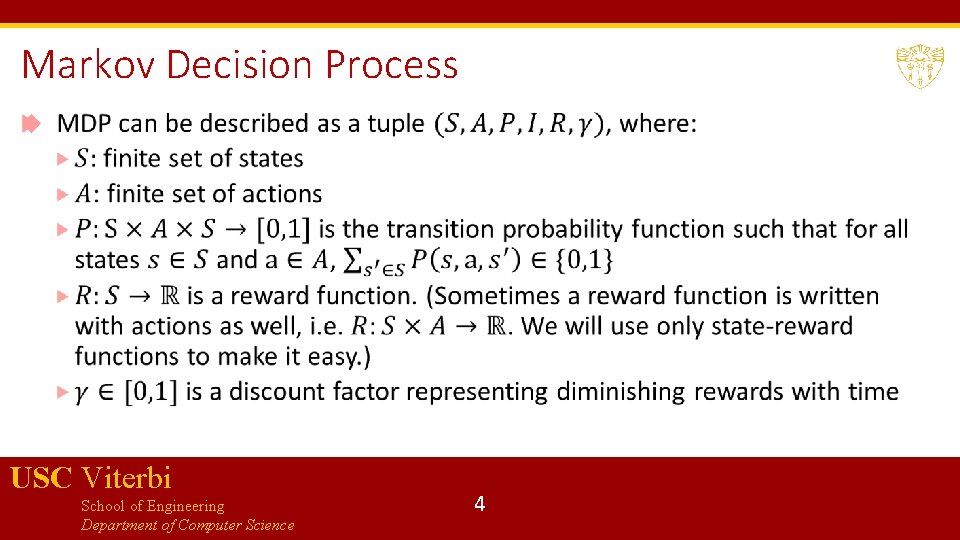
Markov Decision Process USC Viterbi School of Engineering Department of Computer Science 4
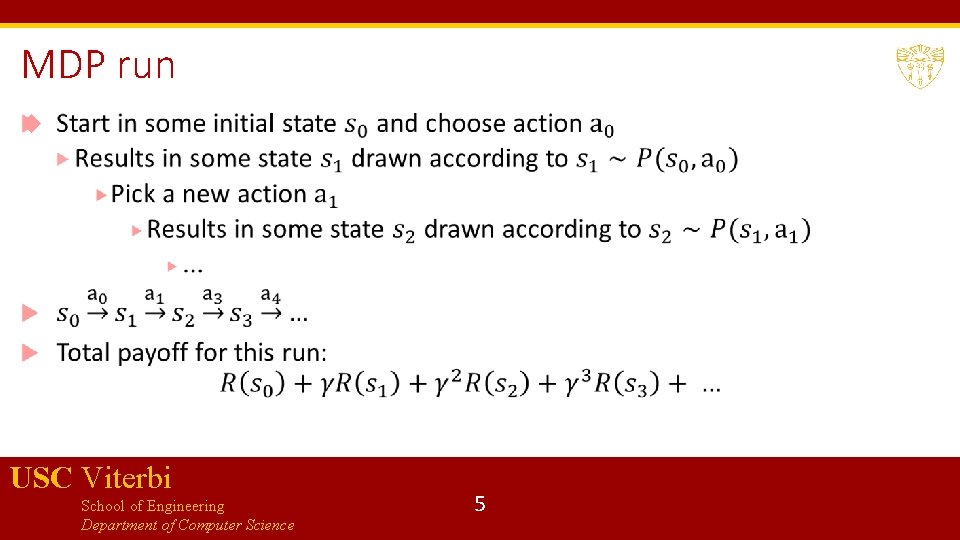
MDP run USC Viterbi School of Engineering Department of Computer Science 5
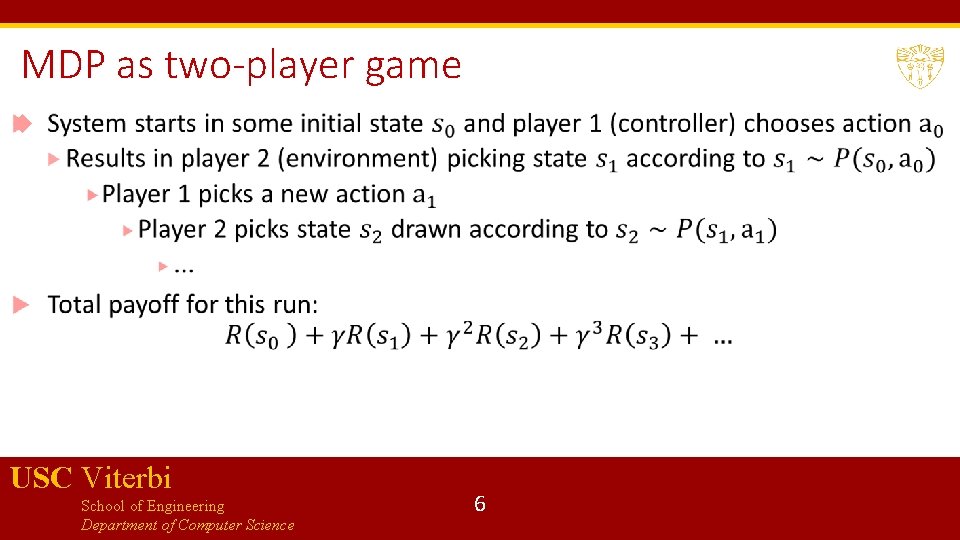
MDP as two-player game USC Viterbi School of Engineering Department of Computer Science 6
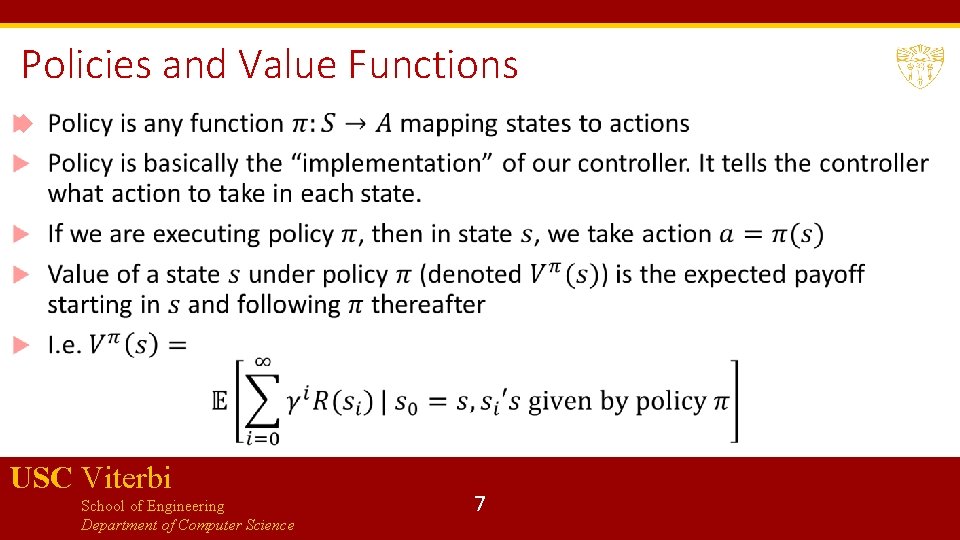
Policies and Value Functions USC Viterbi School of Engineering Department of Computer Science 7
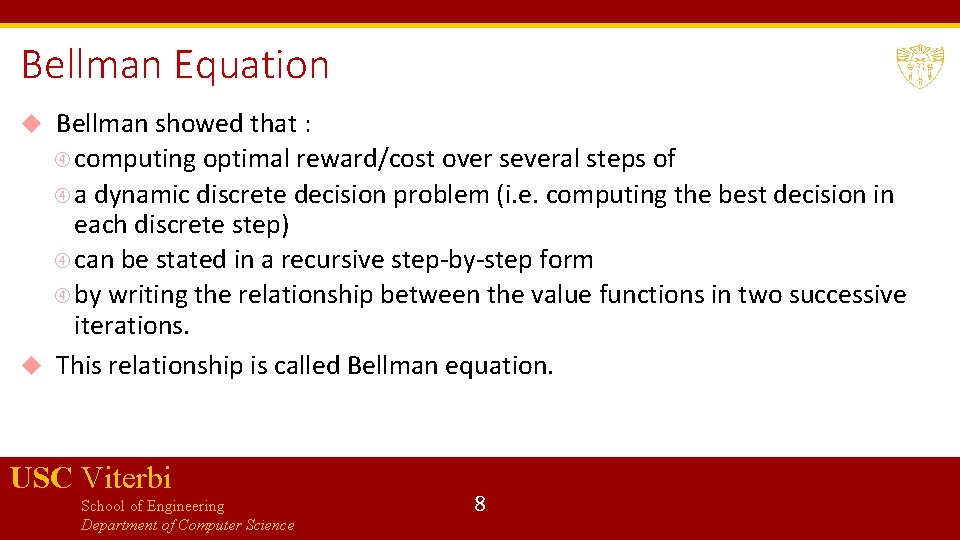
Bellman Equation Bellman showed that : computing optimal reward/cost over several steps of a dynamic discrete decision problem (i. e. computing the best decision in each discrete step) can be stated in a recursive step-by-step form by writing the relationship between the value functions in two successive iterations. This relationship is called Bellman equation. USC Viterbi School of Engineering Department of Computer Science 8
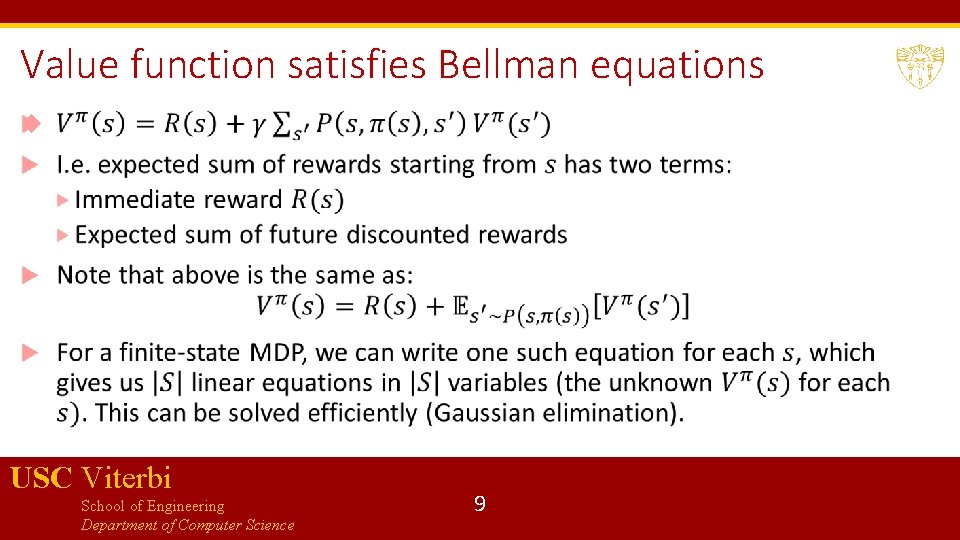
Value function satisfies Bellman equations USC Viterbi School of Engineering Department of Computer Science 9
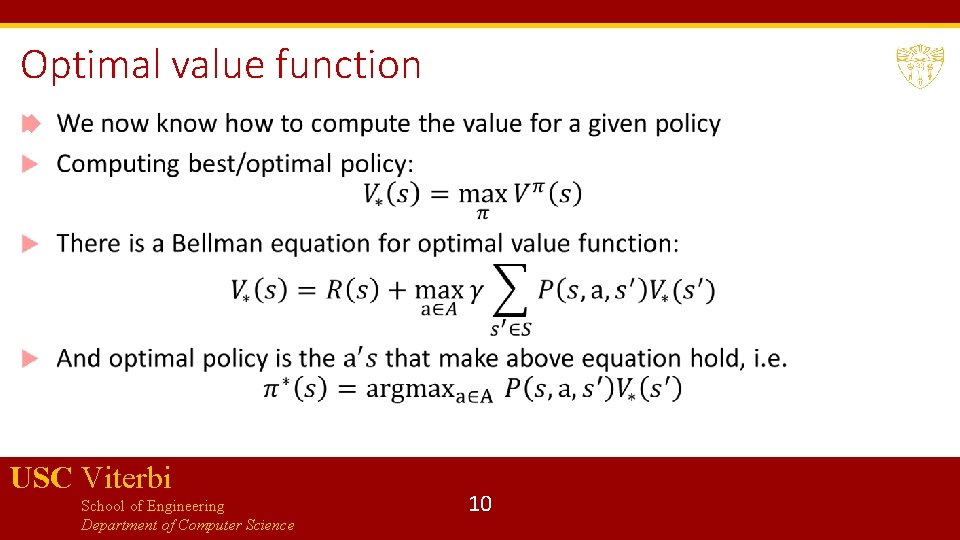
Optimal value function USC Viterbi School of Engineering Department of Computer Science 10
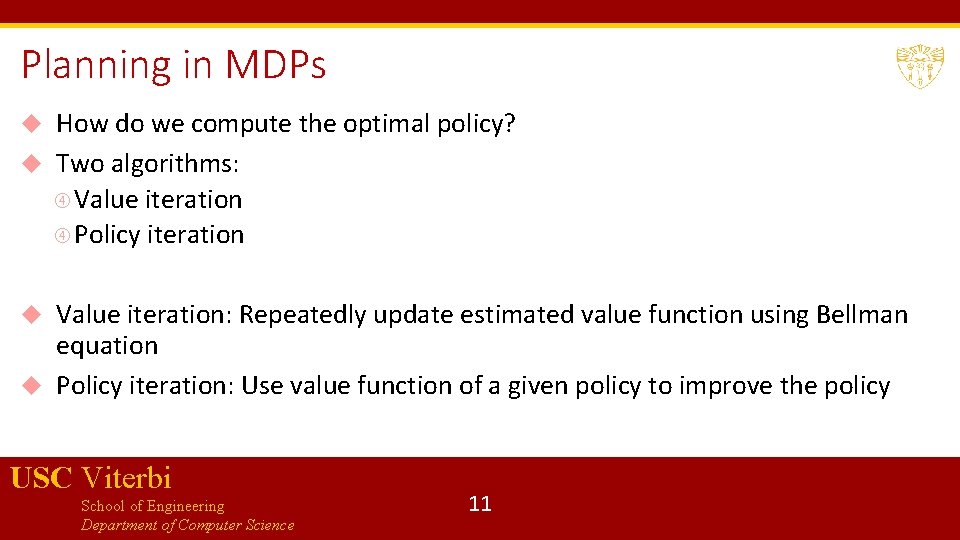
Planning in MDPs How do we compute the optimal policy? Two algorithms: Value iteration Policy iteration Value iteration: Repeatedly update estimated value function using Bellman equation Policy iteration: Use value function of a given policy to improve the policy USC Viterbi School of Engineering Department of Computer Science 11
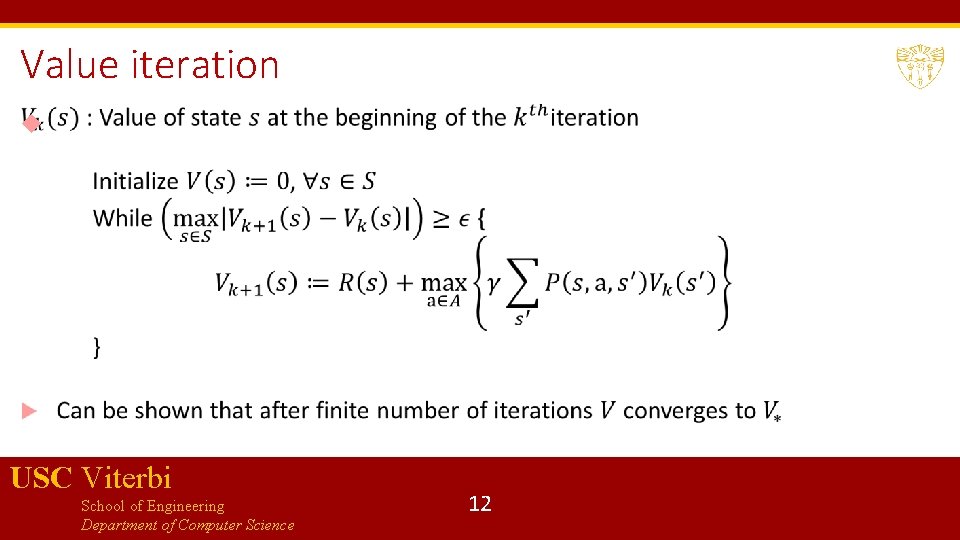
Value iteration USC Viterbi School of Engineering Department of Computer Science 12
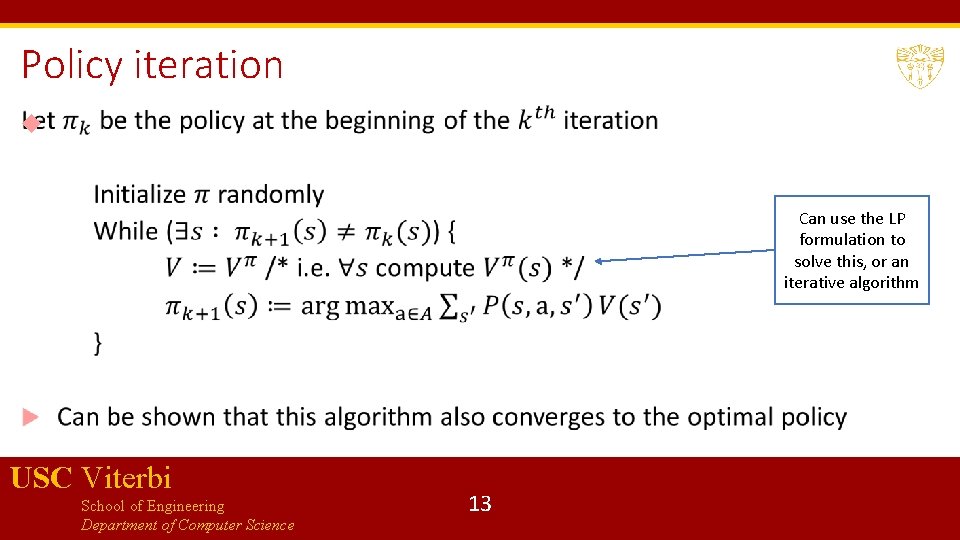
Policy iteration Can use the LP formulation to solve this, or an iterative algorithm USC Viterbi School of Engineering Department of Computer Science 13
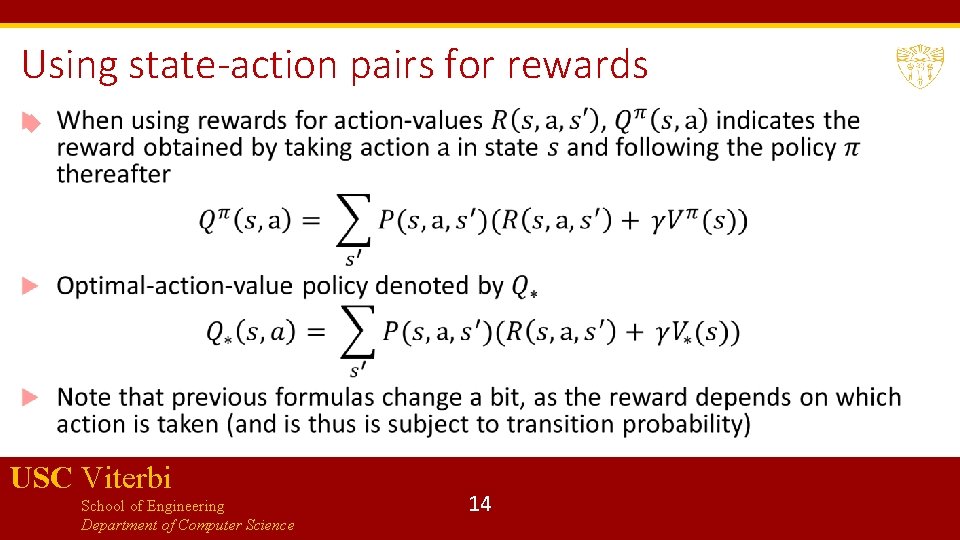
Using state-action pairs for rewards USC Viterbi School of Engineering Department of Computer Science 14
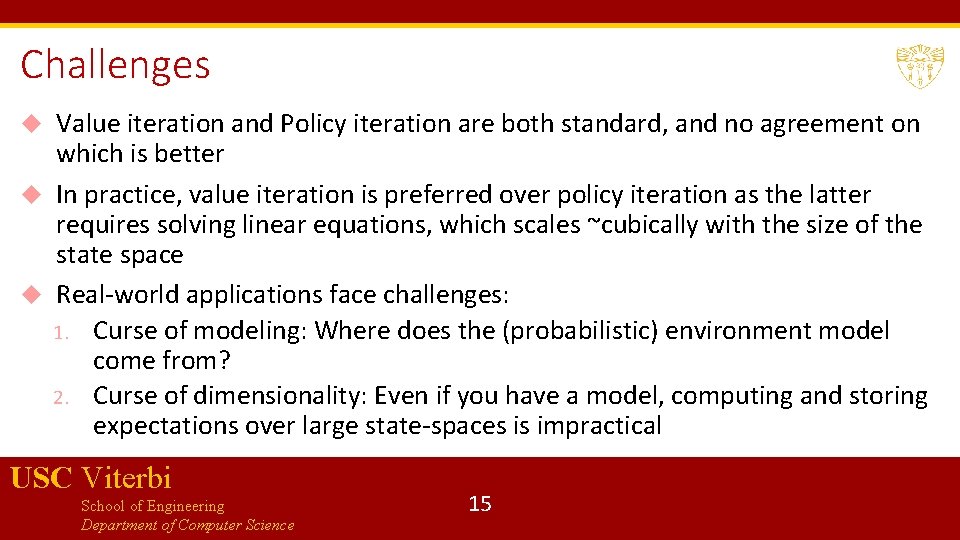
Challenges Value iteration and Policy iteration are both standard, and no agreement on which is better In practice, value iteration is preferred over policy iteration as the latter requires solving linear equations, which scales ~cubically with the size of the state space Real-world applications face challenges: 1. Curse of modeling: Where does the (probabilistic) environment model come from? 2. Curse of dimensionality: Even if you have a model, computing and storing expectations over large state-spaces is impractical USC Viterbi School of Engineering Department of Computer Science 15
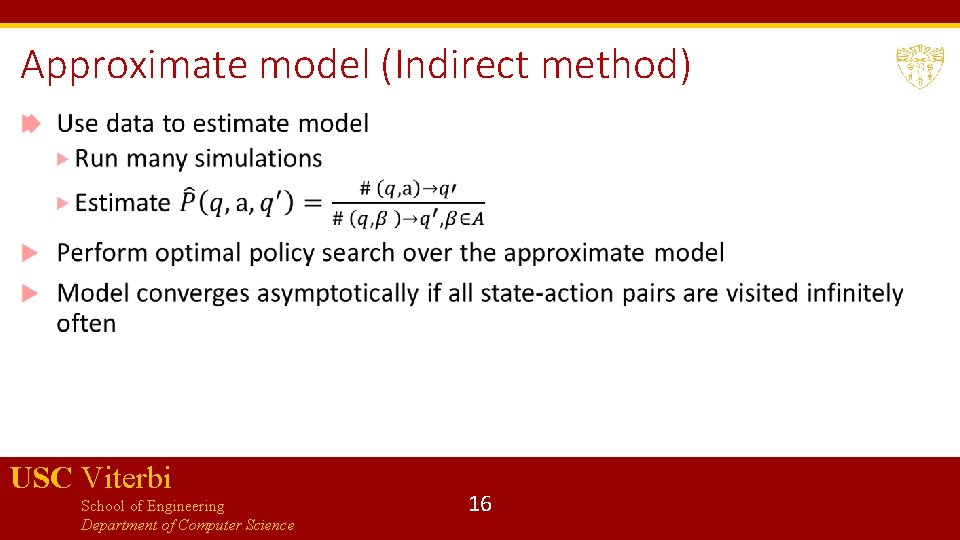
Approximate model (Indirect method) USC Viterbi School of Engineering Department of Computer Science 16
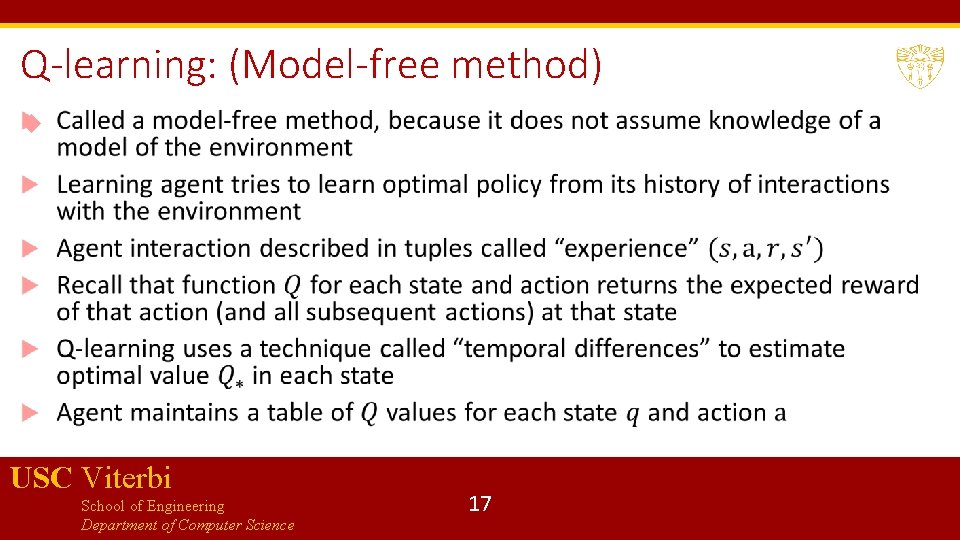
Q-learning: (Model-free method) USC Viterbi School of Engineering Department of Computer Science 17
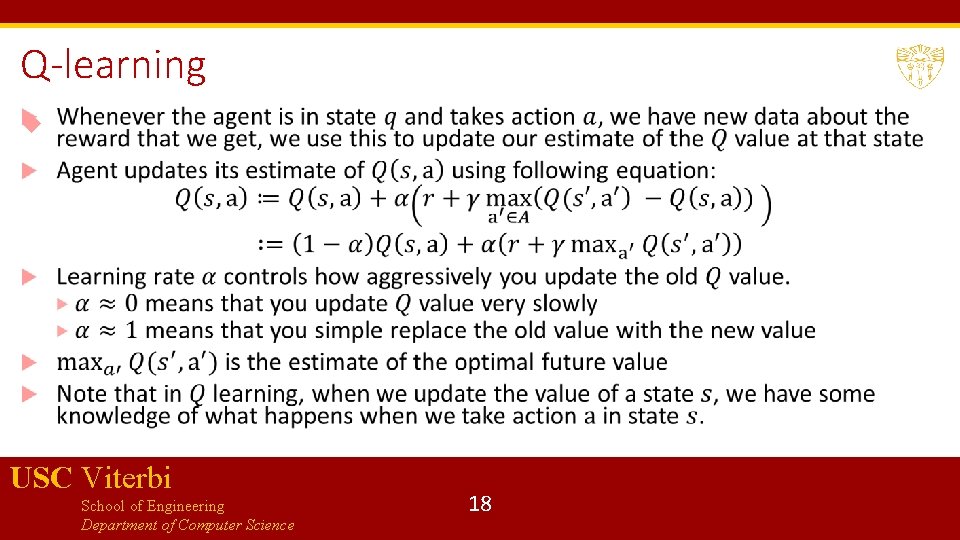
Q-learning USC Viterbi School of Engineering Department of Computer Science 18
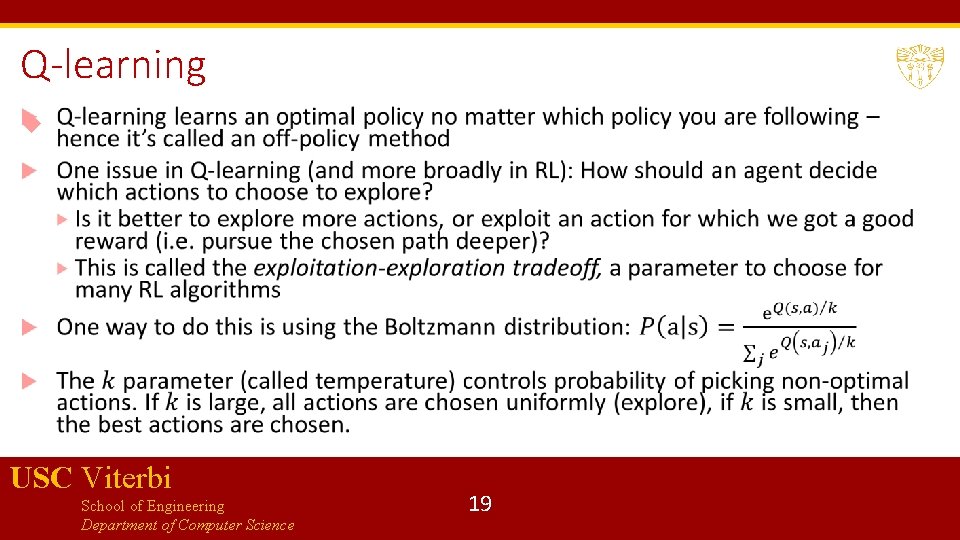
Q-learning USC Viterbi School of Engineering Department of Computer Science 19
Some more challenges for RL in autonomous CPS Uncertainty! In all previous algorithms, we assume that all states are fully visible and precisely estimable In CPS examples, there is uncertainty in states (sensor/actuation noise, state may not be observable but only estimated, etc. ) The approach is to model the underlying system as a Partially-Observable Markov Decision Process (POMDP) -- pronounced POM-DPs USC Viterbi School of Engineering Department of Computer Science 20
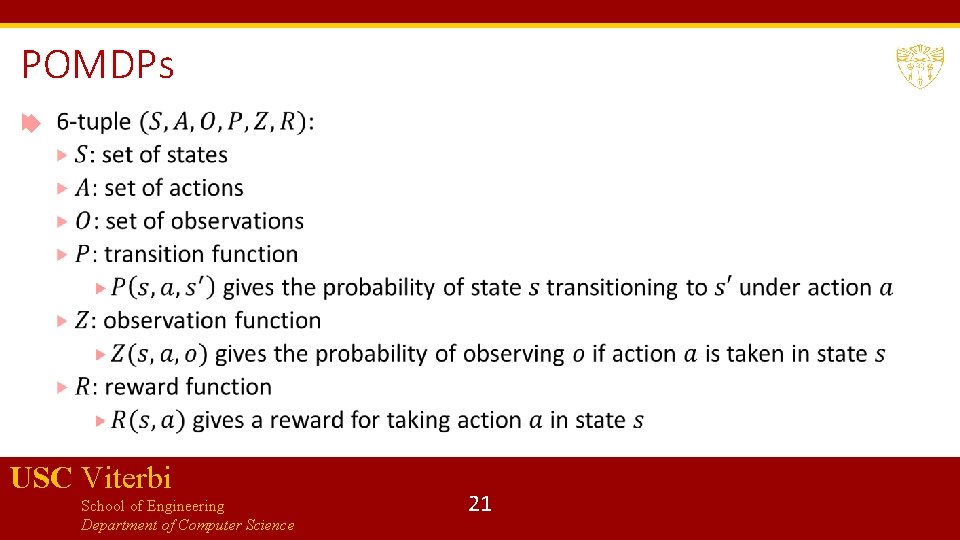
POMDPs USC Viterbi School of Engineering Department of Computer Science 21
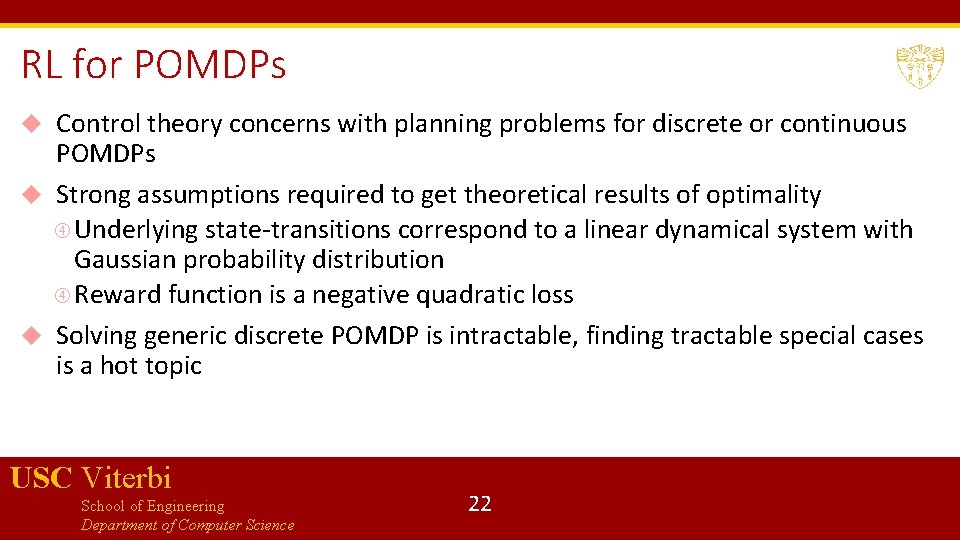
RL for POMDPs Control theory concerns with planning problems for discrete or continuous POMDPs Strong assumptions required to get theoretical results of optimality Underlying state-transitions correspond to a linear dynamical system with Gaussian probability distribution Reward function is a negative quadratic loss Solving generic discrete POMDP is intractable, finding tractable special cases is a hot topic USC Viterbi School of Engineering Department of Computer Science 22
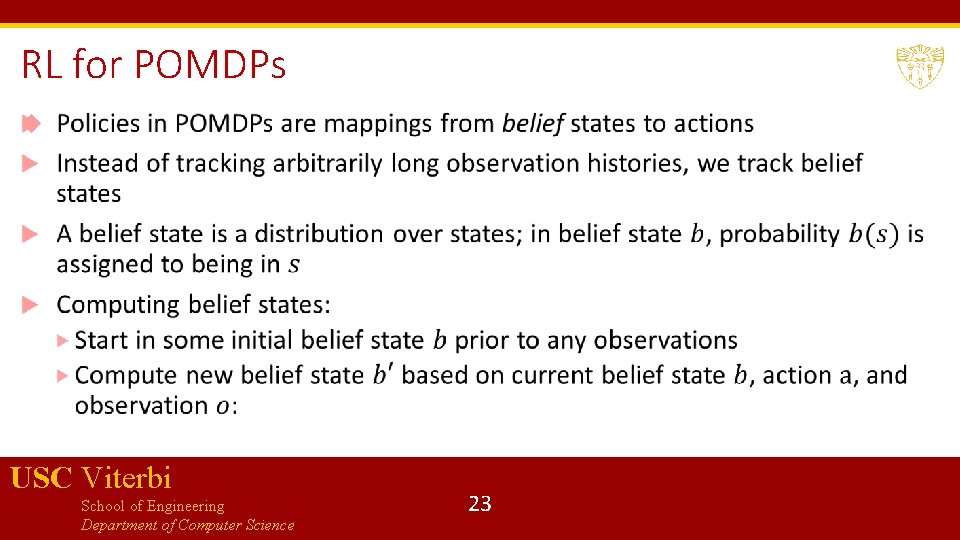
RL for POMDPs USC Viterbi School of Engineering Department of Computer Science 23
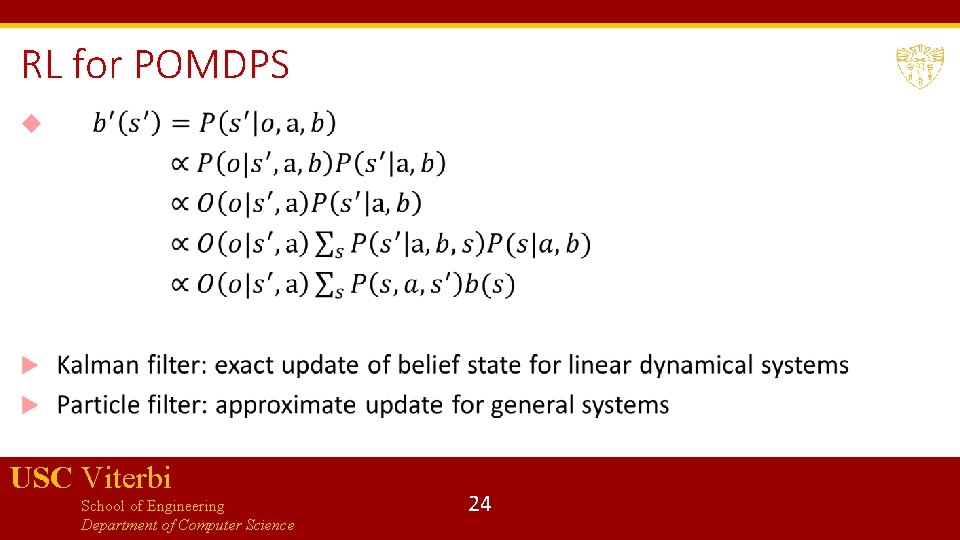
RL for POMDPS USC Viterbi School of Engineering Department of Computer Science 24
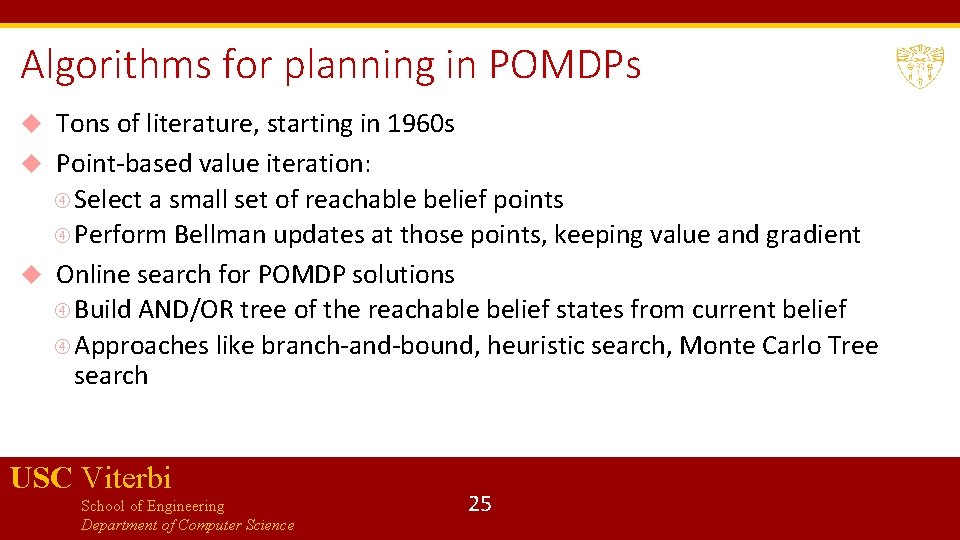
Algorithms for planning in POMDPs Tons of literature, starting in 1960 s Point-based value iteration: Select a small set of reachable belief points Perform Bellman updates at those points, keeping value and gradient Online search for POMDP solutions Build AND/OR tree of the reachable belief states from current belief Approaches like branch-and-bound, heuristic search, Monte Carlo Tree search USC Viterbi School of Engineering Department of Computer Science 25
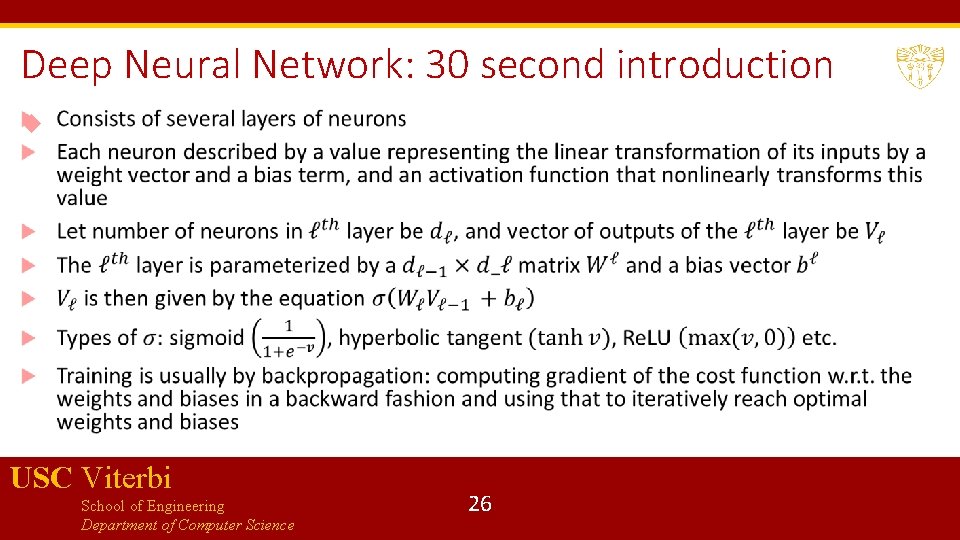
Deep Neural Network: 30 second introduction USC Viterbi School of Engineering Department of Computer Science 26
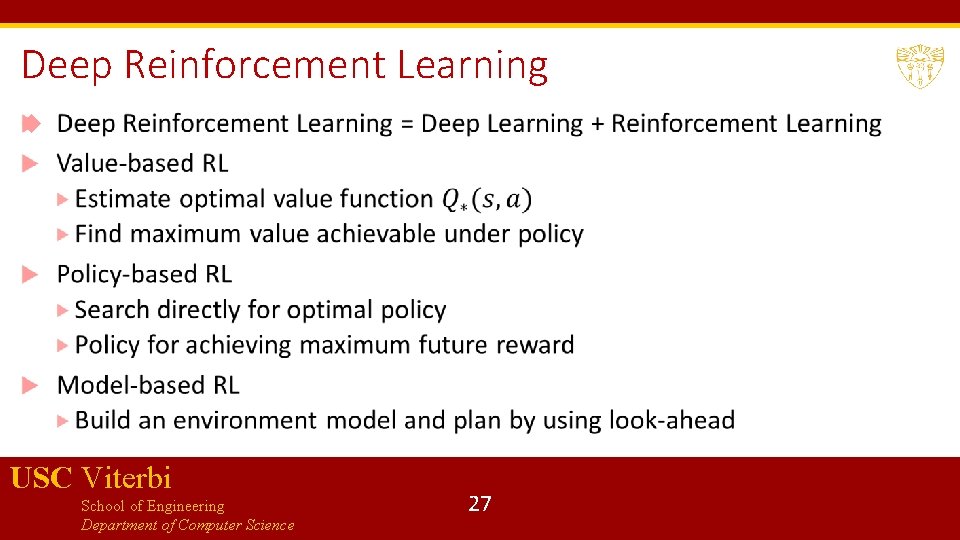
Deep Reinforcement Learning USC Viterbi School of Engineering Department of Computer Science 27
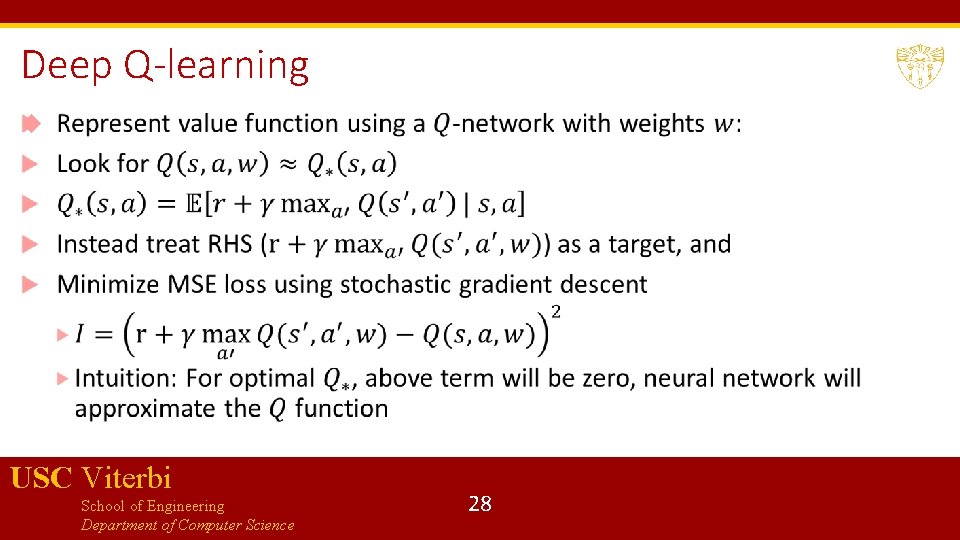
Deep Q-learning USC Viterbi School of Engineering Department of Computer Science 28
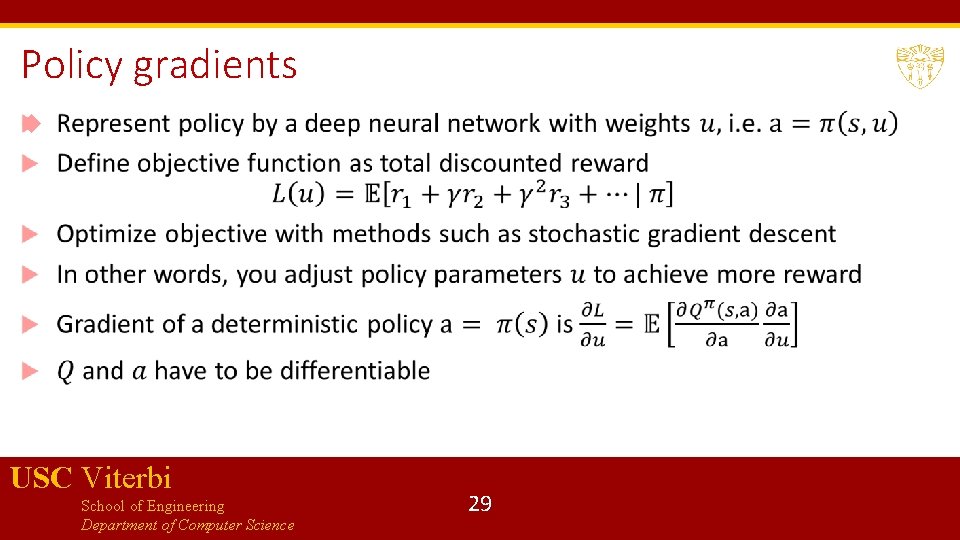
Policy gradients USC Viterbi School of Engineering Department of Computer Science 29
More Deep RL Many different extensions and improvements to basic algorithms Lots of existing research In our context: we need to adapt to deep RL over continuous spaces, or discretize state-space Continuous-time/space methods follow similar ideas. Policy gradient method extends naturally : DPG is the continuous analog of DQN USC Viterbi School of Engineering Department of Computer Science 30
Inverse Reinforcement Learning USC Viterbi School of Engineering Department of Computer Science 31
Bibliography This is a subset of the sources I used. It is possible I missed something! 1. Richard S. Sutton and Andrew G. Barto, Reinforcement Learning, MIT Press. 2. http: //ieeecss. org/CSM/library/1992/april 1992/w 01 -Reinforcement. Learning. pdf 3. Decision making under uncertainty: https: //web. stanford. edu/~mykel/pomdps. pdf 4. Satinder Singh’s tutorial: http: //web. eecs. umich. edu/~baveja/NIPS 05 RLTutorial/NIPS 05 RLMain. Tutorial. pdf 5. Great tutorial on Deep Reinforcement Learning: https: //icml. cc/2016/tutorials/deep_rl_tutorial. pdf USC Viterbi School of Engineering Department of Computer Science 32
- Slides: 32