
Autonomous CyberPhysical Systems Modelbased Design Models of Computation
Autonomous Cyber-Physical Systems: Model-based Design: Models of Computation Spring 2019. CS 599. Instructor: Jyo Deshmukh Acknowledgment: Some of the material in these slides is based on the lecture slides for CIS 540: Principles of Embedded Computation taught by Rajeev Alur at the University of Pennsylvania. http: //www. seas. upenn. edu/~cis 540/ USC Viterbi School of Engineering Department of Computer Science
Model-based Development (MBD) or design Most popular paradigm in CPS software development We will learn various aspects of MBD through this course MBD when used for designing embedded software 1 has 4 main steps 1. Model the physical components/environment (also known as a plant model) 2. Analyze the plant, and synthesize/design the control-software at a high-level 3. Co-Simulate the plant and control-software 4. Automatically generate code from the control-software model for deployment Popular MBD frameworks such as Simulink®, Lab. View™, Rational. Rose, Dy. Mola, Target. Link, Scade, etc. USC Viterbi School of Engineering Department of Computer Science 2 [1] Nicolescu, Gabriela; Mosterman, Pieter J. , eds. (2010). Model-Based Design for Embedded Systems. Computational Analysis, Synthesis, and Design of Dynamic Systems. 1. Boca Raton: CRC Press.
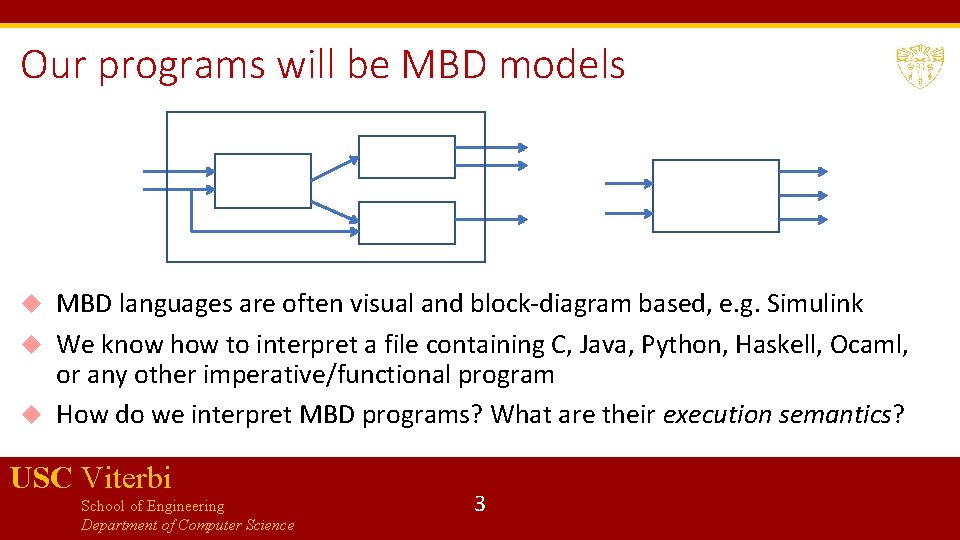
Our programs will be MBD models MBD languages are often visual and block-diagram based, e. g. Simulink We know how to interpret a file containing C, Java, Python, Haskell, Ocaml, or any other imperative/functional program How do we interpret MBD programs? What are their execution semantics? USC Viterbi School of Engineering Department of Computer Science 3
Most convenient model of computation for an Autonomous CPS is a reactive and concurrent model of computation. An autonomous CPS can be viewed as a network of components that communicate either synchronously or asynchronously. USC Viterbi School of Engineering Department of Computer Science 4
Models of Computation: Functional 1. Classical model of computation: Functional or Transformational Programs Start from a given input, Produce a certain output and then terminate Desired functionality can be described by a mathematical function Emphasis is on data computation Canonical model: Turing machines e. g. compute squareroot, encrypt some text, etc. USC Viterbi School of Engineering Department of Computer Science 5
Models of Computation: Reactive/Interactive 2. Interactive Programs: Interact with the user in their own time, i. e. react to user’s commands, but with no real-time constraints Emphasis is on user-interaction; e. g. a web browsers, word processors, etc. 3. Reactive Programs: Continuously interact with the environment at a rate decided by the environment Emphasis is on system-environment interaction; e. g. airline autopilot, mail-servers, etc. USC Viterbi School of Engineering Department of Computer Science 6
Synchronous Components USC Viterbi School of Engineering Department of Computer Science 7
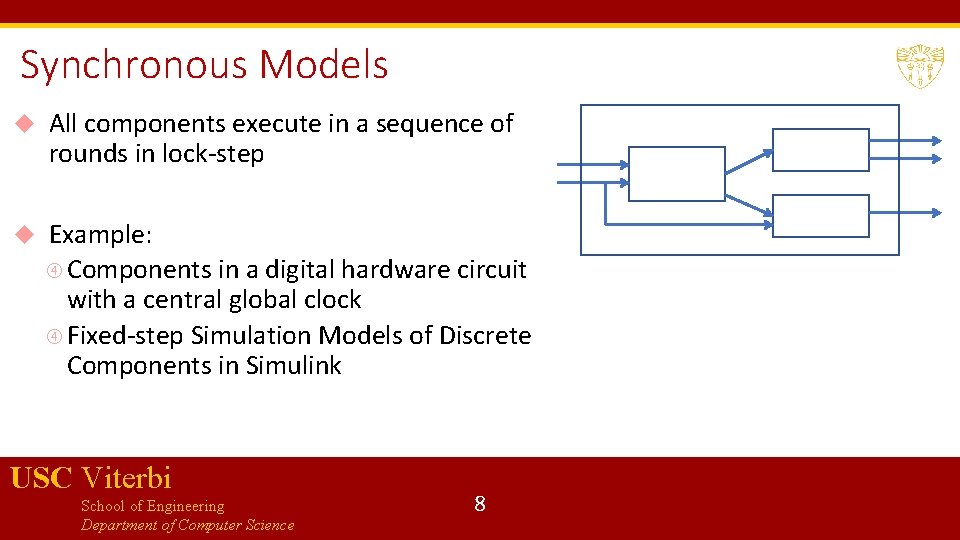
Synchronous Models All components execute in a sequence of rounds in lock-step Example: Components in a digital hardware circuit with a central global clock Fixed-step Simulation Models of Discrete Components in Simulink USC Viterbi School of Engineering Department of Computer Science 8
Synchronous languages Rich class of languages called “synchronous dataflow” Scade-suite from Esterel Technologies Benefit: system design is simpler if we use a simple round-based computation Challenge: How do we ensure synchronous execution when components may execute on different hardware? USC Viterbi School of Engineering Department of Computer Science 9
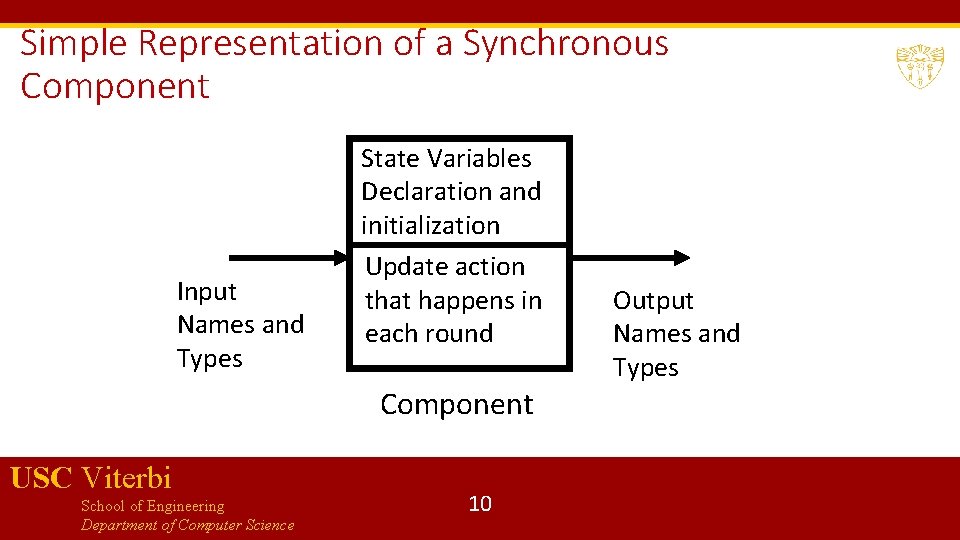
Simple Representation of a Synchronous Component Input Names and Types State Variables Declaration and initialization Update action that happens in each round Component USC Viterbi School of Engineering Department of Computer Science 10 Output Names and Types
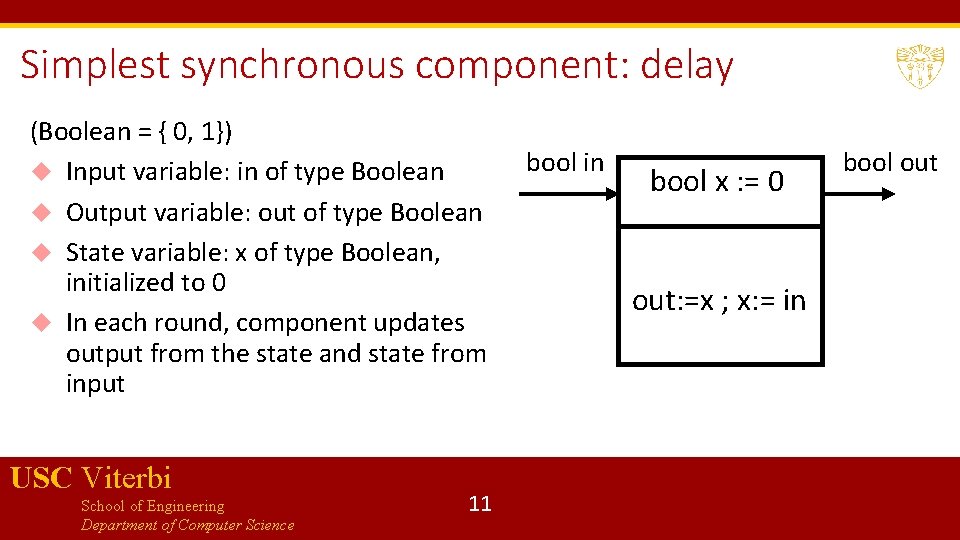
Simplest synchronous component: delay (Boolean = { 0, 1}) Input variable: in of type Boolean Output variable: out of type Boolean State variable: x of type Boolean, initialized to 0 In each round, component updates output from the state and state from input USC Viterbi School of Engineering Department of Computer Science 11 bool in bool x : = 0 out: =x ; x: = in bool out
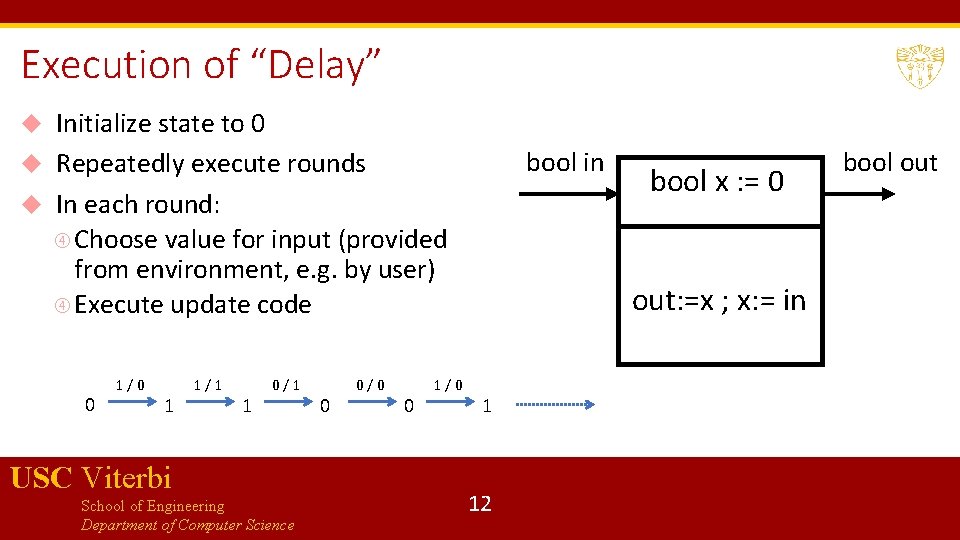
Execution of “Delay” Initialize state to 0 Repeatedly execute rounds In each round: Choose value for input (provided from environment, e. g. by user) Execute update code 0 1 / 0 1 1 / 1 1 0 / 1 USC Viterbi School of Engineering Department of Computer Science 0 0 / 0 0 1 / 0 bool in bool x : = 0 out: =x ; x: = in 1 12 bool out
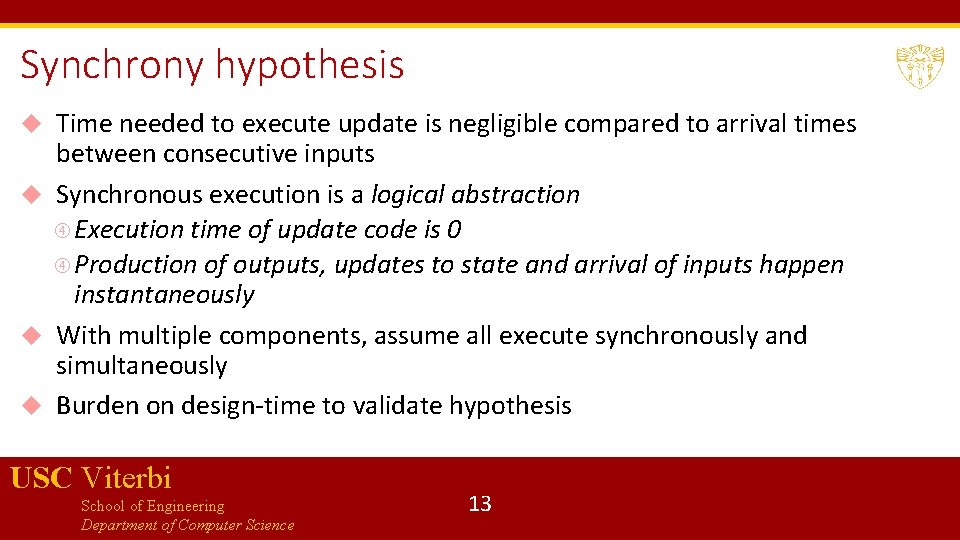
Synchrony hypothesis Time needed to execute update is negligible compared to arrival times between consecutive inputs Synchronous execution is a logical abstraction Execution time of update code is 0 Production of outputs, updates to state and arrival of inputs happen instantaneously With multiple components, assume all execute synchronously and simultaneously Burden on design-time to validate hypothesis USC Viterbi School of Engineering Department of Computer Science 13
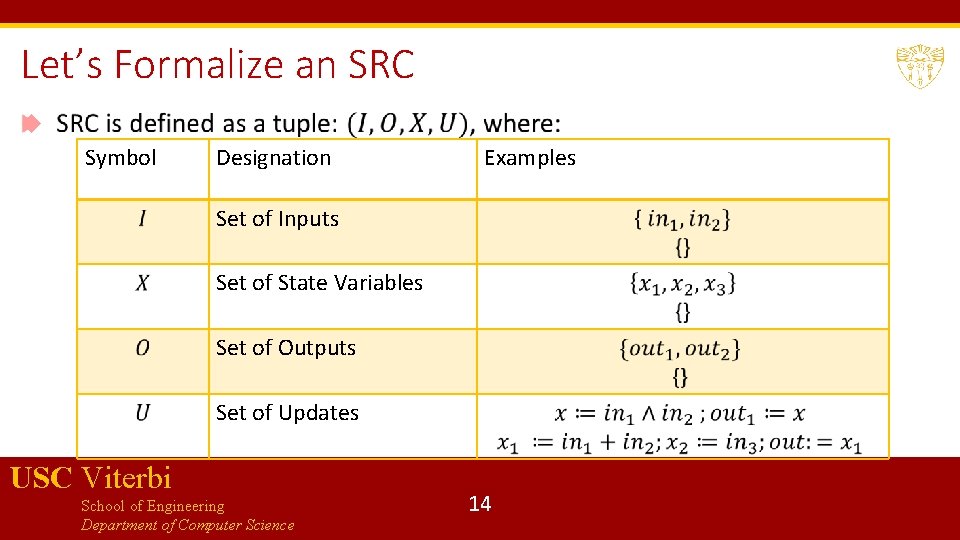
Let’s Formalize an SRC Symbol Designation Examples Set of Inputs Set of State Variables Set of Outputs Set of Updates USC Viterbi School of Engineering Department of Computer Science 14
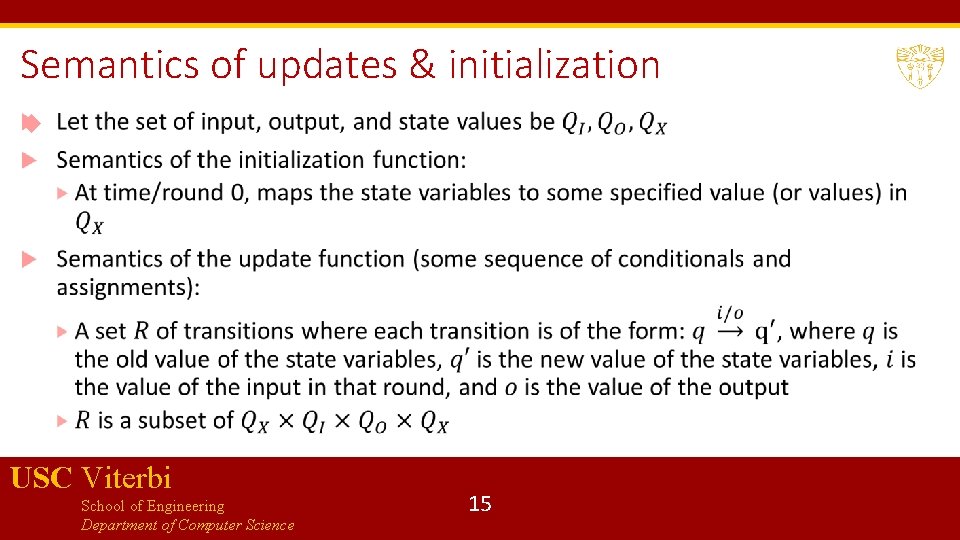
Semantics of updates & initialization USC Viterbi School of Engineering Department of Computer Science 15
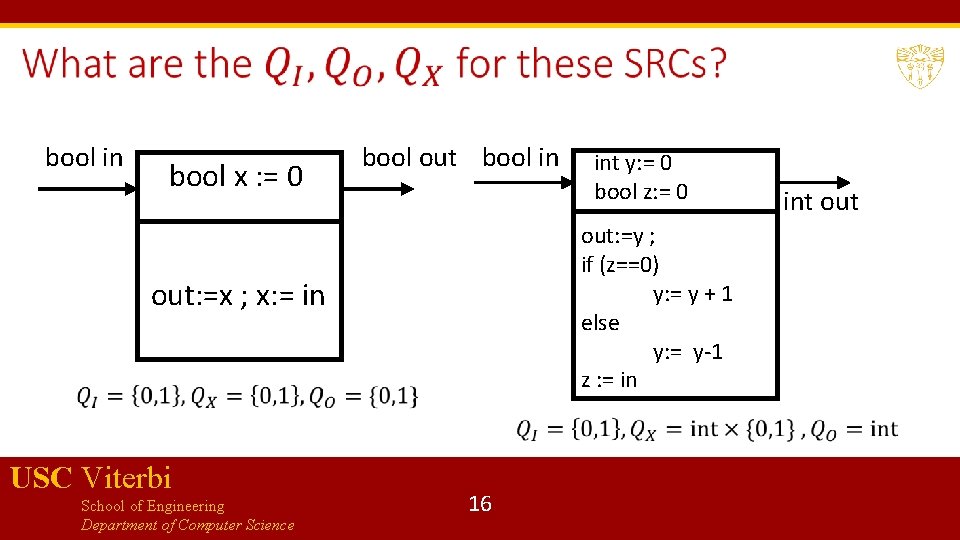
bool in bool x : = 0 bool out bool in out: =y ; if (z==0) y: = y + 1 else y: = y-1 z : = in out: =x ; x: = in USC Viterbi School of Engineering Department of Computer Science int y: = 0 bool z: = 0 16 int out
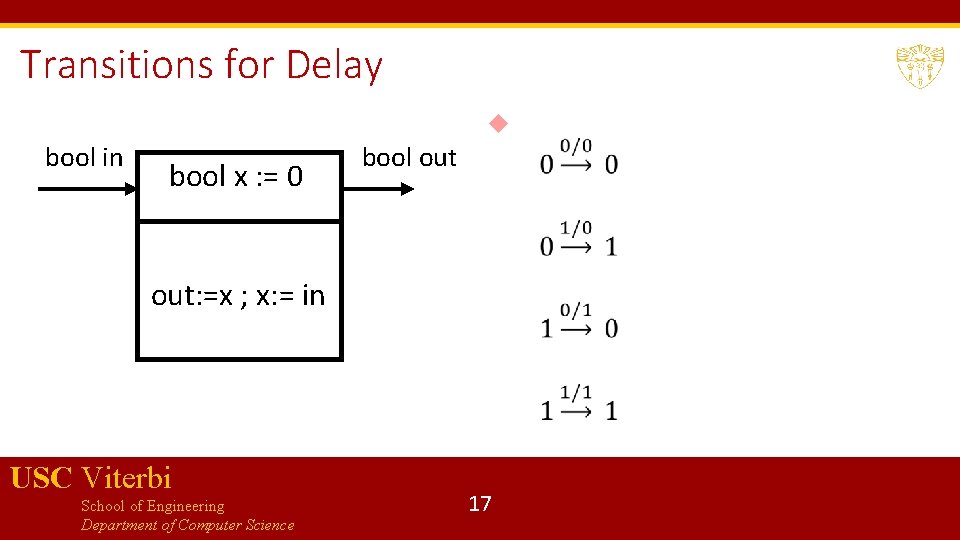
Transitions for Delay bool in bool x : = 0 bool out: =x ; x: = in USC Viterbi School of Engineering Department of Computer Science 17
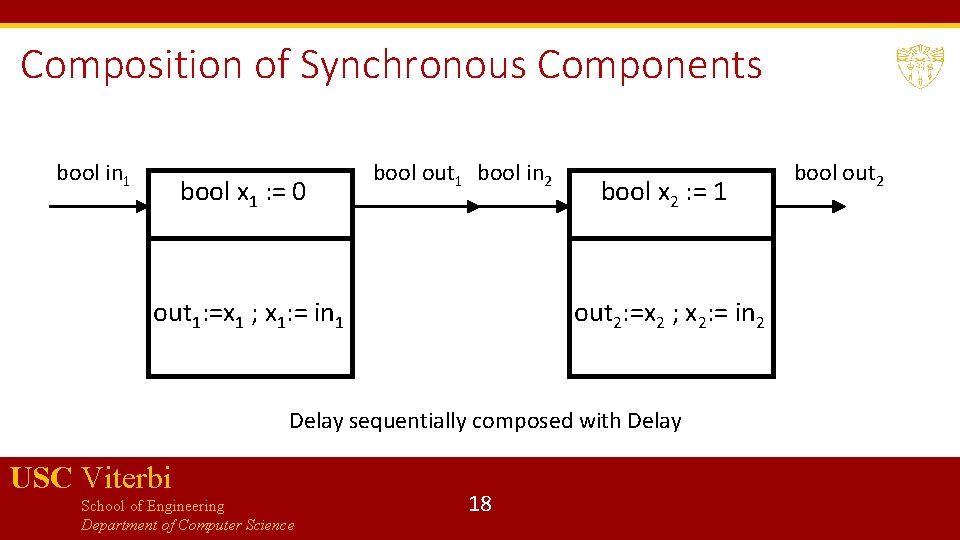
Composition of Synchronous Components bool in 1 bool x 1 : = 0 bool out 1 bool in 2 out 1: =x 1 ; x 1: = in 1 bool x 2 : = 1 out 2: =x 2 ; x 2: = in 2 Delay sequentially composed with Delay USC Viterbi School of Engineering Department of Computer Science 18 bool out 2
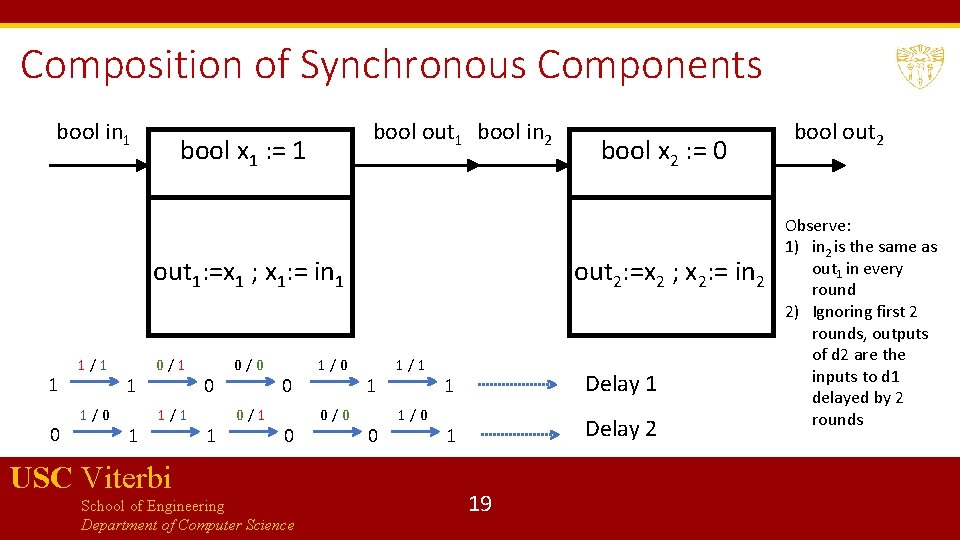
Composition of Synchronous Components bool in 1 bool out 1 bool in 2 bool x 1 : = 1 out 1: =x 1 ; x 1: = in 1 1 0 1 / 1 1 / 0 1 1 0 / 1 1 / 1 0 / 0 0 / 1 0 0 USC Viterbi School of Engineering Department of Computer Science 1 / 0 0 / 0 bool x 2 : = 0 out 2: =x 2 ; x 2: = in 2 1 0 1 / 1 1 / 0 1 Delay 1 1 Delay 2 19 bool out 2 Observe: 1) in 2 is the same as out 1 in every round 2) Ignoring first 2 rounds, outputs of d 2 are the inputs to d 1 delayed by 2 rounds
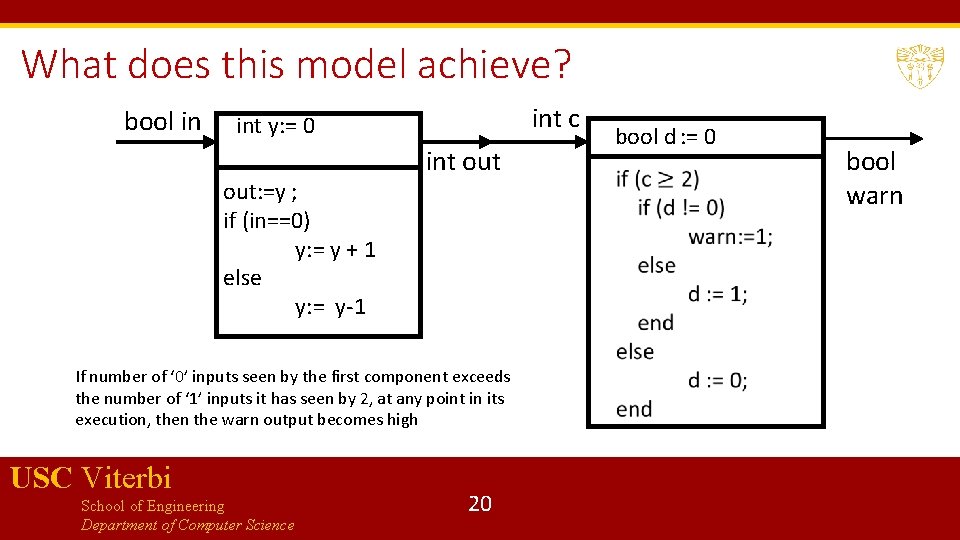
What does this model achieve? bool in int c int y: = 0 out: =y ; if (in==0) y: = y + 1 else y: = y-1 int out If number of ‘ 0’ inputs seen by the first component exceeds the number of ‘ 1’ inputs it has seen by 2, at any point in its execution, then the warn output becomes high USC Viterbi School of Engineering Department of Computer Science 20 bool d : = 0 bool warn
Deterministic Component USC Viterbi School of Engineering Department of Computer Science 21
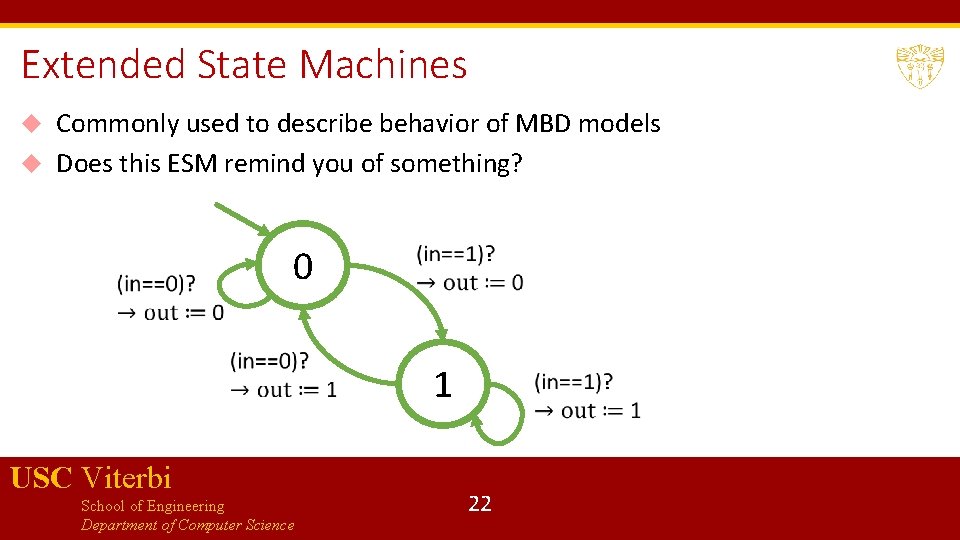
Extended State Machines Commonly used to describe behavior of MBD models Does this ESM remind you of something? 0 USC Viterbi School of Engineering Department of Computer Science 1 22
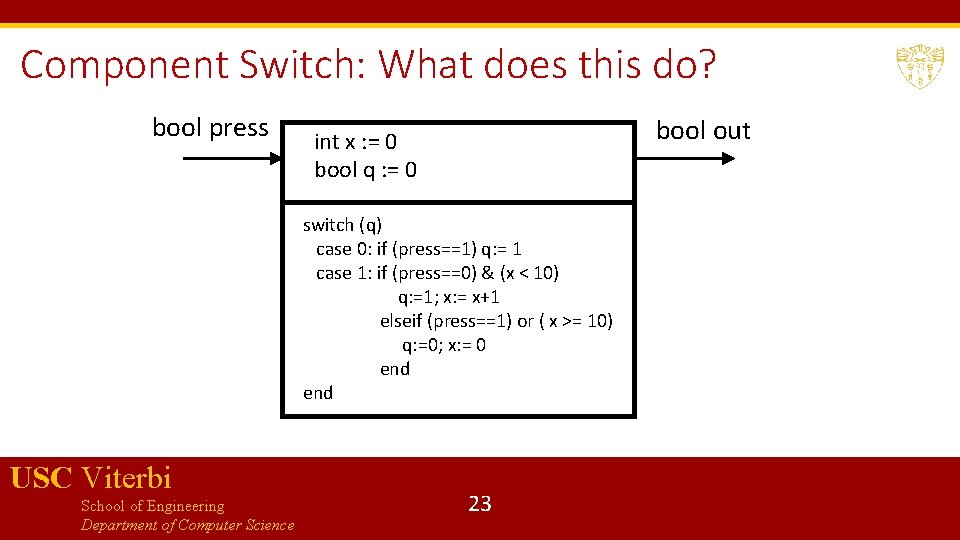
Component Switch: What does this do? bool press bool out int x : = 0 bool q : = 0 switch (q) case 0: if (press==1) q: = 1 case 1: if (press==0) & (x < 10) q: =1; x: = x+1 elseif (press==1) or ( x >= 10) q: =0; x: = 0 end USC Viterbi School of Engineering Department of Computer Science 23
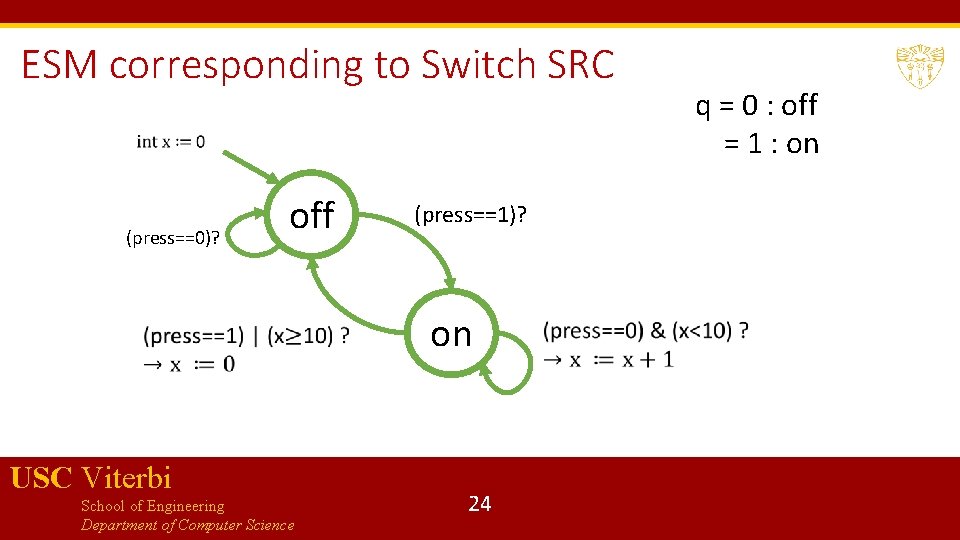
ESM corresponding to Switch SRC (press==0)? off USC Viterbi School of Engineering Department of Computer Science (press==1)? on 24 q = 0 : off = 1 : on
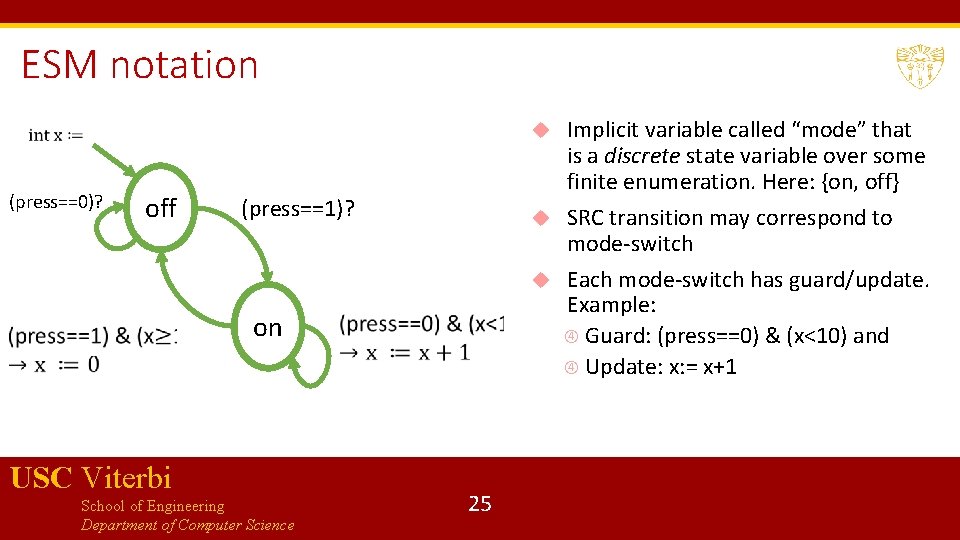
ESM notation Implicit variable called “mode” that is a discrete state variable over some finite enumeration. Here: {on, off} SRC transition may correspond to mode-switch Each mode-switch has guard/update. Example: Guard: (press==0) & (x<10) and Update: x: = x+1 (press==0)? off (press==1)? on USC Viterbi School of Engineering Department of Computer Science 25
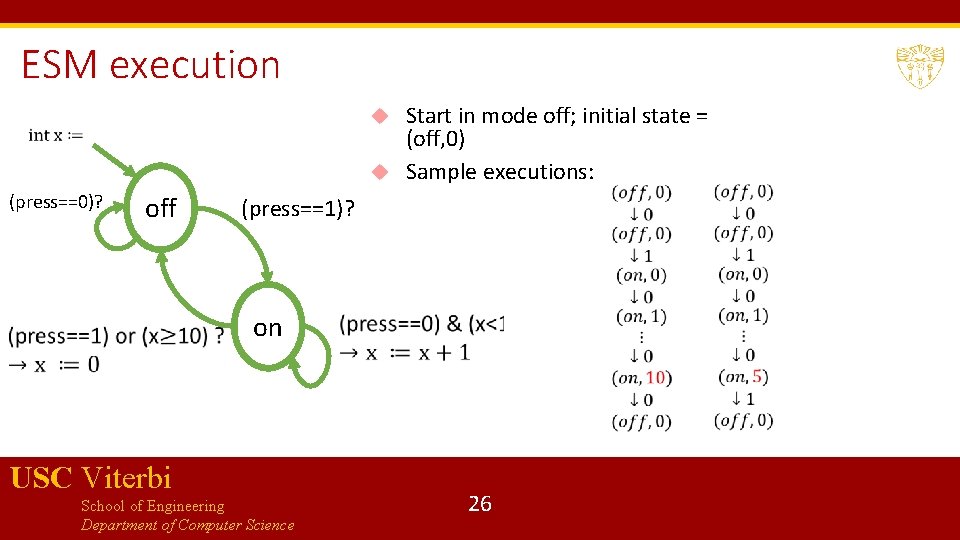
ESM execution Start in mode off; initial state = (off, 0) Sample executions: (press==0)? off (press==1)? on USC Viterbi School of Engineering Department of Computer Science 26
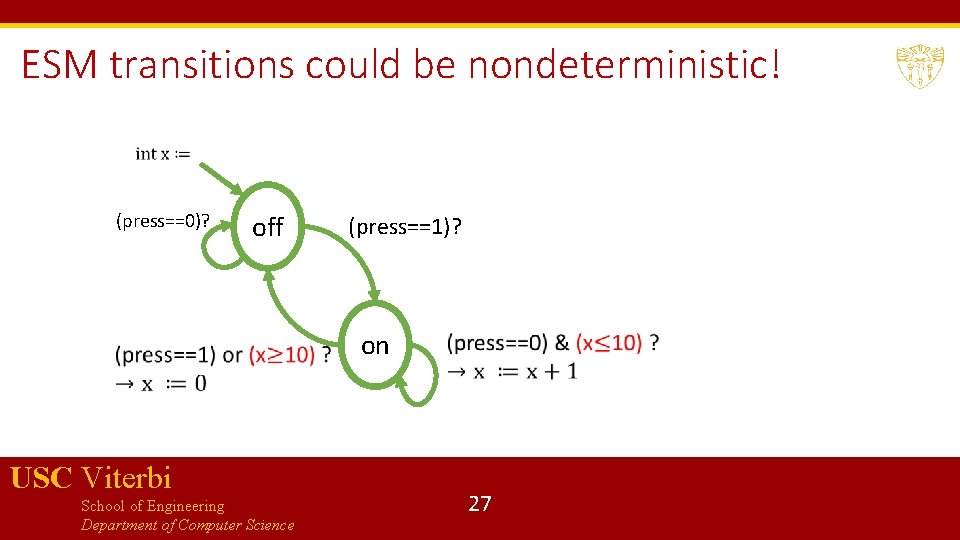
ESM transitions could be nondeterministic! (press==0)? off USC Viterbi School of Engineering Department of Computer Science (press==1)? on 27
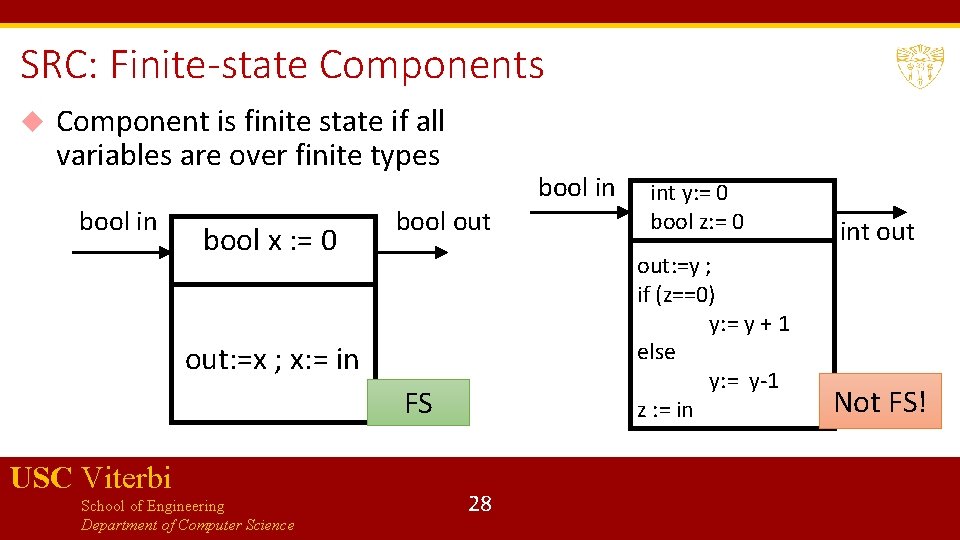
SRC: Finite-state Components Component is finite state if all variables are over finite types bool in bool x : = 0 bool out FS School of Engineering Department of Computer Science int y: = 0 bool z: = 0 out: =y ; if (z==0) y: = y + 1 else y: = y-1 z : = in out: =x ; x: = in USC Viterbi bool in 28 int out Not FS!
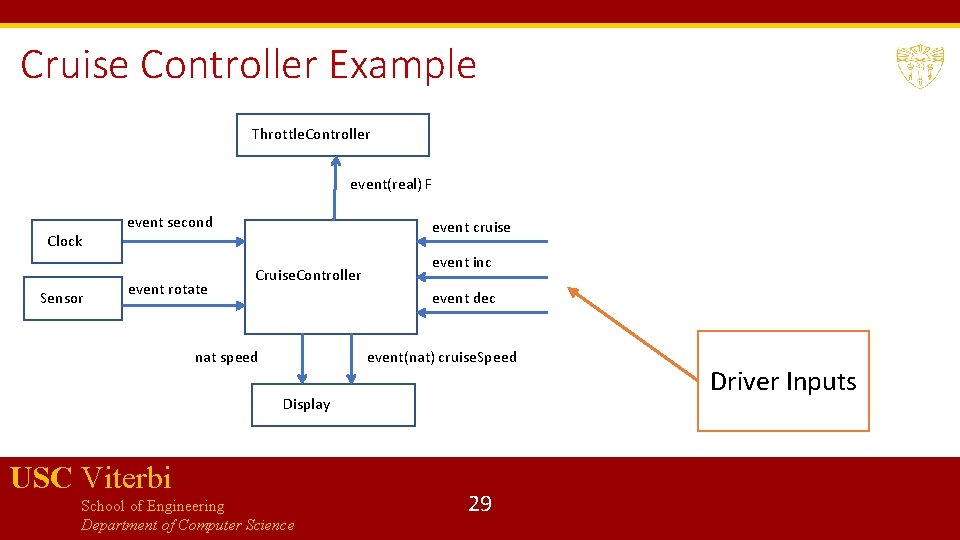
Cruise Controller Example Throttle. Controller event(real) F Clock Sensor event second event rotate event cruise Cruise. Controller event inc event dec nat speed event(nat) cruise. Speed Display USC Viterbi School of Engineering Department of Computer Science 29 Driver Inputs
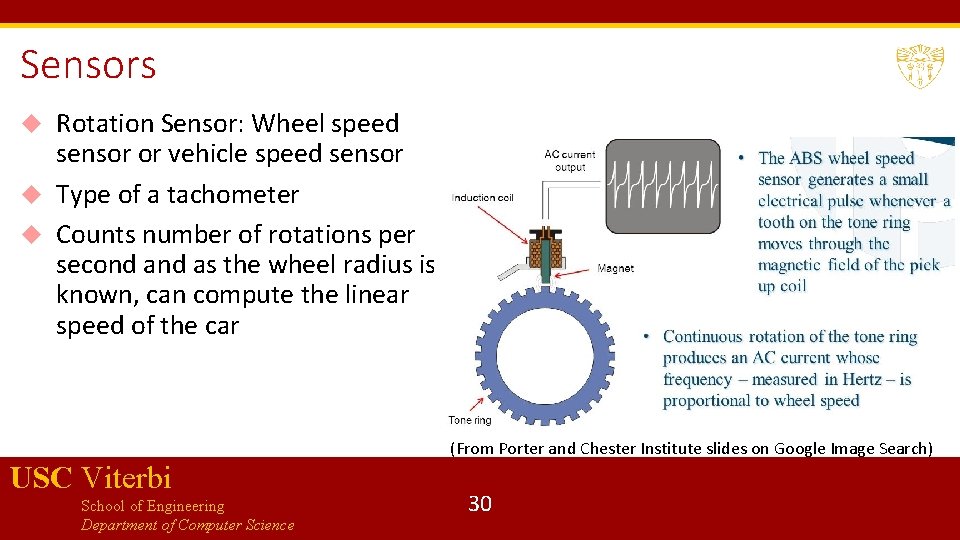
Sensors Rotation Sensor: Wheel speed sensor or vehicle speed sensor Type of a tachometer Counts number of rotations per second as the wheel radius is known, can compute the linear speed of the car (From Porter and Chester Institute slides on Google Image Search) USC Viterbi School of Engineering Department of Computer Science 30
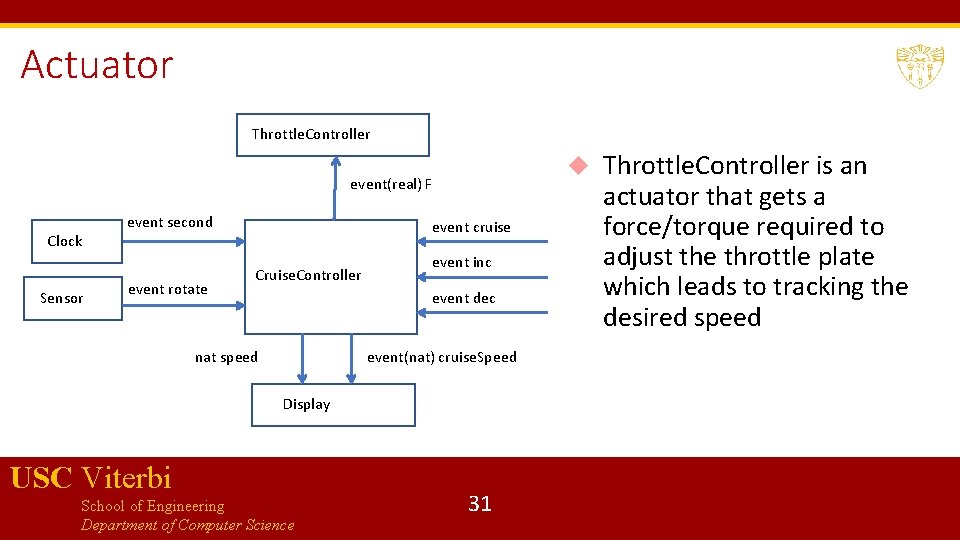
Actuator Throttle. Controller event(real) F Clock Sensor event second event rotate event cruise Cruise. Controller event inc event dec nat speed event(nat) cruise. Speed Display USC Viterbi School of Engineering Department of Computer Science 31 Throttle. Controller is an actuator that gets a force/torque required to adjust the throttle plate which leads to tracking the desired speed
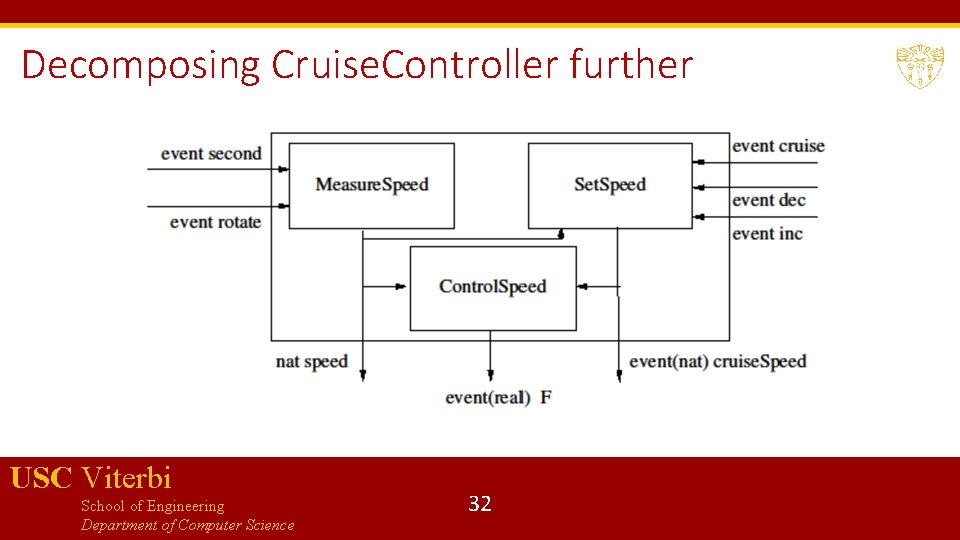
Decomposing Cruise. Controller further USC Viterbi School of Engineering Department of Computer Science 32
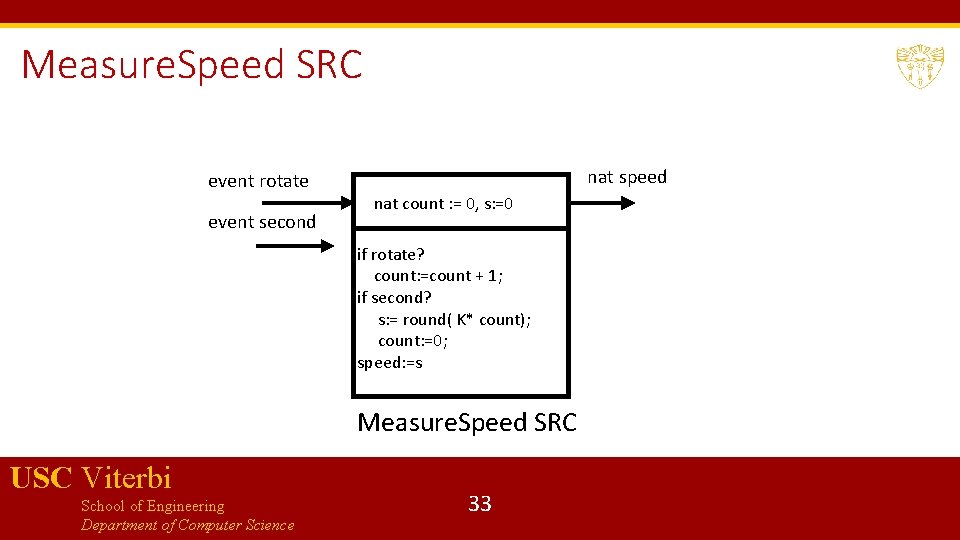
Measure. Speed SRC event rotate event second nat speed nat count : = 0, s: =0 if rotate? count: =count + 1; if second? s: = round( K* count); count: =0; speed: =s Measure. Speed SRC USC Viterbi School of Engineering Department of Computer Science 33
Asynchronous Components USC Viterbi School of Engineering Department of Computer Science 34
Asynchrony Synchrony: All components execute in a sequence of rounds in lock-step Asynchrony: No lock-step computation! Natural model for networked, distributed communicating components executing independently and at possibly different speeds As there is no central, global clock, explicit coordination is required between components Examples: Processes in distributed computation, multiple threads in any modern OS Interrupt-driven processing USC Viterbi School of Engineering Department of Computer Science 35 [1] Nicolescu, Gabriela; Mosterman, Pieter J. , eds. (2010). Model-Based Design for Embedded Systems. Computational Analysis, Synthesis, and Design of Dynamic Systems. 1. Boca Raton: CRC Press.
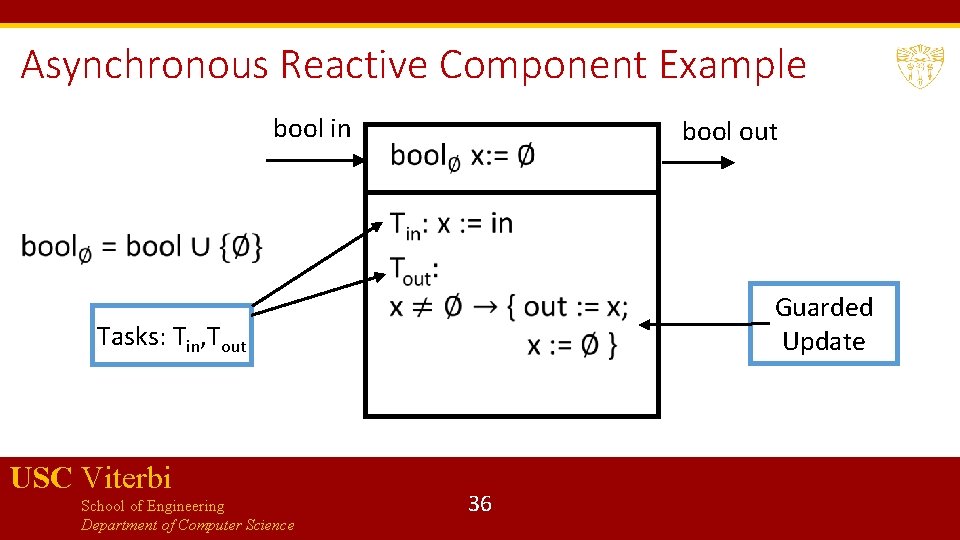
Asynchronous Reactive Component Example bool in bool out Guarded Update Tasks: Tin, Tout USC Viterbi School of Engineering Department of Computer Science 36
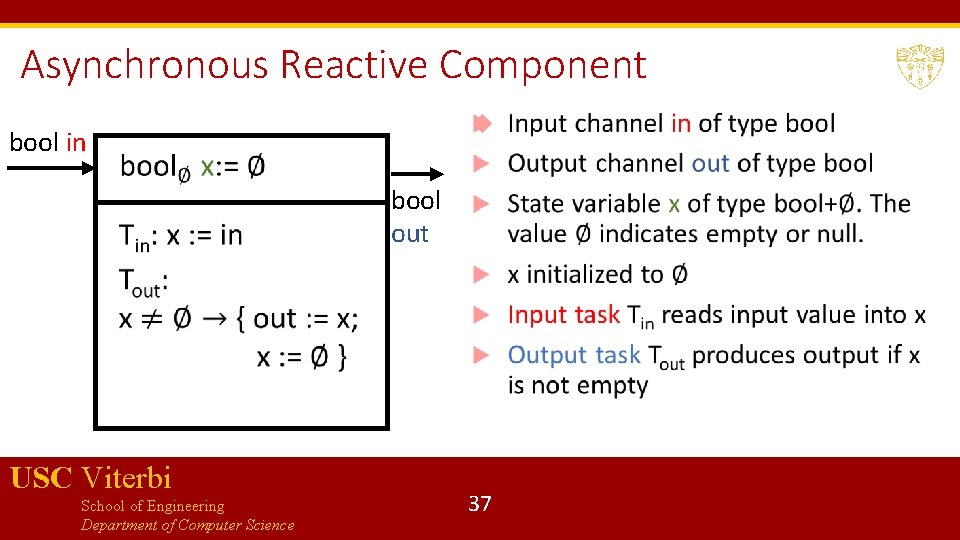
Asynchronous Reactive Component bool in bool out USC Viterbi School of Engineering Department of Computer Science 37
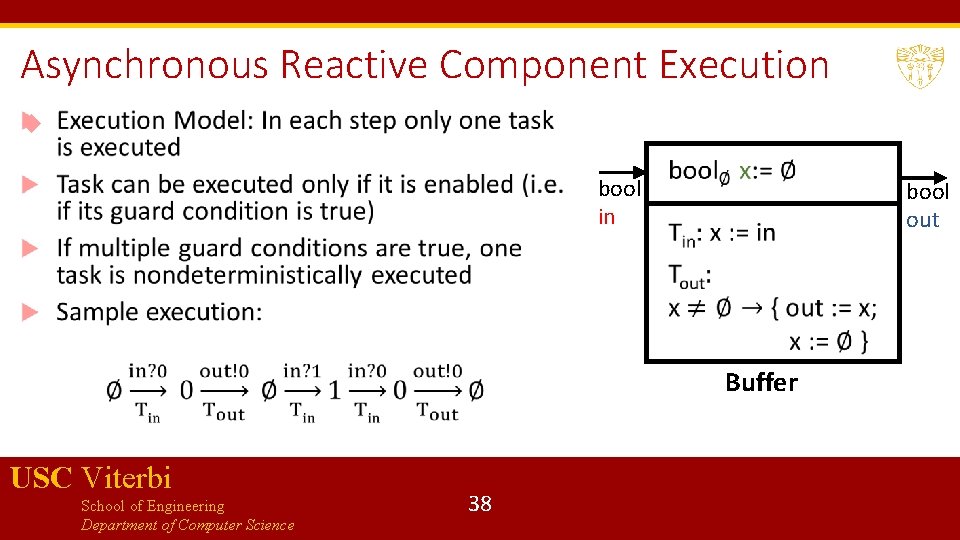
Asynchronous Reactive Component Execution bool in bool out Buffer USC Viterbi School of Engineering Department of Computer Science 38
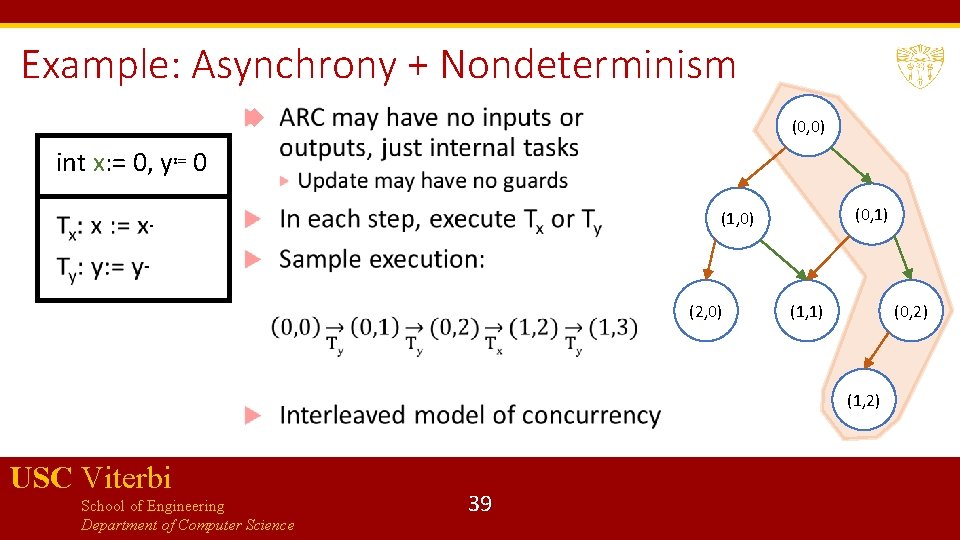
Example: Asynchrony + Nondeterminism (0, 0) int x: = 0, y≔ 0 (0, 1) (1, 0) (2, 0) (1, 1) (0, 2) (1, 2) USC Viterbi School of Engineering Department of Computer Science 39
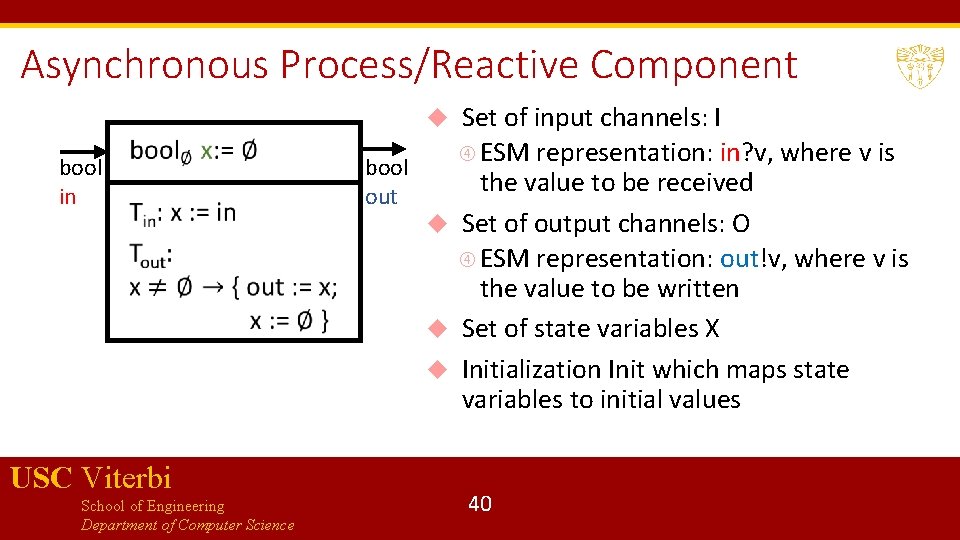
Asynchronous Process/Reactive Component Set of input channels: I ESM representation: in? v, where v is bool the value to be received out Set of output channels: O ESM representation: out!v, where v is the value to be written Set of state variables X Initialization Init which maps state variables to initial values bool in USC Viterbi School of Engineering Department of Computer Science 40
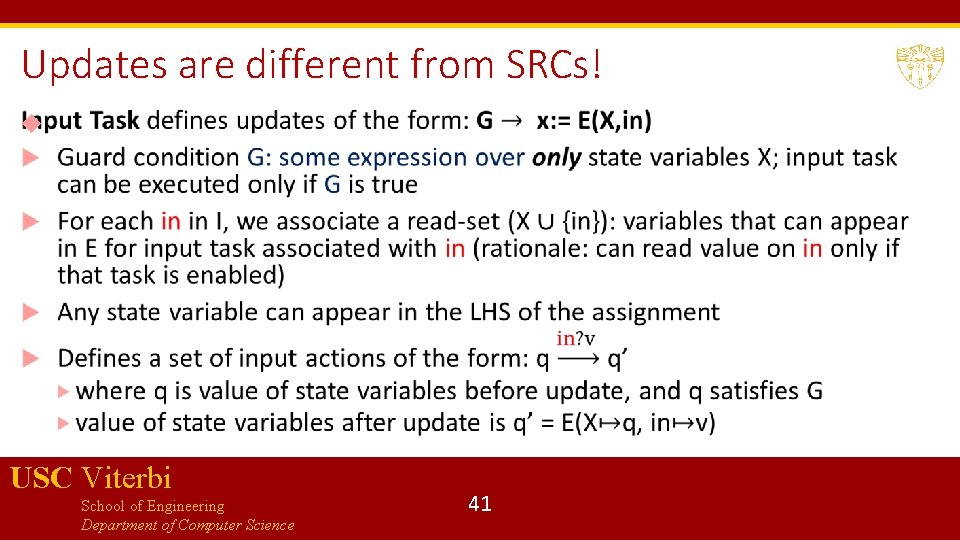
Updates are different from SRCs! USC Viterbi School of Engineering Department of Computer Science 41
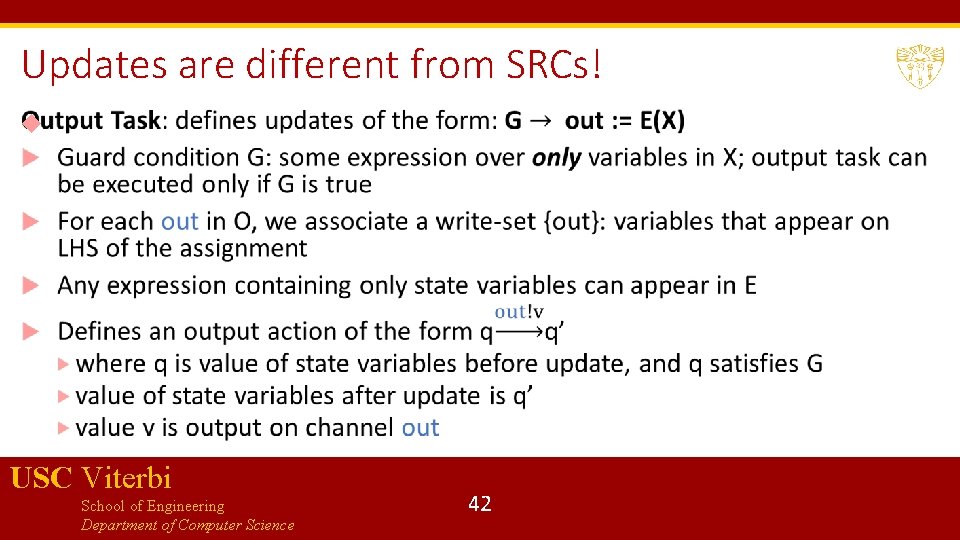
Updates are different from SRCs! USC Viterbi School of Engineering Department of Computer Science 42
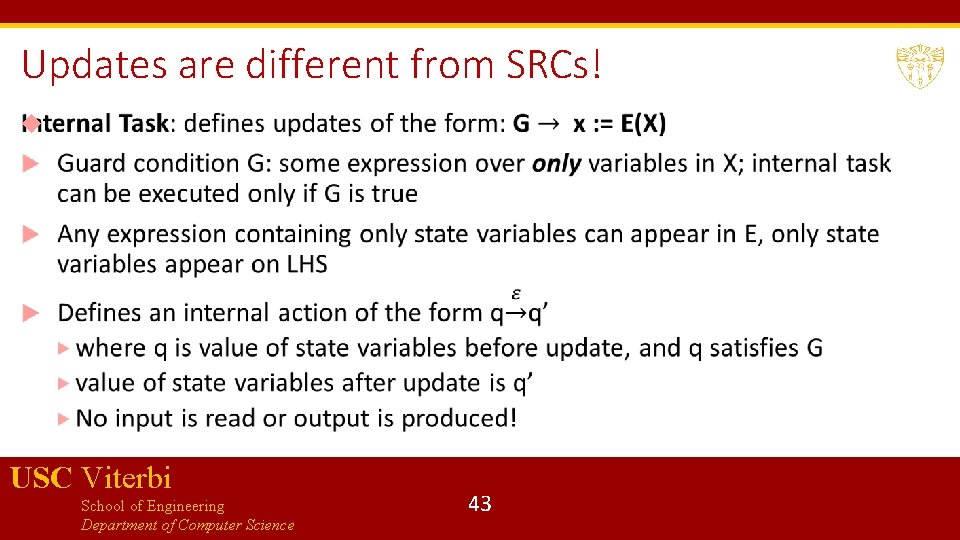
Updates are different from SRCs! USC Viterbi School of Engineering Department of Computer Science 43
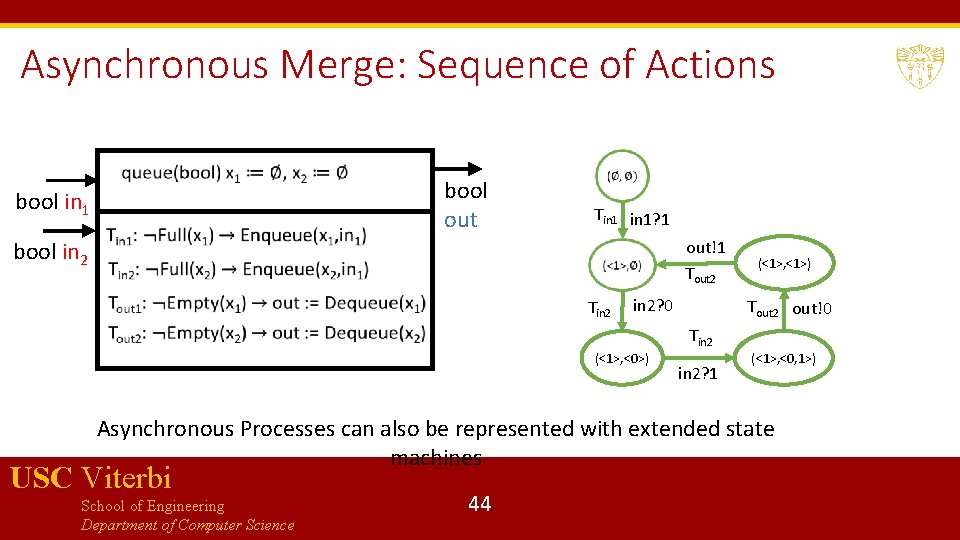
Asynchronous Merge: Sequence of Actions bool in 1 bool in 2 bool out Tin 1? 1 Tin 2 out!1 Tout 2 in 2? 0 (<1>, <1>) Tout 2 out!0 Tin 2 (<1>, <0>) in 2? 1 (<1>, <0, 1>) Asynchronous Processes can also be represented with extended state machines USC Viterbi School of Engineering Department of Computer Science 44
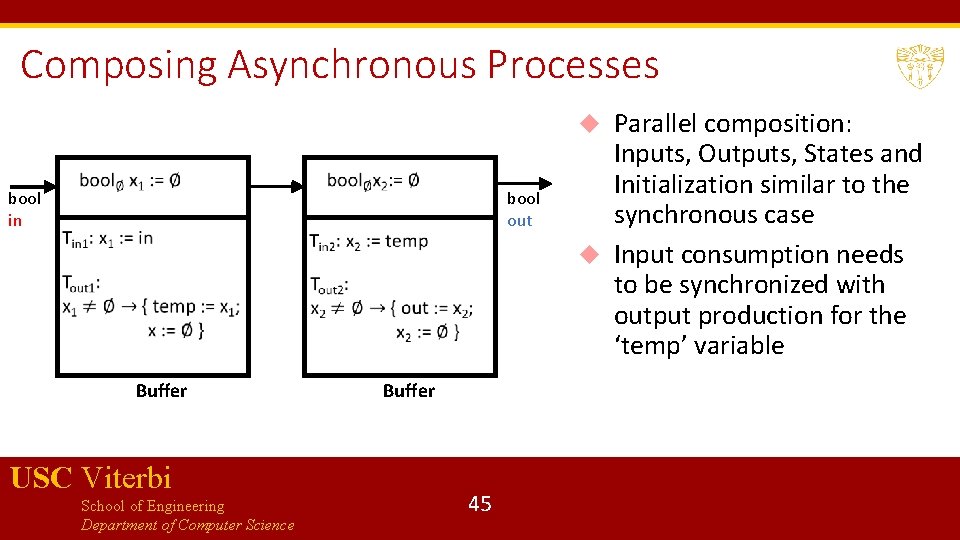
Composing Asynchronous Processes Parallel composition: Inputs, Outputs, States and Initialization similar to the synchronous case Input consumption needs to be synchronized with output production for the ‘temp’ variable bool in Buffer USC Viterbi School of Engineering Department of Computer Science bool out Buffer 45
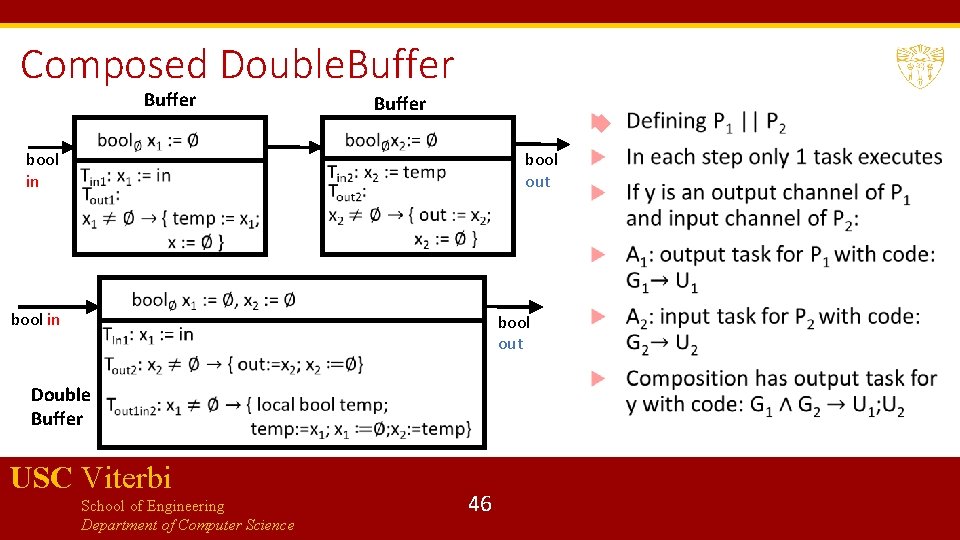
Composed Double. Buffer bool in bool in Buffer bool out Double Buffer USC Viterbi School of Engineering Department of Computer Science 46
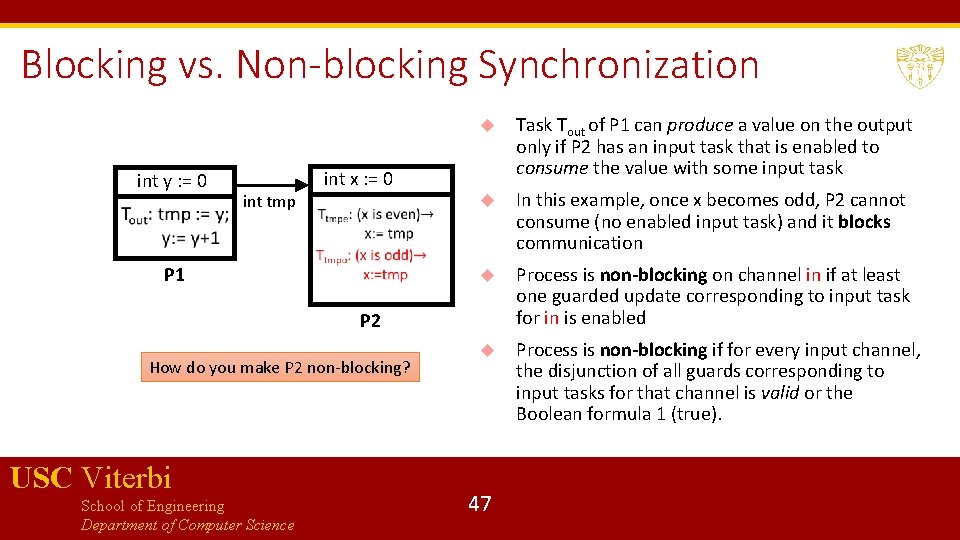
Blocking vs. Non-blocking Synchronization int y : = 0 int tmp P 1 Task Tout of P 1 can produce a value on the output only if P 2 has an input task that is enabled to consume the value with some input task In this example, once x becomes odd, P 2 cannot consume (no enabled input task) and it blocks communication Process is non-blocking on channel in if at least one guarded update corresponding to input task for in is enabled Process is non-blocking if for every input channel, the disjunction of all guards corresponding to input tasks for that channel is valid or the Boolean formula 1 (true). int x : = 0 P 2 How do you make P 2 non-blocking? USC Viterbi School of Engineering Department of Computer Science 47
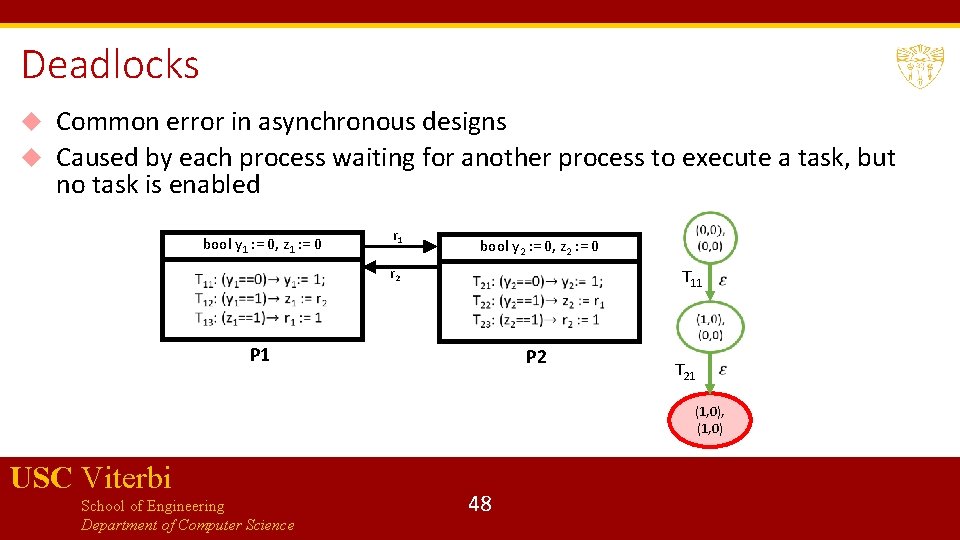
Deadlocks Common error in asynchronous designs Caused by each process waiting for another process to execute a task, but no task is enabled bool y 1 : = 0, z 1 : = 0 r 1 r 2 bool y 2 : = 0, z 2 : = 0 T 11 P 1 P 2 T 21 (1, 0), (1, 0) USC Viterbi School of Engineering Department of Computer Science 48
Wrapping it all up Synchronous components/processes: Good abstraction if you have a common shared clock at which each component in your software executes Asynchronous components/processes Good abstraction if you have interrupts, user-driven actions Next time: Models for the environment/physical processes (timed and dynamical models) USC Viterbi School of Engineering Department of Computer Science 49
- Slides: 49