
Autonomous CyberPhysical Systems Fairness Monitors and BranchingTime Logics
Autonomous Cyber-Physical Systems: Fairness, Monitors and Branching-Time Logics Spring 2018. CS 599. Instructor: Jyo Deshmukh Acknowledgment: Some of the material in these slides is based on the lecture slides for CIS 540: Principles of Embedded Computation taught by Rajeev Alur at the University of Pennsylvania. http: //www. seas. upenn. edu/~cis 540/ USC Viterbi School of Engineering Department of Computer Science
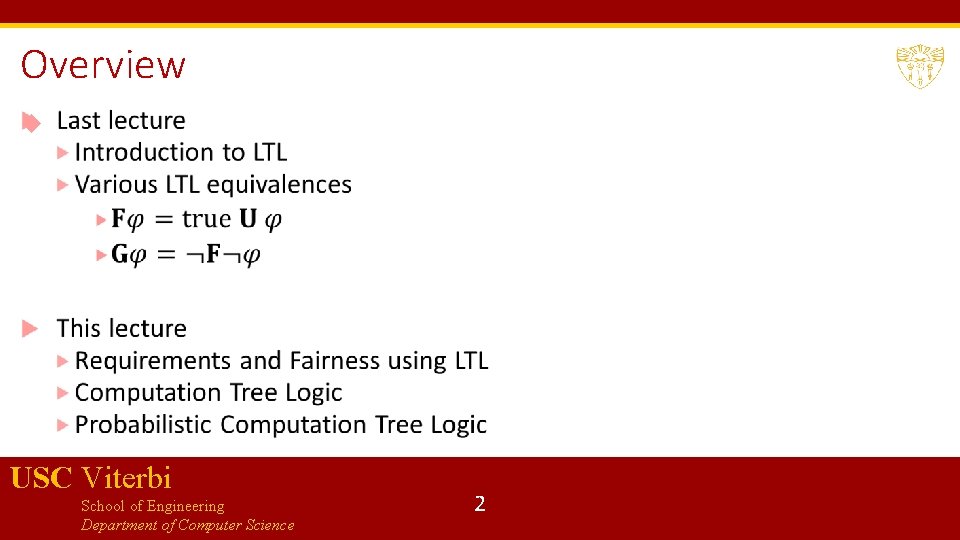
Overview USC Viterbi School of Engineering Department of Computer Science 2
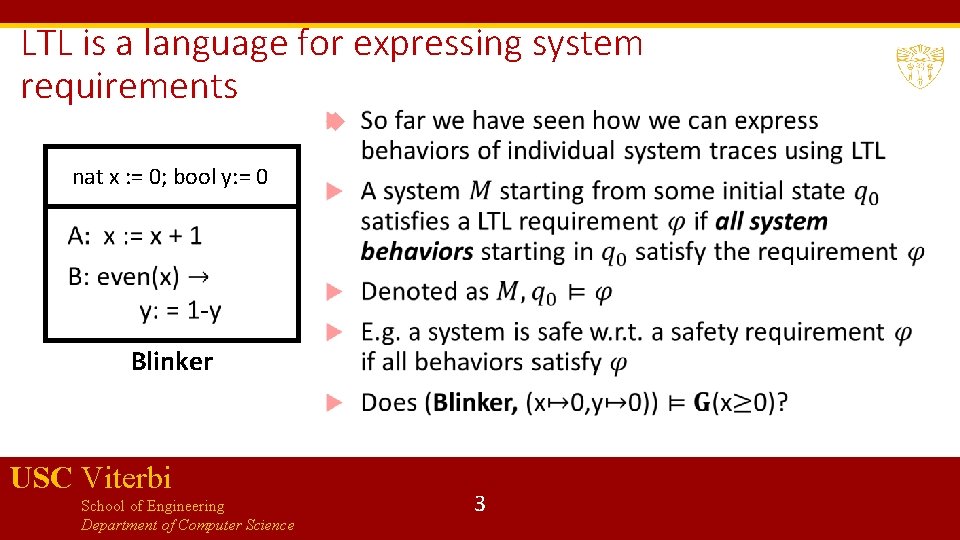
LTL is a language for expressing system requirements nat x : = 0; bool y: = 0 Blinker USC Viterbi School of Engineering Department of Computer Science 3
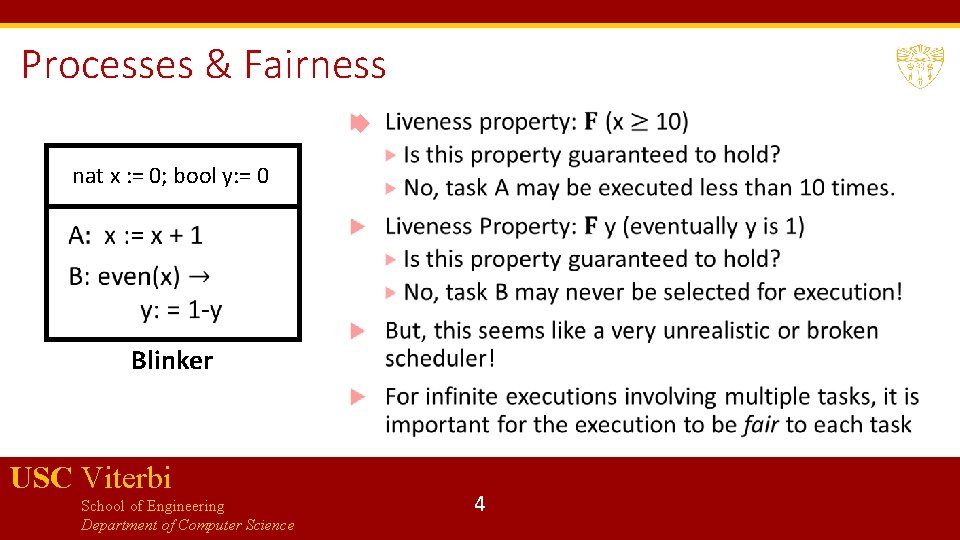
Processes & Fairness nat x : = 0; bool y: = 0 Blinker USC Viterbi School of Engineering Department of Computer Science 4
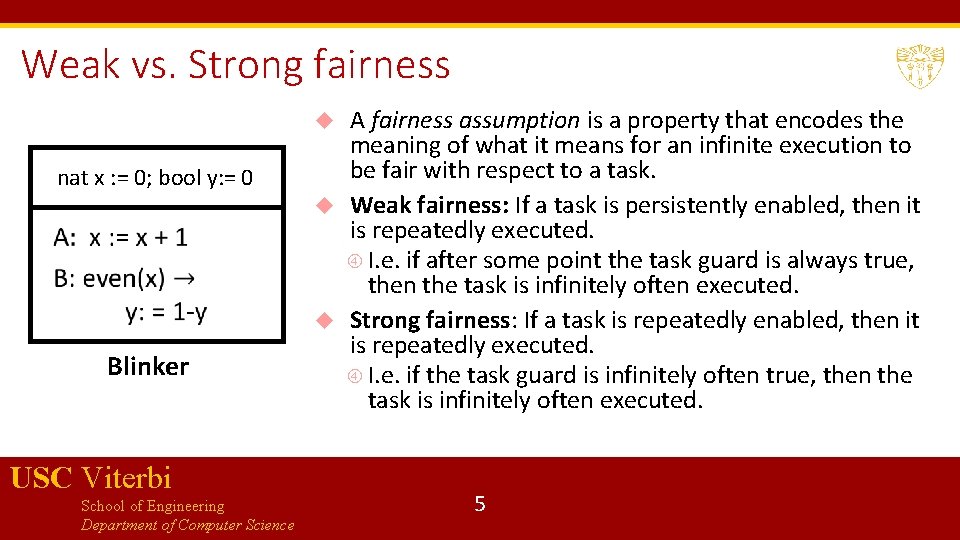
Weak vs. Strong fairness A fairness assumption is a property that encodes the meaning of what it means for an infinite execution to be fair with respect to a task. Weak fairness: If a task is persistently enabled, then it is repeatedly executed. I. e. if after some point the task guard is always true, then the task is infinitely often executed. Strong fairness: If a task is repeatedly enabled, then it is repeatedly executed. I. e. if the task guard is infinitely often true, then the task is infinitely often executed. nat x : = 0; bool y: = 0 Blinker USC Viterbi School of Engineering Department of Computer Science 5
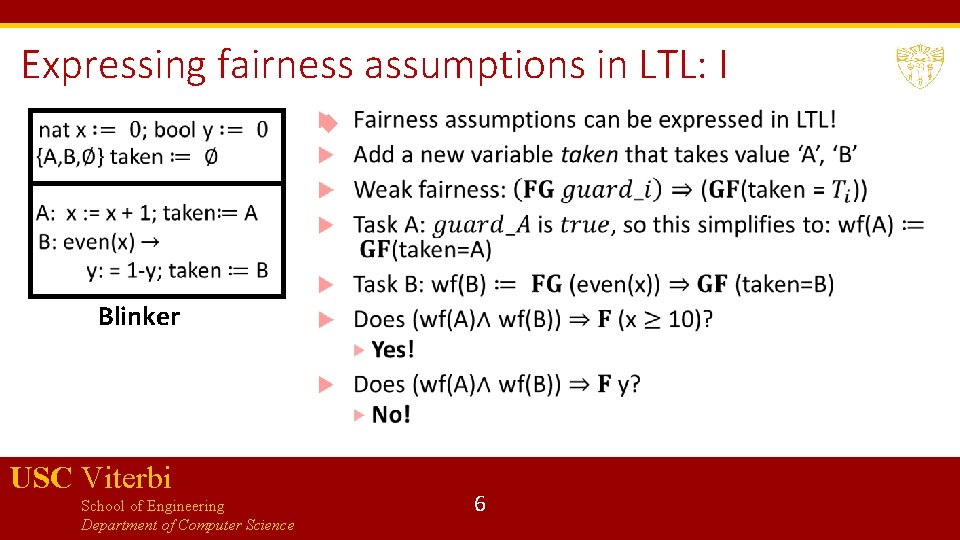
Expressing fairness assumptions in LTL: I Blinker USC Viterbi School of Engineering Department of Computer Science 6
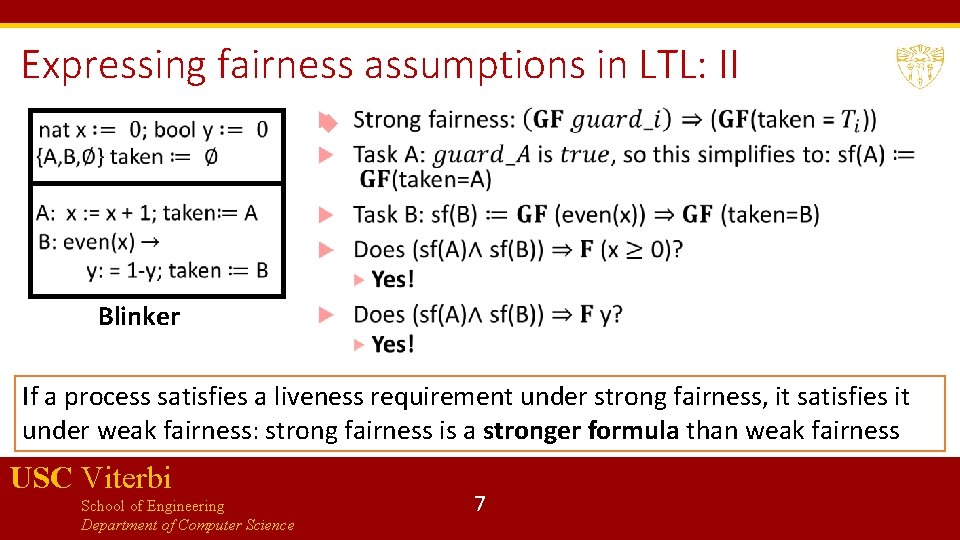
Expressing fairness assumptions in LTL: II Blinker If a process satisfies a liveness requirement under strong fairness, it satisfies it under weak fairness: strong fairness is a stronger formula than weak fairness USC Viterbi School of Engineering Department of Computer Science 7
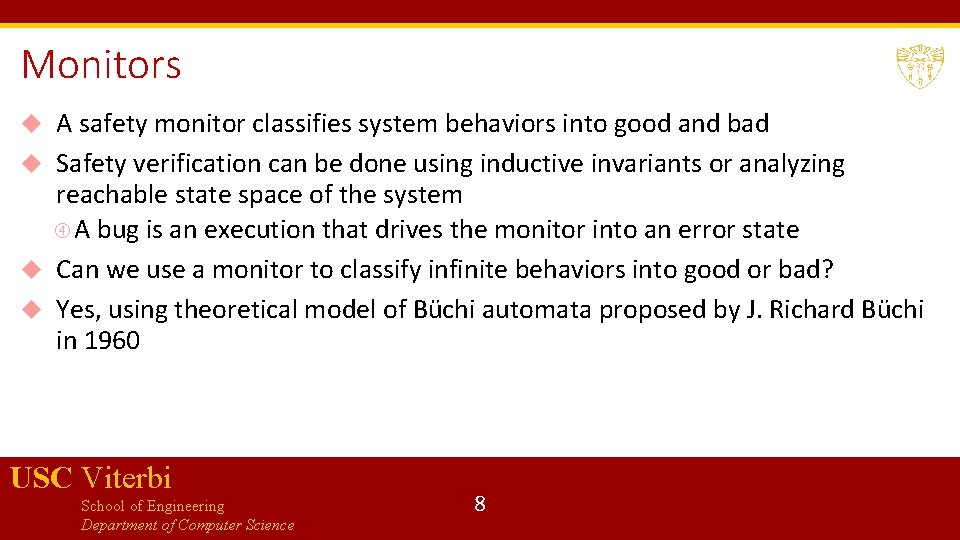
Monitors A safety monitor classifies system behaviors into good and bad Safety verification can be done using inductive invariants or analyzing reachable state space of the system A bug is an execution that drives the monitor into an error state Can we use a monitor to classify infinite behaviors into good or bad? Yes, using theoretical model of Büchi automata proposed by J. Richard Büchi in 1960 USC Viterbi School of Engineering Department of Computer Science 8
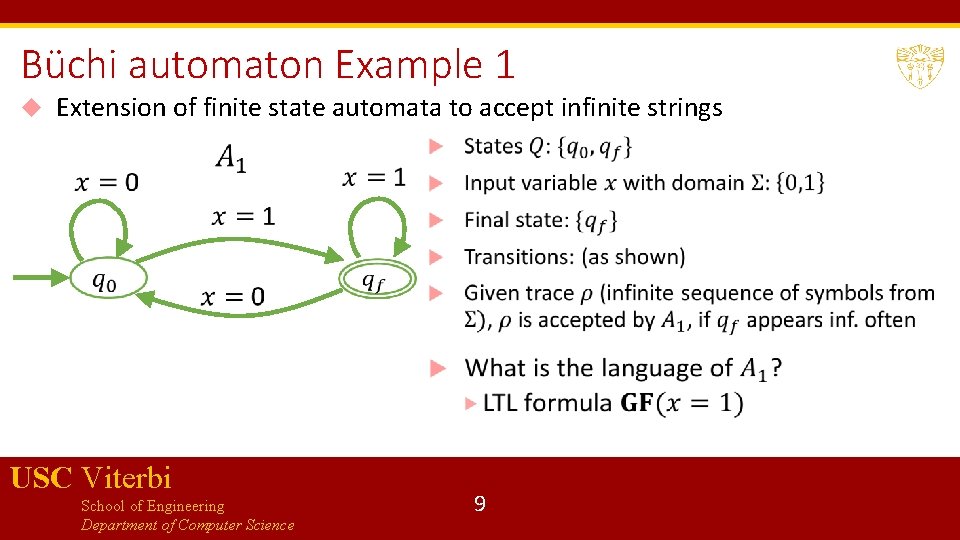
Büchi automaton Example 1 Extension of finite state automata to accept infinite strings USC Viterbi School of Engineering Department of Computer Science 9
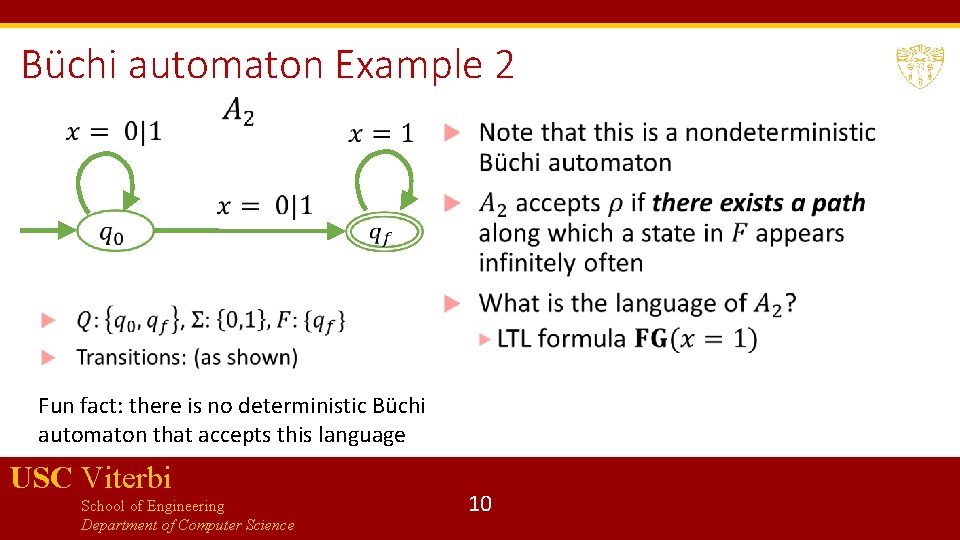
Büchi automaton Example 2 Fun fact: there is no deterministic Büchi automaton that accepts this language USC Viterbi School of Engineering Department of Computer Science 10
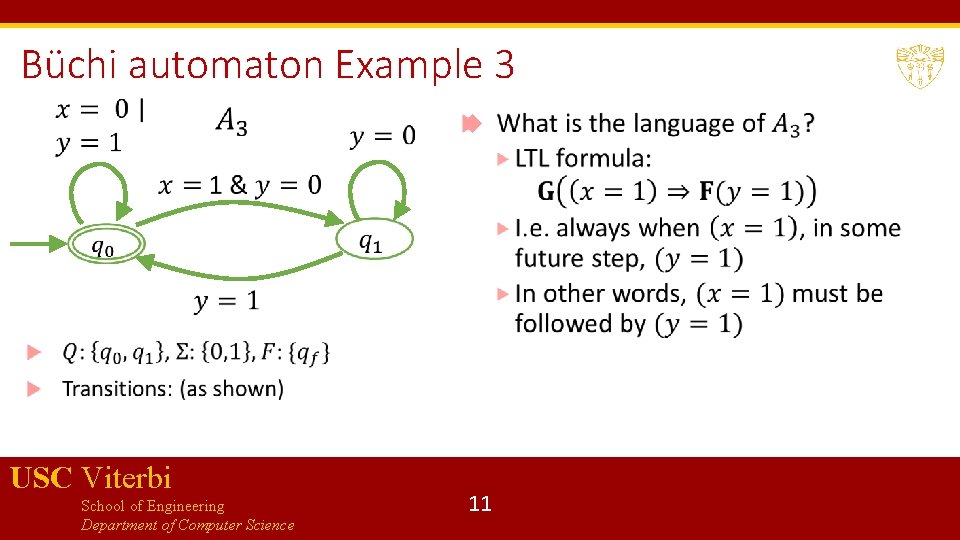
Büchi automaton Example 3 USC Viterbi School of Engineering Department of Computer Science 11
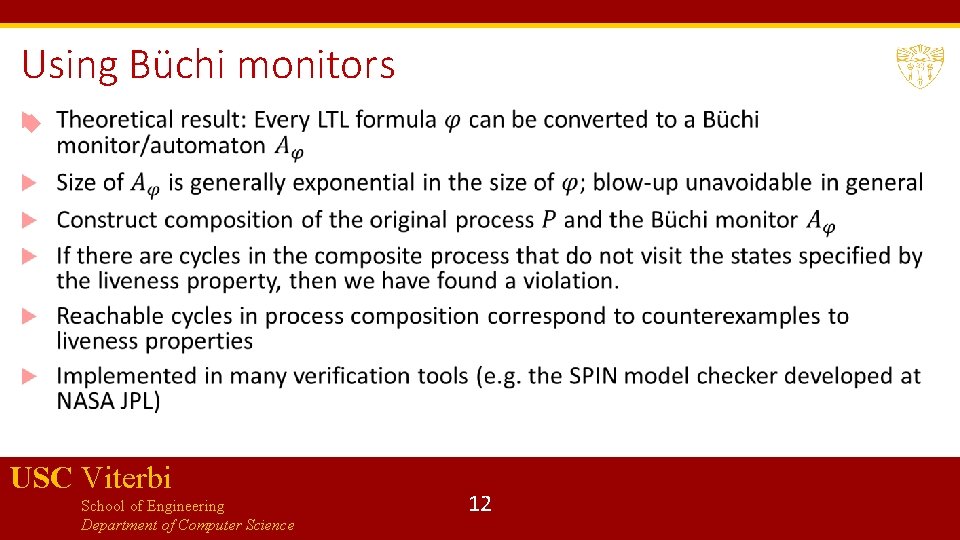
Using Büchi monitors USC Viterbi School of Engineering Department of Computer Science 12
Computation Tree Logic LTL was a linear-time logic where we reason about traces CTL is a logic where we reason over the tree of executions generated by a program, also known as the computation tree We care about CTL because: There are some properties that cannot be expressed in LTL, but can be expressed in CTL: From every system state, there is a system execution that takes it back to the initial state (also known as the reset property) To understand p. CTL (Probabilistic CTL), it’s good if you understand CTL Can express interesting properties for multi-agent systems USC Viterbi School of Engineering Department of Computer Science 13
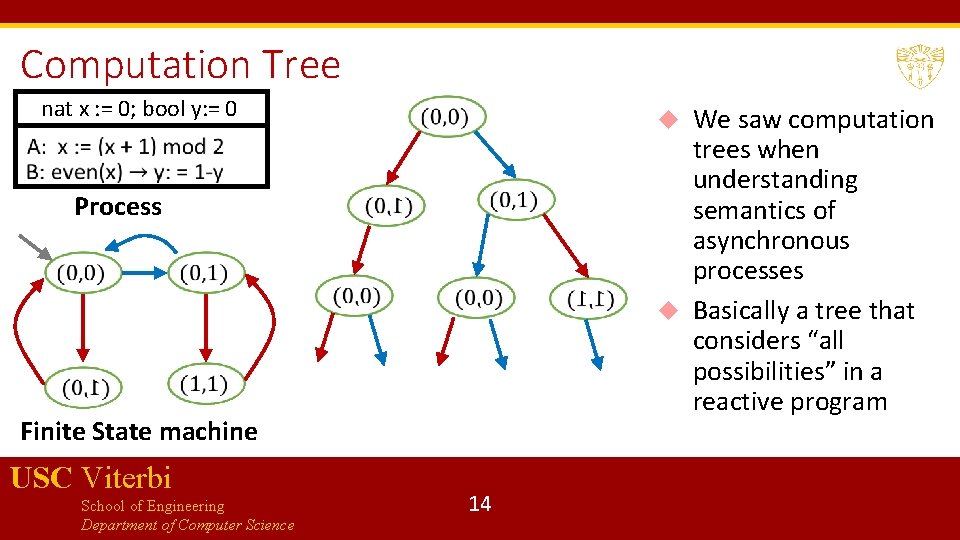
Computation Tree nat x : = 0; bool y: = 0 We saw computation trees when understanding semantics of asynchronous processes Basically a tree that considers “all possibilities” in a reactive program Process Finite State machine USC Viterbi School of Engineering Department of Computer Science 14
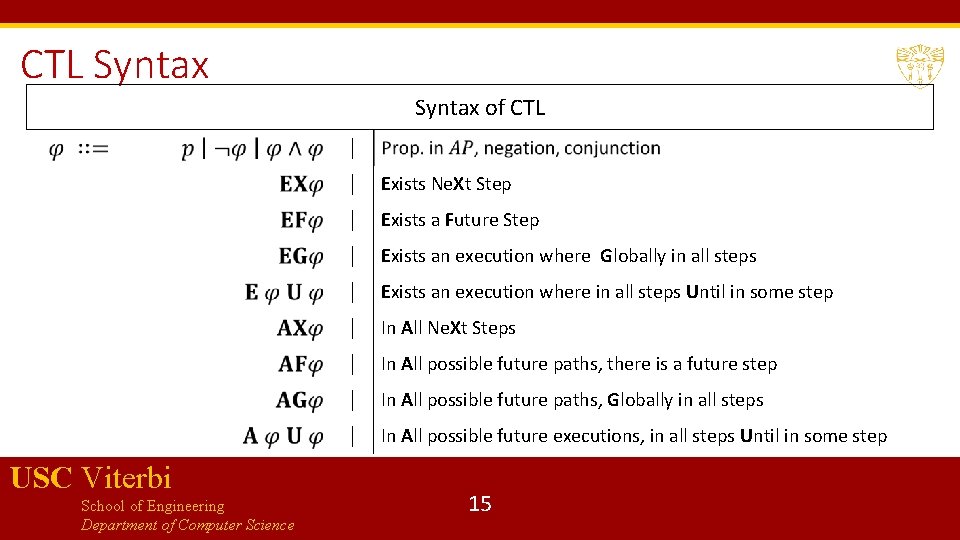
CTL Syntax of CTL | | Exists Ne. Xt Step | Exists a Future Step | | | USC Viterbi School of Engineering Department of Computer Science Exists an execution where Globally in all steps Exists an execution where in all steps Until in some step In All Ne. Xt Steps In All possible future paths, there is a future step In All possible future paths, Globally in all steps In All possible future executions, in all steps Until in some step 15
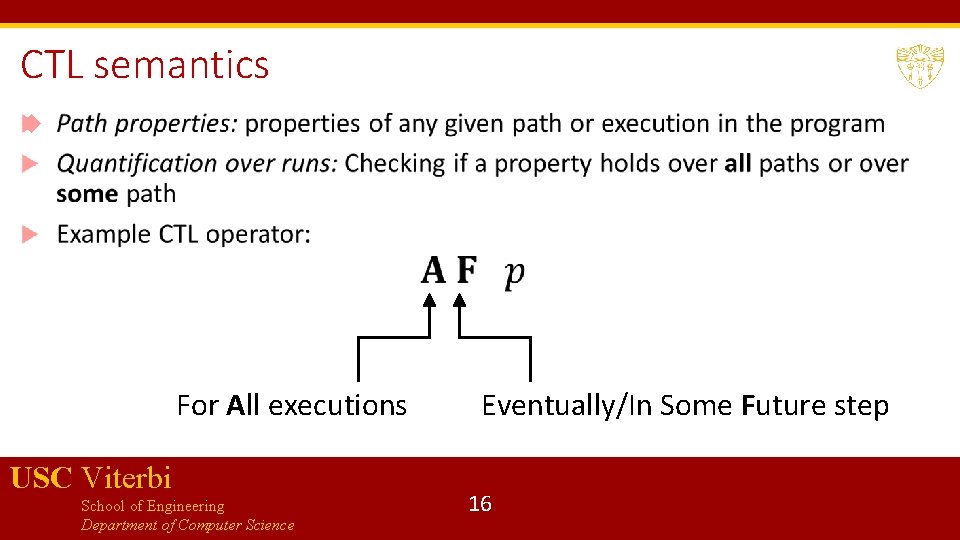
CTL semantics For All executions USC Viterbi School of Engineering Department of Computer Science Eventually/In Some Future step 16
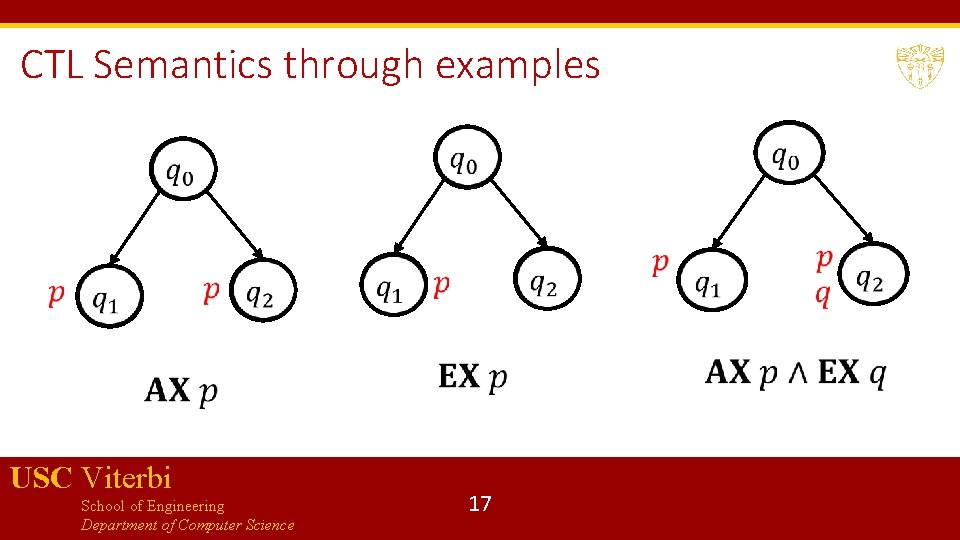
CTL Semantics through examples USC Viterbi School of Engineering Department of Computer Science 17
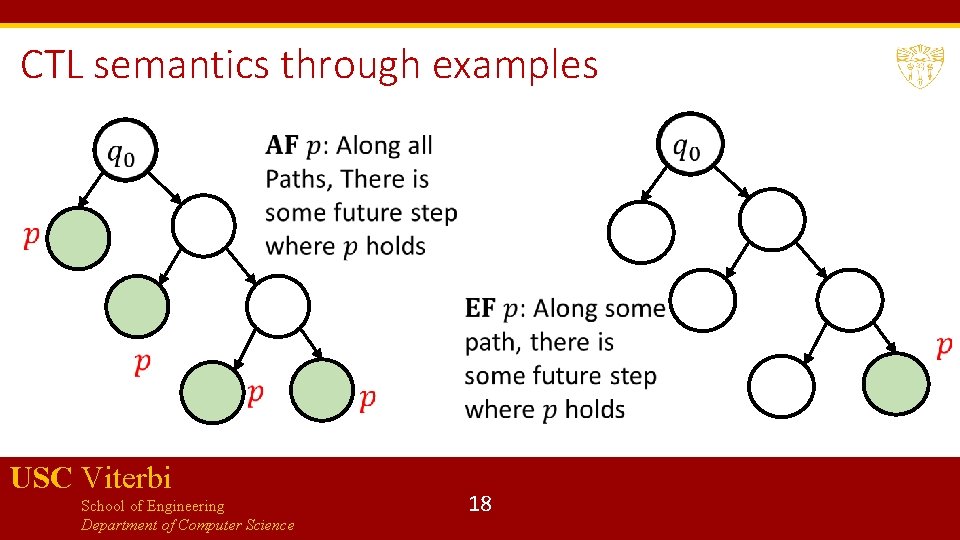
CTL semantics through examples USC Viterbi School of Engineering Department of Computer Science 18
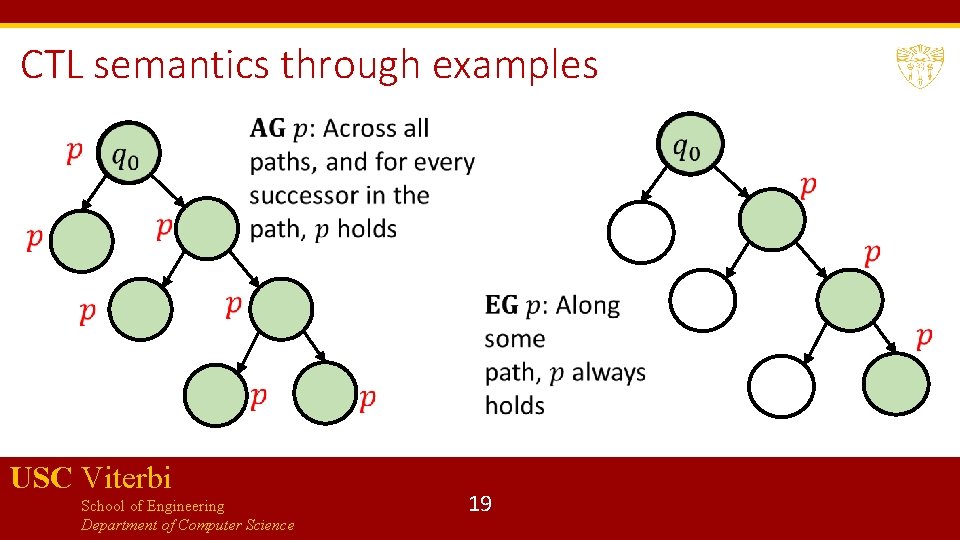
CTL semantics through examples USC Viterbi School of Engineering Department of Computer Science 19
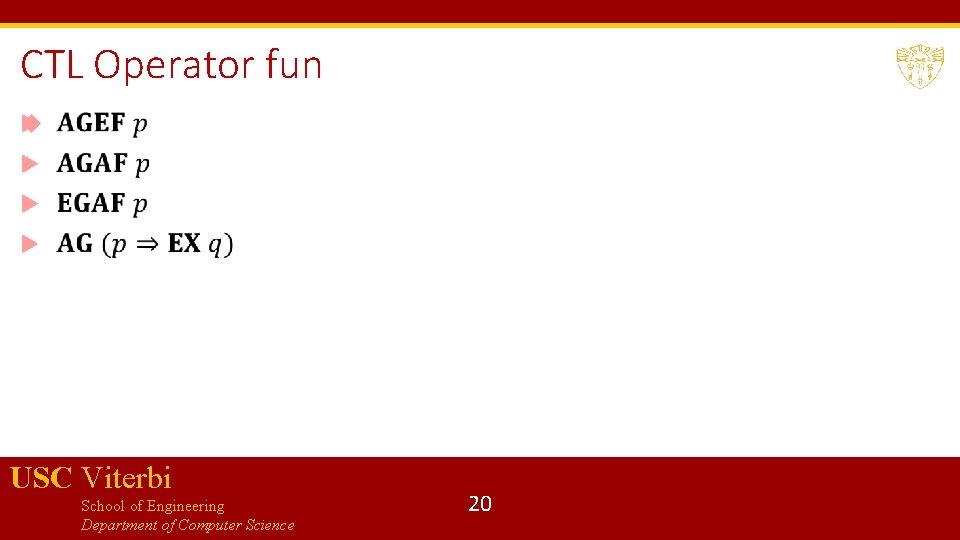
CTL Operator fun USC Viterbi School of Engineering Department of Computer Science 20
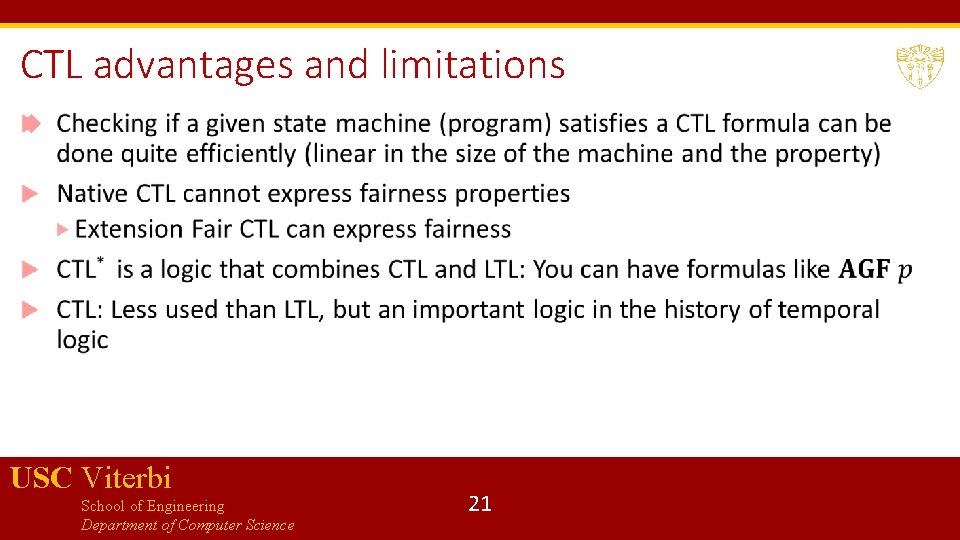
CTL advantages and limitations USC Viterbi School of Engineering Department of Computer Science 21
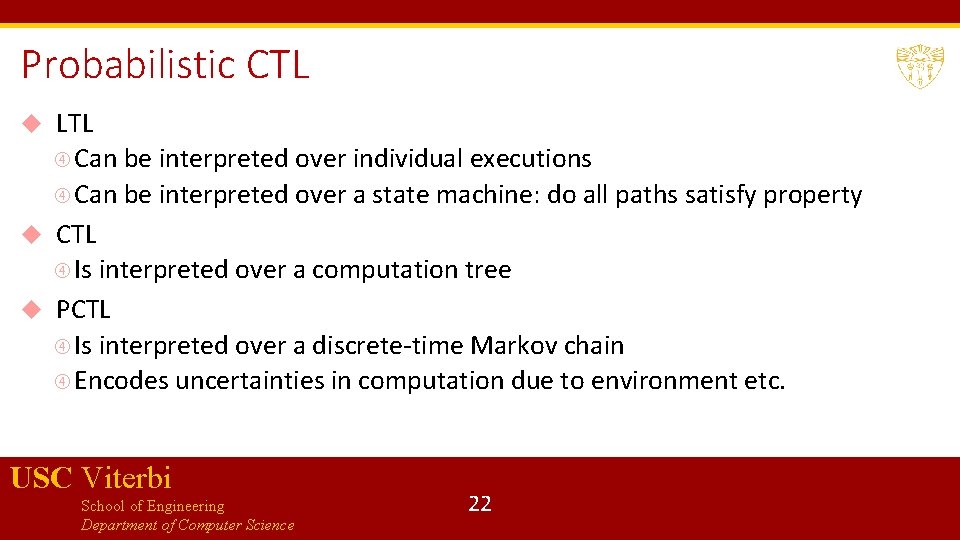
Probabilistic CTL LTL Can be interpreted over individual executions Can be interpreted over a state machine: do all paths satisfy property CTL Is interpreted over a computation tree PCTL Is interpreted over a discrete-time Markov chain Encodes uncertainties in computation due to environment etc. USC Viterbi School of Engineering Department of Computer Science 22
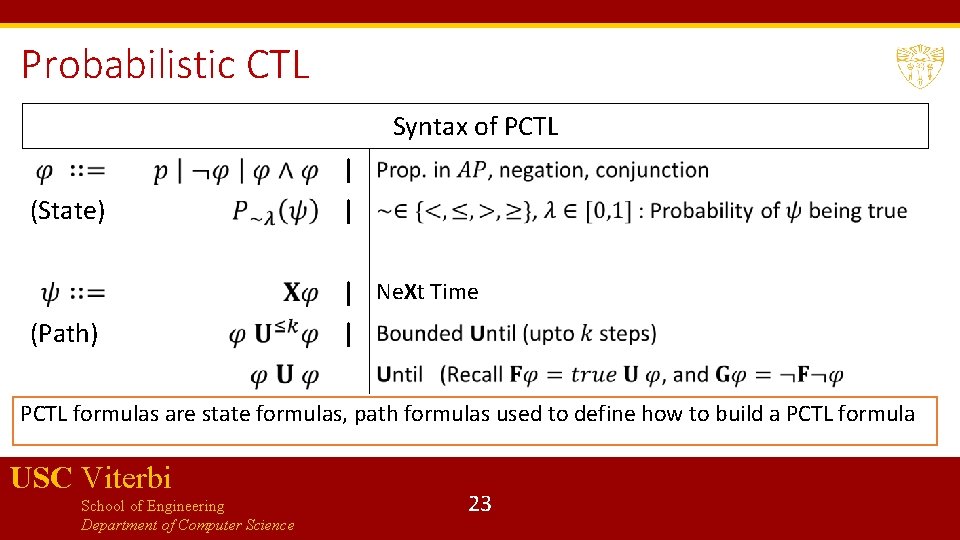
Probabilistic CTL Syntax of PCTL (State) | | (Path) | Ne. Xt Time | PCTL formulas are state formulas, path formulas used to define how to build a PCTL formula USC Viterbi School of Engineering Department of Computer Science 23
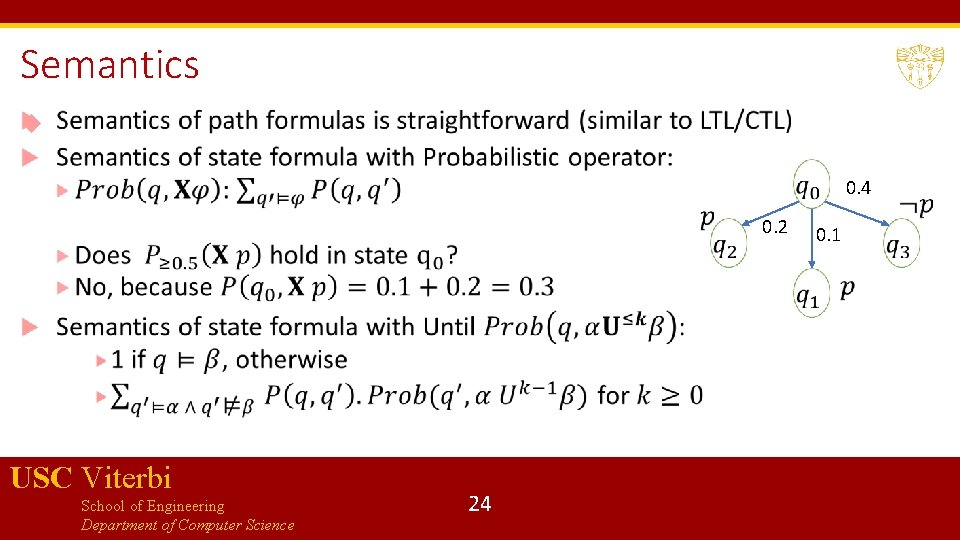
Semantics 0. 4 0. 2 USC Viterbi School of Engineering Department of Computer Science 24 0. 1
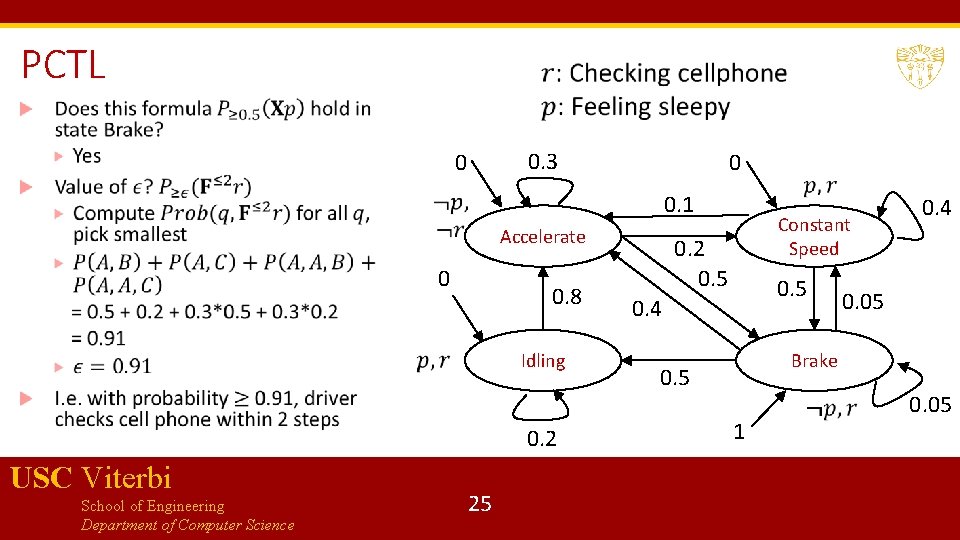
PCTL 0. 3 0 0 0. 1 Accelerate 0 0. 8 Idling 0. 2 USC Viterbi School of Engineering Department of Computer Science 25 Constant Speed 0. 2 0. 5 0. 4 0. 05 Brake 0. 5 1 0. 05
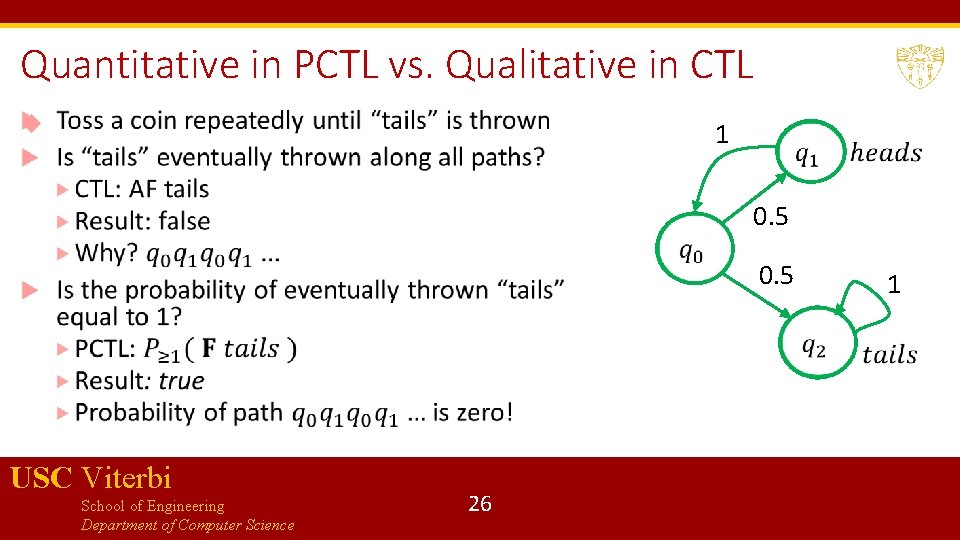
Quantitative in PCTL vs. Qualitative in CTL 1 0. 5 USC Viterbi School of Engineering Department of Computer Science 26 1
Bibliography CTL: Automated Temporal Reasoning about Reactive Systems. www. cs. utexas. edu/users/emerson/Pubs/banff 94 k. ps PCTL: http: //www. prismmodelchecker. org/talks/marta-ssft 14 tutorial-p 1. pdf PCTL heads/tails example: http: //www. prismmodelchecker. org/lectures/pmc/04 prob%20 logics. pdf USC Viterbi School of Engineering Department of Computer Science 27
- Slides: 27