
Autonomous CyberPhysical Systems Convolutional Neural Networks Spring 2018
Autonomous Cyber-Physical Systems: Convolutional Neural Networks Spring 2018. CS 599. Instructor: Jyo Deshmukh USC Viterbi School of Engineering Department of Computer Science
Layout Neural network basics Convolutional Neural Nets USC Viterbi School of Engineering Department of Computer Science 2
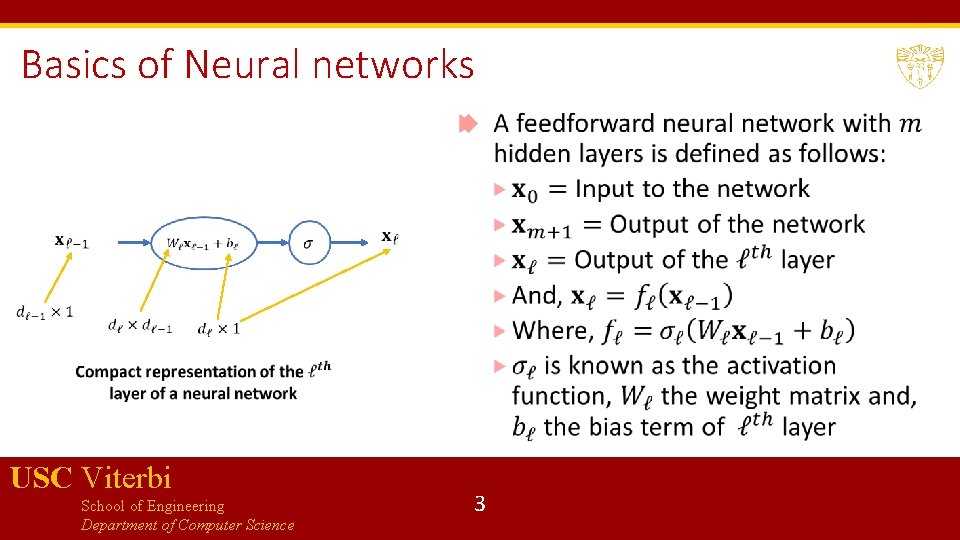
Basics of Neural networks USC Viterbi School of Engineering Department of Computer Science 3

Basics of Training a NN USC Viterbi School of Engineering Department of Computer Science 4
Convolutional Neural Networks Inspired by visual cortex in animals Learns image filters that were previously hand-engineered Basic intuitions for CNNs: Images are too large to be monolithically processed by a feedforward neural network (1000 x 1000 image = 106 inputs, which means the weight matrix for the second layer is proportional to at least 106!) Data in an image is spatially correlated CNN divided into several layers with different purposes USC Viterbi School of Engineering Department of Computer Science 5

Convolutional layer First layer is a convolutional layer Convolutional layer contains neurons associated with subregions of the original image Each sub-region is called receptive field Convolves the weights of the convolutional layer with each cell in receptive field to obtain activation map or feature map Receptive field USC Viterbi School of Engineering Department of Computer Science Image from [1] 6
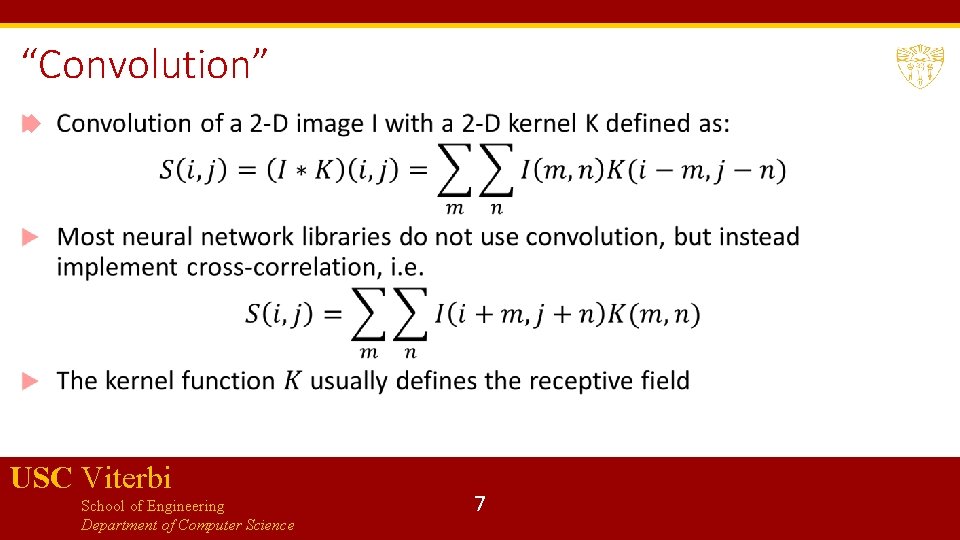
“Convolution” USC Viterbi School of Engineering Department of Computer Science 7
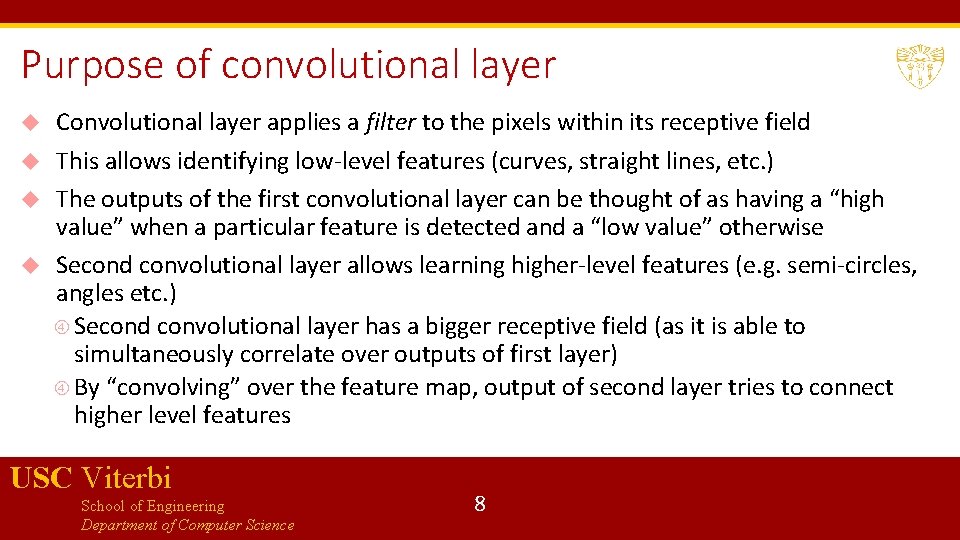
Purpose of convolutional layer Convolutional layer applies a filter to the pixels within its receptive field This allows identifying low-level features (curves, straight lines, etc. ) The outputs of the first convolutional layer can be thought of as having a “high value” when a particular feature is detected and a “low value” otherwise Second convolutional layer allows learning higher-level features (e. g. semi-circles, angles etc. ) Second convolutional layer has a bigger receptive field (as it is able to simultaneously correlate over outputs of first layer) By “convolving” over the feature map, output of second layer tries to connect higher level features USC Viterbi School of Engineering Department of Computer Science 8
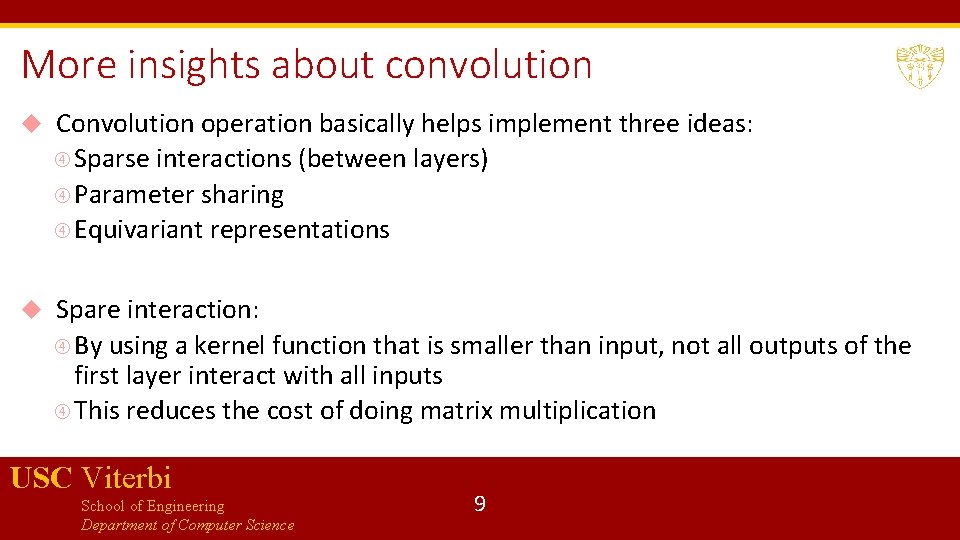
More insights about convolution Convolution operation basically helps implement three ideas: Sparse interactions (between layers) Parameter sharing Equivariant representations Spare interaction: By using a kernel function that is smaller than input, not all outputs of the first layer interact with all inputs This reduces the cost of doing matrix multiplication USC Viterbi School of Engineering Department of Computer Science 9
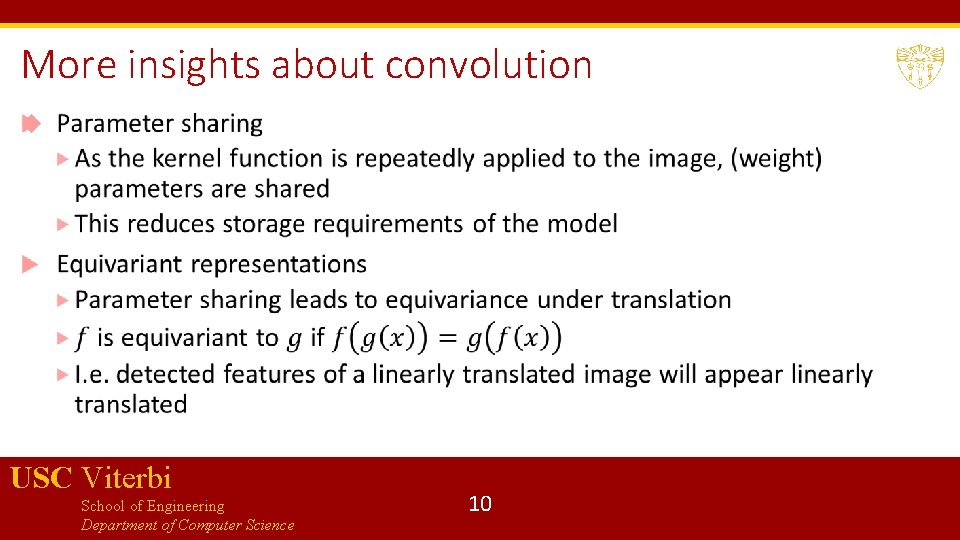
More insights about convolution USC Viterbi School of Engineering Department of Computer Science 10
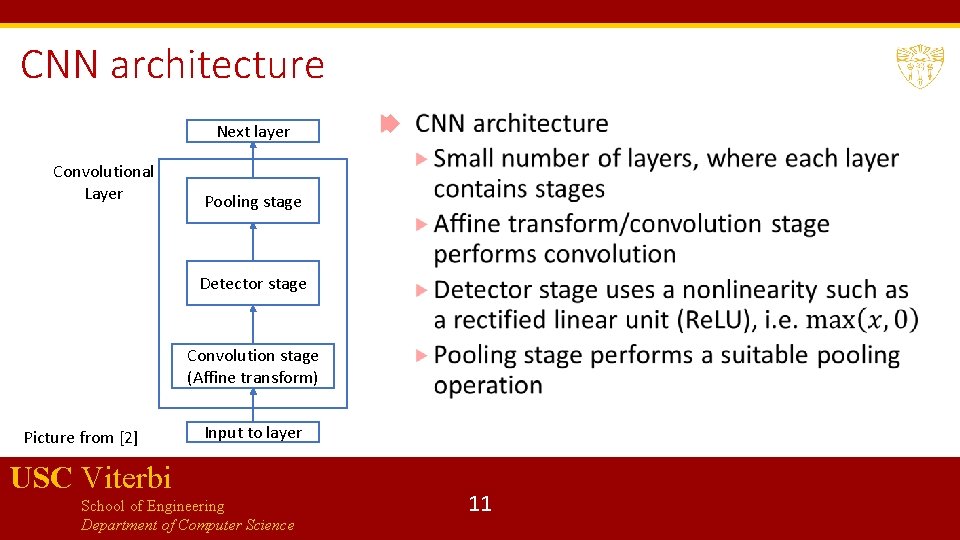
CNN architecture Next layer Convolutional Layer Pooling stage Detector stage Convolution stage (Affine transform) Picture from [2] Input to layer USC Viterbi School of Engineering Department of Computer Science 11
Pooling stage Pooling function replaces the output of a layer at a certain location with a summary statistic of the nearby outputs E. g. max pooling reports maximum output within a rectangular neighborhood Other pooling functions include average, L 2 norm, weighted average etc. Pooling helps representation approximately invariant to small translations By pooling over outputs of different convolutions, features can learn which transformations to become invariant to (e. g. rotation etc. ) USC Viterbi School of Engineering Department of Computer Science 12
Fully connected layers CNNs may have some fully connected layers before the final output These layers allows performing higher-level reasoning over different features learned by the previous convolutional layers Various kind of convolution functions, pooling functions and detection functions are possible, giving rise to many different flavors Number of convolutional layers can be varied depending on complexity of features to be learned USC Viterbi School of Engineering Department of Computer Science 13
![R-CNN[3] R-CNN, Fast R-CNN and Faster R-CNN are specific architectures that help with object](http://slidetodoc.com/presentation_image_h/0dc677b0065a9d4b218a1ad81c2494f4/image-14.jpg "R-CNN[3] R-CNN, Fast R-CNN and Faster R-CNN are specific architectures that help with object")
R-CNN[3] R-CNN, Fast R-CNN and Faster R-CNN are specific architectures that help with object detection Objective is to obtain from an image: A list of bounding boxes A label assigned to each bounding box A probability for each label and bounding box The key idea in R-CNNs is to use region proposals and region of interest pooling We will briefly discuss the architecture of Faster R-CNN USC Viterbi School of Engineering Department of Computer Science 14
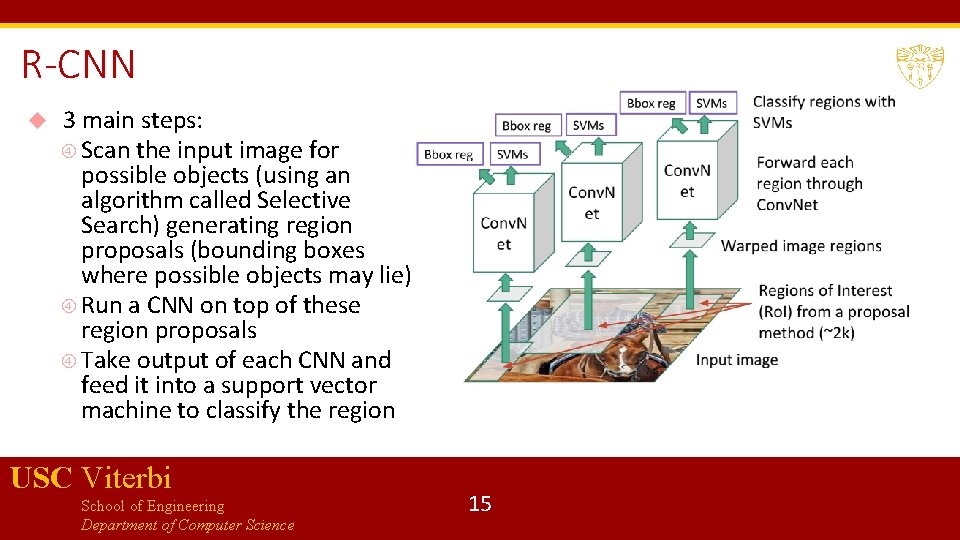
R-CNN 3 main steps: Scan the input image for possible objects (using an algorithm called Selective Search) generating region proposals (bounding boxes where possible objects may lie) Run a CNN on top of these region proposals Take output of each CNN and feed it into a support vector machine to classify the region USC Viterbi School of Engineering Department of Computer Science 15
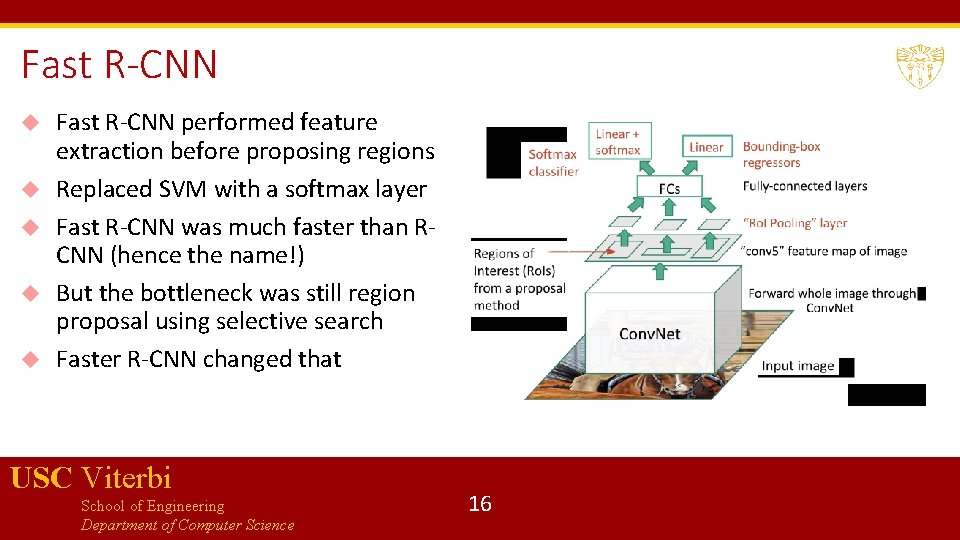
Fast R-CNN performed feature extraction before proposing regions Replaced SVM with a softmax layer Fast R-CNN was much faster than RCNN (hence the name!) But the bottleneck was still region proposal using selective search Faster R-CNN changed that USC Viterbi School of Engineering Department of Computer Science 16

Faster R-CNN Replaces slow selective search algorithm with a fast neural net Introduces a region proposal network Uses an intermediate output of the CNN to generate multiple possible regions based on fixed aspect-ratio anchor boxes, and a score for each region reflecting possibility of containing an object Matlab 17 b uses Faster R-CNN for object detection: you could use this or RCNN in Homework 3 USC Viterbi School of Engineering Department of Computer Science 17
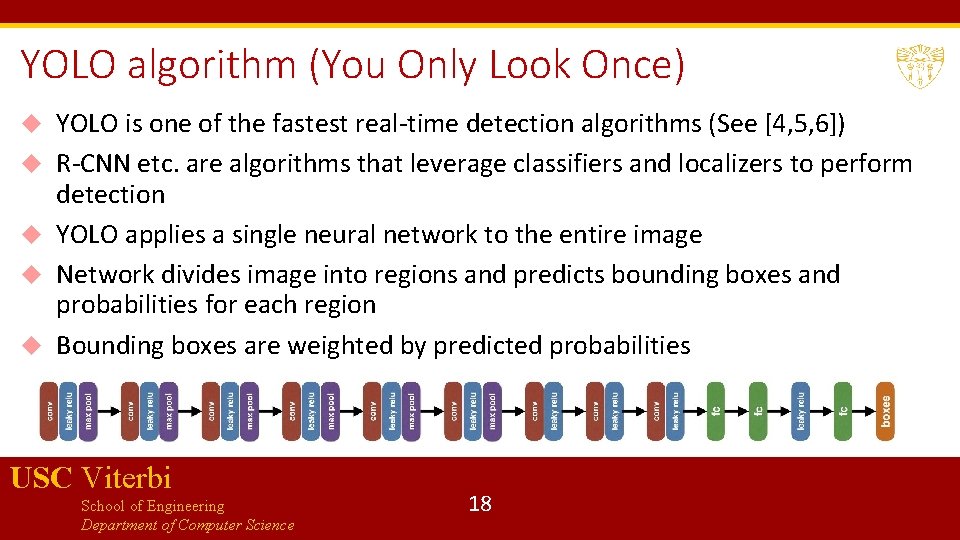
YOLO algorithm (You Only Look Once) YOLO is one of the fastest real-time detection algorithms (See [4, 5, 6]) R-CNN etc. are algorithms that leverage classifiers and localizers to perform detection YOLO applies a single neural network to the entire image Network divides image into regions and predicts bounding boxes and probabilities for each region Bounding boxes are weighted by predicted probabilities USC Viterbi School of Engineering Department of Computer Science 18
![References [1] Understanding CNNs: https: //adeshpande 3. github. io/A-Beginner%27 s-Guide-To-Understanding. Convolutional-Neural-Networks/ [2] I. Goodfellow,](http://slidetodoc.com/presentation_image_h/0dc677b0065a9d4b218a1ad81c2494f4/image-19.jpg "References [1] Understanding CNNs: https: //adeshpande 3. github. io/A-Beginner%27 s-Guide-To-Understanding. Convolutional-Neural-Networks/ [2] I. Goodfellow,")
References [1] Understanding CNNs: https: //adeshpande 3. github. io/A-Beginner%27 s-Guide-To-Understanding. Convolutional-Neural-Networks/ [2] I. Goodfellow, Y. Bengio, A. Courville, Deep Learning, MIT Press. [3] https: //towardsdatascience. com/deep-learning-for-object-detection-a-comprehensive-review 73930816 d 8 d 9 [4] https: //towardsdatascience. com/yolo-you-only-look-once-real-time-object-detection-explained 492 dc 9230006 [5] https: //pjreddie. com/darknet/yolo/ [6] YOLO algorithm: https: //arxiv. org/abs/1506. 02640 USC Viterbi School of Engineering Department of Computer Science 19
- Slides: 19