
Autonomic Nervous System ANS Optimized Cardiac Resynchronization Therapy
- Slides: 10
Autonomic Nervous System (ANS) Optimized Cardiac Resynchronization Therapy (CRT) Tran Thong 1, Dat Tran-Tat 2, Toan Nguyen-Duy 3 1 University of Medicine and Pharmacy, Hue, Vietnam 2 Hospital of Post and Telecommunications, Hanoi, Vietnam 3 Hospital 103, Hanoi, Vietnam trant 51@gmail. com EHRA 2020 May 2020 DOI: Dr Thong is a principal in a distributor of BIOTRONIK cardiac rhythm products in Vietnam. No disclosure for the other authors. ANS-CRT™ 1 EHRA 2020
LV-only CRT • LV-only CRT currently available from at least 2 major CRT manufacturers, in new devices. – Propagation delay from RA to RV measured every minute, and LV AV delay is adjusted per Khaykin 1 (min(70% Ax-RVs, Ax-RVs - 40 ms)) – Atrial Fibrillation reduction observed 2. • In this paper, present initial results of LV-only CRT with fixed AV delay … no adaptation! – Can be implemented in existing CRT devices 1 Khaykin, ANS-CRT™ Europace 2011, 2 Birnie, Heart Rhythm 2017. 2 EHRA 2020
Fixed delay LV-only CRT • Indications: LBBB CRT patient with good A-RV conduction. • 3 chamber conventional CRT device. CRT-P for now. • Intrinsic depolarization used in RV • LV pacing with – AV delay relatively long: Ax-RVs –[25→ 50 ms]. – RVs trigger: LV pace triggered by RV sense event, with inhibited RV pacing… battery saving. – LV T-wave protection to avoid pacing on LV T- wave. LV sensing required… safety for long AV delay ANS-CRT™ 3 EHRA 2020
Methods • 5 CRT-P patients with 3 generations of BIOTRONIK (Berlin, Germany) devices, Evia/ Etrinsa 8/ Evity 8 HF-T devices, all previously programmed to bi-V pacing, – Reprogrammed to LV-only + RVs trigger + LV T-wave protection. – All patients with good sinus node. Almost no atrial pacing. ANS-CRT™ 4 EHRA 2020
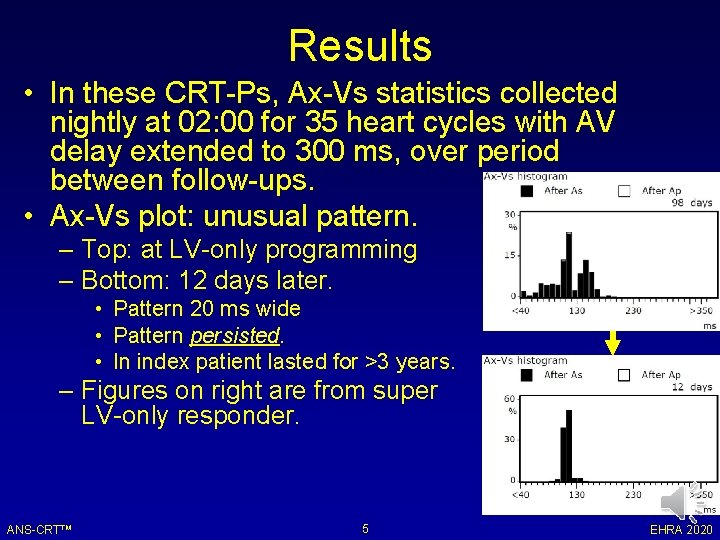
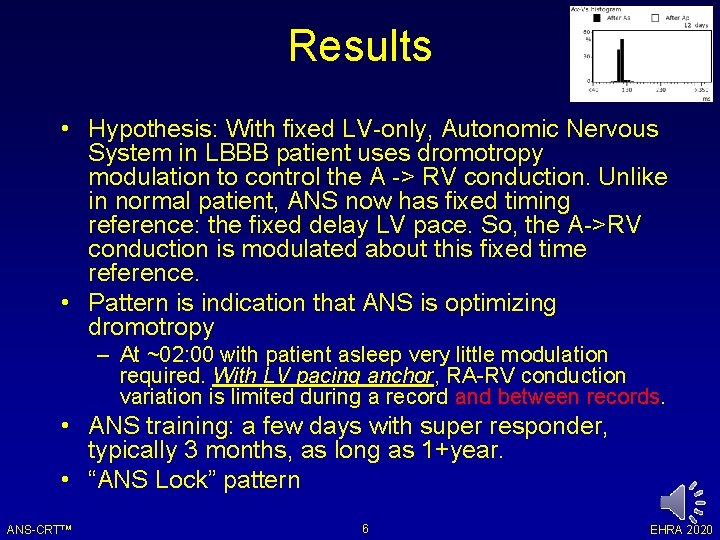
Results • In these CRT-Ps, Ax-Vs statistics collected nightly at 02: 00 for 35 heart cycles with AV delay extended to 300 ms, over period between follow-ups. • Ax-Vs plot: unusual pattern. – Top: at LV-only programming – Bottom: 12 days later. • Pattern 20 ms wide • Pattern persisted. • In index patient lasted for >3 years. – Figures on right are from super LV-only responder. ANS-CRT™ 5 EHRA 2020
Results • Hypothesis: With fixed LV-only, Autonomic Nervous System in LBBB patient uses dromotropy modulation to control the A -> RV conduction. Unlike in normal patient, ANS now has fixed timing reference: the fixed delay LV pace. So, the A->RV conduction is modulated about this fixed time reference. • Pattern is indication that ANS is optimizing dromotropy – At ~02: 00 with patient asleep very little modulation required. With LV pacing anchor, RA-RV conduction variation is limited during a record and between records. • ANS training: a few days with super responder, typically 3 months, as long as 1+year. • “ANS Lock” pattern ANS-CRT™ 6 EHRA 2020
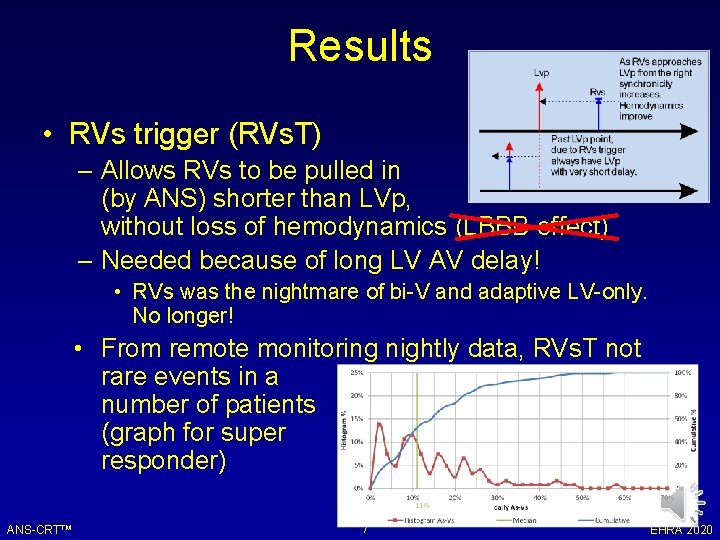
Results • RVs trigger (RVs. T) – Allows RVs to be pulled in (by ANS) shorter than LVp, without loss of hemodynamics (LBBB effect) – Needed because of long LV AV delay! • RVs was the nightmare of bi-V and adaptive LV-only. No longer! • From remote monitoring nightly data, RVs. T not rare events in a number of patients (graph for super responder) ANS-CRT™ 7 EHRA 2020
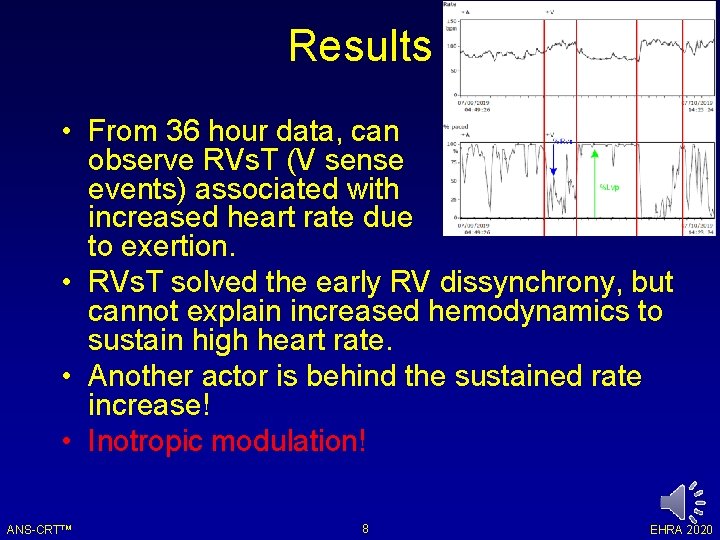
Results • From 36 hour data, can observe RVs. T (V sense events) associated with increased heart rate due to exertion. • RVs. T solved the early RV dissynchrony, but cannot explain increased hemodynamics to sustain high heart rate. • Another actor is behind the sustained rate increase! • Inotropic modulation! ANS-CRT™ 8 EHRA 2020
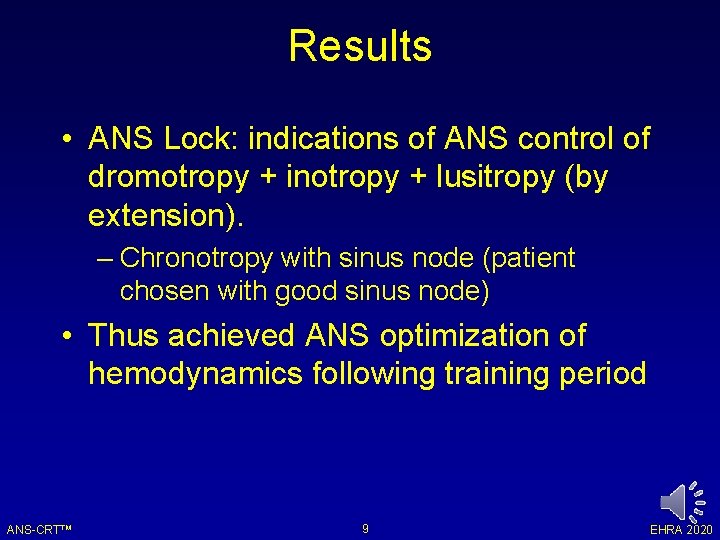
Results • ANS Lock: indications of ANS control of dromotropy + inotropy + lusitropy (by extension). – Chronotropy with sinus node (patient chosen with good sinus node) • Thus achieved ANS optimization of hemodynamics following training period ANS-CRT™ 9 EHRA 2020
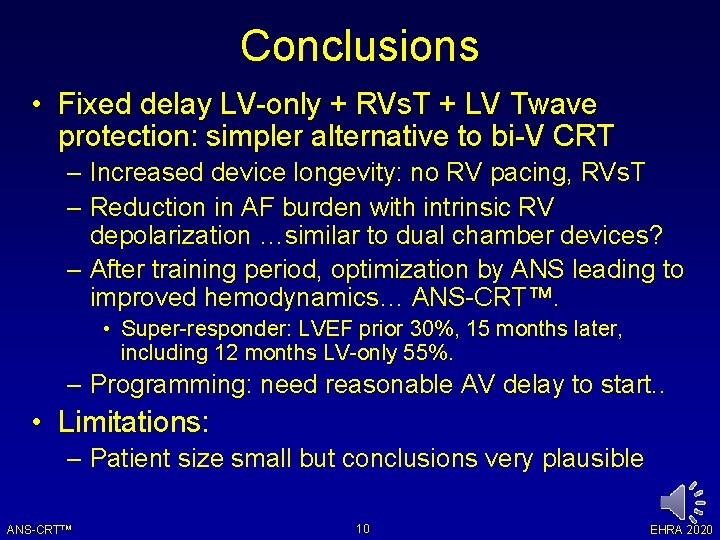
Conclusions • Fixed delay LV-only + RVs. T + LV Twave protection: simpler alternative to bi-V CRT – Increased device longevity: no RV pacing, RVs. T – Reduction in AF burden with intrinsic RV depolarization …similar to dual chamber devices? – After training period, optimization by ANS leading to improved hemodynamics… ANS-CRT™. • Super-responder: LVEF prior 30%, 15 months later, including 12 months LV-only 55%. – Programming: need reasonable AV delay to start. . • Limitations: – Patient size small but conclusions very plausible ANS-CRT™ 10 EHRA 2020