
Automotivesemiconductors Functional Safety A practical chip design solution
- Slides: 23
Automotive-semiconductors Functional Safety A practical chip design solution for functional safety in vehicles Introduction to ISO-26262 challenges for IC’s Jamil R. Mazzawi jamil@optima-da. com www. optima-da. com May 13, 2019 © Optima Design Automation - All Rights reserved – Delivered at Chip. Ex 2019 1 Automotive-semiconductors Functional Safety
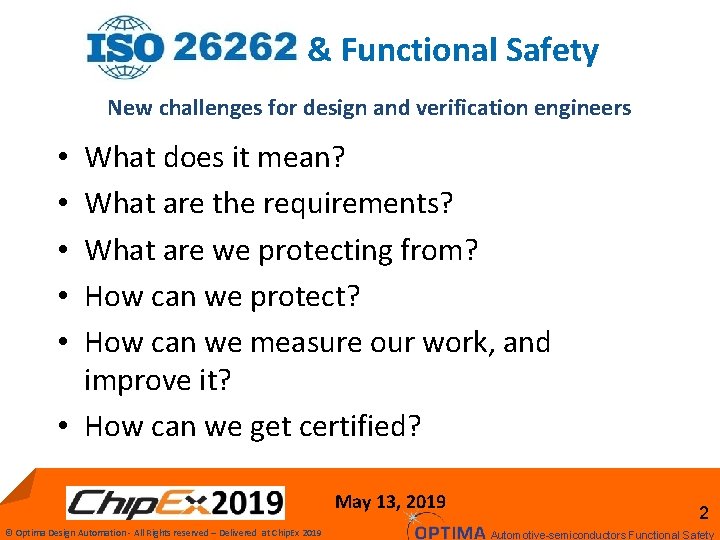
& Functional Safety New challenges for design and verification engineers What does it mean? What are the requirements? What are we protecting from? How can we protect? How can we measure our work, and improve it? • How can we get certified? • • • May 13, 2019 © Optima Design Automation - All Rights reserved – Delivered at Chip. Ex 2019 2 Automotive-semiconductors Functional Safety
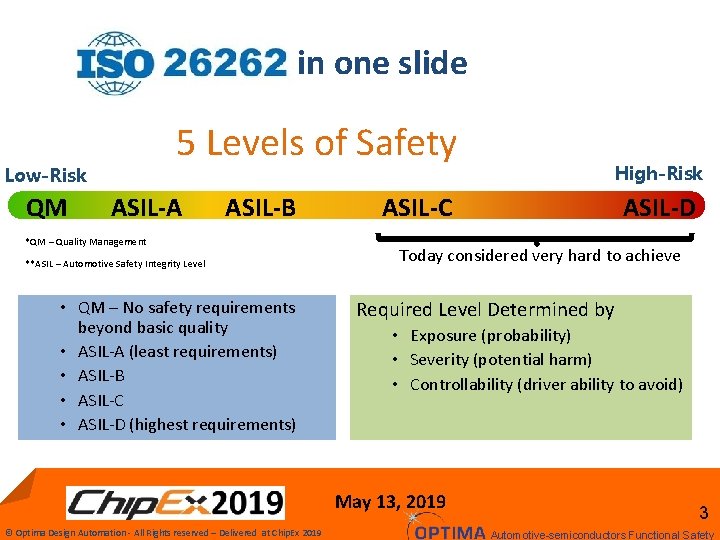
in one slide 5 Levels of Safety Low-Risk QM ASIL-A ASIL-B *QM – Quality Management **ASIL – Automotive Safety Integrity Level • QM – No safety requirements beyond basic quality • ASIL-A (least requirements) • ASIL-B • ASIL-C • ASIL-D (highest requirements) ASIL-C ASIL-D Today considered very hard to achieve Required Level Determined by • Exposure (probability) • Severity (potential harm) • Controllability (driver ability to avoid) May 13, 2019 © Optima Design Automation - All Rights reserved – Delivered at Chip. Ex 2019 High-Risk 3 Automotive-semiconductors Functional Safety
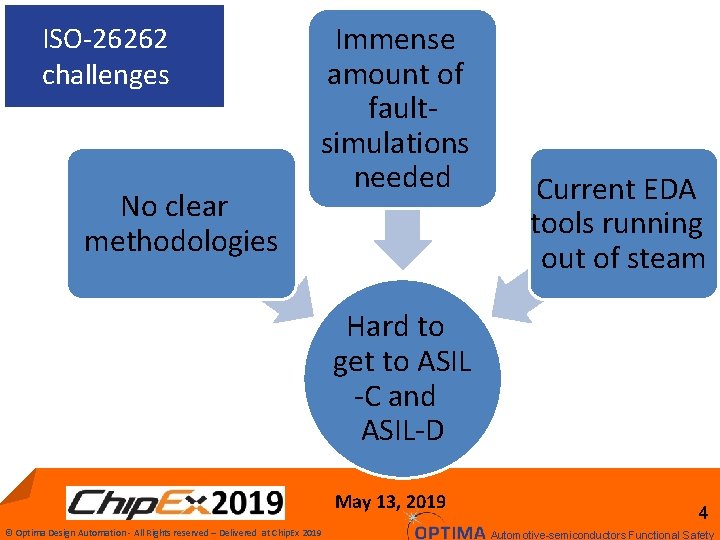
ISO-26262 challenges No clear methodologies Immense amount of faultsimulations needed Current EDA tools running out of steam Hard to get to ASIL -C and ASIL-D May 13, 2019 © Optima Design Automation - All Rights reserved – Delivered at Chip. Ex 2019 4 Automotive-semiconductors Functional Safety
ISO-26262 requirements for IC’s (intro) May 13, 2019 © Optima Design Automation - All Rights reserved – Delivered at Chip. Ex 2019 5 Automotive-semiconductors Functional Safety
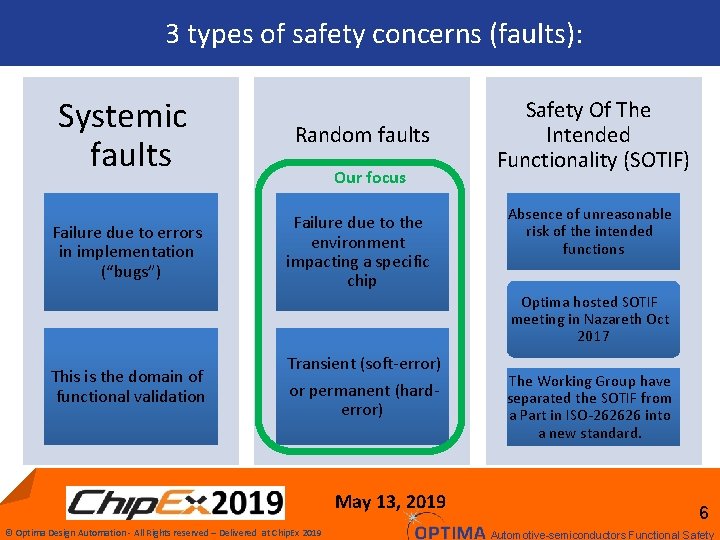
3 types of safety concerns (faults): Systemic faults Random faults Failure due to errors in implementation (“bugs”) Failure due to the environment impacting a specific chip Our focus Safety Of The Intended Functionality (SOTIF) Absence of unreasonable risk of the intended functions Optima hosted SOTIF meeting in Nazareth Oct 2017 This is the domain of functional validation Transient (soft-error) or permanent (harderror) May 13, 2019 © Optima Design Automation - All Rights reserved – Delivered at Chip. Ex 2019 The Working Group have separated the SOTIF from a Part in ISO-262626 into a new standard. 6 Automotive-semiconductors Functional Safety
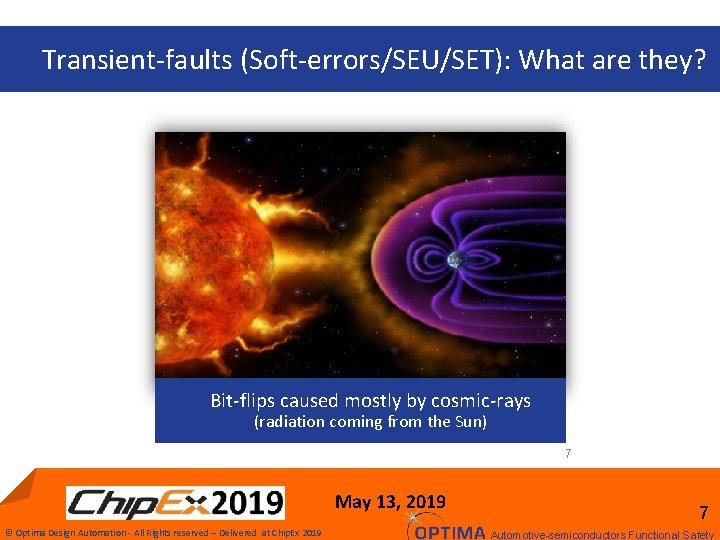
Transient-faults (Soft-errors/SEU/SET): What are they? Bit-flips caused mostly by cosmic-rays (radiation coming from the Sun) 7 May 13, 2019 © Optima Design Automation - All Rights reserved – Delivered at Chip. Ex 2019 7 Automotive-semiconductors Functional Safety
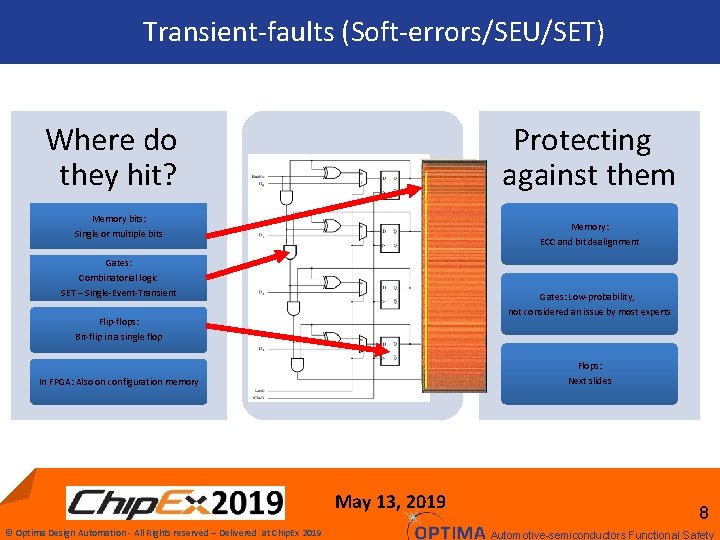
Transient-faults (Soft-errors/SEU/SET) Where do they hit? Protecting against them Memory bits: Memory: ECC and bit dealignment Single or multiple bits Gates: Combinatorial logic SET – Single-Event-Transient Gates: Low-probability, not considered an issue by most experts Flip-flops: Bit-flip in a single flop Flops: Next slides In FPGA: Also on configuration memory May 13, 2019 © Optima Design Automation - All Rights reserved – Delivered at Chip. Ex 2019 8 Automotive-semiconductors Functional Safety
Existing solutions and challenges Transient faults May 13, 2019 © Optima Design Automation - All Rights reserved – Delivered at Chip. Ex 2019 9 Automotive-semiconductors Functional Safety
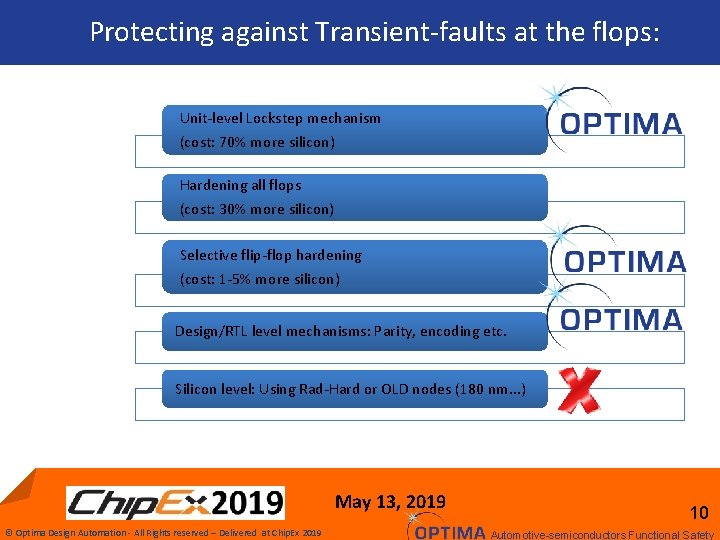
Protecting against Transient-faults at the flops: Unit-level Lockstep mechanism (cost: 70% more silicon) Hardening all flops (cost: 30% more silicon) Selective flip-flop hardening (cost: 1 -5% more silicon) Design/RTL level mechanisms: Parity, encoding etc. Silicon level: Using Rad-Hard or OLD nodes (180 nm. . . ) May 13, 2019 © Optima Design Automation - All Rights reserved – Delivered at Chip. Ex 2019 10 Automotive-semiconductors Functional Safety
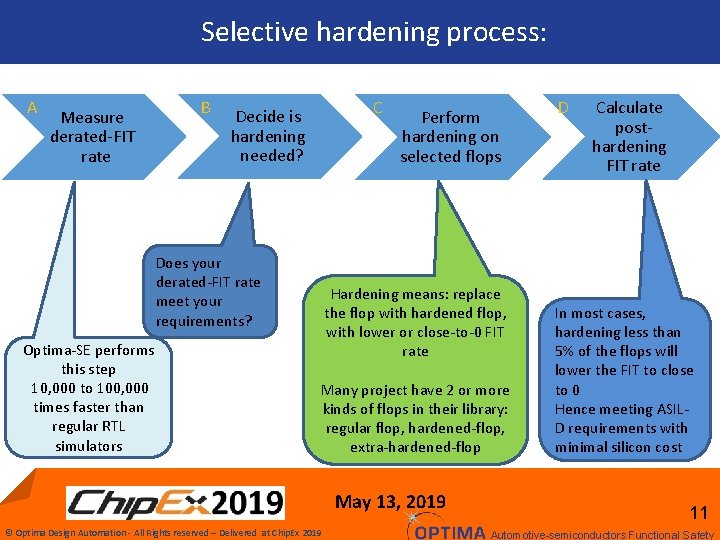
Selective hardening process: A Measure derated-FIT rate B C Decide is hardening needed? Does your derated-FIT rate meet your requirements? Optima-SE performs this step 10, 000 to 100, 000 times faster than regular RTL simulators Perform hardening on selected flops Hardening means: replace the flop with hardened flop, with lower or close-to-0 FIT rate Many project have 2 or more kinds of flops in their library: regular flop, hardened-flop, extra-hardened-flop May 13, 2019 © Optima Design Automation - All Rights reserved – Delivered at Chip. Ex 2019 D Calculate posthardening FIT rate In most cases, hardening less than 5% of the flops will lower the FIT to close to 0 Hence meeting ASILD requirements with minimal silicon cost 11 Automotive-semiconductors Functional Safety
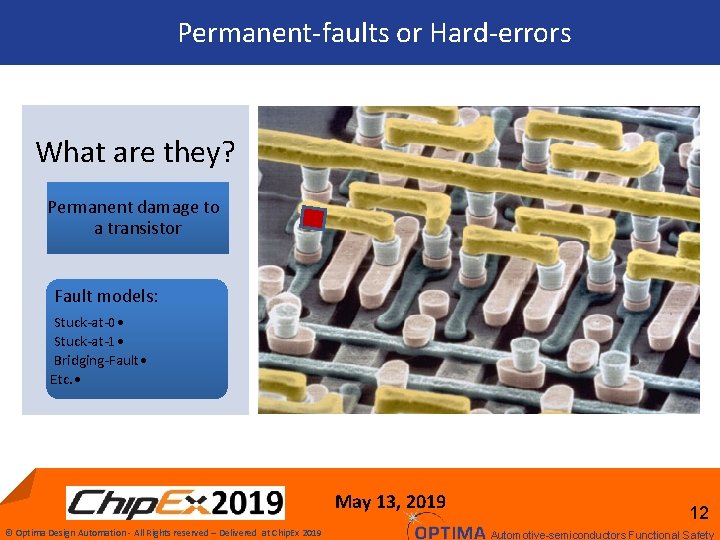
Permanent-faults or Hard-errors What are they? Permanent damage to a transistor Fault models: Stuck-at-0 • Stuck-at-1 • Bridging-Fault • Etc. • May 13, 2019 © Optima Design Automation - All Rights reserved – Delivered at Chip. Ex 2019 12 Automotive-semiconductors Functional Safety
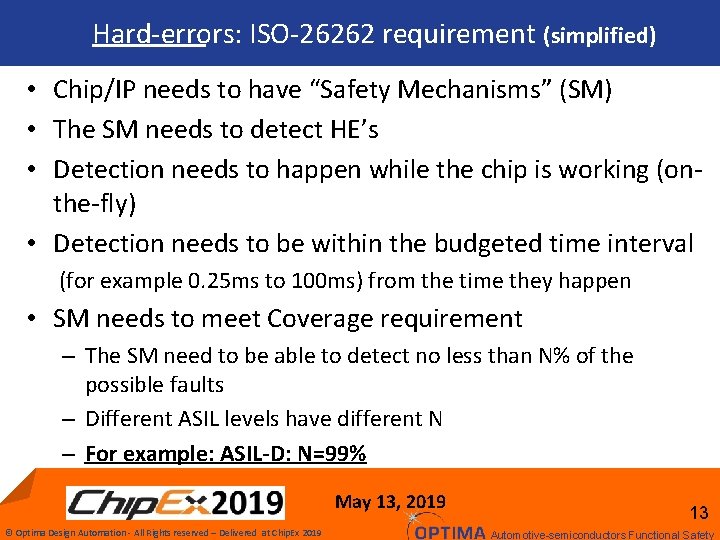
Hard-errors: ISO-26262 requirement (simplified) • Chip/IP needs to have “Safety Mechanisms” (SM) • The SM needs to detect HE’s • Detection needs to happen while the chip is working (onthe-fly) • Detection needs to be within the budgeted time interval (for example 0. 25 ms to 100 ms) from the time they happen • SM needs to meet Coverage requirement – The SM need to be able to detect no less than N% of the possible faults – Different ASIL levels have different N – For example: ASIL-D: N=99% May 13, 2019 © Optima Design Automation - All Rights reserved – Delivered at Chip. Ex 2019 13 Automotive-semiconductors Functional Safety
Existing solutions and challenges Permanent faults May 13, 2019 © Optima Design Automation - All Rights reserved – Delivered at Chip. Ex 2019 14 Automotive-semiconductors Functional Safety
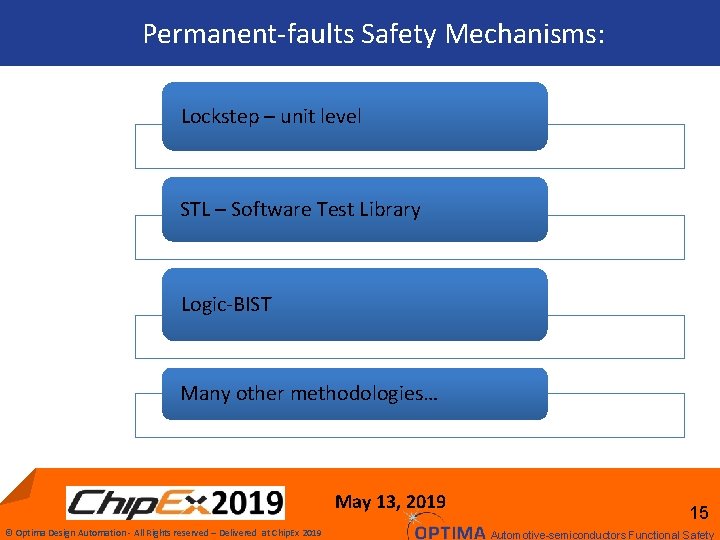
Permanent-faults Safety Mechanisms: Lockstep – unit level STL – Software Test Library Logic-BIST Many other methodologies… May 13, 2019 © Optima Design Automation - All Rights reserved – Delivered at Chip. Ex 2019 15 Automotive-semiconductors Functional Safety
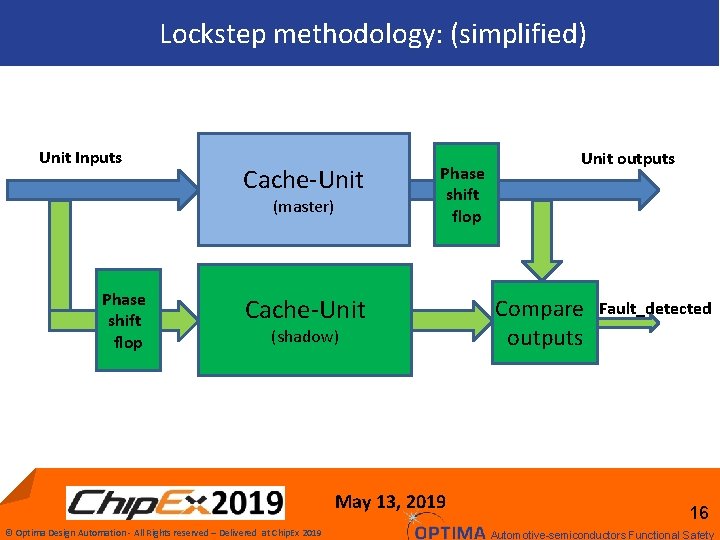
Lockstep methodology: (simplified) Unit Inputs Cache-Unit (master) Phase shift flop Cache-Unit (shadow) May 13, 2019 © Optima Design Automation - All Rights reserved – Delivered at Chip. Ex 2019 Unit outputs Compare outputs Fault_detected 16 Automotive-semiconductors Functional Safety
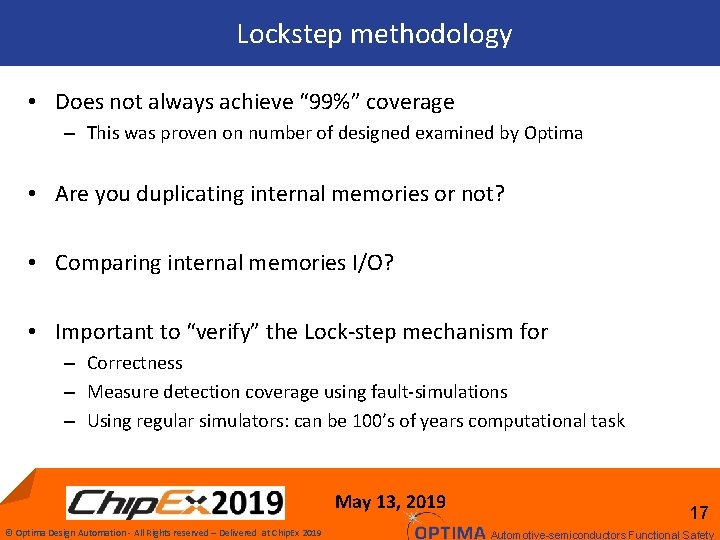
Lockstep methodology • Does not always achieve “ 99%” coverage – This was proven on number of designed examined by Optima • Are you duplicating internal memories or not? • Comparing internal memories I/O? • Important to “verify” the Lock-step mechanism for – Correctness – Measure detection coverage using fault-simulations – Using regular simulators: can be 100’s of years computational task May 13, 2019 © Optima Design Automation - All Rights reserved – Delivered at Chip. Ex 2019 17 Automotive-semiconductors Functional Safety
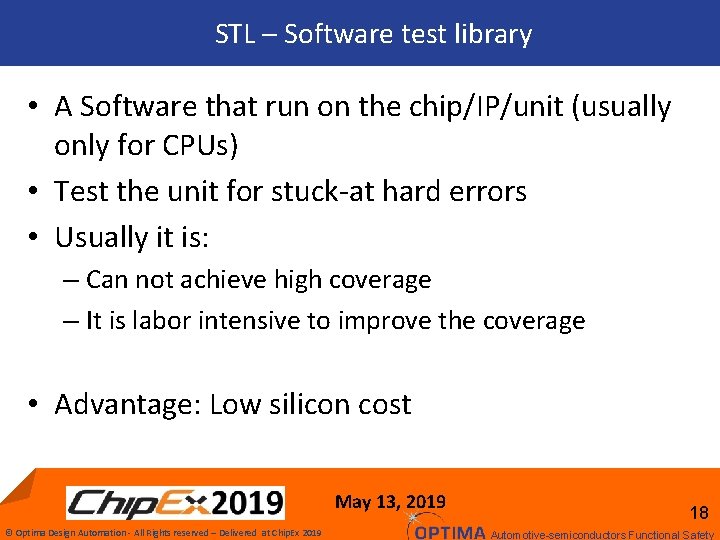
STL – Software test library • A Software that run on the chip/IP/unit (usually only for CPUs) • Test the unit for stuck-at hard errors • Usually it is: – Can not achieve high coverage – It is labor intensive to improve the coverage • Advantage: Low silicon cost May 13, 2019 © Optima Design Automation - All Rights reserved – Delivered at Chip. Ex 2019 18 Automotive-semiconductors Functional Safety
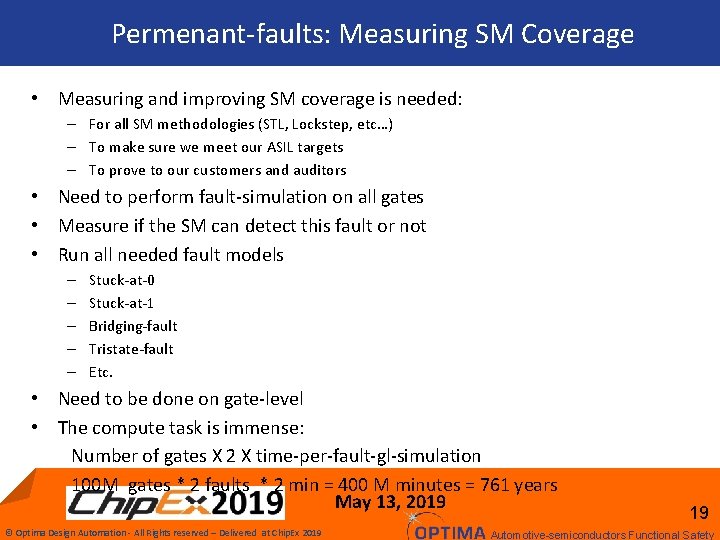
Permenant-faults: Measuring SM Coverage • Measuring and improving SM coverage is needed: – For all SM methodologies (STL, Lockstep, etc…) – To make sure we meet our ASIL targets – To prove to our customers and auditors • Need to perform fault-simulation on all gates • Measure if the SM can detect this fault or not • Run all needed fault models – – – Stuck-at-0 Stuck-at-1 Bridging-fault Tristate-fault Etc. • Need to be done on gate-level • The compute task is immense: Number of gates X 2 X time-per-fault-gl-simulation 100 M gates * 2 faults * 2 min = 400 M minutes = 761 years May 13, 2019 © Optima Design Automation - All Rights reserved – Delivered at Chip. Ex 2019 19 Automotive-semiconductors Functional Safety
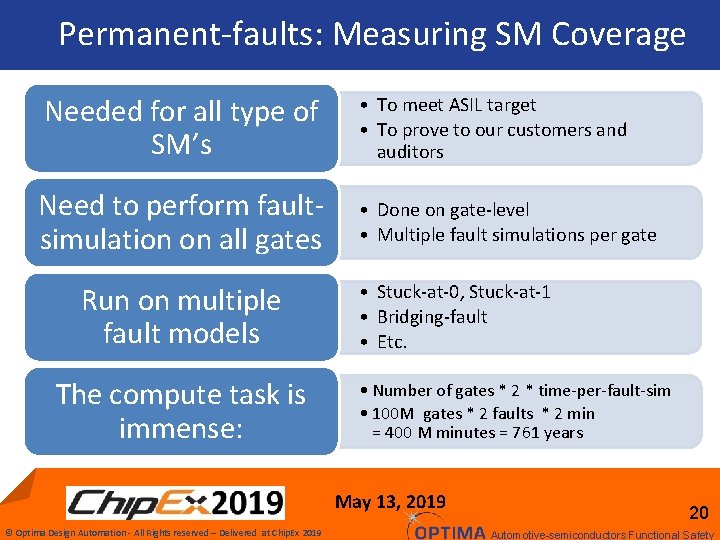
Permanent-faults: Measuring SM Coverage Needed for all type of SM’s • To meet ASIL target • To prove to our customers and auditors Need to perform faultsimulation on all gates • Done on gate-level • Multiple fault simulations per gate Run on multiple fault models The compute task is immense: • Stuck-at-0, Stuck-at-1 • Bridging-fault • Etc. • Number of gates * 2 * time-per-fault-sim • 100 M gates * 2 faults * 2 min = 400 M minutes = 761 years May 13, 2019 © Optima Design Automation - All Rights reserved – Delivered at Chip. Ex 2019 20 Automotive-semiconductors Functional Safety
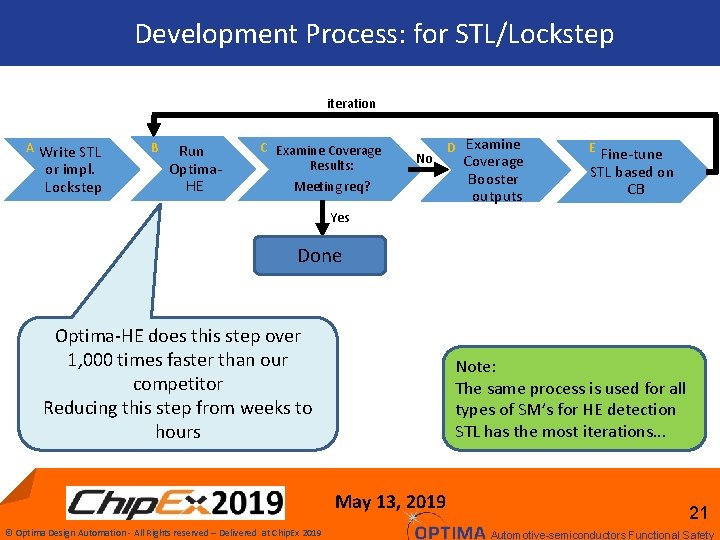
Development Process: for STL/Lockstep iteration A Write STL or impl. Lockstep B Run Optima. HE C Examine Coverage Results: No Meeting req? D Examine Coverage Booster outputs E Fine-tune STL based on CB Yes Done Optima-HE does this step over 1, 000 times faster than our competitor Reducing this step from weeks to hours Note: The same process is used for all types of SM’s for HE detection STL has the most iterations. . . May 13, 2019 © Optima Design Automation - All Rights reserved – Delivered at Chip. Ex 2019 21 Automotive-semiconductors Functional Safety
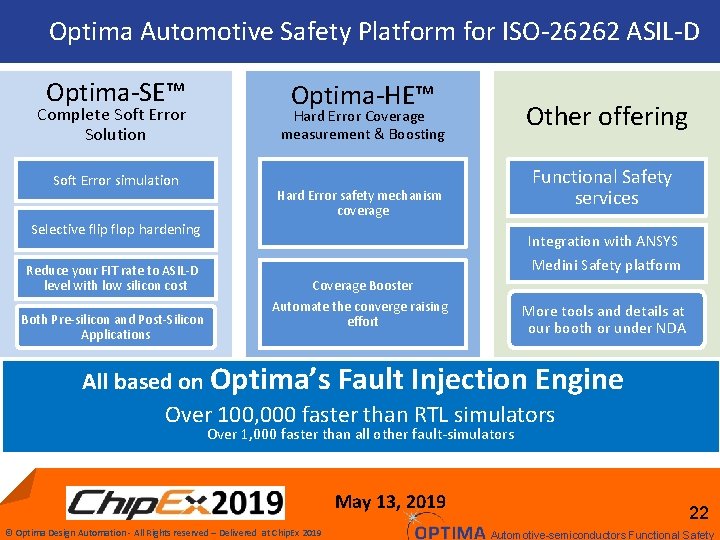
Optima Automotive Safety Platform for ISO-26262 ASIL-D Optima-SE™ Complete Soft Error Solution Soft Error simulation Optima-HE™ Other offering Hard Error Coverage measurement & Boosting Functional Safety services Hard Error safety mechanism coverage Selective flip flop hardening Reduce your FIT rate to ASIL-D level with low silicon cost Both Pre-silicon and Post-Silicon Applications Integration with ANSYS Medini Safety platform Coverage Booster Automate the converge raising effort More tools and details at our booth or under NDA All based on Optima’s Fault Injection Engine Over 100, 000 faster than RTL simulators Over 1, 000 faster than all other fault-simulators May 13, 2019 © Optima Design Automation - All Rights reserved – Delivered at Chip. Ex 2019 22 Automotive-semiconductors Functional Safety
Automotive-semiconductors Functional Automation See you at our booth!!! the sweetest giveaway at Chip. Ex -> www. optima-da. com info@optima-da. com May 13, 2019 © Optima Design Automation - All Rights reserved – Delivered at Chip. Ex 2019 23 Automotive-semiconductors Functional Safety