
Automotive Technology Principles Sixth Edition Diagnosis and Service




- Slides: 113
Automotive Technology Principles, Sixth Edition Diagnosis, and Service Chapter 127 Manual Transmissions/ Transaxles Copyright © 2018, 2015, 2011 Pearson Education, Inc. All Rights Reserved Copyright © 2020, 2016, 2012 Pearson Education, Inc. All Rights Reserved
LEARNING OBJECTIVES (1 of 2) 127. 1 Discuss the need for a transmission. 127. 2 Explain the different types of gears and gear ratios. 127. 3 Describe the relationship between torque, speed, and power. 127. 4 Describe the construction of a transmission. 127. 5 Describe the torque flow through a manual transmission. Copyright © 2020, 2016, 2012 Pearson Education, Inc. All Rights Reserved
LEARNING OBJECTIVES (2 of 2) 127. 6 Describe speed gears. 127. 7 Explain the construction and operation of a synchronizer. 127. 8 Describe the torque flow through a fivespeed manual transmission. 127. 9 Describe the procedure to diagnose, remove, disassemble, and install manual transmission/transaxle. Copyright © 2020, 2016, 2012 Pearson Education, Inc. All Rights Reserved
THE NEED FOR A TRANSMISSION • A vehicle requires a lot of torque to start off and to climb hills, yet it does not require as much torque to move on level ground. • Using gears allows the engine speed to increase at low vehicle speeds yet still permits the engine speed to drop at higher speeds to save fuel and reduce exhaust emissions. Copyright © 2020, 2016, 2012 Pearson Education, Inc. All Rights Reserved
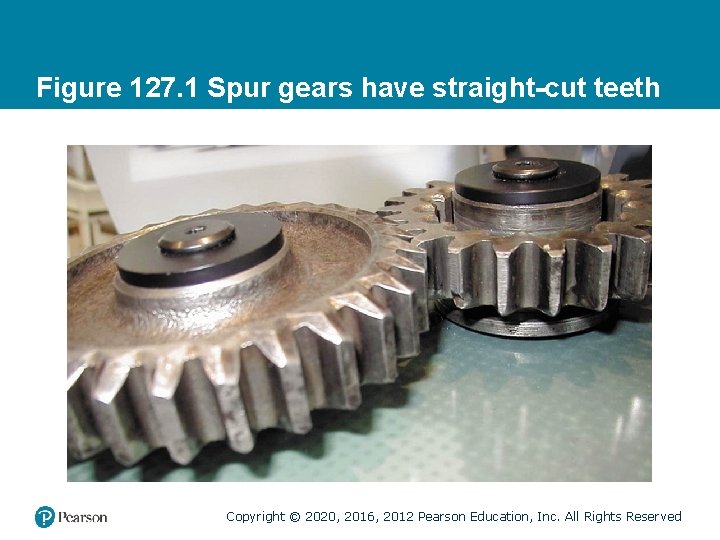
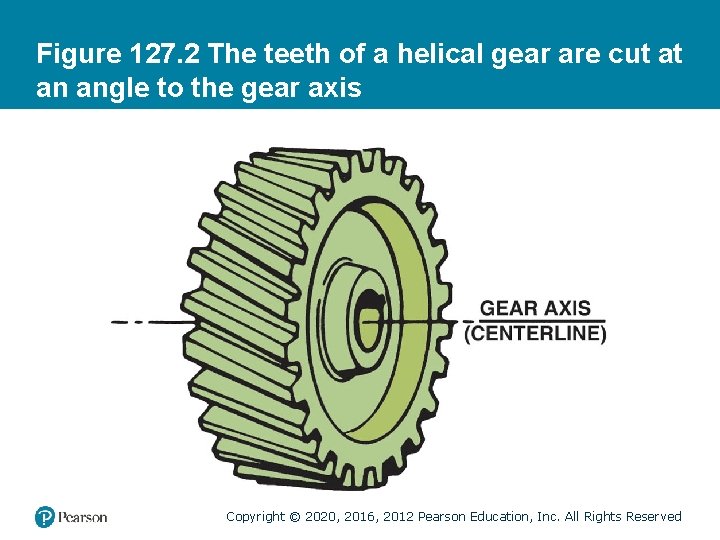
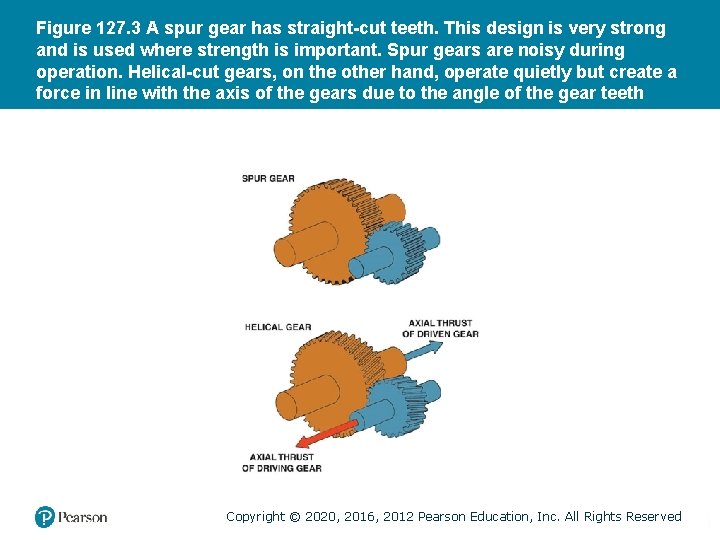
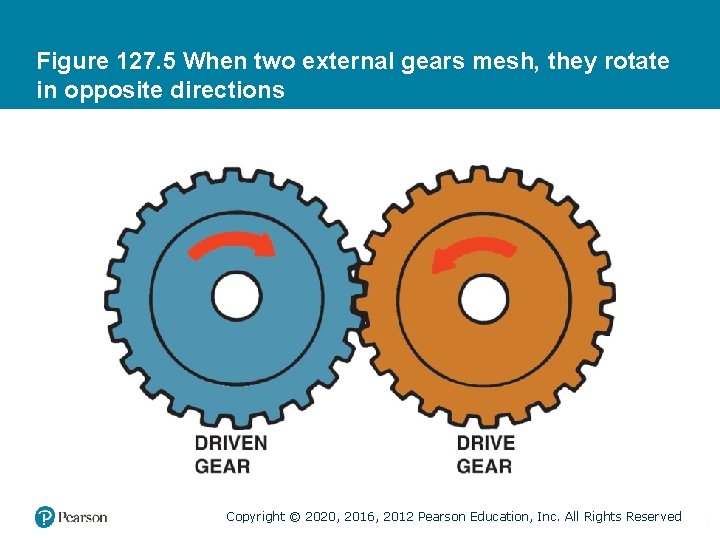
GEAR TYPES (1 OF 2) • Spur Gear – A spur gear consists of a gear blank with straight-cut teeth around its entire circumference. • Helical Gear – A helical gear, although similar to a spur gear, has its teeth cut at an angle to the axis of the gear. • External Gears – Gear teeth on their outside circumference Copyright © 2020, 2016, 2012 Pearson Education, Inc. All Rights Reserved
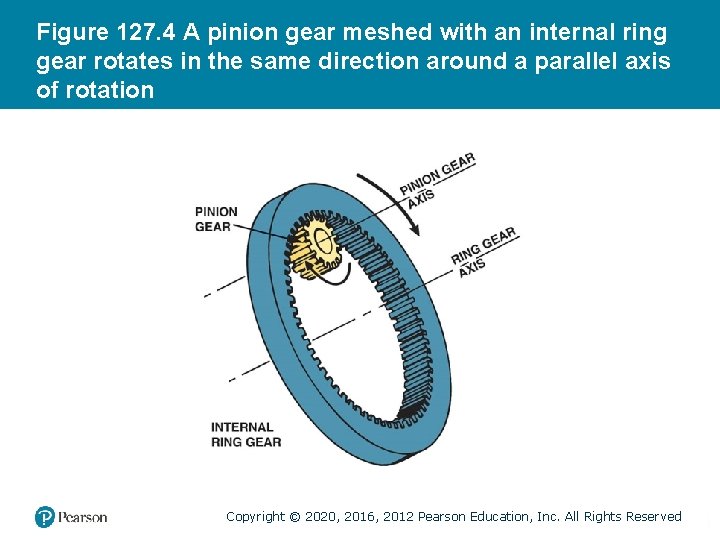
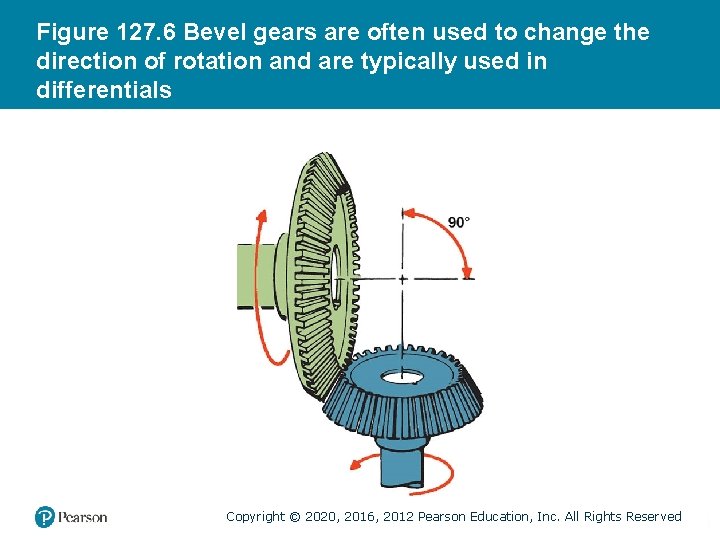
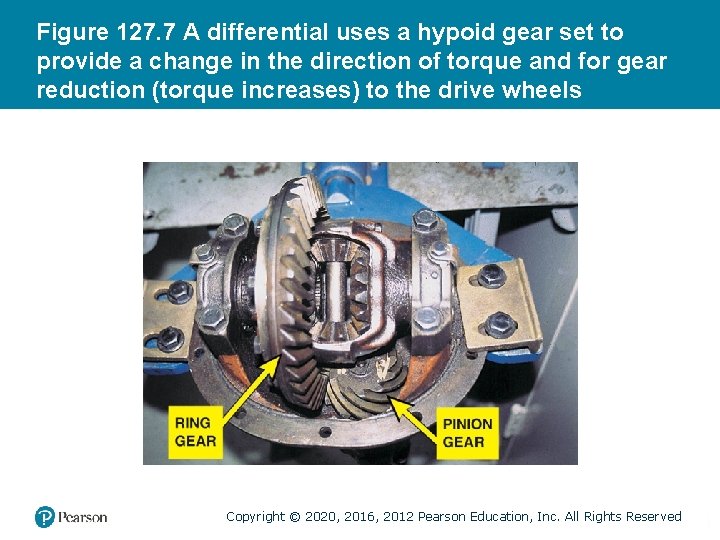
GEAR TYPES (2 OF 2) • Internal Ring Gears – Gears having teeth along the inside circumference. • Bevel Gears – The teeth of a bevel gear are cut at an angle to the outside gear surface. • Hypoid Gears – Hypoid gear sets have gear teeth that are curved much like the teeth of a spiral bevel gear. Copyright © 2020, 2016, 2012 Pearson Education, Inc. All Rights Reserved
Figure 127. 1 Spur gears have straight-cut teeth Copyright © 2020, 2016, 2012 Pearson Education, Inc. All Rights Reserved
Figure 127. 2 The teeth of a helical gear are cut at an angle to the gear axis Copyright © 2020, 2016, 2012 Pearson Education, Inc. All Rights Reserved
Figure 127. 3 A spur gear has straight-cut teeth. This design is very strong and is used where strength is important. Spur gears are noisy during operation. Helical-cut gears, on the other hand, operate quietly but create a force in line with the axis of the gears due to the angle of the gear teeth Copyright © 2020, 2016, 2012 Pearson Education, Inc. All Rights Reserved
Figure 127. 4 A pinion gear meshed with an internal ring gear rotates in the same direction around a parallel axis of rotation Copyright © 2020, 2016, 2012 Pearson Education, Inc. All Rights Reserved
Figure 127. 5 When two external gears mesh, they rotate in opposite directions Copyright © 2020, 2016, 2012 Pearson Education, Inc. All Rights Reserved
Figure 127. 6 Bevel gears are often used to change the direction of rotation and are typically used in differentials Copyright © 2020, 2016, 2012 Pearson Education, Inc. All Rights Reserved
Figure 127. 7 A differential uses a hypoid gear set to provide a change in the direction of torque and for gear reduction (torque increases) to the drive wheels Copyright © 2020, 2016, 2012 Pearson Education, Inc. All Rights Reserved
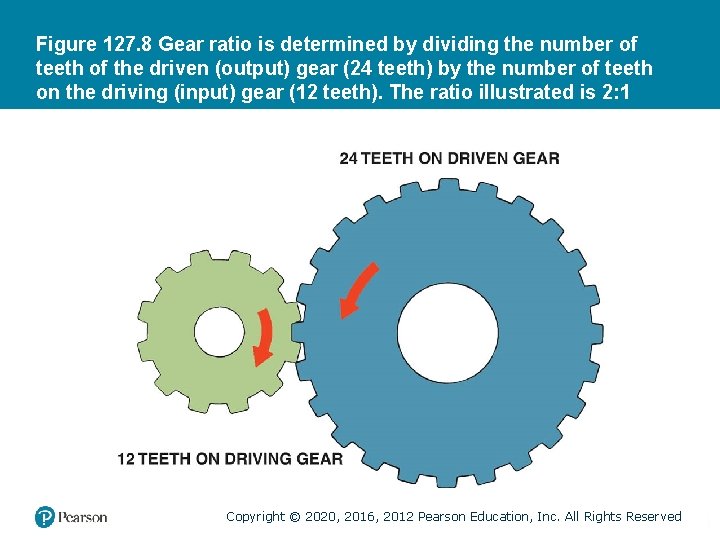
GEAR RATIOS (1 OF 3) • Gear ratio is expressed as the number of rotations the drive gear must make in order to rotate the driven gear through one revolution. • Gear ratios, which are expressed relative to the number one, fall into three categories: – Direct drive – Gear reduction – Overdrive Copyright © 2020, 2016, 2012 Pearson Education, Inc. All Rights Reserved
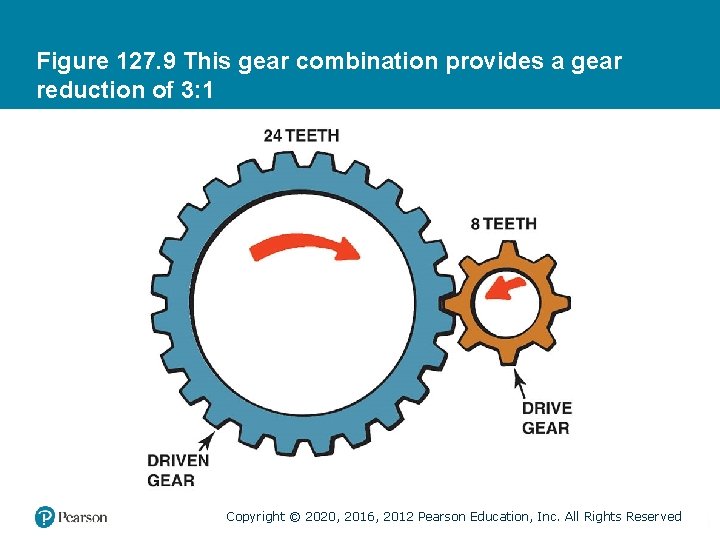
GEAR RATIOS (2 OF 3) • Direct Drive – If two meshed gears are the same size and have the same number of teeth, they will turn at the same speed. • Gear Reduction – If one gear drives a second gear that has three times the number of teeth, the smaller drive gear must travel three complete revolutions in order to drive the larger gear through one rotation. Copyright © 2020, 2016, 2012 Pearson Education, Inc. All Rights Reserved
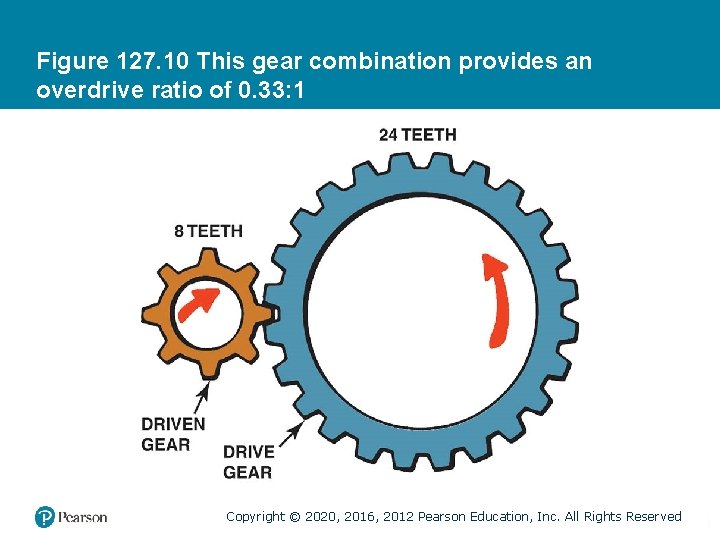
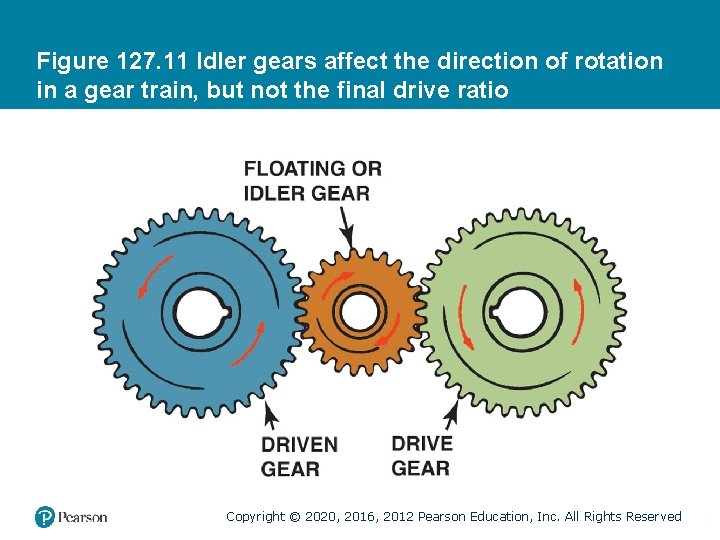
GEAR RATIOS (3 OF 3) • Overdrive – Overdrive is the opposite of a gear reduction condition and occurs when a driven gear turns faster than its drive gear. • Idler Gears – A gear that operates between the drive and driven gears is called a floating gear, or idler gear. – Idler gears affect direction of rotation not the speed of the gear. Copyright © 2020, 2016, 2012 Pearson Education, Inc. All Rights Reserved
Figure 127. 8 Gear ratio is determined by dividing the number of teeth of the driven (output) gear (24 teeth) by the number of teeth on the driving (input) gear (12 teeth). The ratio illustrated is 2: 1 Copyright © 2020, 2016, 2012 Pearson Education, Inc. All Rights Reserved
Figure 127. 9 This gear combination provides a gear reduction of 3: 1 Copyright © 2020, 2016, 2012 Pearson Education, Inc. All Rights Reserved
Figure 127. 10 This gear combination provides an overdrive ratio of 0. 33: 1 Copyright © 2020, 2016, 2012 Pearson Education, Inc. All Rights Reserved
Figure 127. 11 Idler gears affect the direction of rotation in a gear train, but not the final drive ratio Copyright © 2020, 2016, 2012 Pearson Education, Inc. All Rights Reserved
QUESTION 1: ? In an overdrive gear ratio what is the relationship between the drive and driven gear? Copyright © 2020, 2016, 2012 Pearson Education, Inc. All Rights Reserved
ANSWER 1: The driven gear turns faster than its drive gear. Copyright © 2020, 2016, 2012 Pearson Education, Inc. All Rights Reserved
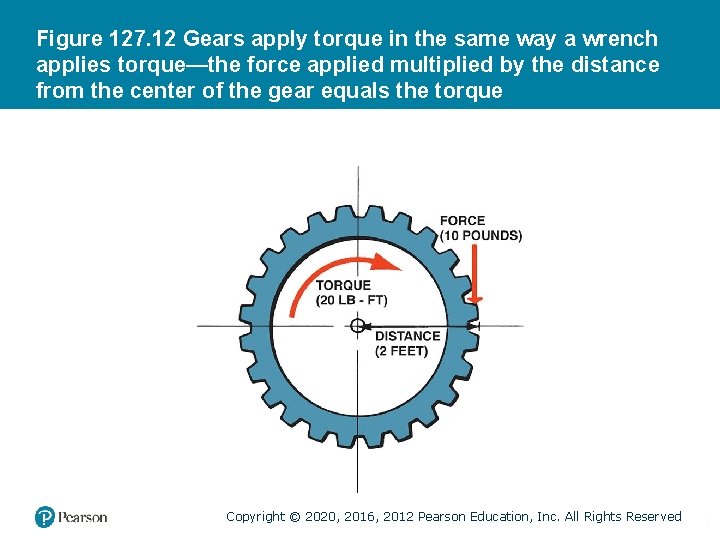
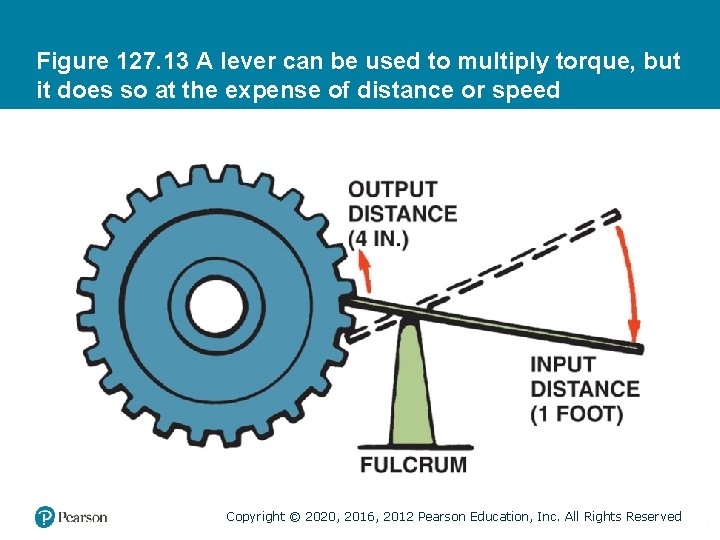
TOEQUE, SPEED, AND POWER • Gears apply torque much like a wrench does; each tooth of a gear is actually a lever. • Torque and Speed Relationship – Torque and speed have an inverse relationship: as one goes up, the other goes down. • Torque Multiplication – Levers can be used to increase or multiply torque. – Either distance or speed must always be given up in order to increase, or multiply, torque. Copyright © 2020, 2016, 2012 Pearson Education, Inc. All Rights Reserved
Figure 127. 12 Gears apply torque in the same way a wrench applies torque—the force applied multiplied by the distance from the center of the gear equals the torque Copyright © 2020, 2016, 2012 Pearson Education, Inc. All Rights Reserved
Figure 127. 13 A lever can be used to multiply torque, but it does so at the expense of distance or speed Copyright © 2020, 2016, 2012 Pearson Education, Inc. All Rights Reserved
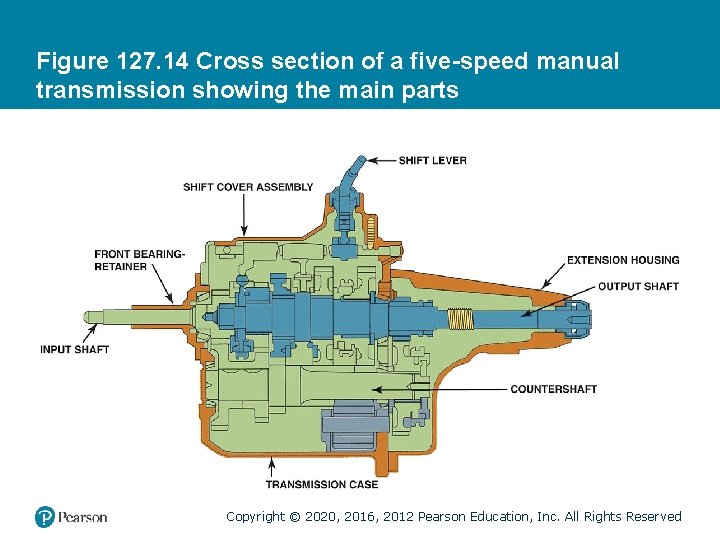
TRANSMISSION CONSTRUCTION (1 OF 2) • A transmission is usually constructed of cast aluminum. • The front of the transmission attaches to a separate bell housing. • At the front of the transmission (toward the engine) is the front bearing retainer. • The rear of the transmission usually includes a separate casting called the extension housing. Copyright © 2020, 2016, 2012 Pearson Education, Inc. All Rights Reserved
TRANSMISSION CONSTRUCTION (2 OF 2) • The center housing is usually referred to as the transmission case. • The input shaft is splined to the clutch disc and is also referred to as the main gear, clutch gear, or main drive pinion assembly. • The main shaft, also called the output shaft. • All manual transmissions/transaxles use a countershaft. Copyright © 2020, 2016, 2012 Pearson Education, Inc. All Rights Reserved
Figure 127. 14 Cross section of a five-speed manual transmission showing the main parts Copyright © 2020, 2016, 2012 Pearson Education, Inc. All Rights Reserved
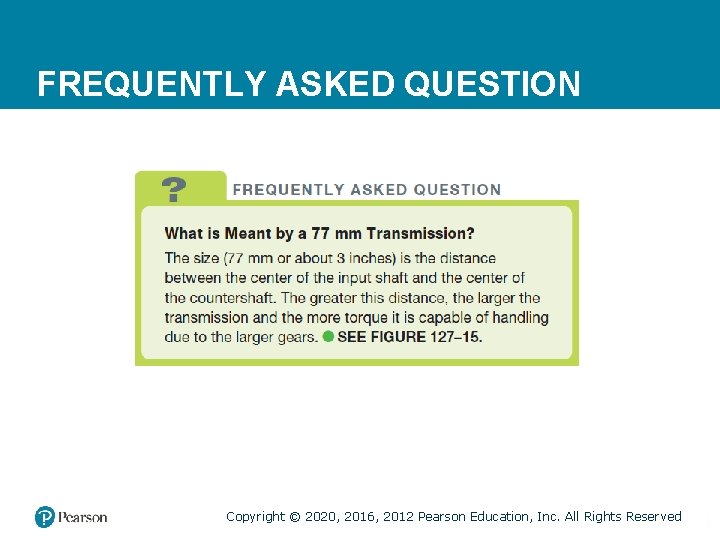
FREQUENTLY ASKED QUESTION Copyright © 2020, 2016, 2012 Pearson Education, Inc. All Rights Reserved
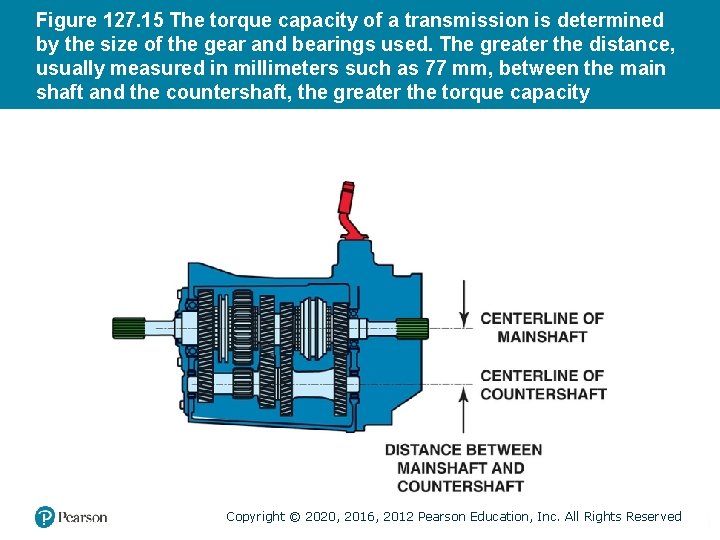
Figure 127. 15 The torque capacity of a transmission is determined by the size of the gear and bearings used. The greater the distance, usually measured in millimeters such as 77 mm, between the main shaft and the countershaft, the greater the torque capacity Copyright © 2020, 2016, 2012 Pearson Education, Inc. All Rights Reserved
TORQUE FLOW THROUGH A MANUAL TRANSMISSION • The engine torque is applied to the input shaft when the clutch is engaged (clutch pedal up). • This torque is applied to the main gear. • The engine torque is multiplied by the ratio difference between the main gear and the cluster gear. • The engine torque then is applied to the drive wheels through the driveshaft, differential, and drive axles. Copyright © 2020, 2016, 2012 Pearson Education, Inc. All Rights Reserved
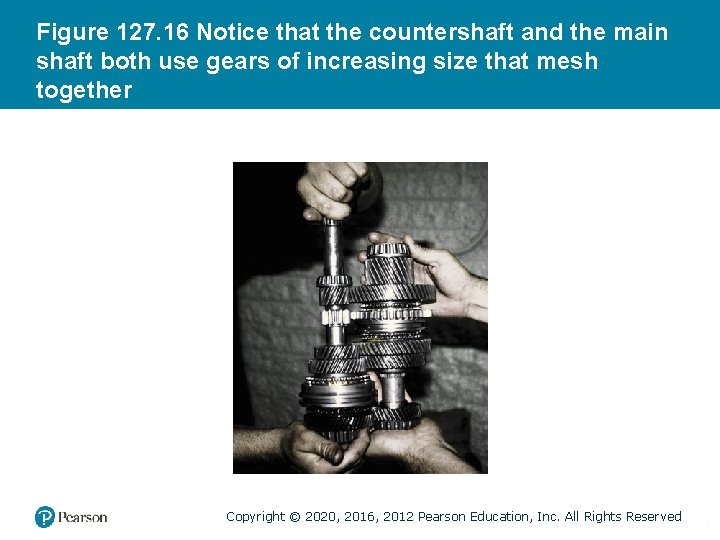
SPEED GEARS • The gears on the main shaft are free to move on the shaft and are connected to the main shaft through the synchronizer hub when a shift is made. • The gears that rotate on the main shaft are called speed gears and are free to rotate on a film of oil or on bearings. Copyright © 2020, 2016, 2012 Pearson Education, Inc. All Rights Reserved
Figure 127. 16 Notice that the countershaft and the main shaft both use gears of increasing size that mesh together Copyright © 2020, 2016, 2012 Pearson Education, Inc. All Rights Reserved
SYNCHRONIZER PARTS AND OPERATION (1 OF 2) • Interlocks either in the shifter linkage itself or inside the transmission/transaxle prevent selecting two gears at the same time. • Synchronizers are used in manual transmissions/transaxles to make shifting easier. • To synchronize means to make two or more events occur at the same time. • The synchronizer ensures the two gears to be meshed must be rotating at the same speed. Copyright © 2020, 2016, 2012 Pearson Education, Inc. All Rights Reserved
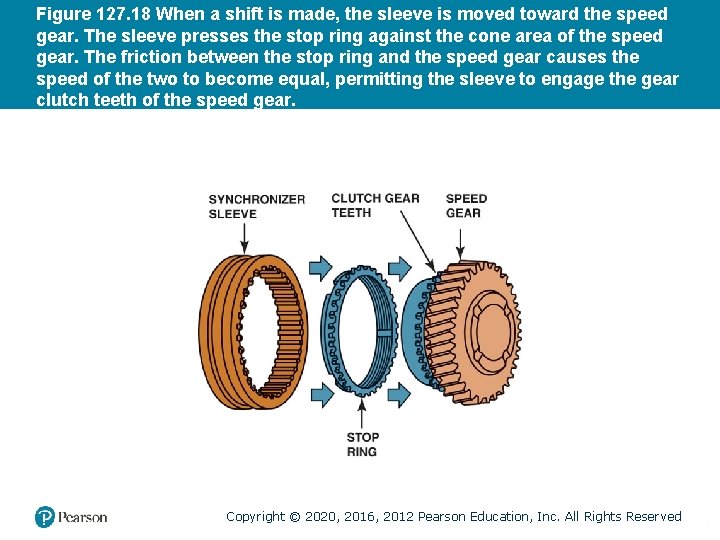
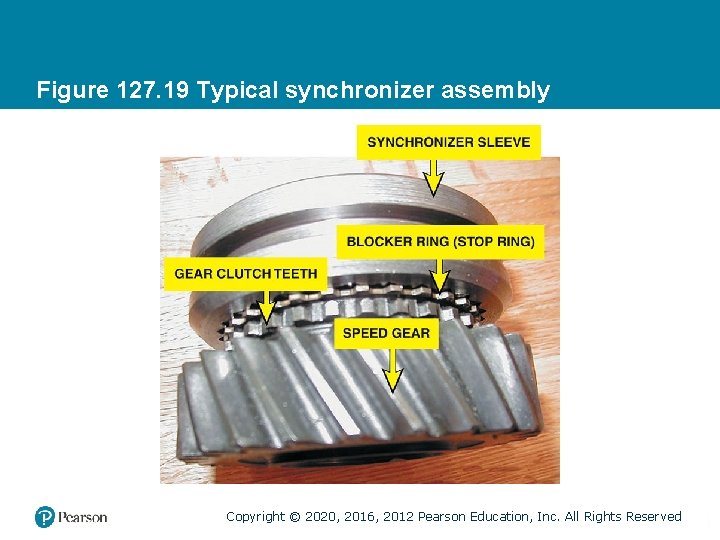
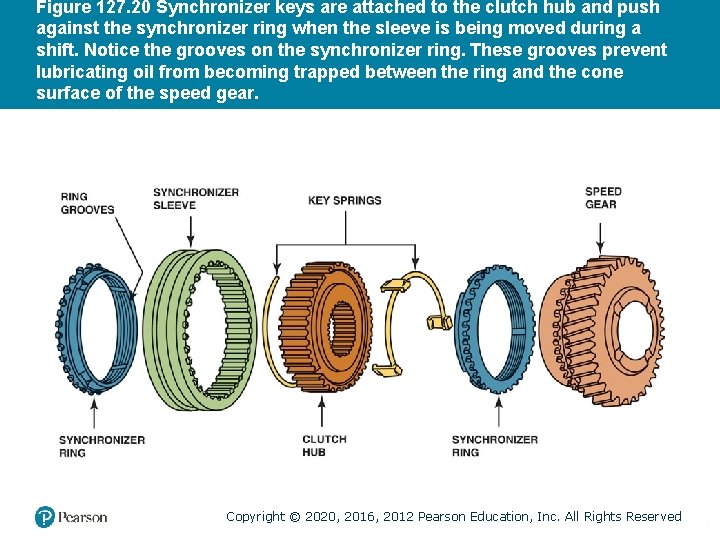
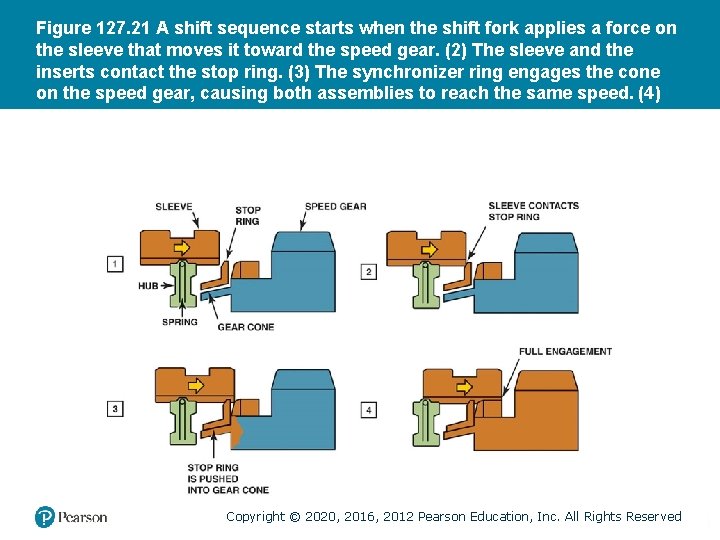
SYNCHRONIZER PARTS AND OPERATION (2 OF 2) • Synchronizer Construction – Although there a number of design variations, all are similar and include a hub, a sliding sleeve, a blocker ring, (or stop ring or synchronizer ring), keys, and springs. • Synchronizer Operation – When a force on the sleeve that moves it toward the speed gear. The sleeve and the inserts contact the stop ring (blocking ring). The synchronizer ring (stop ring) engages the cone on the speed gear, causing both assemblies to reach the same speed. Copyright © 2020, 2016, 2012 Pearson Education, Inc. All Rights Reserved
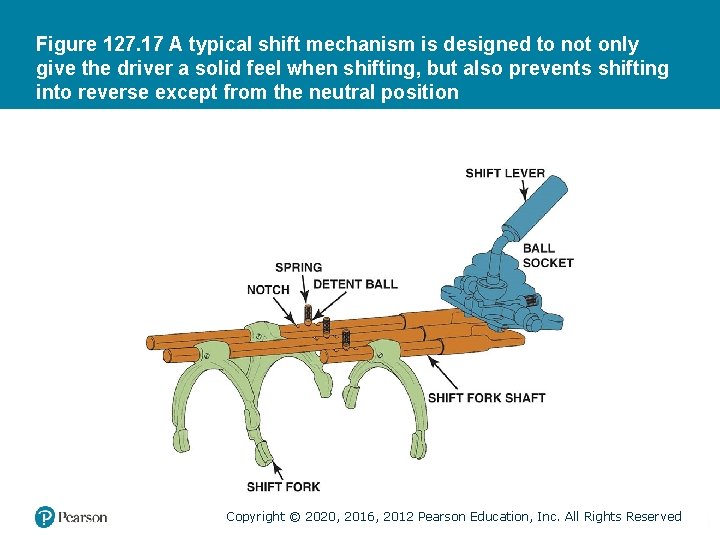
Figure 127. 17 A typical shift mechanism is designed to not only give the driver a solid feel when shifting, but also prevents shifting into reverse except from the neutral position Copyright © 2020, 2016, 2012 Pearson Education, Inc. All Rights Reserved
Figure 127. 18 When a shift is made, the sleeve is moved toward the speed gear. The sleeve presses the stop ring against the cone area of the speed gear. The friction between the stop ring and the speed gear causes the speed of the two to become equal, permitting the sleeve to engage the gear clutch teeth of the speed gear. Copyright © 2020, 2016, 2012 Pearson Education, Inc. All Rights Reserved
Figure 127. 19 Typical synchronizer assembly Copyright © 2020, 2016, 2012 Pearson Education, Inc. All Rights Reserved
Figure 127. 20 Synchronizer keys are attached to the clutch hub and push against the synchronizer ring when the sleeve is being moved during a shift. Notice the grooves on the synchronizer ring. These grooves prevent lubricating oil from becoming trapped between the ring and the cone surface of the speed gear. Copyright © 2020, 2016, 2012 Pearson Education, Inc. All Rights Reserved
Figure 127. 21 A shift sequence starts when the shift fork applies a force on the sleeve that moves it toward the speed gear. (2) The sleeve and the inserts contact the stop ring. (3) The synchronizer ring engages the cone on the speed gear, causing both assemblies to reach the same speed. (4) Copyright © 2020, 2016, 2012 Pearson Education, Inc. All Rights Reserved
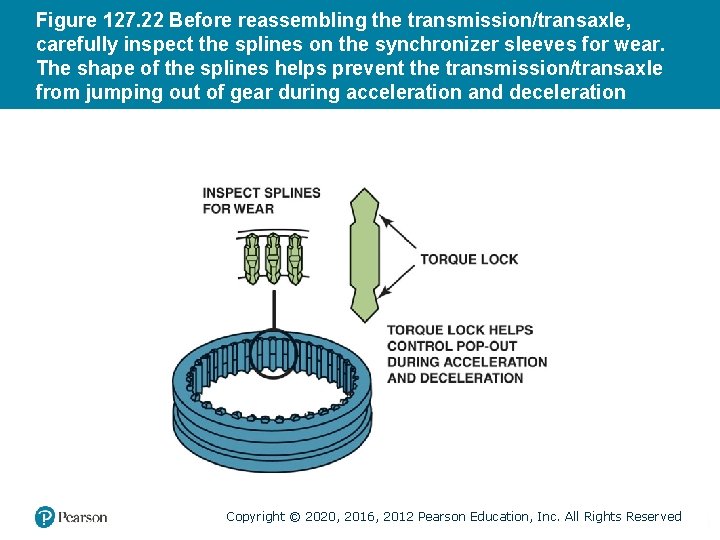
Figure 127. 22 Before reassembling the transmission/transaxle, carefully inspect the splines on the synchronizer sleeves for wear. The shape of the splines helps prevent the transmission/transaxle from jumping out of gear during acceleration and deceleration Copyright © 2020, 2016, 2012 Pearson Education, Inc. All Rights Reserved
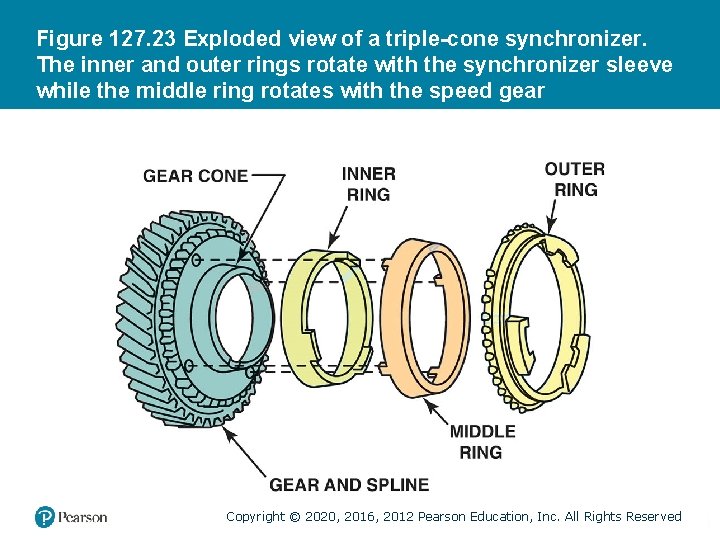
Figure 127. 23 Exploded view of a triple-cone synchronizer. The inner and outer rings rotate with the synchronizer sleeve while the middle ring rotates with the speed gear Copyright © 2020, 2016, 2012 Pearson Education, Inc. All Rights Reserved
QUESTION 2: ? What is the purpose of the synchronizer? Copyright © 2020, 2016, 2012 Pearson Education, Inc. All Rights Reserved
ANSWER 2: The synchronizer ensures the two gears to be meshed must be rotating at the same speed. Copyright © 2020, 2016, 2012 Pearson Education, Inc. All Rights Reserved
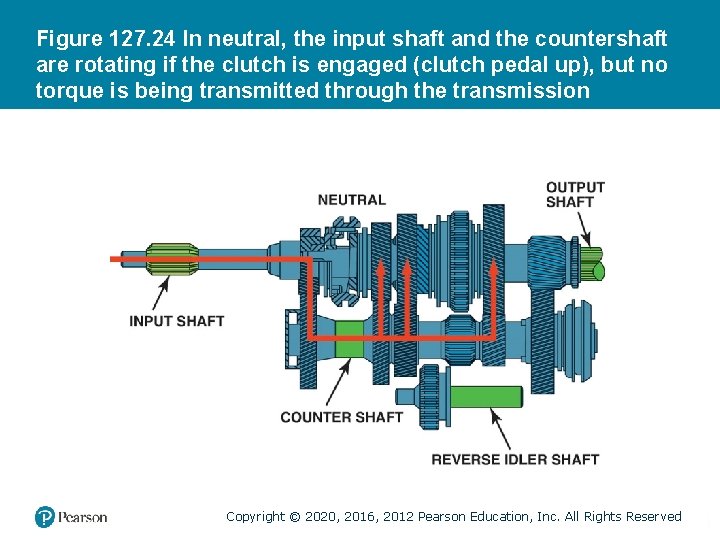
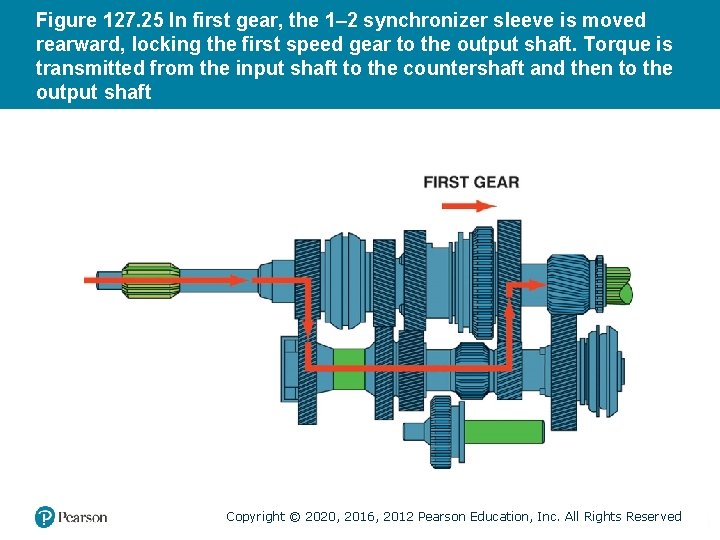
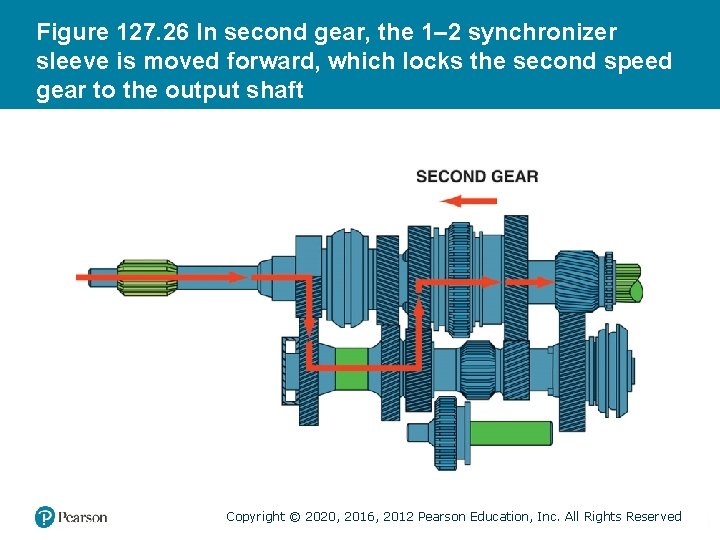
FIVE SPEED TRANSMISSION TORQUE FLOW (1 OF 3) • Neutral – All of the synchronizer sleeves are centered on their hubs. • First Gear – In first gear, the shift linkage slides the 1– 2 synchronizer sleeve rearward toward the first speed gear. • Second Gear – In second gear, the shift linkage slides the 1– 2 synchronizer sleeve forward, away from the first speed gear and toward the second speed gear. Copyright © 2020, 2016, 2012 Pearson Education, Inc. All Rights Reserved
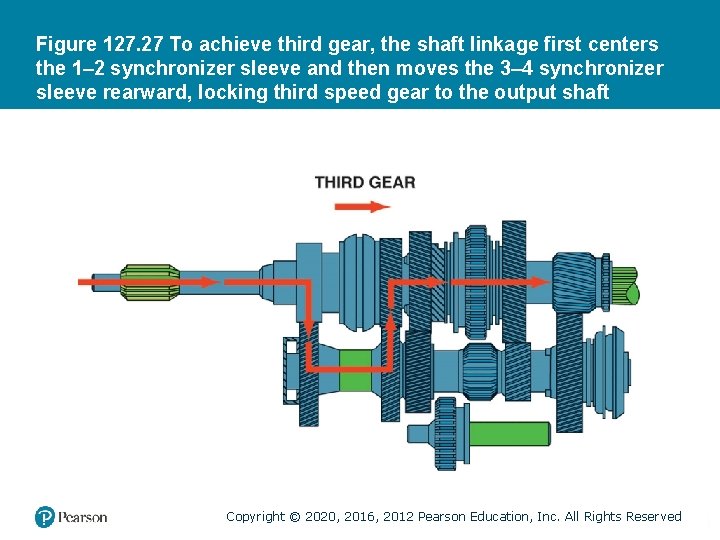
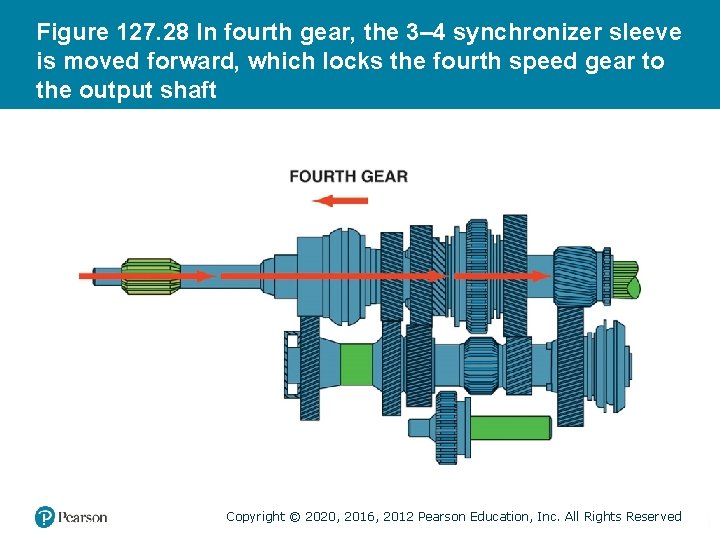
FIVE SPEED TRANSMISSION TORQUE FLOW (2 OF 3) • Third Gear – In third gear, the shift linkage centers the 1– 2 synchronizer sleeve and moves the 3– 4 synchronizer sleeve back toward the third speed gear. • Fourth Gear – In fourth gear, the shift linkage moves the 3– 4 synchronizer sleeve forward, away from the third speed gear and toward the input shaft drive gear. Copyright © 2020, 2016, 2012 Pearson Education, Inc. All Rights Reserved
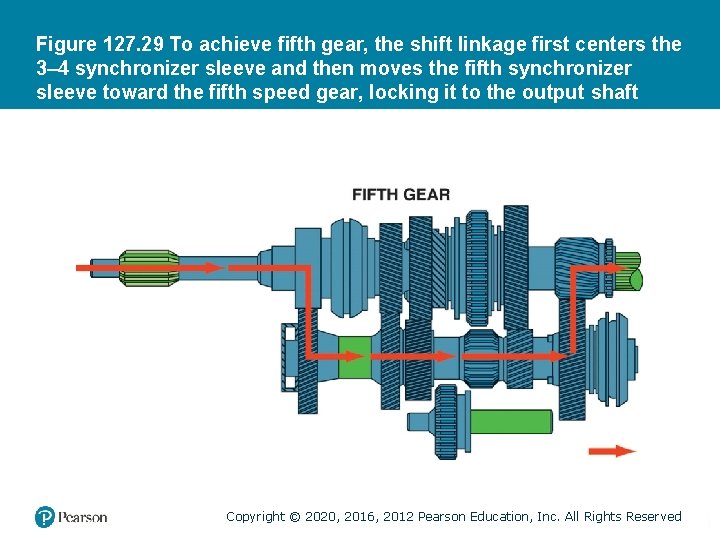
FIVE SPEED TRANSMISSION TORQUE FLOW (3 OF 3) • Fifth Gear – In fifth gear, the shift linkage centers the 3– 4 synchronizer sleeve and moves the fifth synchronizer sleeve toward the fifth speed gear. • Reverse – There are two common reverse gear designs used on transmissions: – Sliding gear – Constant-mesh gear Copyright © 2020, 2016, 2012 Pearson Education, Inc. All Rights Reserved
Figure 127. 24 In neutral, the input shaft and the countershaft are rotating if the clutch is engaged (clutch pedal up), but no torque is being transmitted through the transmission Copyright © 2020, 2016, 2012 Pearson Education, Inc. All Rights Reserved
Figure 127. 25 In first gear, the 1– 2 synchronizer sleeve is moved rearward, locking the first speed gear to the output shaft. Torque is transmitted from the input shaft to the countershaft and then to the output shaft Copyright © 2020, 2016, 2012 Pearson Education, Inc. All Rights Reserved
Figure 127. 26 In second gear, the 1– 2 synchronizer sleeve is moved forward, which locks the second speed gear to the output shaft Copyright © 2020, 2016, 2012 Pearson Education, Inc. All Rights Reserved
Figure 127. 27 To achieve third gear, the shaft linkage first centers the 1– 2 synchronizer sleeve and then moves the 3– 4 synchronizer sleeve rearward, locking third speed gear to the output shaft Copyright © 2020, 2016, 2012 Pearson Education, Inc. All Rights Reserved
Figure 127. 28 In fourth gear, the 3– 4 synchronizer sleeve is moved forward, which locks the fourth speed gear to the output shaft Copyright © 2020, 2016, 2012 Pearson Education, Inc. All Rights Reserved
Figure 127. 29 To achieve fifth gear, the shift linkage first centers the 3– 4 synchronizer sleeve and then moves the fifth synchronizer sleeve toward the fifth speed gear, locking it to the output shaft Copyright © 2020, 2016, 2012 Pearson Education, Inc. All Rights Reserved
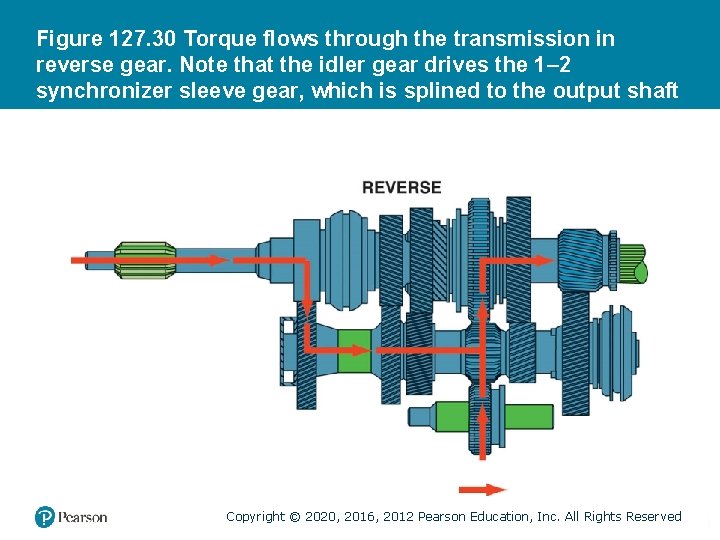
Figure 127. 30 Torque flows through the transmission in reverse gear. Note that the idler gear drives the 1– 2 synchronizer sleeve gear, which is splined to the output shaft Copyright © 2020, 2016, 2012 Pearson Education, Inc. All Rights Reserved
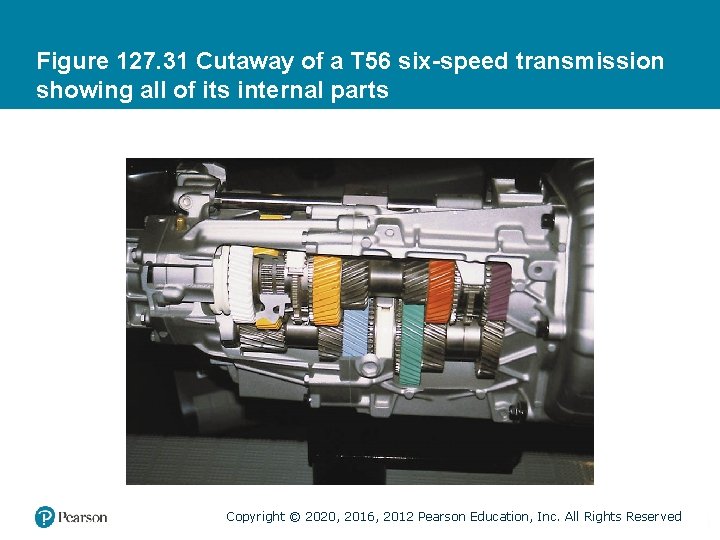
Figure 127. 31 Cutaway of a T 56 six-speed transmission showing all of its internal parts Copyright © 2020, 2016, 2012 Pearson Education, Inc. All Rights Reserved
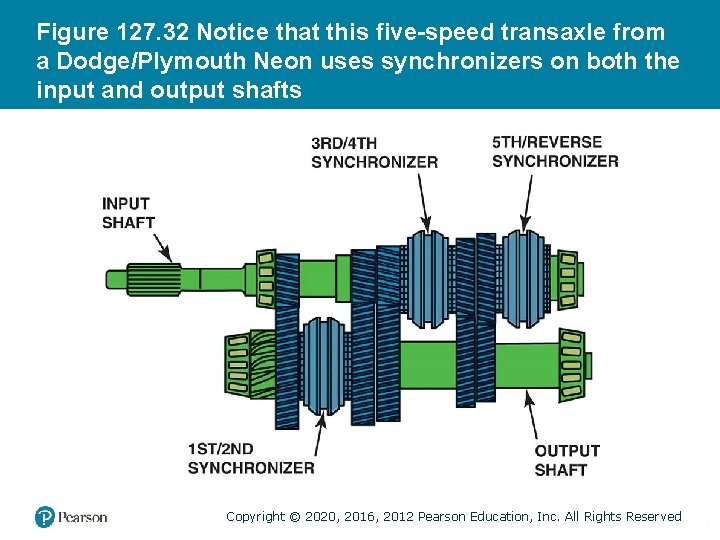
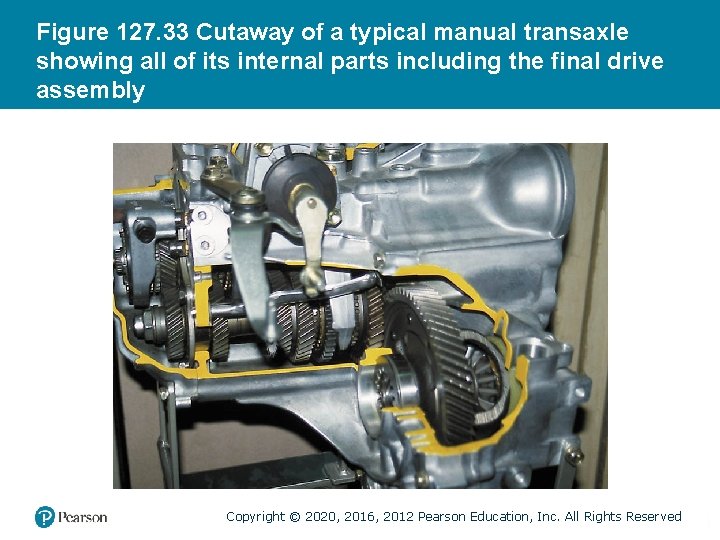
MANUAL TRANSAXLE CONSTRUCTION • Most transaxles use speed gears and synchronizers on both the input and output shafts. • The differential assembly, also called a final drive assembly, attaches to the output shaft and splits the torque to both front drive axles. Copyright © 2020, 2016, 2012 Pearson Education, Inc. All Rights Reserved
Figure 127. 32 Notice that this five-speed transaxle from a Dodge/Plymouth Neon uses synchronizers on both the input and output shafts Copyright © 2020, 2016, 2012 Pearson Education, Inc. All Rights Reserved
Figure 127. 33 Cutaway of a typical manual transaxle showing all of its internal parts including the final drive assembly Copyright © 2020, 2016, 2012 Pearson Education, Inc. All Rights Reserved
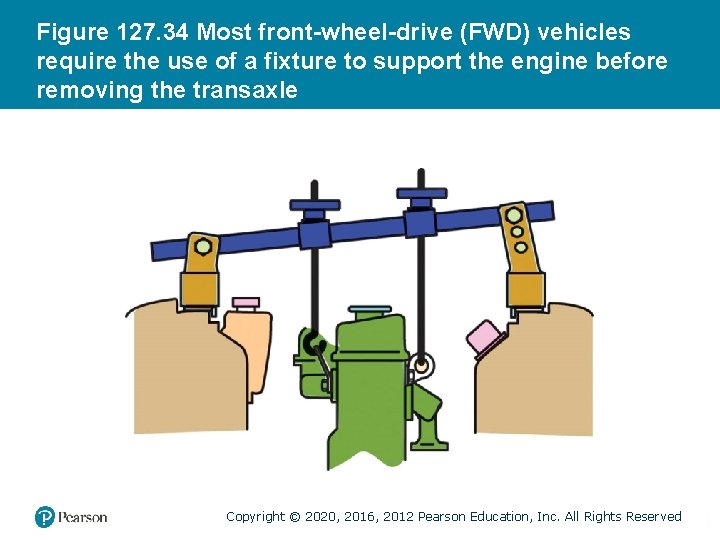
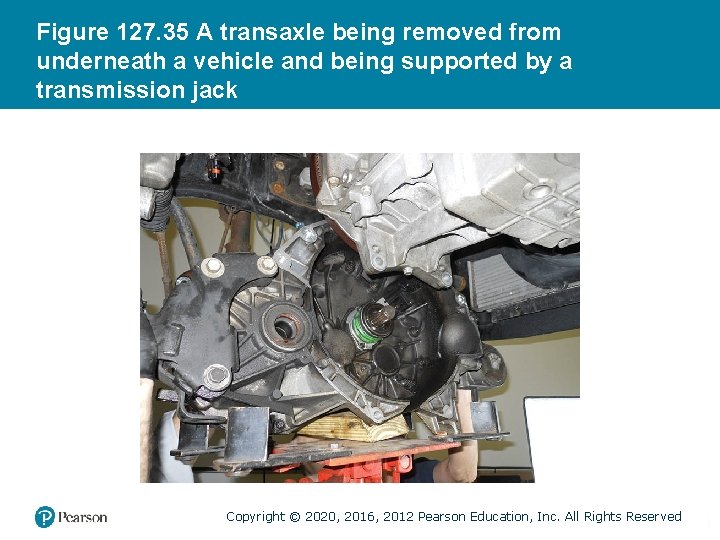
TRANSMISSION/ TRANSAXLE REMOVAL • Disconnecting the negative battery cable. • Safely hoisting and supporting the vehicle. • Supporting the engine with a holding fixture or other support (frontwheel-drive). • Remove the drive axle shafts or drive shaft (rear-wheel-drive). • Remove the clutch linkage and shift linkage. • Disconnect the vehicle speed sensor and reverse (backup) light connectors. • Remove the attaching bolts/nuts from the engine and transmission/transaxle mounts and then removing the unit from the vehicle. Copyright © 2020, 2016, 2012 Pearson Education, Inc. All Rights Reserved
Figure 127. 34 Most front-wheel-drive (FWD) vehicles require the use of a fixture to support the engine before removing the transaxle Copyright © 2020, 2016, 2012 Pearson Education, Inc. All Rights Reserved
Figure 127. 35 A transaxle being removed from underneath a vehicle and being supported by a transmission jack Copyright © 2020, 2016, 2012 Pearson Education, Inc. All Rights Reserved
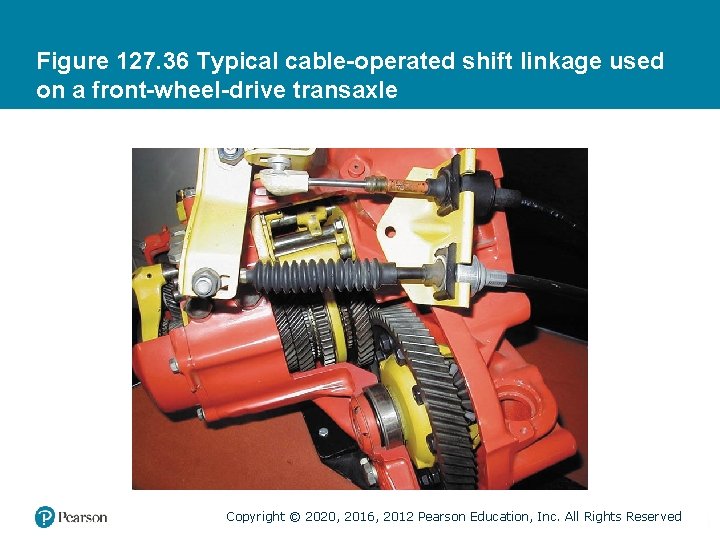
Figure 127. 36 Typical cable-operated shift linkage used on a front-wheel-drive transaxle Copyright © 2020, 2016, 2012 Pearson Education, Inc. All Rights Reserved
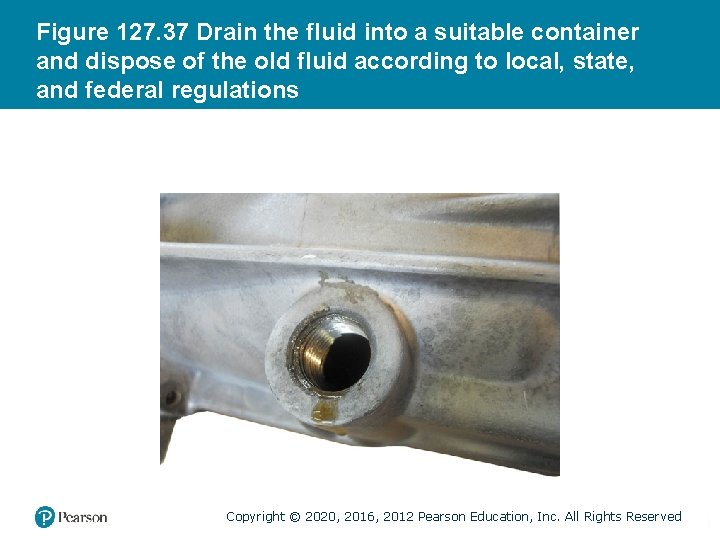
TRANSMISSION/ TRANSAXLE DISASSEMBLY • Before disassembling the transmission/transaxle, drain any remaining gear lubricant from the unit and dispose of it properly. • Mount the transmission/transaxle on a holding fixture or place it on a large, clean work surface. • Check the service manual for the exact disassembly procedures to follow for the unit being serviced. Copyright © 2020, 2016, 2012 Pearson Education, Inc. All Rights Reserved
Figure 127. 37 Drain the fluid into a suitable container and dispose of the old fluid according to local, state, and federal regulations Copyright © 2020, 2016, 2012 Pearson Education, Inc. All Rights Reserved
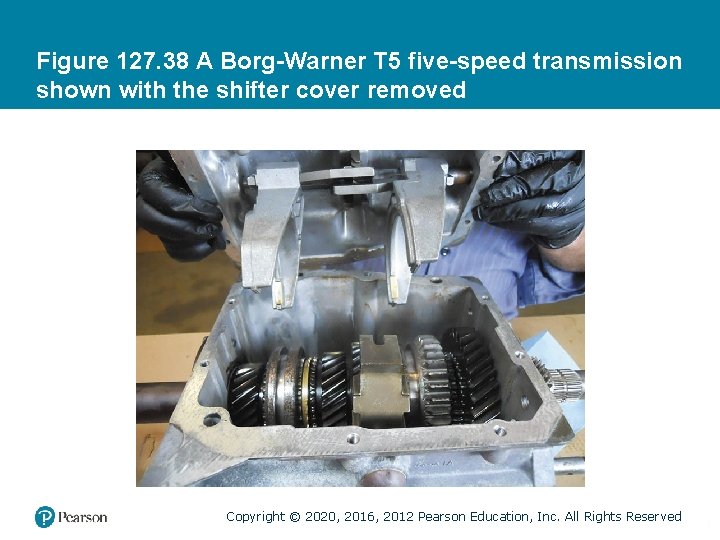
Figure 127. 38 A Borg-Warner T 5 five-speed transmission shown with the shifter cover removed Copyright © 2020, 2016, 2012 Pearson Education, Inc. All Rights Reserved
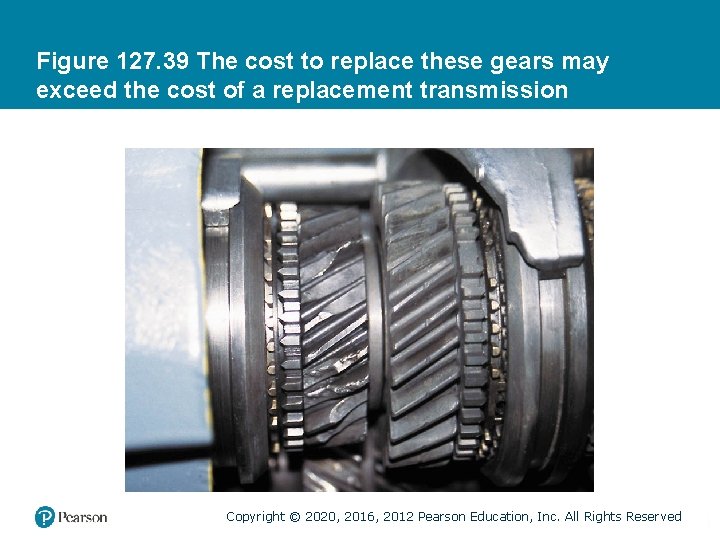
Figure 127. 39 The cost to replace these gears may exceed the cost of a replacement transmission Copyright © 2020, 2016, 2012 Pearson Education, Inc. All Rights Reserved
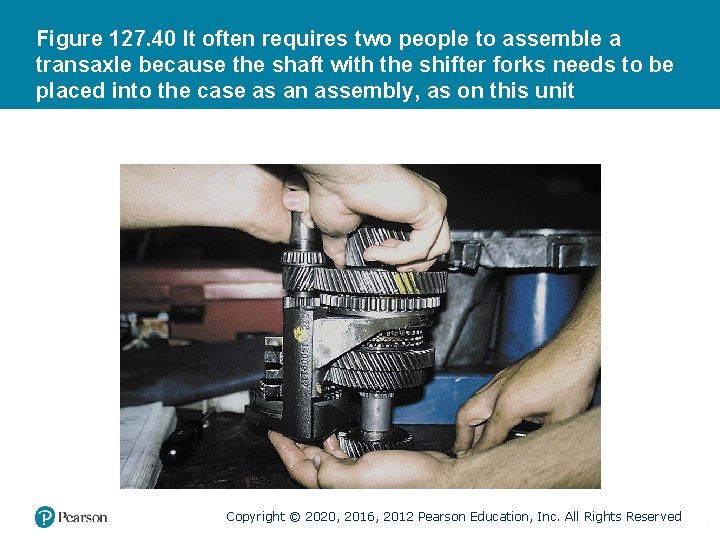
Figure 127. 40 It often requires two people to assemble a transaxle because the shaft with the shifter forks needs to be placed into the case as an assembly, as on this unit Copyright © 2020, 2016, 2012 Pearson Education, Inc. All Rights Reserved
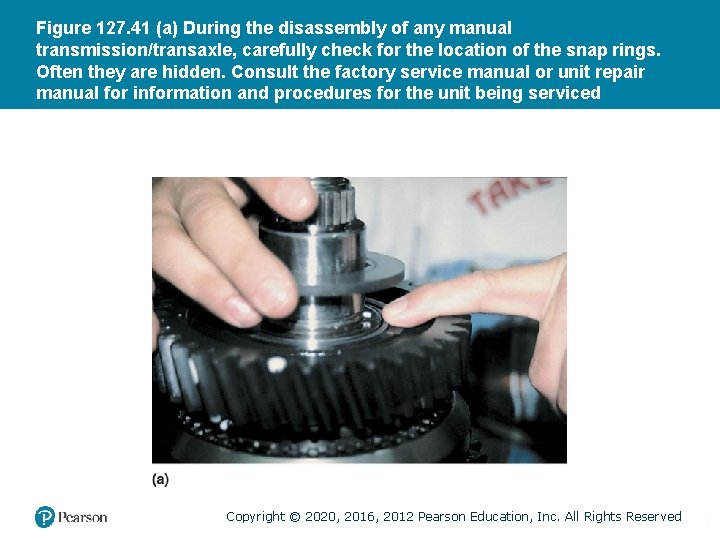
Figure 127. 41 (a) During the disassembly of any manual transmission/transaxle, carefully check for the location of the snap rings. Often they are hidden. Consult the factory service manual or unit repair manual for information and procedures for the unit being serviced Copyright © 2020, 2016, 2012 Pearson Education, Inc. All Rights Reserved
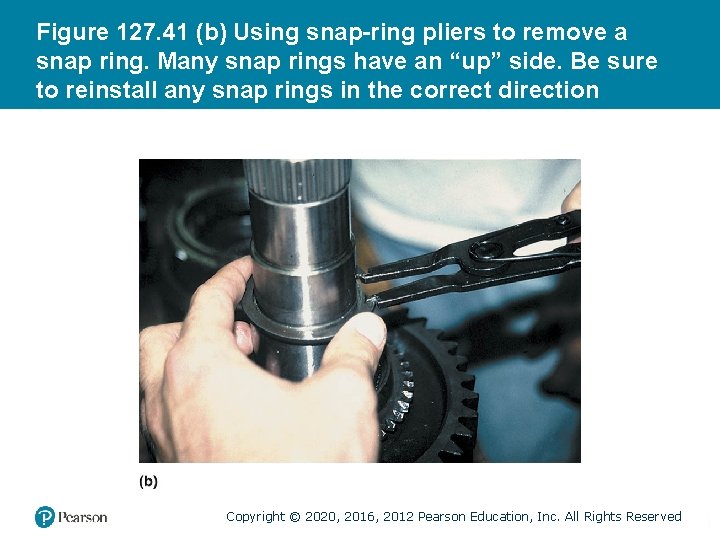
Figure 127. 41 (b) Using snap-ring pliers to remove a snap ring. Many snap rings have an “up” side. Be sure to reinstall any snap rings in the correct direction Copyright © 2020, 2016, 2012 Pearson Education, Inc. All Rights Reserved
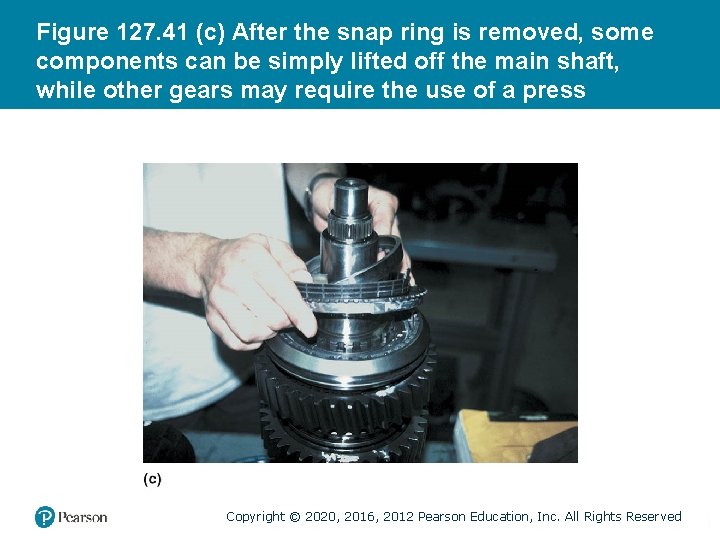
Figure 127. 41 (c) After the snap ring is removed, some components can be simply lifted off the main shaft, while other gears may require the use of a press Copyright © 2020, 2016, 2012 Pearson Education, Inc. All Rights Reserved
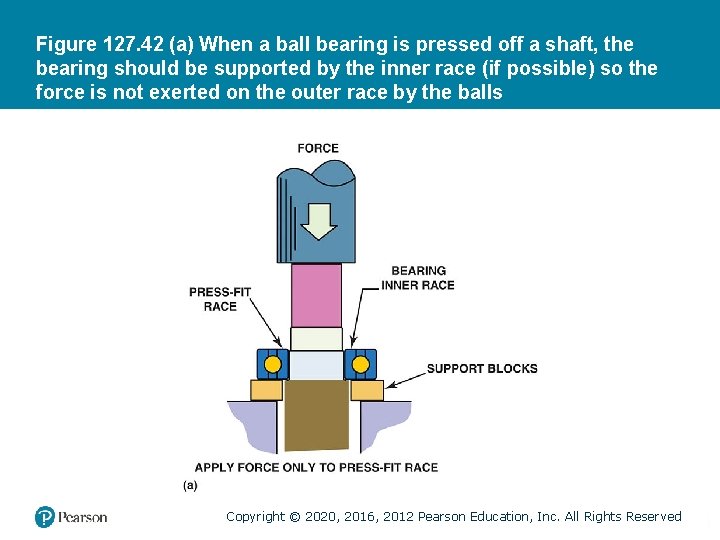
Figure 127. 42 (a) When a ball bearing is pressed off a shaft, the bearing should be supported by the inner race (if possible) so the force is not exerted on the outer race by the balls Copyright © 2020, 2016, 2012 Pearson Education, Inc. All Rights Reserved
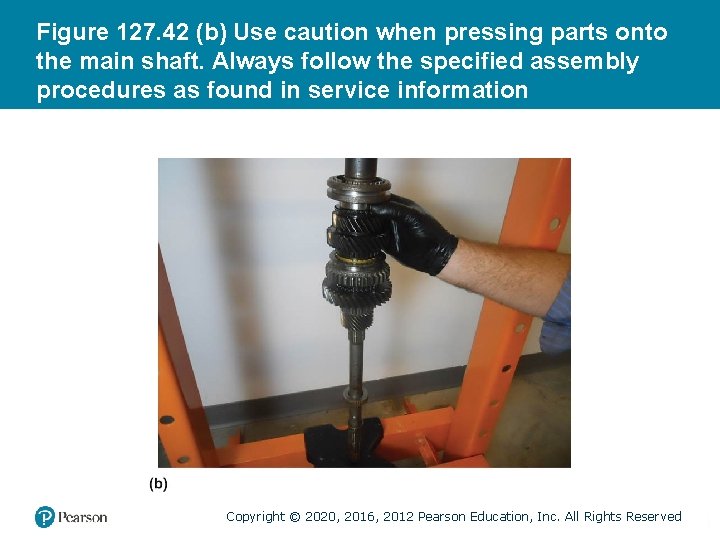
Figure 127. 42 (b) Use caution when pressing parts onto the main shaft. Always follow the specified assembly procedures as found in service information Copyright © 2020, 2016, 2012 Pearson Education, Inc. All Rights Reserved
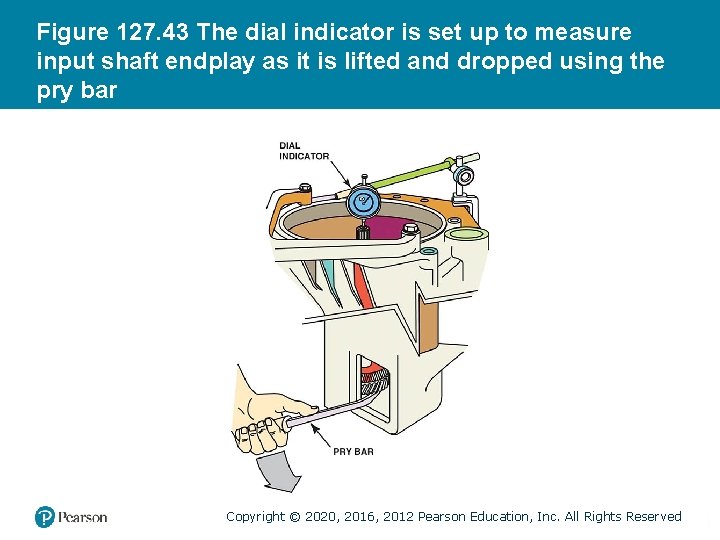
Figure 127. 43 The dial indicator is set up to measure input shaft endplay as it is lifted and dropped using the pry bar Copyright © 2020, 2016, 2012 Pearson Education, Inc. All Rights Reserved
HARD-TO-SHIFT PROBLEM DIAGNOSIS • Several items that could be worn or defective can cause a manual transmission/transaxle to be difficult to shift, including: – – – Clutch not fully disengaging. Worn synchronizer. Worn, cracked, or loose shift forks. Excessive input- or main-shaft end play. Improper lubrication. Copyright © 2020, 2016, 2012 Pearson Education, Inc. All Rights Reserved
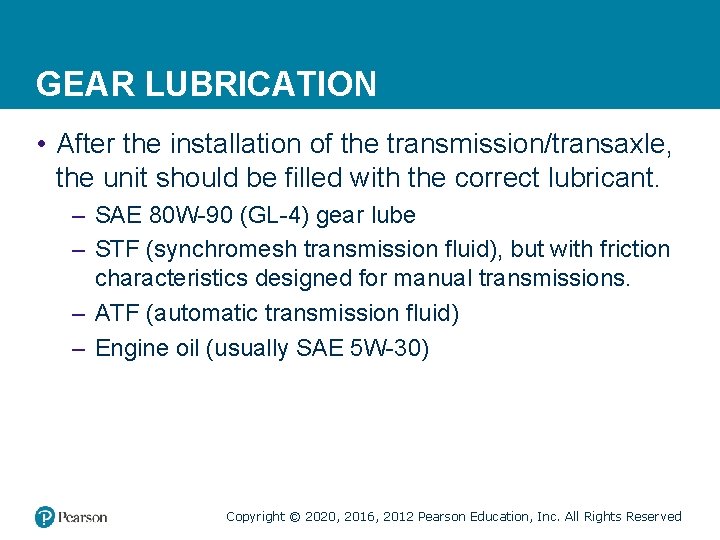
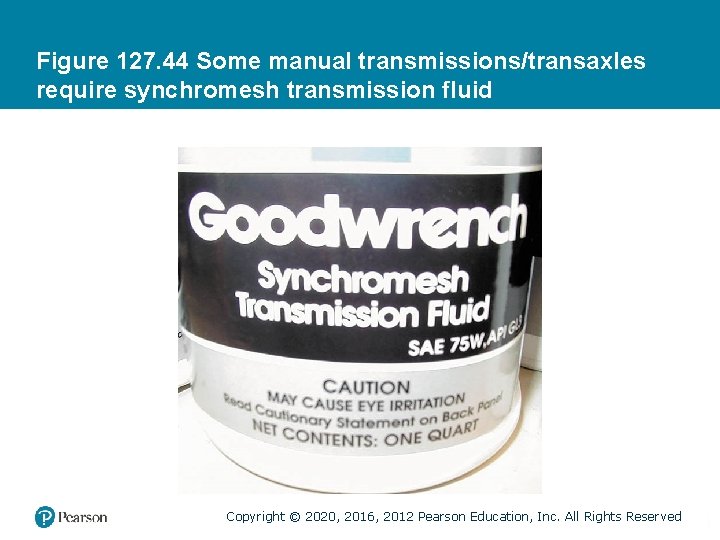
GEAR LUBRICATION • After the installation of the transmission/transaxle, the unit should be filled with the correct lubricant. – SAE 80 W-90 (GL-4) gear lube – STF (synchromesh transmission fluid), but with friction characteristics designed for manual transmissions. – ATF (automatic transmission fluid) – Engine oil (usually SAE 5 W-30) Copyright © 2020, 2016, 2012 Pearson Education, Inc. All Rights Reserved
Figure 127. 44 Some manual transmissions/transaxles require synchromesh transmission fluid Copyright © 2020, 2016, 2012 Pearson Education, Inc. All Rights Reserved
NV 1500 MANUAL TRANSMISSION SERVICE Copyright © 2020, 2016, 2012 Pearson Education, Inc. All Rights Reserved
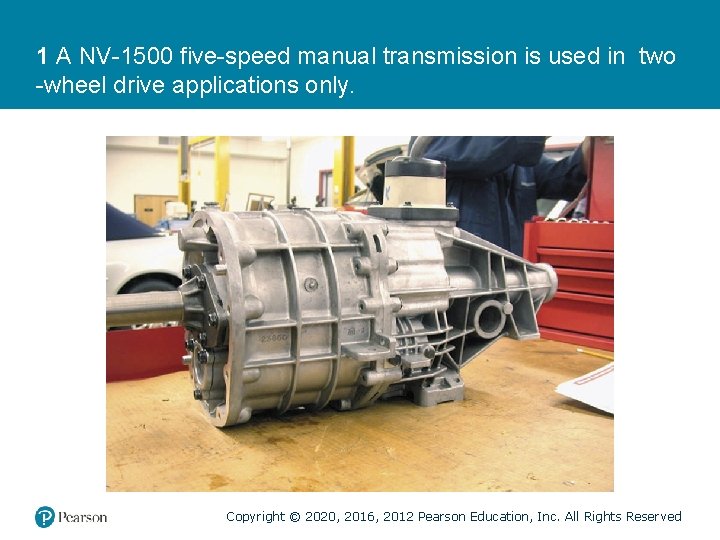
1 A NV-1500 five-speed manual transmission is used in two -wheel drive applications only. Copyright © 2020, 2016, 2012 Pearson Education, Inc. All Rights Reserved
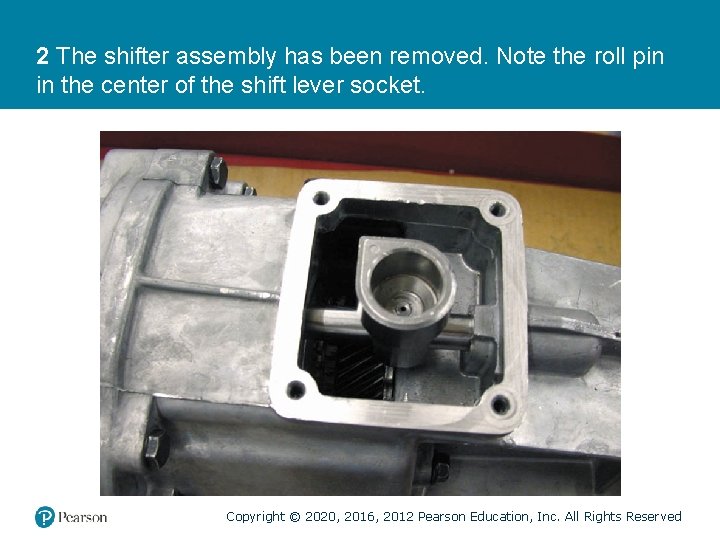
2 The shifter assembly has been removed. Note the roll pin in the center of the shift lever socket. Copyright © 2020, 2016, 2012 Pearson Education, Inc. All Rights Reserved
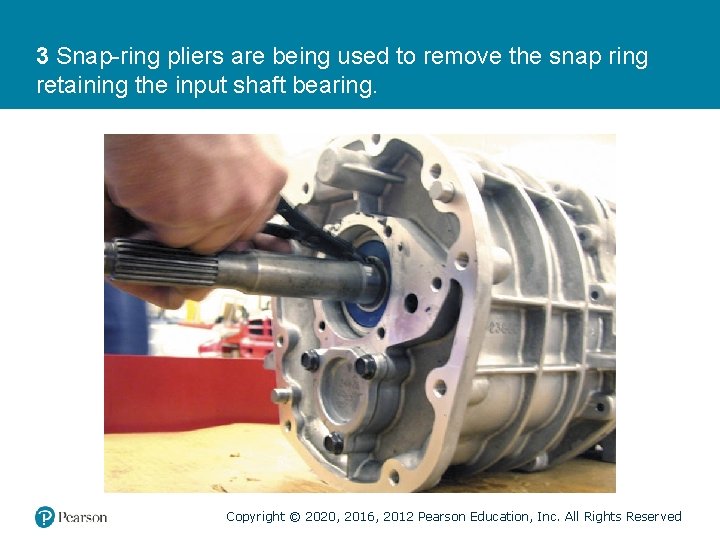
3 Snap-ring pliers are being used to remove the snap ring retaining the input shaft bearing. Copyright © 2020, 2016, 2012 Pearson Education, Inc. All Rights Reserved
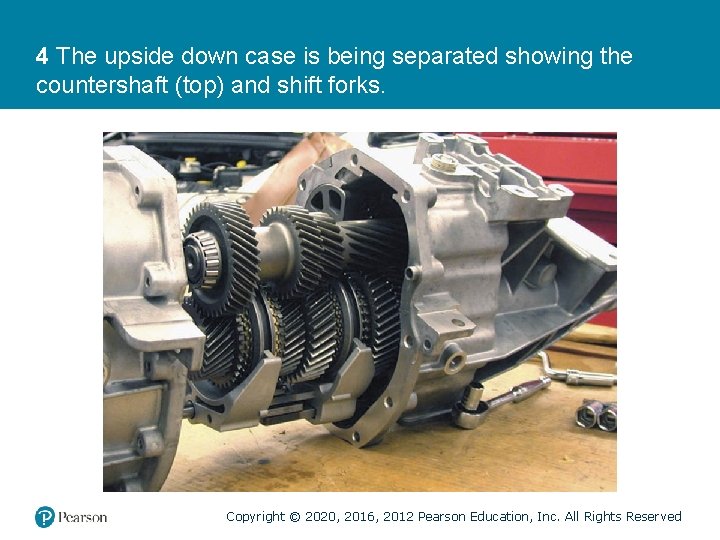
4 The upside down case is being separated showing the countershaft (top) and shift forks. Copyright © 2020, 2016, 2012 Pearson Education, Inc. All Rights Reserved
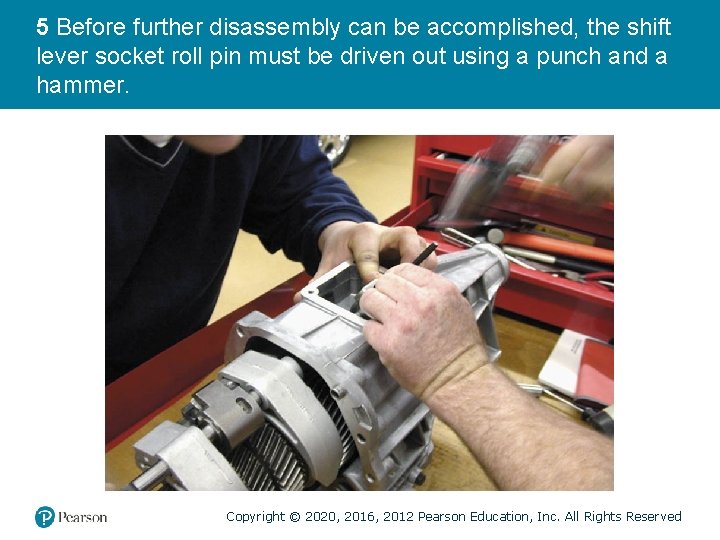
5 Before further disassembly can be accomplished, the shift lever socket roll pin must be driven out using a punch and a hammer. Copyright © 2020, 2016, 2012 Pearson Education, Inc. All Rights Reserved
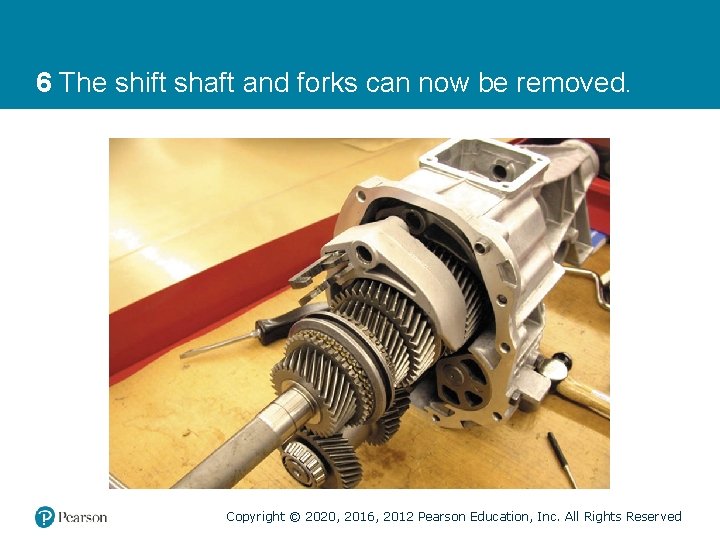
6 The shift shaft and forks can now be removed. Copyright © 2020, 2016, 2012 Pearson Education, Inc. All Rights Reserved
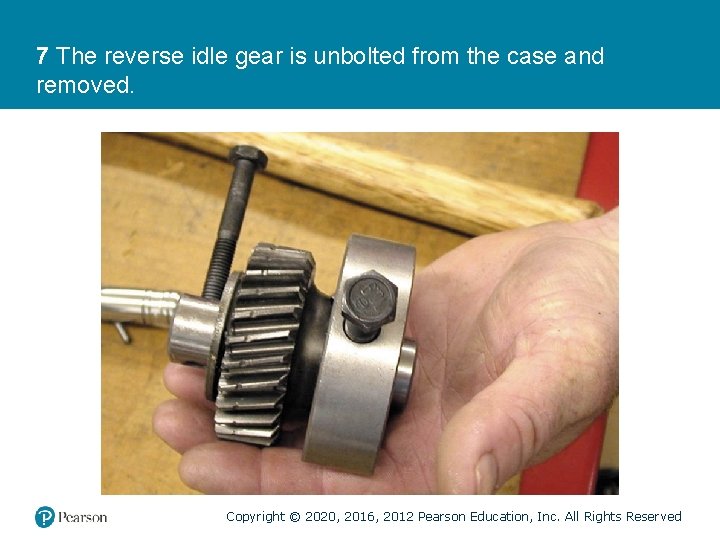
7 The reverse idle gear is unbolted from the case and removed. Copyright © 2020, 2016, 2012 Pearson Education, Inc. All Rights Reserved
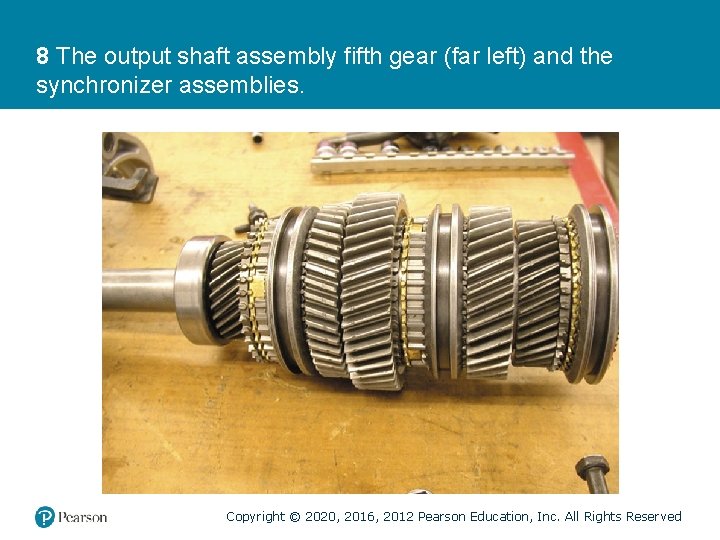
8 The output shaft assembly fifth gear (far left) and the synchronizer assemblies. Copyright © 2020, 2016, 2012 Pearson Education, Inc. All Rights Reserved
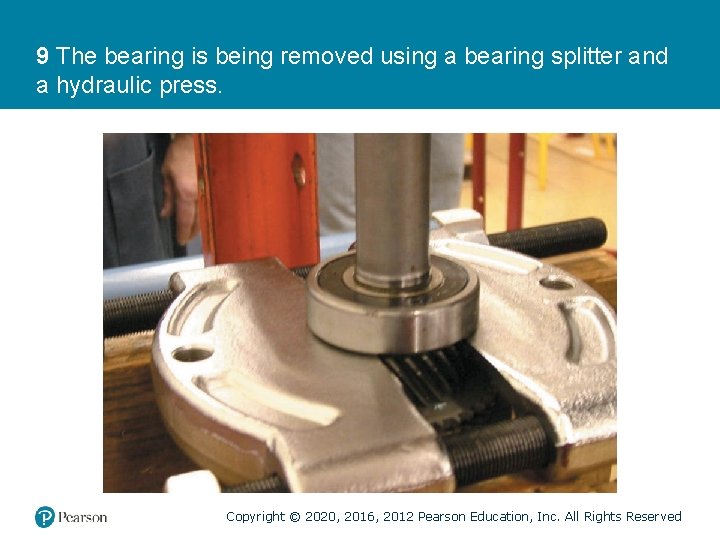
9 The bearing is being removed using a bearing splitter and a hydraulic press. Copyright © 2020, 2016, 2012 Pearson Education, Inc. All Rights Reserved
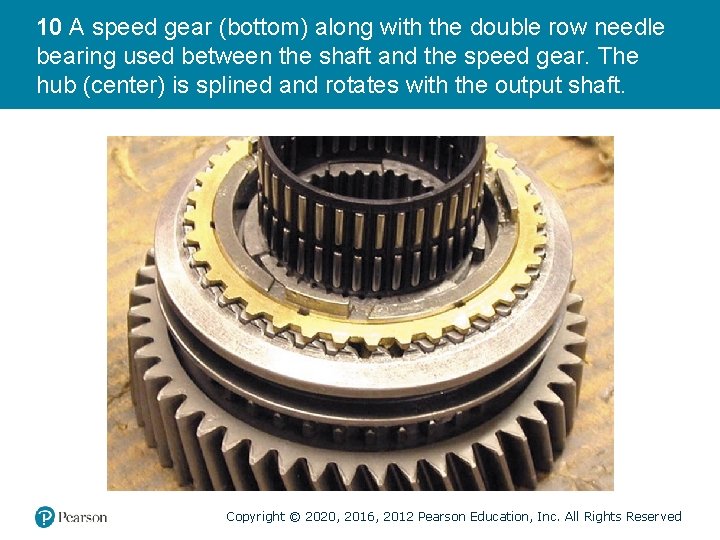
10 A speed gear (bottom) along with the double row needle bearing used between the shaft and the speed gear. The hub (center) is splined and rotates with the output shaft. Copyright © 2020, 2016, 2012 Pearson Education, Inc. All Rights Reserved
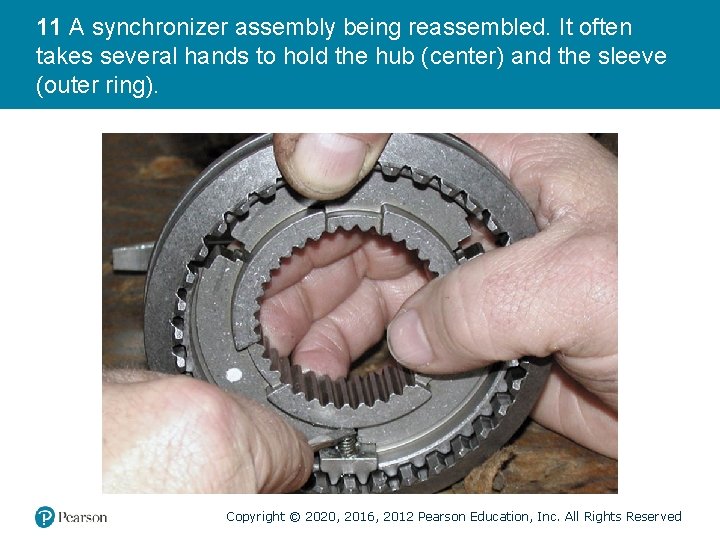
11 A synchronizer assembly being reassembled. It often takes several hands to hold the hub (center) and the sleeve (outer ring). Copyright © 2020, 2016, 2012 Pearson Education, Inc. All Rights Reserved
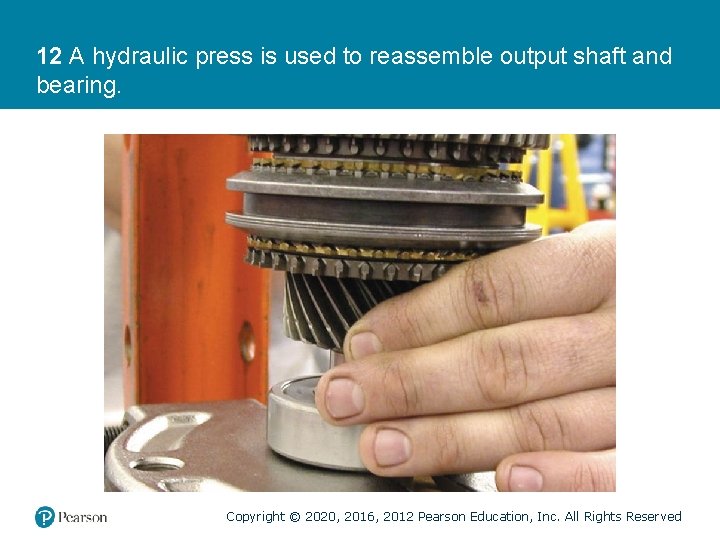
12 A hydraulic press is used to reassemble output shaft and bearing. Copyright © 2020, 2016, 2012 Pearson Education, Inc. All Rights Reserved
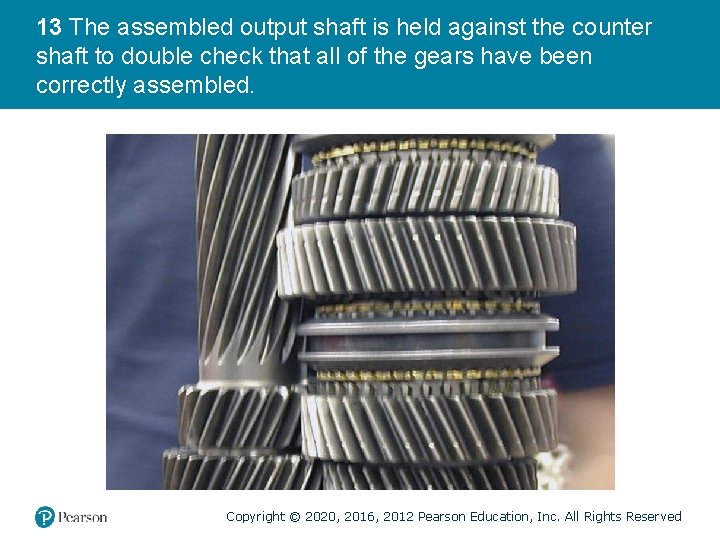
13 The assembled output shaft is held against the counter shaft to double check that all of the gears have been correctly assembled. Copyright © 2020, 2016, 2012 Pearson Education, Inc. All Rights Reserved
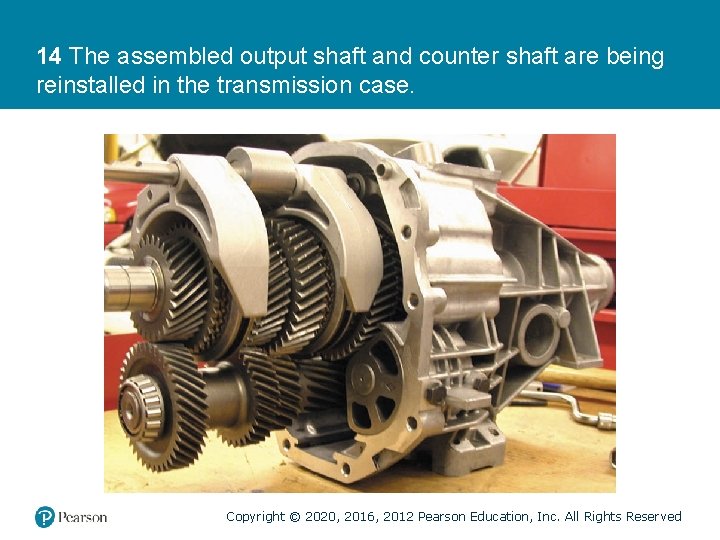
14 The assembled output shaft and counter shaft are being reinstalled in the transmission case. Copyright © 2020, 2016, 2012 Pearson Education, Inc. All Rights Reserved
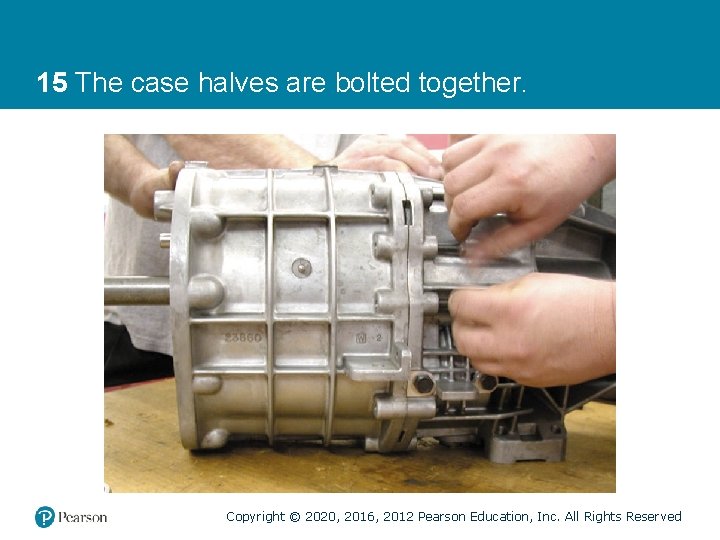
15 The case halves are bolted together. Copyright © 2020, 2016, 2012 Pearson Education, Inc. All Rights Reserved
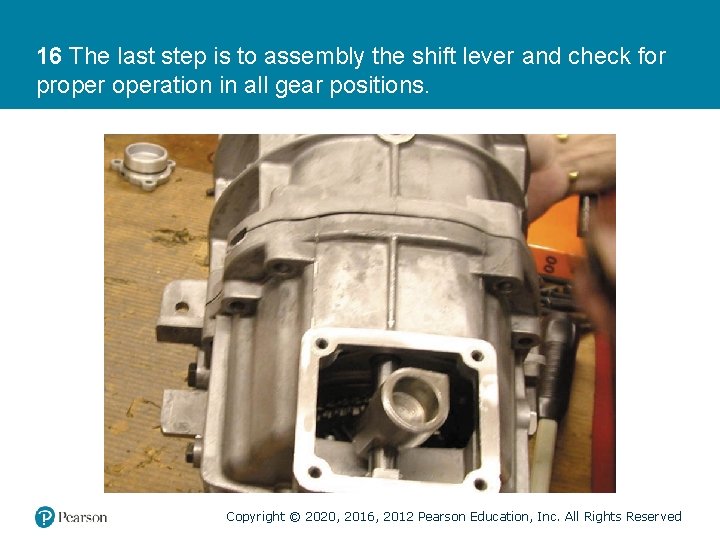
16 The last step is to assembly the shift lever and check for properation in all gear positions. Copyright © 2020, 2016, 2012 Pearson Education, Inc. All Rights Reserved
NV-350 TRANSAXLE SERVICE Copyright © 2020, 2016, 2012 Pearson Education, Inc. All Rights Reserved
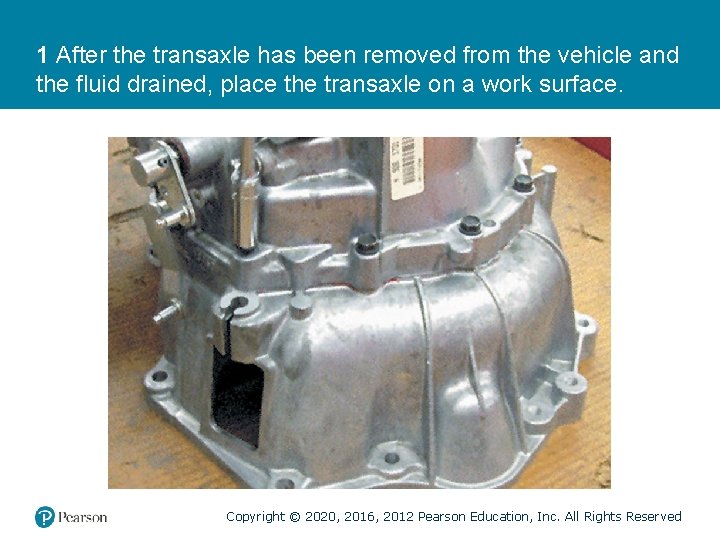
1 After the transaxle has been removed from the vehicle and the fluid drained, place the transaxle on a work surface. Copyright © 2020, 2016, 2012 Pearson Education, Inc. All Rights Reserved
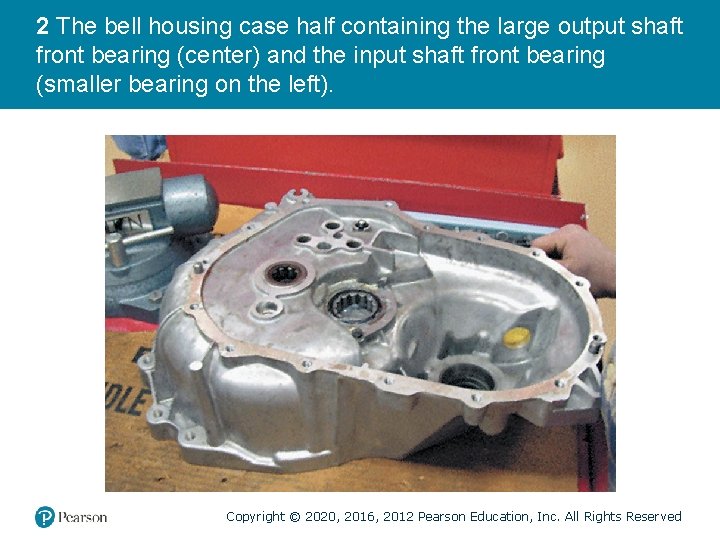
2 The bell housing case half containing the large output shaft front bearing (center) and the input shaft front bearing (smaller bearing on the left). Copyright © 2020, 2016, 2012 Pearson Education, Inc. All Rights Reserved
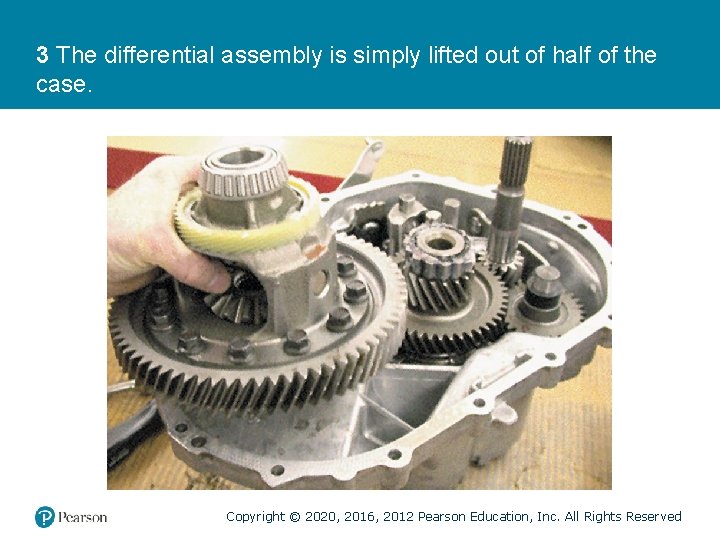
3 The differential assembly is simply lifted out of half of the case. Copyright © 2020, 2016, 2012 Pearson Education, Inc. All Rights Reserved
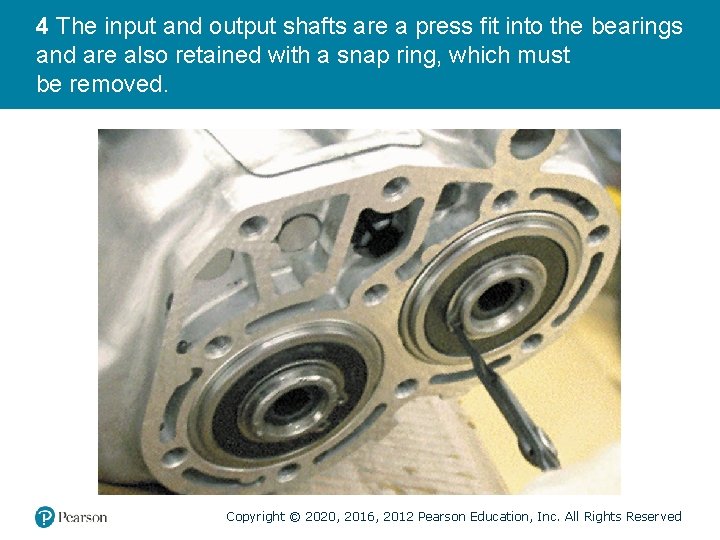
4 The input and output shafts are a press fit into the bearings and are also retained with a snap ring, which must be removed. Copyright © 2020, 2016, 2012 Pearson Education, Inc. All Rights Reserved
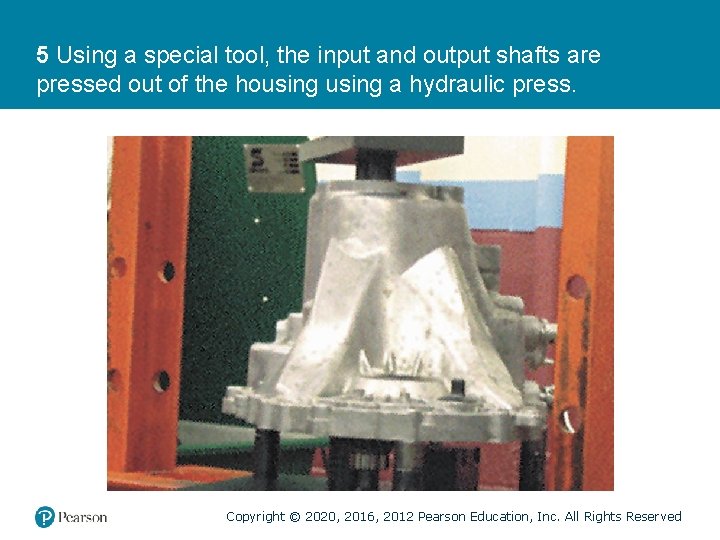
5 Using a special tool, the input and output shafts are pressed out of the housing a hydraulic press. Copyright © 2020, 2016, 2012 Pearson Education, Inc. All Rights Reserved
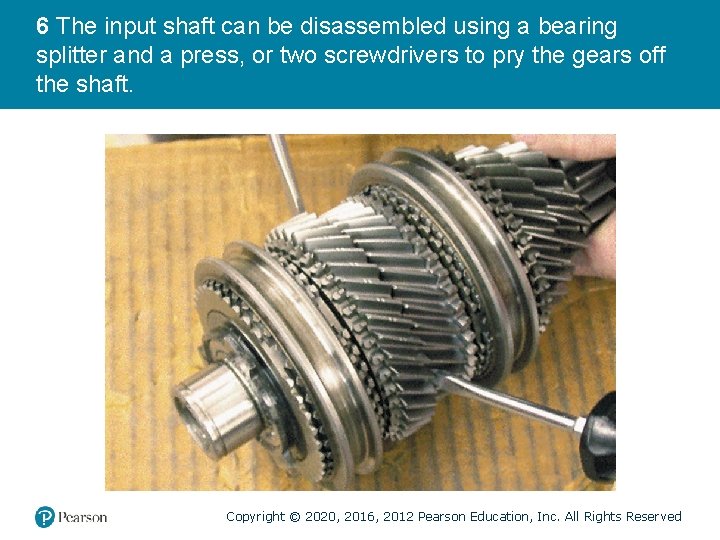
6 The input shaft can be disassembled using a bearing splitter and a press, or two screwdrivers to pry the gears off the shaft. Copyright © 2020, 2016, 2012 Pearson Education, Inc. All Rights Reserved
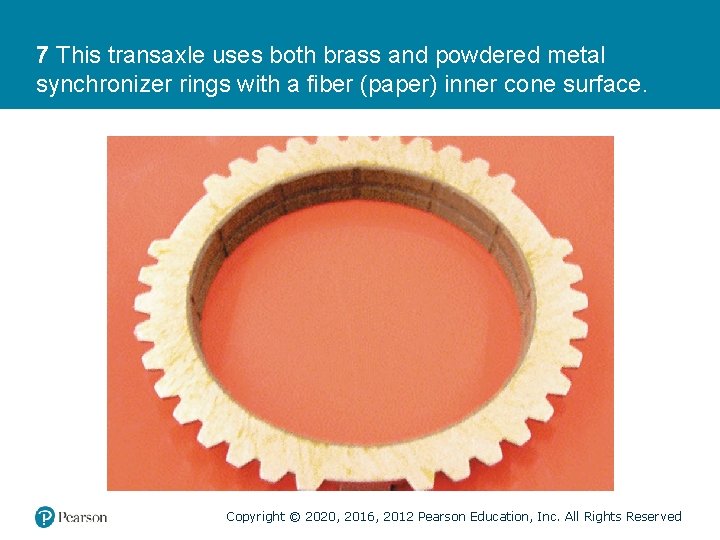
7 This transaxle uses both brass and powdered metal synchronizer rings with a fiber (paper) inner cone surface. Copyright © 2020, 2016, 2012 Pearson Education, Inc. All Rights Reserved
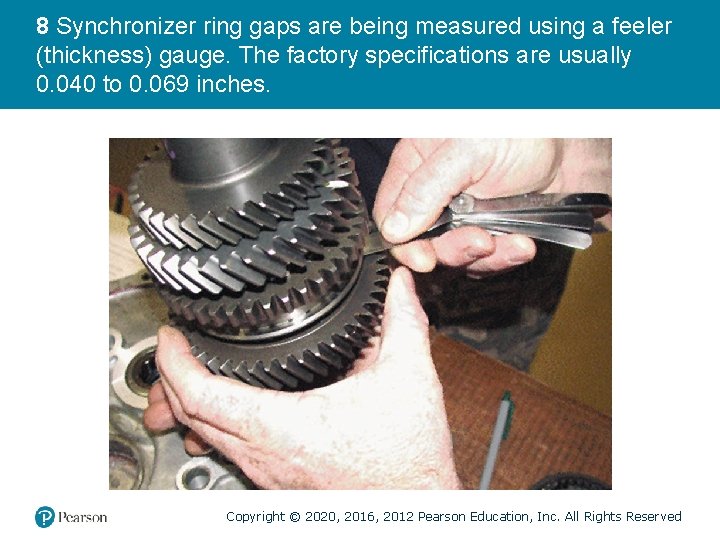
8 Synchronizer ring gaps are being measured using a feeler (thickness) gauge. The factory specifications are usually 0. 040 to 0. 069 inches. Copyright © 2020, 2016, 2012 Pearson Education, Inc. All Rights Reserved
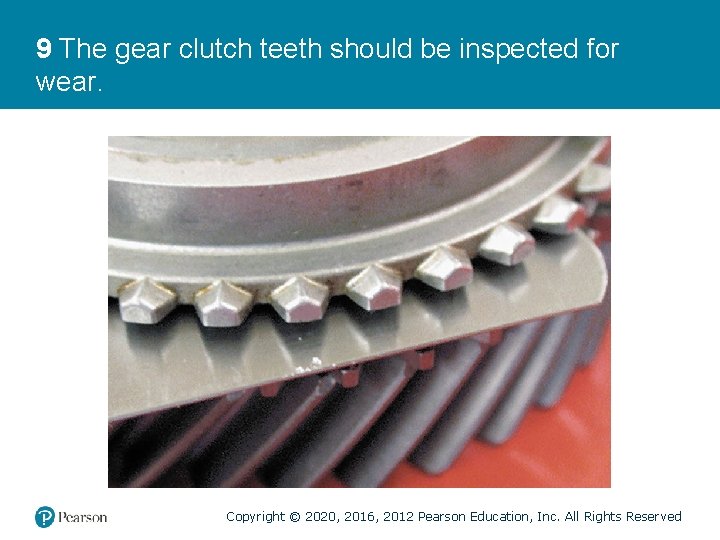
9 The gear clutch teeth should be inspected for wear. Copyright © 2020, 2016, 2012 Pearson Education, Inc. All Rights Reserved
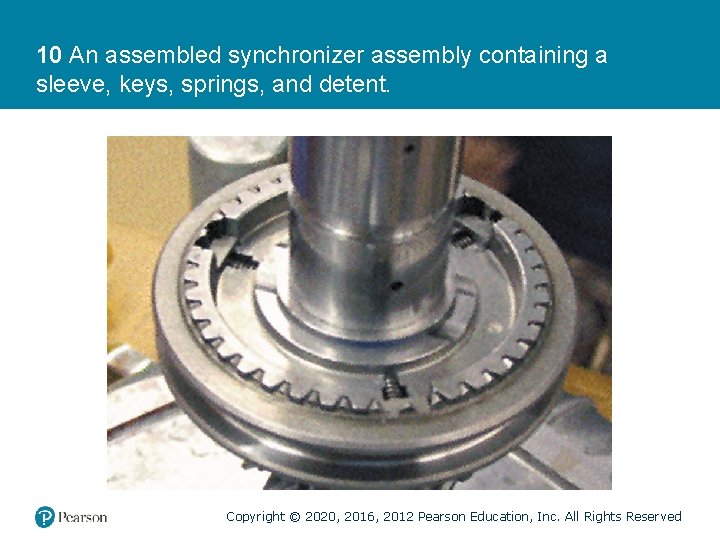
10 An assembled synchronizer assembly containing a sleeve, keys, springs, and detent. Copyright © 2020, 2016, 2012 Pearson Education, Inc. All Rights Reserved
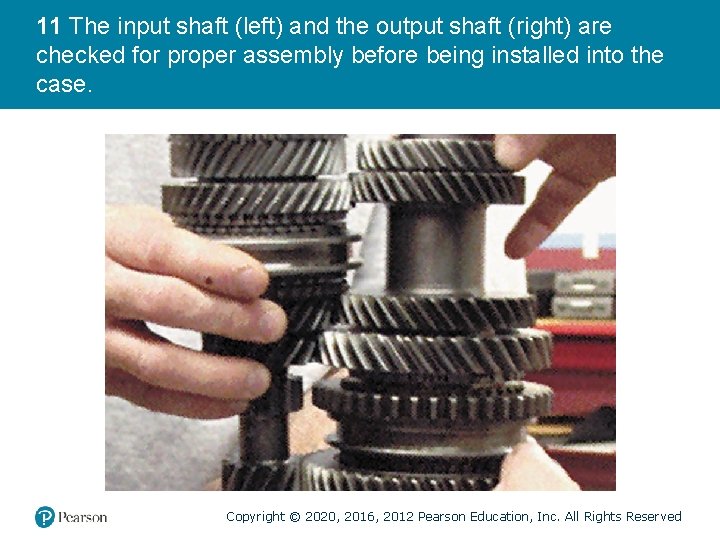
11 The input shaft (left) and the output shaft (right) are checked for proper assembly before being installed into the case. Copyright © 2020, 2016, 2012 Pearson Education, Inc. All Rights Reserved
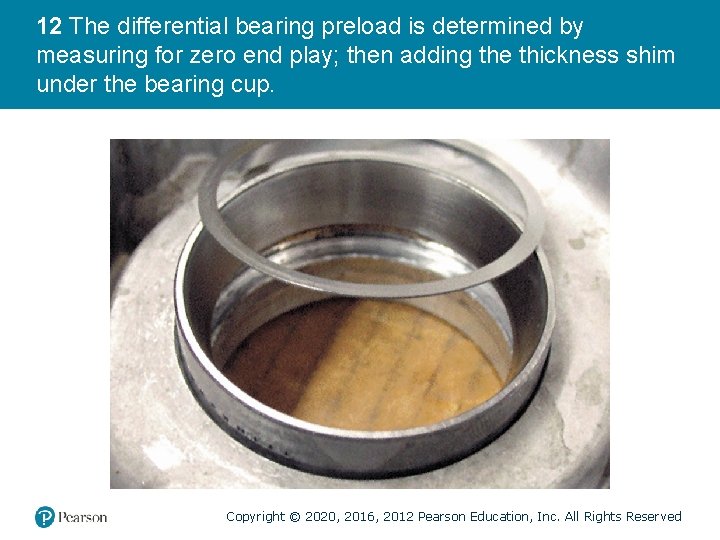
12 The differential bearing preload is determined by measuring for zero end play; then adding the thickness shim under the bearing cup. Copyright © 2020, 2016, 2012 Pearson Education, Inc. All Rights Reserved
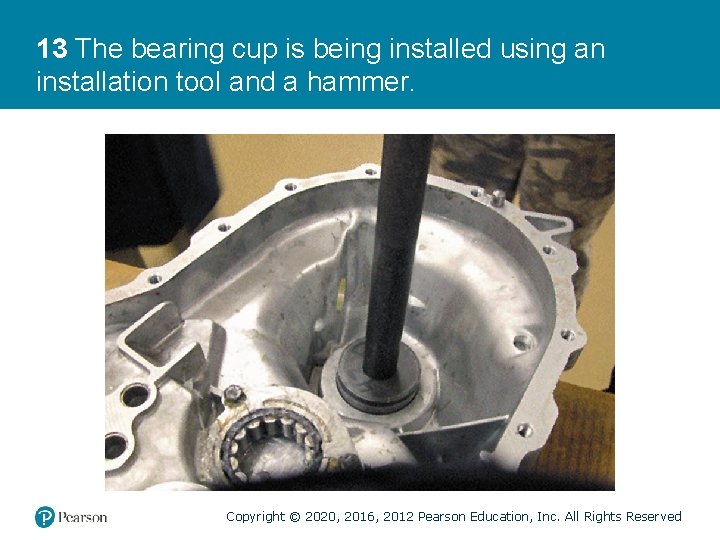
13 The bearing cup is being installed using an installation tool and a hammer. Copyright © 2020, 2016, 2012 Pearson Education, Inc. All Rights Reserved
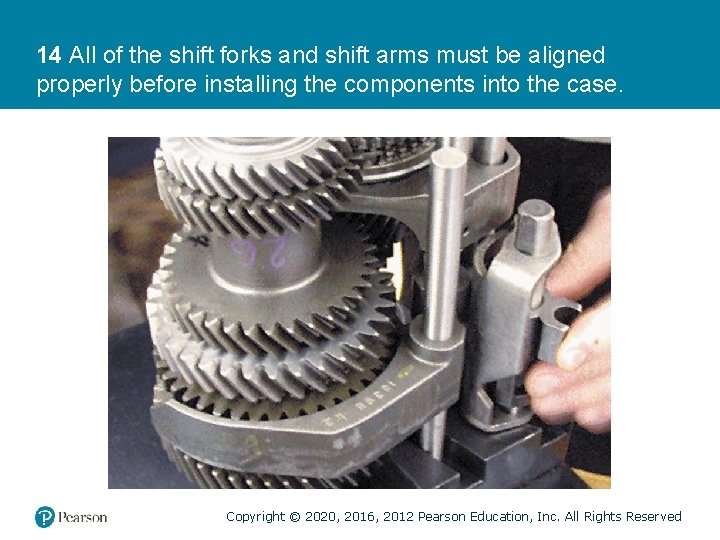
14 All of the shift forks and shift arms must be aligned properly before installing the components into the case. Copyright © 2020, 2016, 2012 Pearson Education, Inc. All Rights Reserved
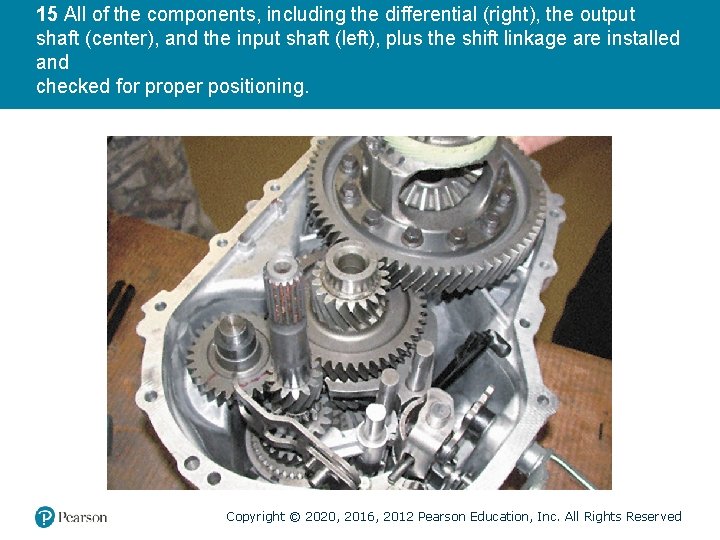
15 All of the components, including the differential (right), the output shaft (center), and the input shaft (left), plus the shift linkage are installed and checked for proper positioning. Copyright © 2020, 2016, 2012 Pearson Education, Inc. All Rights Reserved
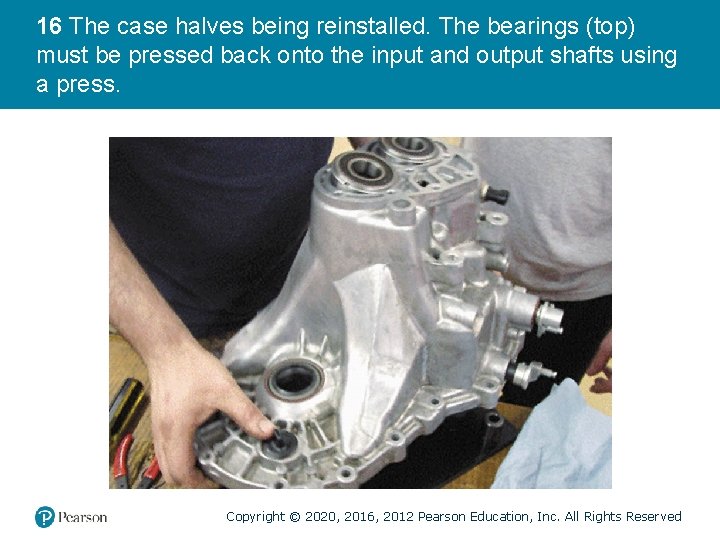
16 The case halves being reinstalled. The bearings (top) must be pressed back onto the input and output shafts using a press. Copyright © 2020, 2016, 2012 Pearson Education, Inc. All Rights Reserved
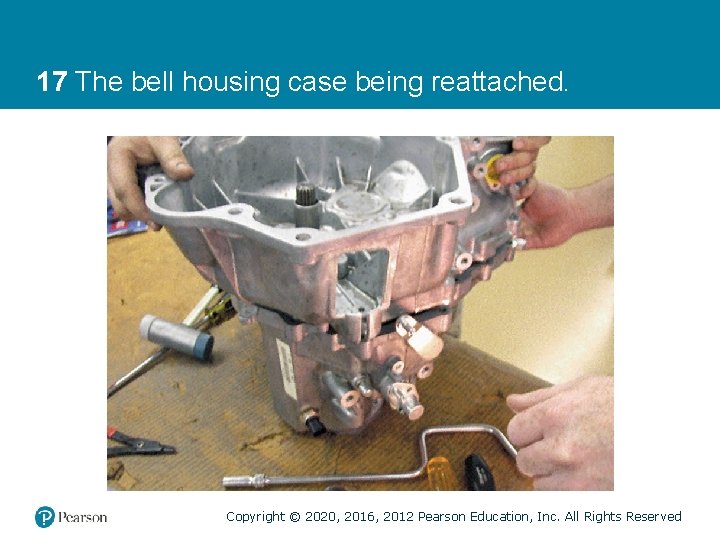
17 The bell housing case being reattached. Copyright © 2020, 2016, 2012 Pearson Education, Inc. All Rights Reserved
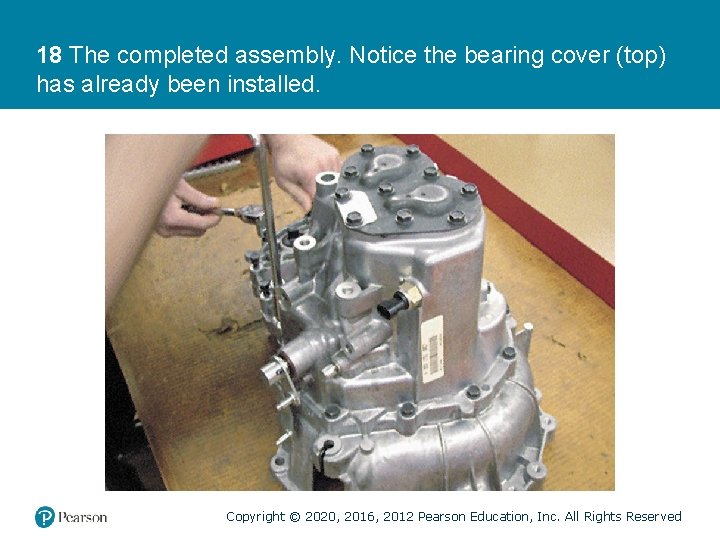
18 The completed assembly. Notice the bearing cover (top) has already been installed. Copyright © 2020, 2016, 2012 Pearson Education, Inc. All Rights Reserved
Copyright © 2020, 2016, 2012 Pearson Education, Inc. All Rights Reserved