
Automotive Maintenance Safety Lesson Todays Assignment Emergency Evacuation


- Slides: 45
Automotive Maintenance Safety Lesson
Todays Assignment Emergency Evacuation Plan and safety item map • Must be neat, legible, and well thought out • Lines must be straight and items must be easily identifiable
Take out a sheet of paper Draw an outline of the perimeter of the auto’s classroom Color code the following items with a color code key box at the bottom right of the paper Locate all emergency exit doors Fire extinguishers Fire alarms Eye wash stations Hand wash stations Fire Blankets Bay doors Lifts Key box Example Locate and label (not color coded) all: • Offices, storage closets, bathrooms, and fenced enclosures
Introduction Today we are going to begin learning the basics of how to stay safe in the automotive industry. Our focus in this lesson will be: The different classes of fire The Fire triangle Directions for using a fire extinguisher Define spontaneous combustion Explain what causes spontaneous combustion Explain how to prevent spontaneous combustion.
VOCAB O. S. H. A – Occupational Safety and Health Administration; Its mission is to prevent workrelated injuries, illnesses, and occupational fatality by issuing and enforcing standards for workplace safety and health. Fire extinguisher – device used to suppress fire Fire triangle – model for understanding the ingredients necessary for most fires Spontaneous combustion - a fire that starts without spark or flame
#1 - What are the 4 Classes of Fires? A - Wood or Paper B - Chemical C - Electrical D - Metals
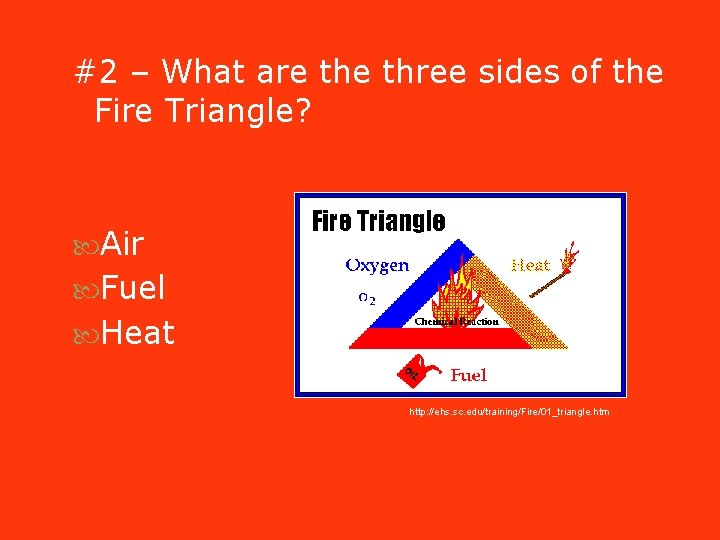
#2 – What are three sides of the Fire Triangle? Air Fuel Heat http: //ehs. sc. edu/training/Fire/01_triangle. htm
#3 – Basic directions for using a fire extinguisher (P. A. S. S. ) Pull the pin Aim at the Base of the Fire Squeeze the handle Sweep from side-to-side
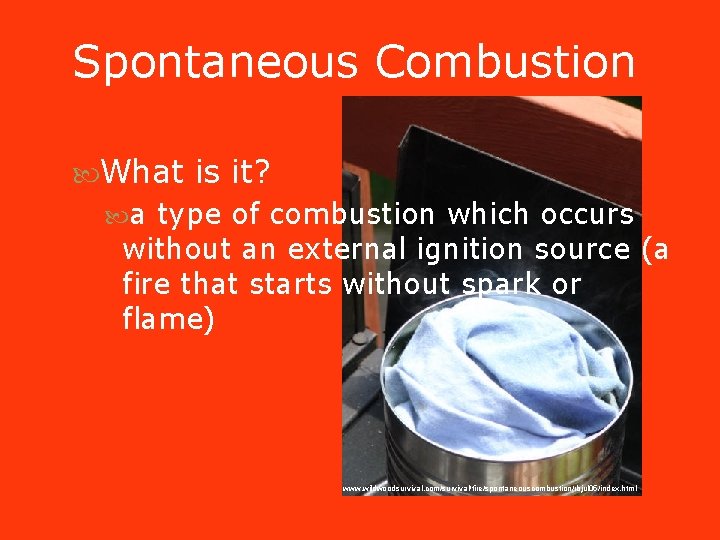
Spontaneous Combustion What is it? a type of combustion which occurs without an external ignition source (a fire that starts without spark or flame) www. wildwoodsurvival. com/survival/fire/spontaneouscombustion/rbjul 05/index. html
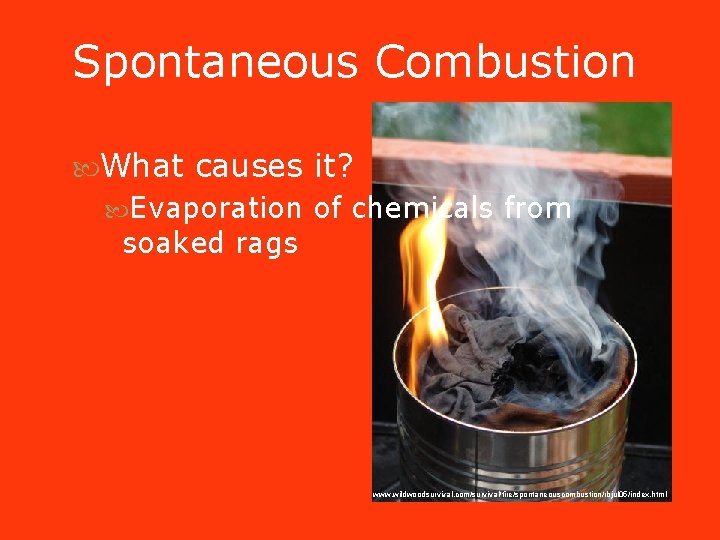
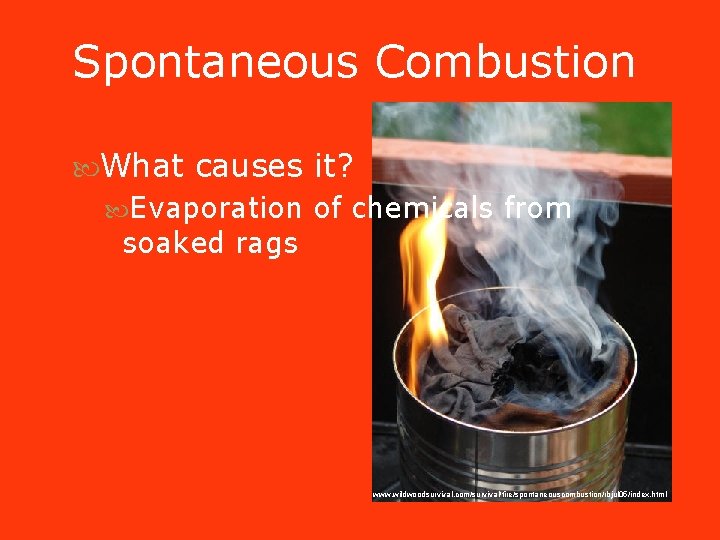
Spontaneous Combustion What causes it? Evaporation of chemicals from soaked rags www. wildwoodsurvival. com/survival/fire/spontaneouscombustion/rbjul 05/index. html
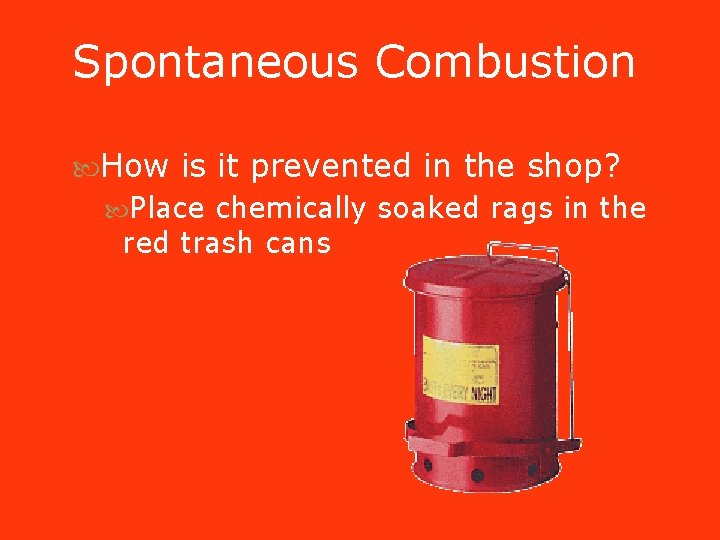
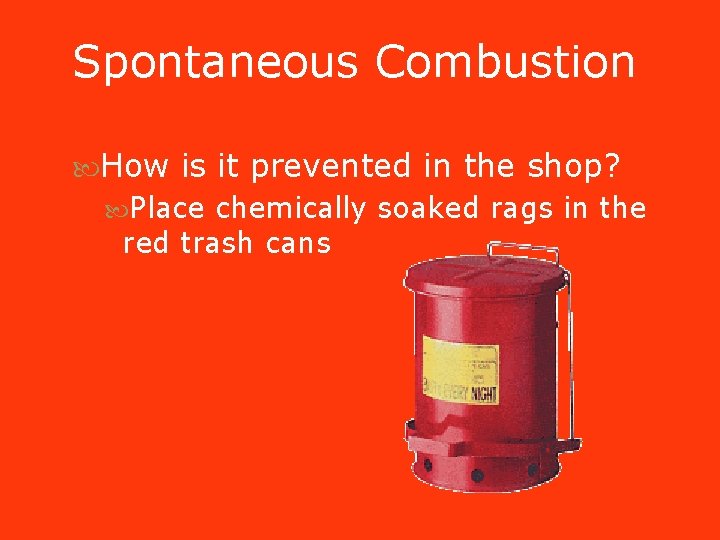
Spontaneous Combustion How is it prevented in the shop? Place chemically soaked rags in the red trash cans
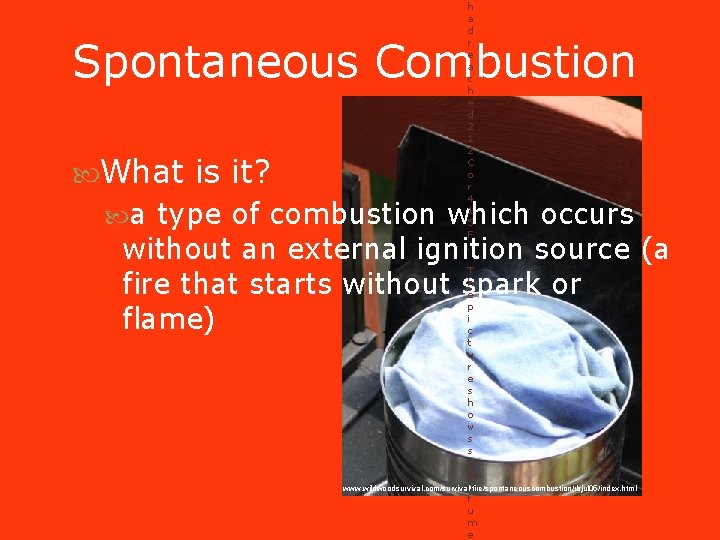
h a d r e a c h e d 2 1 2 C o r 4 1 5 F. Spontaneous Combustion What is it? a type of combustion which occurs without an external ignition source (a fire that starts without spark or flame) T h e p i c t u r e s h o w s s o m e www. wildwoodsurvival. com/survival/fire/spontaneouscombustion/rbjul 05/index. html f u m e
Spontaneous Combustion What causes it? Evaporation of chemicals from soaked rags www. wildwoodsurvival. com/survival/fire/spontaneouscombustion/rbjul 05/index. html
Spontaneous Combustion How is it prevented in the shop? Place chemically soaked rags in the red trash cans
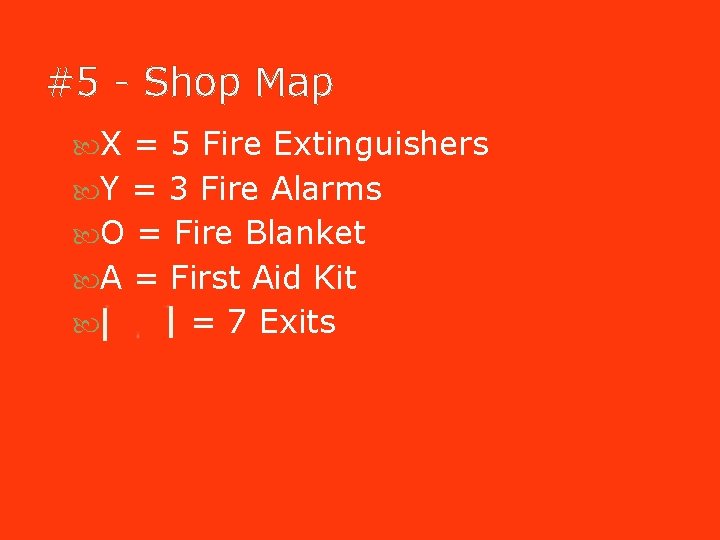
#5 - Shop Map X = 5 Fire Extinguishers Y = 3 Fire Alarms O = Fire Blanket A = First Aid Kit = 7 Exits
#6 - Eye Protection Anytime in the Shop, or Doing Shop Type Operations
#7 - Shop Clean-Up Large Spills or small spills with oil Sawdust, towels, or paper towels Large/Small Spills, not oil Hose out, then mop Cleaning Grease off Cars? Windex or soap and water Working on the Fender when the Hood is opened? Use Fender Covers
#8 - Chemical Burns Cause? Battery Acid (H 2 SO 4 - Sulfuric Acid) Symptom? Itching/burning Treatment? Wash with Water
#9 Shop Clothing Covers the Skin Fits Snuggly No Open Toe Shoes
#10 Who is Notified in Case of Injury? First: Mr. Tarbet Second: 911 (if severe) Third: School Nurse
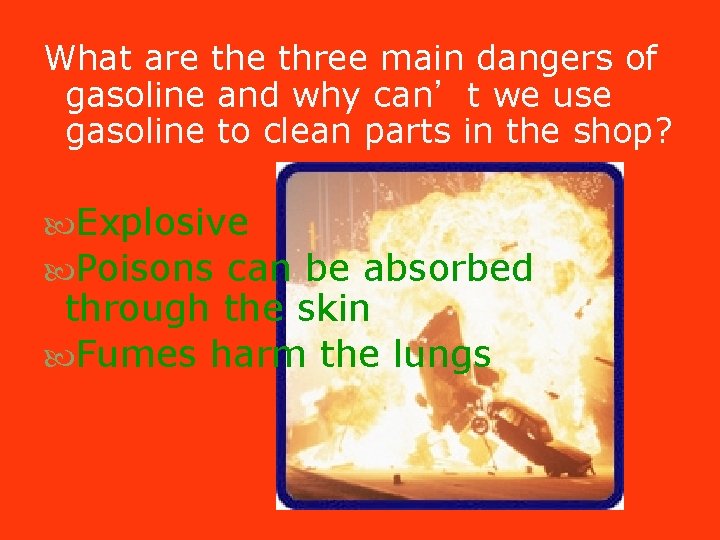
What are three main dangers of gasoline and why can’t we use gasoline to clean parts in the shop? Explosive Poisons can be absorbed through the skin Fumes harm the lungs
What can we use to clean parts in the shop? Solvents/Parts cleaner Soap and Water
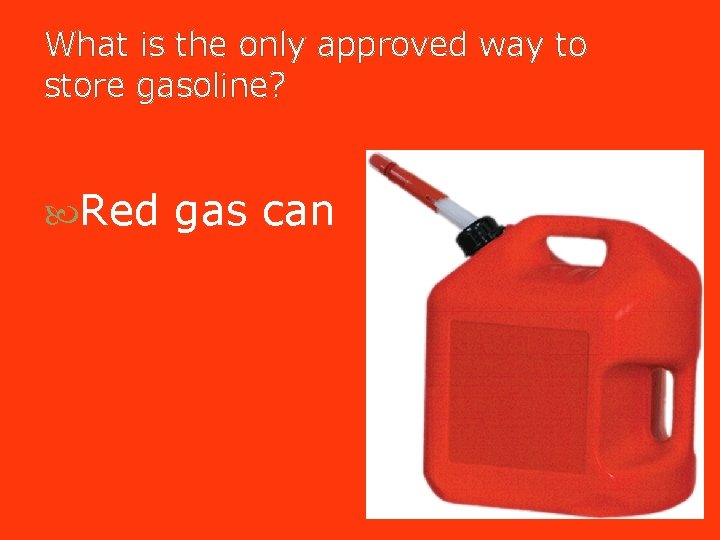
What is the only approved way to store gasoline? Red gas can
Vocabulary Nauseous- Ralph, throw up, puke, up chuck, Barf, hurl and buuuick. Hydro Carbon- A carbon based fuel source. Carbon Monoxide- The bonding of one carbon atom and one oxygen atom. Carbon Dioxide- The bonding of one atom of carbon and two atoms of oxygen. Nitrogen – Inert gas that consists of 79% of the air we breathe. Oxygen – the other 21% of the air we breathe.
#12 Carbon Monoxide How Does It Kill You? Absorbed by the blood in the lungs, carried to body cells, killing them. What are it’s three characteristics? Odorless Colorless Tasteless
#12 Carbon Monoxide (Continued) What are the 5 Symptoms in Order? Tired Headache Dizzy Nauseous Sleep (with blue tinge to lips, finger tips, toes)
Create your own mnemonic. T H D N S
#13 Six Most dangerous areas under the hood. Radiator Fan Belt Exhaust Battery Engine
General shop rule Report and document any accident to your instructor or supervisor.
Evacuating in an emergency: Know your escape route Turn off electrical power if possible Move to the predetermined assembly point Count your classmates/co-workers and report anyone missing
Lifting heavy objects: Stand over the object to be lifted and be sure to center it between your feet. Lift with your legs keeping your back straight.
First Aid: Keep victim protected Keep victim secure Apply direct pressure to wound to stop bleeding Keep wound from worsening If unconscious, place victim on their side not their back.
Moving vehicles Only licensed drivers are allowed to move vehicles. If you are licensed I will need a copy of it before moving vehicles. Only experienced drivers are allowed to test drive higher performance vehicles
Brake system cleaning: Asbestos fibers were once used in automobile brake pads, shoes and clutch systems. It was found to cause lung cancer and Mesothelioma. Do not used compressed air to clean brake and clutch systems as this may cause asbestos fibers to become airborne. Do not use Kerosene to clean brake parts as it will not clean brake fluid, it may saturate the pads or shoes, and may ruin rubber seals and hoses
Dangerous chemicals: SDS – material safety data sheet - a form with data regarding the properties of a particular substance Antifreeze/coolant – very slippery if spilled on floor; has a sweet smell and taste and is harmful or fatal if swallowed If you create a toxic waste spill, you will be liable for the clean up for many years
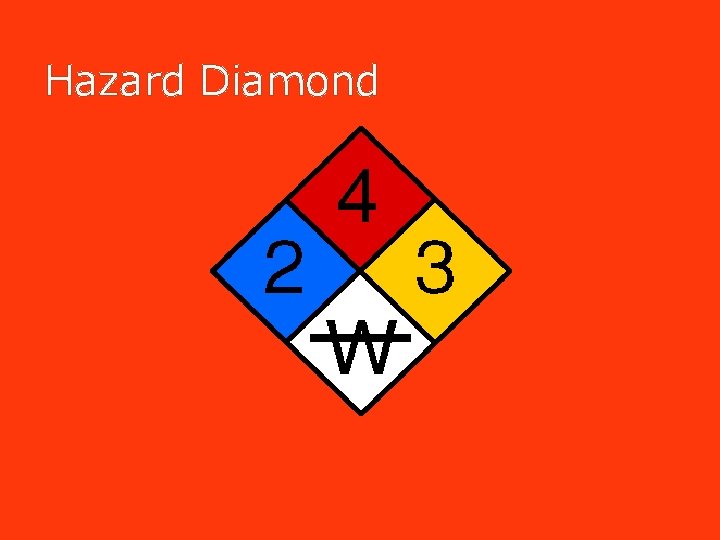
Hazard Diamond
Hazard Diamond 0 -4 scale Zero being non-dangerous Four being highly dangerous
Flammability (Red) 0 = water 4 = propane gas
Health Hazard (Blue) 0 = peanut oil 4 = hydrogen cyanide
Reactivity (Yellow) 0 = liquid nitrogen 4 = trinitrotoluene (TNT)
Special Precautions (White) W -- Material shows unusual reactivity with water (i. e. don't put water on it). Example: magnesium metal. OX -- Material possesses oxidizing properties. ACID- Material is an acid. ALK- Material is a base (alkaline). COR- Material is corrosive. -Material is radioactive.
Summary of Hazard Diamond Flamability = red Health Hazard = blue Reactivity = yellow Special precautions = white
Tool and Equipment Safety Use the proper tool for the job. For instance, don’t use a 12 point socket with an impact wrench/gun, it can break and fly across the shop and seriously hurt someone. It is best to read the manufacture’s instructions before operating new equipment. Don’t run over or close doors on electrical cords or air lines, this may damage them and in turn cause an accident such as electrocution.
Safety signs: Characteristics/components: Signal word Background color Text May also include a picture Three types: Danger Caution Warning
EXIT TICKET Write the acronym for how to extinguish a fire with an extinguisher and what each letter of the acronym means. Be ready to share your answer with the class.