
Automotive Industry in the Era of Sustainability March
Automotive Industry in the Era of Sustainability March 2020 Country deck – China The Automotive Industry in the Era of Sustainability– Key Insights | Capgemini Research Institute | March 2020 © Capgemini 2020. All rights reserved | 1
01 Sustainability is now a strategic priority for the industry 02 However, the implementation of sustainability initiatives is fragmented 03 An additional $50 billion investment is needed to meet sustainability commitments 04 Realizing the true sustainability potential of electric vehicles and circular economy is critical 05 How can automotive firms accelerate sustainability? Country deck – China The Automotive Industry in the Era of Sustainability– Key Insights | Capgemini Research Institute | March 2020 © Capgemini 2020. All rights reserved | 2
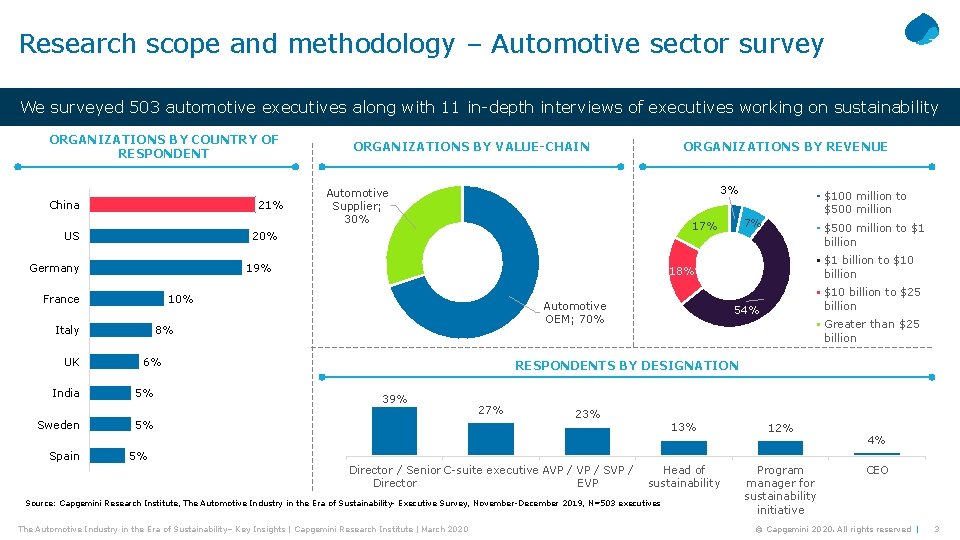
Research scope and methodology – Automotive sector survey We surveyed 503 automotive executives along with 11 in-depth interviews of executives working on sustainability ORGANIZATIONS BY COUNTRY OF RESPONDENT China 21% US India Sweden Spain Automotive OEM; 70% 8% 6% 5% $500 million to $1 billion to $10 billion 18% 10% Italy $100 million to $500 million 7% 19% France ORGANIZATIONS BY REVENUE 3% Automotive Supplier; 30% 20% Germany UK ORGANIZATIONS BY VALUE-CHAIN $10 billion to $25 billion 54% Greater than $25 billion RESPONDENTS BY DESIGNATION 39% 5% 27% 23% 12% 4% 5% Director / Senior C-suite executive AVP / SVP / Head of Director EVP sustainability Source: Capgemini Research Institute, The Automotive Industry in the Era of Sustainability- Executive Survey, November-December 2019, N=503 executives The Automotive Industry in the Era of Sustainability– Key Insights | Capgemini Research Institute | March 2020 Program manager for sustainability initiative CEO © Capgemini 2020. All rights reserved | 3
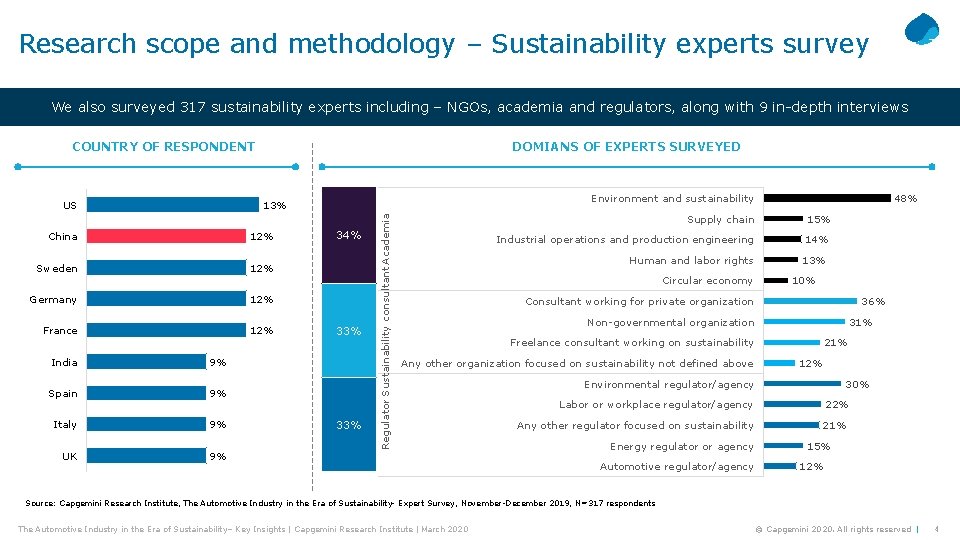
Research scope and methodology – Sustainability experts survey We also surveyed 317 sustainability experts including – NGOs, academia and regulators, along with 9 in-depth interviews COUNTRY OF RESPONDENT Environment and sustainability 13% China 12% Sweden 12% Germany 12% France 12% India 9% Spain 9% Italy 9% UK 9% 34% 33% Regulator Sustainability consultant Academia US DOMIANS OF EXPERTS SURVEYED 48% Supply chain 15% Industrial operations and production engineering 14% Human and labor rights 13% Circular economy 10% Consultant working for private organization 36% 31% Non-governmental organization Freelance consultant working on sustainability Any other organization focused on sustainability not defined above 21% 12% Environmental regulator/agency 30% Labor or workplace regulator/agency 22% Any other regulator focused on sustainability 21% Energy regulator or agency Automotive regulator/agency 15% 12% Source: Capgemini Research Institute, The Automotive Industry in the Era of Sustainability- Expert Survey, November-December 2019, N=317 respondents The Automotive Industry in the Era of Sustainability– Key Insights | Capgemini Research Institute | March 2020 © Capgemini 2020. All rights reserved | 4
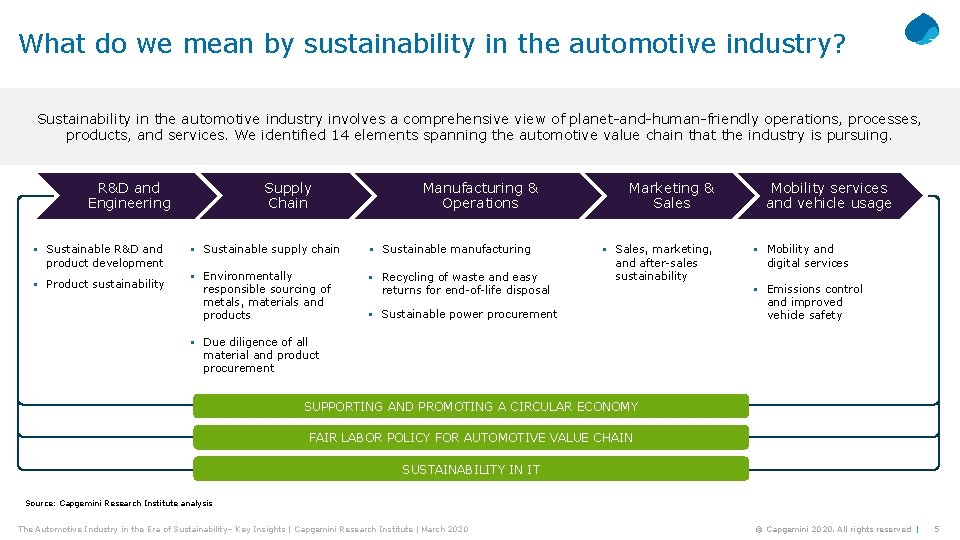
What do we mean by sustainability in the automotive industry? Sustainability in the automotive industry involves a comprehensive view of planet-and-human-friendly operations, processes, products, and services. We identified 14 elements spanning the automotive value chain that the industry is pursuing. R&D and Engineering § Sustainable R&D and product development § Product sustainability Supply Chain Manufacturing & Operations § Sustainable supply chain § Sustainable manufacturing § Environmentally responsible sourcing of metals, materials and products § Recycling of waste and easy returns for end-of-life disposal Marketing & Sales § Sales, marketing, and after-sales sustainability § Sustainable power procurement Mobility services and vehicle usage § Mobility and digital services § Emissions control and improved vehicle safety § Due diligence of all material and product procurement SUPPORTING AND PROMOTING A CIRCULAR ECONOMY FAIR LABOR POLICY FOR AUTOMOTIVE VALUE CHAIN SUSTAINABILITY IN IT Source: Capgemini Research Institute analysis The Automotive Industry in the Era of Sustainability– Key Insights | Capgemini Research Institute | March 2020 © Capgemini 2020. All rights reserved | 5
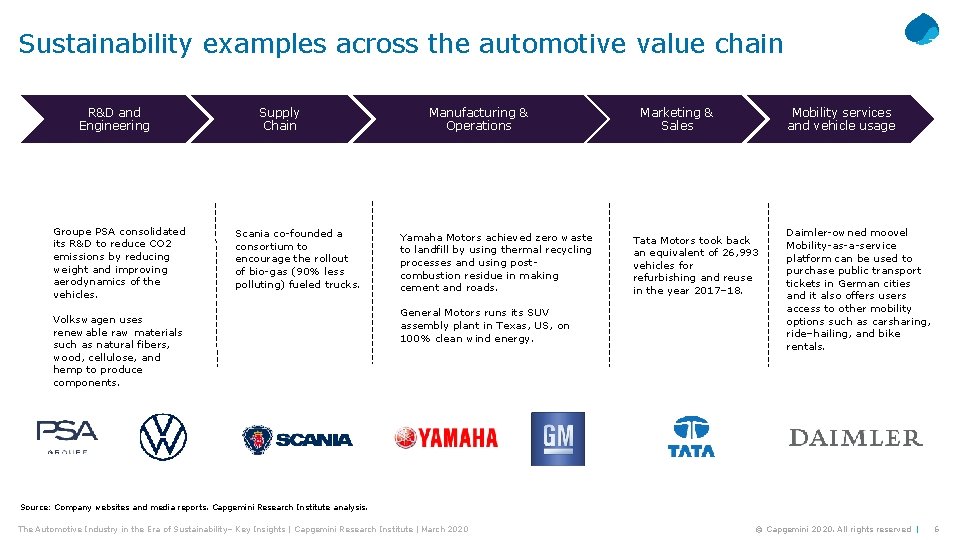
Sustainability examples across the automotive value chain R&D and Engineering Groupe PSA consolidated its R&D to reduce CO 2 emissions by reducing weight and improving aerodynamics of the vehicles. Supply Chain Scania co-founded a consortium to encourage the rollout of bio-gas (90% less polluting) fueled trucks. Volkswagen uses renewable raw materials such as natural fibers, wood, cellulose, and hemp to produce components. Manufacturing & Operations Yamaha Motors achieved zero waste to landfill by using thermal recycling processes and using postcombustion residue in making cement and roads. General Motors runs its SUV assembly plant in Texas, US, on 100% clean wind energy. Marketing & Sales Mobility services and vehicle usage Tata Motors took back an equivalent of 26, 993 vehicles for refurbishing and reuse in the year 2017– 18. Daimler-owned moovel Mobility-as-a-service platform can be used to purchase public transport tickets in German cities and it also offers users access to other mobility options such as carsharing, ride–hailing, and bike rentals. Source: Company websites and media reports. Capgemini Research Institute analysis. The Automotive Industry in the Era of Sustainability– Key Insights | Capgemini Research Institute | March 2020 © Capgemini 2020. All rights reserved | 6
Sustainability is now a strategic priority for the industry The Automotive Industry in the Era of Sustainability– Key Insights | Capgemini Research Institute | March 2020 © Capgemini 2020. All rights reserved | 7
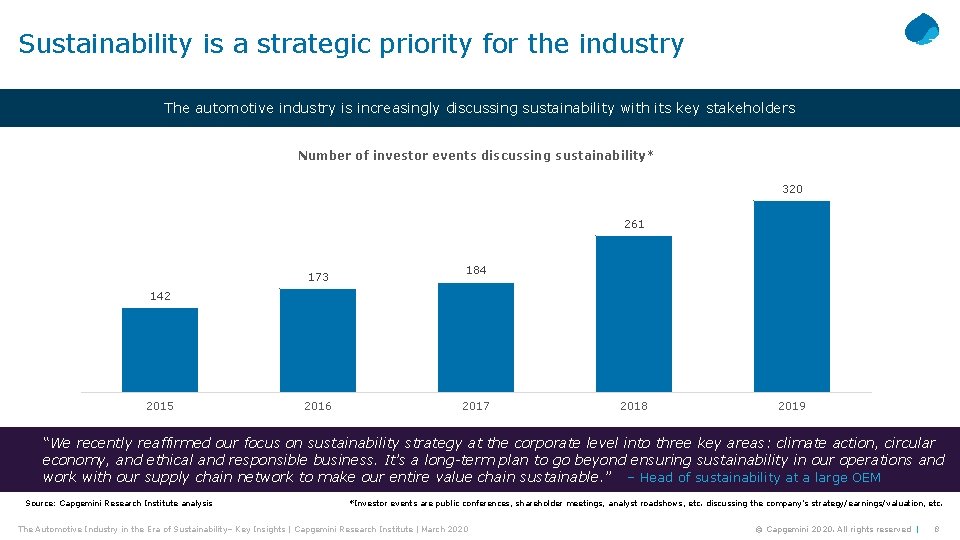
Sustainability is a strategic priority for the industry The automotive industry is increasingly discussing sustainability with its key stakeholders Number of investor events discussing sustainability* 320 261 173 184 142 2015 2016 2017 2018 2019 “We recently reaffirmed our focus on sustainability strategy at the corporate level into three key areas: climate action, circular economy, and ethical and responsible business. It’s a long-term plan to go beyond ensuring sustainability in our operations and work with our supply chain network to make our entire value chain sustainable. ” – Head of sustainability at a large OEM Source: Capgemini Research Institute analysis *Investor events are public conferences, shareholder meetings, analyst roadshows, etc. discussing the company’s strategy/earnings/valuation, etc. The Automotive Industry in the Era of Sustainability– Key Insights | Capgemini Research Institute | March 2020 © Capgemini 2020. All rights reserved | 8
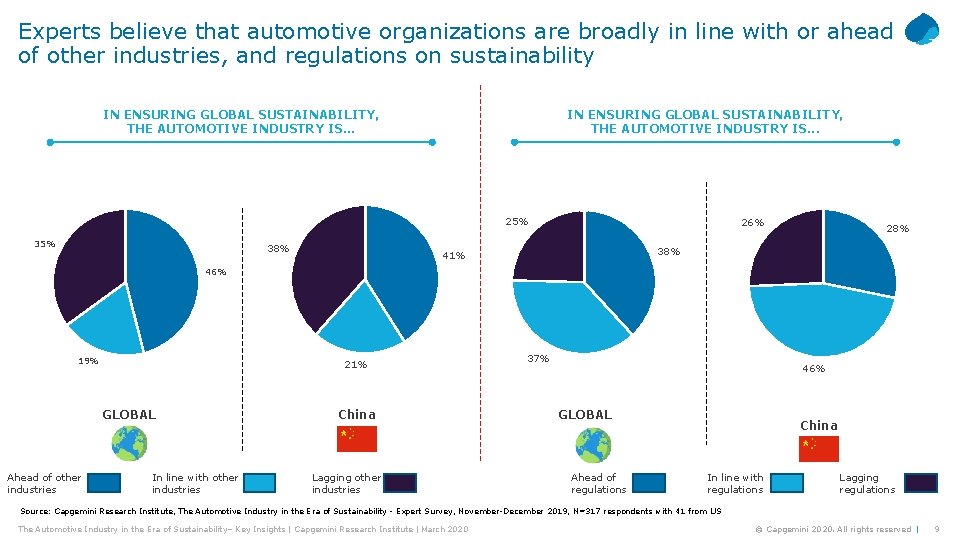
Experts believe that automotive organizations are broadly in line with or ahead of other industries, and regulations on sustainability IN ENSURING GLOBAL SUSTAINABILITY, THE AUTOMOTIVE INDUSTRY IS. . . 25% 38% 26% 28% 38% 41% 46% 19% 21% GLOBAL Ahead of other industries In line with other industries China Lagging other industries 37% 46% GLOBAL Ahead of regulations China In line with regulations Lagging regulations Source: Capgemini Research Institute, The Automotive Industry in the Era of Sustainability - Expert Survey, November-December 2019, N=317 respondents with 41 from US The Automotive Industry in the Era of Sustainability– Key Insights | Capgemini Research Institute | March 2020 © Capgemini 2020. All rights reserved | 9
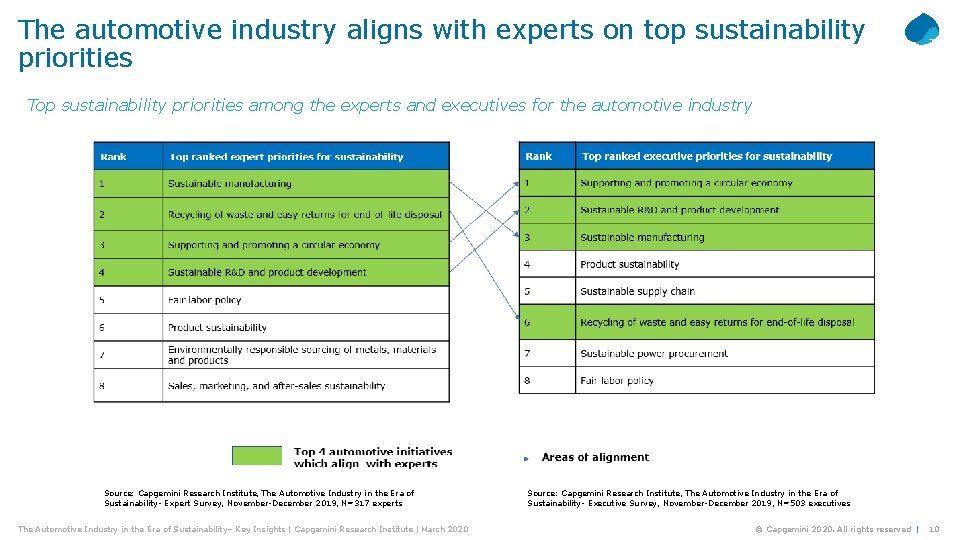
The automotive industry aligns with experts on top sustainability priorities Top sustainability priorities among the experts and executives for the automotive industry Source: Capgemini Research Institute, The Automotive Industry in the Era of Sustainability- Expert Survey, November-December 2019, N=317 experts The Automotive Industry in the Era of Sustainability– Key Insights | Capgemini Research Institute | March 2020 Source: Capgemini Research Institute, The Automotive Industry in the Era of Sustainability- Executive Survey, November-December 2019, N=503 executives © Capgemini 2020. All rights reserved | 10
However, the implementation of sustainability initiatives is fragmented The Automotive Industry in the Era of Sustainability– Key Insights | Capgemini Research Institute | March 2020 © Capgemini 2020. All rights reserved | 11
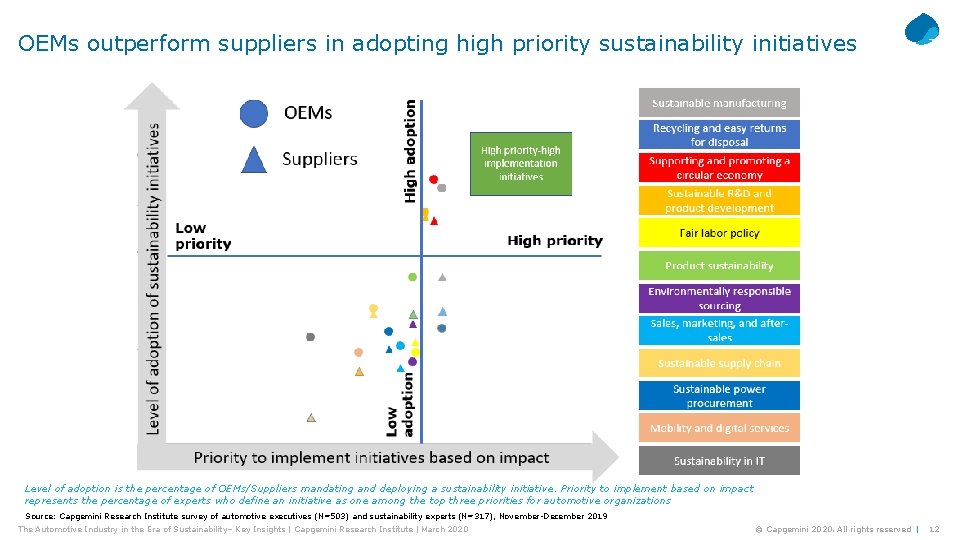
OEMs outperform suppliers in adopting high priority sustainability initiatives Level of adoption is the percentage of OEMs/Suppliers mandating and deploying a sustainability initiative. Priority to implement based on impact represents the percentage of experts who define an initiative as one among the top three priorities for automotive organizations Source: Capgemini Research Institute survey of automotive executives (N=503) and sustainability experts (N=317), November-December 2019 The Automotive Industry in the Era of Sustainability– Key Insights | Capgemini Research Institute | March 2020 © Capgemini 2020. All rights reserved | 12
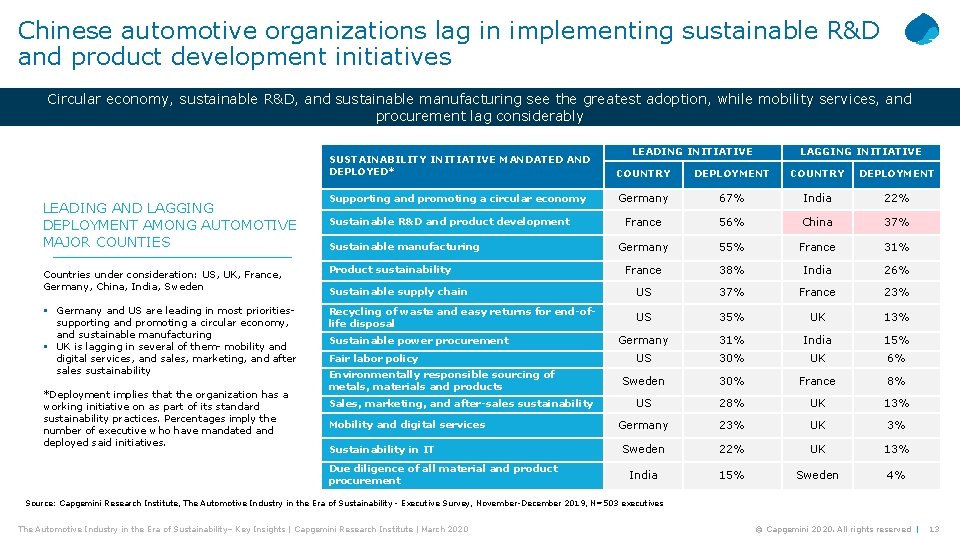
Chinese automotive organizations lag in implementing sustainable R&D and product development initiatives Circular economy, sustainable R&D, and sustainable manufacturing see the greatest adoption, while mobility services, and procurement lag considerably LEADING AND LAGGING DEPLOYMENT AMONG AUTOMOTIVE MAJOR COUNTIES LEADING INITIATIVE LAGGING INITIATIVE SUSTAINABILITY INITIATIVE MANDATED AND DEPLOYED* COUNTRY DEPLOYMENT Supporting and promoting a circular economy Germany 67% India 22% France 56% China 37% Germany 55% France 31% France 38% India 26% Sustainable R&D and product development Sustainable manufacturing Countries under consideration: US, UK, France, Germany, China, India, Sweden Product sustainability Sustainable supply chain US 37% France 23% § Germany and US are leading in most priorities- supporting and promoting a circular economy, and sustainable manufacturing § UK is lagging in several of them- mobility and digital services, and sales, marketing, and after sales sustainability Recycling of waste and easy returns for end-oflife disposal US 35% UK 13% Germany 31% India 15% US 30% UK 6% Sweden 30% France 8% US 28% UK 13% Germany 23% UK 3% Sweden 22% UK 13% India 15% Sweden 4% *Deployment implies that the organization has a working initiative on as part of its standard sustainability practices. Percentages imply the number of executive who have mandated and deployed said initiatives. Sustainable power procurement Fair labor policy Environmentally responsible sourcing of metals, materials and products Sales, marketing, and after-sales sustainability Mobility and digital services Sustainability in IT Due diligence of all material and product procurement Source: Capgemini Research Institute, The Automotive Industry in the Era of Sustainability - Executive Survey, November-December 2019, N=503 executives The Automotive Industry in the Era of Sustainability– Key Insights | Capgemini Research Institute | March 2020 © Capgemini 2020. All rights reserved | 13
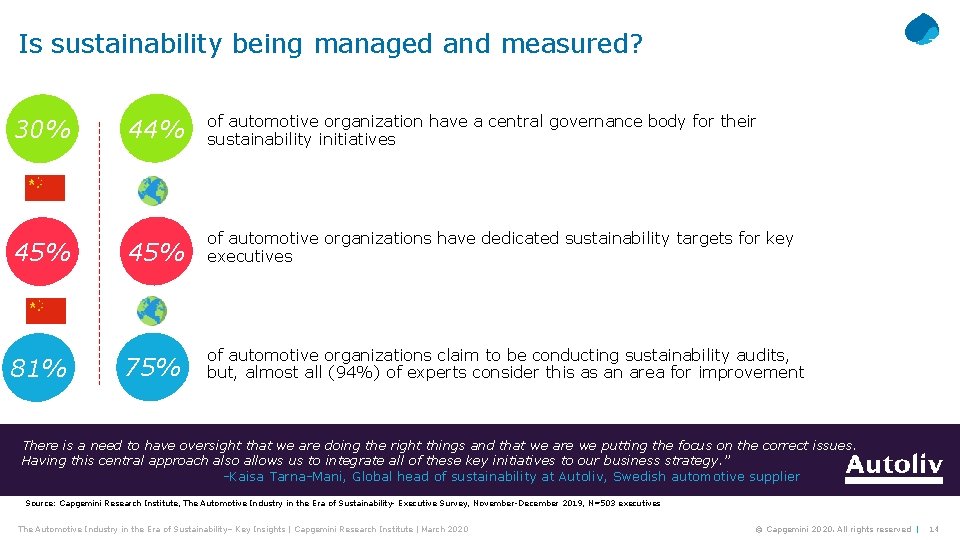
Is sustainability being managed and measured? 30% 45% 81% 44% of automotive organization have a central governance body for their sustainability initiatives 45% of automotive organizations have dedicated sustainability targets for key executives 75% of automotive organizations claim to be conducting sustainability audits, but, almost all (94%) of experts consider this as an area for improvement There is a need to have oversight that we are doing the right things and that we are we putting the focus on the correct issues. Having this central approach also allows us to integrate all of these key initiatives to our business strategy. ” -Kaisa Tarna-Mani, Global head of sustainability at Autoliv, Swedish automotive supplier Source: Capgemini Research Institute, The Automotive Industry in the Era of Sustainability- Executive Survey, November-December 2019, N=503 executives The Automotive Industry in the Era of Sustainability– Key Insights | Capgemini Research Institute | March 2020 © Capgemini 2020. All rights reserved | 14

An additional $50 billion investment is needed to meet sustainability commitments The Automotive Industry in the Era of Sustainability– Key Insights | Capgemini Research Institute | March 2020 © Capgemini 2020. All rights reserved | 15
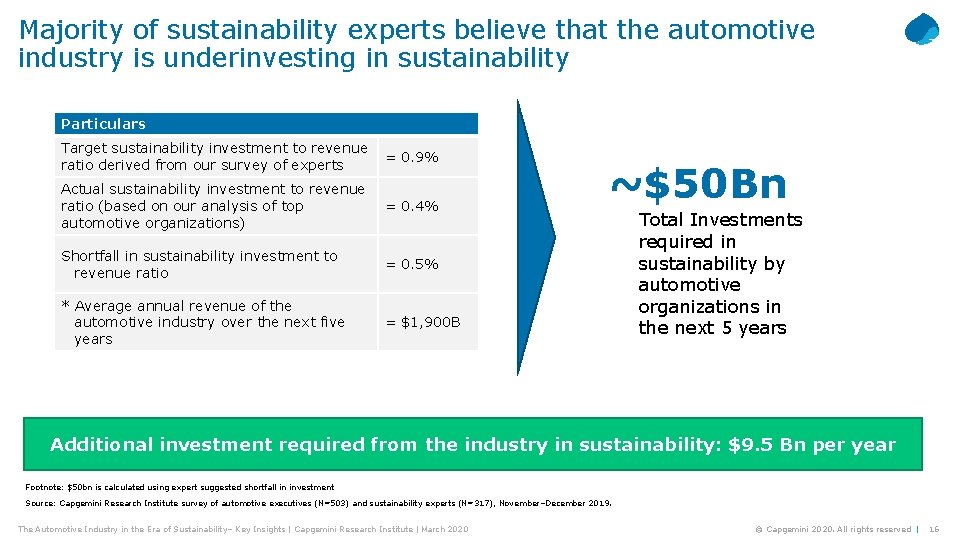
Majority of sustainability experts believe that the automotive industry is underinvesting in sustainability Particulars Target sustainability investment to revenue = 0. 9% ratio derived from our survey of experts Actual sustainability investment to revenue ratio (based on our analysis of top automotive organizations) = 0. 4% Shortfall in sustainability investment to revenue ratio = 0. 5% * Average annual revenue of the automotive industry over the next five years = $1, 900 B ~$50 Bn Total Investments required in sustainability by automotive organizations in the next 5 years Additional investment required from the industry in sustainability: $9. 5 Bn per year Footnote: $50 bn is calculated using expert suggested shortfall in investment Source: Capgemini Research Institute survey of automotive executives (N=503) and sustainability experts (N=317), November–December 2019. The Automotive Industry in the Era of Sustainability– Key Insights | Capgemini Research Institute | March 2020 © Capgemini 2020. All rights reserved | 16
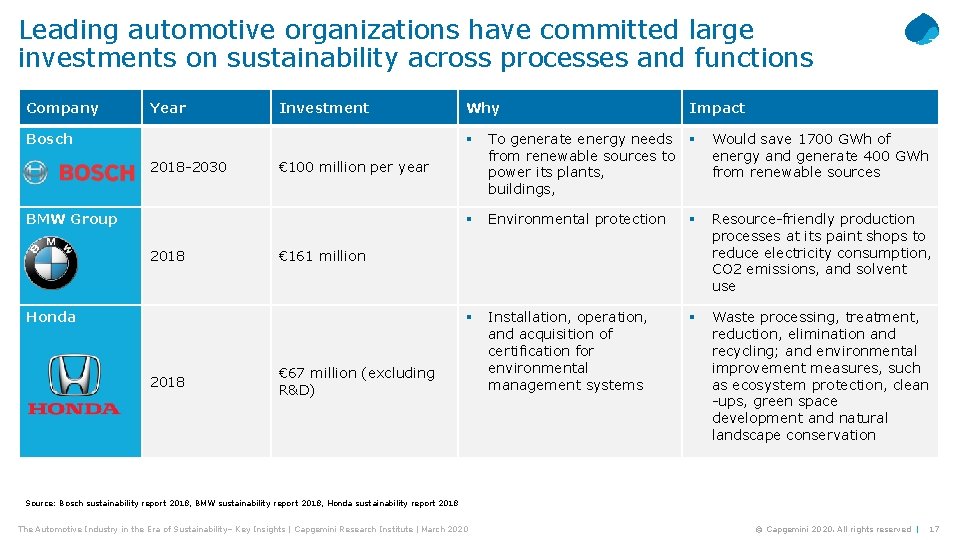
Leading automotive organizations have committed large investments on sustainability across processes and functions Company Year Investment Bosch 2018 -2030 To generate energy needs § from renewable sources to power its plants, buildings, Would save 1700 GWh of energy and generate 400 GWh from renewable sources § Environmental protection § Resource-friendly production processes at its paint shops to reduce electricity consumption, CO 2 emissions, and solvent use § Installation, operation, and acquisition of certification for environmental management systems § Waste processing, treatment, reduction, elimination and recycling; and environmental improvement measures, such as ecosystem protection, clean -ups, green space development and natural landscape conservation € 161 million Honda 2018 Impact § € 100 million per year BMW Group 2018 Why € 67 million (excluding R&D) Source: Bosch sustainability report 2018, BMW sustainability report 2018, Honda sustainability report 2018 The Automotive Industry in the Era of Sustainability– Key Insights | Capgemini Research Institute | March 2020 © Capgemini 2020. All rights reserved | 17
Realizing the true sustainability potential of electric vehicles and circular economy is critical The Automotive Industry in the Era of Sustainability– Key Insights | Capgemini Research Institute | March 2020 © Capgemini 2020. All rights reserved | 18
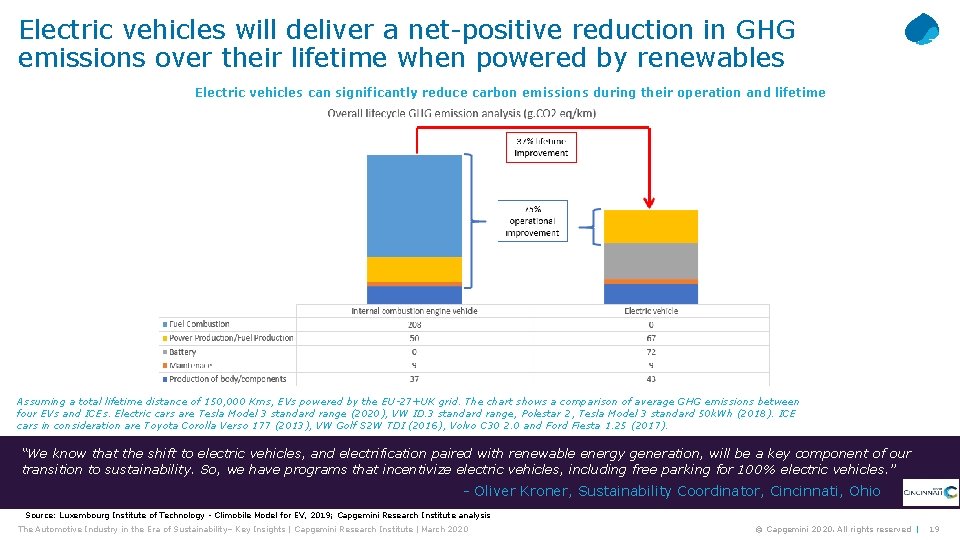
Electric vehicles will deliver a net-positive reduction in GHG emissions over their lifetime when powered by renewables Electric vehicles can significantly reduce carbon emissions during their operation and lifetime Assuming a total lifetime distance of 150, 000 Kms, EVs powered by the EU-27+UK grid. The chart shows a comparison of average GHG emissions between four EVs and ICEs. Electric cars are Tesla Model 3 standard range (2020), VW ID. 3 standard range, Polestar 2, Tesla Model 3 standard 50 k. Wh (2018). ICE cars in consideration are Toyota Corolla Verso 177 (2013), VW Golf S 2 W TDI (2016), Volvo C 30 2. 0 and Ford Fiesta 1. 25 (2017). “We know that the shift to electric vehicles, and electrification paired with renewable energy generation, will be a key component of our transition to sustainability. So, we have programs that incentivize electric vehicles, including free parking for 100% electric vehicles. ” - Oliver Kroner, Sustainability Coordinator, Cincinnati, Ohio Source: Luxembourg Institute of Technology - Climobile Model for EV, 2019; Capgemini Research Institute analysis The Automotive Industry in the Era of Sustainability– Key Insights | Capgemini Research Institute | March 2020 © Capgemini 2020. All rights reserved | 19
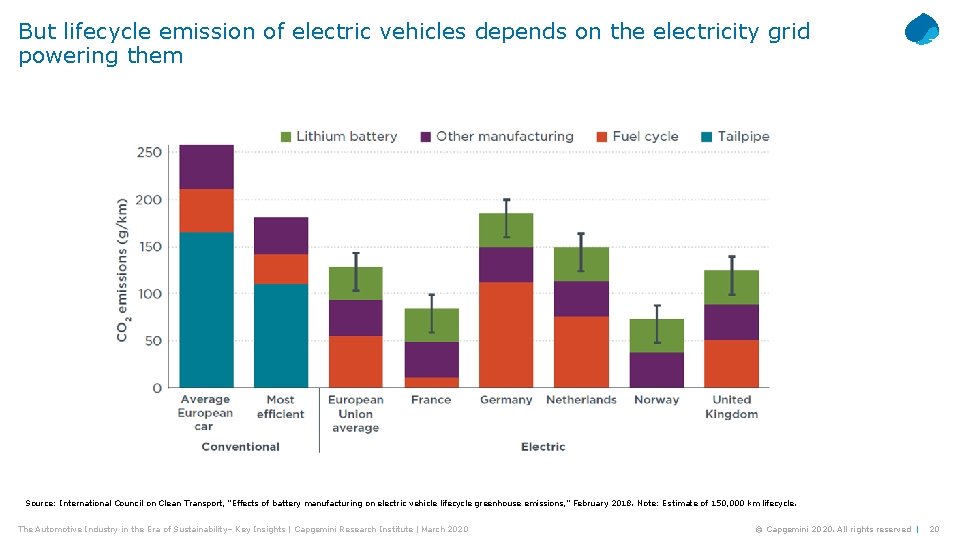
But lifecycle emission of electric vehicles depends on the electricity grid powering them Source: International Council on Clean Transport, “Effects of battery manufacturing on electric vehicle lifecycle greenhouse emissions, ” February 2018. Note: Estimate of 150, 000 km lifecycle. The Automotive Industry in the Era of Sustainability– Key Insights | Capgemini Research Institute | March 2020 © Capgemini 2020. All rights reserved | 20
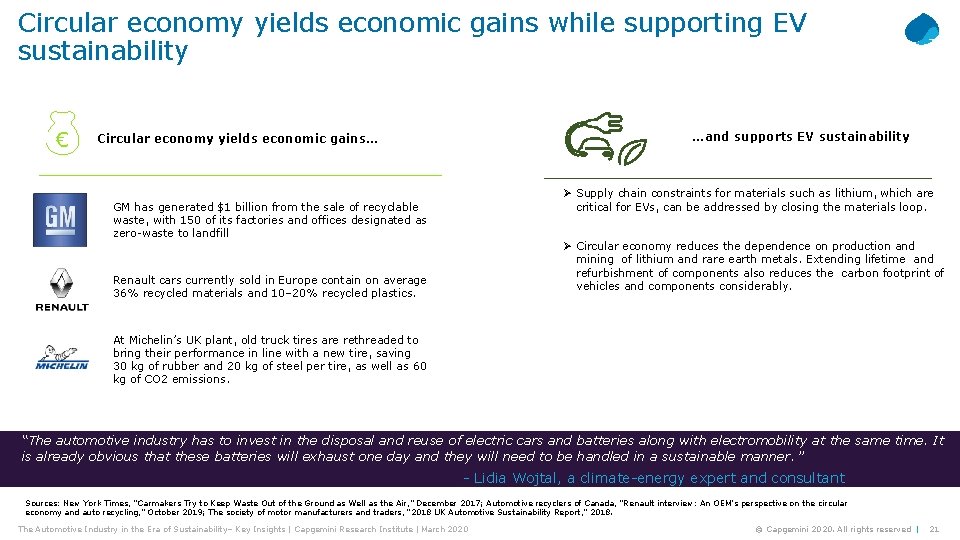
Circular economy yields economic gains while supporting EV sustainability € …and supports EV sustainability Circular economy yields economic gains… Ø Supply chain constraints for materials such as lithium, which are critical for EVs, can be addressed by closing the materials loop. GM has generated $1 billion from the sale of recyclable waste, with 150 of its factories and offices designated as zero-waste to landfill Ø Circular economy reduces the dependence on production and mining of lithium and rare earth metals. Extending lifetime and refurbishment of components also reduces the carbon footprint of vehicles and components considerably. Renault cars currently sold in Europe contain on average 36% recycled materials and 10– 20% recycled plastics. At Michelin’s UK plant, old truck tires are rethreaded to bring their performance in line with a new tire, saving 30 kg of rubber and 20 kg of steel per tire, as well as 60 kg of CO 2 emissions. “The automotive industry has to invest in the disposal and reuse of electric cars and batteries along with electromobility at the same time. It is already obvious that these batteries will exhaust one day and they will need to be handled in a sustainable manner. ” - Lidia Wojtal, a climate-energy expert and consultant Sources: New York Times, “Carmakers Try to Keep Waste Out of the Ground as Well as the Air, ” December 2017; Automotive recyclers of Canada, “Renault interview: An OEM’s perspective on the circular economy and auto recycling, ” October 2019; The society of motor manufacturers and traders, “ 2018 UK Automotive Sustainability Report, ” 2018. The Automotive Industry in the Era of Sustainability– Key Insights | Capgemini Research Institute | March 2020 © Capgemini 2020. All rights reserved | 21
Sustainability initiatives across the automotive value chain § SUSTAINABLE R&D involves designing products to reduce environmental impact and optimizing the use of natural resources by ensuring their recyclability. § PRODUCT SUSTAINABILITY involves moving to fuel-efficient or electric vehicles and bio-degradable components. § SUSTAINABLE SUPPLY CHAIN includes adoption of environmentally conscious operations in logistics, distribution, warehousing and inventory management, etc. § ENVIRONMENTALLY RESPONSIBLE SOURCING OF METALS, MATERIALS AND PRODUCTS ensures the mining, extraction and production are implemented with minimum effects to the environment, mitigating long-term impact. § DUE DILIGENCE OF ALL MATERIAL AND PRODUCT PROCUREMENT involves ensuring that all process and procedures are compatible with human and environmental guidelines and are independently verified. § SUSTAINABLE MANUFACTURING involves implementing maintenance, quality, and production processes to reduce waste and improve recyclability and reuse of materials. § RECYCLING OF WASTE AND EASY RETURNS FOR END-OF-LIFE DISPOSAL involves the consumer being given options to return their vehicles and parts for responsible disposal. § SUSTAINABLE POWER PROCUREMENT includes activities such as building or leasing renewable energy assets. § SALES, MARKETING, AND AFTER-SALES SUSTAINABILITY includes initiatives such as retrofitting to improve emissions and improving efficiencies on older models and refurbishing old components or vehicles. § MOBILITY AND DIGITAL SERVICES examples include encouraging ride sharing, subscription models, and connected services. § EMISSION CONTROL AND IMPROVED VEHICLE SAFETY ensuring that the lifetime emissions are accounted during any sustainability initiatives § CIRCULAR ECONOMY is an industrial or economic system that maximizes the use of resources by being restorative and regenerative by design and intention. It favours re-use of materials instead of the traditional manufacturing cycle of “take-make-use-dispose. ” § FAIR LABOR POLICY components include freedom of association and unionizing, work safety, and child labor. Source: Capgemini Research Institute, The Automotive Industry in the Era of Sustainability- Executive Survey, November-December 2019, N=503 executives The Automotive Industry in the Era of Sustainability– Key Insights | Capgemini Research Institute | March 2020 © Capgemini 2020. All rights reserved | 22

How can automotive firms accelerate sustainability? The Automotive Industry in the Era of Sustainability– Key Insights | Capgemini Research Institute | March 2020 © Capgemini 2020. All rights reserved | 23
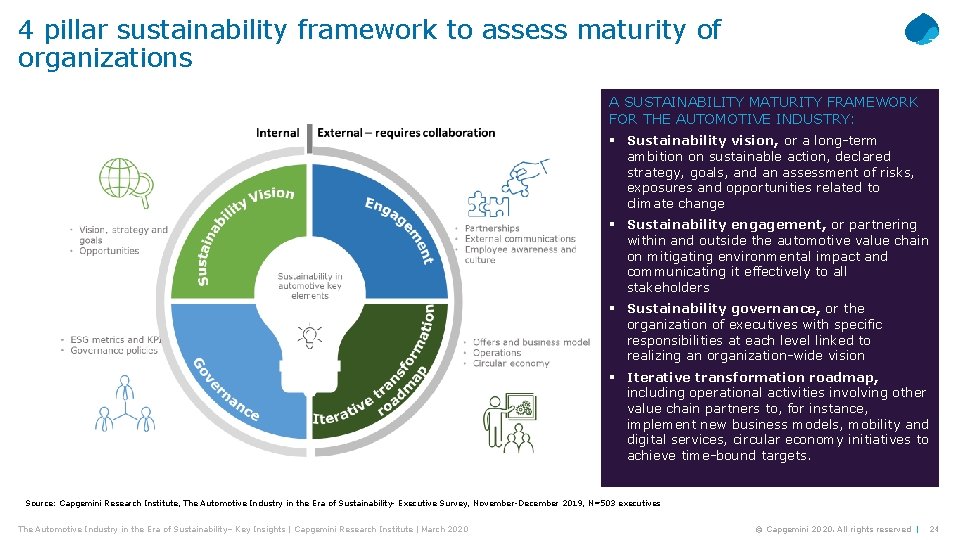
4 pillar sustainability framework to assess maturity of organizations A SUSTAINABILITY MATURITY FRAMEWORK FOR THE AUTOMOTIVE INDUSTRY: § Sustainability vision, or a long-term ambition on sustainable action, declared strategy, goals, and an assessment of risks, exposures and opportunities related to climate change § Sustainability engagement, or partnering within and outside the automotive value chain on mitigating environmental impact and communicating it effectively to all stakeholders § Sustainability governance, or the organization of executives with specific responsibilities at each level linked to realizing an organization-wide vision § Iterative transformation roadmap, including operational activities involving other value chain partners to, for instance, implement new business models, mobility and digital services, circular economy initiatives to achieve time-bound targets. Source: Capgemini Research Institute, The Automotive Industry in the Era of Sustainability- Executive Survey, November-December 2019, N=503 executives The Automotive Industry in the Era of Sustainability– Key Insights | Capgemini Research Institute | March 2020 © Capgemini 2020. All rights reserved | 24
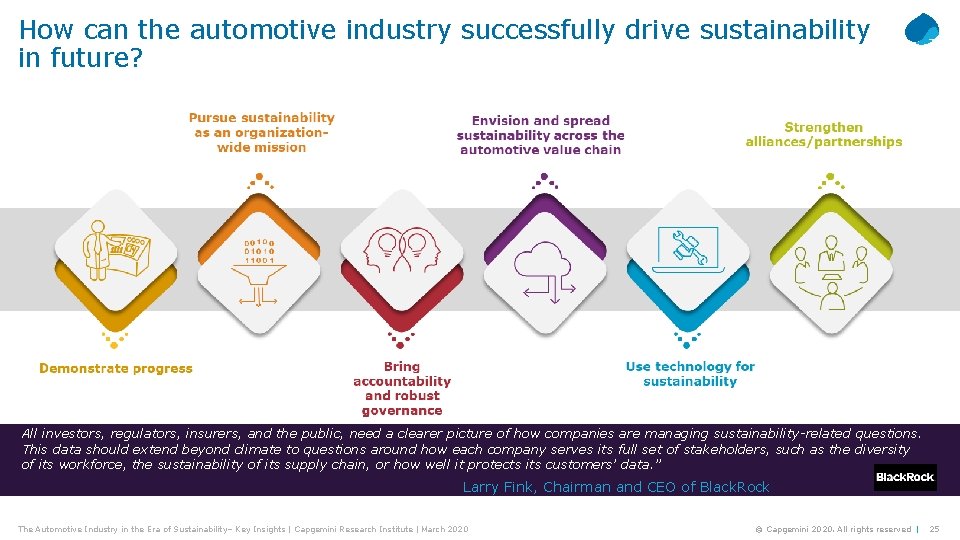
How can the automotive industry successfully drive sustainability in future? All investors, regulators, insurers, and the public, need a clearer picture of how companies are managing sustainability-related questions. This data should extend beyond climate to questions around how each company serves its full set of stakeholders, such as the diversity of its workforce, the sustainability of its supply chain, or how well it protects its customers’ data. ” Larry Fink, Chairman and CEO of Black. Rock The Automotive Industry in the Era of Sustainability– Key Insights | Capgemini Research Institute | March 2020 © Capgemini 2020. All rights reserved | 25
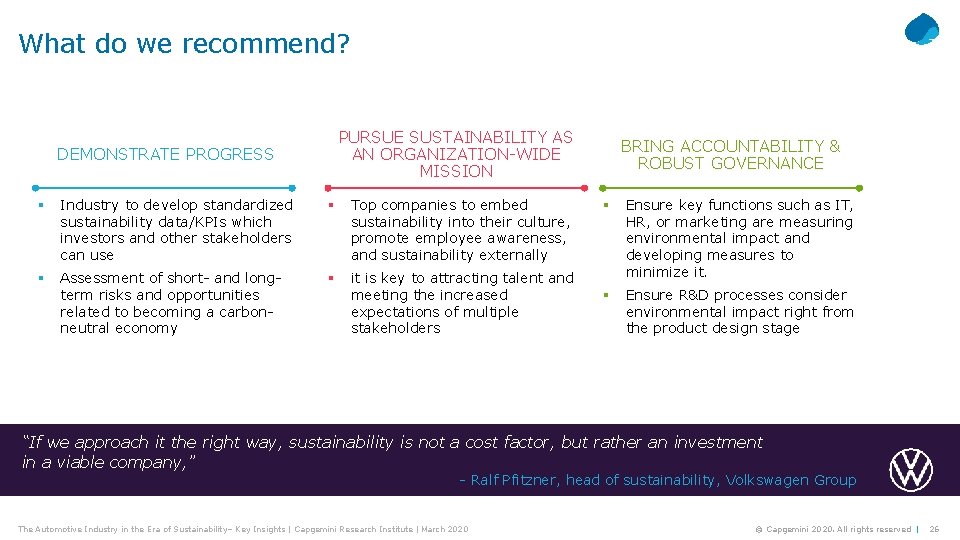
What do we recommend? PURSUE SUSTAINABILITY AS AN ORGANIZATION-WIDE MISSION DEMONSTRATE PROGRESS § Industry to develop standardized sustainability data/KPIs which investors and other stakeholders can use § Top companies to embed sustainability into their culture, promote employee awareness, and sustainability externally § Assessment of short- and longterm risks and opportunities related to becoming a carbonneutral economy § it is key to attracting talent and meeting the increased expectations of multiple stakeholders BRING ACCOUNTABILITY & ROBUST GOVERNANCE § Ensure key functions such as IT, HR, or marketing are measuring environmental impact and developing measures to minimize it. § Ensure R&D processes consider environmental impact right from the product design stage “If we approach it the right way, sustainability is not a cost factor, but rather an investment in a viable company, ” - Ralf Pfitzner, head of sustainability, Volkswagen Group The Automotive Industry in the Era of Sustainability– Key Insights | Capgemini Research Institute | March 2020 © Capgemini 2020. All rights reserved | 26
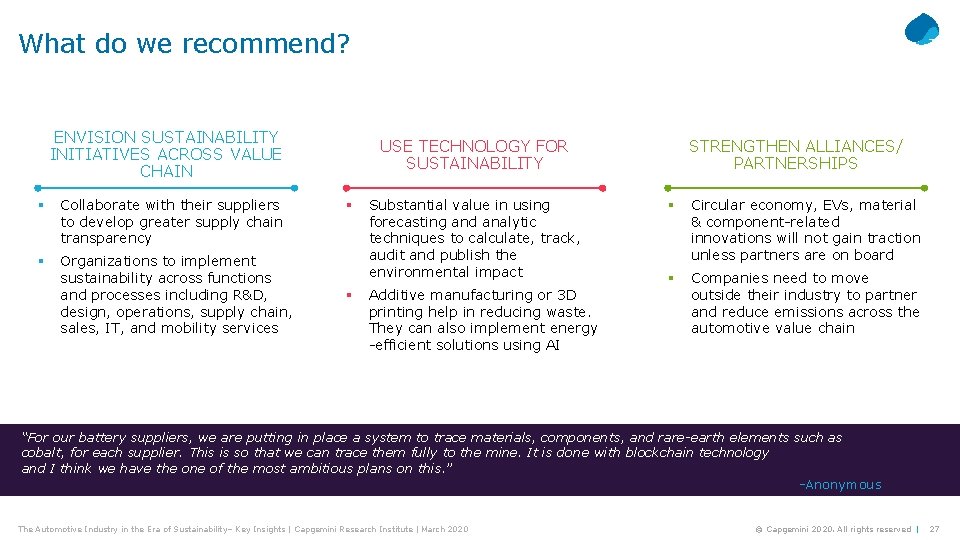
What do we recommend? ENVISION SUSTAINABILITY INITIATIVES ACROSS VALUE CHAIN § Collaborate with their suppliers to develop greater supply chain transparency § Organizations to implement sustainability across functions and processes including R&D, design, operations, supply chain, sales, IT, and mobility services USE TECHNOLOGY FOR SUSTAINABILITY § § Substantial value in using forecasting and analytic techniques to calculate, track, audit and publish the environmental impact Additive manufacturing or 3 D printing help in reducing waste. They can also implement energy -efficient solutions using AI STRENGTHEN ALLIANCES/ PARTNERSHIPS § Circular economy, EVs, material & component-related innovations will not gain traction unless partners are on board § Companies need to move outside their industry to partner and reduce emissions across the automotive value chain “For our battery suppliers, we are putting in place a system to trace materials, components, and rare-earth elements such as cobalt, for each supplier. This is so that we can trace them fully to the mine. It is done with blockchain technology and I think we have the one of the most ambitious plans on this. ” -Anonymous The Automotive Industry in the Era of Sustainability– Key Insights | Capgemini Research Institute | March 2020 © Capgemini 2020. All rights reserved | 27
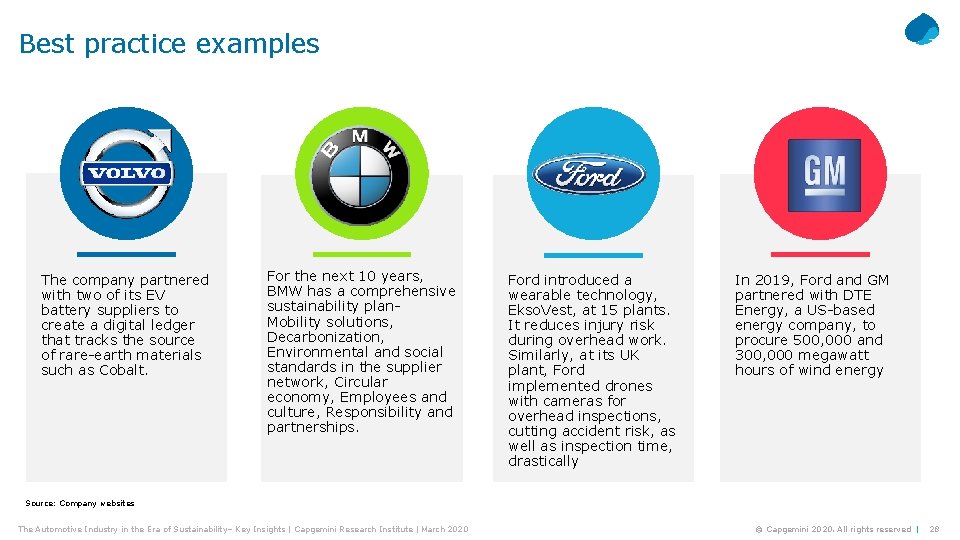
Best practice examples The company partnered with two of its EV battery suppliers to create a digital ledger that tracks the source of rare-earth materials such as Cobalt. For the next 10 years, BMW has a comprehensive sustainability plan- Mobility solutions, Decarbonization, Environmental and social standards in the supplier network, Circular economy, Employees and culture, Responsibility and partnerships. Ford introduced a wearable technology, Ekso. Vest, at 15 plants. It reduces injury risk during overhead work. Similarly, at its UK plant, Ford implemented drones with cameras for overhead inspections, cutting accident risk, as well as inspection time, drastically In 2019, Ford and GM partnered with DTE Energy, a US-based energy company, to procure 500, 000 and 300, 000 megawatt hours of wind energy Source: Company websites The Automotive Industry in the Era of Sustainability– Key Insights | Capgemini Research Institute | March 2020 © Capgemini 2020. All rights reserved | 28

Subscribe to latest research from Capgemini Research Institute Receive advance copies of our reports by scanning the QR code or visiting Capgemini. com/Research-Institute The Automotive Industry in the Era of Sustainability– Key Insights | Capgemini Research Institute | March 2020 © Capgemini 2020. All rights reserved | 29

About Capgemini A global leader in consulting, technology services and digital transformation, Capgemini is at the forefront of innovation to address the entire breadth of clients’ opportunities in the evolving world of cloud, digital and platforms. Building on its strong 50 -year heritage and deep industry-specific expertise, Capgemini enables organizations to realize their business ambitions through an array of services from strategy to operations. Capgemini is driven by the conviction that the business value of technology comes from and through people. It is a multicultural company of almost 220, 000 team members in more than 40 countries. The Group reported 2019 global revenues of EUR 14. 1 billion. Visit us at www. capgemini. com People matter, results count. This presentation contains information that may be privileged or confidential and is the property of the Capgemini Group. Copyright © 2020 Capgemini. All rights reserved. The Automotive Industry in the Era of Sustainability– Key Insights | Capgemini Research Institute | March 2020 © Capgemini 2020. All rights reserved | 30
- Slides: 30