
AUTOMOBILE INDUSTRY Fletcher Baldwin Conor Mc Nerney Patrick
AUTOMOBILE INDUSTRY Fletcher Baldwin Conor Mc. Nerney Patrick Litten Gina Kim Dien Nguyen
Outline • Supply and Demand • Production and Comparative Advantage • Unions and the Work and Labor Market • Fuel Economy Standards • Auto Market Competition
Supply, Demand, and 2011 U. S. Auto Sales • Situation from 2008 -2010 • Demand Supply Factors for 2011 • Sales Predictions in 2011 • Was the Forecast Correct?
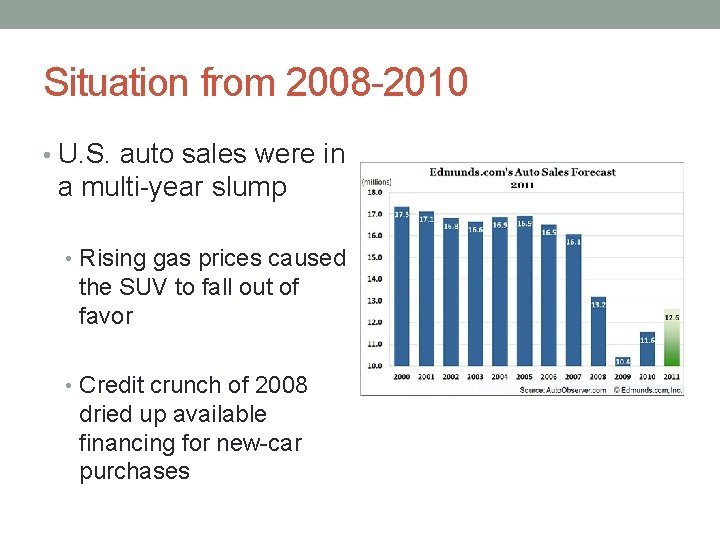
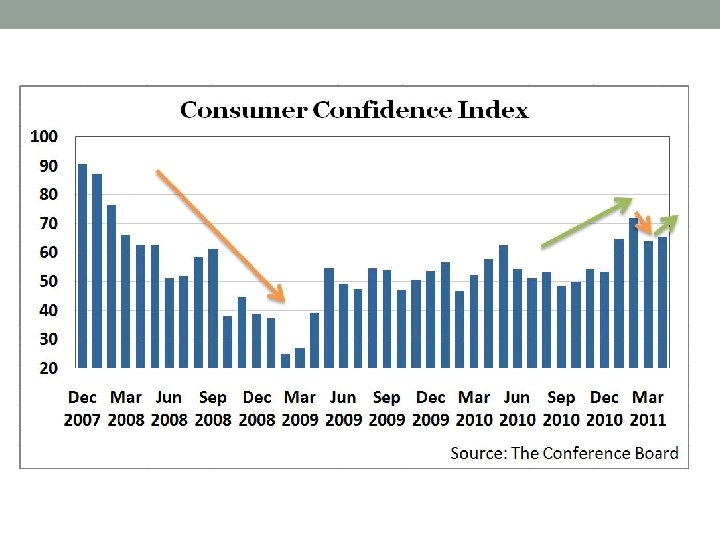
Situation from 2008 -2010 • U. S. auto sales were in a multi-year slump • Rising gas prices caused the SUV to fall out of favor • Credit crunch of 2008 dried up available financing for new-car purchases
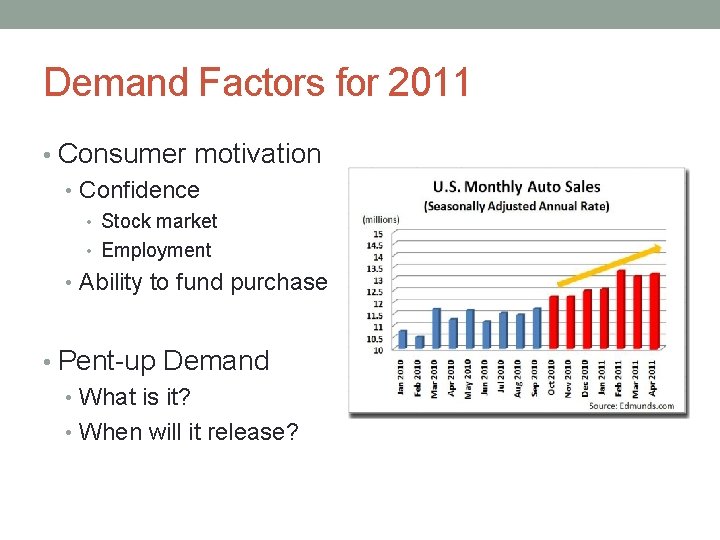
Demand Factors for 2011 • Consumer motivation • Confidence • Stock market • Employment • Ability to fund purchase • Pent-up Demand • What is it? • When will it release?
Supply Factors for 2011 • Earthquake in Japan • Production shortages in Japan • Will demand outpace supply? • US automakers will be able to meet demand
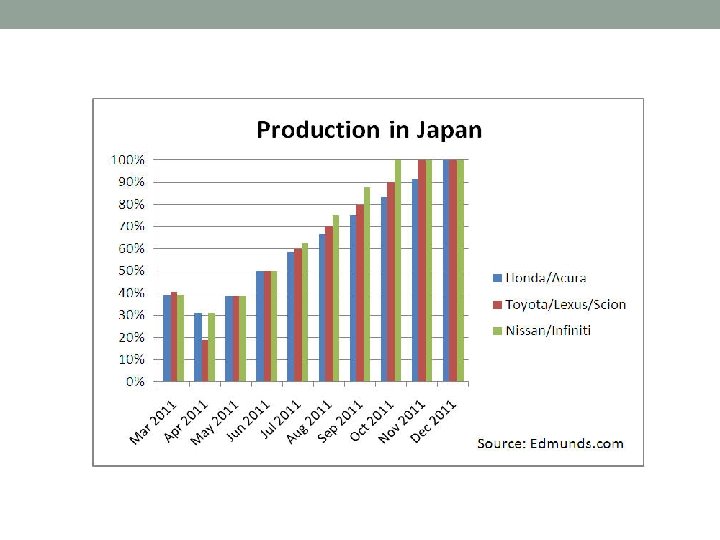
Outlook in 2011? • 12. 9 million domestic vehicle sales • Demand will overcome rising prices from supply shortages • Foreign shortages caused by the earthquake will resolve before the year is over
Did It Hold True? • 12. 8 million new car sales • Hopefully, pent-up demand will continue to drive sales up • Key Points • GM +13% • Ford +17% • Chrysler +26% • Toyota -7% • Honda -7%
COMPARATIVE ADVANTAGE AND PRODUCTION COST ANALYSIS

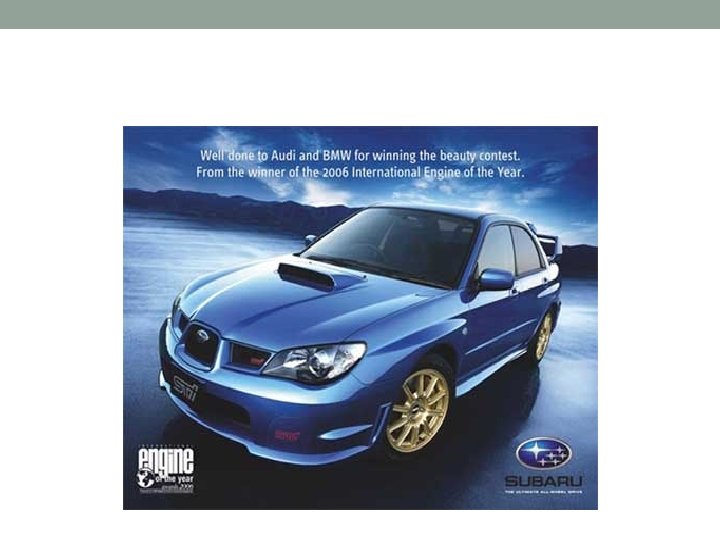
Comparative Advantage • Definition: The ability to be better suited to the production of one good than to the production of another • Opportunity cost • This technology over that technology • This raw material over that raw material • Advertisement
Production Cost Analysis • Comparative Advantage • What and How Much to produce • GM and auto-workers • Germany (a case study) • SWOT matrix
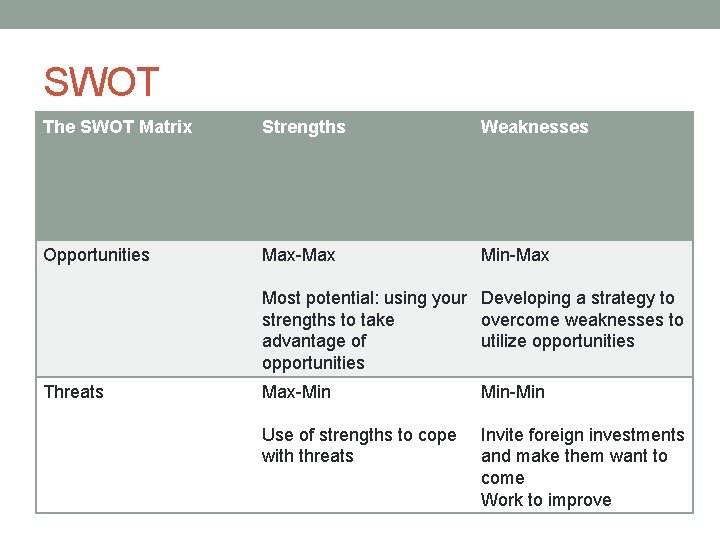
SWOT The SWOT Matrix Strengths Weaknesses Opportunities Max-Max Min-Max Most potential: using your Developing a strategy to strengths to take overcome weaknesses to advantage of utilize opportunities Threats Max-Min Min-Min Use of strengths to cope with threats Invite foreign investments and make them want to come Work to improve
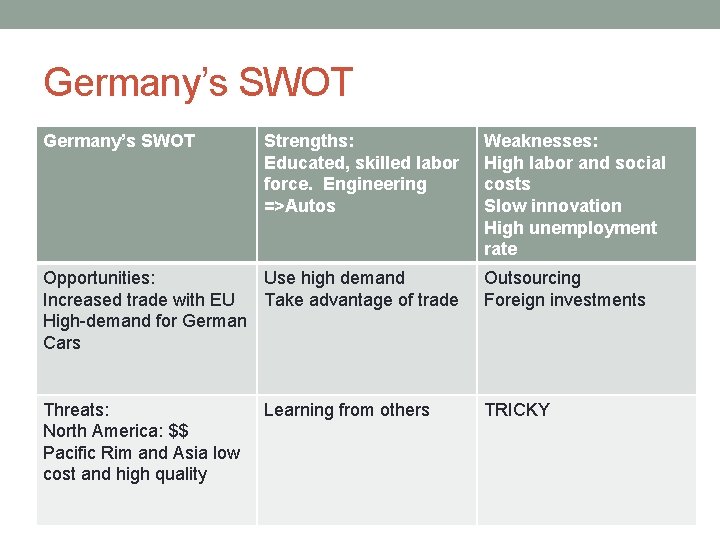
Germany’s SWOT Strengths: Educated, skilled labor force. Engineering =>Autos Weaknesses: High labor and social costs Slow innovation High unemployment rate Opportunities: Use high demand Increased trade with EU Take advantage of trade High-demand for German Cars Outsourcing Foreign investments Threats: North America: $$ Pacific Rim and Asia low cost and high quality TRICKY Learning from others
WORK AND LABOR MARKET
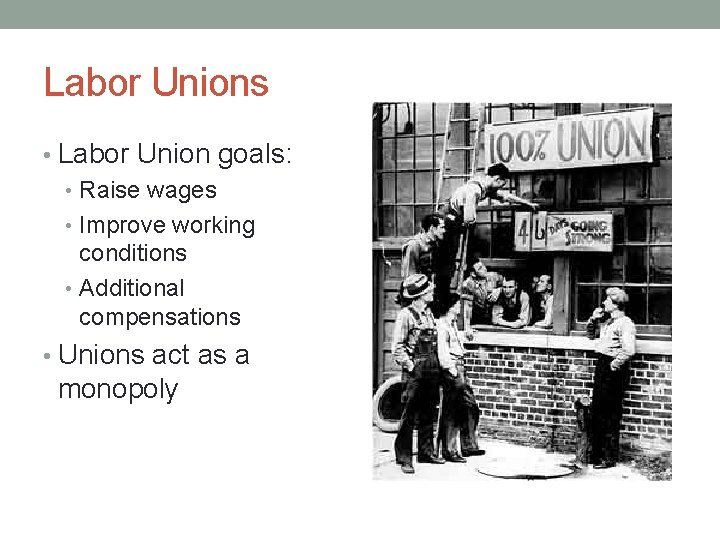
Labor Unions • Labor Union goals: • Raise wages • Improve working conditions • Additional compensations • Unions act as a monopoly
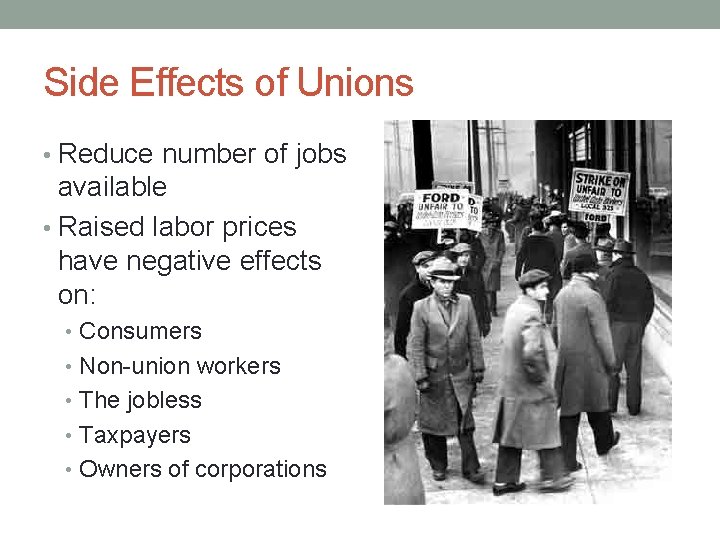
Side Effects of Unions • Reduce number of jobs available • Raised labor prices have negative effects on: • Consumers • Non-union workers • The jobless • Taxpayers • Owners of corporations
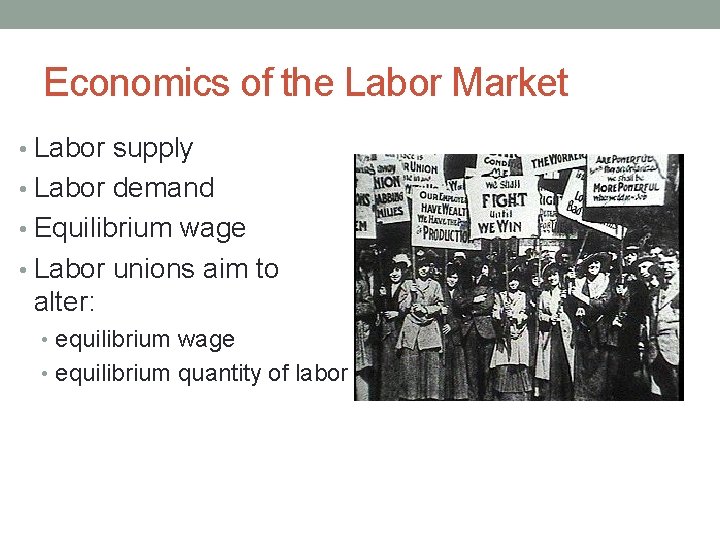
Economics of the Labor Market • Labor supply • Labor demand • Equilibrium wage • Labor unions aim to alter: • equilibrium wage • equilibrium quantity of labor
Marginal Wage • Marginal Wage=change in total wage/change in quantity of labor • Union’s labor equilibrium: wage rate = labor supply curve
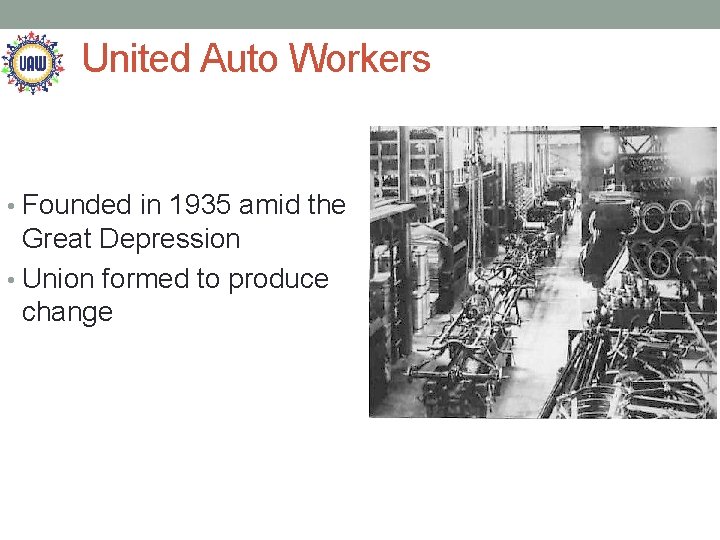
United Auto Workers • Founded in 1935 amid the Great Depression • Union formed to produce change
UAW and the 08 -09 Auto Crisis • Big Three Hourly Wage: $28 • Foreign Competitors: $14 • 85 -95% of union wages and benefits paid to out-of-work UAW laborers • Millions paid to out-of-workers
UAW & GM Break-Even Point: Revenue=Costs
FUEL ECONOMY STANDARDS Impacts, Efficiency, and Alternatives
Introduction • What is fuel economy? • It refers to the fuel efficiency relationship between distance traveled by an automobile and the amount of fuel consumed. • What are fuel economy standards? • A required fuel economy threshold that cars of a certain class must meet. • Why do we have them? • They are emission regulations that set specific limits to the amount of pollutants that can be released into the environment.
CAFE Program • Established by the Energy Policy and Conservation Act in 1975 • Created to improve the average fuel economy of cars and light trucks sold in the U. S. • Was one of the main forces behind a 35 percent increase in new vehicle fuel economy between 1978 and 1985
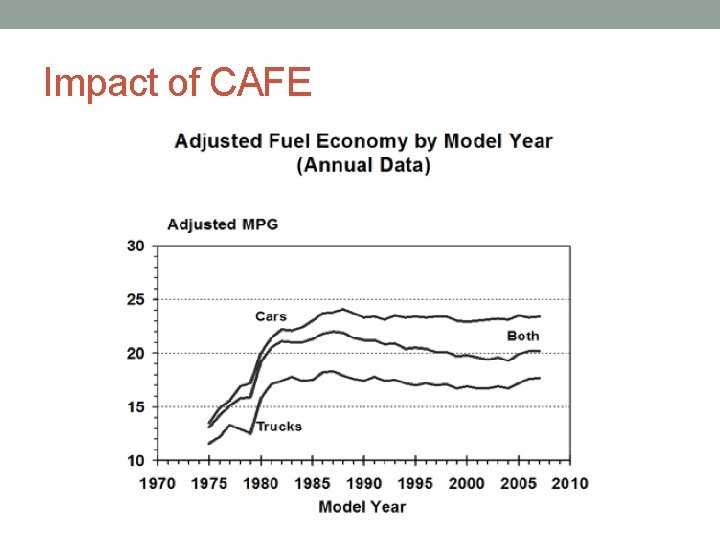
Impact of CAFE
Criticism • CAFE standards impose significant costs on automakers and consumers. • Short Run vs. Long Run Effects • Gasoline taxes are far more cost-effective and more effectively reduce gasoline use.
Criticism • Why doesn’t the government increase gasoline taxes dramatically then? • What do economists say?
“Feebates” • Inefficient vehicles receive a surcharge (FEE-), and efficient vehicles are granted a rebate (–BATE). • What is a “pivot point”? • What are the “components” of the system? • What are the “characteristics” of the system? • Is this system a viable alternative?
AUTO MARKET COMPETITION
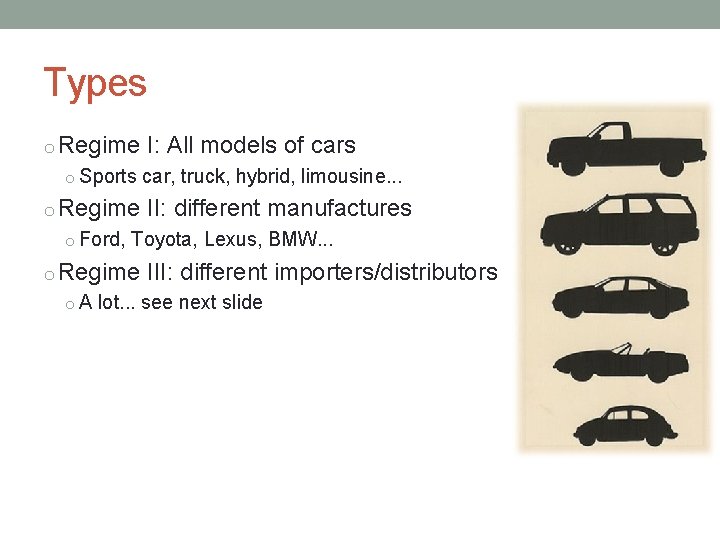
Types o Regime I: All models of cars o Sports car, truck, hybrid, limousine. . . o Regime II: different manufactures o Ford, Toyota, Lexus, BMW. . . o Regime III: different importers/distributors o A lot. . . see next slide
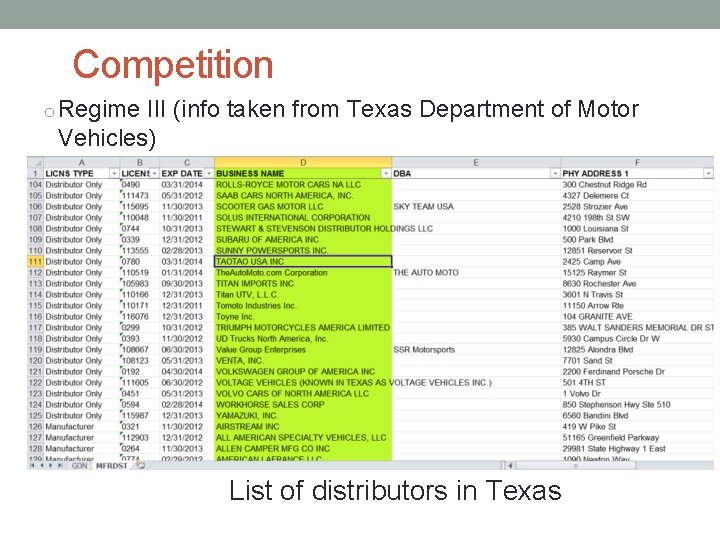
Competition o Regime III (info taken from Texas Department of Motor Vehicles) List of distributors in Texas
Rivalry in the Auto Industry • Due to global competition • The entry of foreign producers (Honda, Toyota. . . ) • Threats of substitutes (bus, train, new models) • Dealership: sales, services. Decrease in concentration ratio (measure of the monopolistic of the market)
Oligopoly and Cartel • But. . . they are smart Getting market power by: rent-seeking, informal collusion, differentiating products (reducing competition) • Ex: The Big 3 and SUV prices • Where’s the evidence? . . they are making lots of profits (take a look at Toyota income)
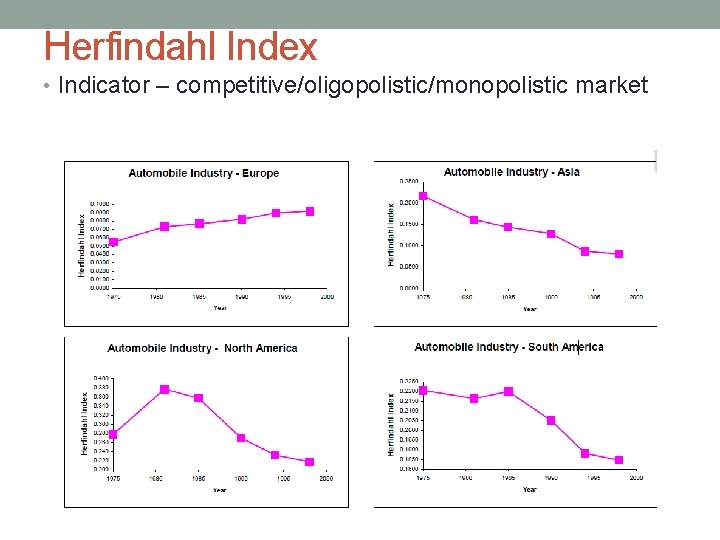
Herfindahl Index • Indicator – competitive/oligopolistic/monopolistic market
Imperfect competition • Substantial barrier to entry (equipment, buildings, patents, license, trademarks) • Price is set by dealers • Number of firms is small • Products are differentiated (types, bonus, discounts, guarantee. . . ) • Incomplete info
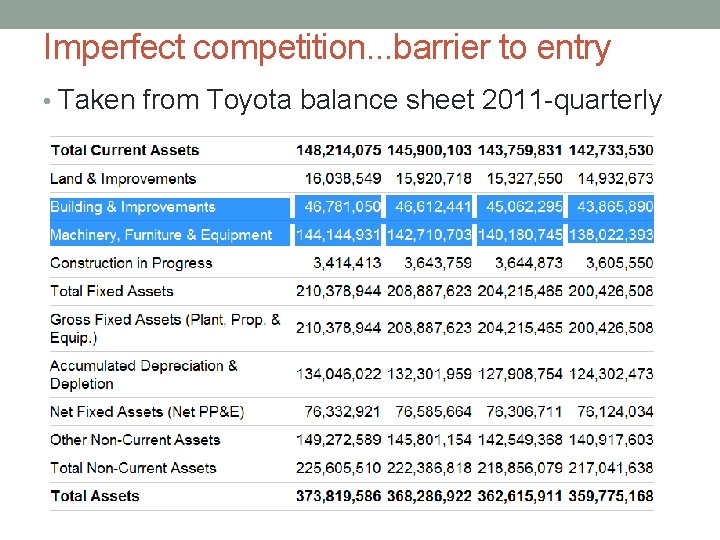
Imperfect competition. . . barrier to entry • Taken from Toyota balance sheet 2011 -quarterly
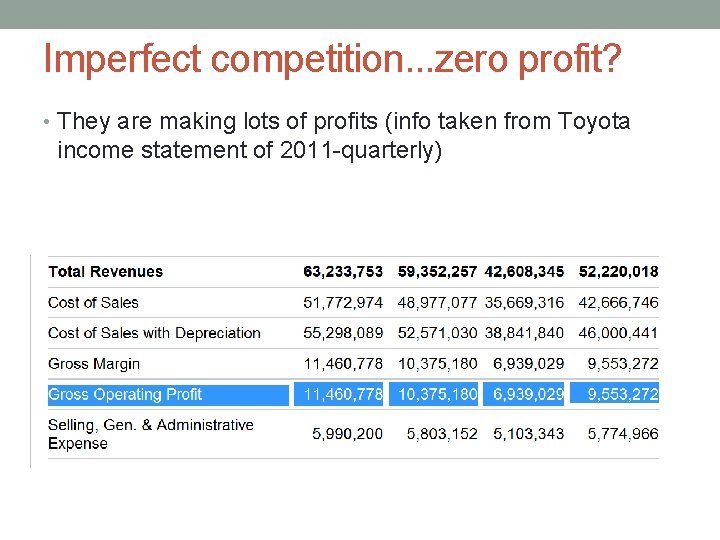
Imperfect competition. . . zero profit? • They are making lots of profits (info taken from Toyota income statement of 2011 -quarterly)
Questions? Balloon Car
References • Anderson, S. (2011). Automobile fuel economy standards: Impacts, efficiency, and alternatives. Review of Environmental Economics and Policy, 5(1), 89 -108. Retrieved from http: //reep. oxfordjournals. org/content/5/1/89. full • Dowgiewicz, Kathryn. "UAW: an iconic union turns 75. " Michigan History Magazine 94. 4 (2010): 23+. Gale U. S. History In Context. Web. 12 Apr. 2012. • Lorio, J. (2012). 2011 Auto Sales. Retrieved from http: //www. automobilemag. com/features/ news/1201_2011_auto_sales/viewall. html • Plache, L. (2011). Top Factors Driving 2011 Auto Sales. Retrieved from http: // www. autoobserver. com/2011/05/top-factorsdriving-2011 -auto-sales. html • Plache, L. (2011). 2011 Forecast 12. 9 Million Still Holds. Retrieved from http: // www. autoobserver. com/2011/06/2011 -forecast -129 -million-still-holds. html • Reynolds, Morgan O. "Labor Unions. " The Concise Encyclopedia of Economics. Library of Economics Liberty. Web. 12 Apr. 2012. • Toyota. (n. d. ). Retrieved from http: //finapps. forbes. com/finapps/jsp/ finance/compinfo/Financial. Industrial. jsp? tkr=tm&period=qtr • Toyota. (n. d. ). Retrieved from http: //finapps. forbes. com/finapps/jsp/ finance/compinfo/Income. Statement. jsp? tkr=tm&period=qtr • Weihrich, H. (1999). Analyzing the competitive advantages and disadvantages of Germany with the tows matrix. European Business Review, Retrieved from http: // www. usfca. edu/ fac_staff/ weihrichh/docs/germany. pdf • White, Jerry. "UAW Membership Continues to Plummet. " Wsws. org. Web.
- Slides: 42