
AUTOMOBILE AERODYNAMICS MODULE 3 Ground Vehicle Aerodynamics Ground

AUTOMOBILE AERODYNAMICS MODULE 3

Ground Vehicle Aerodynamics Ground Vehicle aerodynamics is the study of the aerodynamics of road vehicles. Its main goals are reducing drag and wind noise, minimizing noise emission, and preventing undesired lift forces and other causes of aerodynamic instability at high speeds. For some classes of racing vehicles, it may also be important to produce downforce to improve traction and thus cornering abilities.

Comparison with Aircraft Aerodynamics Ground Vehicle aerodynamics differs from aircraft aerodynamics in several ways. First, the characteristic shape of a road vehicle is much less streamlined compared to an aircraft. Second, the vehicle operates very close to the ground, rather than in free air. Third, the operating speeds are lower (and aerodynamic drag varies as the square of speed). Fourth, a ground vehicle has fewer degrees of freedom than an aircraft, and its motion is less affected by aerodynamic forces. Fifth, passenger and commercial ground vehicles have very specific design constraints such as their intended purpose, high safety standards (requiring, for example, more 'dead' structural space to act as crumple zones), and certain regulations.

VEHICLE POWER REQUIREMENTS Resistance forces acting on a ground vehicle are 1. Aerodynamic 2. Rolling 3. Grade

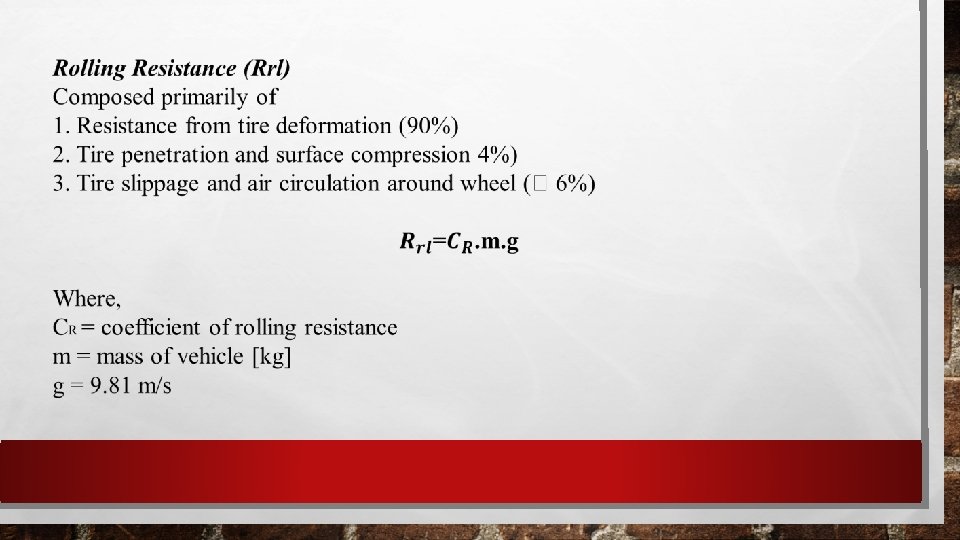

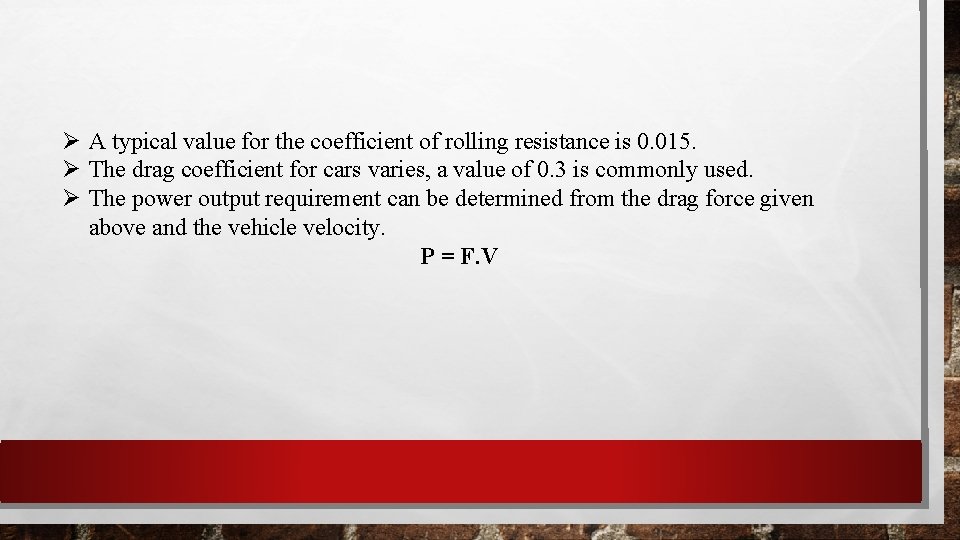
A typical value for the coefficient of rolling resistance is 0. 015. The drag coefficient for cars varies, a value of 0. 3 is commonly used. The power output requirement can be determined from the drag force given above and the vehicle velocity. P = F. V

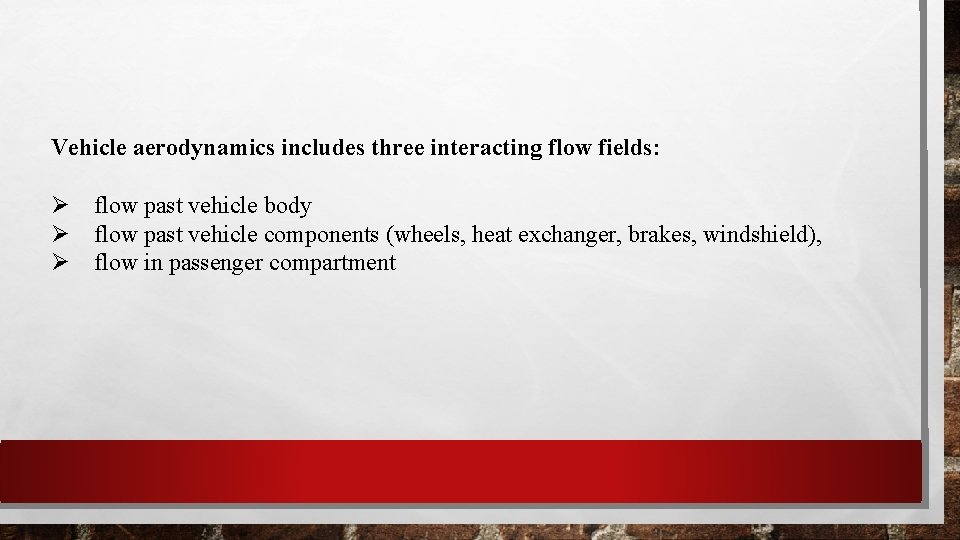
Vehicle aerodynamics includes three interacting flow fields: flow past vehicle body flow past vehicle components (wheels, heat exchanger, brakes, windshield), flow in passenger compartment

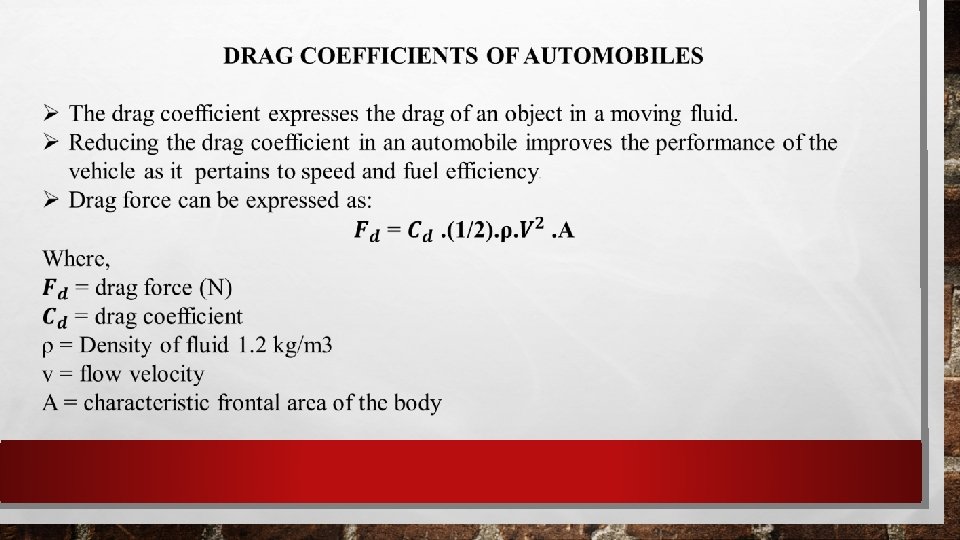
AERODYNAMICS OF CAR A body in motion is affected by aerodynamic forces. The aerodynamic force acts externally on the body of a vehicle. The component of the resultant aerodynamic force which opposes the forward motion is called the aerodynamic drag. The aerodynamic drag affects the performance of a car in both speed and fuel economy as it is the power required to overcome the opposing force. The other component, directed vertically, is called the aerodynamic lift. It reduces the frictional forces between the tyres and the road thus changing dramatically the handling characteristics of the vehicle. The aerodynamic force is the net result of all the changing distributed pressures which airstreams exert on the car surface. Therefore aerodynamic studies are very important as far as the car stability is concerned.
The main concerns of automotive aerodynamics are reducing drag, reducing wind noise, and preventing undesired lift forces at high speeds. For some classes of vehicles, it may also be important to produce desirable downwards aerodynamic forces, to improve cornering. As the years passed the studies on aerodynamic effects on cars increased and the designs were being developed to accommodate for the increasing needs and for economic reasons. The wheels developed to be designed within the body, lowering as a result the aerodynamic drag and produce a more gentle flow. The tail was for many years long and oddly shaped to maintain attached streamline. The automobiles became developed even more with smooth bodies, integrated fenders and headlamps enclosed in the body. The designers had achieved a shape of a car that differed from the traditional horsedrawn carriages.
They had certainly succeeded in building cars with low drag coefficient. Road conditions have limited the width of automobiles. It is said this width was established by the width needed for two horses running comfortably side by side drawing a carriage. Length is not as much of a restriction but long bodies were not efficient enough for traffic use. Aerodynamic drag In order to explain the Aerodynamic drag the two forces - the frontal pressure and the rear vacuum – have to be analyzed. Frontal pressure is caused by the air attempting to flow around the front of the car. As millions of air molecules approach the front part of the car, they begin to compress, and in doing so raise the air pressure in front of the car. At the same time, the air molecules traveling along the sides of the car are at atmospheric pressure, a lower pressure compared to the molecules at the front of the car.
The compressed molecules of air naturally seek a way out of the high pressure zone in front of the car, and they find it around the sides, top and bottom of the car. Rear vacuum or wake is caused by the "hole" left in the air as the car passes through it. This empty area is a result of the air molecules not being able to fill the hole as quickly as the car can make it. The air molecules attempt to fill in to this area, but the car is always one step ahead. As a result, a continuous vacuum in the rear of the car sucks in the opposite direction of the motion of the car. This inability to fill the hole left by the car is technically called Flow detachment applies only to the "rear vacuum" portion of the drag equation, and it is really about giving the air molecules time to follow the contours of a car's bodywork, and to fill the hole left by the vehicle, it's tyres, it's suspension and protrusions (i. e. mirrors, roll bars).
The flow attachment is very important because the drag created by the vacuum far exceeds that created by frontal pressure, and this can be attributed to the turbulence created by the detachment. That is why in the early years of automotive industry the cars used to be designed with long tail. This was done as to maintain the streamlines created by the flow, attached. Turbulence generally affects the "rear vacuum" portion of the drag equation, but if we look at a protrusion from the race car such as a mirror, we see a compounding effect. For instance, the air flow detaches from the flat side of the mirror, which of course faces toward the back of the car. The turbulence created by this detachment can then affect the air flow to parts of the car which lie behind the mirror. Intake ducts, for instance, function best when the air entering them flows smoothly. Therefore, the entire length of the car really needs to be optimized to provide the least amount of turbulence at high speed.
Drag Coefficient The shape of a car, as the aerodynamic theory above suggests, is largely responsible for how much drag the car has. Ideally, the car body should: Have a small grill, to minimize frontal pressure. Have minimal ground clearance below the grill, to minimize air flow under the car. In combination to this, a raked underside with the rear of the car raised can create down force. Have a steeply raked windshield to avoid pressure build up in front. Have a "Fastback" style rear window and deck, to permit the air flow to stay attached. Have a converging "Tail" to keep the air flow attached.
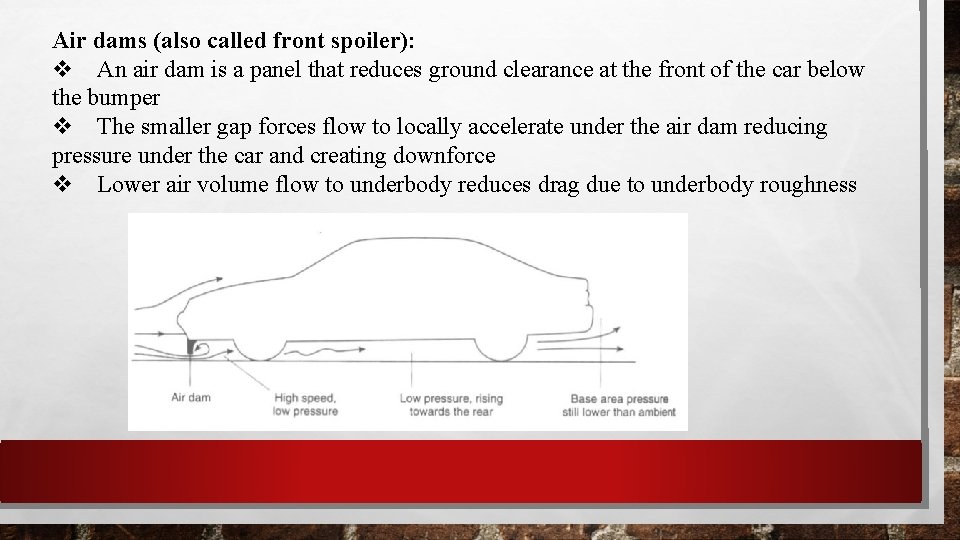
Air dams (also called front spoiler): An air dam is a panel that reduces ground clearance at the front of the car below the bumper The smaller gap forces flow to locally accelerate under the air dam reducing pressure under the car and creating downforce Lower air volume flow to underbody reduces drag due to underbody roughness
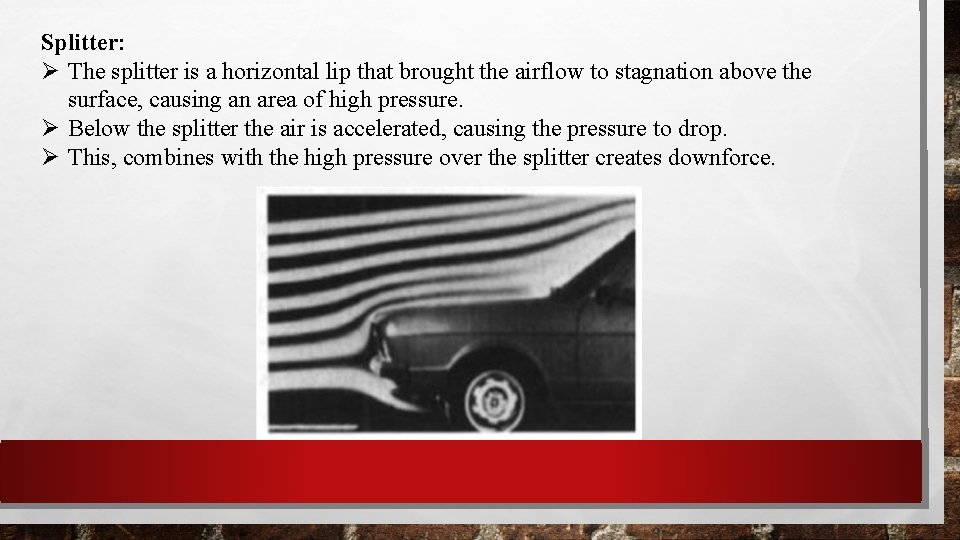
Splitter: The splitter is a horizontal lip that brought the airflow to stagnation above the surface, causing an area of high pressure. Below the splitter the air is accelerated, causing the pressure to drop. This, combines with the high pressure over the splitter creates downforce.
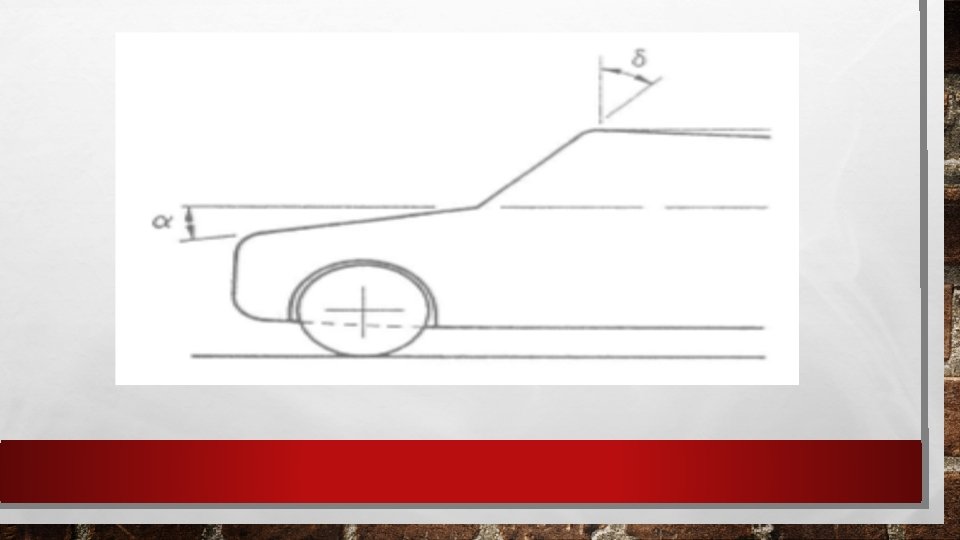
Reduction of forebodydrag: The most significant drag reduction can be achieved by rounding up the vertical and upper horizontal leading edges on the front face. Relatively small amendments can result considerable drag reduction. The drag reduction of front spoiler is large if its use is combined with rounded leading edges. Hood and Windshield Angle of Inclination: The hood angle (α) determines the pressure gradient and plays a role in maintaining attached flow The windshield angle, δ (rake) plays a stronger role by controlling point of attachment of flow to roof
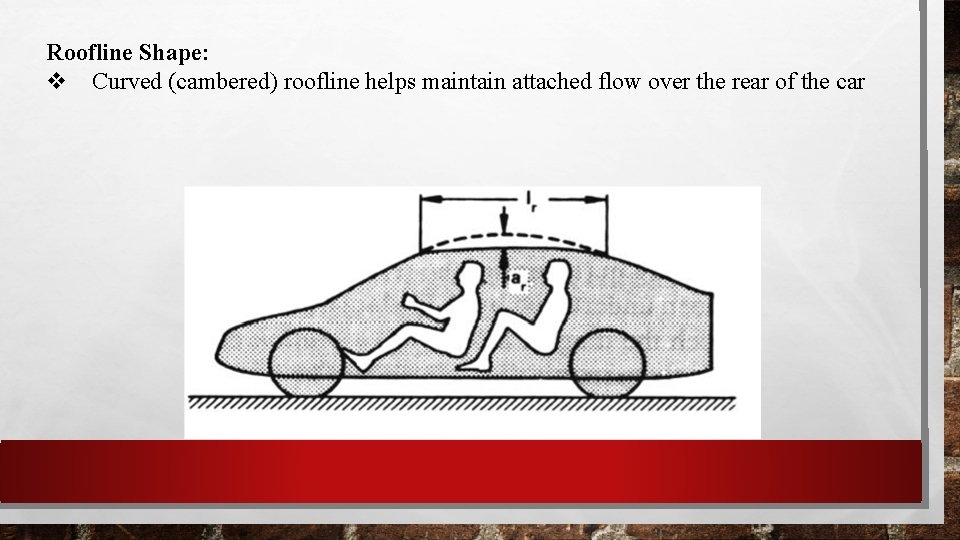
Roofline Shape: Curved (cambered) roofline helps maintain attached flow over the rear of the car
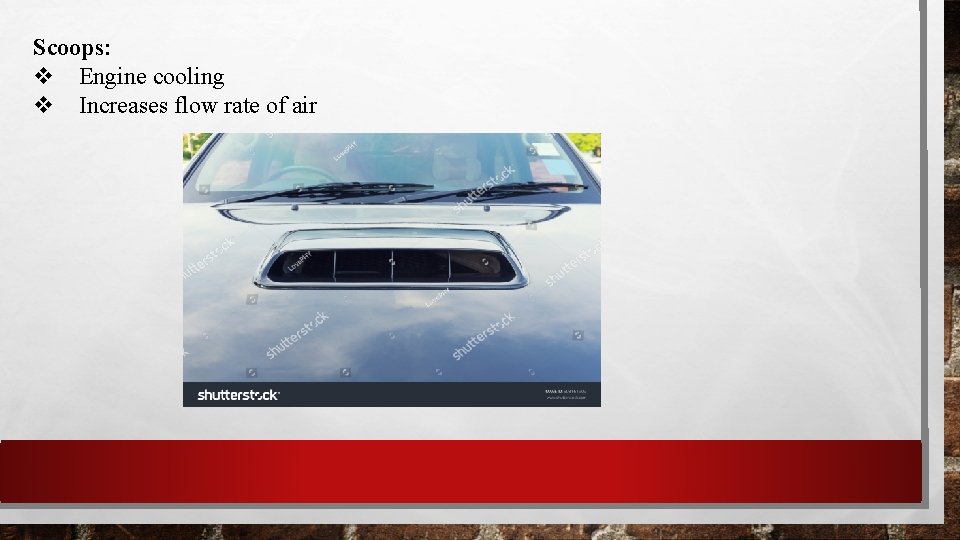
Scoops: Engine cooling Increases flow rate of air
EFFECT OF CUT BACK ANGLE (Back Light Angle Or Rear Wind Shield Angle): The rear window angle with horizontal is called the “cut back angle” or “back light angle”. The angle of inclination affects the trailing vortex location and strength The nature of the counter rotating vortex structure is controlled primarily by the cut back angle. Vortices expend energy gives Drag. So the amount of drag force creation is controlled by the cut back angle. The airflow over the rear surfaces of the vehicle is more complex and the solutions required to minimize drag for practical shapes are less intuitive. The inclination of the screen may be sufficient to cause the flow to separate from the rear window although in many cases the separation is followed by flow re-attachment along the boot lid.


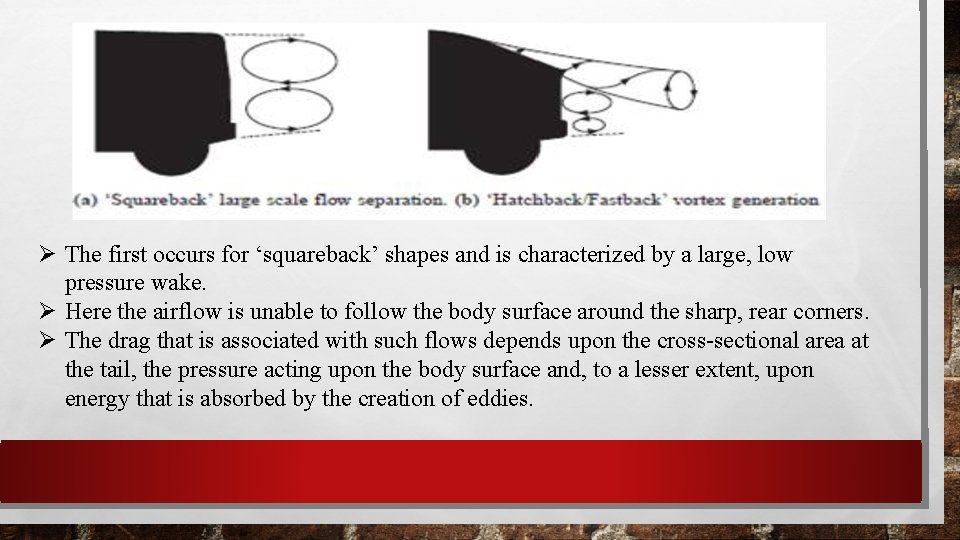
The first occurs for ‘squareback’ shapes and is characterized by a large, low pressure wake. Here the airflow is unable to follow the body surface around the sharp, rear corners. The drag that is associated with such flows depends upon the cross-sectional area at the tail, the pressure acting upon the body surface and, to a lesser extent, upon energy that is absorbed by the creation of eddies.
A very different flow structure arises if the rear surface slopes more gently as is the case for hatchback, fastback and most notchback shapes. The centreline pressure distribution that the surface air pressure over the rear of the car is significantly lower than that of the surroundings. Along the sides of the car the body curvature is much less and the pressures recorded here differ little from the ambient conditions. The low pressure over the upper surface draws the relatively higher pressure air along the sides of the car upwards and leads to the creation of intense, conical vortices at the ‘C’ pillars. These vortices increase the likelihood of the upper surface flow remaining attached to the surface even at backlight angles of over 30 degrees. Air is thus drawn down over the rear of the car resulting in a reacting force that has components in both the lift and the drag directions.
The backlight angle has been shown to be absolutely critical for vehicles of this type demonstrates the change in the drag coefficient of a typical vehicle with changing backlight angle. As the angle increases from zero (typical squareback) towards 15 degrees there is initially a slight drag reduction as the effective base area is reduced. Further increase in backlight angle reverses this trend as the drag inducing influence of the upper surface pressures and trailing vortex creation increase. As 300 is approached the drag is observed to increase particularly rapidly as these effects become stronger until at approximately 30 degree the drag dramatically drops to a much lower value. This sudden drop corresponds to the backlight angle at which the upper surface flow is no longer able to remain attached around the increasingly sharp top, rear corner and the flow reverts to a structure more akin to that of the initial squareback.
In the light of the reasonably good aerodynamic performance of the squareback shape it is not surprising that many recent, small hatchback designs have adopted the square profiles that maximize interior space with little aerodynamic penalty.
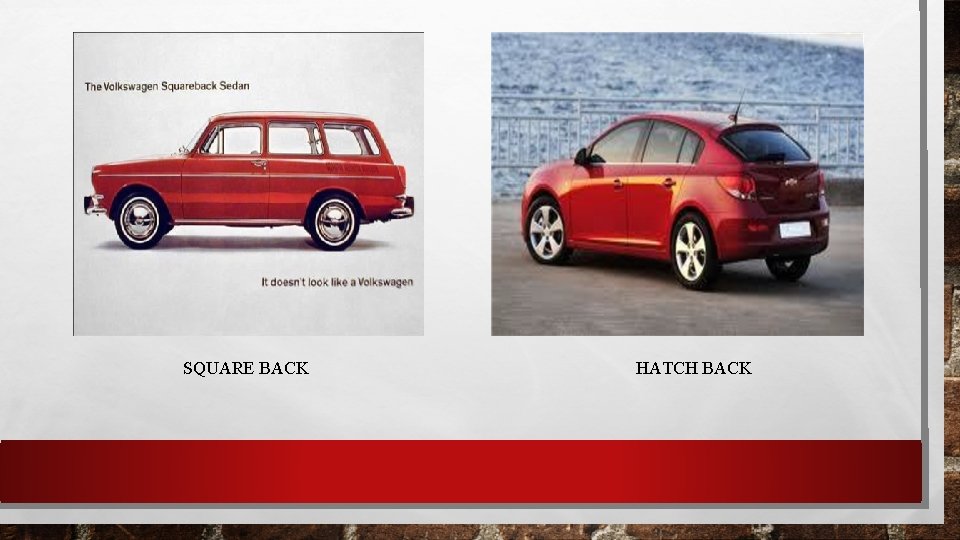
SQUARE BACK HATCH BACK

NOTCH BACK
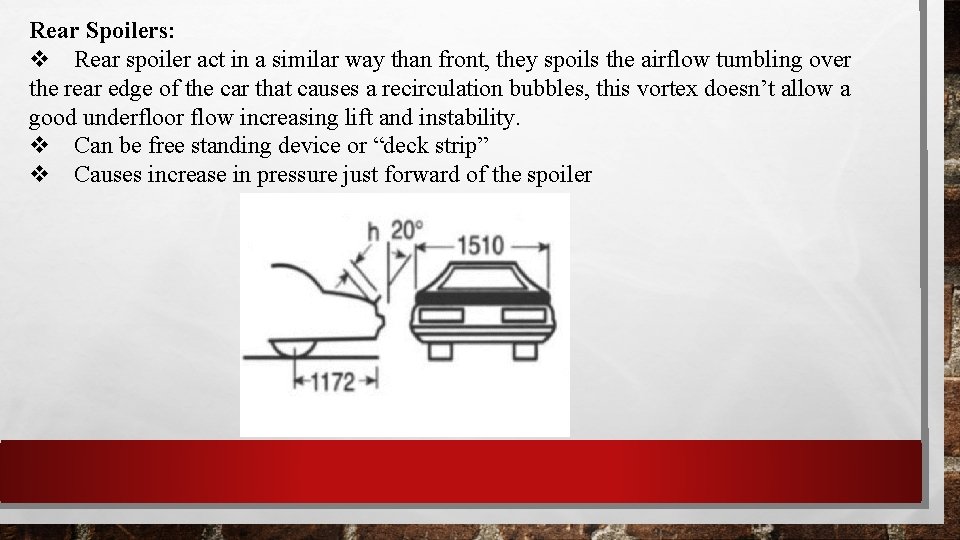
Rear Spoilers: Rear spoiler act in a similar way than front, they spoils the airflow tumbling over the rear edge of the car that causes a recirculation bubbles, this vortex doesn’t allow a good underfloor flow increasing lift and instability. Can be free standing device or “deck strip” Causes increase in pressure just forward of the spoiler

Boat-Tailing (Tapering the rear end) Tapering of rear part results is reduction of the size of rear separation bubble and increase of pressure
Aerodynamics of Race Car Front and rear wings: The main focus in race cars is on the down force and drag. The relationship between drag and down force is especially important. Aerodynamic improvements in wings are directed at generating down force on the race car with a minimum of drag. Down force is necessary for maintaining speed through the corners. A track with low speed corners requires a car setup with a high down force package. A high down force package is necessary to maintain speeds in the corners. This setup includes large front and rear wings. The front wings have additional flaps which are adjustable. The rear wing is made up of more than one section that maximizes down force.
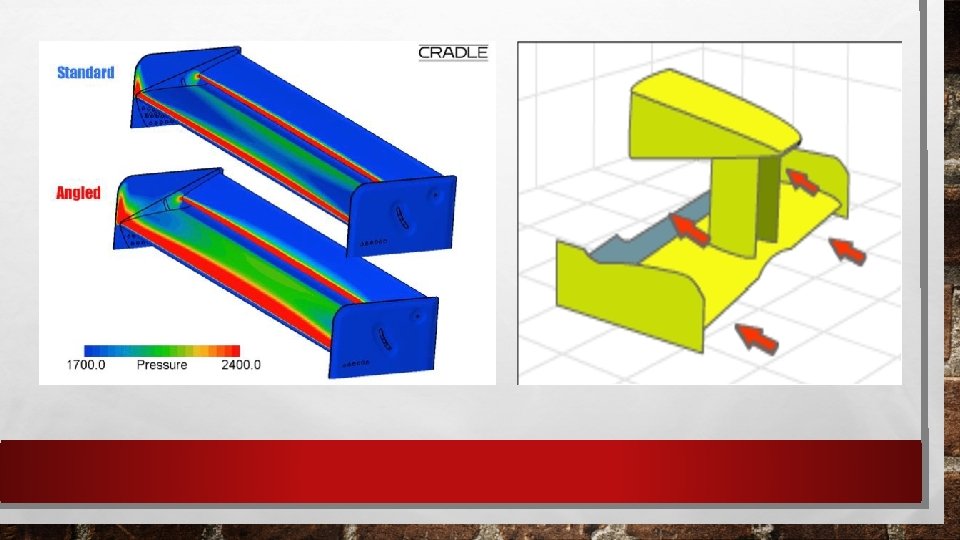
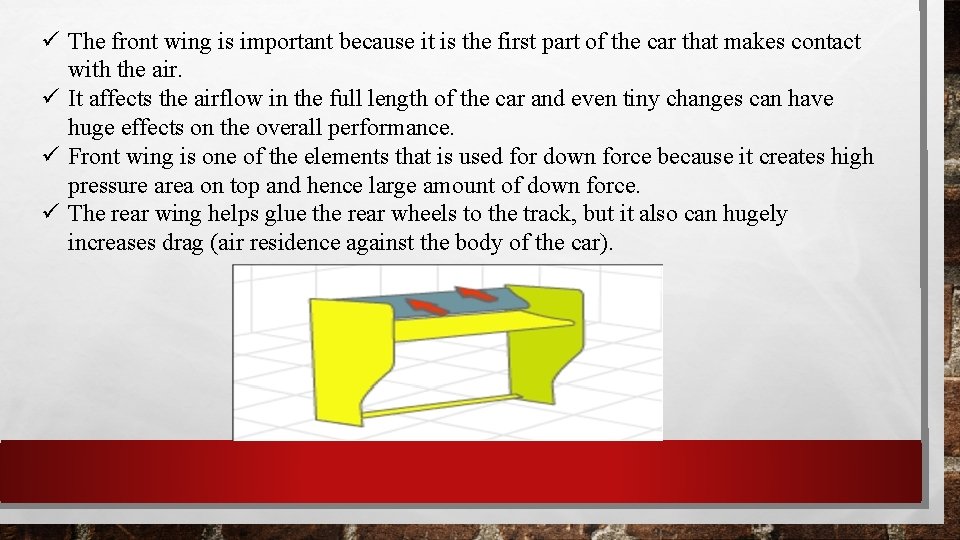
The front wing is important because it is the first part of the car that makes contact with the air. It affects the airflow in the full length of the car and even tiny changes can have huge effects on the overall performance. Front wing is one of the elements that is used for down force because it creates high pressure area on top and hence large amount of down force. The rear wing helps glue the rear wheels to the track, but it also can hugely increases drag (air residence against the body of the car).
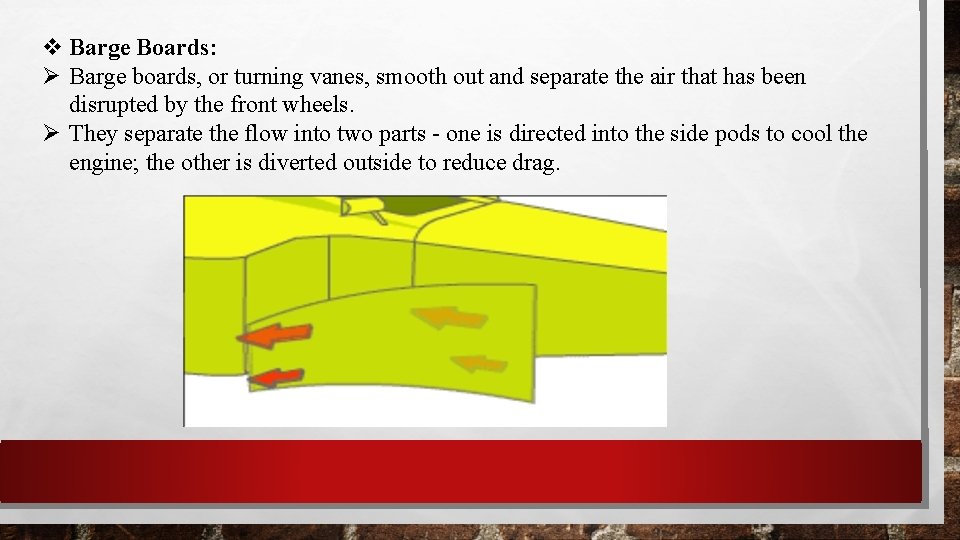
Barge Boards: Barge boards, or turning vanes, smooth out and separate the air that has been disrupted by the front wheels. They separate the flow into two parts - one is directed into the side pods to cool the engine; the other is diverted outside to reduce drag.
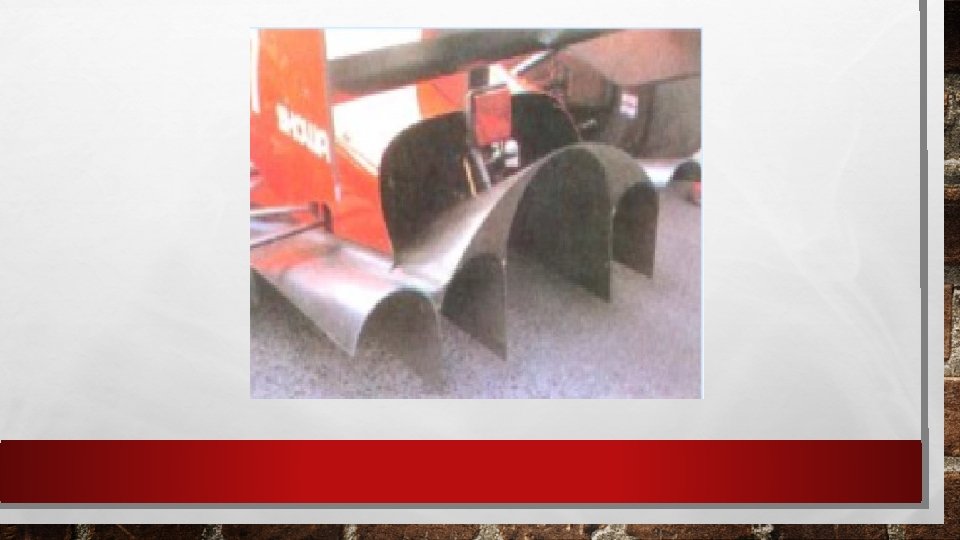
Wheels: Open-wheeled race car have a very complicated aerodynamics due to the large exposed wheels The flow behind wheels is completed separated Diffusers: The diffusers help to drive the low-pressure from beneath the car. The most common one is the upswept duct at the rear and below the bumper. The other type is located directly behind the splitter leading into the front wheels. Aerodynamically, both of these diffusers achieve the same thing i. e. minimising pressure under the car.

THANK YOU
- Slides: 42