
Automating Service Provisioning and Service Assurance with IntentBased
Automating Service Provisioning and Service Assurance with Intent-Based Networking Dr. John Strassner CTO and VP Network Strategy, Futurewei Technologies MEF Q 3/19 Members Meeting, July 2019
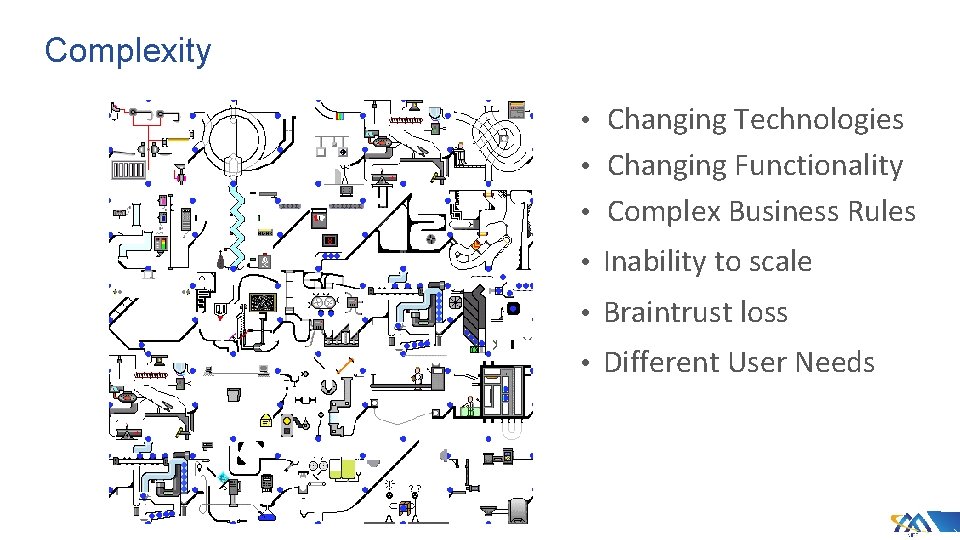
Complexity • Changing Technologies • Changing Functionality • Complex Business Rules • Inability to scale • Braintrust loss • Different User Needs
Definitions of Intent and AI/ML • Intent – Enables definition of business and technical abstractions that invoke network services and manage their behavior – Specified declaratively using a restricted form of a natural language. • AI – Machine-based intelligence in the service provider’s systems that contextually self-learns and provides rapid decisions in the form of policies for deployment of virtualized resources and reprogramming of networks. • Machine Learning – Machines in service provider’s systems that learn from acquired data on how to solve a problem more effectively so that AI can adapt policies accordingly.
Service Provider Motivations for Using Intent, AI and ML • Requirements changing ever more rapidly • Non-technical end-users want to define policies to control behavior • Products becoming increasingly customer-specific, complex and dynamic • Operators want more abstraction and power when defining network services • Rate of change of network conditions constantly increasing • Current mediation between user requirements and network configuration is too slow for rapidly changing user requirements • Application developers are limited by existing interfaces to build network services • Policy management is HARD and complex • Pre-defined and static APIs can’t be adapted fast enough to new situations
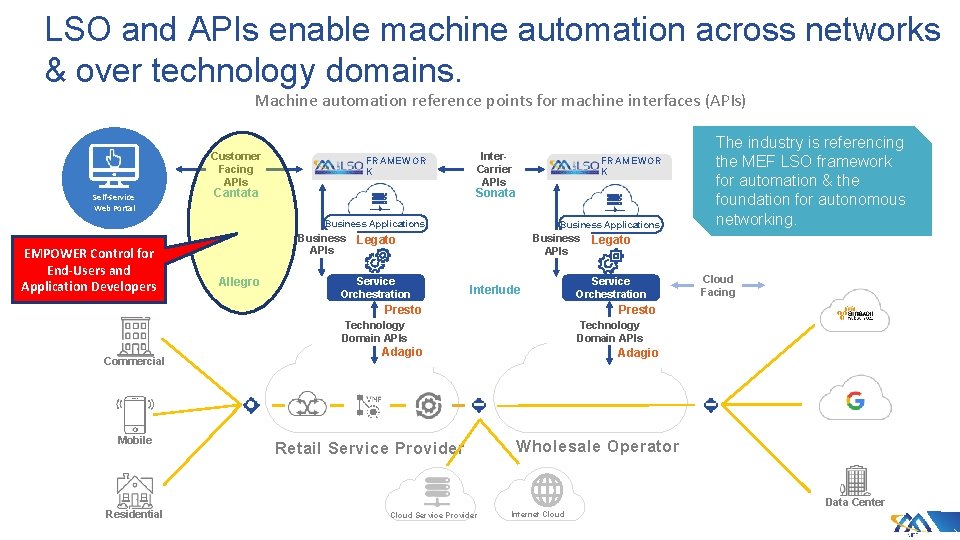
LSO and APIs enable machine automation across networks & over technology domains. Machine automation reference points for machine interfaces (APIs) Customer Facing APIs Self-service Web Portal FRAMEWOR K Cantata Inter. Carrier APIs FRAMEWOR K Sonata Business Applications EMPOWER Control for End-Users and Application Developers Business APIs Allegro Business Applications Business APIs Legato Service Orchestration Interlude Presto Mobile Residential Service Orchestration Cloud Facing Technology Domain APIs Adagio Retail Service Provider Legato Presto Technology Domain APIs Commercial The industry is referencing the MEF LSO framework for automation & the foundation for autonomous networking. Adagio Wholesale Operator Data Center Cloud Service Provider Internet Cloud
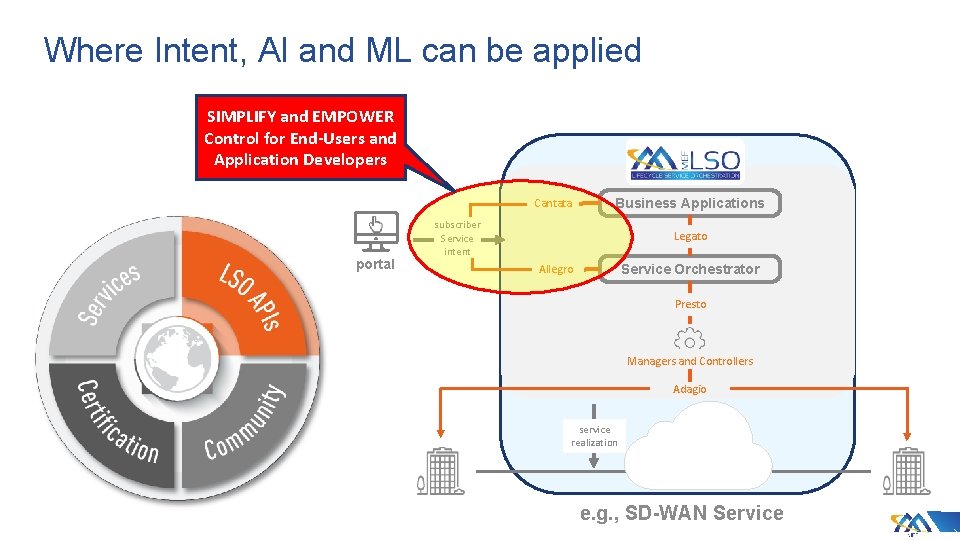
Where Intent, AI and ML can be applied SIMPLIFY and EMPOWER Control for End-Users and Application Developers Cantata portal Business Applications subscriber Service intent Legato Service Orchestrator Allegro Presto Managers Controllers WANand controller Adagio service realization e. g. , SD-WAN Service
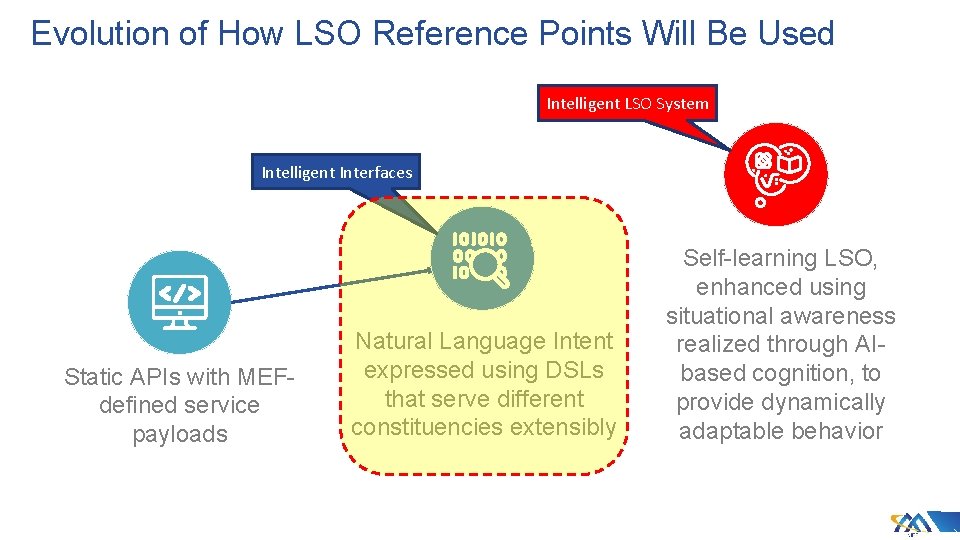
Evolution of How LSO Reference Points Will Be Used Intelligent LSO System Intelligent Interfaces Static APIs with MEFdefined service payloads Natural Language Intent expressed using DSLs that serve different constituencies extensibly Self-learning LSO, enhanced using situational awareness realized through AIbased cognition, to provide dynamically adaptable behavior
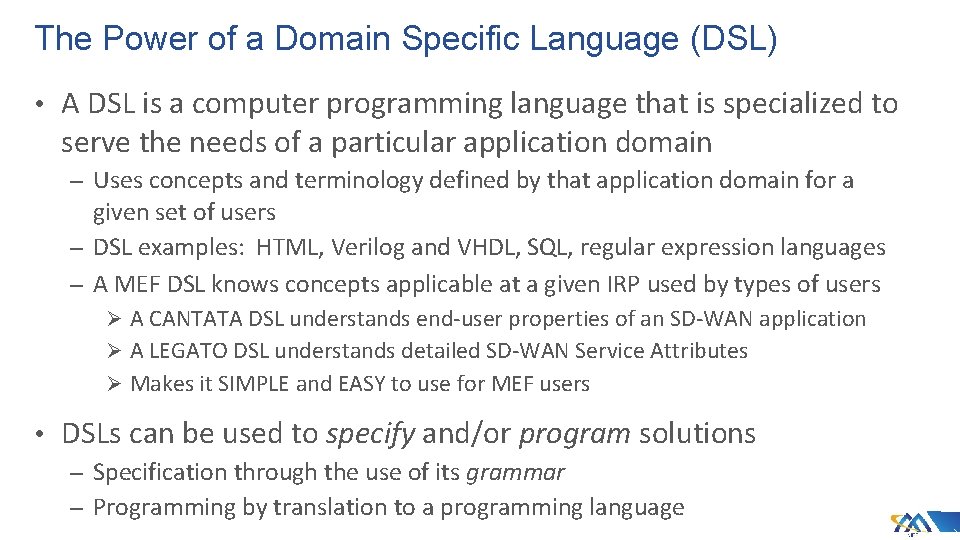
The Power of a Domain Specific Language (DSL) • A DSL is a computer programming language that is specialized to serve the needs of a particular application domain – Uses concepts and terminology defined by that application domain for a given set of users – DSL examples: HTML, Verilog and VHDL, SQL, regular expression languages – A MEF DSL knows concepts applicable at a given IRP used by types of users Ø A CANTATA DSL understands end-user properties of an SD-WAN application Ø A LEGATO DSL understands detailed SD-WAN Service Attributes Ø Makes it SIMPLE and EASY to use for MEF users • DSLs can be used to specify and/or program solutions – Specification through the use of its grammar – Programming by translation to a programming language
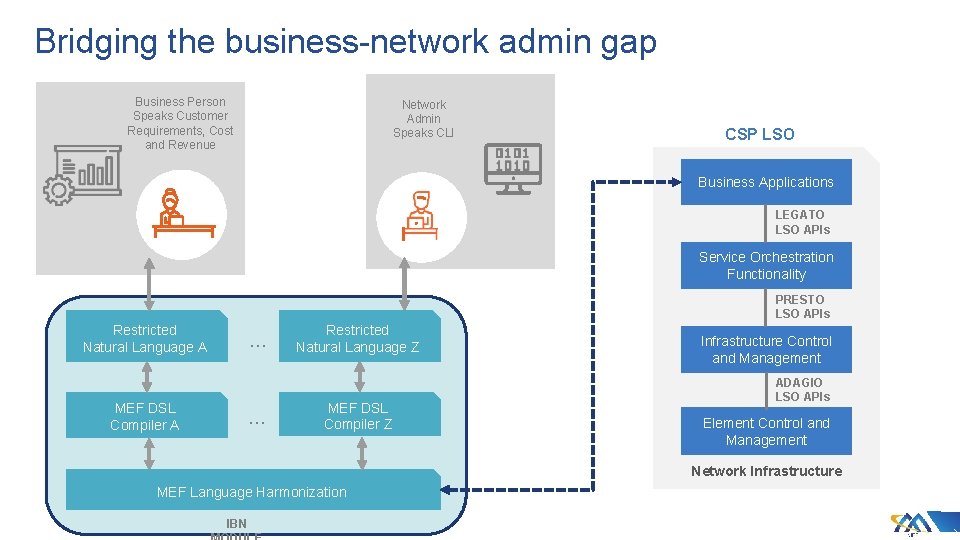
Bridging the business-network admin gap Business Person Speaks Customer Requirements, Cost and Revenue Network Admin Speaks CLI CSP LSO Business Applications LEGATO LSO APIs Service Orchestration Functionality PRESTO LSO APIs Restricted Natural Language A … MEF DSL Compiler A … Restricted Natural Language Z MEF DSL Compiler Z Infrastructure Control and Management ADAGIO LSO APIs Element Control and Management Network Infrastructure MEF Language Harmonization IBN
Example • “Skype for Business Performance is Mission Critical” – Ambiguous! – Skype – for Business Performance – is Mission Critical…or – Skype for Business – Performance is Mission Critical • Lexicon used to disambiguate the input – Recognizes “Skype for Business” is a type of application – Recognizes that “Mission Critical” is the highest level of Class of Service • The point of Intent is to help the user! – User should not need to know exact language or technical terms – Most users have not programmed a network device!
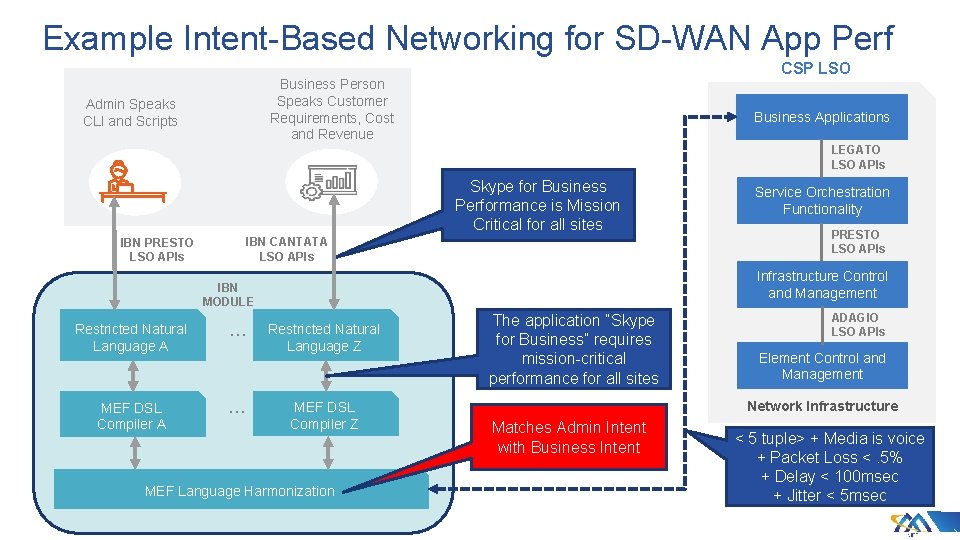
Example Intent-Based Networking for SD-WAN App Perf CSP LSO Business Person Speaks Customer Requirements, Cost and Revenue Admin Speaks CLI and Scripts Business Applications LEGATO LSO APIs Skype for Business Performance is Mission Critical for all sites IBN CANTATA LSO APIs IBN PRESTO LSO APIs … MEF DSL Compiler A … PRESTO LSO APIs Infrastructure Control and Management IBN MODULE Restricted Natural Language A Service Orchestration Functionality Restricted Natural Language Z MEF DSL Compiler Z MEF Language Harmonization The application “Skype for Business” requires mission-critical performance for all sites ADAGIO LSO APIs Element Control and Management Network Infrastructure Matches Admin Intent with Business Intent < 5 tuple> + Media is voice + Packet Loss <. 5% + Delay < 100 msec + Jitter < 5 msec
Parsing Overview • Recognize Named Entities – Text strings that belong to different classes of interest – Examples: People, Locations, Organizations, Products, Dates, Time • Disambiguate Text – Fundamental for understanding what the user meant! – Foundation for Information Extraction* to better understand context • Enables additional facts to be inferred • Customer has an SLA which maps to a Co. S for each App user can use… – Bank: financial institution vs aerial maneuver vs. part of water vs. support • Use a combination of open source tools to build custom software that understands MEF context • Named Entities mapped to Model classes, attributes, relationships * the automatic identification of selected types of entities, relations, or events in free text
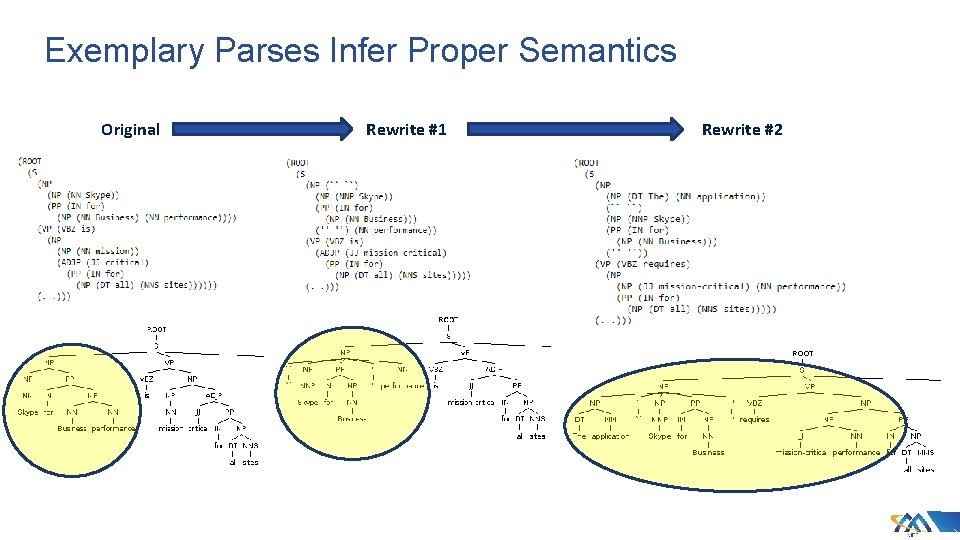
Exemplary Parses Infer Proper Semantics Original Rewrite #1 Rewrite #2
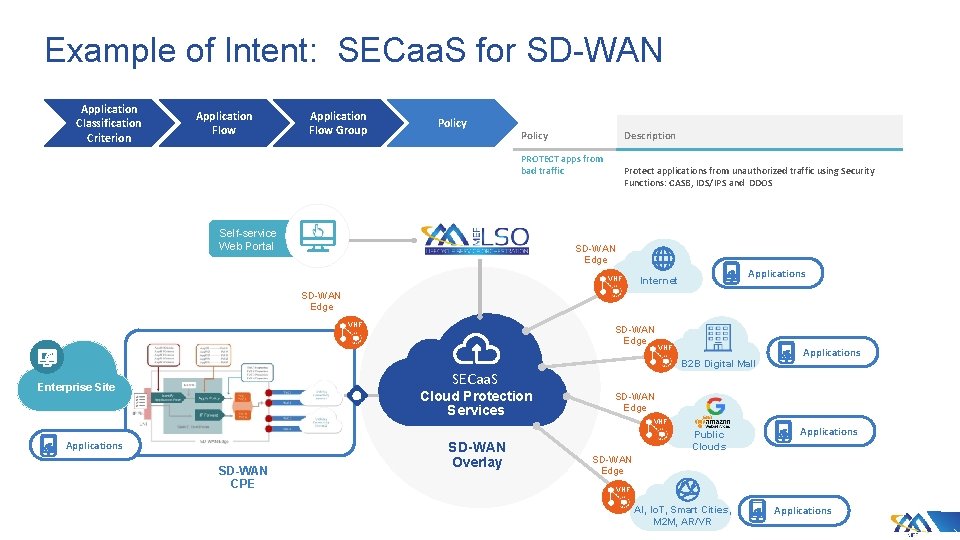
Example of Intent: SECaa. S for SD-WAN Application Classification Criterion Application Flow Group Policy Description PROTECT apps from bad traffic Self-service Web Portal Protect applications from unauthorized traffic using Security Functions: CASB, IDS/IPS and DDOS SD-WAN Edge VNF Applications Internet SD-WAN Edge VNF B 2 B Digital Mall SECaa. S Enterprise Site Cloud Protection Services Applications SD-WAN CPE SD-WAN Overlay Applications SD-WAN Edge VNF Public Clouds Applications SD-WAN Edge VNF AI, Io. T, Smart Cities, M 2 M, AR/VR Applications
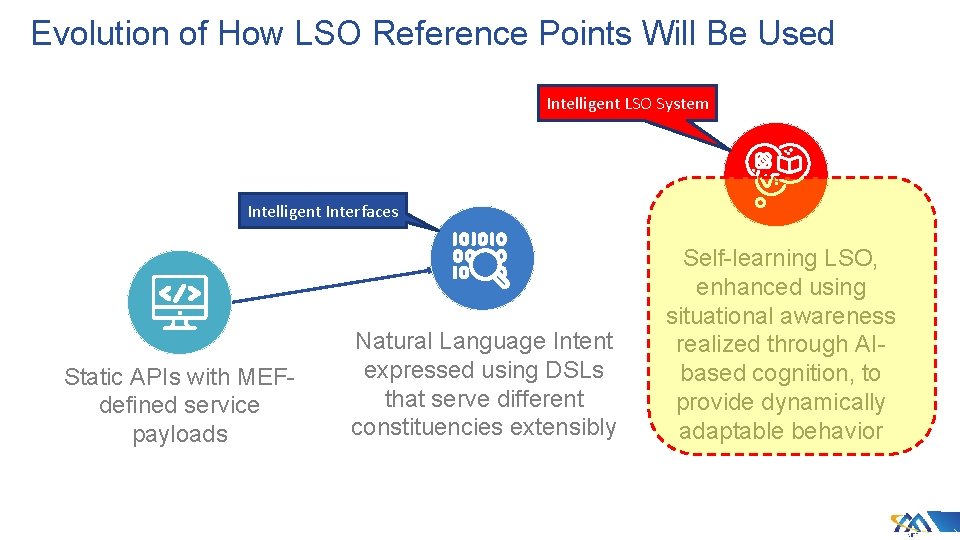
Evolution of How LSO Reference Points Will Be Used Intelligent LSO System Intelligent Interfaces Static APIs with MEFdefined service payloads Natural Language Intent expressed using DSLs that serve different constituencies extensibly Self-learning LSO, enhanced using situational awareness realized through AIbased cognition, to provide dynamically adaptable behavior
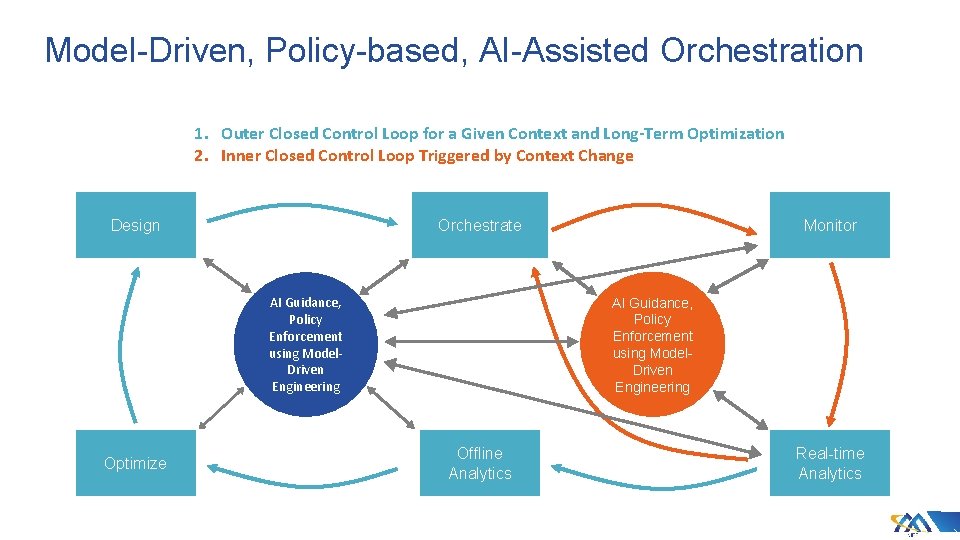
Model-Driven, Policy-based, AI-Assisted Orchestration 1. Outer Closed Control Loop for a Given Context and Long-Term Optimization 2. Inner Closed Control Loop Triggered by Context Change Design Orchestrate AI Guidance, Policy Enforcement using Model. Driven Engineering Optimize Monitor AI Guidance, Policy Enforcement using Model. Driven Engineering Offline Analytics Real-time Analytics
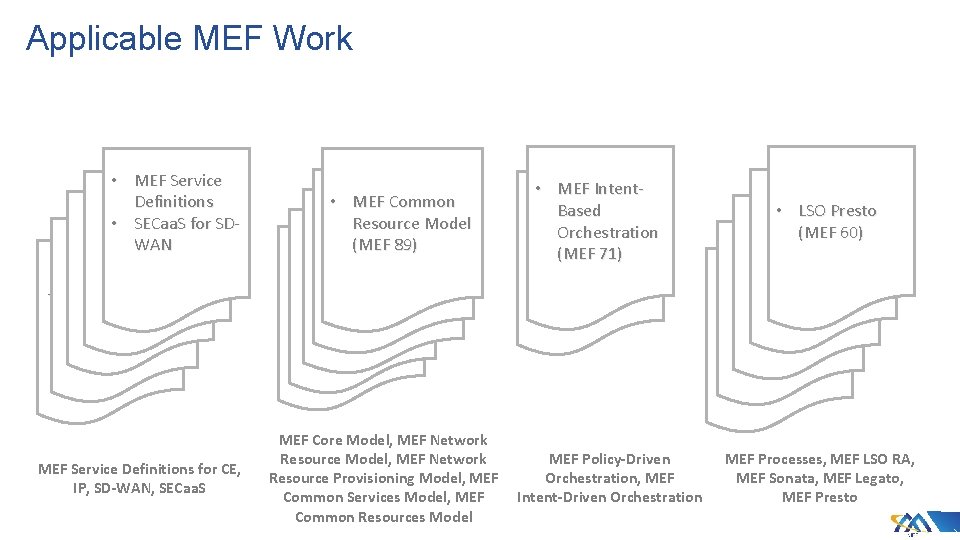
Applicable MEF Work • MEF Service Definitions MEF • Service SECaa. S for SDOptical Definitions WAN MEF Service Transport MEF- SD-WAN Service Definitions (MEF Definitions 70)63) - Carrier (MEF Ethernet - IP (MEF 61) (MEF 6. x; MEF 51. x; MEF 10. x; MEF 26. x) MEF Service Definitions for CE, IP, SD-WAN, SECaa. S • MEF Common Resource Model • • MEF Network Services Model (MEF 89) MEF Network Resource (MEFModels 82) Resource Provisioning MEF Core Model (MEF 59) (MEF 78) 60) (MEF Core Model, MEF Network Resource Provisioning Model, MEF Common Services Model, MEF Common Resources Model • MEF Intent. Based MEFOrchestration Policy Driven Orchestration (MEF 71) (MEF 85) MEF Policy-Driven Orchestration, MEF Intent-Driven Orchestration • LSO Presto (MEF 60) LSO Sonata 57) LSO(MEF Legato Lifecycle Service (MEF 56) Orchestration (MEF 55) MEF 50 Processes MEF Processes, MEF LSO RA, MEF Sonata, MEF Legato, MEF Presto
Automating Service Provisioning and Service Assurance with Intent-Based Networking Dr. John Strassner CTO and VP Network Strategy, Futurewei Technologies MEF Q 3/19 Members Meeting, July 2019
- Slides: 18