
Automating Assessment and Feedback for Teamwork to Operationalize
Automating Assessment and Feedback for Teamwork to Operationalize Team Functional Resilience J. T. Folsom-Kovarik, Ph. D. Soar Technology, Inc. Anne M. Sinatra, Ph. D. U. S. Army Combat Capabilities Development Command (CCDC) – Soldier Center – Simulation and Training Technology Center (STTC) 8 th GIFT Symposium, 29 May 2020
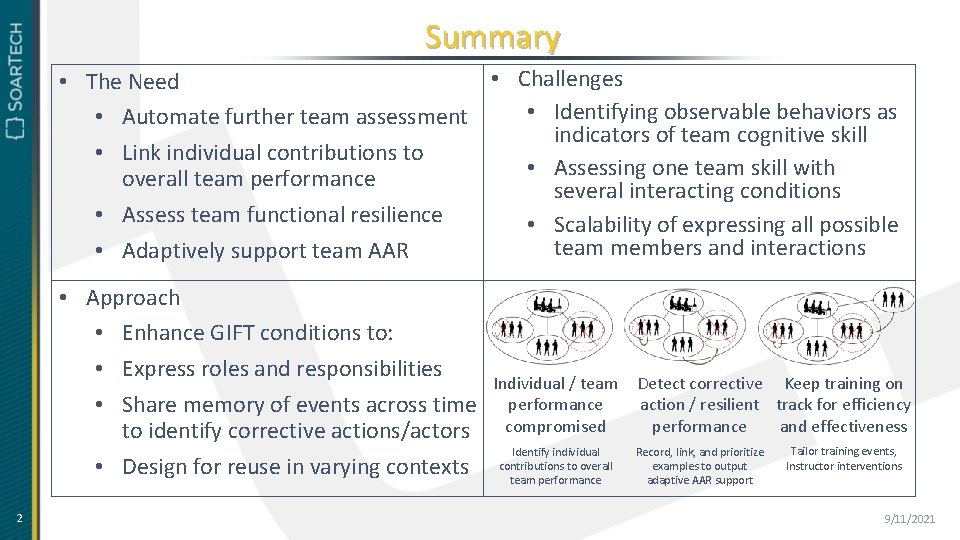
Summary • Challenges • The Need • Identifying observable behaviors as • Automate further team assessment indicators of team cognitive skill • Link individual contributions to • Assessing one team skill with overall team performance several interacting conditions • Assess team functional resilience • Scalability of expressing all possible team members and interactions • Adaptively support team AAR • Approach • Enhance GIFT conditions to: • Express roles and responsibilities • Share memory of events across time to identify corrective actions/actors • Design for reuse in varying contexts 2 Individual / team performance compromised Identify individual contributions to overall team performance Detect corrective Keep training on action / resilient track for efficiency performance and effectiveness Record, link, and prioritize examples to output adaptive AAR support Tailor training events, Instructor interventions 9/11/2021
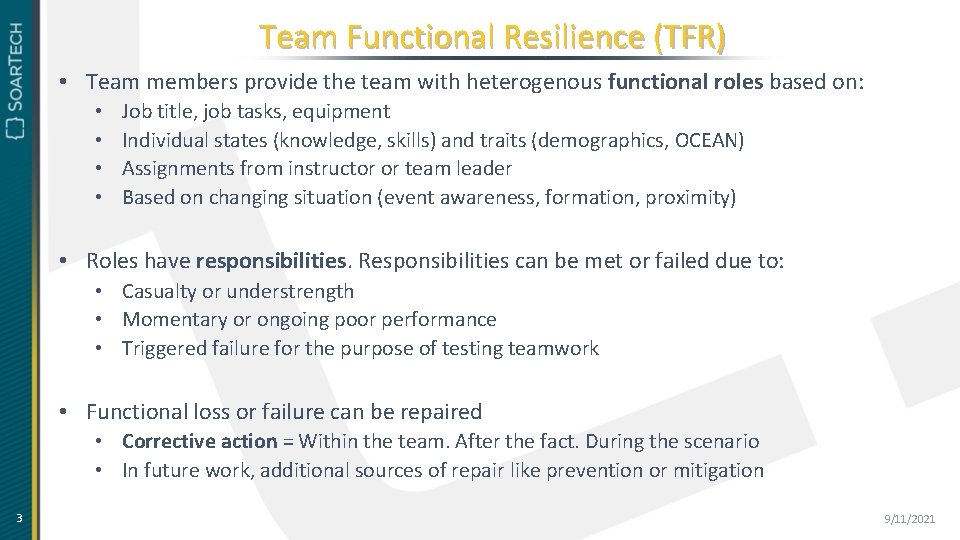
Team Functional Resilience (TFR) • Team members provide the team with heterogenous functional roles based on: • • Job title, job tasks, equipment Individual states (knowledge, skills) and traits (demographics, OCEAN) Assignments from instructor or team leader Based on changing situation (event awareness, formation, proximity) • Roles have responsibilities. Responsibilities can be met or failed due to: • Casualty or understrength • Momentary or ongoing poor performance • Triggered failure for the purpose of testing teamwork • Functional loss or failure can be repaired • Corrective action = Within the team. After the fact. During the scenario • In future work, additional sources of repair like prevention or mitigation 3 9/11/2021
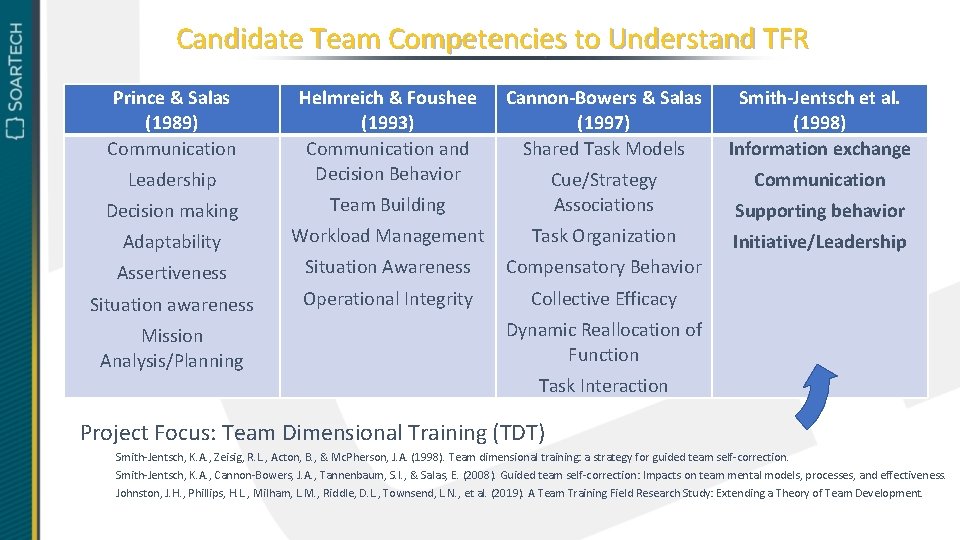
Candidate Team Competencies to Understand TFR Prince & Salas (1989) Communication Leadership Helmreich & Foushee (1993) Communication and Decision Behavior Decision making Team Building Cue/Strategy Associations Adaptability Workload Management Task Organization Assertiveness Situation Awareness Compensatory Behavior Situation awareness Operational Integrity Collective Efficacy Mission Analysis/Planning Cannon-Bowers & Salas (1997) Shared Task Models Smith-Jentsch et al. (1998) Information exchange Communication Supporting behavior Initiative/Leadership Dynamic Reallocation of Function Task Interaction Project Focus: Team Dimensional Training (TDT) Smith-Jentsch, K. A. , Zeisig, R. L. , Acton, B. , & Mc. Pherson, J. A. (1998). Team dimensional training: a strategy for guided team self-correction. Smith-Jentsch, K. A. , Cannon-Bowers, J. A. , Tannenbaum, S. I. , & Salas, E. (2008). Guided team self-correction: Impacts on team mental models, processes, and effectiveness. Johnston, J. H. , Phillips, H. L. , Milham, L. M. , Riddle, D. L. , Townsend, L. N. , et al. (2019). A Team Training Field Research Study: Extending a Theory of Team Development.

Linking Individual Contributions to Team Performance Team Competency Information Exchange Individual Contribution Domain-specific Observation Time from role failure to role replacement Team member in compromised role Actions indicating compromise Replacing team member Actions indicating role replacement “Is expressed by” Domain-general Measure Initiative / Leadership
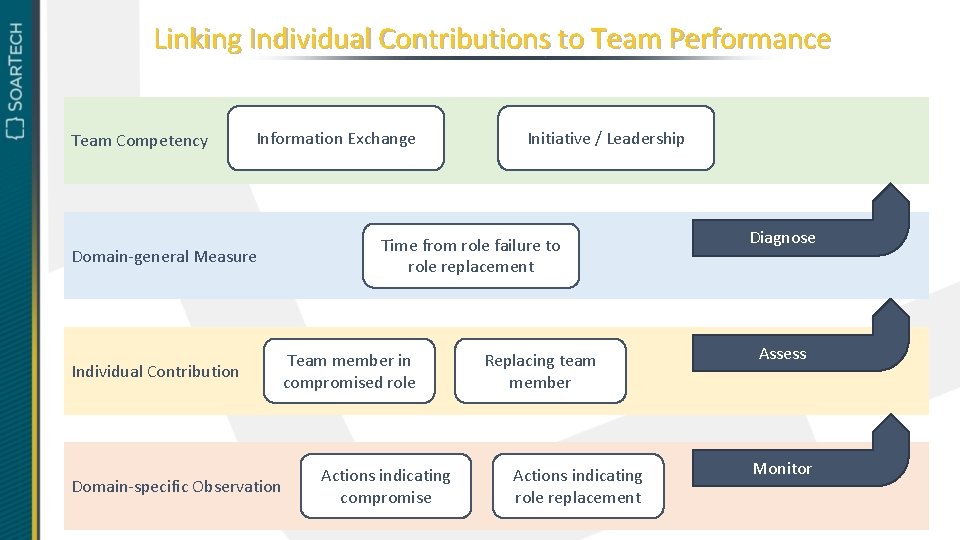
Linking Individual Contributions to Team Performance Team Competency Information Exchange Domain-general Measure Individual Contribution Domain-specific Observation Initiative / Leadership Time from role failure to role replacement Team member in compromised role Actions indicating compromise Replacing team member Actions indicating role replacement Diagnose Assess Monitor
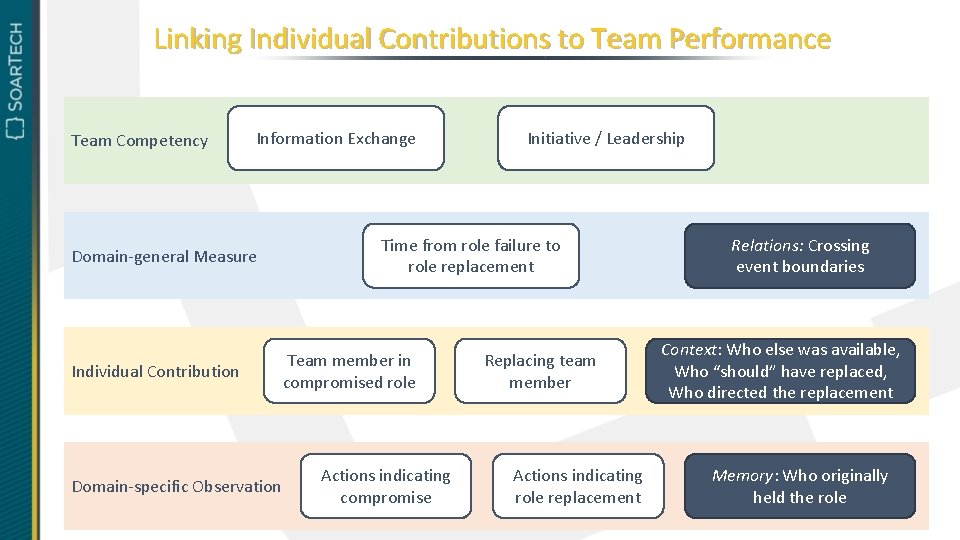
Linking Individual Contributions to Team Performance Team Competency Information Exchange Domain-general Measure Individual Contribution Domain-specific Observation Initiative / Leadership Time from role failure to role replacement Team member in compromised role Actions indicating compromise Replacing team member Actions indicating role replacement Relations: Crossing event boundaries Context: Who else was available, Who “should” have replaced, Who directed the replacement Memory: Who originally held the role
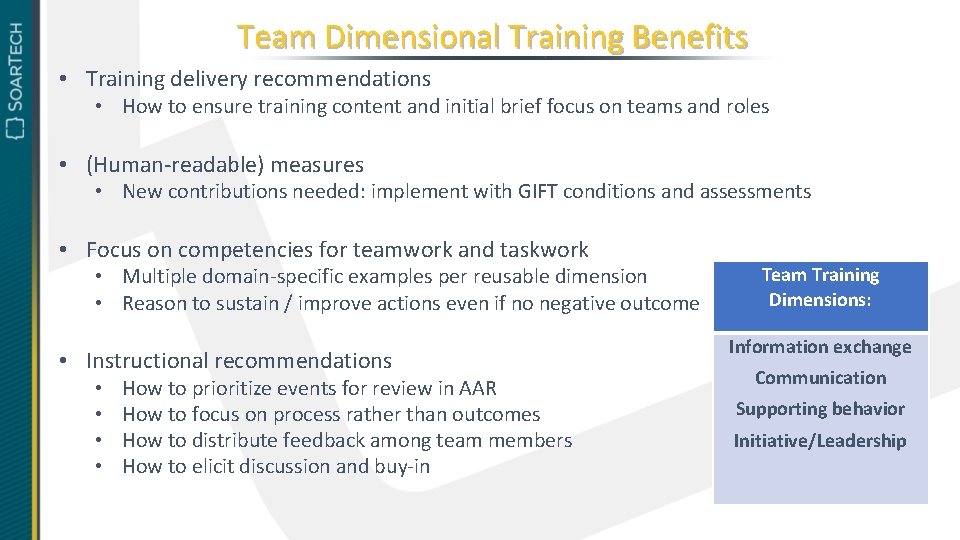
Team Dimensional Training Benefits • Training delivery recommendations • How to ensure training content and initial brief focus on teams and roles • (Human-readable) measures • New contributions needed: implement with GIFT conditions and assessments • Focus on competencies for teamwork and taskwork • Multiple domain-specific examples per reusable dimension • Reason to sustain / improve actions even if no negative outcome • Instructional recommendations • • How to prioritize events for review in AAR How to focus on process rather than outcomes How to distribute feedback among team members How to elicit discussion and buy-in Team Training Dimensions: Information exchange Communication Supporting behavior Initiative/Leadership
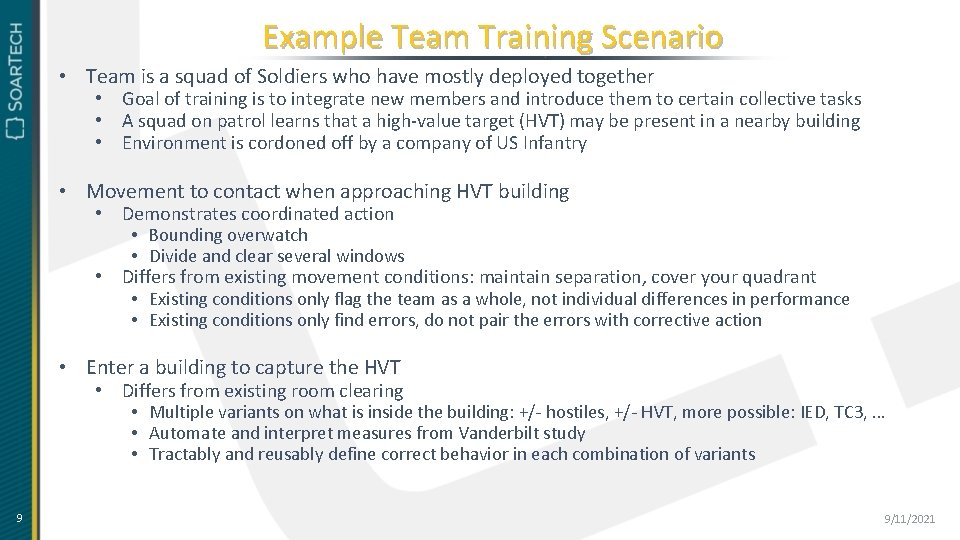
Example Team Training Scenario • Team is a squad of Soldiers who have mostly deployed together • Goal of training is to integrate new members and introduce them to certain collective tasks • A squad on patrol learns that a high-value target (HVT) may be present in a nearby building • Environment is cordoned off by a company of US Infantry • Movement to contact when approaching HVT building • Demonstrates coordinated action • Bounding overwatch • Divide and clear several windows • Differs from existing movement conditions: maintain separation, cover your quadrant • Existing conditions only flag the team as a whole, not individual differences in performance • Existing conditions only find errors, do not pair the errors with corrective action • Enter a building to capture the HVT • Differs from existing room clearing • Multiple variants on what is inside the building: +/- hostiles, +/- HVT, more possible: IED, TC 3, … • Automate and interpret measures from Vanderbilt study • Tractably and reusably define correct behavior in each combination of variants 9 9/11/2021
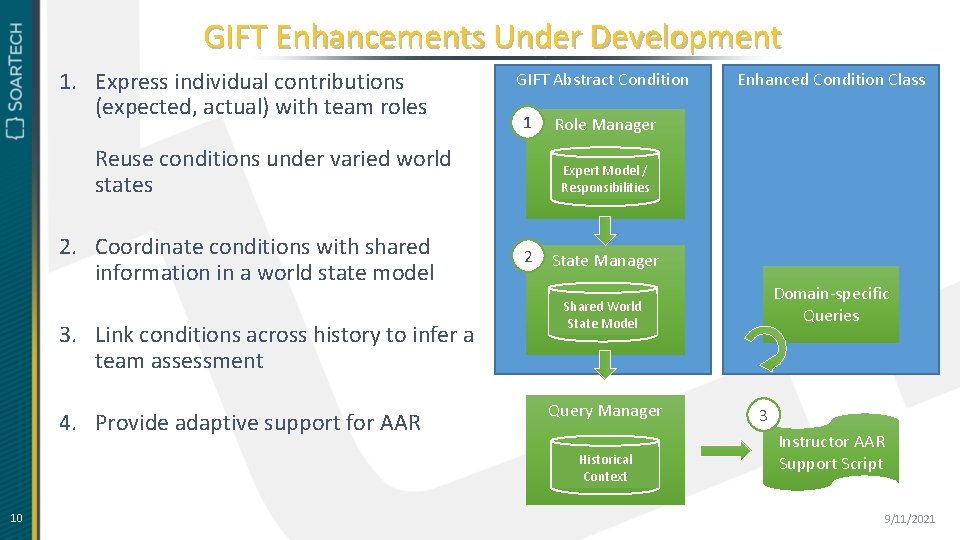
GIFT Enhancements Under Development 1. Express individual contributions (expected, actual) with team roles GIFT Abstract Condition 1 Reuse conditions under varied world states 2. Coordinate conditions with shared information in a world state model 3. Link conditions across history to infer a team assessment 4. Provide adaptive support for AAR Role Manager Expert Model / Responsibilities 2 State Manager Domain-specific Queries Shared World State Model Query Manager Historical Context 10 Enhanced Condition Class 3 Instructor AAR Support Script 9/11/2021
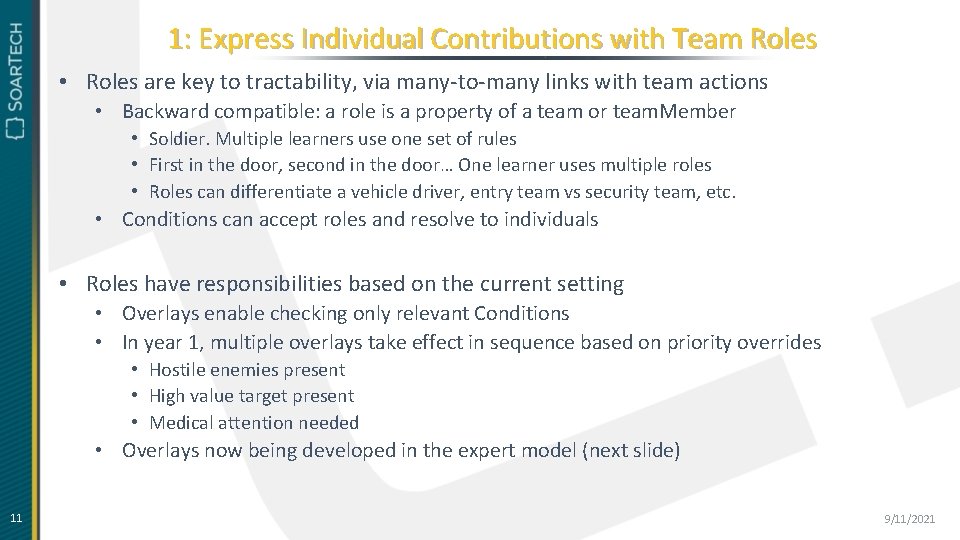
1: Express Individual Contributions with Team Roles • Roles are key to tractability, via many-to-many links with team actions • Backward compatible: a role is a property of a team or team. Member • Soldier. Multiple learners use one set of rules • First in the door, second in the door… One learner uses multiple roles • Roles can differentiate a vehicle driver, entry team vs security team, etc. • Conditions can accept roles and resolve to individuals • Roles have responsibilities based on the current setting • Overlays enable checking only relevant Conditions • In year 1, multiple overlays take effect in sequence based on priority overrides • Hostile enemies present • High value target present • Medical attention needed • Overlays now being developed in the expert model (next slide) 11 9/11/2021
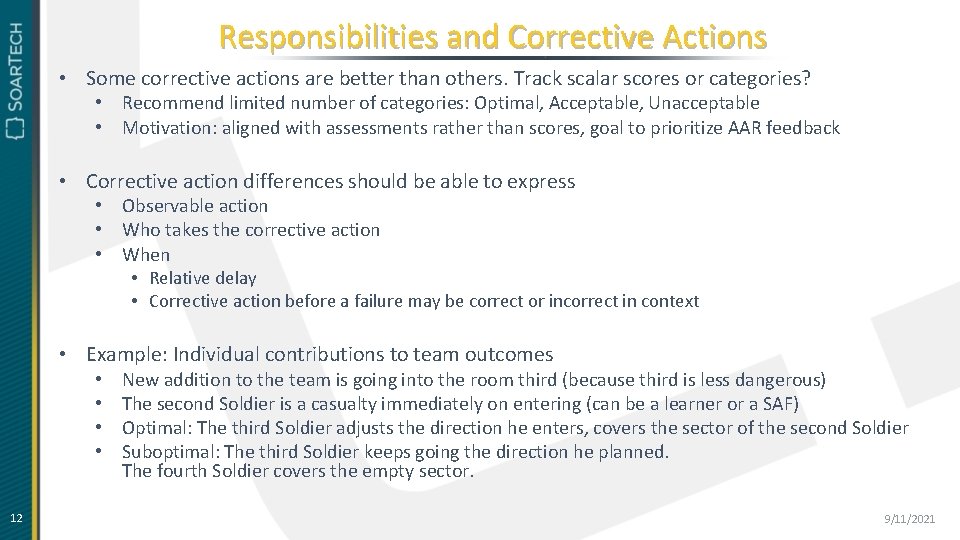
Responsibilities and Corrective Actions • Some corrective actions are better than others. Track scalar scores or categories? • Recommend limited number of categories: Optimal, Acceptable, Unacceptable • Motivation: aligned with assessments rather than scores, goal to prioritize AAR feedback • Corrective action differences should be able to express • Observable action • Who takes the corrective action • When • Relative delay • Corrective action before a failure may be correct or incorrect in context • Example: Individual contributions to team outcomes • • 12 New addition to the team is going into the room third (because third is less dangerous) The second Soldier is a casualty immediately on entering (can be a learner or a SAF) Optimal: The third Soldier adjusts the direction he enters, covers the sector of the second Soldier Suboptimal: The third Soldier keeps going the direction he planned. The fourth Soldier covers the empty sector. 9/11/2021
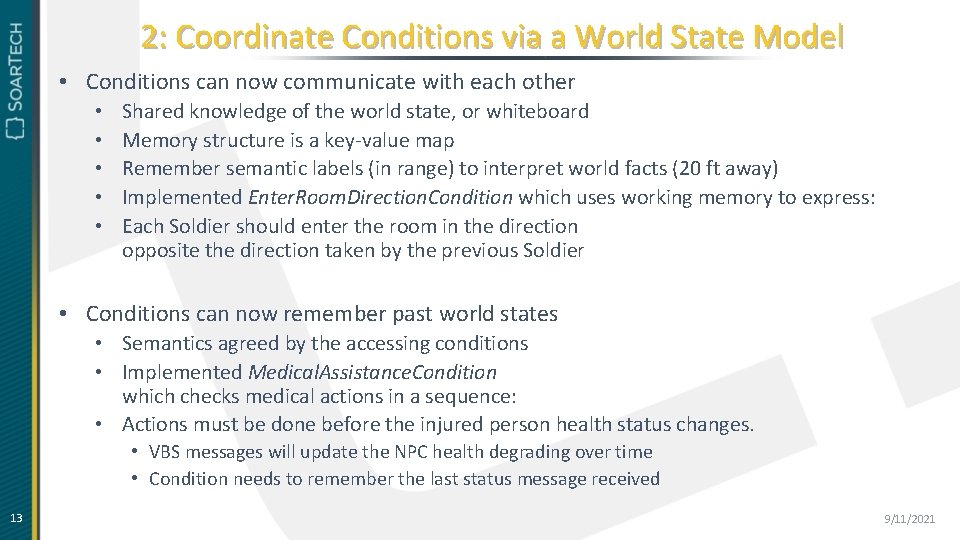
2: Coordinate Conditions via a World State Model • Conditions can now communicate with each other • • • Shared knowledge of the world state, or whiteboard Memory structure is a key-value map Remember semantic labels (in range) to interpret world facts (20 ft away) Implemented Enter. Room. Direction. Condition which uses working memory to express: Each Soldier should enter the room in the direction opposite the direction taken by the previous Soldier • Conditions can now remember past world states • Semantics agreed by the accessing conditions • Implemented Medical. Assistance. Condition which checks medical actions in a sequence: • Actions must be done before the injured person health status changes. • VBS messages will update the NPC health degrading over time • Condition needs to remember the last status message received 13 9/11/2021
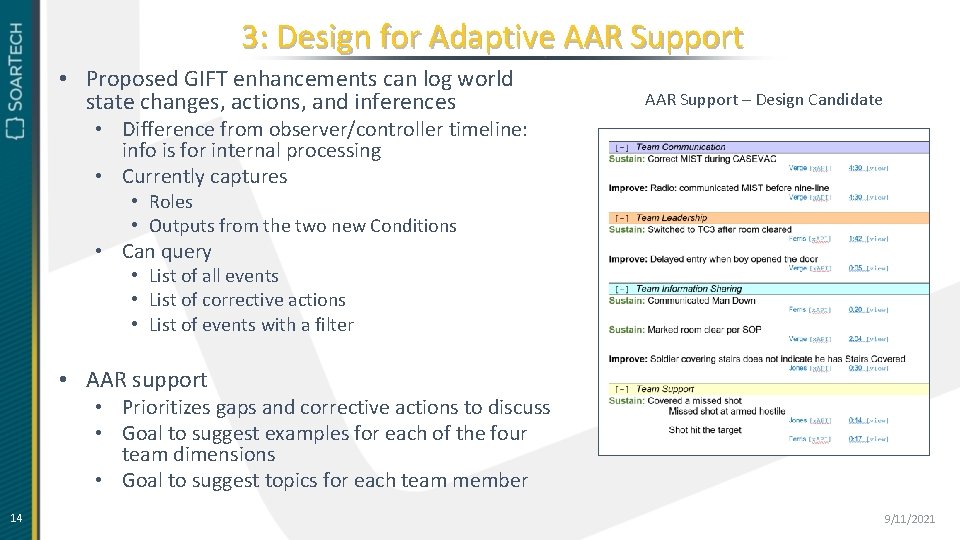
3: Design for Adaptive AAR Support • Proposed GIFT enhancements can log world state changes, actions, and inferences AAR Support – Design Candidate • Difference from observer/controller timeline: info is for internal processing • Currently captures • Roles • Outputs from the two new Conditions • Can query • List of all events • List of corrective actions • List of events with a filter • AAR support • Prioritizes gaps and corrective actions to discuss • Goal to suggest examples for each of the four team dimensions • Goal to suggest topics for each team member 14 9/11/2021
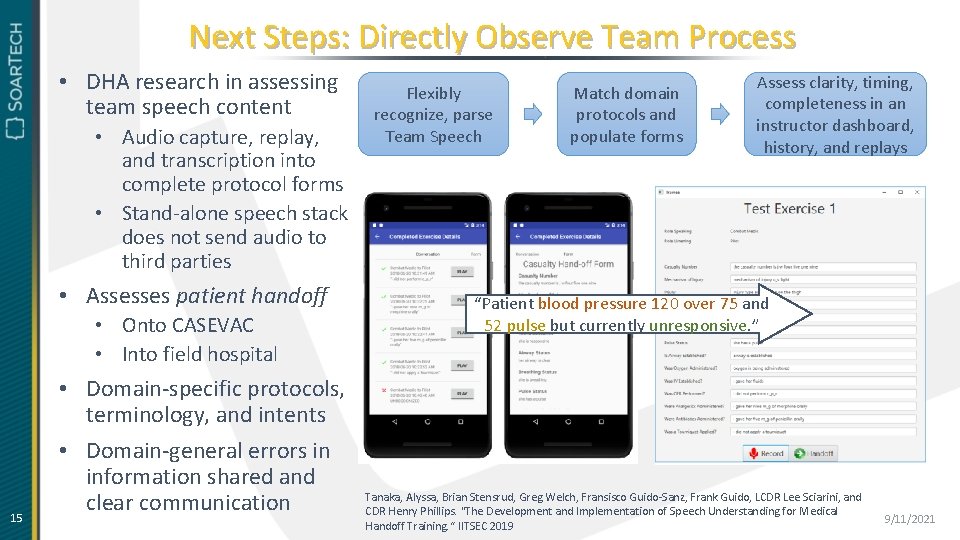
Next Steps: Directly Observe Team Process • DHA research in assessing team speech content • Audio capture, replay, and transcription into complete protocol forms • Stand-alone speech stack does not send audio to third parties • Assesses patient handoff • Onto CASEVAC • Into field hospital 15 • Domain-specific protocols, terminology, and intents • Domain-general errors in information shared and clear communication Flexibly recognize, parse Team Speech Match domain protocols and populate forms Assess clarity, timing, completeness in an instructor dashboard, history, and replays “Patient blood pressure 120 over 75 and 52 pulse but currently unresponsive. ” Tanaka, Alyssa, Brian Stensrud, Greg Welch, Fransisco Guido-Sanz, Frank Guido, LCDR Lee Sciarini, and CDR Henry Phillips. "The Development and Implementation of Speech Understanding for Medical Handoff Training. “ IITSEC 2019 9/11/2021
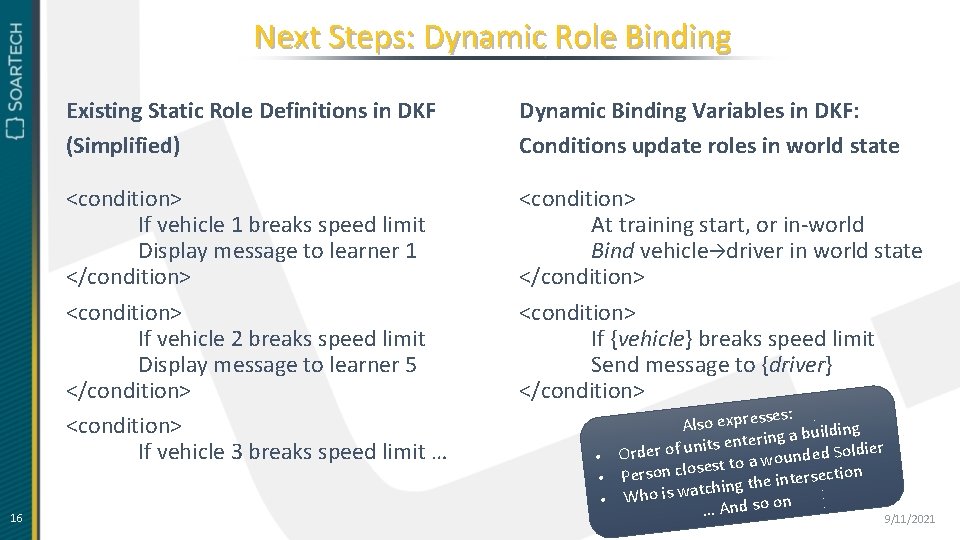
Next Steps: Dynamic Role Binding 16 Existing Static Role Definitions in DKF (Simplified) Dynamic Binding Variables in DKF: Conditions update roles in world state <condition> If vehicle 1 breaks speed limit Display message to learner 1 </condition> <condition> If vehicle 2 breaks speed limit Display message to learner 5 </condition> <condition> If vehicle 3 breaks speed limit … <condition> At training start, or in-world Bind vehicle driver in world state </condition> <condition> If {vehicle} breaks speed limit Send message to {driver} </condition> ses: Also expres uilding b a g in r e t n units e d Soldier e d n • Order of u o w a losest to c n o s r e P rsection e t • in e h t g atchin • Who is w n … And so o 9/11/2021
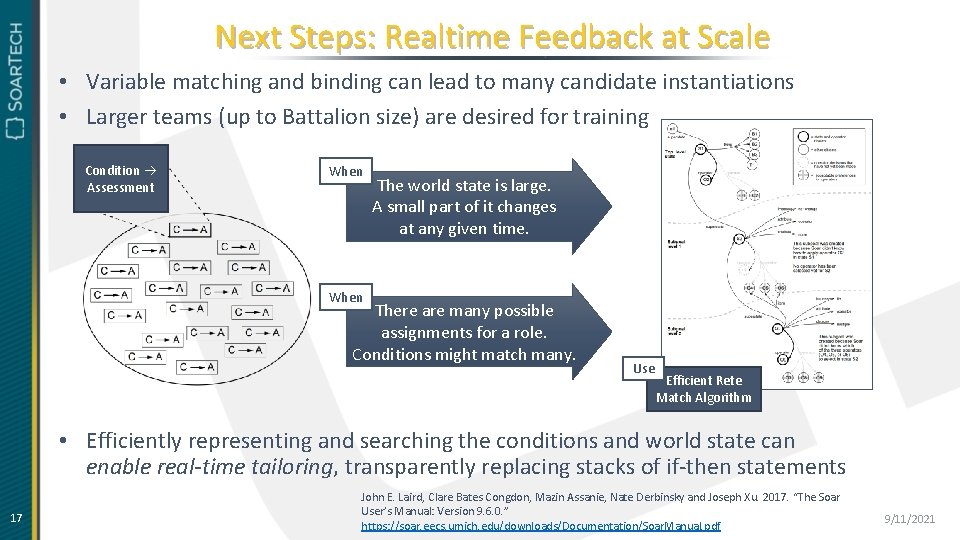
Next Steps: Realtime Feedback at Scale • Variable matching and binding can lead to many candidate instantiations • Larger teams (up to Battalion size) are desired for training Condition Assessment When The world state is large. A small part of it changes at any given time. When There are many possible assignments for a role. Conditions might match many. Use Efficient Rete Match Algorithm • Efficiently representing and searching the conditions and world state can enable real-time tailoring, transparently replacing stacks of if-then statements 17 John E. Laird, Clare Bates Congdon, Mazin Assanie, Nate Derbinsky and Joseph Xu. 2017. “The Soar User’s Manual: Version 9. 6. 0. ” https: //soar. eecs. umich. edu/downloads/Documentation/Soar. Manual. pdf 9/11/2021
Conclusions • • • Assess team functional resilience and provide principled, adaptive AAR support Link individual contributions to team performance, across GIFT conditions Automate team assessment for some technically challenging domain expressions Proposed enhancements aim to make DKF authoring more scalable and reusable Invite discussion as the proof of concept is implemented and demonstrated • Questions? J. T. Folsom-Kovarik Senior Scientist Soar Technology, Inc. Jeremiah@soartech. com The research reported in this document/presentation was performed in connection with contract number W 912 CG-19 -C-0009 with the U. S. Army Contracting Command - Aberdeen Proving Ground (ACC-APG). The views and conclusions contained in this document/presentation are those of the authors and should not be interpreted as presenting the official policies or position, either expressed or implied, of ACC-APG, CCDC-SC STTC or the U. S. Government unless so designated by other authorized documents. Citation of manufacturer's or trade names does not constitute an official endorsement or approval of the use thereof. The U. S. Government is authorized to reproduce and distribute reprints for Government purposes notwithstanding any copyright notation hereon. 18 9/11/2021
- Slides: 18