
Automatic Suggestion of QueryRewrite Rules for Enterprise Search




- Slides: 29
Automatic Suggestion of Query-Rewrite Rules for Enterprise Search Date : 2013/08/13 Source : SIGIR’ 12 Authors : Zhuowei Bao, Benny Kimelfeld , Yunyao Li Advisor : Dr. Jia-ling, Koh Speaker : Shun-Chen, Cheng
Outline �Introduction �Recognizing Nature Rules �Optimizing Multi-Rules Selection �Experiments �Conclusions
Outline �Introduction �Recognizing Nature Rules �Optimizing Multi-Rules Selection �Experiments �Conclusions
Introduction l Enterprise Search index data and documents from a variety of sources such as: file systems, intranets, document management systems, e-mail, and databases. Ø integrate structured and unstructured data in their collections. Ø dynamic terminology and jargon that are specific to the enterprise domain. Ø domain experts maintaining
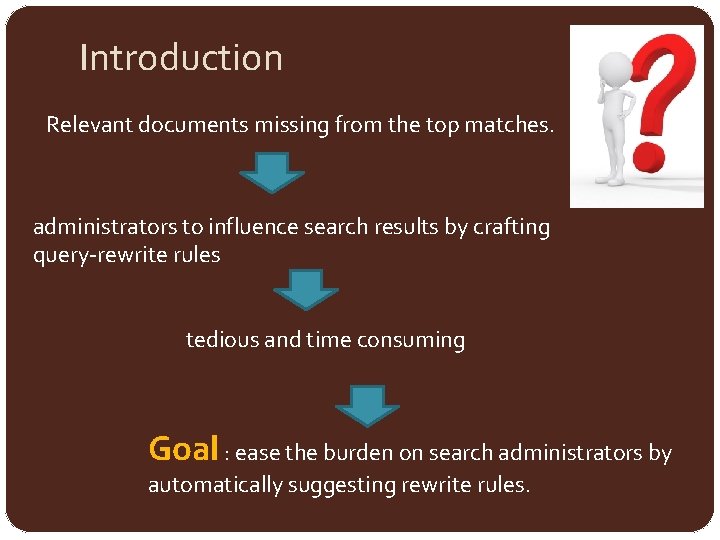
Introduction Relevant documents missing from the top matches. administrators to influence search results by crafting query-rewrite rules tedious and time consuming Goal : ease the burden on search administrators by automatically suggesting rewrite rules.
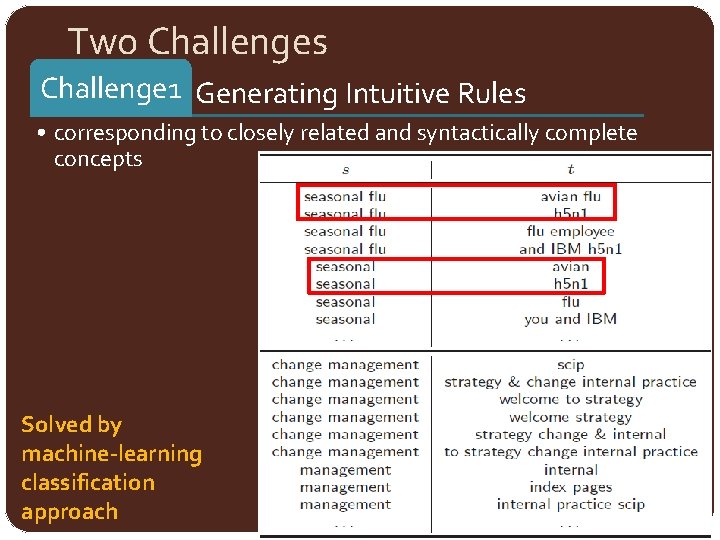
Two Challenges Challenge 1 Generating Intuitive Rules • corresponding to closely related and syntactically complete concepts Solved by machine-learning classification approach
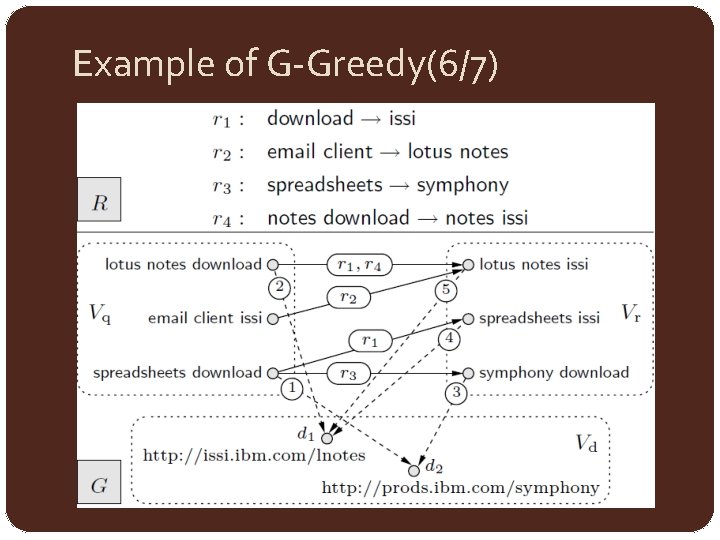
Challenge 2 Cross-Query Effect Query 1 : spreadsheets download -> r 3 -> symphony download -> d 2 on top match Query 1 -> r 1 -> spreadsheets issi -> pushing d 2 below d 1. Propose a heuristic approaches and optimization thereof
Outline �Introduction �Recognizing Nature Rules �Optimizing Multi-Rules Selection �Experiments �Conclusions
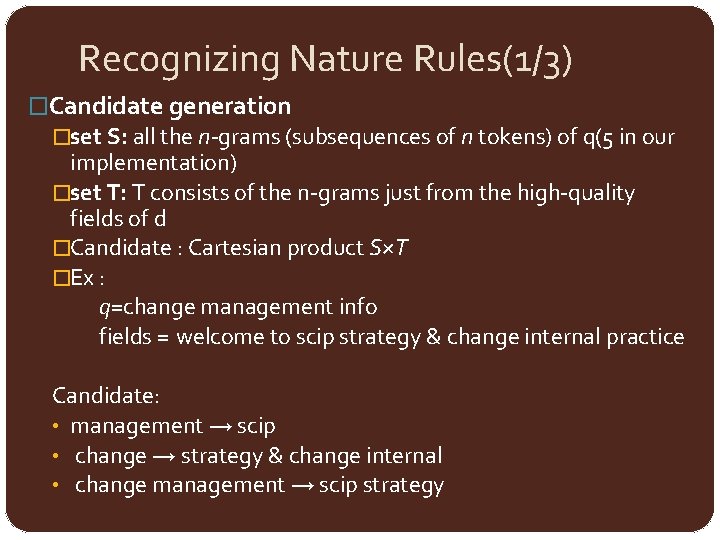
Recognizing Nature Rules(1/3) �Candidate generation �set S: all the n-grams (subsequences of n tokens) of q(5 in our implementation) �set T: T consists of the n-grams just from the high-quality fields of d �Candidate : Cartesian product S×T �Ex : q=change management info fields = welcome to scip strategy & change internal practice Candidate: • management → scip • change → strategy & change internal • change management → scip strategy
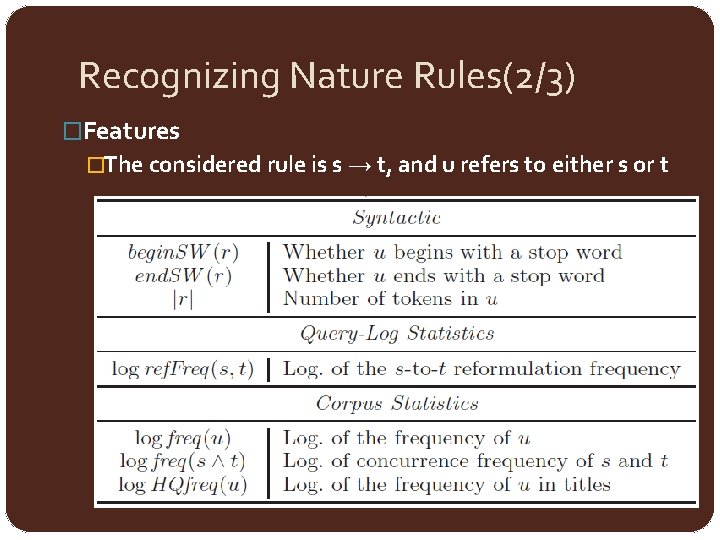
Recognizing Nature Rules(2/3) �Features �The considered rule is s → t, and u refers to either s or t
Recognizing Nature Rules(3/3) �Classification models �SVM �Decision Tree with linear-combination splits(r. DTLC)
Outline �Introduction �Recognizing Nature Rules �Optimizing Multi-Rules Selection �Experiments �Conclusions
Optimizing Multi-Rules Selection(1/7) W(q, d)
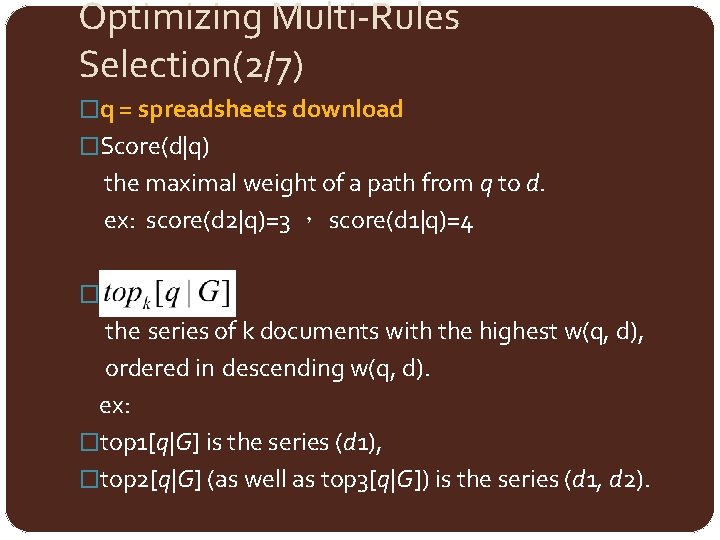
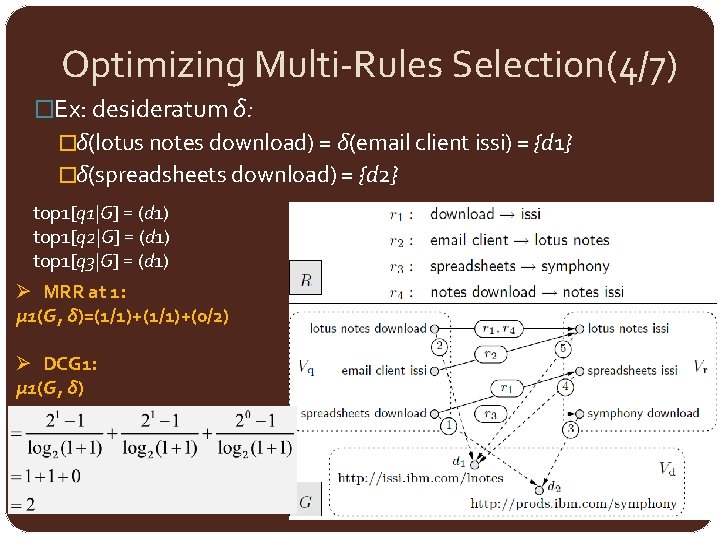
Optimizing Multi-Rules Selection(2/7) �q = spreadsheets download �Score(d|q) the maximal weight of a path from q to d. ex: score(d 2|q)=3 , score(d 1|q)=4 � the series of k documents with the highest w(q, d), ordered in descending w(q, d). ex: �top 1[q|G] is the series (d 1), �top 2[q|G] (as well as top 3[q|G]) is the series (d 1, d 2).
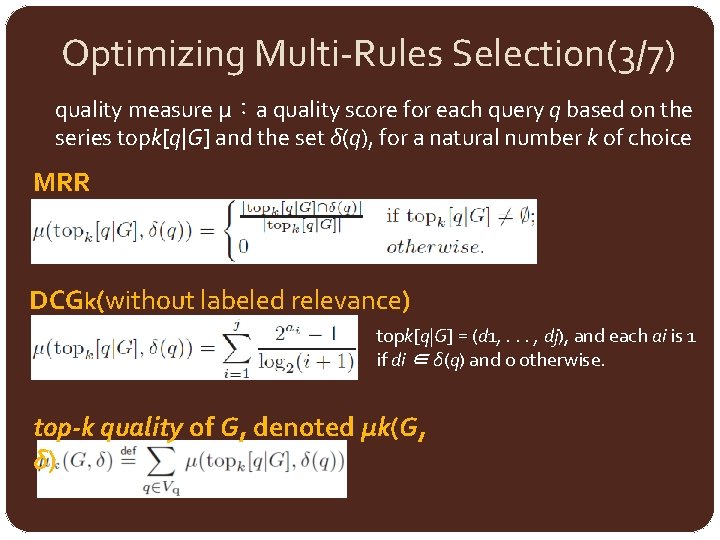
Optimizing Multi-Rules Selection(3/7) quality measure μ:a quality score for each query q based on the series topk[q|G] and the set δ(q), for a natural number k of choice MRR DCGk(without labeled relevance) topk[q|G] = (d 1, . . . , dj), and each ai is 1 if di ∈ δ(q) and 0 otherwise. top-k quality of G, denoted μk(G, δ)
Optimizing Multi-Rules Selection(4/7) �Ex: desideratum δ: �δ(lotus notes download) = δ(email client issi) = {d 1} �δ(spreadsheets download) = {d 2} top 1[q 1|G] = (d 1) top 1[q 2|G] = (d 1) top 1[q 3|G] = (d 1) Ø MRR at 1: μ 1(G, δ)=(1/1)+(0/2) Ø DCG 1: μ 1(G, δ)
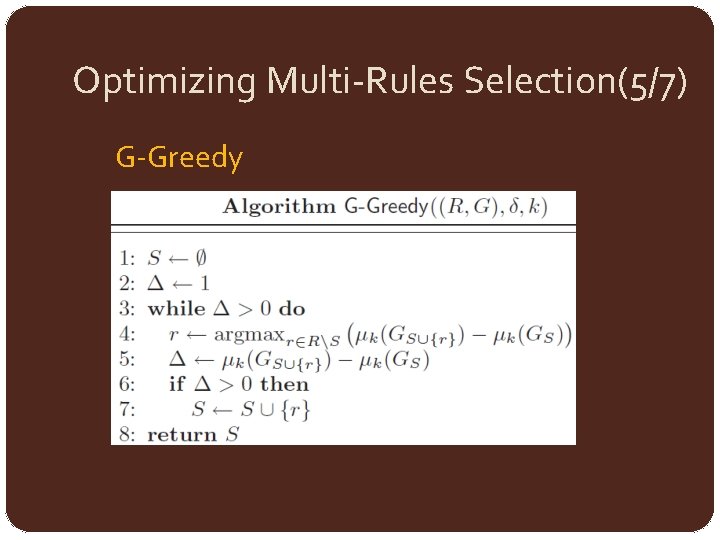
Optimizing Multi-Rules Selection(5/7) G-Greedy
Example of G-Greedy(6/7)
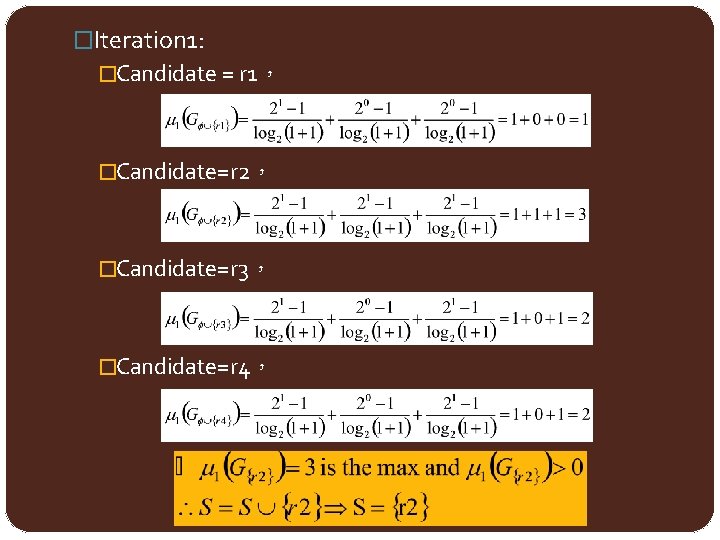
�Iteration 1: �Candidate = r 1, �Candidate=r 2, �Candidate=r 3, �Candidate=r 4,
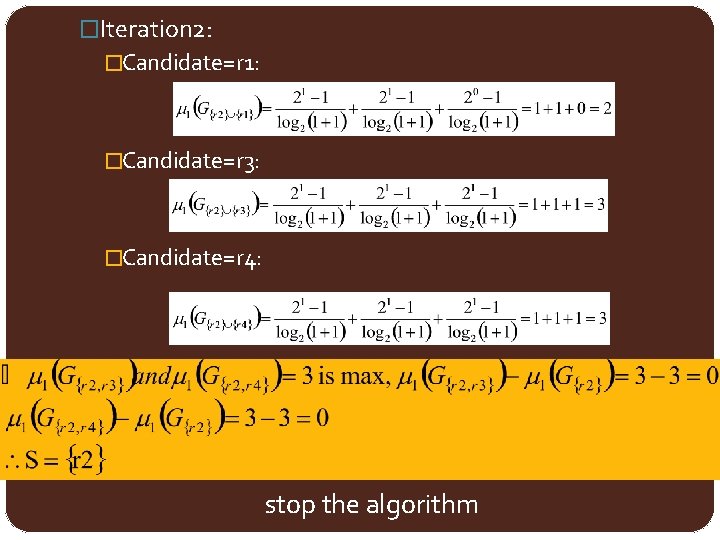
�Iteration 2: �Candidate=r 1: �Candidate=r 3: �Candidate=r 4: stop the algorithm
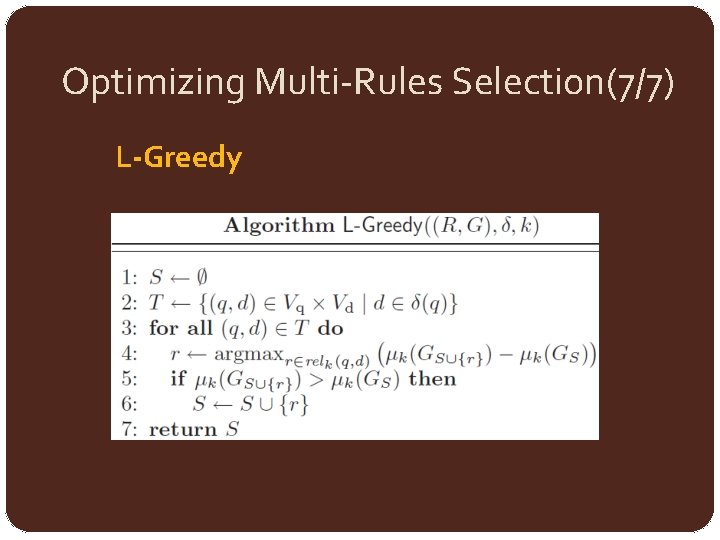
Optimizing Multi-Rules Selection(7/7) L-Greedy
Outline �Introduction �Recognizing Nature Rules �Optimizing Multi-Rules Selection �Experiments �Conclusions
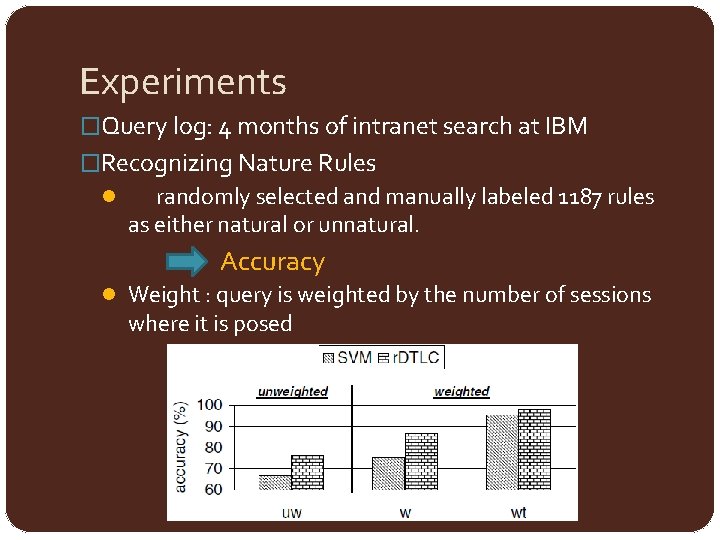
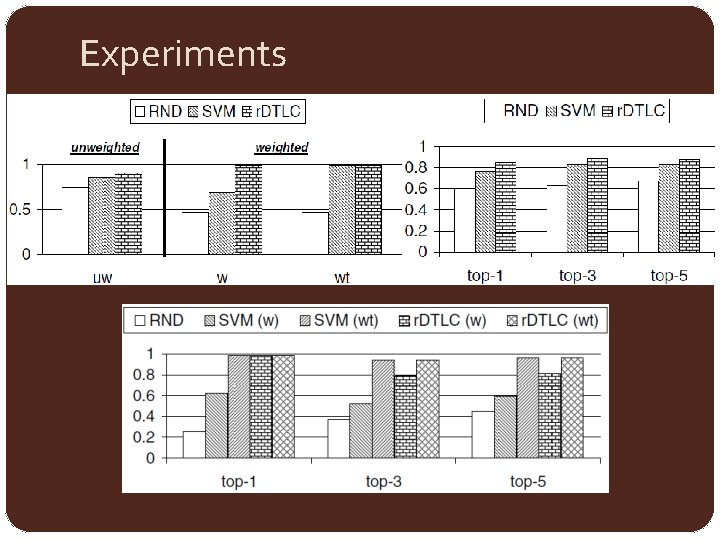
Experiments �Query log: 4 months of intranet search at IBM �Recognizing Nature Rules l randomly selected and manually labeled 1187 rules as either natural or unnatural. Accuracy l Weight : query is weighted by the number of sessions where it is posed
Experiments
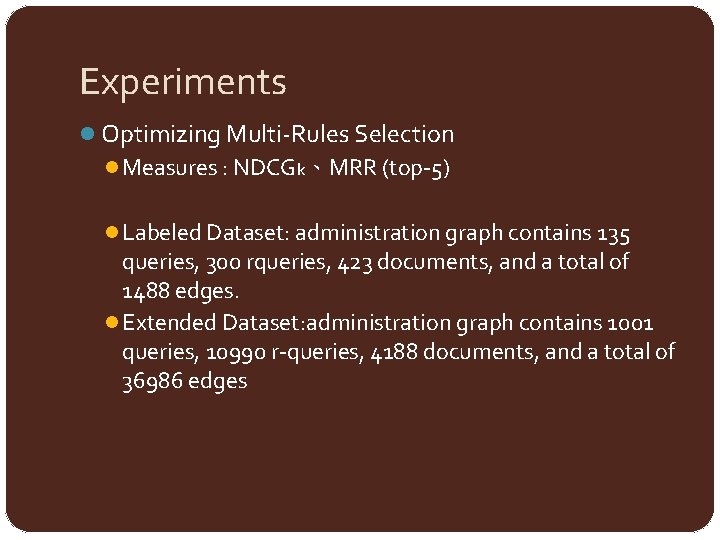
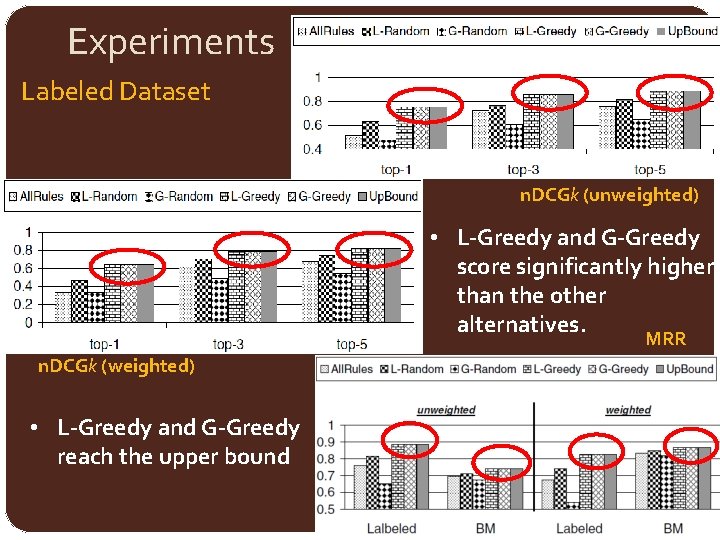
Experiments l Optimizing Multi-Rules Selection l Measures : NDCGk、MRR (top-5) l Labeled Dataset: administration graph contains 135 queries, 300 rqueries, 423 documents, and a total of 1488 edges. l Extended Dataset: administration graph contains 1001 queries, 10990 r-queries, 4188 documents, and a total of 36986 edges
Experiments Labeled Dataset n. DCGk (unweighted) • L-Greedy and G-Greedy score significantly higher than the other alternatives. MRR n. DCGk (weighted) • L-Greedy and G-Greedy reach the upper bound
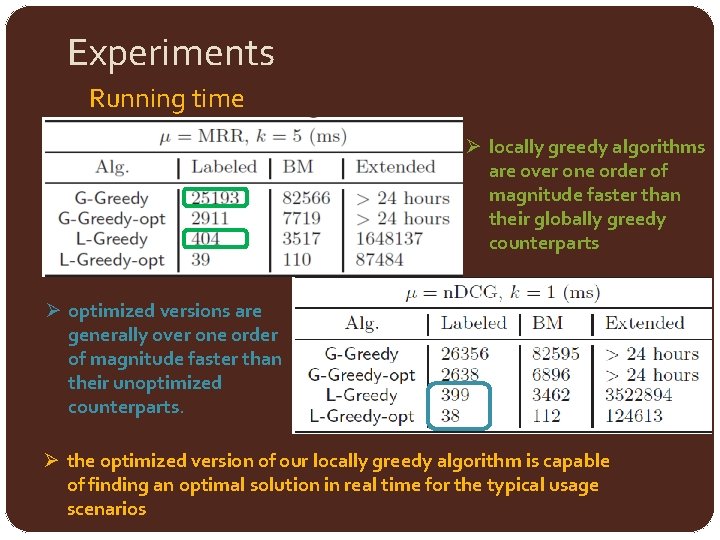
Experiments Running time Ø locally greedy algorithms are over one order of magnitude faster than their globally greedy counterparts Ø optimized versions are generally over one order of magnitude faster than their unoptimized counterparts. Ø the optimized version of our locally greedy algorithm is capable of finding an optimal solution in real time for the typical usage scenarios
Outline �Introduction �Recognizing Nature Rules �Optimizing Multi-Rules Selection �Experiments �Conclusions
Conclusions �proposed heuristic algorithms to accommodate the hardness of the task(the problem of selecting rules). �Experiments on a real enterprise case (IBM intranet search) indicate that the proposed solutions are effective and feasible. �In future work, we plan to focus on extending our techniques to handle significantly more expressive rules.