
Automatic Semantic Role Labeling Thanks to Scott Wentau

Automatic Semantic Role Labeling Thanks to Scott Wen-tau Yih Kristina Toutanova Microsoft Research 1
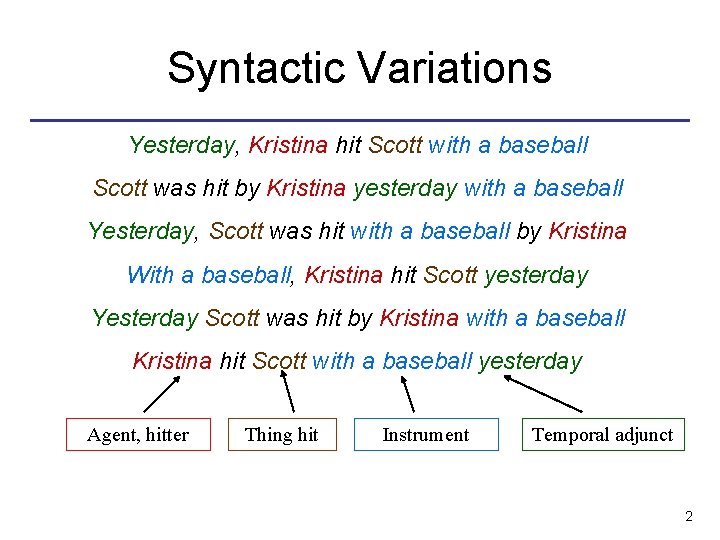
Syntactic Variations Yesterday, Kristina hit Scott with a baseball Scott was hit by Kristina yesterday with a baseball Yesterday, Scott was hit with a baseball by Kristina With a baseball, Kristina hit Scott yesterday Yesterday Scott was hit by Kristina with a baseball Kristina hit Scott with a baseball yesterday Agent, hitter Thing hit Instrument Temporal adjunct 2
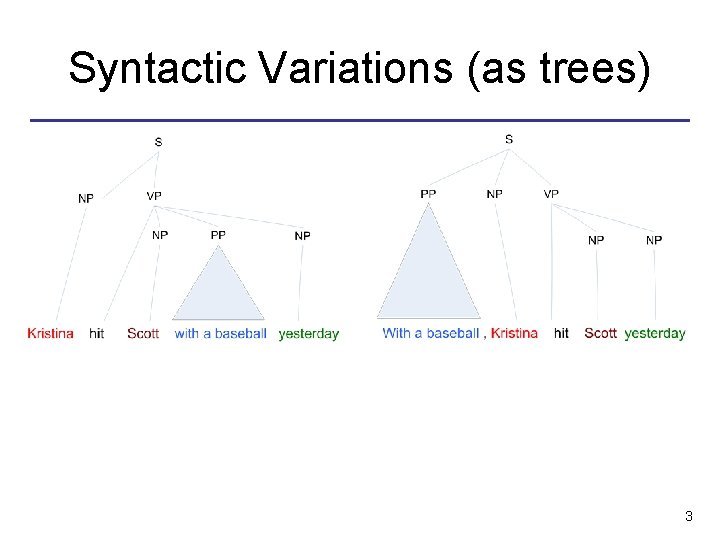
Syntactic Variations (as trees) 3
![Semantic Role Labeling – Giving Semantic Labels to Phrases § [AGENT John] broke [THEME](http://slidetodoc.com/presentation_image_h/fe712a2e39735fb5056320ba637242ac/image-4.jpg "Semantic Role Labeling – Giving Semantic Labels to Phrases § [AGENT John] broke [THEME")
Semantic Role Labeling – Giving Semantic Labels to Phrases § [AGENT John] broke [THEME the window] § [THEME The window] broke § [AGENTSotheby’s]. . offered [RECIPIENT the Dorrance heirs] [THEME a money-back guarantee] § [AGENT Sotheby’s] offered [THEME a money-back guarantee] to [RECIPIENT the Dorrance heirs] § [THEME a money-back guarantee] offered by [AGENT Sotheby’s] § [RECIPIENT the Dorrance heirs] will [ARM-NEG not] be offered [THEME a money-back guarantee] 4
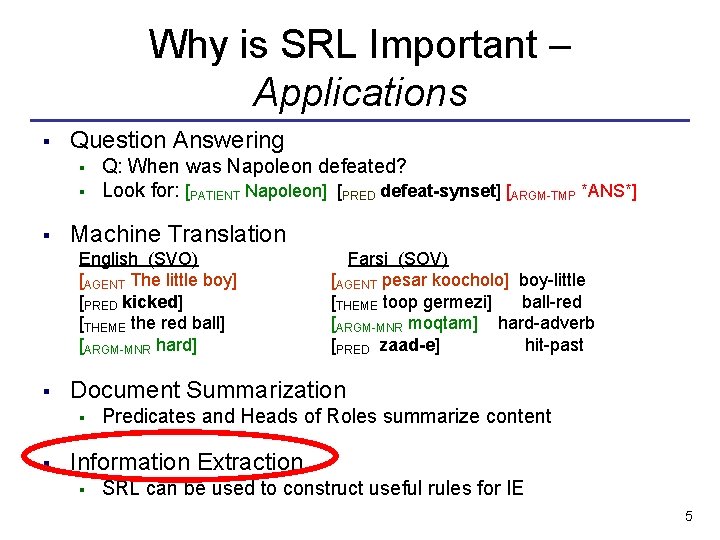
Why is SRL Important – Applications § Question Answering § § § Q: When was Napoleon defeated? Look for: [PATIENT Napoleon] [PRED defeat-synset] [ARGM-TMP *ANS*] Machine Translation English (SVO) [AGENT The little boy] [PRED kicked] [THEME the red ball] [ARGM-MNR hard] § Document Summarization § § Farsi (SOV) [AGENT pesar koocholo] boy-little [THEME toop germezi] ball-red [ARGM-MNR moqtam] hard-adverb [PRED zaad-e] hit-past Predicates and Heads of Roles summarize content Information Extraction § SRL can be used to construct useful rules for IE 5
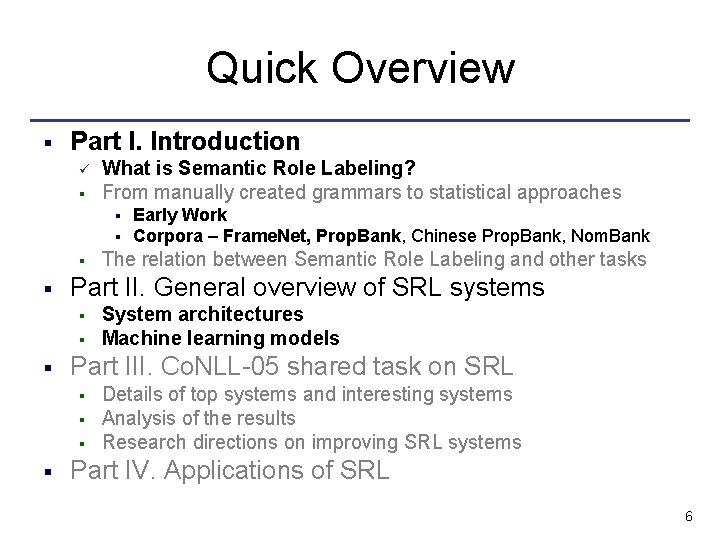
Quick Overview § Part I. Introduction ü § What is Semantic Role Labeling? From manually created grammars to statistical approaches § § § System architectures Machine learning models Part III. Co. NLL-05 shared task on SRL § § The relation between Semantic Role Labeling and other tasks Part II. General overview of SRL systems § § Early Work Corpora – Frame. Net, Prop. Bank, Chinese Prop. Bank, Nom. Bank Details of top systems and interesting systems Analysis of the results Research directions on improving SRL systems Part IV. Applications of SRL 6
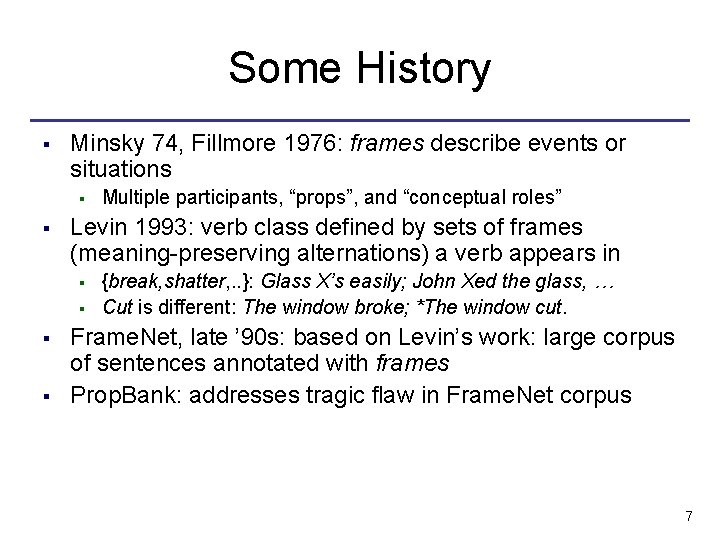
Some History § Minsky 74, Fillmore 1976: frames describe events or situations § § Levin 1993: verb class defined by sets of frames (meaning-preserving alternations) a verb appears in § § Multiple participants, “props”, and “conceptual roles” {break, shatter, . . }: Glass X’s easily; John Xed the glass, … Cut is different: The window broke; *The window cut. Frame. Net, late ’ 90 s: based on Levin’s work: large corpus of sentences annotated with frames Prop. Bank: addresses tragic flaw in Frame. Net corpus 7
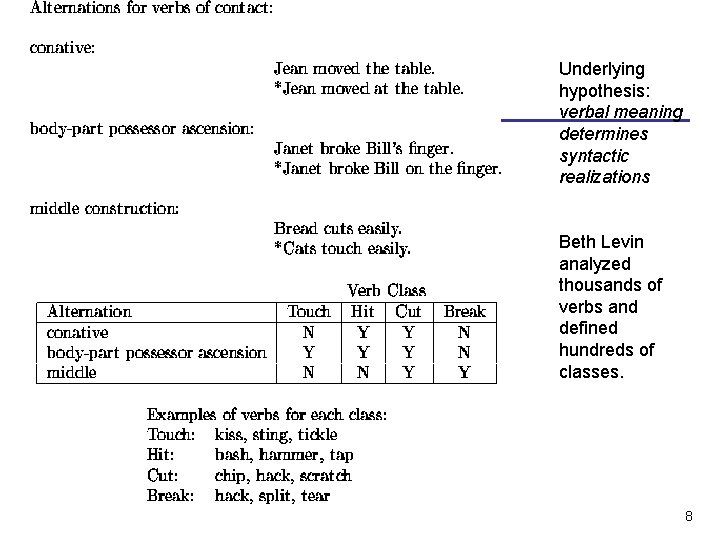
Underlying hypothesis: verbal meaning determines syntactic realizations Beth Levin analyzed thousands of verbs and defined hundreds of classes. 8
![Frames in Frame. Net [Baker, Fillmore, Lowe, 1998] 9](http://slidetodoc.com/presentation_image_h/fe712a2e39735fb5056320ba637242ac/image-9.jpg "Frames in Frame. Net [Baker, Fillmore, Lowe, 1998] 9")
Frames in Frame. Net [Baker, Fillmore, Lowe, 1998] 9
![Frame. Net [Fillmore et al. 01] Frame: Hit_target (hit, pick off, shoot) Core Agent](http://slidetodoc.com/presentation_image_h/fe712a2e39735fb5056320ba637242ac/image-10.jpg "Frame. Net [Fillmore et al. 01] Frame: Hit_target (hit, pick off, shoot) Core Agent")
Frame. Net [Fillmore et al. 01] Frame: Hit_target (hit, pick off, shoot) Core Agent Means Target Place Instrument Purpose Manner Subregion Time Lexical units (LUs): Words that evoke the frame (usually verbs) Non-Core Frame elements (FEs): The involved semantic roles [Agent Kristina] hit [Target Scott] [Instrument with a baseball] [Time yesterday ]. 10
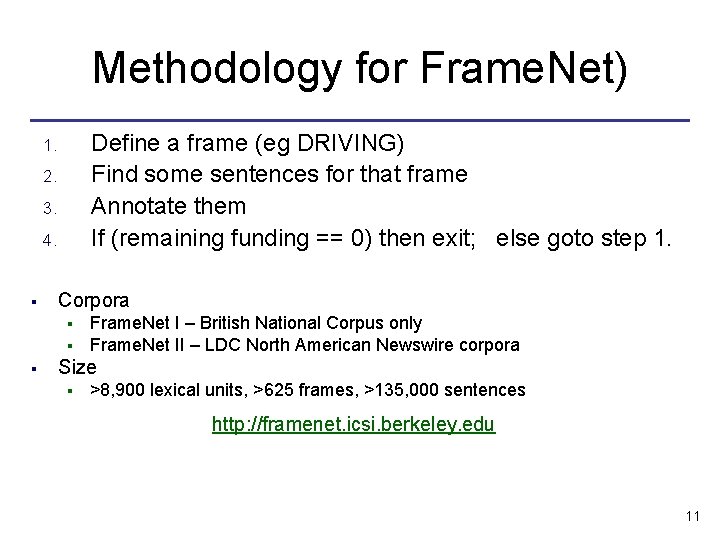
Methodology for Frame. Net) Define a frame (eg DRIVING) Find some sentences for that frame Annotate them If (remaining funding == 0) then exit; else goto step 1. 2. 3. 4. § Corpora § § § Frame. Net I – British National Corpus only Frame. Net II – LDC North American Newswire corpora Size § >8, 900 lexical units, >625 frames, >135, 000 sentences http: //framenet. icsi. berkeley. edu 11
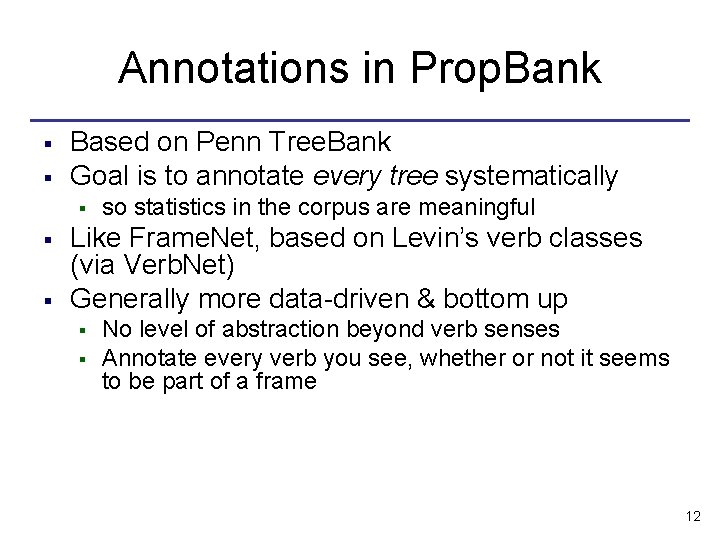
Annotations in Prop. Bank § § Based on Penn Tree. Bank Goal is to annotate every tree systematically § § § so statistics in the corpus are meaningful Like Frame. Net, based on Levin’s verb classes (via Verb. Net) Generally more data-driven & bottom up § § No level of abstraction beyond verb senses Annotate every verb you see, whether or not it seems to be part of a frame 12
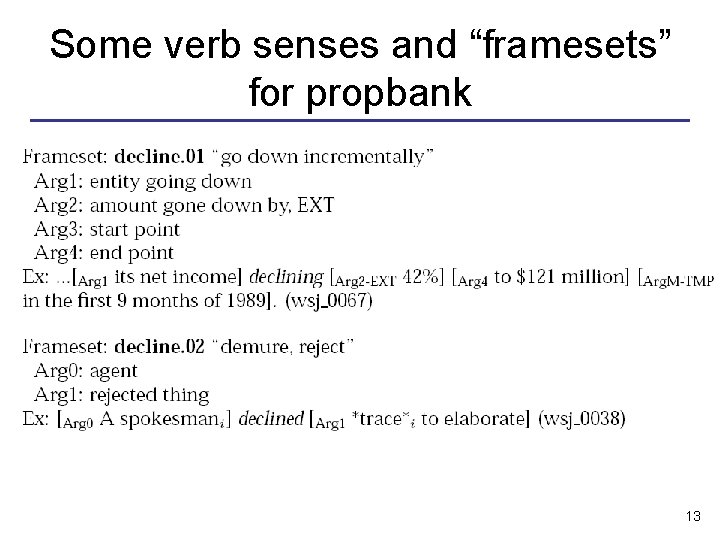
Some verb senses and “framesets” for propbank 13
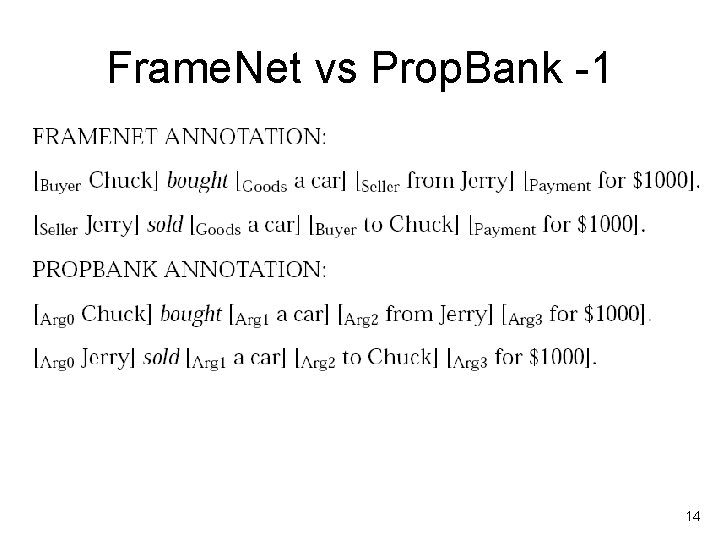
Frame. Net vs Prop. Bank -1 14
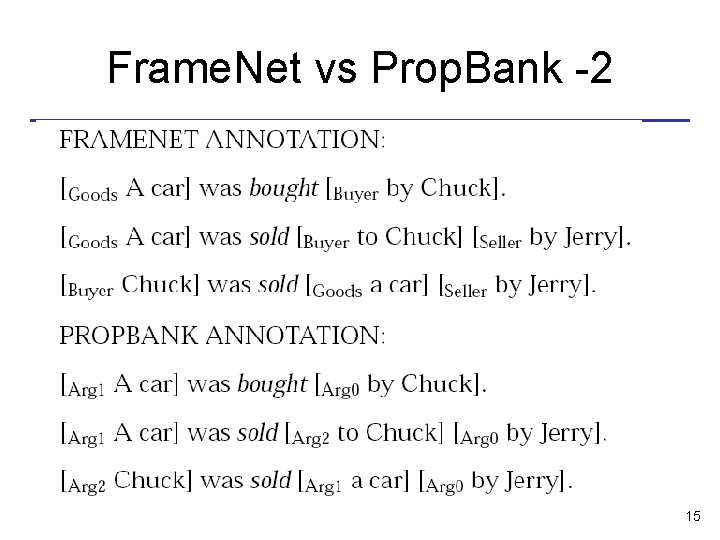
Frame. Net vs Prop. Bank -2 15
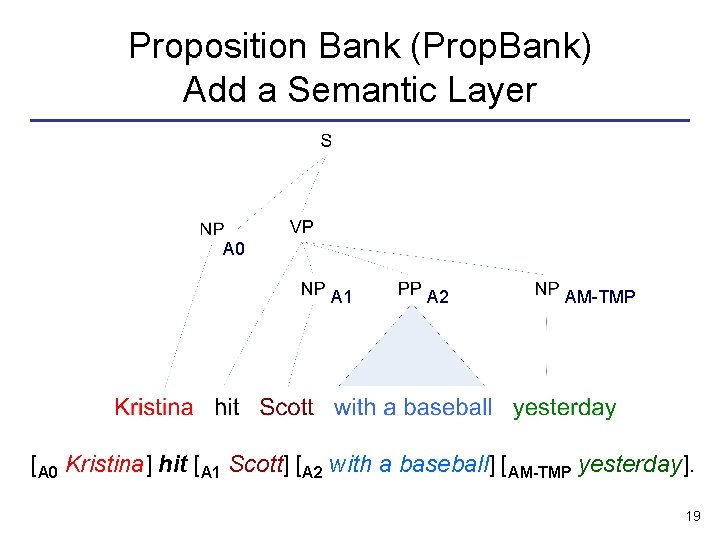
Proposition Bank (Prop. Bank) Add a Semantic Layer A 0 A 1 A 2 AM-TMP [A 0 Kristina] hit [A 1 Scott] [A 2 with a baseball] [AM-TMP yesterday]. 19
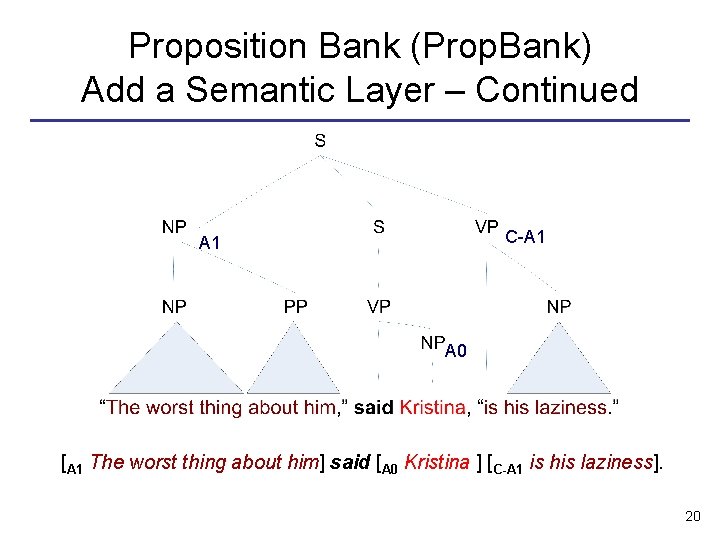
Proposition Bank (Prop. Bank) Add a Semantic Layer – Continued C-A 1 A 0 [A 1 The worst thing about him] said [A 0 Kristina ] [C-A 1 is his laziness]. 20
Proposition Bank (Prop. Bank) Final Notes § Current release (Mar 4, 2005): Proposition Bank I § § Verb Lexicon: 3, 324 frame files Annotation: ~113, 000 propositions http: //www. cis. upenn. edu/~mpalmer/project_pages/ACE. htm § Alternative format: Co. NLL-04, 05 shared task § § Represented in table format Has been used as standard data set for the shared tasks on semantic role labeling http: //www. lsi. upc. es/~srlconll/soft. html 21
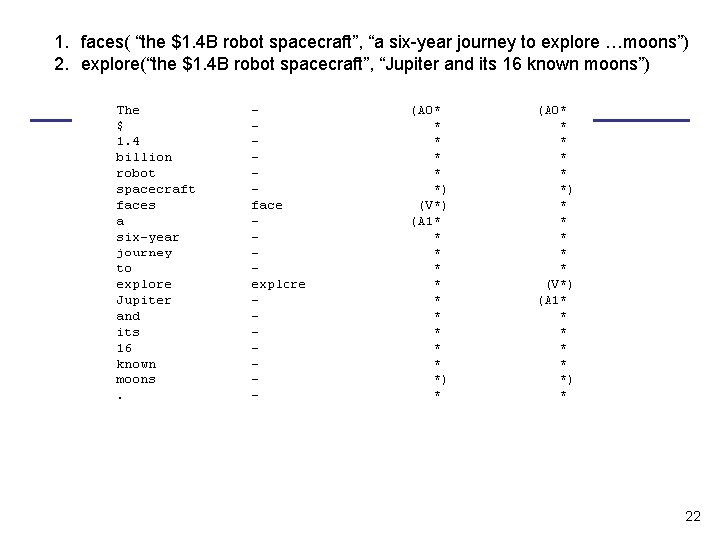
1. faces( “the $1. 4 B robot spacecraft”, “a six-year journey to explore …moons”) 2. explore(“the $1. 4 B robot spacecraft”, “Jupiter and its 16 known moons”) 22
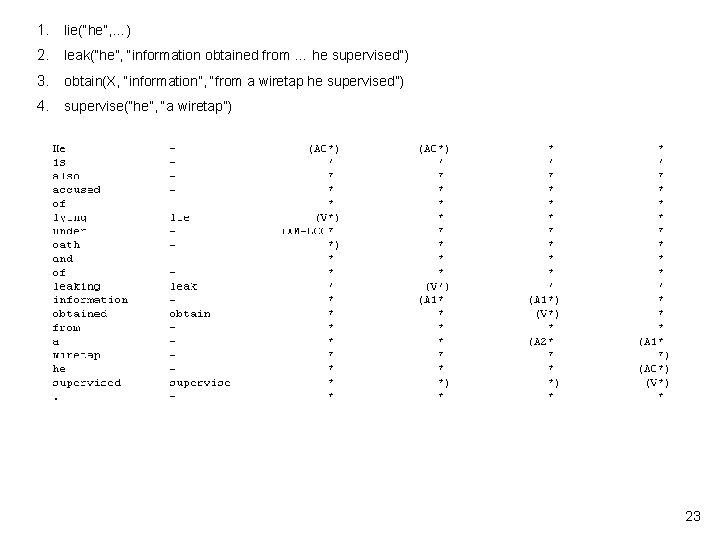
1. lie(“he”, …) 2. leak(“he”, “information obtained from … he supervised”) 3. obtain(X, “information”, “from a wiretap he supervised”) 4. supervise(“he”, “a wiretap”) 23
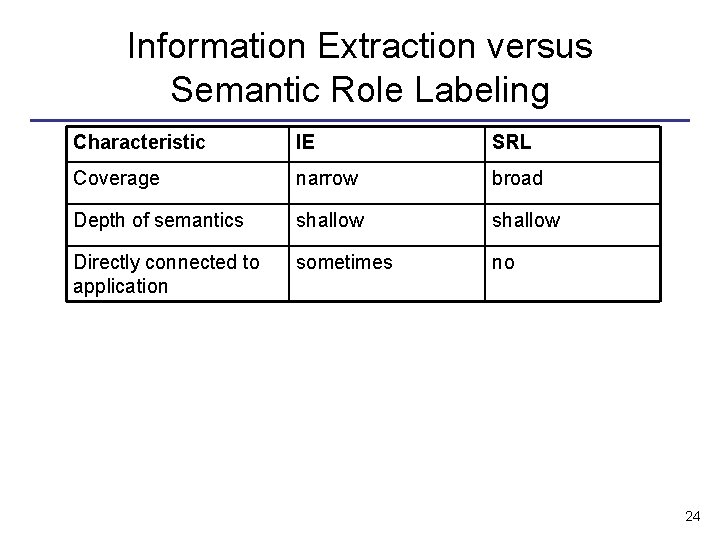
Information Extraction versus Semantic Role Labeling Characteristic IE SRL Coverage narrow broad Depth of semantics shallow Directly connected to application sometimes no 24

Part II: Overview of SRL Systems § Definition of the SRL task § § § Evaluation measures General system architectures Machine learning models § § Features & models Performance gains from different techniques 25
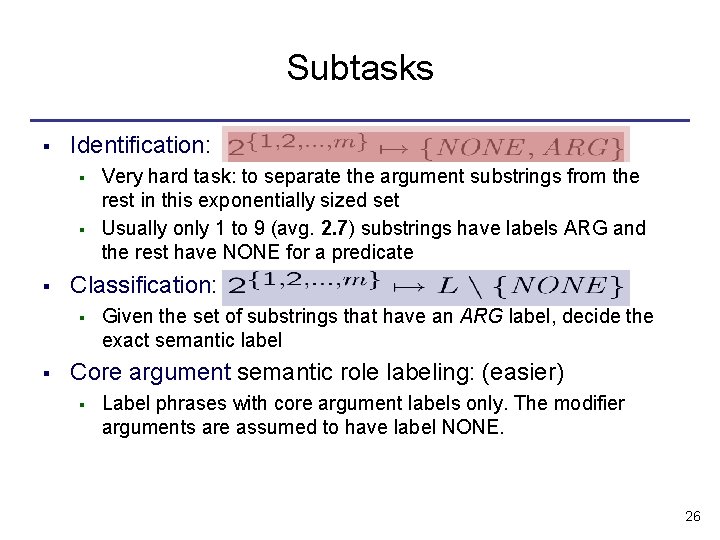
Subtasks § Identification: § § § Classification: § § Very hard task: to separate the argument substrings from the rest in this exponentially sized set Usually only 1 to 9 (avg. 2. 7) substrings have labels ARG and the rest have NONE for a predicate Given the set of substrings that have an ARG label, decide the exact semantic label Core argument semantic role labeling: (easier) § Label phrases with core argument labels only. The modifier arguments are assumed to have label NONE. 26
![Evaluation Measures Correct: [A 0 The queen] broke [A 1 the window] [AM-TMP yesterday]](http://slidetodoc.com/presentation_image_h/fe712a2e39735fb5056320ba637242ac/image-24.jpg "Evaluation Measures Correct: [A 0 The queen] broke [A 1 the window] [AM-TMP yesterday]")
Evaluation Measures Correct: [A 0 The queen] broke [A 1 the window] [AM-TMP yesterday] Guess: [A 0 The queen] broke the [A 1 window] [AM-LOC yesterday] § § Correct Guess {The queen} →A 0 {the window} →A 1 {yesterday} ->AM-TMP all other → NONE {The queen} →A 0 {window} →A 1 {yesterday} ->AM-LOC all other → NONE Precision , Recall, F-Measure {tp=1, fp=2, fn=2} p=r=f=1/3 Measures for subtasks § § § Identification (Precision, Recall, F-measure) {tp=2, fp=1, fn=1} p=r=f=2/3 Classification (Accuracy) acc =. 5 (labeling of correctly identified phrases) Core arguments (Precision, Recall, F-measure) {tp=1, fn=1} p=r=f=1/2 27

Basic Architecture of a Generic SRL System (adding features) Local scores for phrase labels do not depend on labels of other phrases Joint scores take into account dependencies among the labels of multiple phrases 28
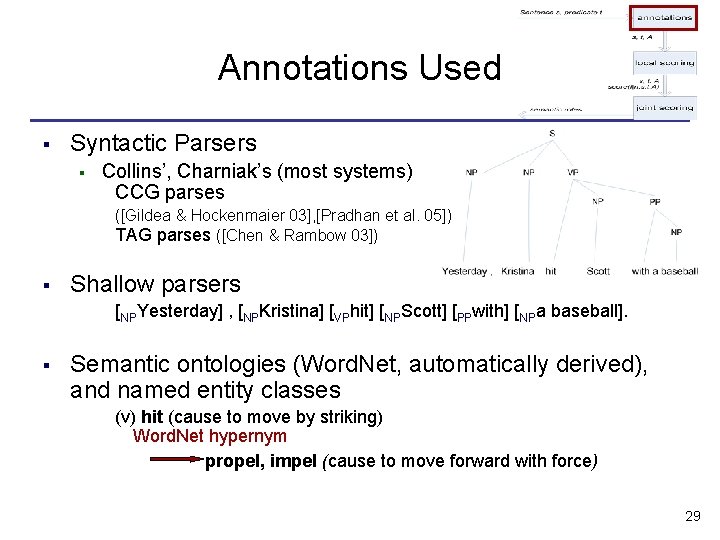
Annotations Used § Syntactic Parsers § Collins’, Charniak’s (most systems) CCG parses ([Gildea & Hockenmaier 03], [Pradhan et al. 05]) TAG parses ([Chen & Rambow 03]) § Shallow parsers [NPYesterday] , [NPKristina] [VPhit] [NPScott] [PPwith] [NPa baseball]. § Semantic ontologies (Word. Net, automatically derived), and named entity classes (v) hit (cause to move by striking) Word. Net hypernym propel, impel (cause to move forward with force) 29
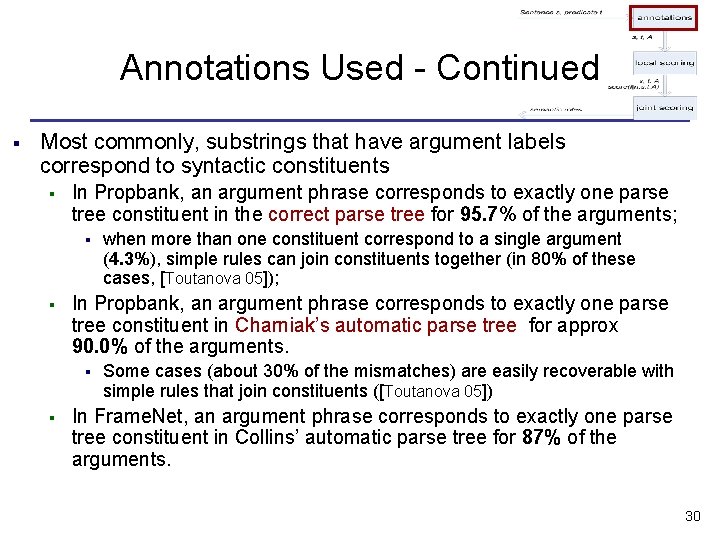
Annotations Used - Continued § Most commonly, substrings that have argument labels correspond to syntactic constituents § In Propbank, an argument phrase corresponds to exactly one parse tree constituent in the correct parse tree for 95. 7% of the arguments; § § In Propbank, an argument phrase corresponds to exactly one parse tree constituent in Charniak’s automatic parse tree for approx 90. 0% of the arguments. § § when more than one constituent correspond to a single argument (4. 3%), simple rules can join constituents together (in 80% of these cases, [Toutanova 05]); Some cases (about 30% of the mismatches) are easily recoverable with simple rules that join constituents ([Toutanova 05]) In Frame. Net, an argument phrase corresponds to exactly one parse tree constituent in Collins’ automatic parse tree for 87% of the arguments. 30
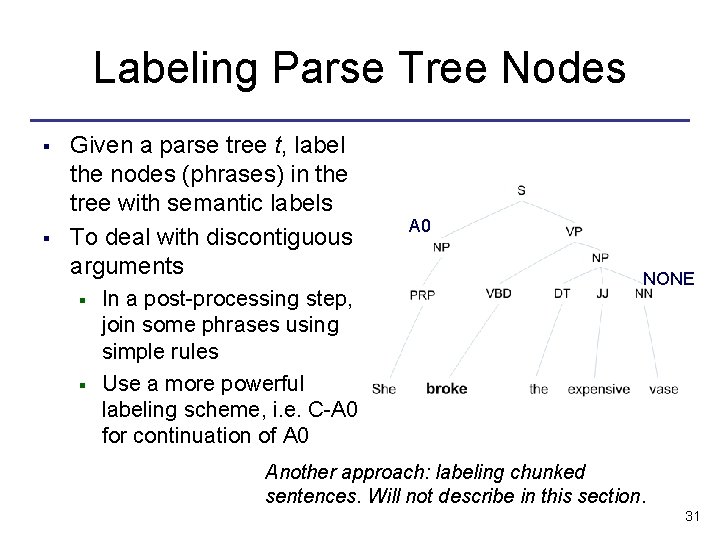
Labeling Parse Tree Nodes § § Given a parse tree t, label the nodes (phrases) in the tree with semantic labels To deal with discontiguous arguments § § In a post-processing step, join some phrases using simple rules Use a more powerful labeling scheme, i. e. C-A 0 for continuation of A 0 NONE Another approach: labeling chunked sentences. Will not describe in this section. 31
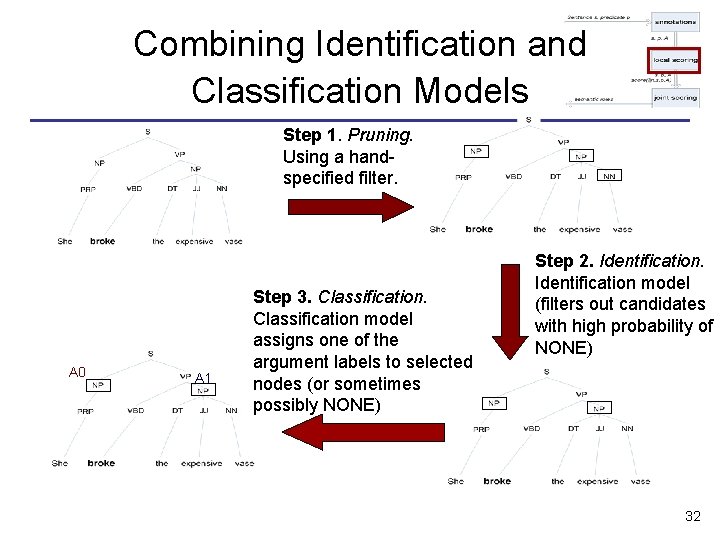
Combining Identification and Classification Models Step 1. Pruning. Using a handspecified filter. A 0 A 1 Step 3. Classification model assigns one of the argument labels to selected nodes (or sometimes possibly NONE) Step 2. Identification model (filters out candidates with high probability of NONE) 32
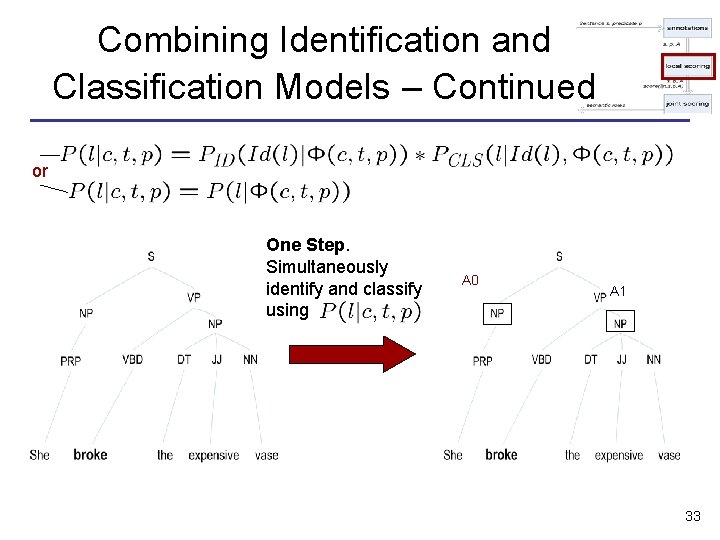
Combining Identification and Classification Models – Continued or One Step. Simultaneously identify and classify using A 0 A 1 33
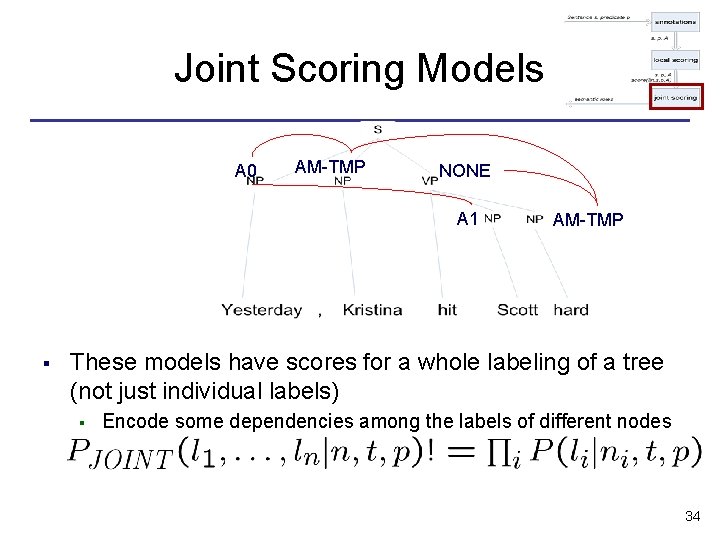
Joint Scoring Models A 0 AM-TMP NONE A 1 § AM-TMP These models have scores for a whole labeling of a tree (not just individual labels) § Encode some dependencies among the labels of different nodes 34
Combining Local and Joint Scoring Models § Tight integration of local and joint scoring in a single probabilistic model and exact search [Cohn&Blunsom 05] [Màrquez et al. 05], [Thompson et al. 03] § When the joint model makes strong independence assumptions § Re-ranking or approximate search to find the labeling which maximizes a combination of local and a joint score [Gildea&Jurafsky 02] [Pradhan et al. 04] [Toutanova et al. 05] § § Usually exponential search required to find the exact maximizer Exact search for best assignment by local model satisfying hard joint constraints § Using Integer Linear Programming [Punyakanok et al 04, 05] (worst case NP-hard) § More details later 35
Gildea & Jurafsky (2002) Features § Key early work § § Constituent Independent § § Future systems use these features as a baseline Target predicate (lemma) Voice Subcategorization Constituent Specific § § § Path Position (left, right) Phrase Type Governing Category (S or VP) Head Word Target Voice Subcategorization Path Position Phrase Type Gov Cat Head Word broke active VP→VBD NP VBD↑VP↑S↓NP left NP S She 36
Performance with Baseline Features using the G&J Model § Machine learning algorithm: interpolation of relative frequency estimates based on subsets of the 7 features introduced earlier Frame. Net Results Propbank Results 37
Performance with Baseline Features using the G&J Model • Better ML: 67. 6 → 80. 8 using SVMs [Pradhan et al. 04]). Content Word (different from head word) § Head Word and Content Word POS tags § NE labels (Organization, Location, etc. ) § Structural/lexical context (phrase/words around parse tree) § Head of PP Parent § If the parent of a constituent is a PP, the identity of the preposition § 38
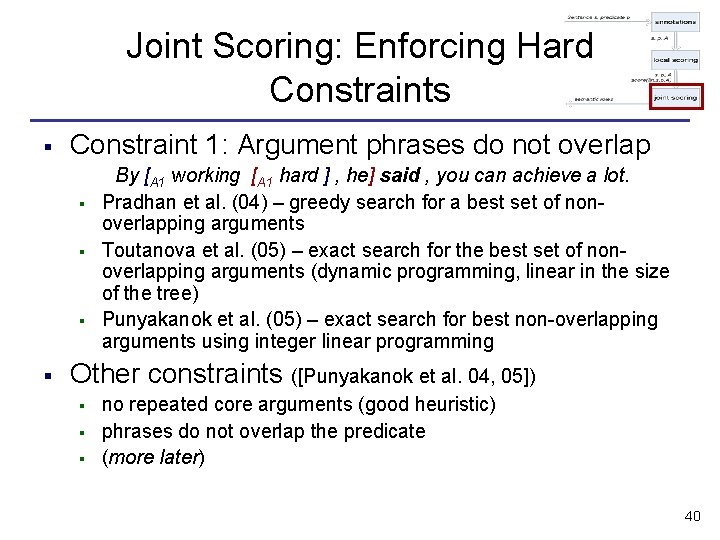
Joint Scoring: Enforcing Hard Constraints § Constraint 1: Argument phrases do not overlap § § By [A 1 working [A 1 hard ] , he] said , you can achieve a lot. Pradhan et al. (04) – greedy search for a best set of nonoverlapping arguments Toutanova et al. (05) – exact search for the best set of nonoverlapping arguments (dynamic programming, linear in the size of the tree) Punyakanok et al. (05) – exact search for best non-overlapping arguments using integer linear programming Other constraints ([Punyakanok et al. 04, 05]) § § § no repeated core arguments (good heuristic) phrases do not overlap the predicate (more later) 40
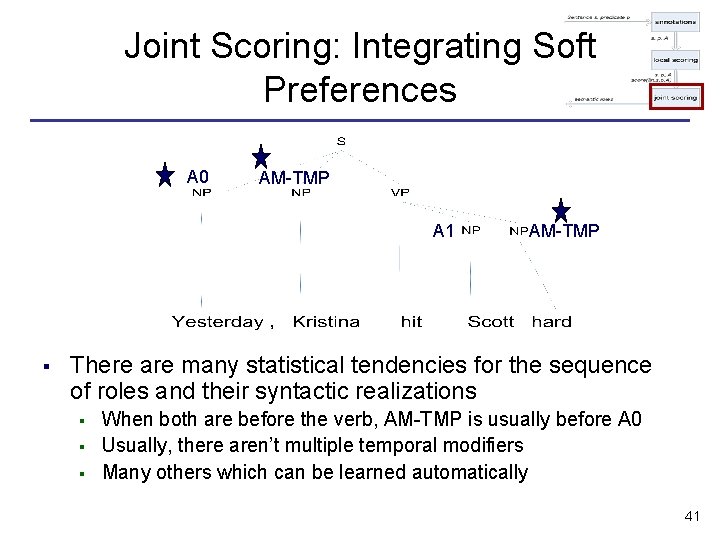
Joint Scoring: Integrating Soft Preferences A 0 AM-TMP A 1 § AM-TMP There are many statistical tendencies for the sequence of roles and their syntactic realizations § § § When both are before the verb, AM-TMP is usually before A 0 Usually, there aren’t multiple temporal modifiers Many others which can be learned automatically 41
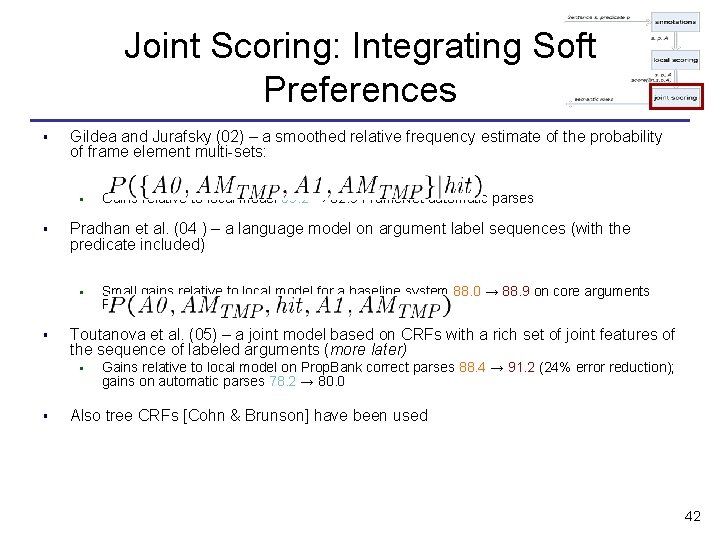
Joint Scoring: Integrating Soft Preferences § Gildea and Jurafsky (02) – a smoothed relative frequency estimate of the probability of frame element multi-sets: § § Pradhan et al. (04 ) – a language model on argument label sequences (with the predicate included) § § Small gains relative to local model for a baseline system 88. 0 → 88. 9 on core arguments Prop. Bank correct parses Toutanova et al. (05) – a joint model based on CRFs with a rich set of joint features of the sequence of labeled arguments (more later) § § Gains relative to local model 59. 2 → 62. 9 Frame. Net automatic parses Gains relative to local model on Prop. Bank correct parses 88. 4 → 91. 2 (24% error reduction); gains on automatic parses 78. 2 → 80. 0 Also tree CRFs [Cohn & Brunson] have been used 42
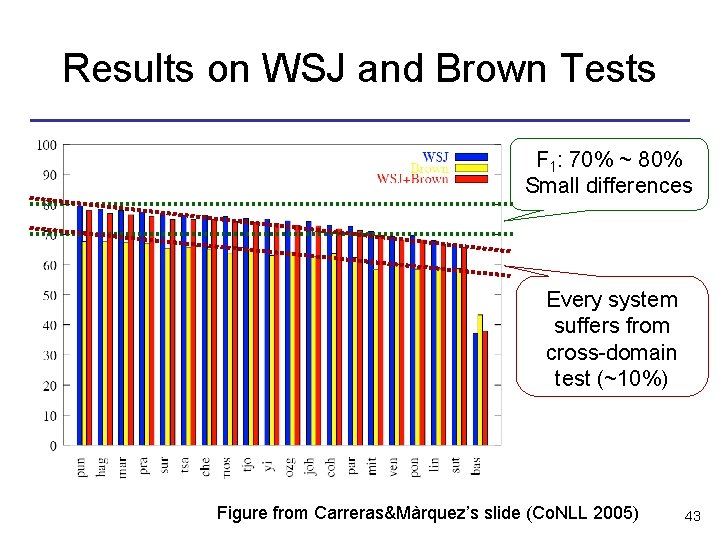
Results on WSJ and Brown Tests F 1: 70% ~ 80% Small differences Every system suffers from cross-domain test (~10%) Figure from Carreras&Màrquez’s slide (Co. NLL 2005) 43
System Properties § Learning Methods § Ø § SNo. W, Max. Ent, Ada. Boost, SVM, CRFs, etc. The choice of learning algorithms is less important. Features § § § All teams implement more or less the standard features with some variations. A must-do for building a good system! A clear feature study and more feature engineering will be helpful. 44
System Properties – Continued § Syntactic Information § § Ø § Charniak’s parser, Collins’ parser, clauser, chunker, etc. Top systems use Charniak’s parser or some mixture Quality of syntactic information is very important! System/Information Combination § § Ø 8 teams implement some level of combination Greedy, Re-ranking, Stacking, ILP inference Combination of systems or syntactic information is a good strategy to reduce the influence of incorrect syntactic information! 45
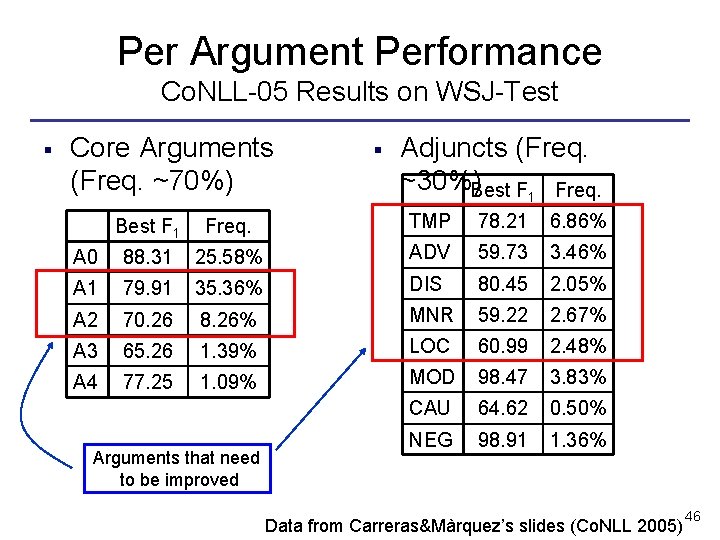
Per Argument Performance Co. NLL-05 Results on WSJ-Test § Core Arguments (Freq. ~70%) § Adjuncts (Freq. ~30%)Best F 1 Freq. TMP 78. 21 6. 86% A 0 88. 31 25. 58% ADV 59. 73 3. 46% A 1 79. 91 35. 36% DIS 80. 45 2. 05% A 2 70. 26 8. 26% MNR 59. 22 2. 67% A 3 65. 26 1. 39% LOC 60. 99 2. 48% A 4 77. 25 1. 09% MOD 98. 47 3. 83% CAU 64. 62 0. 50% NEG 98. 91 1. 36% Arguments that need to be improved Data from Carreras&Màrquez’s slides (Co. NLL 2005) 46
- Slides: 42