
AUTOMATIC SEIZURE DETECTION ON THE TUH EEG SEIZURE
- Slides: 6
AUTOMATIC SEIZURE DETECTION ON THE TUH EEG SEIZURE CORPUS Neural Engineering Data Consortium College of Engineering Temple University
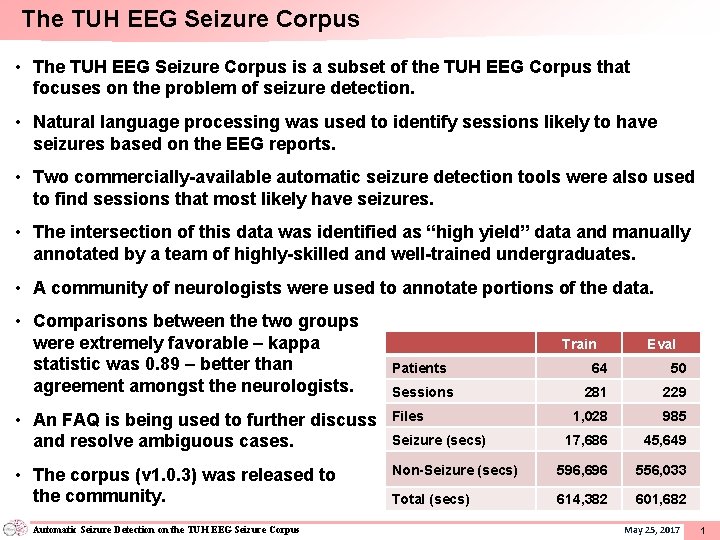
The TUH EEG Seizure Corpus • The TUH EEG Seizure Corpus is a subset of the TUH EEG Corpus that focuses on the problem of seizure detection. • Natural language processing was used to identify sessions likely to have seizures based on the EEG reports. • Two commercially-available automatic seizure detection tools were also used to find sessions that most likely have seizures. • The intersection of this data was identified as “high yield” data and manually annotated by a team of highly-skilled and well-trained undergraduates. • A community of neurologists were used to annotate portions of the data. • Comparisons between the two groups were extremely favorable – kappa statistic was 0. 89 – better than agreement amongst the neurologists. Train Eval Patients 64 50 Sessions 281 229 1, 028 985 17, 686 45, 649 • An FAQ is being used to further discuss and resolve ambiguous cases. Files • The corpus (v 1. 0. 3) was released to the community. Non-Seizure (secs) 596, 696 556, 033 Total (secs) 614, 382 601, 682 Automatic Seizure Detection on the TUH EEG Seizure Corpus Seizure (secs) May 25, 2017 1
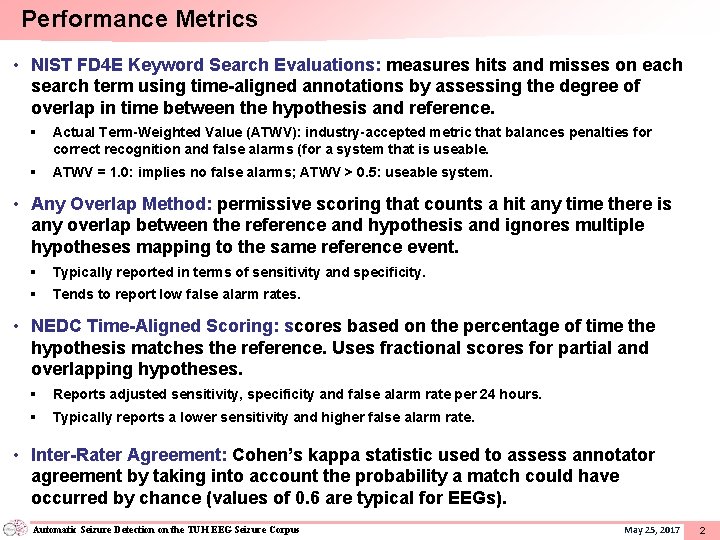
Performance Metrics • NIST FD 4 E Keyword Search Evaluations: measures hits and misses on each search term using time-aligned annotations by assessing the degree of overlap in time between the hypothesis and reference. § Actual Term-Weighted Value (ATWV): industry-accepted metric that balances penalties for correct recognition and false alarms (for a system that is useable. § ATWV = 1. 0: implies no false alarms; ATWV > 0. 5: useable system. • Any Overlap Method: permissive scoring that counts a hit any time there is any overlap between the reference and hypothesis and ignores multiple hypotheses mapping to the same reference event. § Typically reported in terms of sensitivity and specificity. § Tends to report low false alarm rates. • NEDC Time-Aligned Scoring: scores based on the percentage of time the hypothesis matches the reference. Uses fractional scores for partial and overlapping hypotheses. § Reports adjusted sensitivity, specificity and false alarm rate per 24 hours. § Typically reports a lower sensitivity and higher false alarm rate. • Inter-Rater Agreement: Cohen’s kappa statistic used to assess annotator agreement by taking into account the probability a match could have occurred by chance (values of 0. 6 are typical for EEGs). Automatic Seizure Detection on the TUH EEG Seizure Corpus May 25, 2017 2
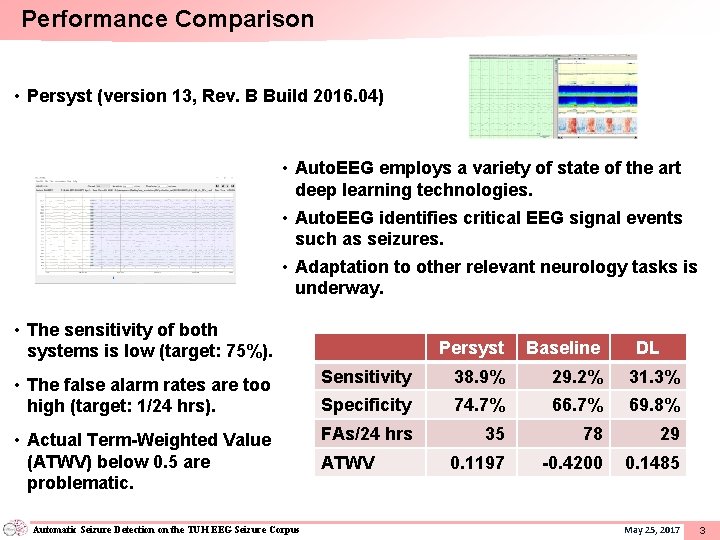
Performance Comparison • Persyst (version 13, Rev. B Build 2016. 04) • Auto. EEG employs a variety of state of the art deep learning technologies. • Auto. EEG identifies critical EEG signal events such as seizures. • Adaptation to other relevant neurology tasks is underway. • The sensitivity of both systems is low (target: 75%). Persyst Baseline DL • The false alarm rates are too high (target: 1/24 hrs). Sensitivity 38. 9% 29. 2% 31. 3% Specificity 74. 7% 66. 7% 69. 8% • Actual Term-Weighted Value (ATWV) below 0. 5 are problematic. FAs/24 hrs 35 78 29 0. 1197 -0. 4200 0. 1485 Automatic Seizure Detection on the TUH EEG Seizure Corpus ATWV May 25, 2017 3
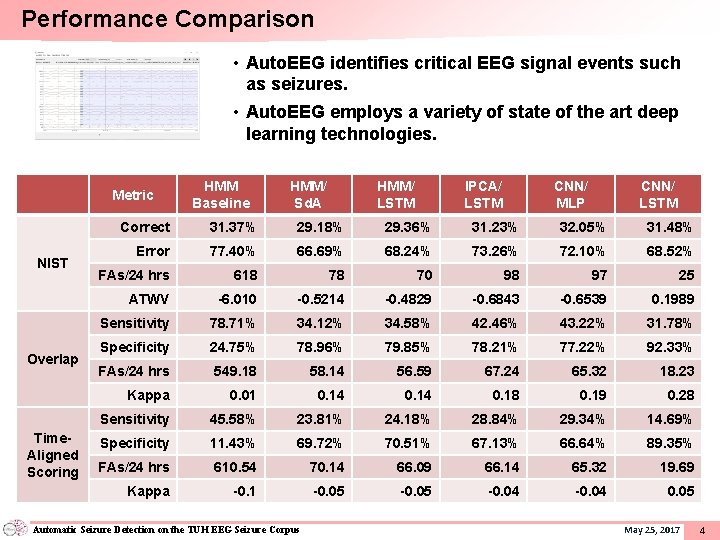
Performance Comparison • Auto. EEG identifies critical EEG signal events such as seizures. • Auto. EEG employs a variety of state of the art deep learning technologies. Metric NIST Overlap Time. Aligned Scoring HMM Baseline HMM/ Sd. A HMM/ LSTM IPCA/ LSTM CNN/ MLP CNN/ LSTM Correct 31. 37% 29. 18% 29. 36% 31. 23% 32. 05% 31. 48% Error 77. 40% 66. 69% 68. 24% 73. 26% 72. 10% 68. 52% FAs/24 hrs 618 78 70 98 97 25 ATWV -6. 010 -0. 5214 -0. 4829 -0. 6843 -0. 6539 0. 1989 Sensitivity 78. 71% 34. 12% 34. 58% 42. 46% 43. 22% 31. 78% Specificity 24. 75% 78. 96% 79. 85% 78. 21% 77. 22% 92. 33% FAs/24 hrs 549. 18 58. 14 56. 59 67. 24 65. 32 18. 23 Kappa 0. 01 0. 14 0. 18 0. 19 0. 28 Sensitivity 45. 58% 23. 81% 24. 18% 28. 84% 29. 34% 14. 69% Specificity 11. 43% 69. 72% 70. 51% 67. 13% 66. 64% 89. 35% FAs/24 hrs 610. 54 70. 14 66. 09 66. 14 65. 32 19. 69 Kappa -0. 1 -0. 05 -0. 04 0. 05 Automatic Seizure Detection on the TUH EEG Seizure Corpus May 25, 2017 4
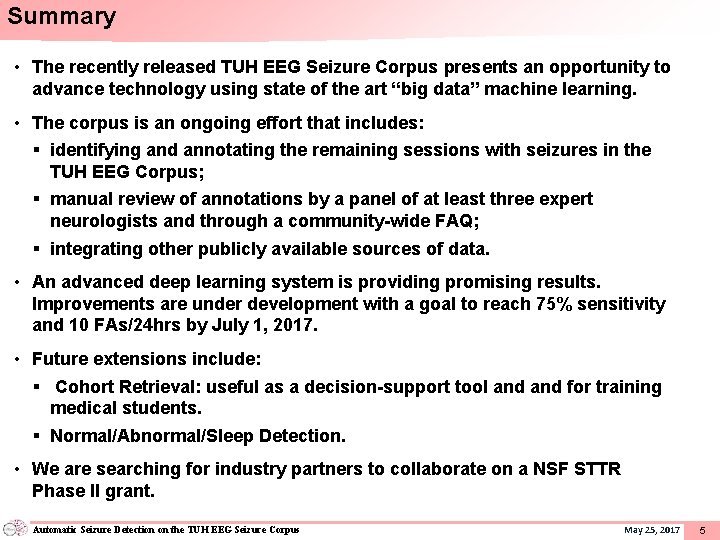
Summary • The recently released TUH EEG Seizure Corpus presents an opportunity to advance technology using state of the art “big data” machine learning. • The corpus is an ongoing effort that includes: § identifying and annotating the remaining sessions with seizures in the TUH EEG Corpus; § manual review of annotations by a panel of at least three expert neurologists and through a community-wide FAQ; § integrating other publicly available sources of data. • An advanced deep learning system is providing promising results. Improvements are under development with a goal to reach 75% sensitivity and 10 FAs/24 hrs by July 1, 2017. • Future extensions include: § Cohort Retrieval: useful as a decision-support tool and for training medical students. § Normal/Abnormal/Sleep Detection. • We are searching for industry partners to collaborate on a NSF STTR Phase II grant. Automatic Seizure Detection on the TUH EEG Seizure Corpus May 25, 2017 5