
Automatic Schema Evolution in ROOT CHEP 09 Prague
- Slides: 24
Automatic Schema Evolution in ROOT CHEP 09: Prague, 24 March 2009 Philippe Canal/FNAL René BRUN/CERN, Lukasz Janyst/ CERN, Jérôme Lauret/BNL, Valeri Fine/BNL
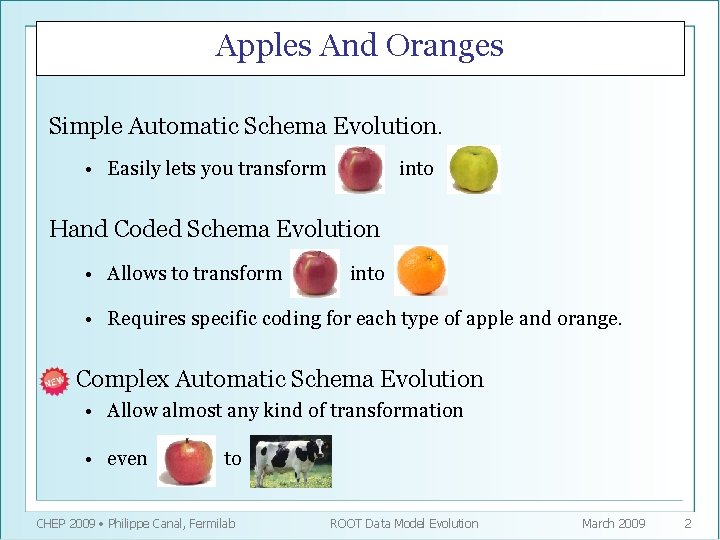
Apples And Oranges Simple Automatic Schema Evolution. • Easily lets you transform into Hand Coded Schema Evolution • Allows to transform into • Requires specific coding for each type of apple and orange. Complex Automatic Schema Evolution • Allow almost any kind of transformation • even apples to oranges CHEP 2009 • Philippe Canal, Fermilab ROOT Data Model Evolution March 2009 2
A Brief history of ROOT’s support for Schema Evolution CHEP 2009 • Philippe Canal, Fermilab ROOT Data Model Evolution March 2009 3
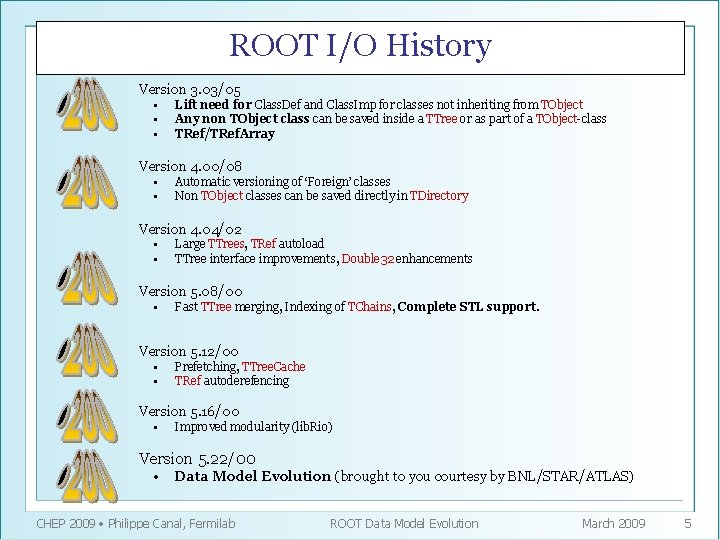
ROOT I/O History Version 0. 9 • Hand-written Streamers Version 1 • • Streamers generated via rootcint Support for Class Version 2. 25 • • • Support for Byte. Count Several attempts to introduce automatic class evolution Simple support for STL Only hand coded and generated streamer function, Schema evolution done by hand I/O requires : Class. Def, Class. Imp and CINT Dictionary Version 2. 26 – 3. 00 • • Automatic schema evolution Use TStreamer. Info (with info from dictionary) to drive a general I/O routine. Self describing files Make. Project can regenerate the file’s classes layout CHEP 2009 • Philippe Canal, Fermilab ROOT Data Model Evolution March 2009 4
ROOT I/O History Version 3. 03/05 • • • Lift need for Class. Def and Class. Imp for classes not inheriting from TObject Any non TObject class can be saved inside a TTree or as part of a TObject-class TRef/TRef. Array Version 4. 00/08 • • Automatic versioning of ‘Foreign’ classes Non TObject classes can be saved directly in TDirectory Version 4. 04/02 • • Large TTrees, TRef autoload TTree interface improvements, Double 32 enhancements Version 5. 08/00 • Fast TTree merging, Indexing of TChains, Complete STL support. Version 5. 12/00 • • Prefetching, TTree. Cache TRef autoderefencing Version 5. 16/00 • Improved modularity (lib. Rio) Version 5. 22/00 • Data Model Evolution (brought to you courtesy by BNL/STAR/ATLAS) CHEP 2009 • Philippe Canal, Fermilab ROOT Data Model Evolution March 2009 5
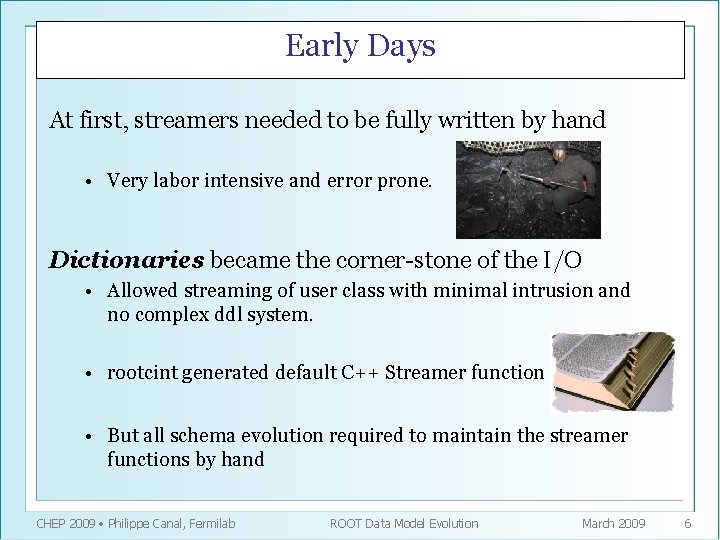
Early Days At first, streamers needed to be fully written by hand • Very labor intensive and error prone. Dictionaries became the corner-stone of the I/O • Allowed streaming of user class with minimal intrusion and no complex ddl system. • rootcint generated default C++ Streamer function • But all schema evolution required to maintain the streamer functions by hand CHEP 2009 • Philippe Canal, Fermilab ROOT Data Model Evolution March 2009 6
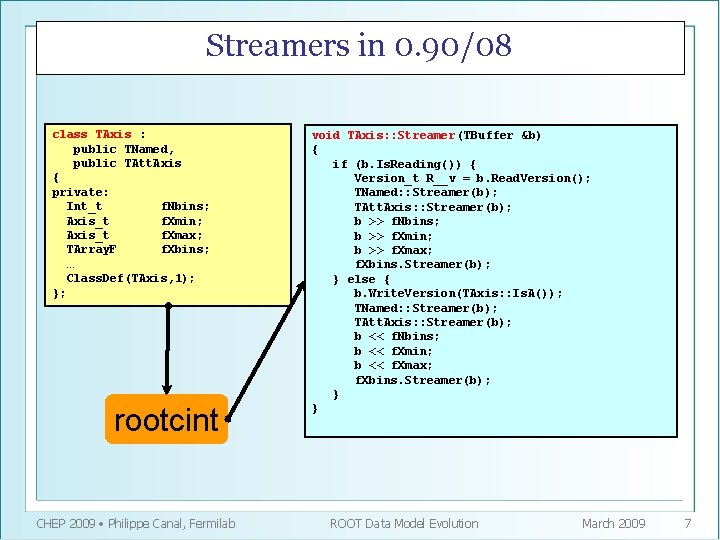
Streamers in 0. 90/08 class TAxis : public TNamed, public TAtt. Axis { private: Int_t f. Nbins; Axis_t f. Xmin; Axis_t f. Xmax; TArray. F f. Xbins; … Class. Def(TAxis, 1); }; rootcint CHEP 2009 • Philippe Canal, Fermilab void TAxis: : Streamer(TBuffer &b) { if (b. Is. Reading()) { Version_t R__v = b. Read. Version(); TNamed: : Streamer(b); TAtt. Axis: : Streamer(b); b >> f. Nbins; b >> f. Xmin; b >> f. Xmax; f. Xbins. Streamer(b); } else { b. Write. Version(TAxis: : Is. A()); TNamed: : Streamer(b); TAtt. Axis: : Streamer(b); b << f. Nbins; b << f. Xmin; b << f. Xmax; f. Xbins. Streamer(b); } } ROOT Data Model Evolution March 2009 7
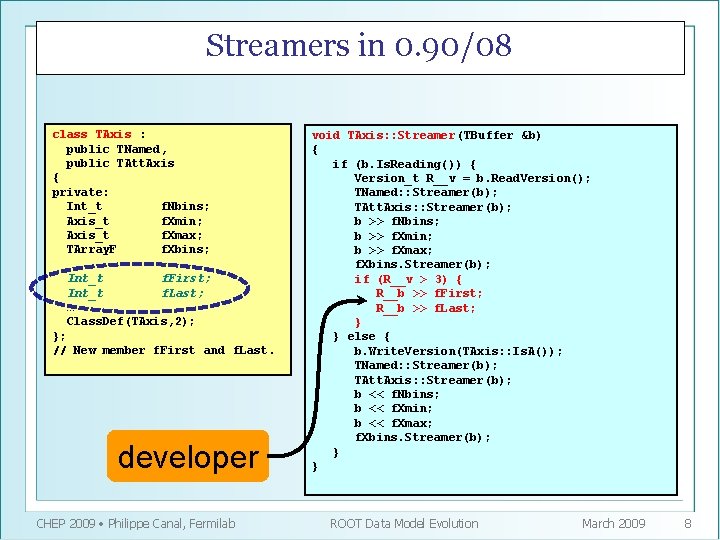
Streamers in 0. 90/08 class TAxis : public TNamed, public TAtt. Axis { private: Int_t f. Nbins; Axis_t f. Xmin; Axis_t f. Xmax; TArray. F f. Xbins; Int_t f. First; Int_t f. Last; … Class. Def(TAxis, 2); }; // New member f. First and f. Last. developer CHEP 2009 • Philippe Canal, Fermilab void TAxis: : Streamer(TBuffer &b) { if (b. Is. Reading()) { Version_t R__v = b. Read. Version(); TNamed: : Streamer(b); TAtt. Axis: : Streamer(b); b >> f. Nbins; b >> f. Xmin; b >> f. Xmax; f. Xbins. Streamer(b); if (R__v > 3) { R__b >> f. First; R__b >> f. Last; } } else { b. Write. Version(TAxis: : Is. A()); TNamed: : Streamer(b); TAtt. Axis: : Streamer(b); b << f. Nbins; b << f. Xmin; b << f. Xmax; f. Xbins. Streamer(b); } } ROOT Data Model Evolution March 2009 8
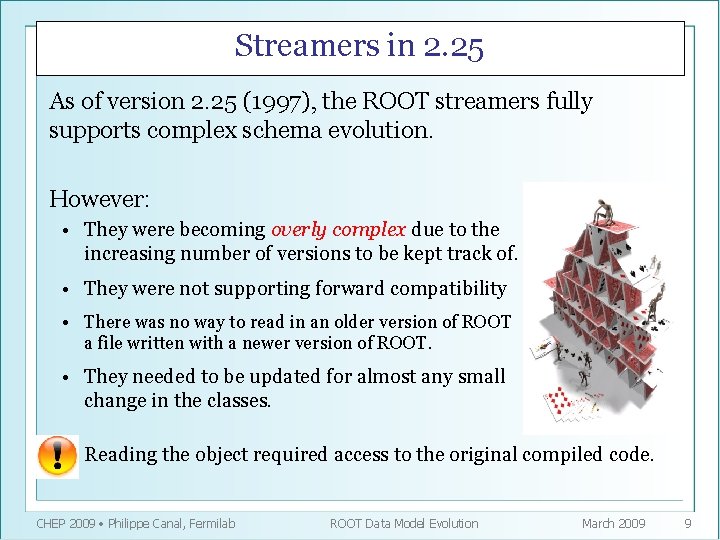
Streamers in 2. 25 As of version 2. 25 (1997), the ROOT streamers fully supports complex schema evolution. However: • They were becoming overly complex due to the increasing number of versions to be kept track of. • They were not supporting forward compatibility • There was no way to read in an older version of ROOT a file written with a newer version of ROOT. • They needed to be updated for almost any small change in the classes. • Reading the object required access to the original compiled code. CHEP 2009 • Philippe Canal, Fermilab ROOT Data Model Evolution March 2009 9
2000 - Streamer. Info ROOT Files are now self describing • • • Dictionary for persistent classes written to the file when closing the file. ROOT files can be read by foreign readers (JAS for example) Support for Backward and Forward compatibility Files created in 2003 can be read in 2015 Classes (data objects) for all objects in a file can be regenerated via TFile: : Make. Project • Data can be read without the original code Support for simple automatic schema evolution: • • Change the order of the members Change simple data type (float to int) Add or remove data members, base classes Migrate a member to base class CHEP 2009 • Philippe Canal, Fermilab ROOT Data Model Evolution March 2009 10
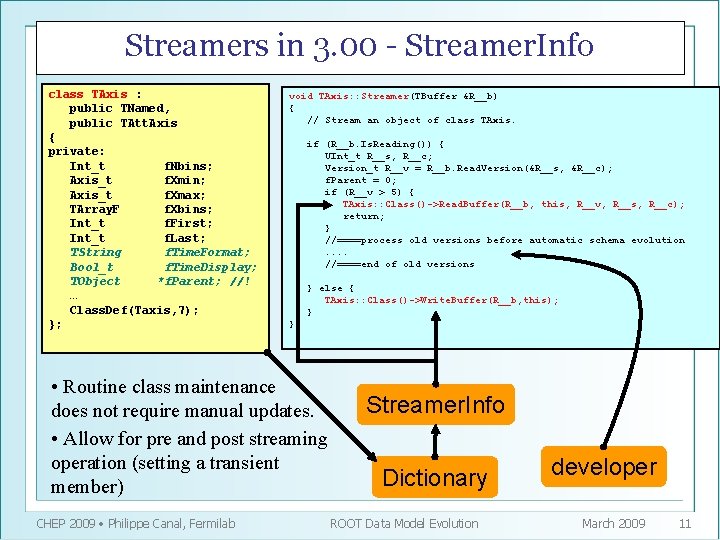
Streamers in 3. 00 - Streamer. Info class TAxis : public TNamed, public TAtt. Axis { private: Int_t f. Nbins; Axis_t f. Xmin; Axis_t f. Xmax; TArray. F f. Xbins; Int_t f. First; Int_t f. Last; TString f. Time. Format; Bool_t f. Time. Display; TObject *f. Parent; //! … Class. Def(Taxis, 7); }; void TAxis: : Streamer(TBuffer &R__b) { // Stream an object of class TAxis. if (R__b. Is. Reading()) { UInt_t R__s, R__c; Version_t R__v = R__b. Read. Version(&R__s, &R__c); f. Parent = 0; if (R__v > 5) { TAxis: : Class() >Read. Buffer(R__b, this, R__v, R__s, R__c); return; } //====process old versions before automatic schema evolution . . //====end of old versions } else { TAxis: : Class() >Write. Buffer(R__b, this); } } • Routine class maintenance does not require manual updates. • Allow for pre and post streaming operation (setting a transient member) CHEP 2009 • Philippe Canal, Fermilab Streamer. Info Dictionary ROOT Data Model Evolution developer March 2009 11
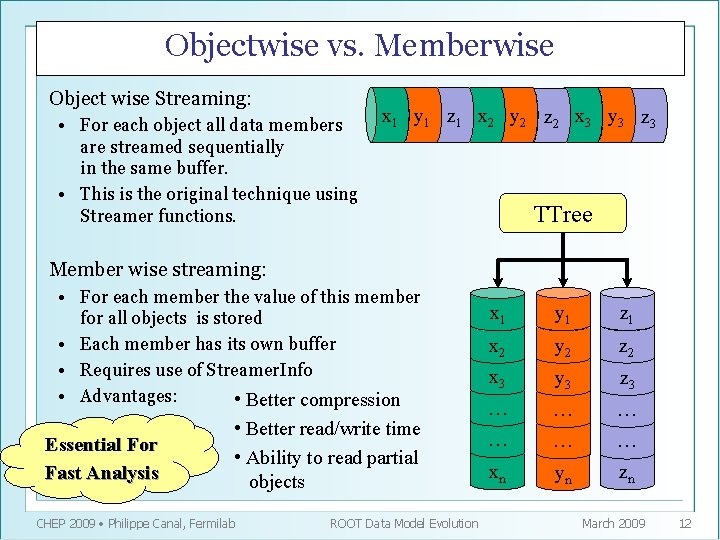
Objectwise vs. Memberwise Object wise Streaming: • For each object all data members are streamed sequentially in the same buffer. • This is the original technique using Streamer functions. x 1 y 1 z 1 x 2 y 2 z 2 x 3 y 3 z 3 TTree Member wise streaming: • For each member the value of this member for all objects is stored • Each member has its own buffer • Requires use of Streamer. Info • Advantages: • Better compression Essential For Fast Analysis • Better read/write time • Ability to read partial objects CHEP 2009 • Philippe Canal, Fermilab ROOT Data Model Evolution x 1 y 1 z 1 x 2 y 2 z 2 x 3 y 3 z 3 … … … xn yn zn March 2009 12
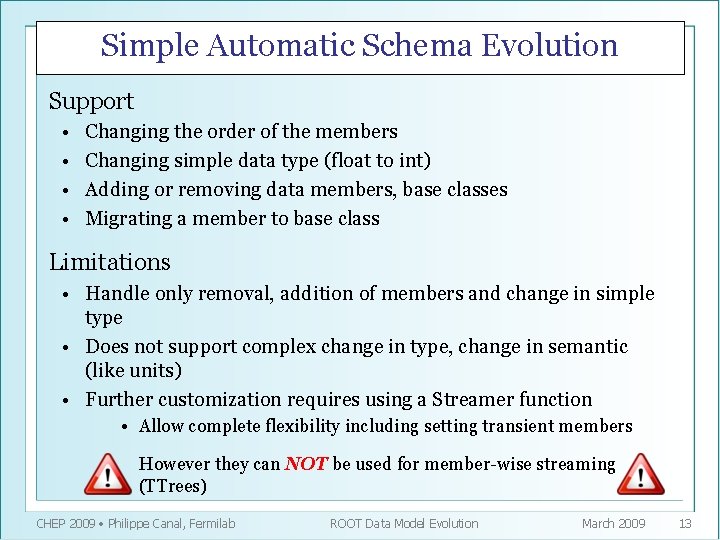
Simple Automatic Schema Evolution Support • • Changing the order of the members Changing simple data type (float to int) Adding or removing data members, base classes Migrating a member to base class Limitations • Handle only removal, addition of members and change in simple type • Does not support complex change in type, change in semantic (like units) • Further customization requires using a Streamer function • Allow complete flexibility including setting transient members However they can NOT be used for member-wise streaming (TTrees) CHEP 2009 • Philippe Canal, Fermilab ROOT Data Model Evolution March 2009 13
Complex Automatic Schema Evolution CHEP 2009 • Philippe Canal, Fermilab ROOT Data Model Evolution March 2009 14
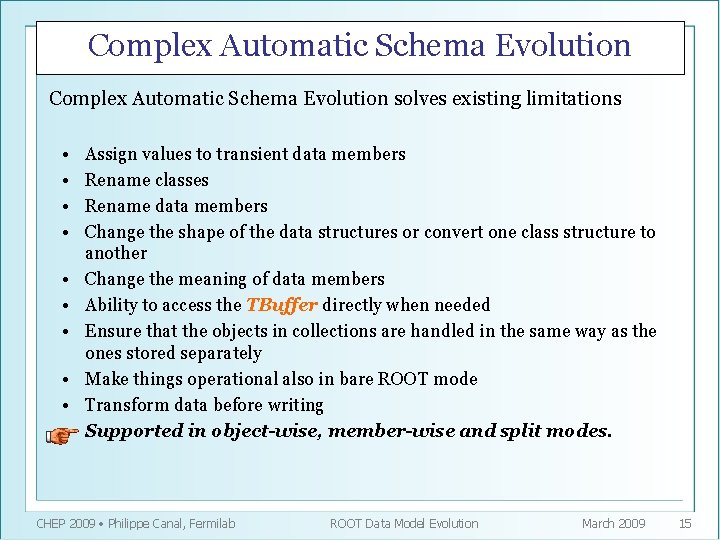
Complex Automatic Schema Evolution solves existing limitations • • • Assign values to transient data members Rename classes Rename data members Change the shape of the data structures or convert one class structure to another Change the meaning of data members Ability to access the TBuffer directly when needed Ensure that the objects in collections are handled in the same way as the ones stored separately Make things operational also in bare ROOT mode Transform data before writing Supported in object-wise, member-wise and split modes. CHEP 2009 • Philippe Canal, Fermilab ROOT Data Model Evolution March 2009 15
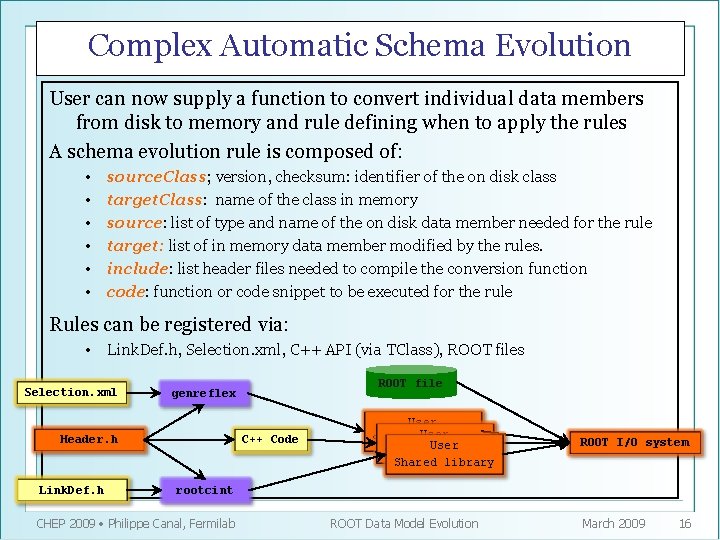
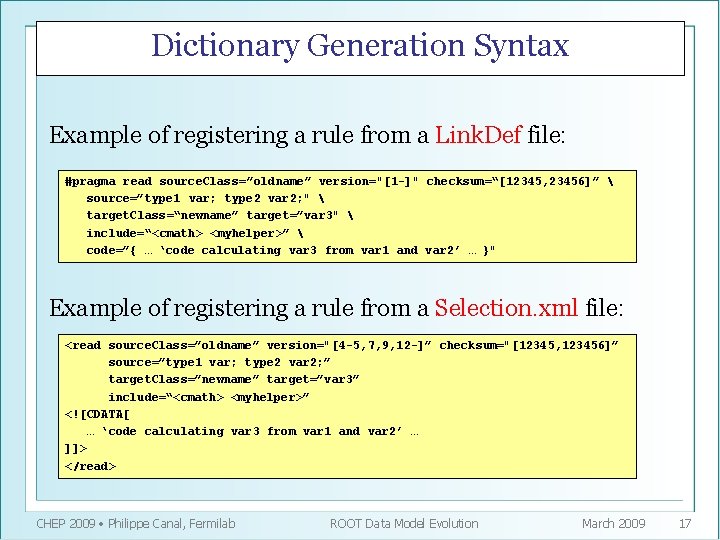
Complex Automatic Schema Evolution User can now supply a function to convert individual data members from disk to memory and rule defining when to apply the rules A schema evolution rule is composed of: • • • source. Class; version, checksum: identifier of the on disk class target. Class: name of the class in memory source: list of type and name of the on disk data member needed for the rule target: list of in memory data member modified by the rules. include: list header files needed to compile the conversion function code: function or code snippet to be executed for the rule Rules can be registered via: • Link. Def. h, Selection. xml, C++ API (via TClass), ROOT files Selection. xml C++ Code Header. h Link. Def. h ROOT file genreflex User Shared User library User Shared library ROOT I/O system rootcint CHEP 2009 • Philippe Canal, Fermilab ROOT Data Model Evolution March 2009 16
Dictionary Generation Syntax Example of registering a rule from a Link. Def file: #pragma read source. Class=”oldname” version="[1 ]" checksum=“[12345, 23456]” source=”type 1 var; type 2 var 2; " target. Class=“newname” target=”var 3" include=“<cmath> <myhelper>” code=”{ … ‘code calculating var 3 from var 1 and var 2’ … }" Example of registering a rule from a Selection. xml file: <read source. Class=”oldname” version="[4 5, 7, 9, 12 ]” checksum="[12345, 123456]” source=”type 1 var; type 2 var 2; ” target. Class=”newname” target=”var 3” include=“<cmath> <myhelper>” <![CDATA[ … ‘code calculating var 3 from var 1 and var 2’ … ]]> </read> CHEP 2009 • Philippe Canal, Fermilab ROOT Data Model Evolution March 2009 17
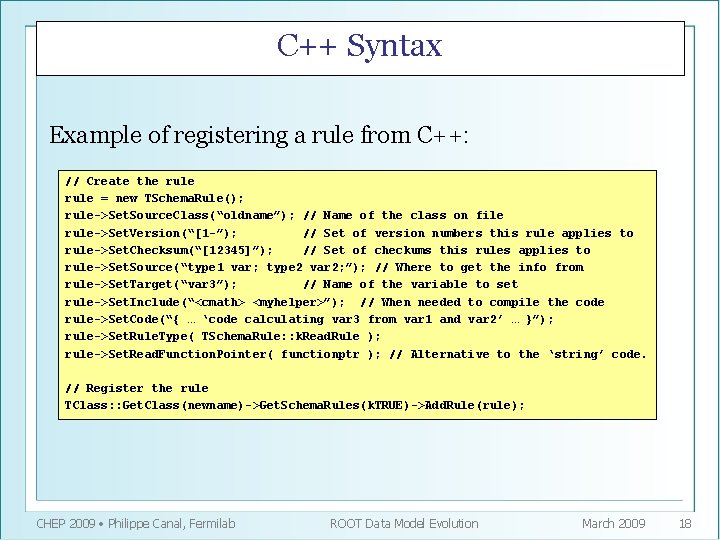
C++ Syntax Example of registering a rule from C++: // Create the rule = new TSchema. Rule(); rule >Set. Source. Class(“oldname”); // Name of the class on file rule >Set. Version(“[1 ”); // Set of version numbers this rule applies to rule >Set. Checksum(“[12345]”); // Set of checkums this rules applies to rule >Set. Source(“type 1 var; type 2 var 2; ”); // Where to get the info from rule >Set. Target(“var 3”); // Name of the variable to set rule >Set. Include(“<cmath> <myhelper>”); // When needed to compile the code rule >Set. Code(“{ … ‘code calculating var 3 from var 1 and var 2’ … }”); rule >Set. Rule. Type( TSchema. Rule: : k. Read. Rule ); rule >Set. Read. Function. Pointer( functionptr ); // Alternative to the ‘string’ code. // Register the rule TClass: : Get. Class(newname) >Get. Schema. Rules(k. TRUE) >Add. Rule(rule); CHEP 2009 • Philippe Canal, Fermilab ROOT Data Model Evolution March 2009 18
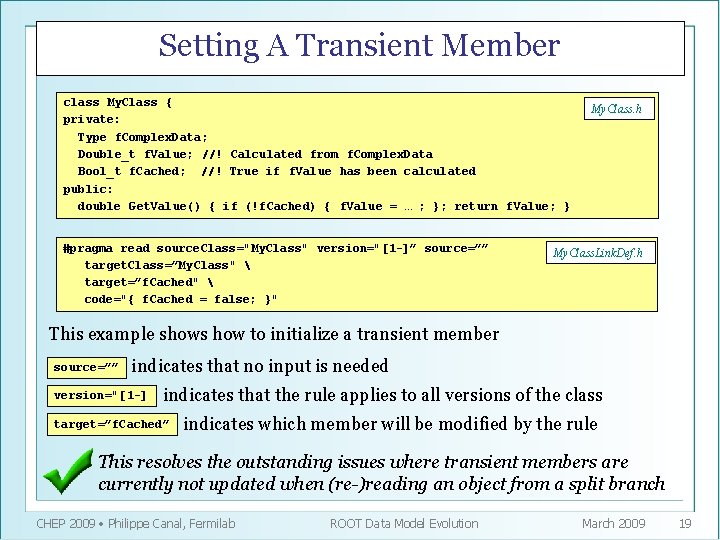
Setting A Transient Member class My. Class { private: Type f. Complex. Data; Double_t f. Value; //! Calculated from f. Complex. Data Bool_t f. Cached; //! True if f. Value has been calculated public: double Get. Value() { if (!f. Cached) { f. Value = … ; }; return f. Value; } #pragma read source. Class="My. Class" version="[1 ]” source=”” target. Class=”My. Class" target=”f. Cached" code="{ f. Cached = false; }" My. Class. h My. Class. Link. Def. h This example shows how to initialize a transient member source=”” indicates that no input is needed source=“” version="[1 ] indicates that the rule applies to all versions of the class version=“[1 -] target=”f. Cached” indicates which member will be modified by the rule target=“f. Cached This resolves the outstanding issues where transient members are currently not updated when (re-)reading an object from a split branch CHEP 2009 • Philippe Canal, Fermilab ROOT Data Model Evolution March 2009 19
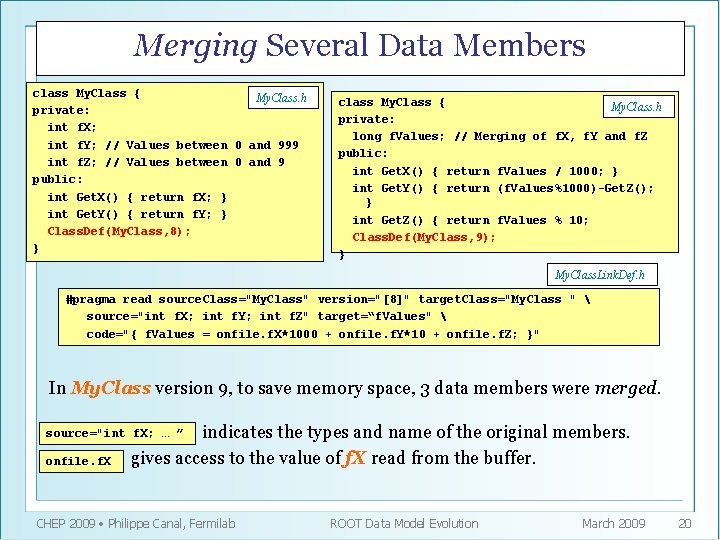
Merging Several Data Members class My. Class { My. Class. h private: int f. X; int f. Y; // Values between 0 and 999 int f. Z; // Values between 0 and 9 public: int Get. X() { return f. X; } int Get. Y() { return f. Y; } Class. Def(My. Class, 8); } class My. Class { My. Class. h private: long f. Values; // Merging of f. X, f. Y and f. Z public: int Get. X() { return f. Values / 1000; } int Get. Y() { return (f. Values%1000) Get. Z(); } int Get. Z() { return f. Values % 10; Class. Def(My. Class, 9); } My. Class. Link. Def. h #pragma read source. Class="My. Class" version="[8]" target. Class="My. Class " source="int f. X; int f. Y; int f. Z" target=“f. Values" code="{ f. Values = onfile. f. X*1000 + onfile. f. Y*10 + onfile. f. Z; }" In My. Class version 9, to save memory space, 3 data members were merged. source="int f. X; … ” source=“int f. X; . . ”: indicates the types and name of the original members. onfile. f. X gives access to the value of f. X read from the buffer. onfile. f. X CHEP 2009 • Philippe Canal, Fermilab ROOT Data Model Evolution March 2009 20
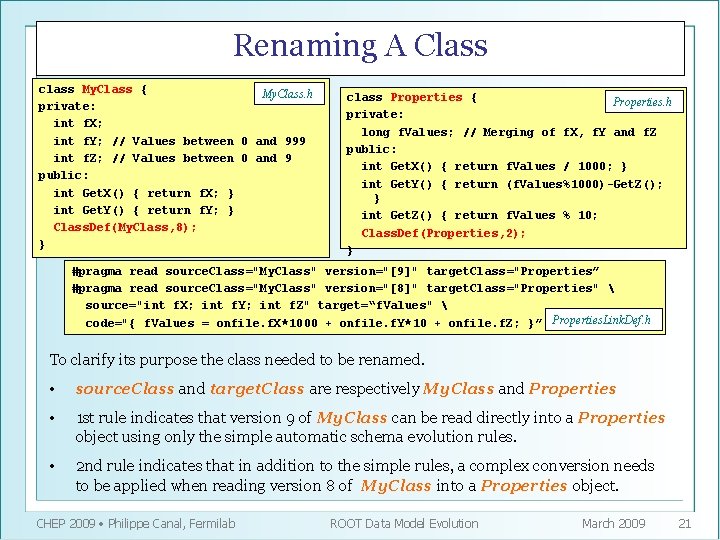
Renaming A Class class My. Class { My. Class. h private: int f. X; int f. Y; // Values between 0 and 999 int f. Z; // Values between 0 and 9 public: int Get. X() { return f. X; } int Get. Y() { return f. Y; } Class. Def(My. Class, 8); } class Properties { Properties. h private: long f. Values; // Merging of f. X, f. Y and f. Z public: int Get. X() { return f. Values / 1000; } int Get. Y() { return (f. Values%1000) Get. Z(); } int Get. Z() { return f. Values % 10; Class. Def(Properties, 2); } #pragma read source. Class="My. Class" version="[9]" target. Class="Properties” #pragma read source. Class="My. Class" version="[8]" target. Class="Properties" source="int f. X; int f. Y; int f. Z" target=“f. Values" code="{ f. Values = onfile. f. X*1000 + onfile. f. Y*10 + onfile. f. Z; }” Properties. Link. Def. h To clarify its purpose the class needed to be renamed. • source. Class and target. Class are respectively My. Class and Properties • 1 st rule indicates that version 9 of My. Class can be read directly into a Properties object using only the simple automatic schema evolution rules. • 2 nd rule indicates that in addition to the simple rules, a complex conversion needs to be applied when reading version 8 of My. Class into a Properties object. CHEP 2009 • Philippe Canal, Fermilab ROOT Data Model Evolution March 2009 21
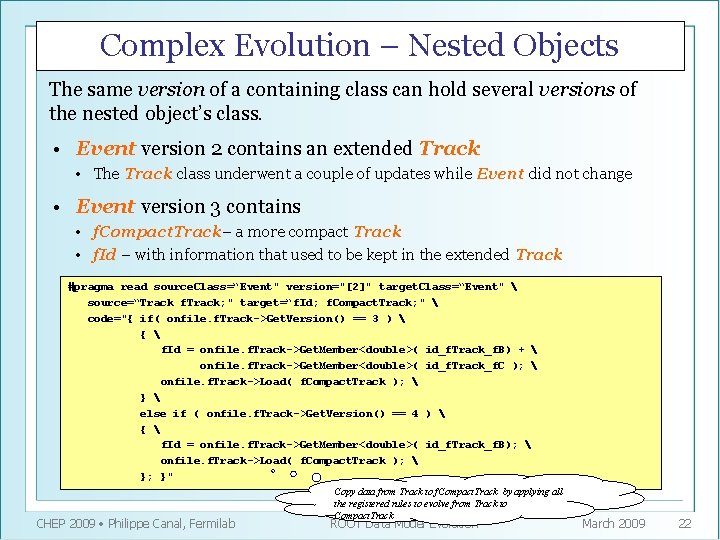
Complex Evolution – Nested Objects The same version of a containing class can hold several versions of the nested object’s class. • Event version 2 contains an extended Track • The Track class underwent a couple of updates while Event did not change • Event version 3 contains • f. Compact. Track– a more compact Track • f. Id – with information that used to be kept in the extended Track #pragma read source. Class=“Event" version="[2]" target. Class=“Event" source=“Track f. Track; " target=“f. Id; f. Compact. Track; " code="{ if( onfile. f. Track >Get. Version() == 3 ) { f. Id = onfile. f. Track >Get. Member<double>( id_f. Track_f. B) + onfile. f. Track >Get. Member<double>( id_f. Track_f. C ); onfile. f. Track >Load( f. Compact. Track ); } else if ( onfile. f. Track >Get. Version() == 4 ) { f. Id = onfile. f. Track >Get. Member<double>( id_f. Track_f. B); onfile. f. Track >Load( f. Compact. Track ); }; }" CHEP 2009 • Philippe Canal, Fermilab Copy data from Track to f. Compact. Track by applying all the registered rules to evolve from Track to Compact. Track ROOT Data Model Evolution March 2009 22
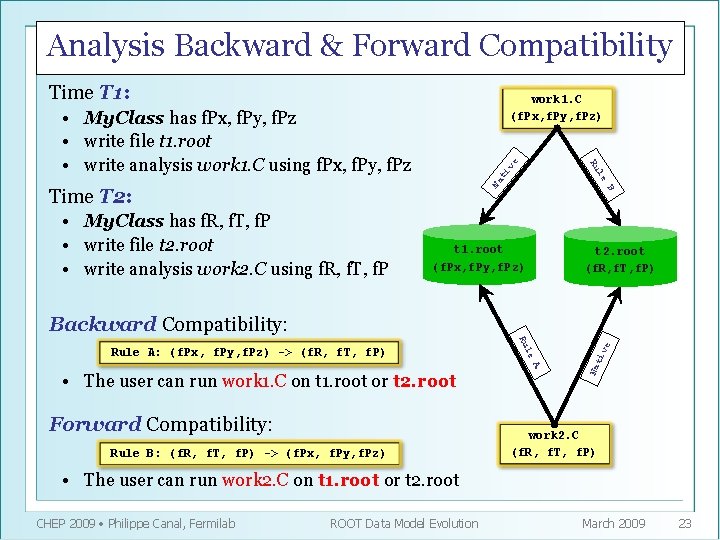
Analysis Backward & Forward Compatibility Time T 1: work 1. C (f. Px, f. Py, f. Pz) Time T 2: • My. Class has f. R, f. T, f. P • write file t 2. root • write analysis work 2. C using f. R, f. T, f. P B Na le ti Ru ve • My. Class has f. Px, f. Py, f. Pz • write file t 1. root • write analysis work 1. C using f. Px, f. Py, f. Pz t 1. root (f. Px, f. Py, f. Pz) t 2. root (f. R, f. T, f. P) Rule B: (f. R, f. T, f. P) > (f. Px, f. Py, f. Pz) Na t A Forward Compatibility: le • The user can run work 1. C on t 1. root or t 2. root Ru Rule A: (f. Px, f. Py, f. Pz) > (f. R, f. T, f. P) iv e Backward Compatibility: work 2. C (f. R, f. T, f. P) • The user can run work 2. C on t 1. root or t 2. root CHEP 2009 • Philippe Canal, Fermilab ROOT Data Model Evolution March 2009 23
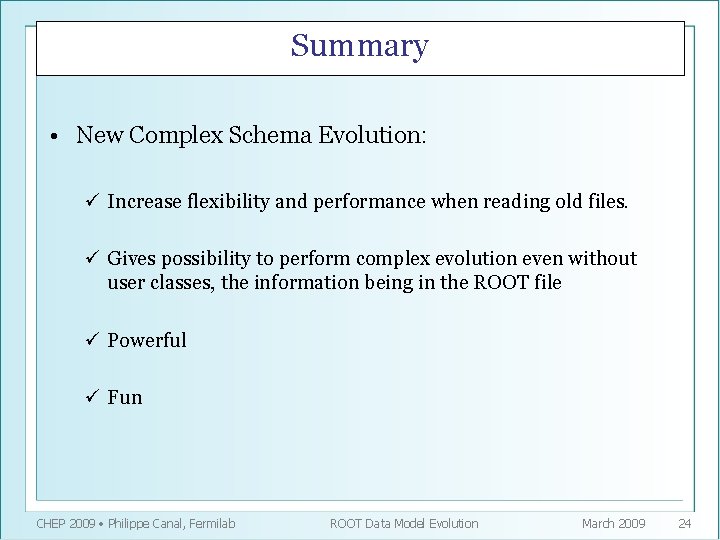
Summary • New Complex Schema Evolution: ü Increase flexibility and performance when reading old files. ü Gives possibility to perform complex evolution even without user classes, the information being in the ROOT file ü Powerful ü Fun CHEP 2009 • Philippe Canal, Fermilab ROOT Data Model Evolution March 2009 24