
Automatic Question Generation for Vocabulary Assessment Jonathan C
Automatic Question Generation for Vocabulary Assessment Jonathan C. Brown, Gwen A. Frishkoff , Maxine Eskenazi Proceedings of Human Language Technology Conference and Conference on Empirical Methods in Natural Language Processing (HLT/EMNLP), pages 819– 826, Vancouver, October 2005. c 2005 Association for Computational Linguistics 2021/12/14 1
AGENDA �Introduction �Measuring Vocabulary Knowledge �Question Generation ◦ Question Types ◦ Question Forms �Question Assessment ◦ Question Coverage ◦ Experiment Design ◦ Experiment Results �Conclusions 2021/12/14 2
Introduction �The REAP system automatically provides users with individualized authentic texts to read. �These texts, usually retrieved from the Web, are chosen to satisfy several criteria. 2021/12/14 3
Introduction �To match the reading level of the student: ◦ The system can locate documents that include a given percentage (e. g. , 95%) of words that are known to the student. The remaining percentage (e. g. 5%) consists of new words that the student needs to learn. �After reading the text, the student’s understanding of new words is assessed. �The student’s responses are used to update the student model, to support retrieval of future documents that take into account the changes in student word knowledge. 2021/12/14 4
Introduction �In this paper, we describe our work on automatic generation of vocabulary assessment questions. �We also report results from a study that was designed to assess the validity of the generated questions. 2021/12/14 5
AGENDA �Introduction �Measuring Vocabulary Knowledge �Question Generation ◦ Question Types ◦ Question Forms �Question Assessment ◦ Question Coverage ◦ Experiment Design ◦ Experiment Results �Conclusions 2021/12/14 6
Measuring Vocabulary Knowledge �Several models have been proposed to account for these multiple levels of word knowledge. �Dale posited four stages of knowledge of word meaning (Dale and O’Rourke, 1965). �Stahl (1986) proposed a similar model of word knowledge, the levels of which overlap with Dale’s last two stages. 2021/12/14 7
Measuring Vocabulary Knowledge �The first level : association processing. � The second level : comprehension processing. �The third level : generation processing. �Taking Stahl’s framework as a working model, we constructed multiple types of vocabulary questions designed to assess different “stages” or “levels” of word knowledge. 2021/12/14 8
AGENDA �Introduction �Measuring Vocabulary Knowledge �Question Generation ◦ Question Types ◦ Question Forms �Question Assessment ◦ Question Coverage ◦ Experiment Design ◦ Experiment Results �Conclusions 2021/12/14 9
Question Types �The information available in Word. Net, we generated 6 types of questions: definition, synonym, antonym, hypernym, hyponym, and cloze questions. �We select the most frequently used sense of the word with the correct POS, using Word. Net’s frequency data. 2021/12/14 10
Question Types �The input is comprised of just the target word and its part of speech (POS). �The words of the document were already automatically POS annotated. �If we have only the word, we select the most frequent sense, ignoring part of speech. 2021/12/14 11
Question Types 1: Definition question �The definition question requires a definition of the word, available in Word. Net’s gloss for the chosen sense. �The system chooses the first definition which does not include the target word. �The first of Stahl’s three levels: association processing. 2021/12/14 12

Question Types 2: Synonym question �The system can extract this synonym from Word. Net using two methods. �One method is to select words that belong to the same synset as the target word and are thus synonyms. �The other method is that the synonym relation in Word. Net may connect this synset to another synset, and all the words in the latter are acceptable synonyms. �The first or the second of Stahl’s three levels: association processing or comprehension processing. 2021/12/14 13
Question Types 3: Antonym question �Word. Net provides two kinds of relations that can be used to procure antonyms: direct and indirect antonyms. �Direct antonyms are antonyms of the target word, whereas indirect antonyms are direct antonyms of a synonym of the target. 2021/12/14 14
Question Types 3: Antonym question �The words “fast” and “slow” are direct antonyms of one another. �The word “quick” does not have a direct antonym, but it does have an indirect antonym, “slow”, via “fast”, its synonym. �The second of Stahl’s three levels: comprehension processing. 2021/12/14 15

Question Types 4 and 5: Hypernym and Hyponym question �The hypernym and hyponym questions are similar in structure. �Hypernym is the generic term used to describe a whole class of specific instances. The word “organism” is a hypernym of “person”. �Hyponyms are members of a class. The words “adult”, “expert” and “worker” are hyponyms of “person”. �The second of Stahl’s three levels: comprehension processing. 2021/12/14 16
Question Types 6: Cloze question �It requires the use of the target word in a specific context, either a complete sentence or a phrase. �The example sentence or phrase is retrieved from the gloss for a specific word sense in Word. Net. �The present word is replaced by a blank in the cloze question phrase. 2021/12/14 17
Question Types 6: Cloze question �Some consider a cloze question to be more difficult than any of the other question types. �The second of Stahl’s three levels: comprehension processing. 2021/12/14 18
Question Types �Question types: ◦ Dale’s all four stages(1965) ◦ Stahl’s first two stages(1986) ◦ do not provide Stahl’s highest level, generation processing, where the testee must write a sentence using the word in a personalized context. �We expect the six question types to be of increasing difficulty, with definition or synonym being the easiest and cloze the hardest. 2021/12/14 19
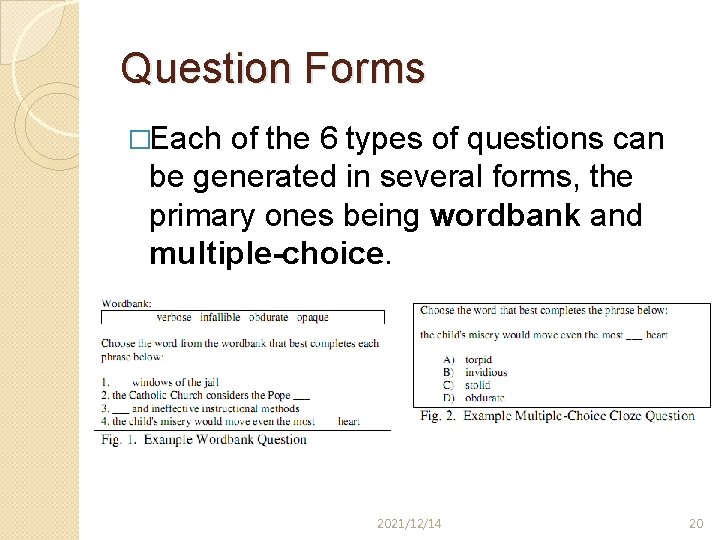
Question Forms �Each of the 6 types of questions can be generated in several forms, the primary ones being wordbank and multiple-choice. 2021/12/14 20
Question Forms �For the definition version, each of the items is a definition. The testee must select the word which best corresponds to the definition. �For the synonym and antonym questions, the testee selects the word which is the most similar or the most opposite in meaning to the synonym or antonym. �For the hypernym and hyponym question types, the testee is asked to complete phrases such as “___ is a kind of person” (with target “adult”) or “person is a kind of ___” (with target “organism”). 2021/12/14 21
Question Forms �In the cloze question, the testee fills in the blank with the appropriate word. �Concerning distractor choice, the question generation system chooses distractors of the same part of speech and similar frequency to the correct answer. �The system chooses distractors based on the British National Corpus (BNC) (Burnage, 1991). 2021/12/14 22
AGENDA �Introduction �Measuring Vocabulary Knowledge �Question Generation ◦ Question Types ◦ Question Forms �Question Assessment ◦ Question Coverage ◦ Experiment Design ◦ Experiment Results �Conclusions 2021/12/14 23
Question Assessment �The validity of the automatically generated vocabulary questions was examined in reference to humangenerated questions for 75 lowfrequency English words. �We compared student performance (accuracy and response time) on the computer and human-generated questions. �We focused on the automatically generated multiple-choice questions, with distractors based on frequency and 2021/12/14 24
Question Assessment �Four of the six computer-generated question types were assessed: the definition, synonym, antonym, and cloze questions. �Hypernym and hyponym questions were excluded, since we were unable to generate a large number of these questions for adjectives, which constitute a large portion of the word list. 2021/12/14 25
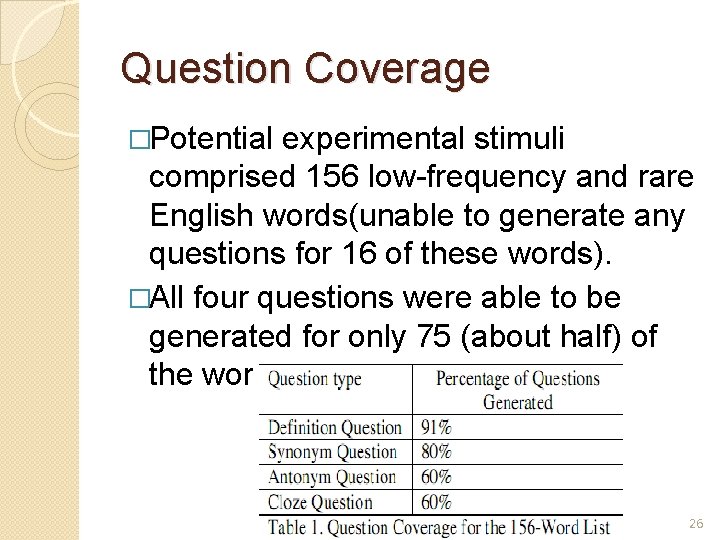
Question Coverage �Potential experimental stimuli comprised 156 low-frequency and rare English words(unable to generate any questions for 16 of these words). �All four questions were able to be generated for only 75 (about half) of the words. 2021/12/14 26
Experiment Design �Behavioral measures of vocabulary knowledge were acquired for the 75 target words using the four computer -generated question types, as well as five human-generated question types. �The human-generated questions were developed by a group of three learning researchers, without knowledge of the computer-generated question types. 2021/12/14 27
Experiment Design �Two of the five human-generated assessments, the synonym and cloze questions, were similar in form to the corresponding computer-generated question types in that they had the same type of stem and answer. �The other three human-generated questions included an inference task, a sentence completion task, and a question. 2021/12/14 28
Experiment Design �In the inference task, participants were asked to select a context where the target word could be meaning fully applied. �For example, the correct response to the question “Which of the following is most likely to be lenitive? ” was “a glass of iced tea, ” and distractors were “a shot of tequila, ” “a bowl of rice, ” and “a cup of chowder. ” 2021/12/14 29
Experiment Design �In the sentence completion task, the participant was presented with a sentence fragment containing the target word and was asked to choose the most probable completion. �For example, the stem could be “The music was so lenitive…, ” with the correct answer “…it was tempting to lie back and go to sleep, ” and with distractors such as “…it took some concentration to appreciate the complexity. ” 2021/12/14 30
Experiment Design �The fifth question type was a factoranalytic model of word-level semantic dimensions. �In addition to the human-generated questions, we administered a battery of standardized tests, including the Nelson-Denny Reading Test, the Raven’s Matrices Test, and the Lexical Knowledge Battery. 2021/12/14 31
Experiment Design �The Nelson-Denny Reading Test is a standardized test of vocabulary and reading comprehension(Brown, 1981). �The Raven’s Matrices Test is a test of non-verbal reasoning(Raven, 1960). �The Lexical Knowledge Battery has multiple subsections that test orthographic and phonological skills 2021/12/14 32
Experiment Design �Twenty-one native-English speaking adults participated in two experiment sessions. �Session 1 lasted for about one hour and included the battery of vocabulary and reading-related assessments described above. �Session 2 lasted between two and three hours and comprised 9 tasks, including the five human and four computer-generated questions. 2021/12/14 33
Experiment Design �The experiment began with a confidence -rating task, in which participants indicated with a key press how well they knew the meaning of each target word (on a 1– 5 scale). �For the remaining tasks, subjects were asked to respond “as quickly as possible without making errors. ” �The order of the tasks (question types) and the order of the 75 items within each task were randomized across subjects. 2021/12/14 34
Experiment Results �We report on four aspects of this study: participant performance on questions, correlations between question types, correlations with confidence ratings, and correlations with external assessments. �Mean accuracy scores for each question type varied from. 5286 to. 6452. 2021/12/14 35
Experiment Results �The easiest question types, were the computer-generated definition task and the human-generated semantic differential task, both having mean accuracy scores of. 6452. �The hardest was the computergenerated cloze task, with a mean score of. 5286. 2021/12/14 36
Experiment Results �We also computed correlations between the different question types. Mean accuracies were highly and statistically significantly correlated across the nine question types (r>. 7, p<. 01 for all correlations). �The correlation between participant accuracy on the computer-generated synonym and the human-generated synonym questions was particularly high (r=. 906), as was the correlation between the human and computer cloze questions (r=. 860). 2021/12/14 37
Experiment Results �The response-time (RT) for the human versus computer versions of both the synonym and cloze questions were strongly correlated (r>. 7, p<. 01). �An item analysis (test item discrimination) was also performed. This analysis revealed relatively low correlations(. 12 < r <. 25) between the individual question types and the test as a whole(without that question type). 2021/12/14 38
Experiment Results �The average total-score correlations for the four computer-generated questions (r=. 18) and for the five human-generated questions (r=. 19) were not significantly different. �The average correlation between accuracy on the question types and confidence ratings for a particular word was. 265. �The correlations between the accuracy on each of the nine question types and the Nelson-Denny vocabulary subtest 2021/12/14 39
AGENDA �Introduction �Measuring Vocabulary Knowledge �Question Generation ◦ Question Types ◦ Question Forms �Question Assessment ◦ Question Coverage ◦ Experiment Design ◦ Experiment Results �Conclusions 2021/12/14 40
Conclusions �We have described the six types of computer-generated questions and the forms in which they appear. �Extending our experiments to the question types that we have not yet assessed is an important next step. �One is the creation of new question types to test other aspects of word knowledge. �Another is using other resources such as text collections to enable us to generate more questions per word, especially for the cloze questions. 2021/12/14 41
Conclusions � Extending our experiments to the question types that we have not yet assessed is an important next step. � In addition, we want to assess questions individually, evaluating their use of distractors. � Finally, we need to assess questions generated on word lists with different characteristics. � There also a number of ongoing extensions � to this project. One is the creation of new question � types to test other aspects of word knowledge. An� other is using other resources such as text collec� tions to enable us to generate more questions per � word, especially for the cloze questions. 2021/12/14 42
- Slides: 42