
Automatic Programming Revisited Part II Synthesizer Algorithms Rastislav
![Ex : bit population count. int pop (bit[W] x) { int count = 0;](https://slidetodoc.com/presentation_image_h2/de02abb2e3adbb8529c92eb7bb596e2e/image-13.jpg "Ex : bit population count. int pop (bit[W] x) { int count = 0;")
![a. Lisp [Andre, Bhaskara, Russell, … 2002]](https://slidetodoc.com/presentation_image_h2/de02abb2e3adbb8529c92eb7bb596e2e/image-42.jpg "a. Lisp [Andre, Bhaskara, Russell, … 2002]")
![SMARTedit* [Lau, Wolfman, Domingos, Weld 2000]](https://slidetodoc.com/presentation_image_h2/de02abb2e3adbb8529c92eb7bb596e2e/image-50.jpg "SMARTedit* [Lau, Wolfman, Domingos, Weld 2000]")
![Prospector [Mandelin, Bodik, Kimelman 2005]](https://slidetodoc.com/presentation_image_h2/de02abb2e3adbb8529c92eb7bb596e2e/image-56.jpg "Prospector [Mandelin, Bodik, Kimelman 2005]")
- Slides: 65
Automatic Programming Revisited Part II: Synthesizer Algorithms Rastislav Bodik University of California, Berkeley
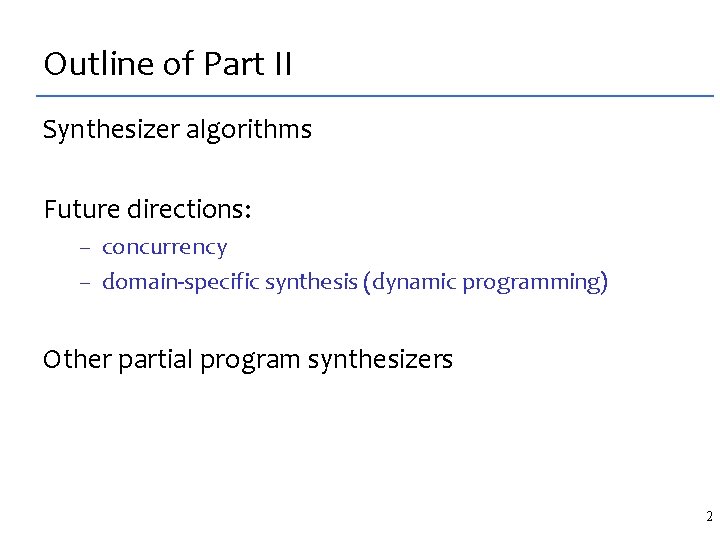
Outline of Part II Synthesizer algorithms Future directions: – concurrency – domain-specific synthesis (dynamic programming) Other partial program synthesizers 2
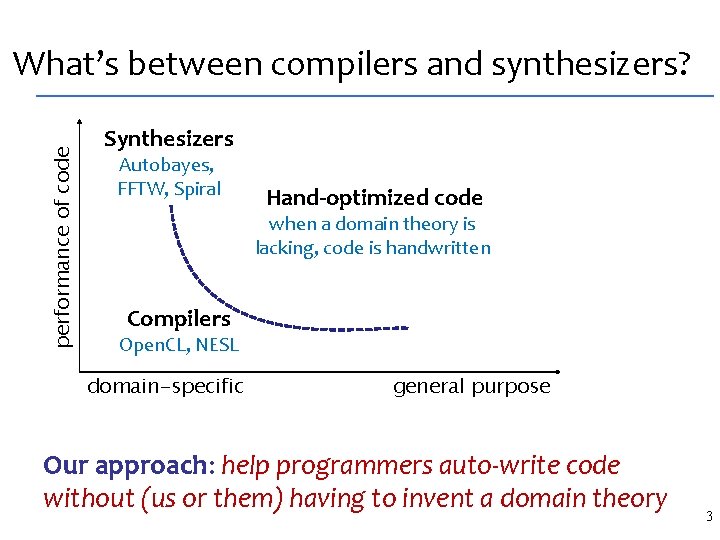
performance of code What’s between compilers and synthesizers? Synthesizers Autobayes, FFTW, Spiral Hand-optimized code when a domain theory is lacking, code is handwritten Compilers Open. CL, NESL domain-specific general purpose Our approach: help programmers auto-write code without (us or them) having to invent a domain theory 3
Automating code writing 4
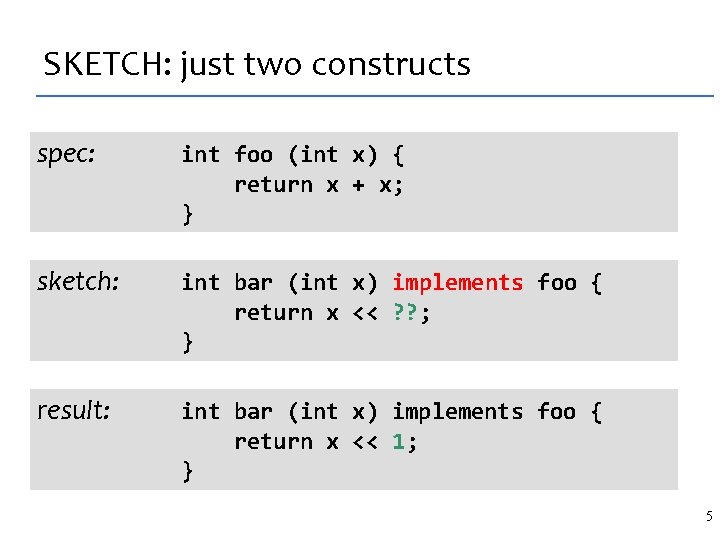
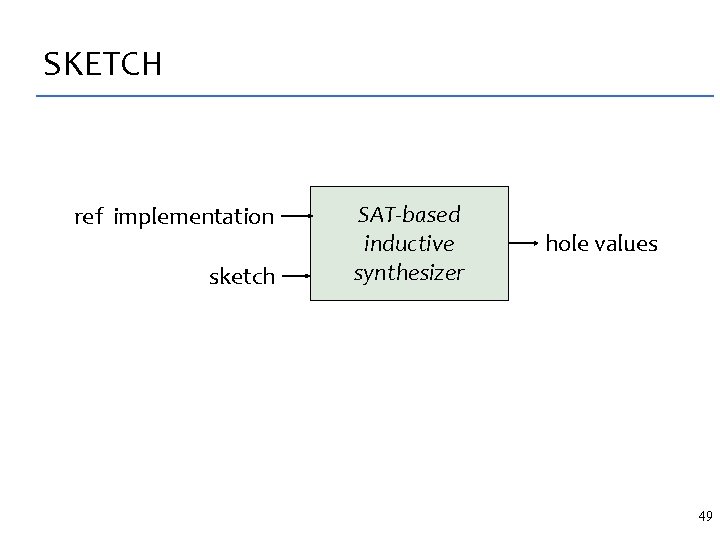
SKETCH: just two constructs spec: int foo (int x) { return x + x; } sketch: int bar (int x) implements foo { return x << ? ? ; } result: int bar (int x) implements foo { return x << 1; } 5
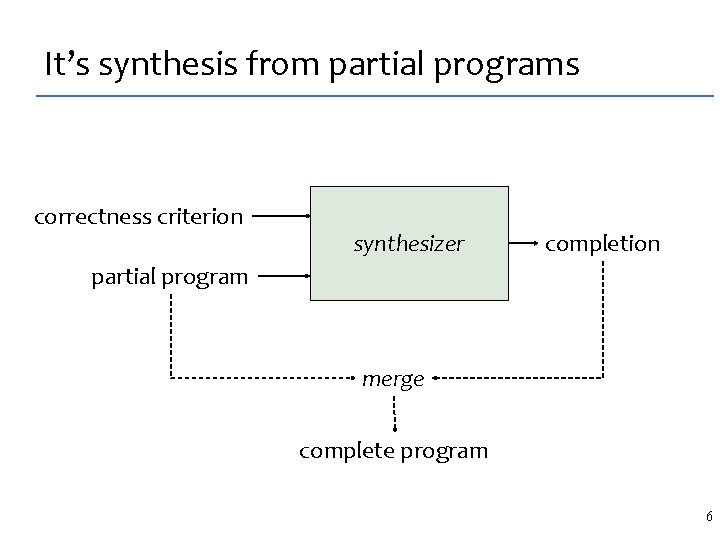
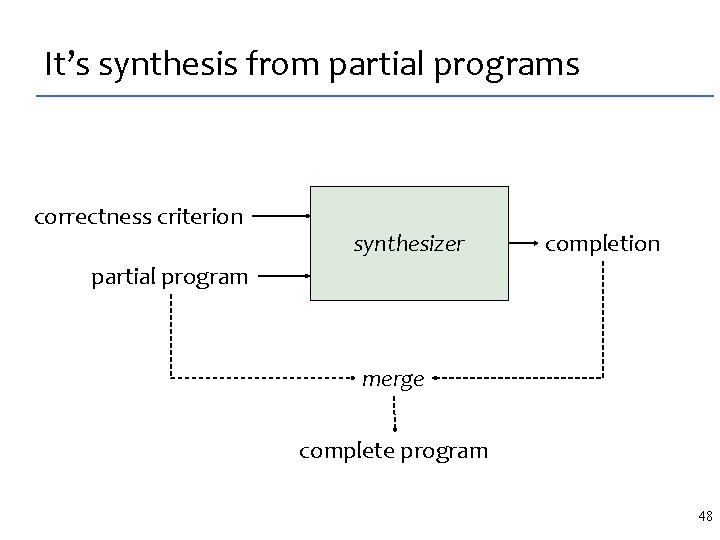
It’s synthesis from partial programs correctness criterion synthesizer completion partial program merge complete program 6
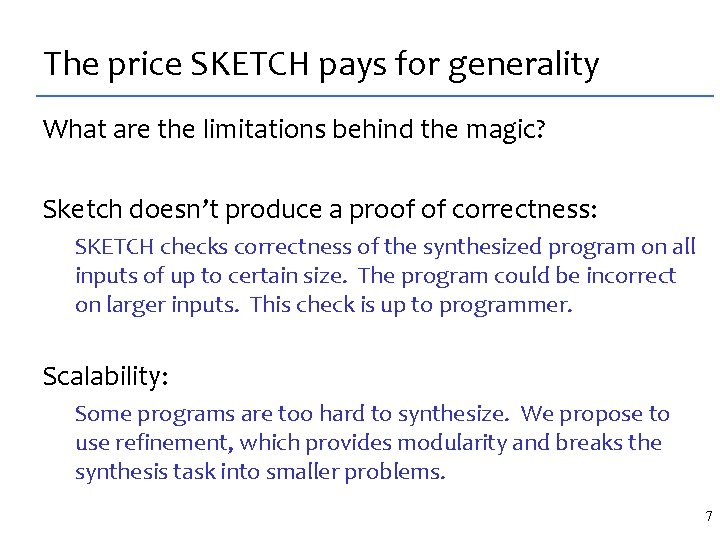
The price SKETCH pays for generality What are the limitations behind the magic? Sketch doesn’t produce a proof of correctness: SKETCH checks correctness of the synthesized program on all inputs of up to certain size. The program could be incorrect on larger inputs. This check is up to programmer. Scalability: Some programs are too hard to synthesize. We propose to use refinement, which provides modularity and breaks the synthesis task into smaller problems. 7
Counterexample-Guided Inductive Synthesis (CEGIS) 8
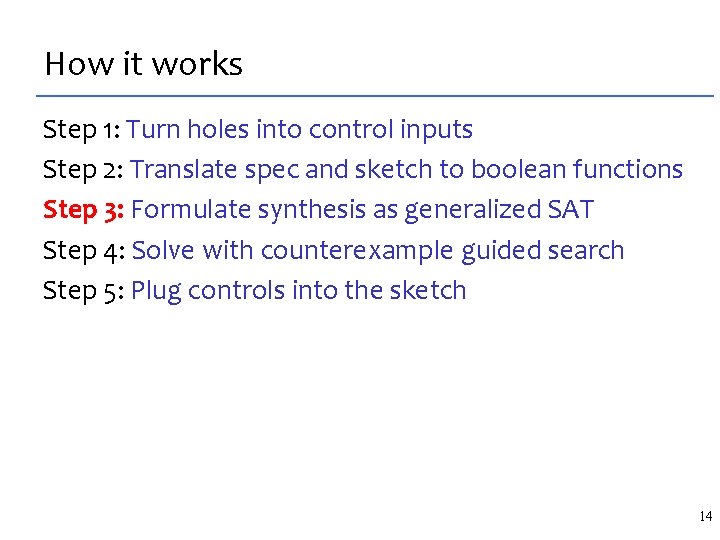
How it works Step 1: Turn holes into control inputs Step 2: Translate spec and sketch to boolean functions Step 3: Formulate synthesis as generalized SAT Step 4: Solve with counterexample guided search Step 5: Plug controls into the sketch 9
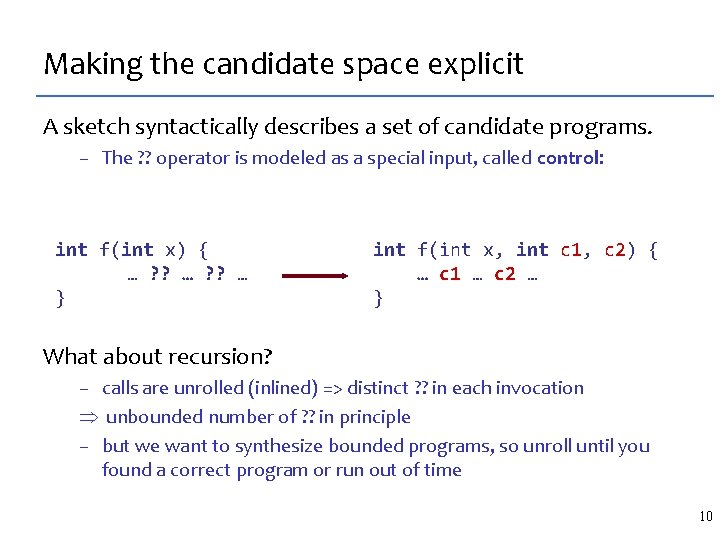
Making the candidate space explicit A sketch syntactically describes a set of candidate programs. – The ? ? operator is modeled as a special input, called control: int f(int x) { … ? ? … } int f(int x, int c 1, c 2) { … c 1 … c 2 … } What about recursion? – calls are unrolled (inlined) => distinct ? ? in each invocation Þ unbounded number of ? ? in principle – but we want to synthesize bounded programs, so unroll until you found a correct program or run out of time 10
How it works Step 1: Turn holes into control inputs Step 2: Translate spec and sketch to boolean functions Step 3: Formulate synthesis as generalized SAT Step 4: Solve with counterexample guided search Step 5: Plug controls into the sketch 11
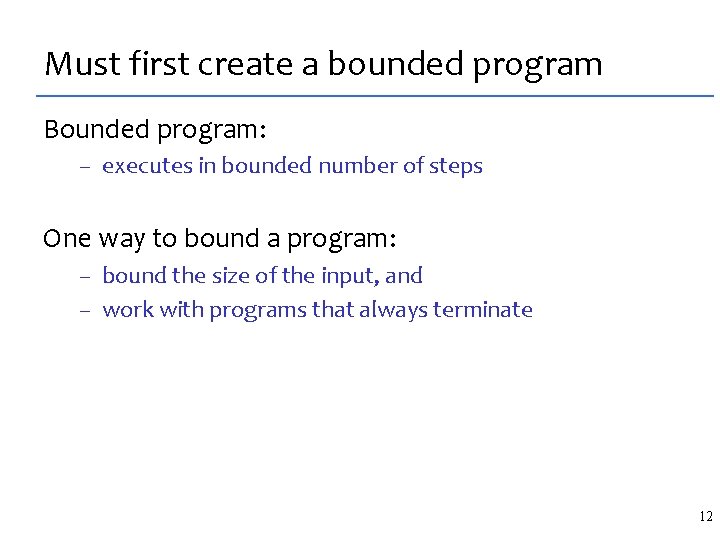
Must first create a bounded program Bounded program: – executes in bounded number of steps One way to bound a program: – bound the size of the input, and – work with programs that always terminate 12
Ex : bit population count. int pop (bit[W] x) { int count = 0; for(int i=0; i<W; i++) if (x[i]) count++; return count; } x count 0 0 one 0 0 0 1 + mux count mux F(x) = count + 13
How it works Step 1: Turn holes into control inputs Step 2: Translate spec and sketch to boolean functions Step 3: Formulate synthesis as generalized SAT Step 4: Solve with counterexample guided search Step 5: Plug controls into the sketch 14
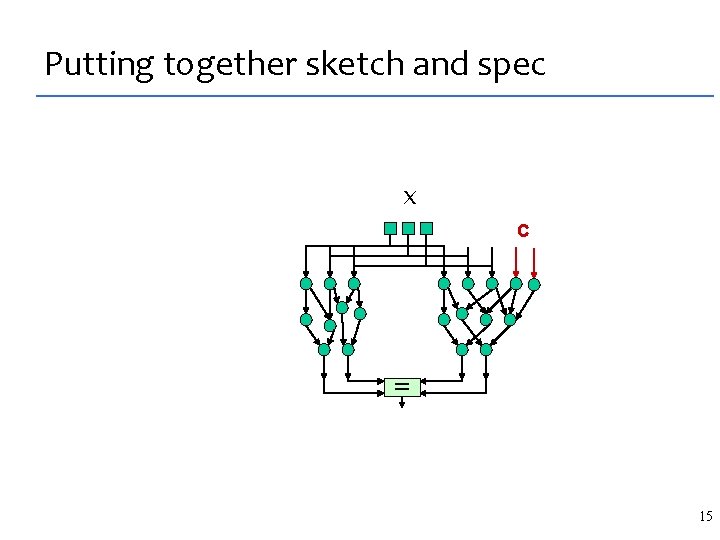
Putting together sketch and spec x c = 15
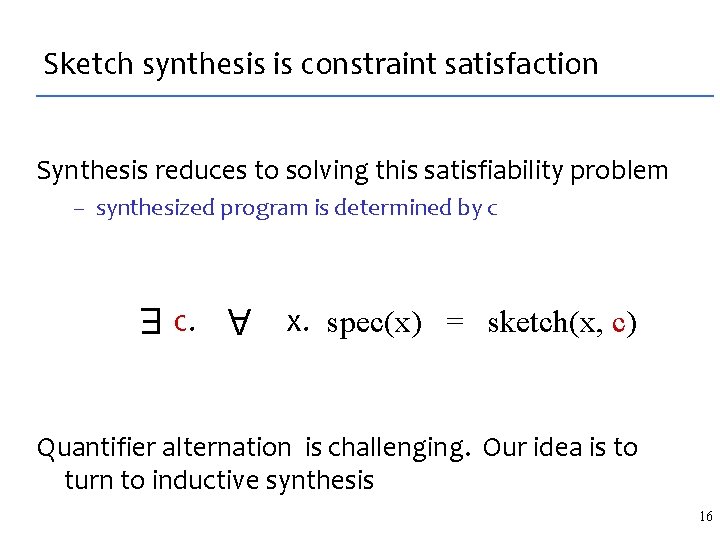
Sketch synthesis is constraint satisfaction Synthesis reduces to solving this satisfiability problem – synthesized program is determined by c A c. x. spec(x) = sketch(x, c) E Quantifier alternation is challenging. Our idea is to turn to inductive synthesis 16
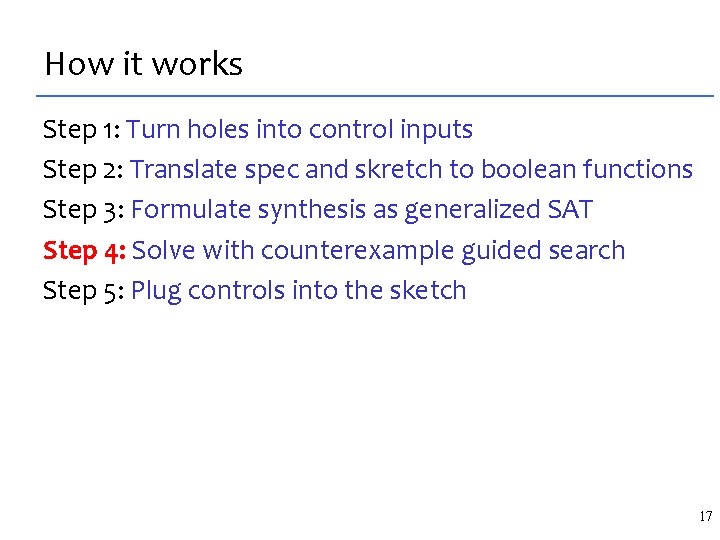
How it works Step 1: Turn holes into control inputs Step 2: Translate spec and skretch to boolean functions Step 3: Formulate synthesis as generalized SAT Step 4: Solve with counterexample guided search Step 5: Plug controls into the sketch 17
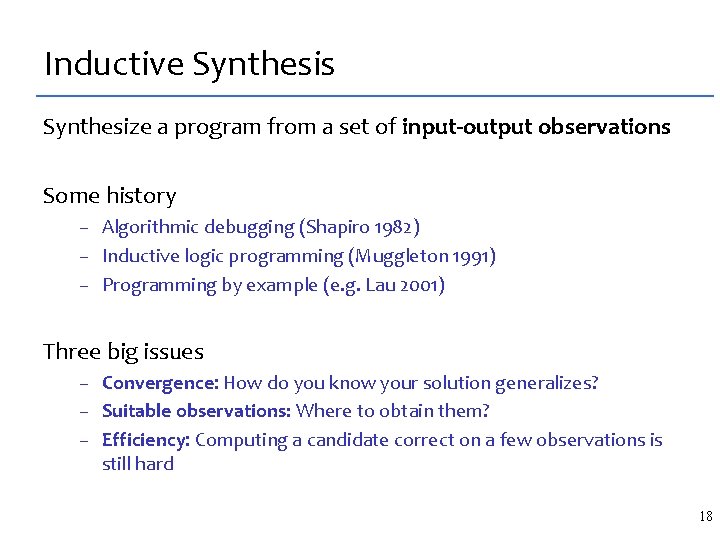
Inductive Synthesis Synthesize a program from a set of input-output observations Some history – Algorithmic debugging (Shapiro 1982) – Inductive logic programming (Muggleton 1991) – Programming by example (e. g. Lau 2001) Three big issues – Convergence: How do you know your solution generalizes? – Suitable observations: Where to obtain them? – Efficiency: Computing a candidate correct on a few observations is still hard 18
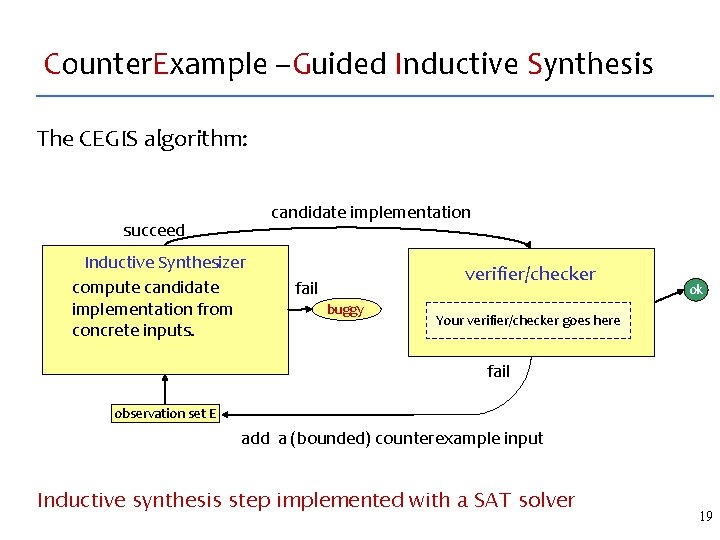
Counter. Example –Guided Inductive Synthesis The CEGIS algorithm: candidate implementation succeed Inductive Synthesizer compute candidate implementation from concrete inputs. verifier/checker fail buggy ok Your verifier/checker goes here fail observation set E add a (bounded) counterexample input Inductive synthesis step implemented with a SAT solver 19
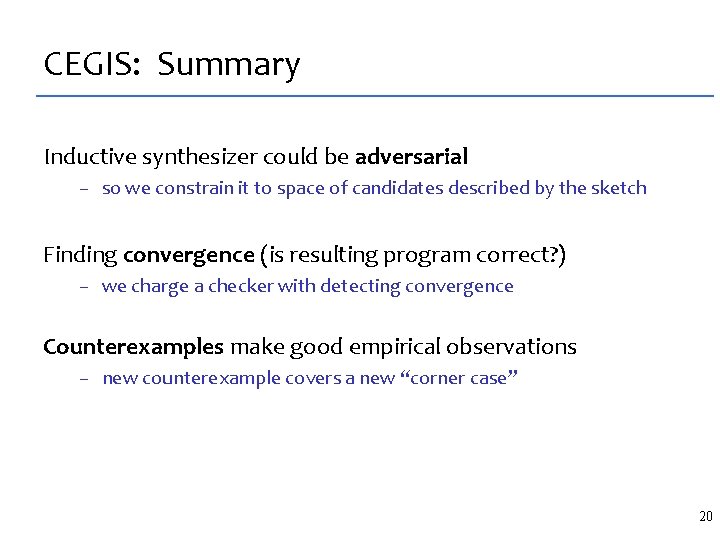
CEGIS: Summary Inductive synthesizer could be adversarial – so we constrain it to space of candidates described by the sketch Finding convergence (is resulting program correct? ) – we charge a checker with detecting convergence Counterexamples make good empirical observations – new counterexample covers a new “corner case” 20
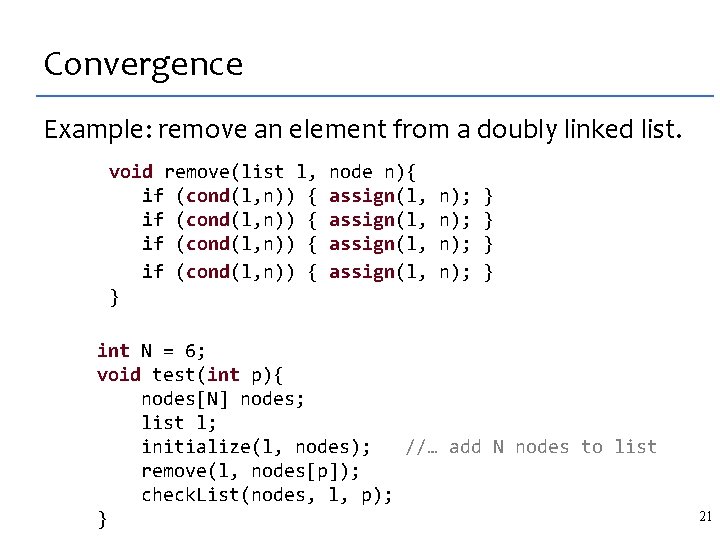
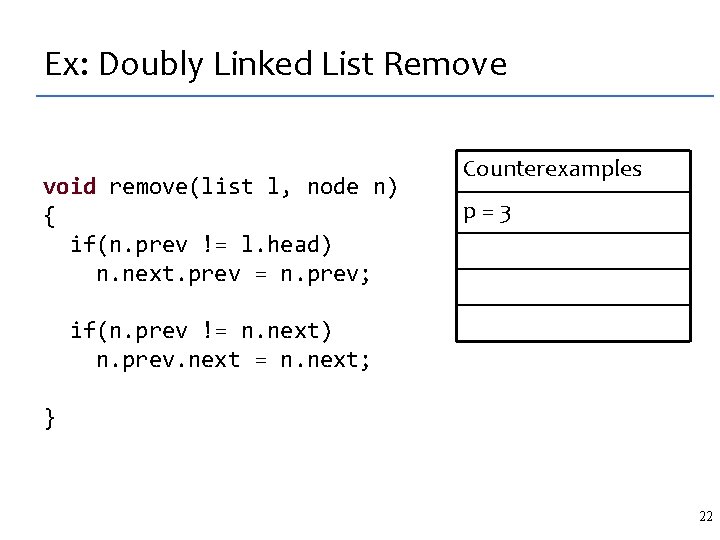
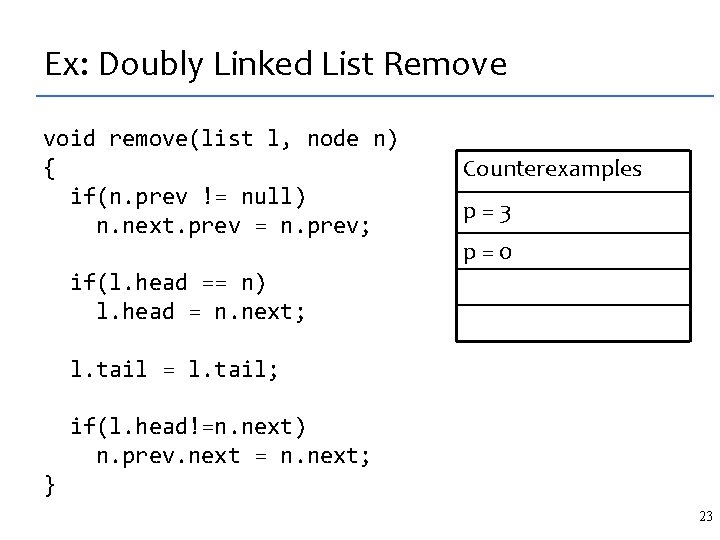
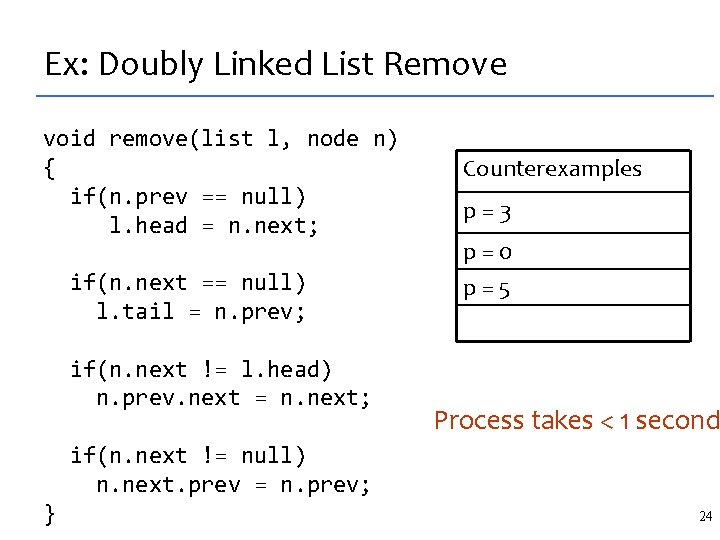
Convergence Example: remove an element from a doubly linked list. void remove(list l, if (cond(l, n)) { } node n){ assign(l, n); n); } } int N = 6; void test(int p){ nodes[N] nodes; list l; initialize(l, nodes); //… add N nodes to list remove(l, nodes[p]); check. List(nodes, l, p); } 21
Ex: Doubly Linked List Remove void remove(list l, node n) { if(n. prev != l. head) n. next. prev = n. prev; Counterexamples p=3 if(n. prev != n. next) n. prev. next = n. next; } 22
Ex: Doubly Linked List Remove void remove(list l, node n) { if(n. prev != null) n. next. prev = n. prev; Counterexamples p=3 p=0 if(l. head == n) l. head = n. next; l. tail = l. tail; if(l. head!=n. next) n. prev. next = n. next; } 23
Ex: Doubly Linked List Remove void remove(list l, node n) { if(n. prev == null) l. head = n. next; if(n. next == null) l. tail = n. prev; if(n. next != l. head) n. prev. next = n. next; Counterexamples p=3 p=0 p=5 Process takes < 1 second if(n. next != null) n. next. prev = n. prev; } 24
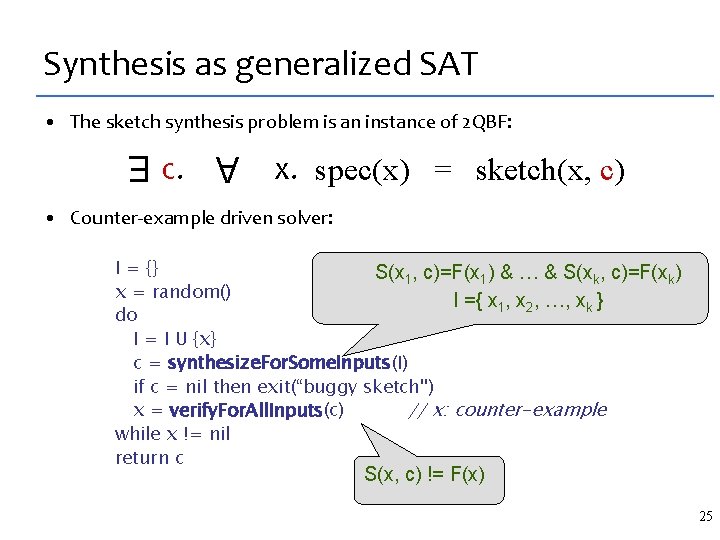
Synthesis as generalized SAT • The sketch synthesis problem is an instance of 2 QBF: A c. x. spec(x) = sketch(x, c) E • Counter-example driven solver: I = {} S(x 1, c)=F(x 1) & … & S(xk, c)=F(xk) x = random() I ={ x 1, x 2, …, xk } do I = I U {x} c = synthesize. For. Some. Inputs(I) if c = nil then exit(“buggy sketch'') x = verify. For. All. Inputs(c) // x: counter-example while x != nil return c S(x, c) != F(x) 25
How it works Step 1: Turn holes into control inputs Step 2: Translate spec and sketch to boolean functions Step 3: Formulate synthesis as generalized SAT Step 4: Solve with counterexample guided search Step 5: Plug controls into the sketch 26
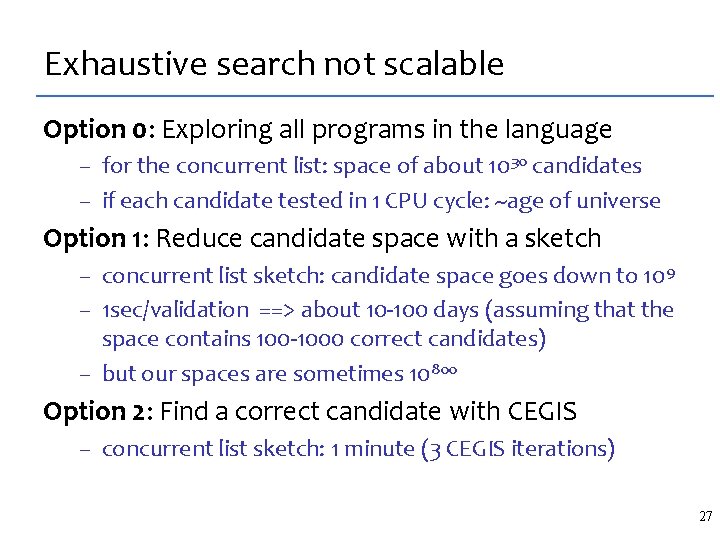
Exhaustive search not scalable Option 0: Exploring all programs in the language – for the concurrent list: space of about 1030 candidates – if each candidate tested in 1 CPU cycle: ~age of universe Option 1: Reduce candidate space with a sketch – concurrent list sketch: candidate space goes down to 10 9 – 1 sec/validation ==> about 10 -100 days (assuming that the space contains 100 -1000 correct candidates) – but our spaces are sometimes 10800 Option 2: Find a correct candidate with CEGIS – concurrent list sketch: 1 minute (3 CEGIS iterations) 27
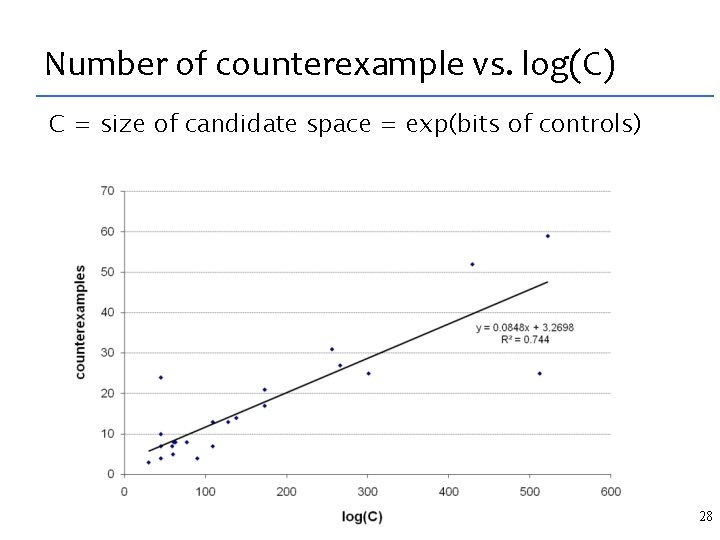
Number of counterexample vs. log(C) C = size of candidate space = exp(bits of controls) 28
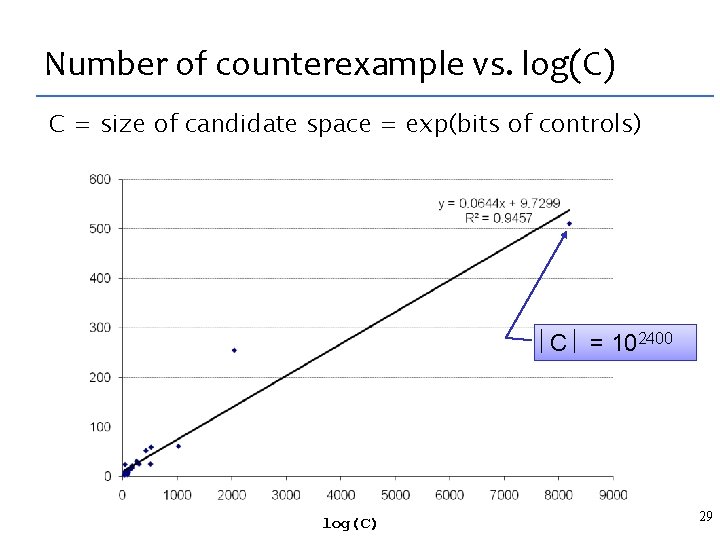
Number of counterexample vs. log(C) C = size of candidate space = exp(bits of controls) C = 102400 log(C) 29
Synthesis of Concurrent Programs 30
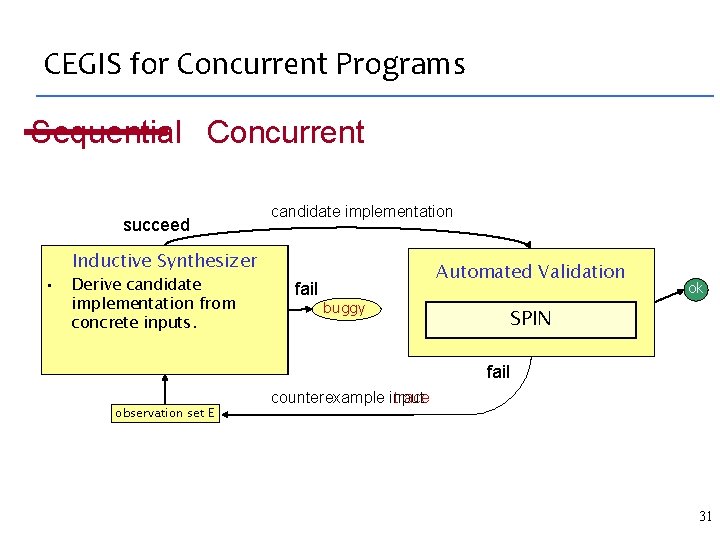
CEGIS for Concurrent Programs Sequential Concurrent succeed candidate implementation Inductive Synthesizer • Derive candidate implementation from counterexample concrete inputs. traces fail Automated Validation buggy ok SPIN Your verifier/checker goes here fail observation set E counterexample input trace 31
Synthesis of Dynamic Programming 32
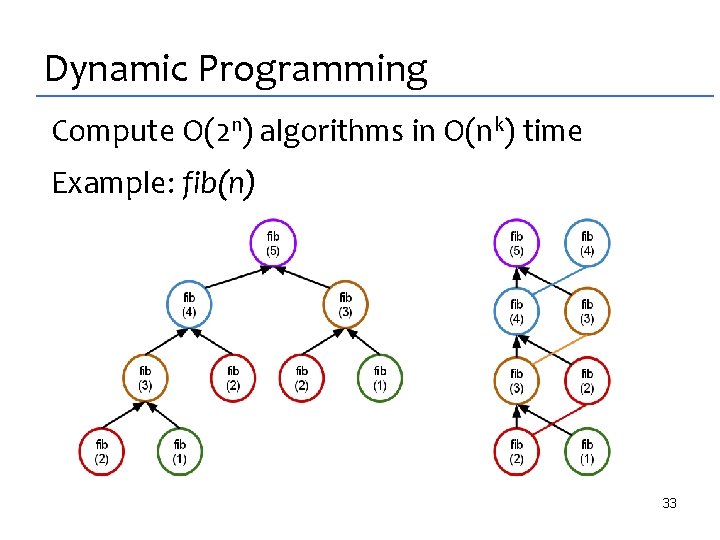
Dynamic Programming Compute O(2 n) algorithms in O(nk) time Example: fib(n) 33
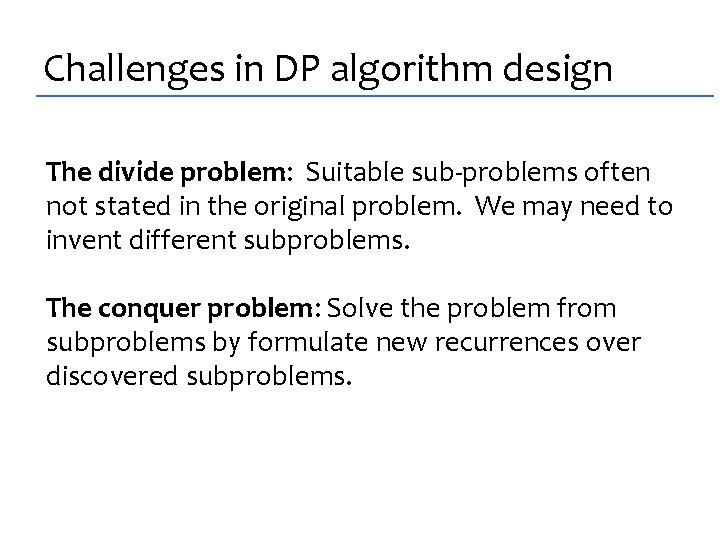
Challenges in DP algorithm design The divide problem: Suitable sub-problems often not stated in the original problem. We may need to invent different subproblems. The conquer problem: Solve the problem from subproblems by formulate new recurrences over discovered subproblems.
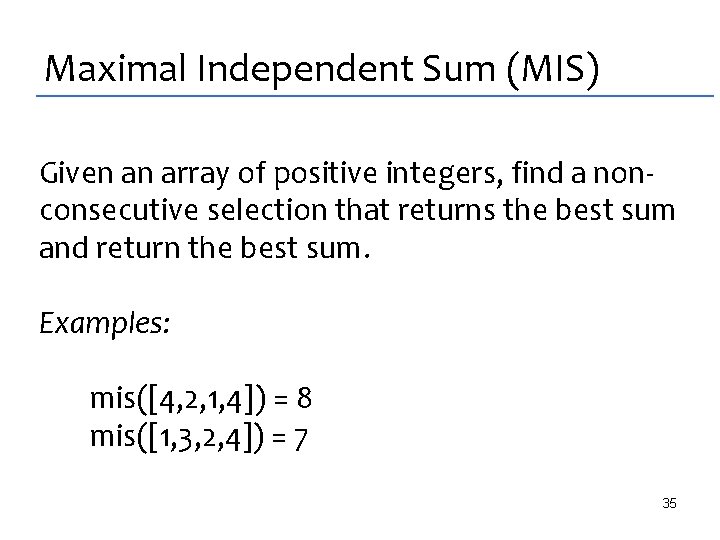
Maximal Independent Sum (MIS) Given an array of positive integers, find a nonconsecutive selection that returns the best sum and return the best sum. Examples: mis([4, 2, 1, 4]) = 8 mis([1, 3, 2, 4]) = 7 35
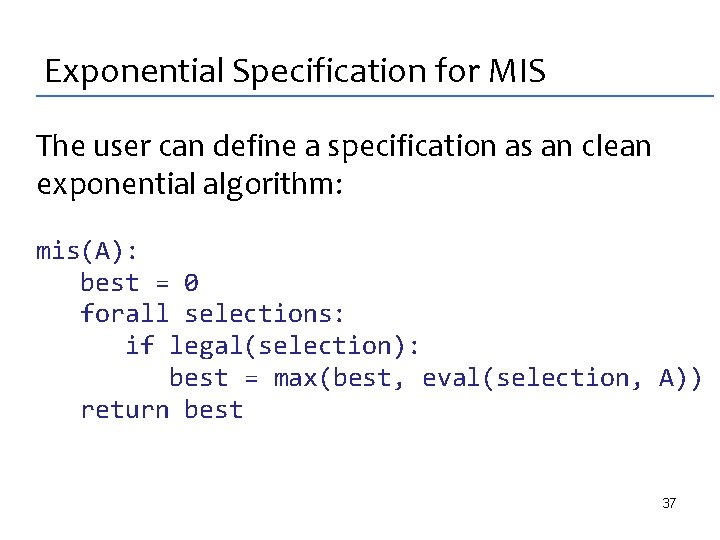
Exponential Specification for MIS The user can define a specification as an clean exponential algorithm: mis(A): best = 0 forall selections: if legal(selection): best = max(best, eval(selection, A)) return best 37
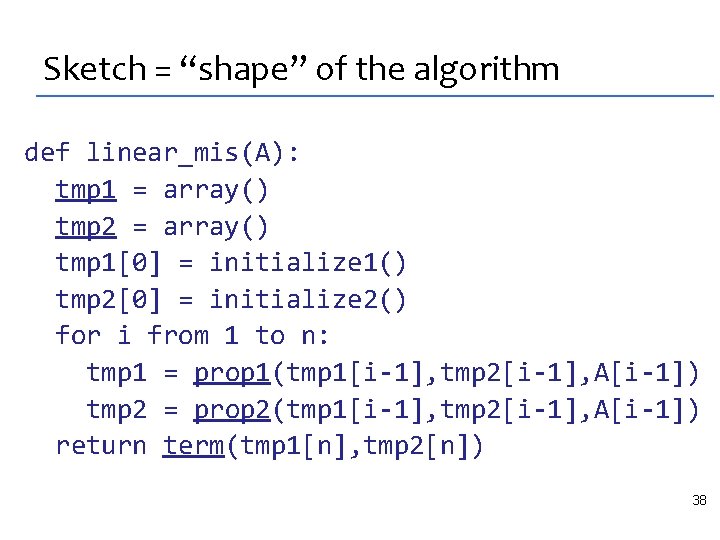
Sketch = “shape” of the algorithm def linear_mis(A): tmp 1 = array() tmp 2 = array() tmp 1[0] = initialize 1() tmp 2[0] = initialize 2() for i from 1 to n: tmp 1 = prop 1(tmp 1[i-1], tmp 2[i-1], A[i-1]) tmp 2 = prop 2(tmp 1[i-1], tmp 2[i-1], A[i-1]) return term(tmp 1[n], tmp 2[n]) 38
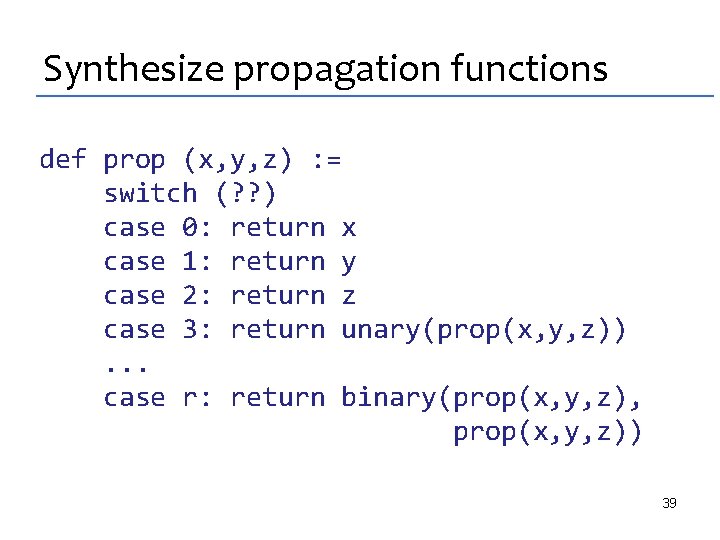
Synthesize propagation functions def prop (x, y, z) : = switch (? ? ) case 0: return x case 1: return y case 2: return z case 3: return unary(prop(x, y, z)). . . case r: return binary(prop(x, y, z), prop(x, y, z)) 39
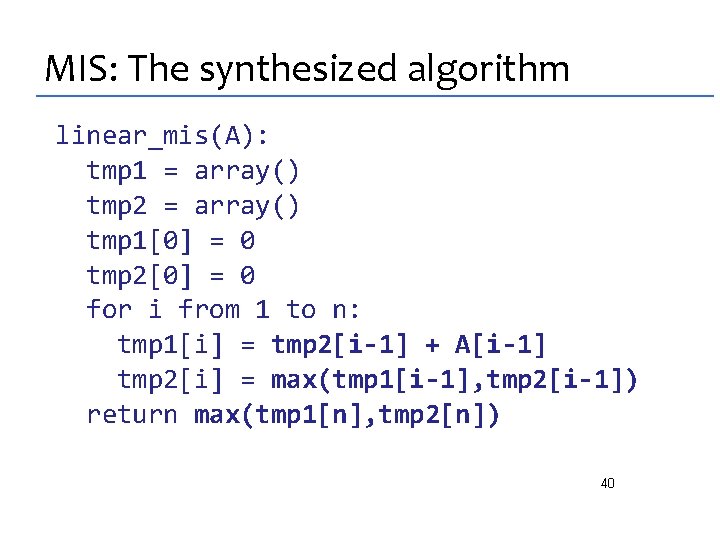
MIS: The synthesized algorithm linear_mis(A): tmp 1 = array() tmp 2 = array() tmp 1[0] = 0 tmp 2[0] = 0 for i from 1 to n: tmp 1[i] = tmp 2[i-1] + A[i-1] tmp 2[i] = max(tmp 1[i-1], tmp 2[i-1]) return max(tmp 1[n], tmp 2[n]) 40
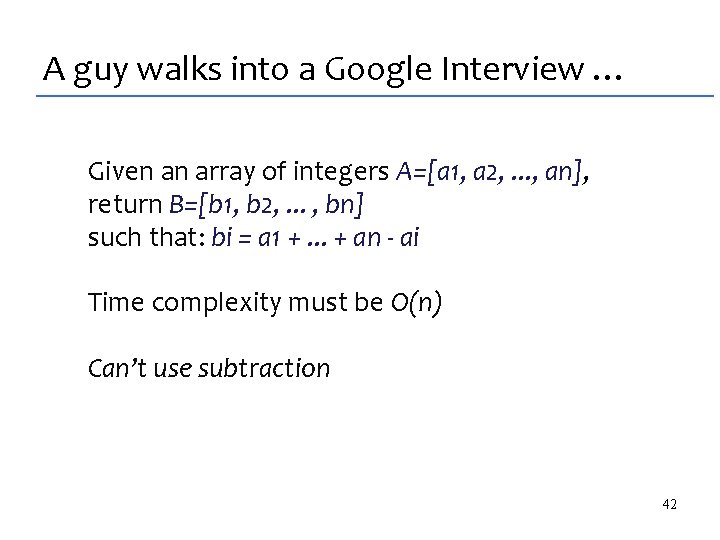
A guy walks into a Google Interview … Given an array of integers A=[a 1, a 2, . . . , an], return B=[b 1, b 2, . . . , bn] such that: bi = a 1 +. . . + an - ai Time complexity must be O(n) Can’t use subtraction 42
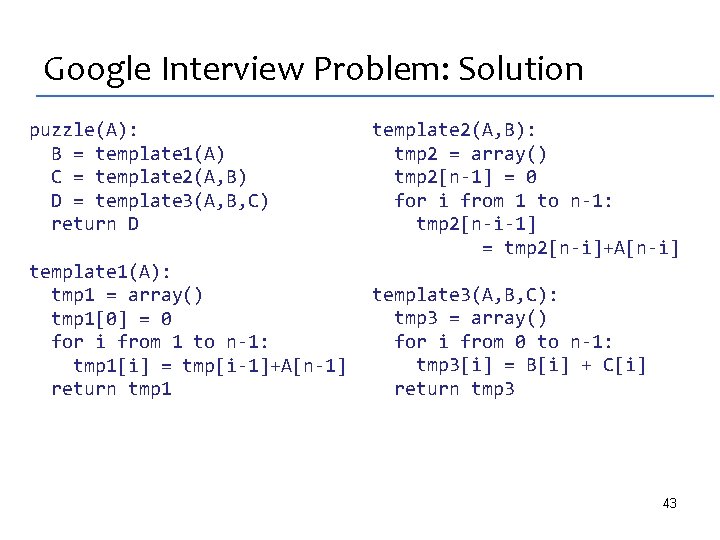
Google Interview Problem: Solution puzzle(A): B = template 1(A) C = template 2(A, B) D = template 3(A, B, C) return D template 1(A): tmp 1 = array() tmp 1[0] = 0 for i from 1 to n-1: tmp 1[i] = tmp[i-1]+A[n-1] return tmp 1 template 2(A, B): tmp 2 = array() tmp 2[n-1] = 0 for i from 1 to n-1: tmp 2[n-i-1] = tmp 2[n-i]+A[n-i] template 3(A, B, C): tmp 3 = array() for i from 0 to n-1: tmp 3[i] = B[i] + C[i] return tmp 3 43
a. Lisp [Andre, Bhaskara, Russell, … 2002]
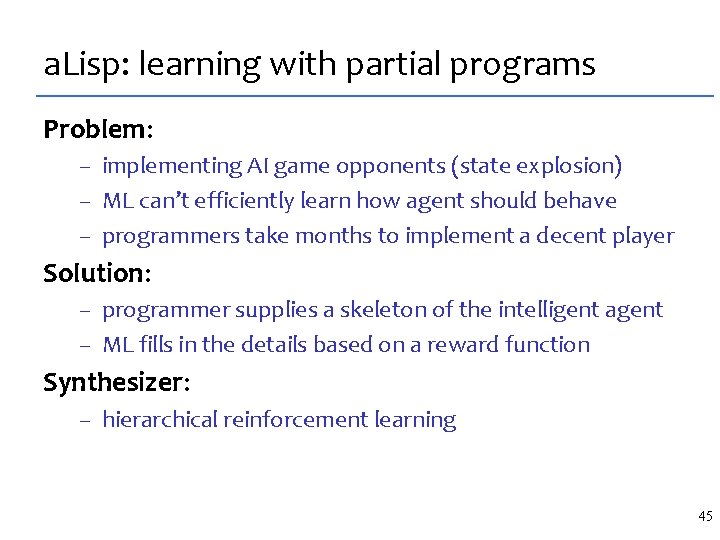
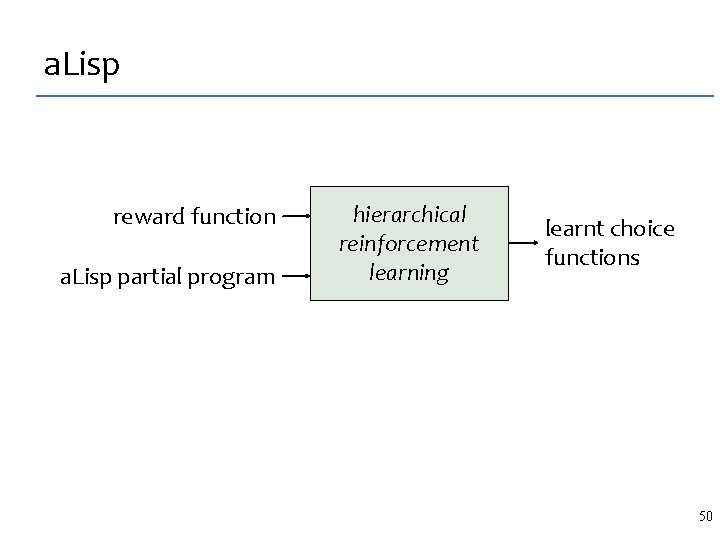
a. Lisp: learning with partial programs Problem: – implementing AI game opponents (state explosion) – ML can’t efficiently learn how agent should behave – programmers take months to implement a decent player Solution: – programmer supplies a skeleton of the intelligent agent – ML fills in the details based on a reward function Synthesizer: – hierarchical reinforcement learning 45
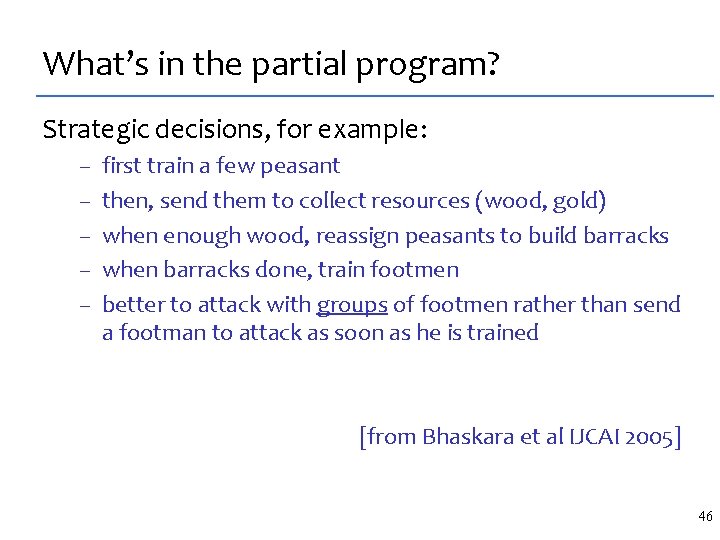
What’s in the partial program? Strategic decisions, for example: – – – first train a few peasant then, send them to collect resources (wood, gold) when enough wood, reassign peasants to build barracks when barracks done, train footmen better to attack with groups of footmen rather than send a footman to attack as soon as he is trained [from Bhaskara et al IJCAI 2005] 46
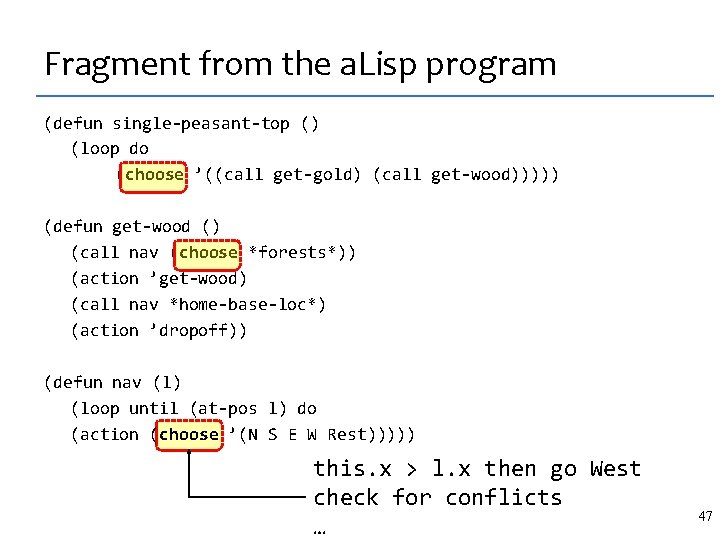
Fragment from the a. Lisp program (defun single-peasant-top () (loop do (choose ’((call get-gold) (call get-wood))))) (defun get-wood () (call nav (choose *forests*)) (action ’get-wood) (call nav *home-base-loc*) (action ’dropoff)) (defun nav (l) (loop until (at-pos l) do (action (choose ’(N S E W Rest))))) this. x > l. x then go West check for conflicts … 47
It’s synthesis from partial programs correctness criterion synthesizer completion partial program merge complete program 48
SKETCH ref implementation sketch SAT-based inductive synthesizer hole values 49
a. Lisp reward function a. Lisp partial program hierarchical reinforcement learning learnt choice functions 50
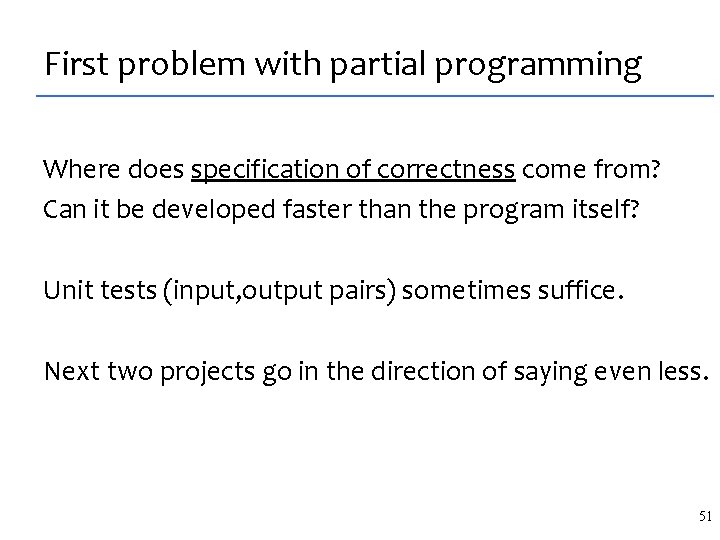
First problem with partial programming Where does specification of correctness come from? Can it be developed faster than the program itself? Unit tests (input, output pairs) sometimes suffice. Next two projects go in the direction of saying even less. 51
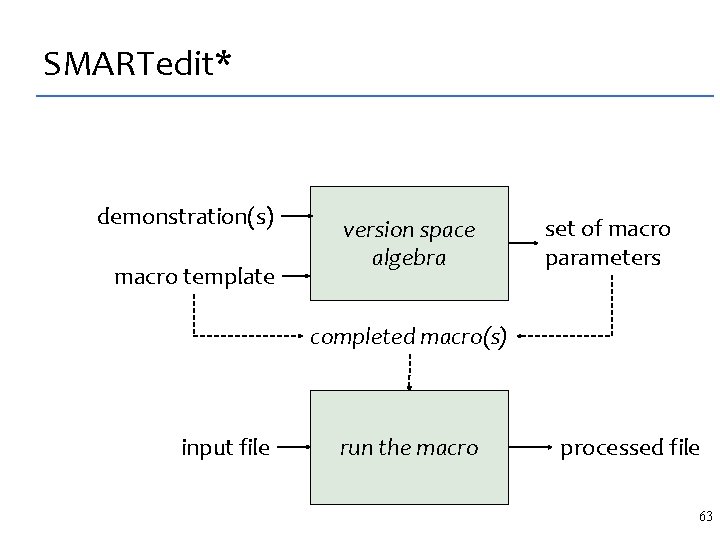
SMARTedit* [Lau, Wolfman, Domingos, Weld 2000]
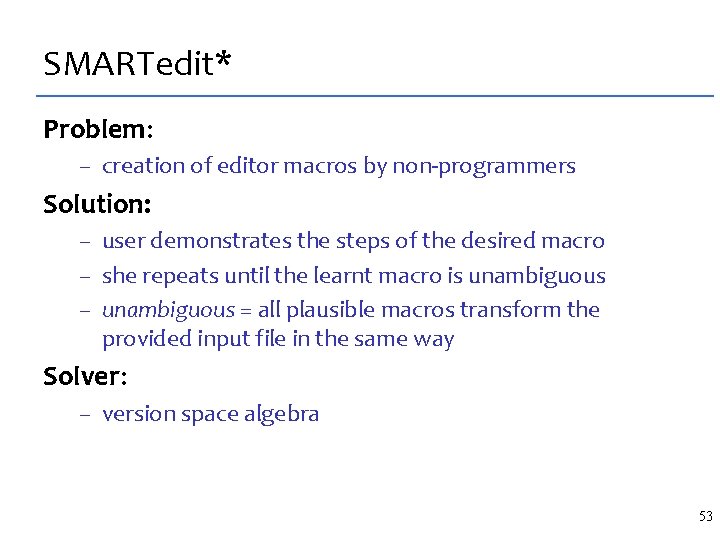
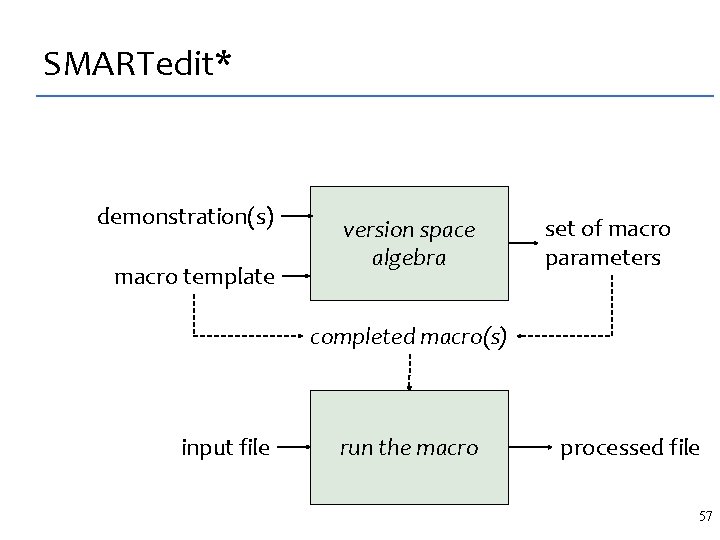
SMARTedit* Problem: – creation of editor macros by non-programmers Solution: – user demonstrates the steps of the desired macro – she repeats until the learnt macro is unambiguous – unambiguous = all plausible macros transform the provided input file in the same way Solver: – version space algebra 53
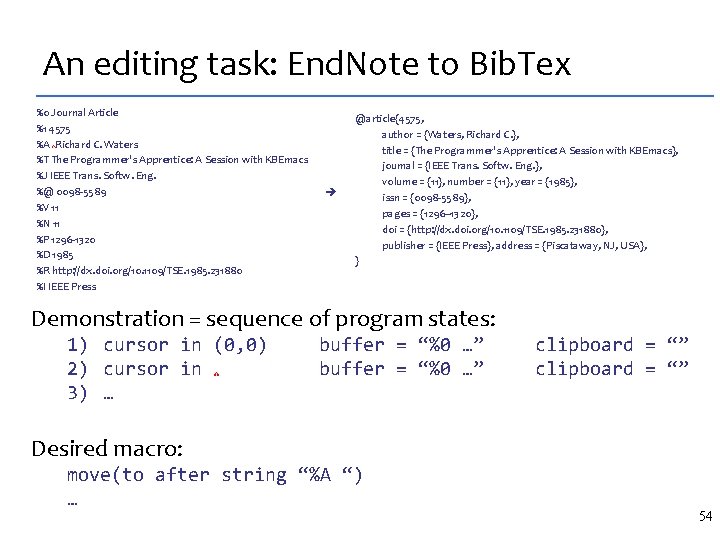
An editing task: End. Note to Bib. Tex %0 Journal Article %1 4575 %A ^Richard C. Waters %T The Programmer's Apprentice: A Session with KBEmacs %J IEEE Trans. Softw. Eng. %@ 0098 -5589 %V 11 %N 11 %P 1296 -1320 %D 1985 %R http: //dx. doi. org/10. 1109/TSE. 1985. 231880 %I IEEE Press @article{4575, author = {Waters, Richard C. }, title = {The Programmer's Apprentice: A Session with KBEmacs}, journal = {IEEE Trans. Softw. Eng. }, volume = {11}, number = {11}, year = {1985}, issn = {0098 -5589}, pages = {1296 --1320}, doi = {http: //dx. doi. org/10. 1109/TSE. 1985. 231880}, publisher = {IEEE Press}, address = {Piscataway, NJ, USA}, } Demonstration = sequence of program states: 1) cursor in (0, 0) 2) cursor in ^ 3) … buffer = “%0 …” clipboard = “” Desired macro: move(to after string “%A “) … 54
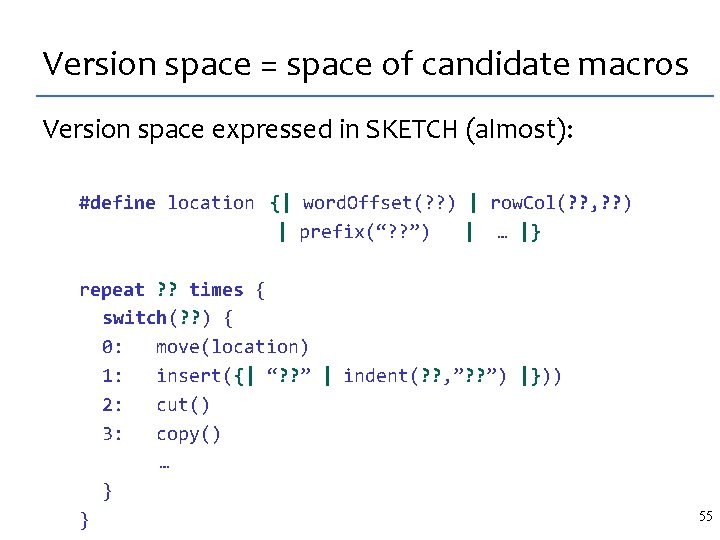
Version space = space of candidate macros Version space expressed in SKETCH (almost): #define location {| word. Offset(? ? ) | row. Col(? ? , ? ? ) | prefix(“? ? ”) | … |} repeat ? ? times { switch(? ? ) { 0: move(location) 1: insert({| “? ? ” | indent(? ? , ”? ? ”) |})) 2: cut() 3: copy() … } } 55
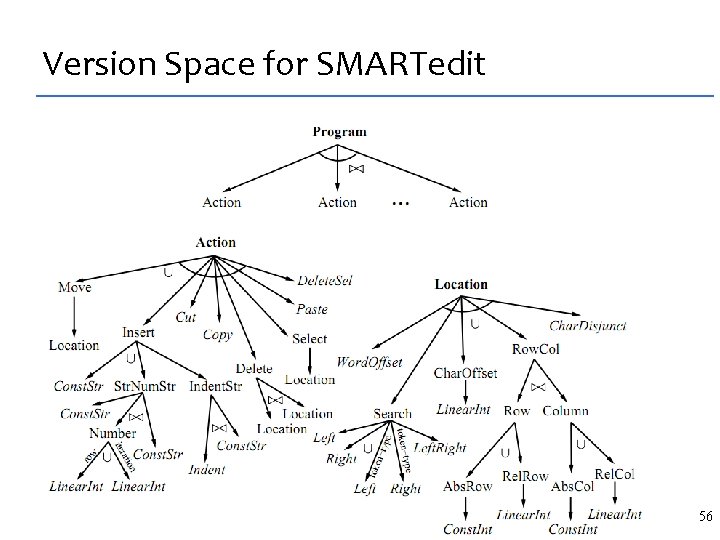
Version Space for SMARTedit 56
SMARTedit* demonstration(s) macro template version space algebra set of macro parameters completed macro(s) input file run the macro processed file 57
Prospector [Mandelin, Bodik, Kimelman 2005]
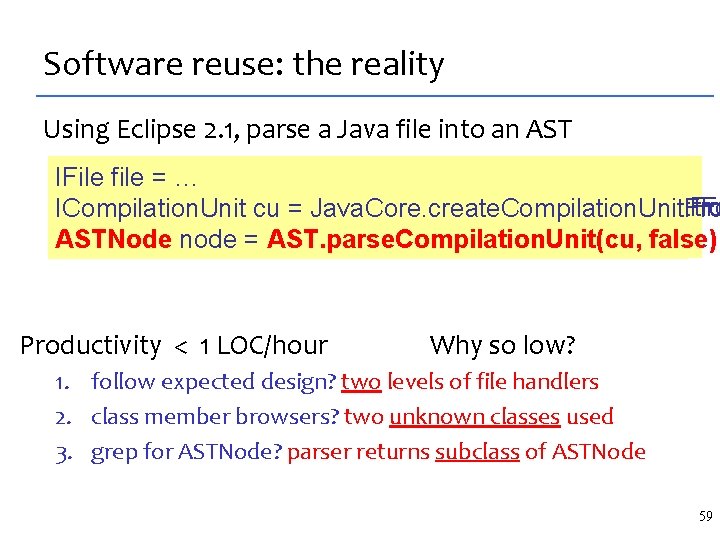
Software reuse: the reality Using Eclipse 2. 1, parse a Java file into an AST IFile file == … … IFile ICompilation. Unitcucu= =Java. Core. create. Compilation. Unit. Fro Java. Core. create. Compilation. Unit. Fr ICompilation. Unit ASTNode ? AST. parse. Compilation. Unit(cu, false); ASTNode node == AST. parse. Compilation. Unit(cu, false); Productivity < 1 LOC/hour Why so low? 1. follow expected design? two levels of file handlers 2. class member browsers? two unknown classes used 3. grep for ASTNode? parser returns subclass of ASTNode 59
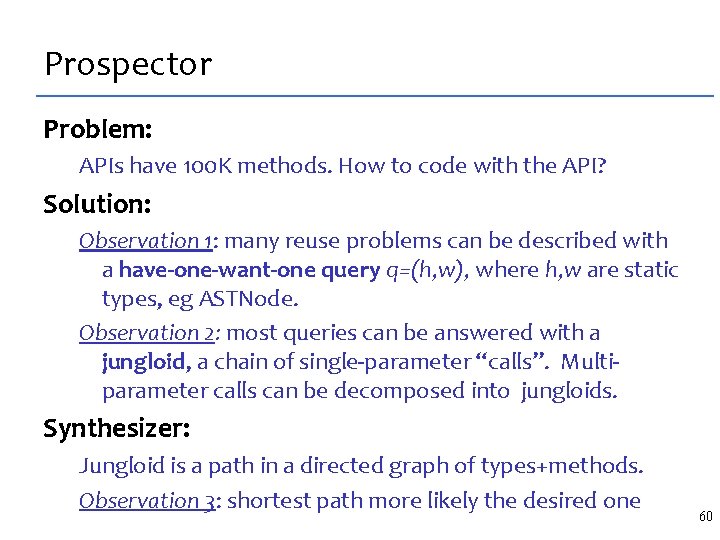
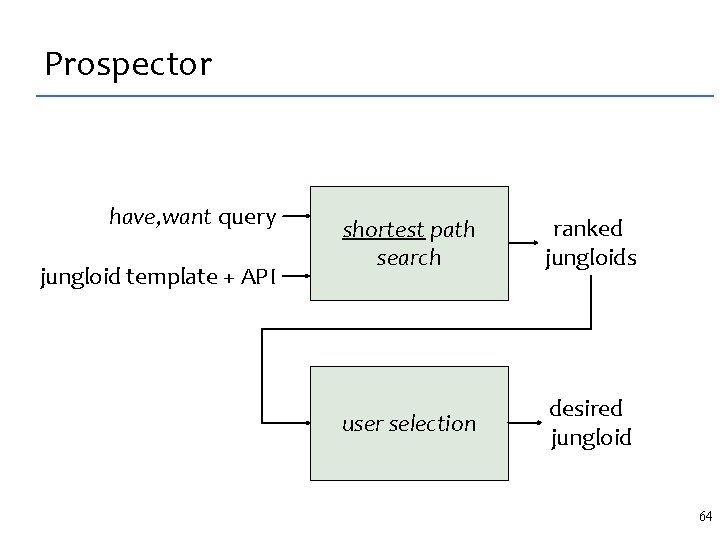
Prospector Problem: APIs have 100 K methods. How to code with the API? Solution: Observation 1: many reuse problems can be described with a have-one-want-one query q=(h, w), where h, w are static types, eg ASTNode. Observation 2: most queries can be answered with a jungloid, a chain of single-parameter “calls”. Multiparameter calls can be decomposed into jungloids. Synthesizer: Jungloid is a path in a directed graph of types+methods. Observation 3: shortest path more likely the desired one 60
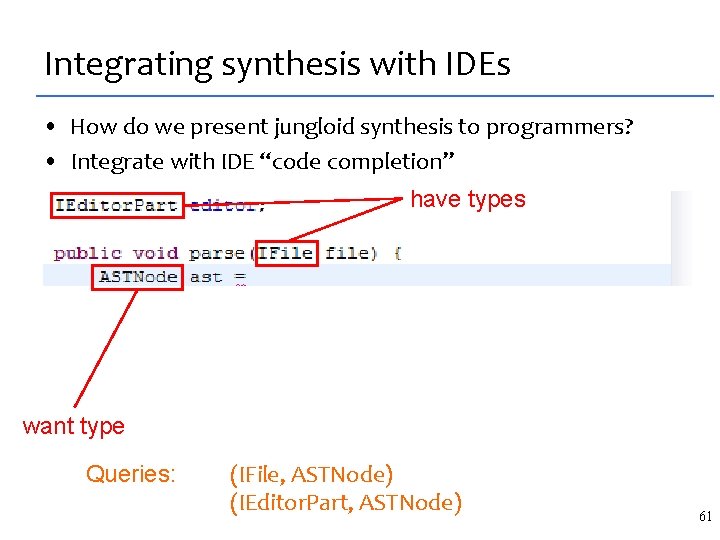
Integrating synthesis with IDEs • How do we present jungloid synthesis to programmers? • Integrate with IDE “code completion” have types want type Queries: (IFile, ASTNode) (IEditor. Part, ASTNode) 61
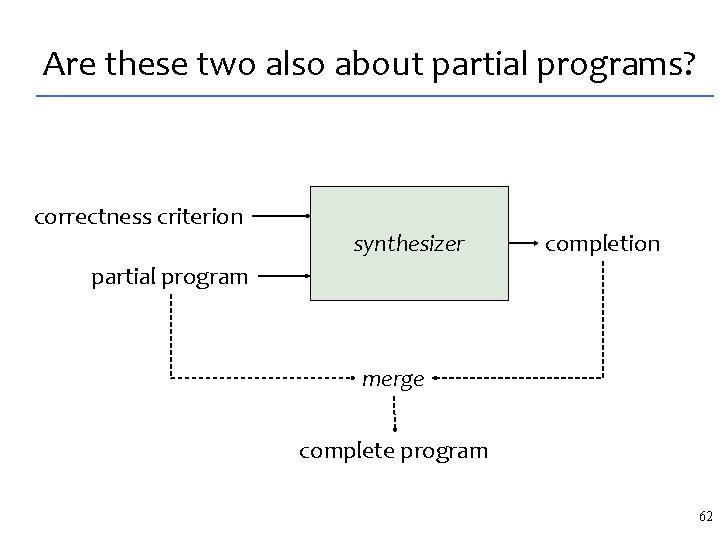
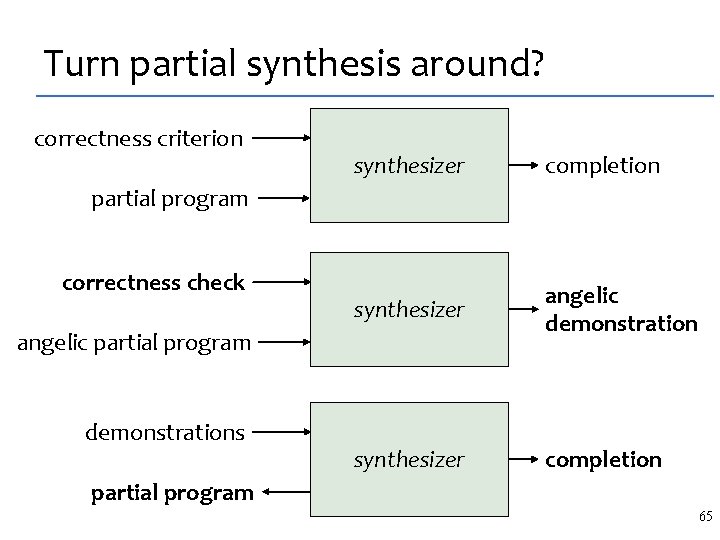
Are these two also about partial programs? correctness criterion synthesizer completion partial program merge complete program 62
SMARTedit* demonstration(s) macro template version space algebra set of macro parameters completed macro(s) input file run the macro processed file 63
Prospector have, want query jungloid template + API shortest path search ranked jungloids user selection desired jungloid 64
Turn partial synthesis around? correctness criterion synthesizer completion synthesizer angelic demonstration synthesizer completion partial program correctness check angelic partial program demonstrations partial program 65
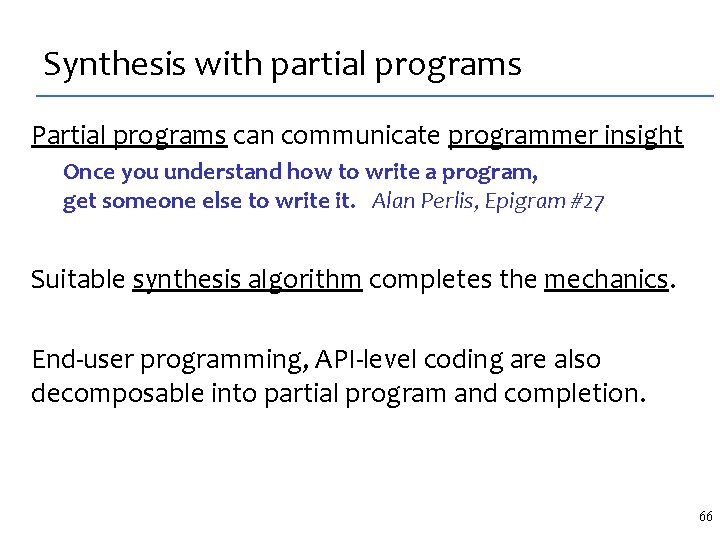
Synthesis with partial programs Partial programs can communicate programmer insight Once you understand how to write a program, get someone else to write it. Alan Perlis, Epigram #27 Suitable synthesis algorithm completes the mechanics. End-user programming, API-level coding are also decomposable into partial program and completion. 66
Acknowledgements UC Berkeley Gilad Arnold Shaon Barman Prof. Ras Bodik Prof. Bob Brayton Joel Galenson Sagar Jain Chris Jones Evan Pu MIT Casey Rodarmor Prof. Koushik Sen Prof. Sanjit Seshia Lexin Shan Saurabh Srivastava Liviu Tancau Nicholas Tung Prof. Armando Solar-Lezama Rishabh Singh Kuat Yesenov Jean Yung Zhiley Xu IBM Satish Chandra Kemal Ebcioglu Rodric Rabbah Vijay Saraswat Vivek Sarkar 67