
Automatic Programming Revisited Part I Puzzles and Oracles
![The SIMD matrix transpose, sketched int[16] trans_sse(int[16] M) implements trans { int[16] S =](https://slidetodoc.com/presentation_image_h2/0ed4dc48abd1d039d4fd7dc0ae2cdea6/image-12.jpg "The SIMD matrix transpose, sketched int[16] trans_sse(int[16] M) implements trans { int[16] S =")
![Our results: what we synthesized Concurrent Data Structures [PLDI 2008] lock free lists and](https://slidetodoc.com/presentation_image_h2/0ed4dc48abd1d039d4fd7dc0ae2cdea6/image-50.jpg "Our results: what we synthesized Concurrent Data Structures [PLDI 2008] lock free lists and")
- Slides: 51
Automatic Programming Revisited Part I: Puzzles and Oracles Rastislav Bodik University of California, Berkeley Once you understand how to write a program, get someone else to write it. Alan Perlis, Epigram #27
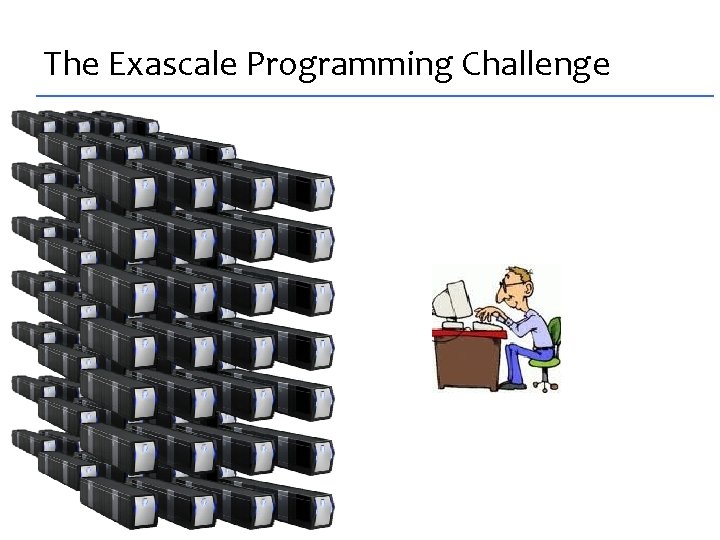
The Exascale Programming Challenge
The Exascale Programming Challenge More levels of hierarchy Accelerators everywhere The revenge of Ahmdal’s Law Programmers will be swamped in design choices 3
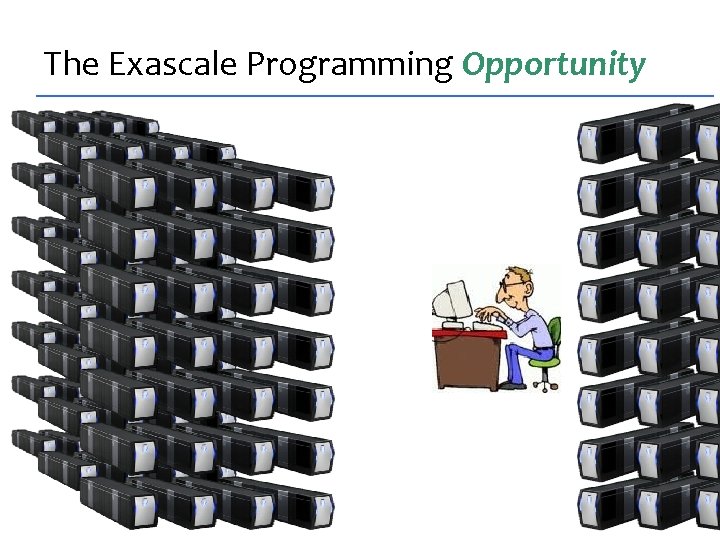
The Exascale Programming Opportunity
How can CPU cycles help in programming? 5
The SKETCH Language try it at bit. ly/sketch-language 6
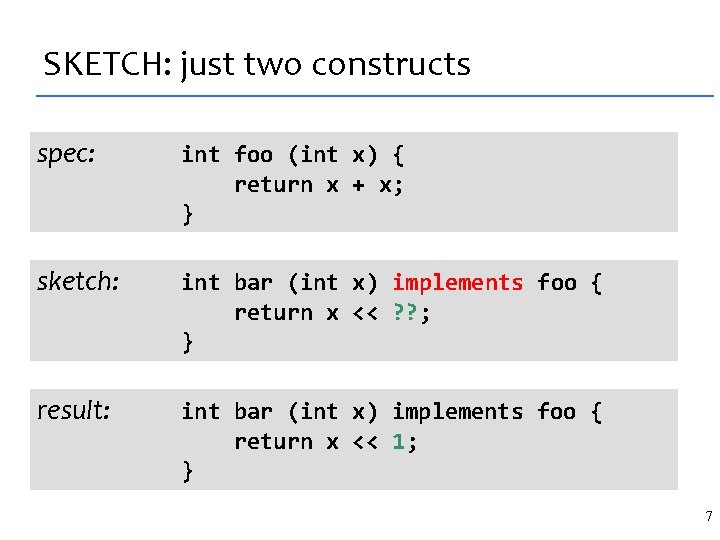
SKETCH: just two constructs spec: int foo (int x) { return x + x; } sketch: int bar (int x) implements foo { return x << ? ? ; } result: int bar (int x) implements foo { return x << 1; } 7
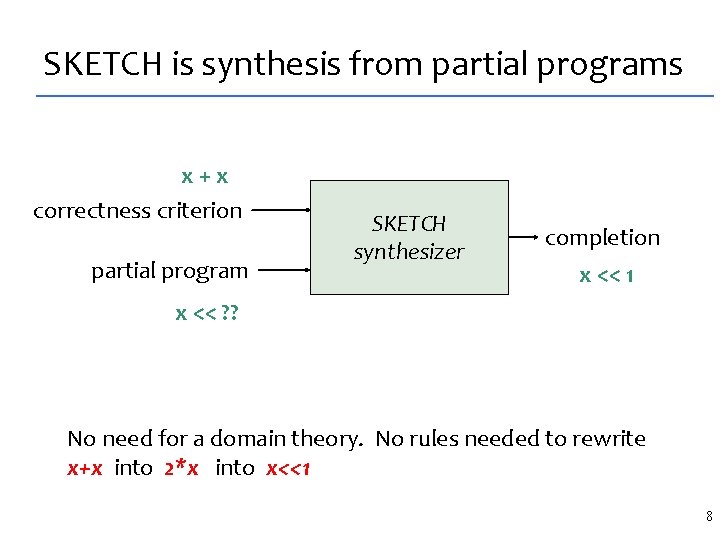
SKETCH is synthesis from partial programs x+x correctness criterion partial program SKETCH synthesizer completion x << 1 x << ? ? No need for a domain theory. No rules needed to rewrite x+x into 2*x into x<<1 8
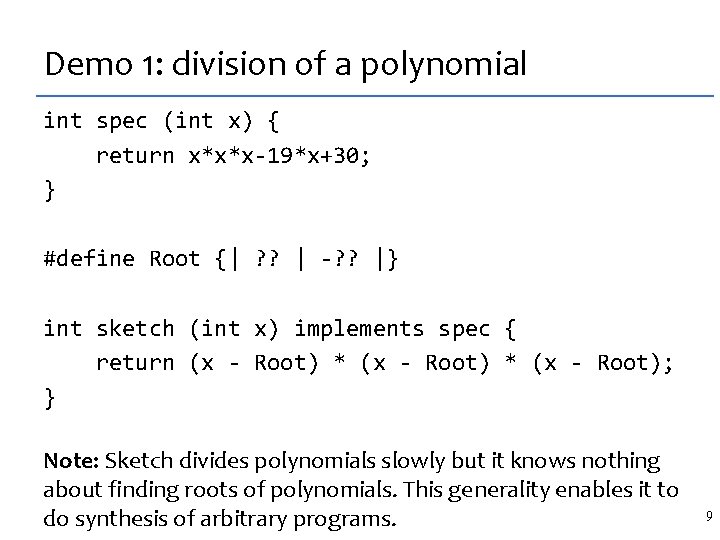
Demo 1: division of a polynomial int spec (int x) { return x*x*x-19*x+30; } #define Root {| ? ? | -? ? |} int sketch (int x) implements spec { return (x - Root) * (x - Root); } Note: Sketch divides polynomials slowly but it knows nothing about finding roots of polynomials. This generality enables it to do synthesis of arbitrary programs. 9
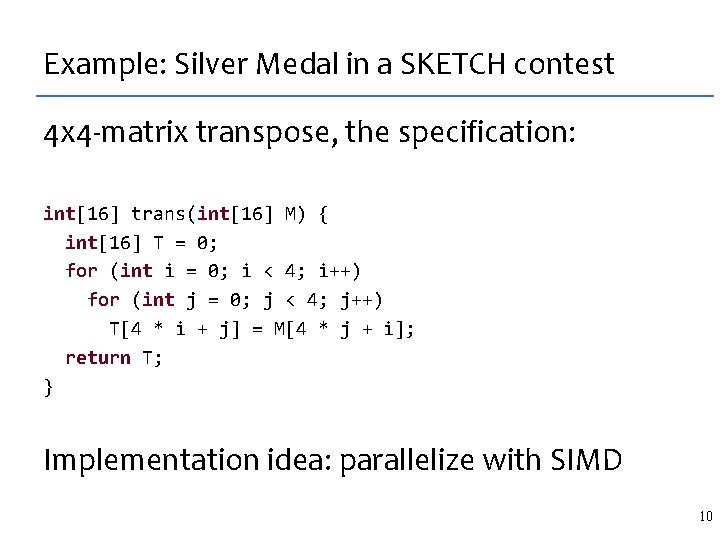
Example: Silver Medal in a SKETCH contest 4 x 4 -matrix transpose, the specification: int[16] trans(int[16] M) { int[16] T = 0; for (int i = 0; i < 4; i++) for (int j = 0; j < 4; j++) T[4 * i + j] = M[4 * j + i]; return T; } Implementation idea: parallelize with SIMD 10
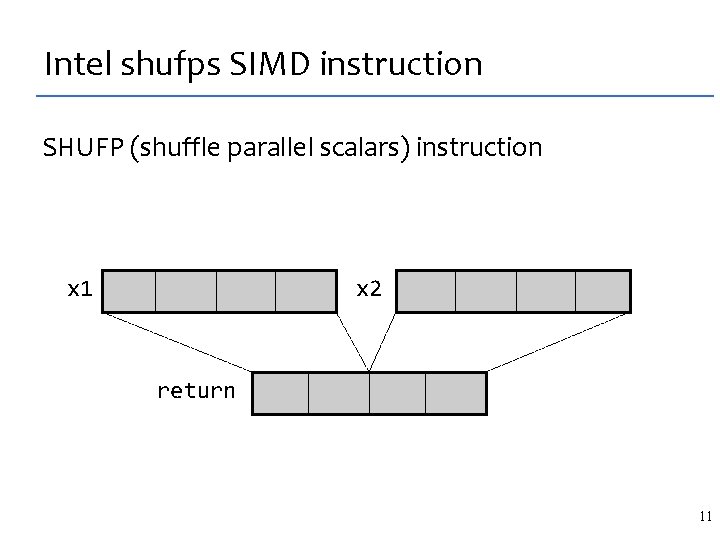
Intel shufps SIMD instruction SHUFP (shuffle parallel scalars) instruction x 1 x 2 return 11
The SIMD matrix transpose, sketched int[16] trans_sse(int[16] M) implements trans { int[16] S = 0, T = 0; repeat (? ? ) S[? ? : : 4] = shufps(M[? ? : : 4], ? ? ); repeat (? ? ) T[? ? : : 4] = shufps(S[? ? : : 4], ? ? ); return T; } int[16] trans_sse(int[16] M) implements trans { // synthesized code S[4: : 4] = shufps(M[6: : 4], M[2: : 4], 11001000 b); S[0: : 4] = shufps(M[11: : 4], M[6: : 4], 10010110 b); S[12: : 4] = shufps(M[0: : 4], M[2: : 4], 10001101 b); S[8: : 4] = shufps(M[8: : 4], M[12: : 4], 11010111 b); T[4: : 4] = shufps(S[11: : 4], S[1: : 4], 10111100 b); T[12: : 4] = shufps(S[3: : 4], S[8: : 4], 11000011 b); From the contestant email: Over the summer, I spent about 1/2 T[8: : 4] = shufps(S[4: : 4], S[9: : 4], 11100010 b); a day S[0: : 4], manually 10110100 b); figuring it out. T[0: : 4] = shufps(S[12: : 4], 12 Synthesis time: 30 minutes. }
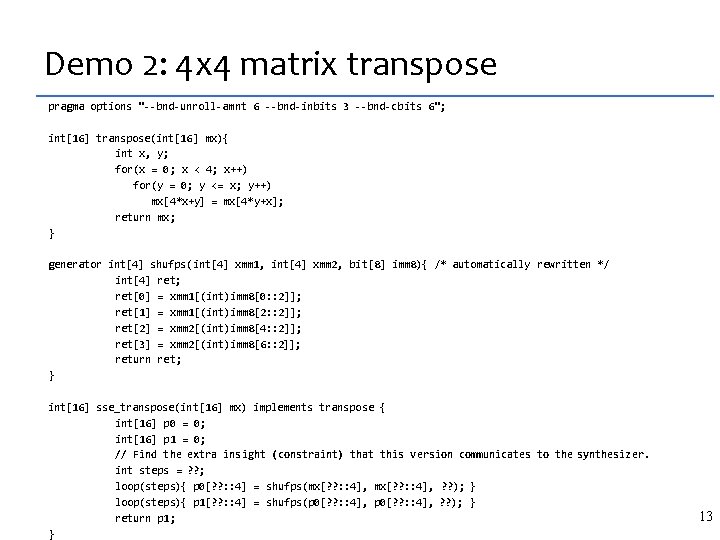
Demo 2: 4 x 4 matrix transpose pragma options "--bnd-unroll-amnt 6 --bnd-inbits 3 --bnd-cbits 6"; int[16] transpose(int[16] mx){ int x, y; for(x = 0; x < 4; x++) for(y = 0; y <= x; y++) mx[4*x+y] = mx[4*y+x]; return mx; } generator int[4] shufps(int[4] xmm 1, int[4] xmm 2, bit[8] imm 8){ /* automatically rewritten */ int[4] ret; ret[0] = xmm 1[(int)imm 8[0: : 2]]; ret[1] = xmm 1[(int)imm 8[2: : 2]]; ret[2] = xmm 2[(int)imm 8[4: : 2]]; ret[3] = xmm 2[(int)imm 8[6: : 2]]; return ret; } int[16] sse_transpose(int[16] mx) implements transpose { int[16] p 0 = 0; int[16] p 1 = 0; // Find the extra insight (constraint) that this version communicates to the synthesizer. int steps = ? ? ; loop(steps){ p 0[? ? : : 4] = shufps(mx[? ? : : 4], ? ? ); } loop(steps){ p 1[? ? : : 4] = shufps(p 0[? ? : : 4], ? ? ); } return p 1; } 13
How can synthesis help? In this example, our programmer possessed enough knowledge to actually write the program himself. The synthesizer saved him from tedious details, like a compiler. Note we did not have to teach that compiler any SIMD optimizations, as is usually necessary. In the next example, the synthesizer will help us find the program (actually, a solution to a puzzle). We could not solve the problem without the synthesizer. 14
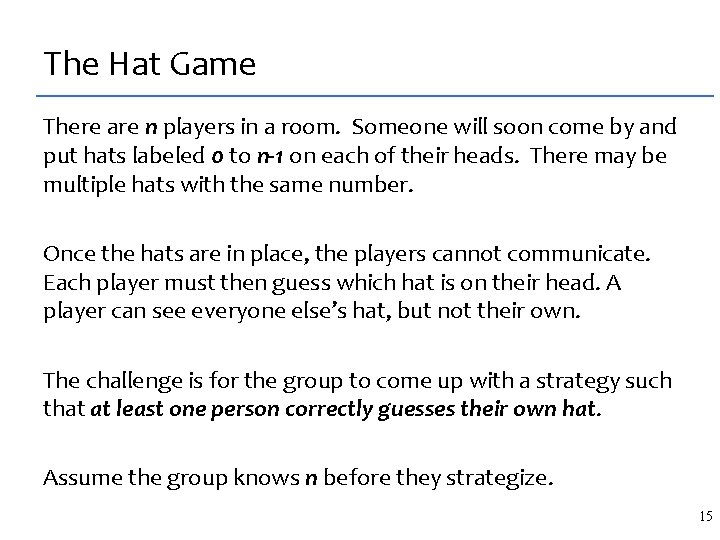
The Hat Game There are n players in a room. Someone will soon come by and put hats labeled 0 to n-1 on each of their heads. There may be multiple hats with the same number. Once the hats are in place, the players cannot communicate. Each player must then guess which hat is on their head. A player can see everyone else’s hat, but not their own. The challenge is for the group to come up with a strategy such that at least one person correctly guesses their own hat. Assume the group knows n before they strategize. 15
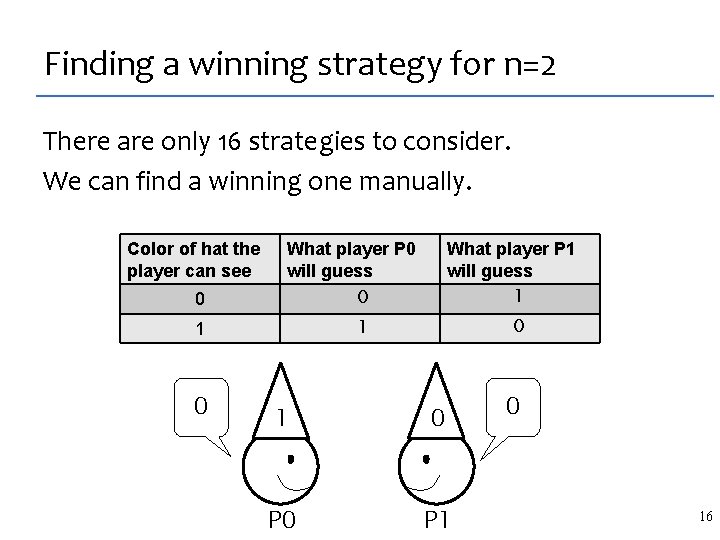
Finding a winning strategy for n=2 There are only 16 strategies to consider. We can find a winning one manually. Color of hat the player can see 0 What player P 0 will guess 0 0 1 1 0 What player P 1 will guess 1 1 0 P 1 0 16
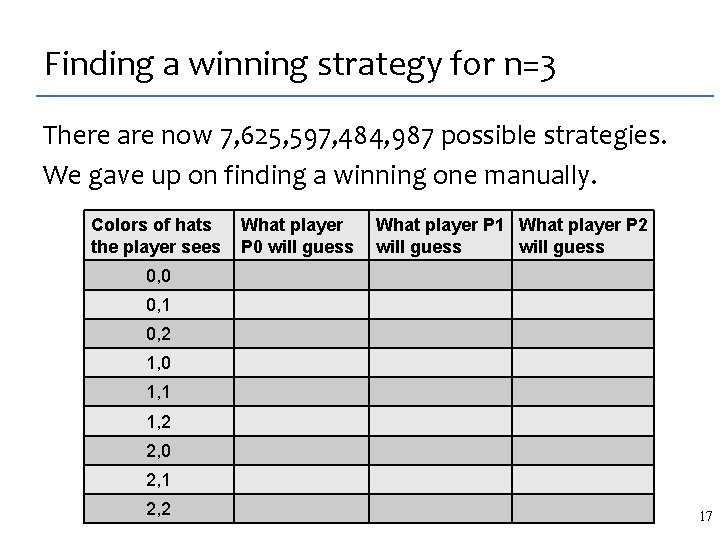
Finding a winning strategy for n=3 There are now 7, 625, 597, 484, 987 possible strategies. We gave up on finding a winning one manually. Colors of hats the player sees What player P 0 will guess What player P 1 What player P 2 will guess 0, 0 0, 1 0, 2 1, 0 1, 1 1, 2 2, 0 2, 1 2, 2 17
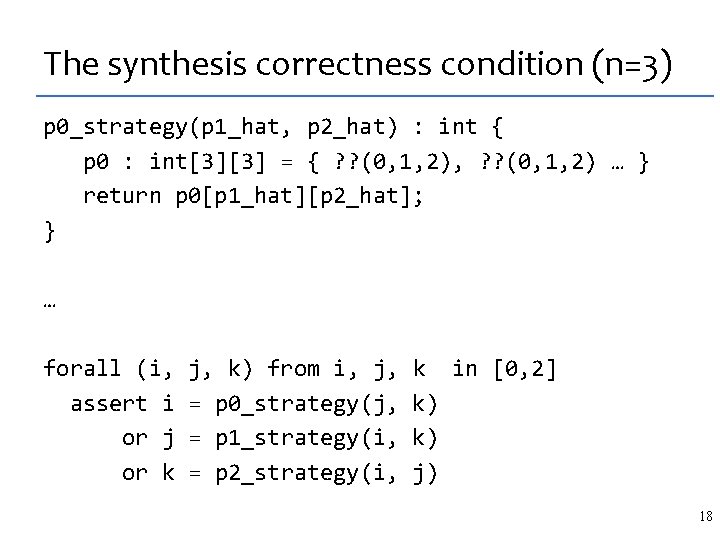
The synthesis correctness condition (n=3) p 0_strategy(p 1_hat, p 2_hat) : int { p 0 : int[3][3] = { ? ? (0, 1, 2), ? ? (0, 1, 2) … } return p 0[p 1_hat][p 2_hat]; } … forall (i, assert i or j or k j, k) from i, j, = p 0_strategy(j, = p 1_strategy(i, = p 2_strategy(i, k in [0, 2] k) k) j) 18
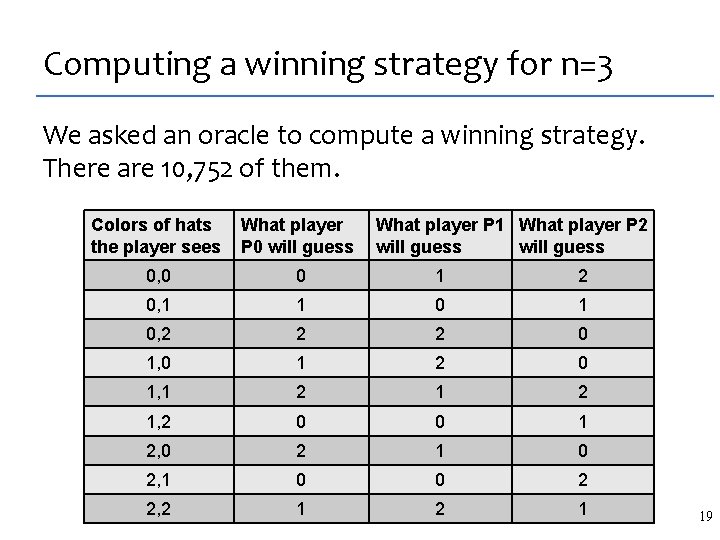
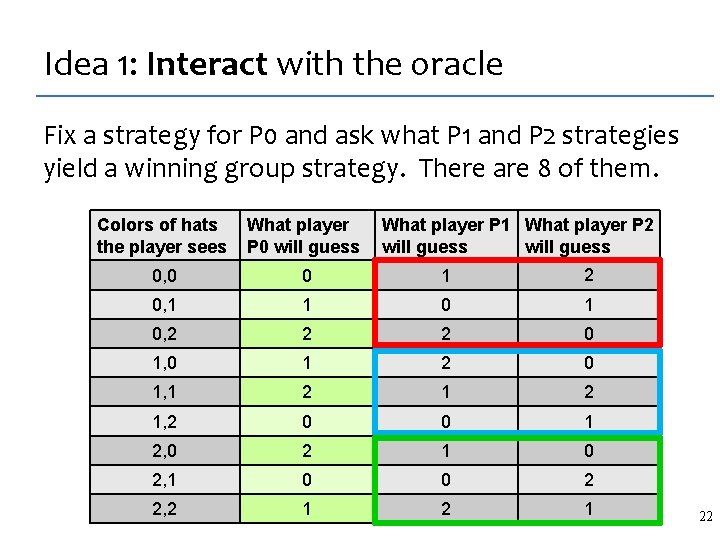
Computing a winning strategy for n=3 We asked an oracle to compute a winning strategy. There are 10, 752 of them. Colors of hats the player sees What player P 0 will guess What player P 1 What player P 2 will guess 0, 0 0 1 2 0, 1 1 0, 2 2 2 0 1, 0 1 2 0 1, 1 2 1, 2 0 0 1 2, 0 2 1 0 2, 1 0 0 2 2, 2 1 19
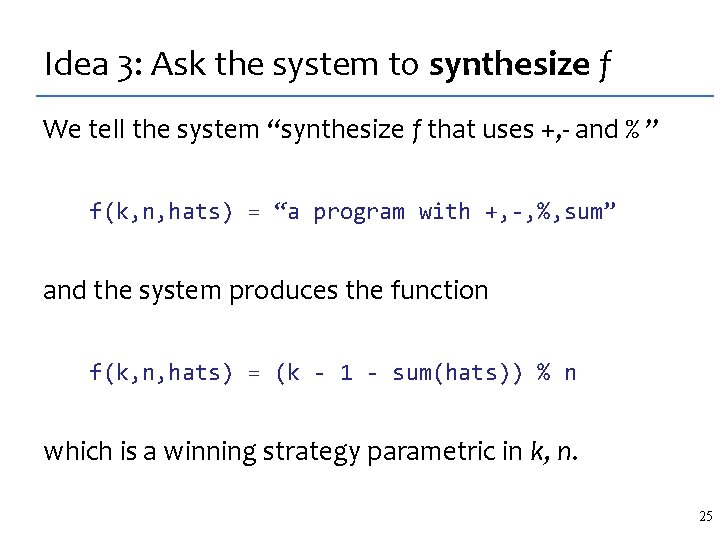
The Hat Game, Revisited Now assume that the players do not know the total number of players, n, or their own id, k, until the hats are placed. Their winning strategy thus must be a function f(k, n, hats). Our goal is to devise such a function f. This is our “program”. We (humans) will observe the (oracle’s) winning strategies for n=3 and generalize them for arbitrary n. 20
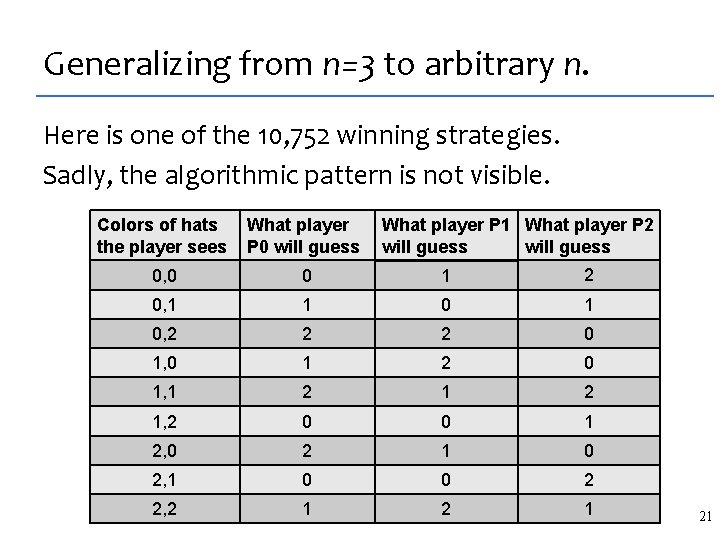
Generalizing from n=3 to arbitrary n. Here is one of the 10, 752 winning strategies. Sadly, the algorithmic pattern is not visible. What player P 1 What player P 2 will guess Colors of hats the player sees What player P 0 will guess 0, 0 0 1 2 0, 1 1 0, 2 2 2 0 1, 0 1 2 0 1, 1 2 1, 2 0 0 1 2, 0 2 1 0 2, 1 0 0 2 2, 2 1 21
Idea 1: Interact with the oracle Fix a strategy for P 0 and ask what P 1 and P 2 strategies yield a winning group strategy. There are 8 of them. What player P 1 What player P 2 will guess Colors of hats the player sees What player P 0 will guess 0, 0 0 1 2 0, 1 1 0, 2 2 2 0 1, 0 1 2 0 1, 1 2 1, 2 0 0 1 2, 0 2 1 0 2, 1 0 0 2 2, 2 1 22
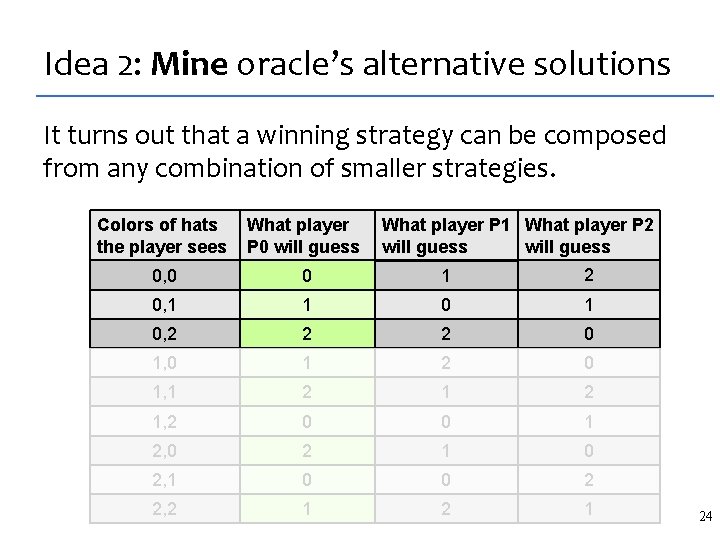
Idea 2: Mine oracle’s alternative solutions It turns out that a winning strategy can be composed from any combination of smaller strategies. What player P 1 What player P 2 will guess Colors of hats the player sees What player P 0 will guess 0, 0 0 1 2 0, 1 1 0, 2 2 2 0 1, 0 1 2 0 1, 1 2 1, 2 0 0 1 2, 0 2 1 0 2, 1 0 0 2 2, 2 1 24
Idea 3: Ask the system to synthesize f We tell the system “synthesize f that uses +, - and % ” f(k, n, hats) = “a program with +, -, %, sum” and the system produces the function f(k, n, hats) = (k - 1 - sum(hats)) % n which is a winning strategy parametric in k, n. 25
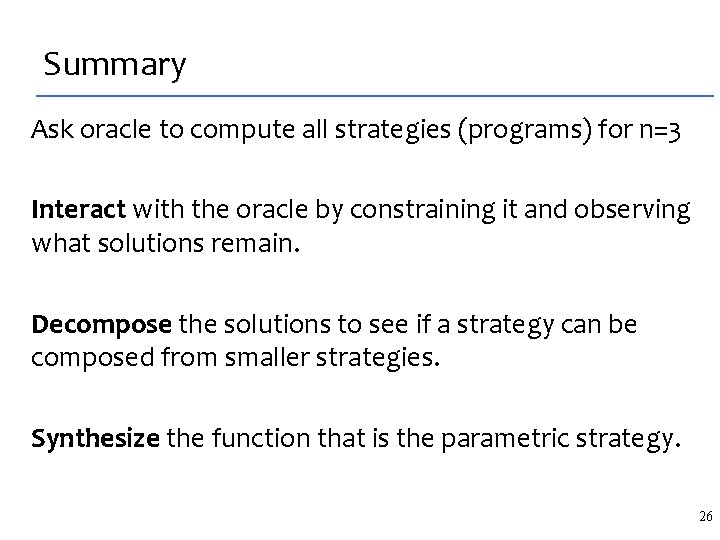
Summary Ask oracle to compute all strategies (programs) for n=3 Interact with the oracle by constraining it and observing what solutions remain. Decompose the solutions to see if a strategy can be composed from smaller strategies. Synthesize the function that is the parametric strategy. 26
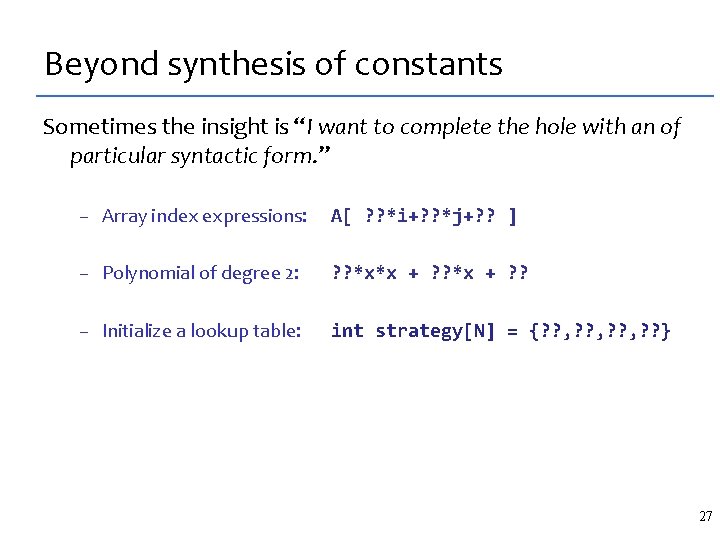
Beyond synthesis of constants Sometimes the insight is “I want to complete the hole with an of particular syntactic form. ” – Array index expressions: A[ ? ? *i+? ? *j+? ? ] – Polynomial of degree 2: ? ? *x*x + ? ? – Initialize a lookup table: int strategy[N] = {? ? , ? ? } 27
Angelic Programming 28
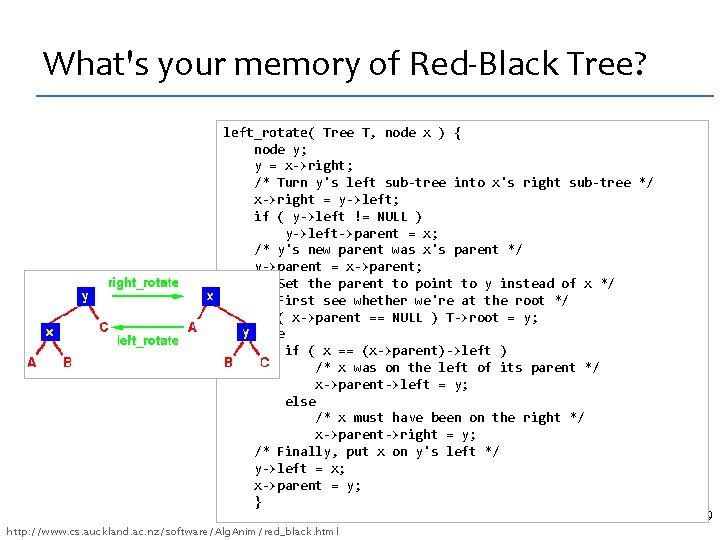
What's your memory of Red-Black Tree? left_rotate( Tree T, node x ) { node y; y = x->right; /* Turn y's left sub-tree into x's right sub-tree */ x->right = y->left; if ( y->left != NULL ) y->left->parent = x; /* y's new parent was x's parent */ y->parent = x->parent; /* Set the parent to point to y instead of x */ /* First see whether we're at the root */ if ( x->parent == NULL ) T->root = y; else if ( x == (x->parent)->left ) /* x was on the left of its parent */ x->parent->left = y; else /* x must have been on the right */ x->parent->right = y; /* Finally, put x on y's left */ y->left = x; x->parent = y; } http: //www. cs. auckland. ac. nz/software/Alg. Anim/red_black. html 29
Jim Demmel's napkin 30
Programmers often think with examples They often design algorithms by devising and studying examples demonstrating steps of algorithm at hand. If only the programmer could ask for a demonstration of the desired algorithm! The demonstration (a trace) reveals the insight. We create demonstration with an executable oracle. 31
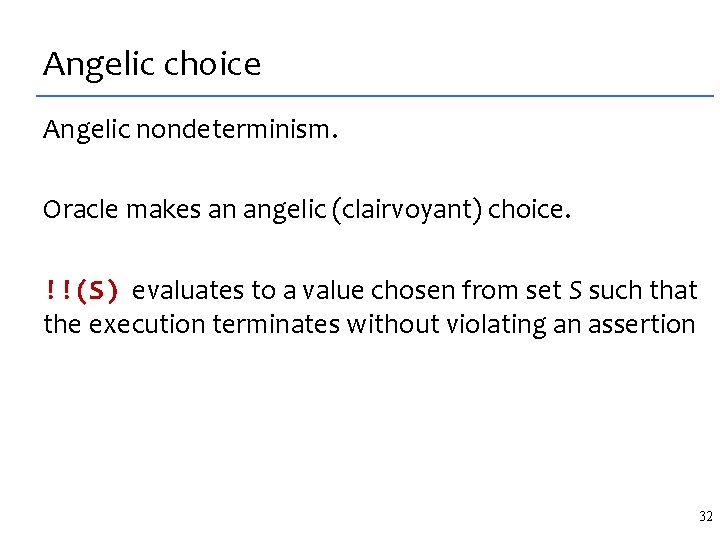
Angelic choice Angelic nondeterminism. Oracle makes an angelic (clairvoyant) choice. !!(S) evaluates to a value chosen from set S such that the execution terminates without violating an assertion 32
Programming with oracles (DFS) Design DFS traversal that does not use a stack. Used in garbage collection: when out of memory, you cannot ask for O(N) memory to mark reachable nodes We want DFS that uses O(1) memory. 34
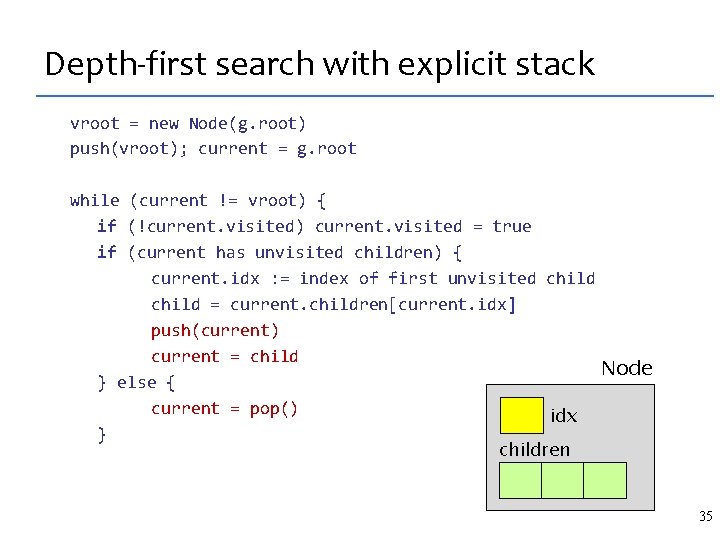
Depth-first search with explicit stack vroot = new Node(g. root) push(vroot); current = g. root while (current != vroot) { if (!current. visited) current. visited = true if (current has unvisited children) { current. idx : = index of first unvisited child = current. children[current. idx] push(current) current = child Node } else { current = pop() idx } children 35
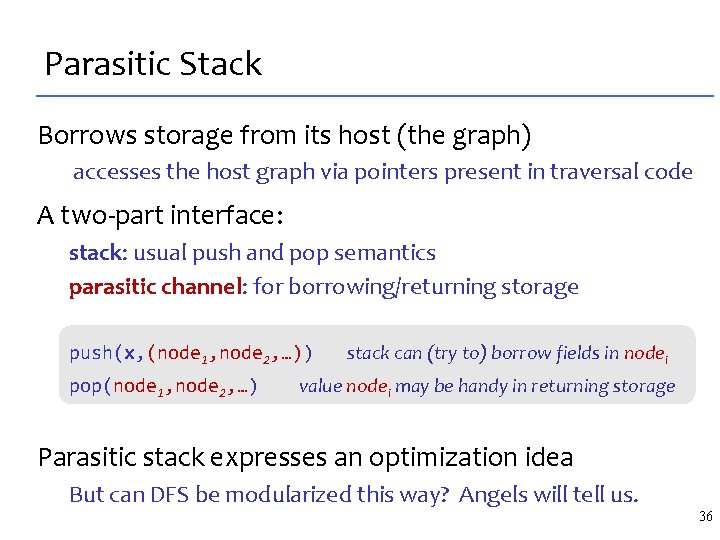
Parasitic Stack Borrows storage from its host (the graph) accesses the host graph via pointers present in traversal code A two-part interface: stack: usual push and pop semantics parasitic channel: for borrowing/returning storage push(x, (node 1, node 2, …)) pop(node 1, node 2, …) stack can (try to) borrow fields in nodei value nodei may be handy in returning storage Parasitic stack expresses an optimization idea But can DFS be modularized this way? Angels will tell us. 36
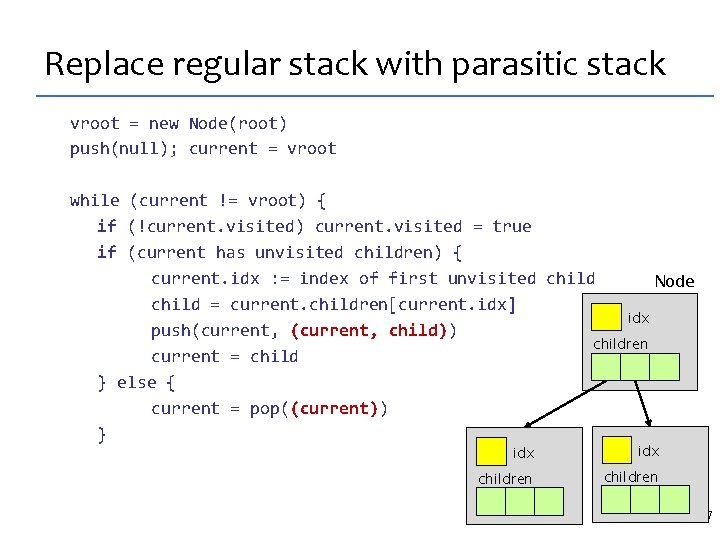
Replace regular stack with parasitic stack vroot = new Node(root) push(null); current = vroot while (current != vroot) { if (!current. visited) current. visited = true if (current has unvisited children) { current. idx : = index of first unvisited child Node child = current. children[current. idx] idx push(current, child)) children current = child } else { current = pop((current)) } idx children 37
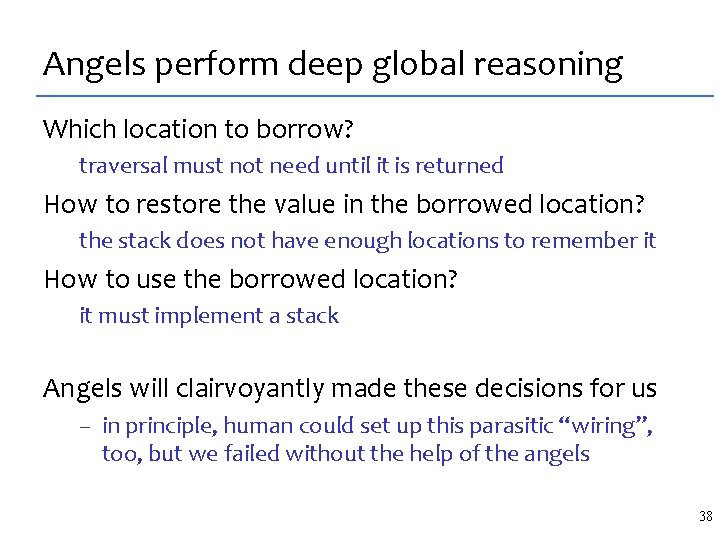
Angels perform deep global reasoning Which location to borrow? traversal must not need until it is returned How to restore the value in the borrowed location? the stack does not have enough locations to remember it How to use the borrowed location? it must implement a stack Angels will clairvoyantly made these decisions for us – in principle, human could set up this parasitic “wiring”, too, but we failed without the help of the angels 38
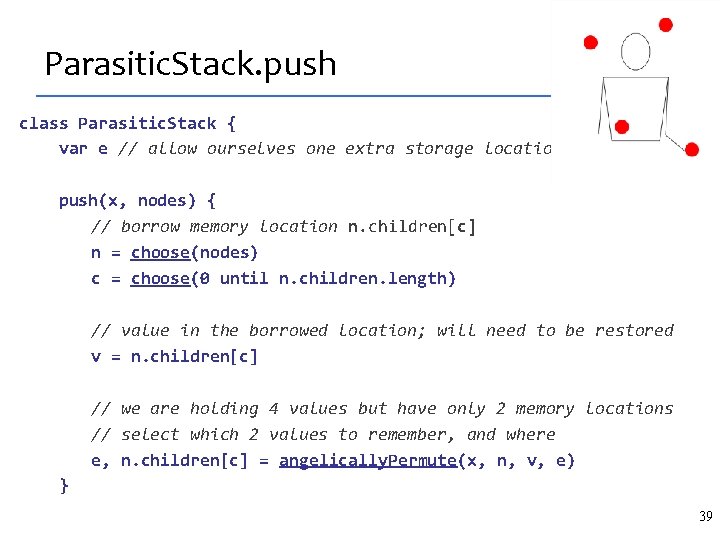
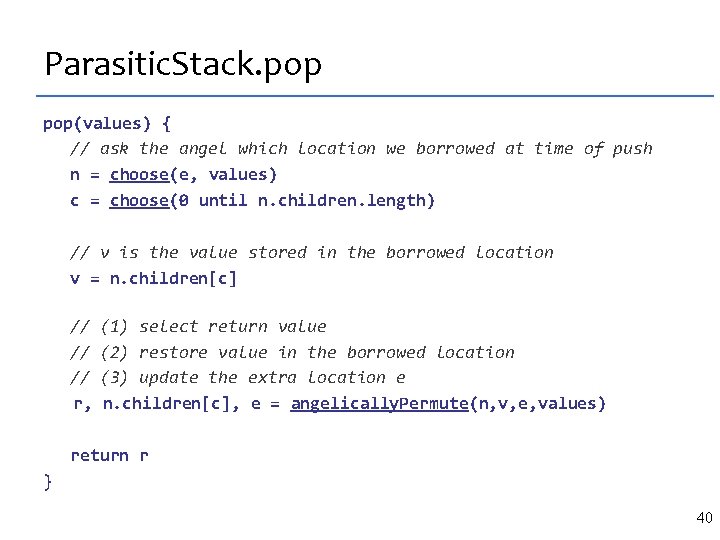
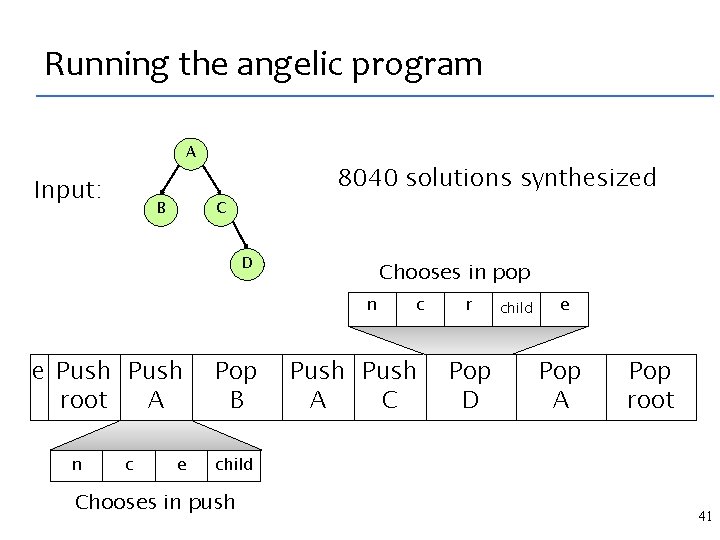
Parasitic. Stack. push class Parasitic. Stack { var e // allow ourselves one extra storage location push(x, nodes) { // borrow memory location n. children[c] n = choose(nodes) c = choose(0 until n. children. length) // value in the borrowed location; will need to be restored v = n. children[c] // we are holding 4 values but have only 2 memory locations // select which 2 values to remember, and where e, n. children[c] = angelically. Permute(x, n, v, e) } 39
Parasitic. Stack. pop(values) { // ask the angel which location we borrowed at time of push n = choose(e, values) c = choose(0 until n. children. length) // v is the value stored in the borrowed location v = n. children[c] // // // r, (1) select return value (2) restore value in the borrowed location (3) update the extra location e n. children[c], e = angelically. Permute(n, v, e, values) return r } 40
Running the angelic program A Input: B 8040 solutions synthesized C D Chooses in pop n e Push root A n c e Pop B c Push A C r Pop D child e Pop A Pop root child Chooses in push 41
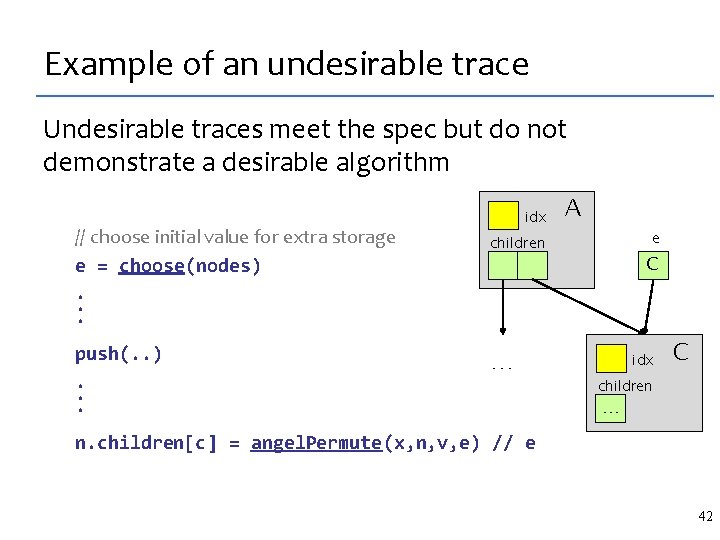
Example of an undesirable trace Undesirable traces meet the spec but do not demonstrate a desirable algorithm // choose initial value for extra storage e = choose(nodes). . . push(. . ). . . idx A e children … C idx C children … n. children[c] = angel. Permute(x, n, v, e) // e 42
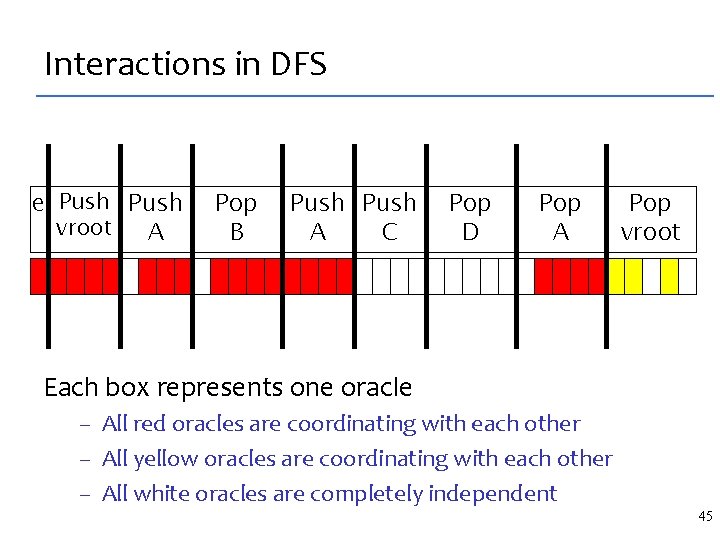
Interactions in DFS e Push vroot A Pop B Push A C Pop D Pop A Pop vroot Each box represents one oracle – All red oracles are coordinating with each other – All yellow oracles are coordinating with each other – All white oracles are completely independent 45
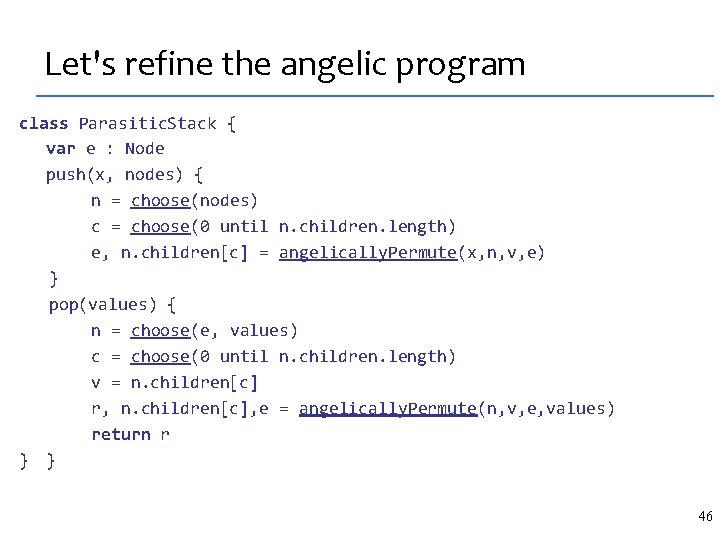
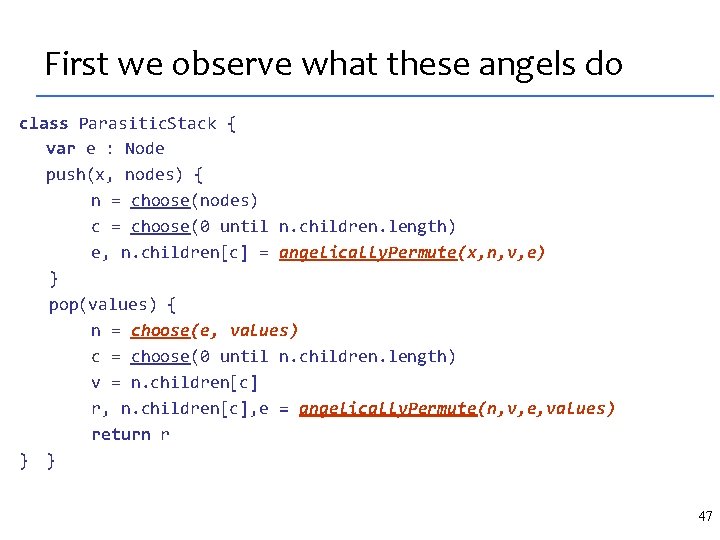
Let's refine the angelic program class Parasitic. Stack { var e : Node push(x, nodes) { n = choose(nodes) c = choose(0 until n. children. length) e, n. children[c] = angelically. Permute(x, n, v, e) } pop(values) { n = choose(e, values) c = choose(0 until n. children. length) v = n. children[c] r, n. children[c], e = angelically. Permute(n, v, e, values) return r } } 46
First we observe what these angels do class Parasitic. Stack { var e : Node push(x, nodes) { n = choose(nodes) c = choose(0 until n. children. length) e, n. children[c] = angelically. Permute(x, n, v, e) } pop(values) { n = choose(e, values) c = choose(0 until n. children. length) v = n. children[c] r, n. children[c], e = angelically. Permute(n, v, e, values) return r } } 47
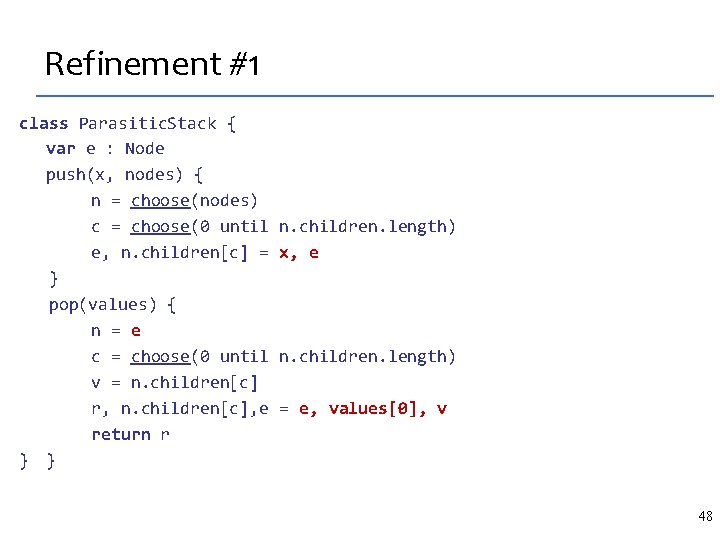
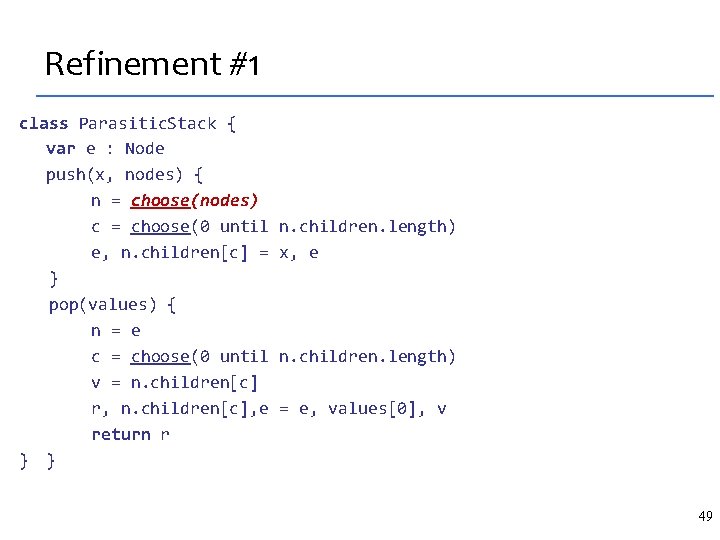
Refinement #1 class Parasitic. Stack { var e : Node push(x, nodes) { n = choose(nodes) c = choose(0 until e, n. children[c] = } pop(values) { n = e c = choose(0 until v = n. children[c] r, n. children[c], e return r } } n. children. length) x, e n. children. length) = e, values[0], v 48
Refinement #1 class Parasitic. Stack { var e : Node push(x, nodes) { n = choose(nodes) c = choose(0 until e, n. children[c] = } pop(values) { n = e c = choose(0 until v = n. children[c] r, n. children[c], e return r } } n. children. length) x, e n. children. length) = e, values[0], v 49
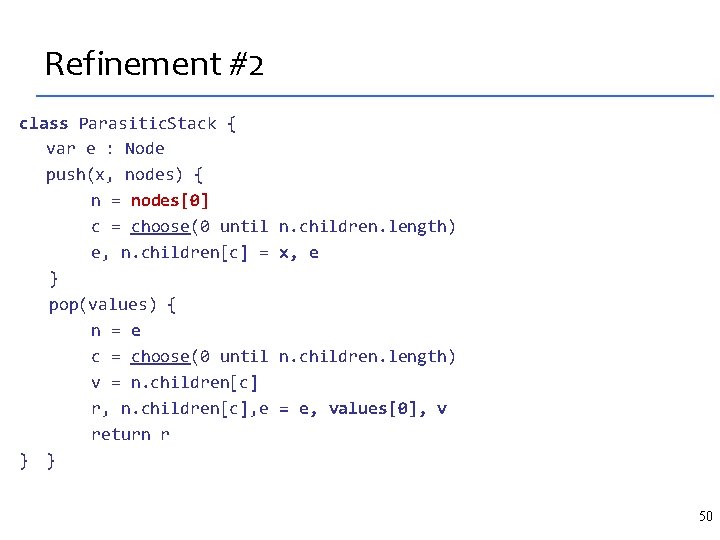
Refinement #2 class Parasitic. Stack { var e : Node push(x, nodes) { n = nodes[0] c = choose(0 until e, n. children[c] = } pop(values) { n = e c = choose(0 until v = n. children[c] r, n. children[c], e return r } } n. children. length) x, e n. children. length) = e, values[0], v 50
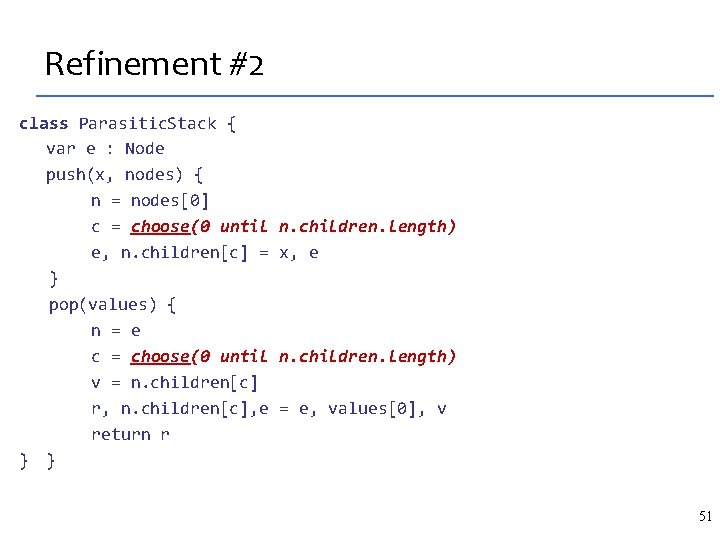
Refinement #2 class Parasitic. Stack { var e : Node push(x, nodes) { n = nodes[0] c = choose(0 until e, n. children[c] = } pop(values) { n = e c = choose(0 until v = n. children[c] r, n. children[c], e return r } } n. children. length) x, e n. children. length) = e, values[0], v 51
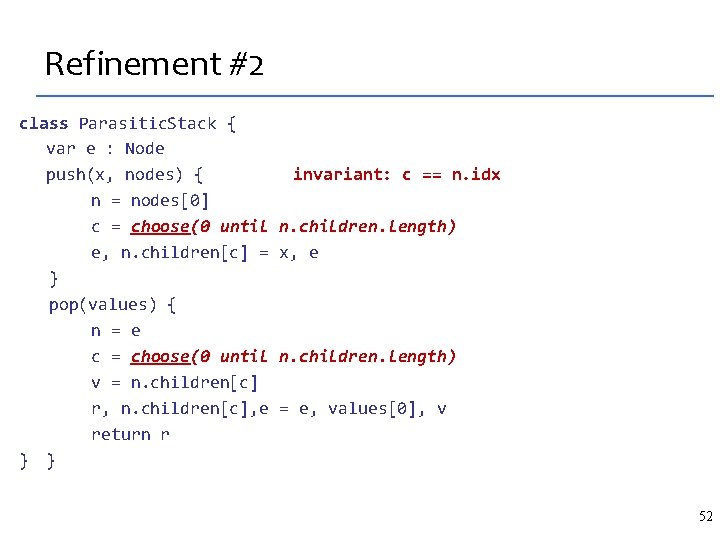
Refinement #2 class Parasitic. Stack { var e : Node push(x, nodes) { n = nodes[0] c = choose(0 until e, n. children[c] = } pop(values) { n = e c = choose(0 until v = n. children[c] r, n. children[c], e return r } } invariant: c == n. idx n. children. length) x, e n. children. length) = e, values[0], v 52
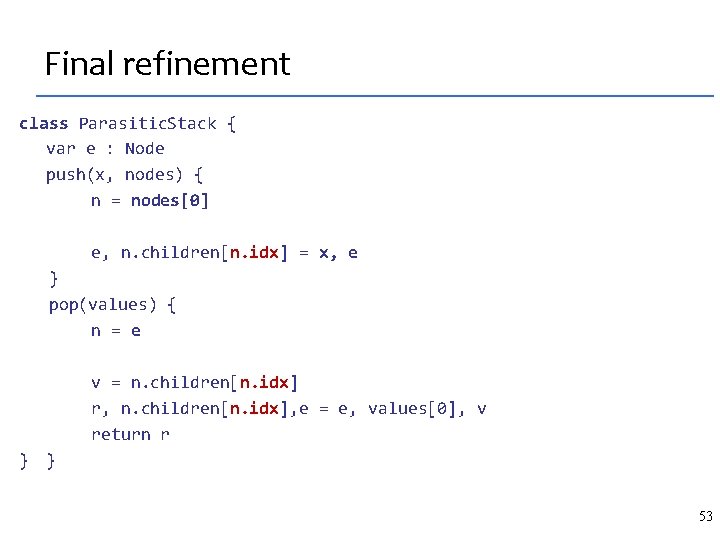
Final refinement class Parasitic. Stack { var e : Node push(x, nodes) { n = nodes[0] e, n. children[n. idx] = x, e } pop(values) { n = e v = n. children[n. idx] r, n. children[n. idx], e = e, values[0], v return r } } 53
Our results: what we synthesized Concurrent Data Structures [PLDI 2008] lock free lists and barriers Stencils [PLDI 2007] highly optimized matrix codes Dynamic Programming Algorithms [OOPSLA 2011] O(N) algorithms, including parallel ones 54
To be continued after lunch How to implement the oracles (synthesis algorithms) Hiding sketches from programmers Similar synthesizers and the space of synthesis ideas 55