
Automatic Photo Popup Derek Hoiem Alexei A Efros


- Slides: 52
Automatic Photo Popup Derek Hoiem Alexei A. Efros Martial Hebert Carnegie Mellon University
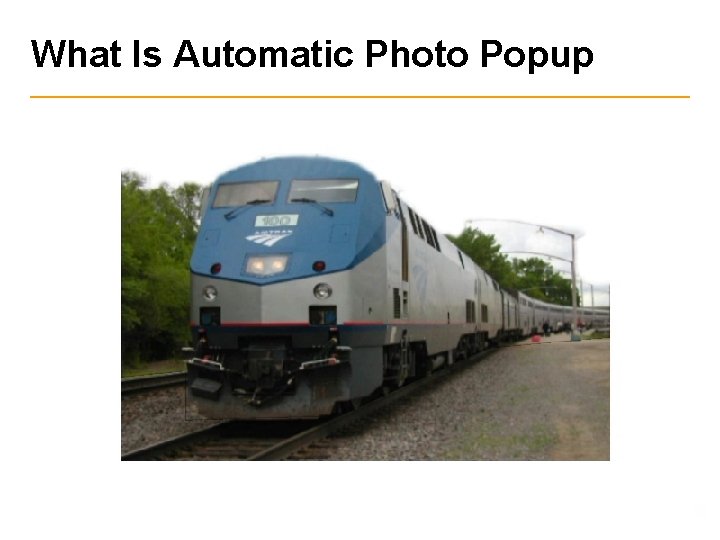
What Is Automatic Photo Popup
Introduction • Creating 3 D models from images is a complex process – Time-consuming – Special equipment – Large number of photographs • Easy methods not widely accessible to general public
Related Work • Multiple Images – Manual Reconstruction • Façade [Debevec et al. 1996], REALVIZ Image Modeler, Photobuilder [Cipolla et al. 1999], [Zieglier et al. 2003], etc. – Automatic Reconstruction • Structure from Motion (e. g. [Nister 2001], [Pollefeys et al. 2004]) • Single Image – Manual Reconstruction • Metric ([Liebowitz et al. 1999], [Criminisi et al. 1999]) • Approximate: Tour into the Picture [Horry et al. 1997]; [Kang et al. 2001], [Oh et al. 2001], [Zhang et al. 2001], etc. – Automatic Reconstruction •
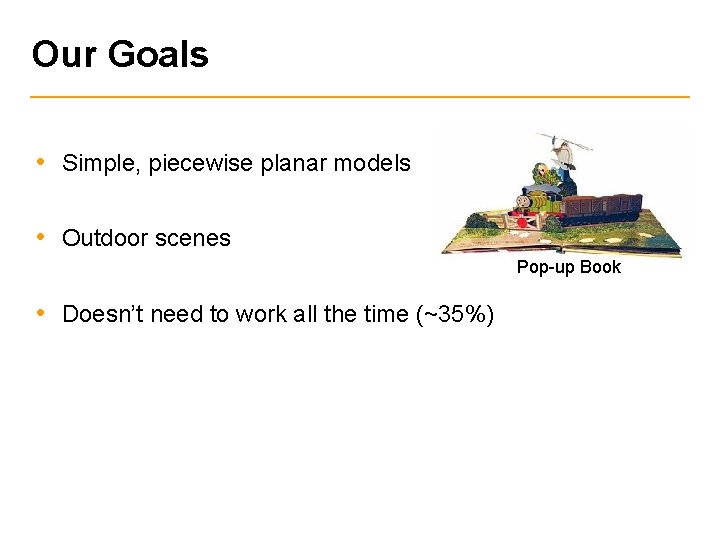
Our Goals • Simple, piecewise planar models • Outdoor scenes Pop-up Book • Doesn’t need to work all the time (~35%)
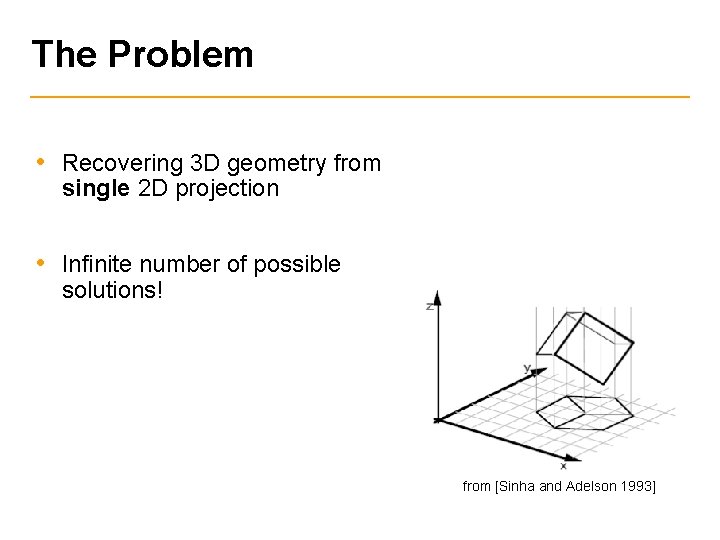
The Problem • Recovering 3 D geometry from single 2 D projection • Infinite number of possible solutions! from [Sinha and Adelson 1993]
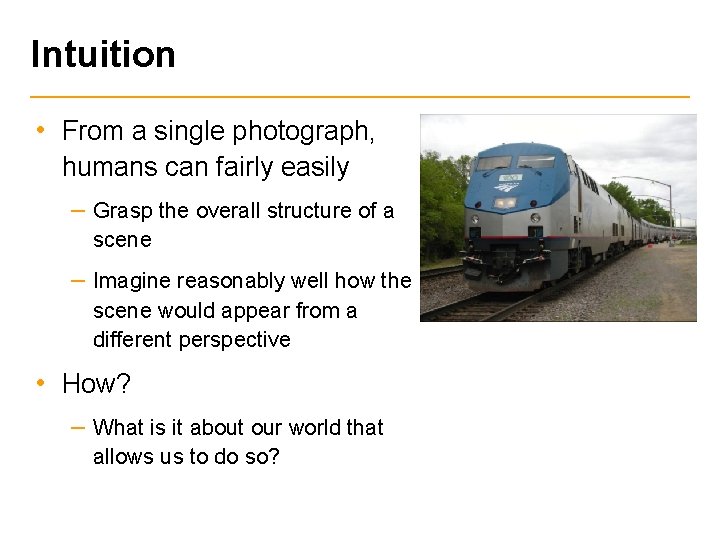
Intuition • From a single photograph, humans can fairly easily – Grasp the overall structure of a scene – Imagine reasonably well how the scene would appear from a different perspective • How? – What is it about our world that allows us to do so?
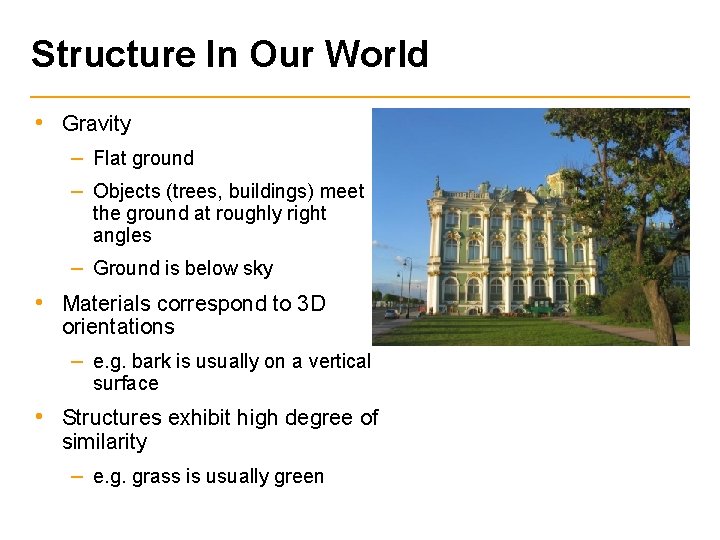
Structure In Our World • Gravity – Flat ground – Objects (trees, buildings) meet the ground at roughly right angles – Ground is below sky • Materials correspond to 3 D orientations – e. g. bark is usually on a vertical surface • Structures exhibit high degree of similarity – e. g. grass is usually green
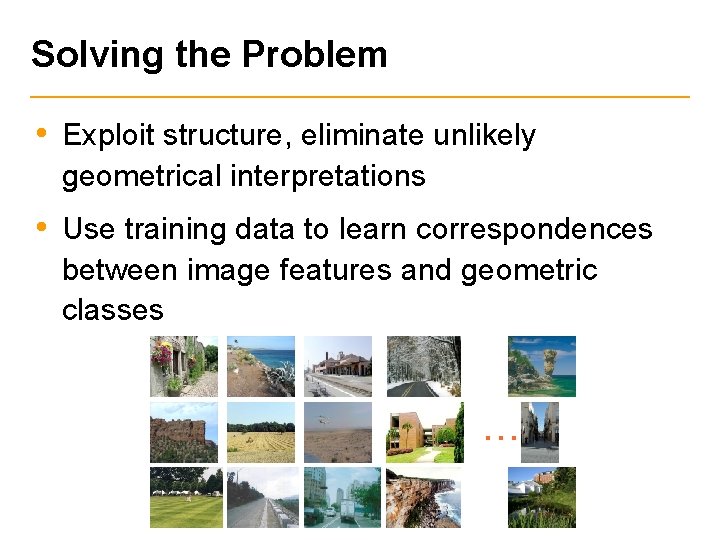
Solving the Problem • Exploit structure, eliminate unlikely geometrical interpretations • Use training data to learn correspondences between image features and geometric classes …
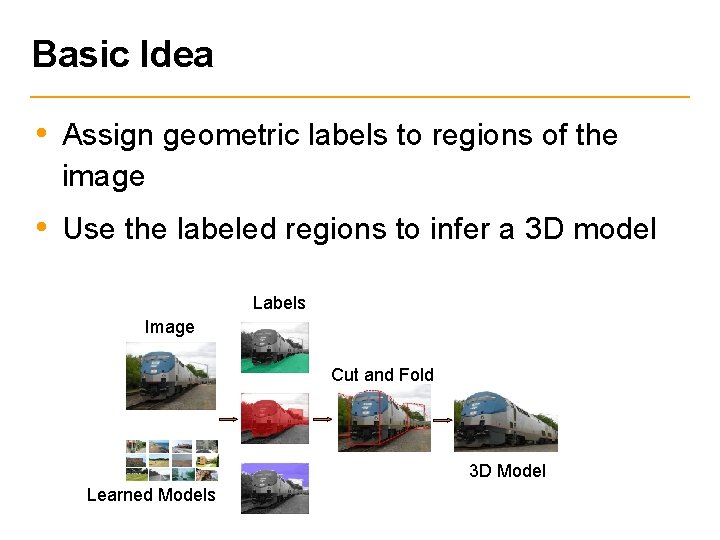
Basic Idea • Assign geometric labels to regions of the image • Use the labeled regions to infer a 3 D model Labels Image Cut and Fold 3 D Model Learned Models
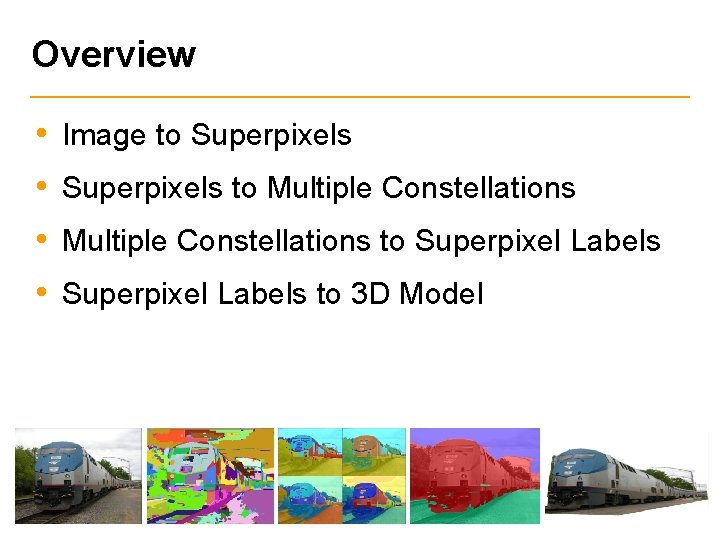
Overview • Image to Superpixels • Superpixels to Multiple Constellations • Multiple Constellations to Superpixel Labels • Superpixel Labels to 3 D Model
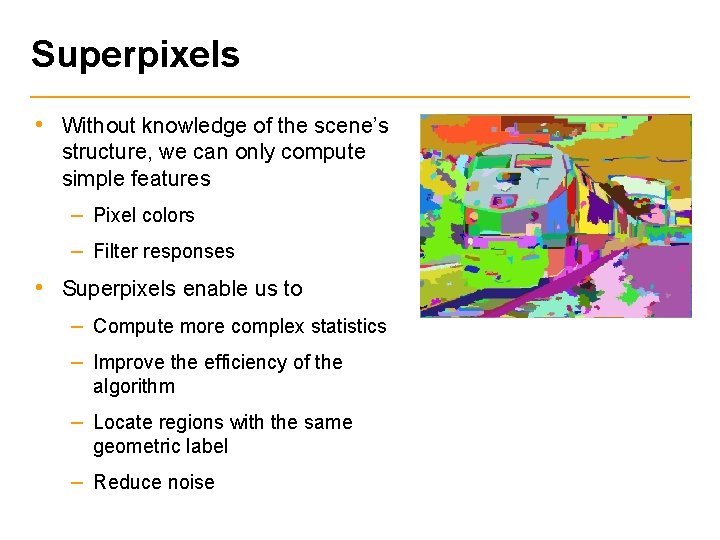
Superpixels • Without knowledge of the scene’s structure, we can only compute simple features – Pixel colors – Filter responses • Superpixels enable us to – Compute more complex statistics – Improve the efficiency of the algorithm – Locate regions with the same geometric label – Reduce noise
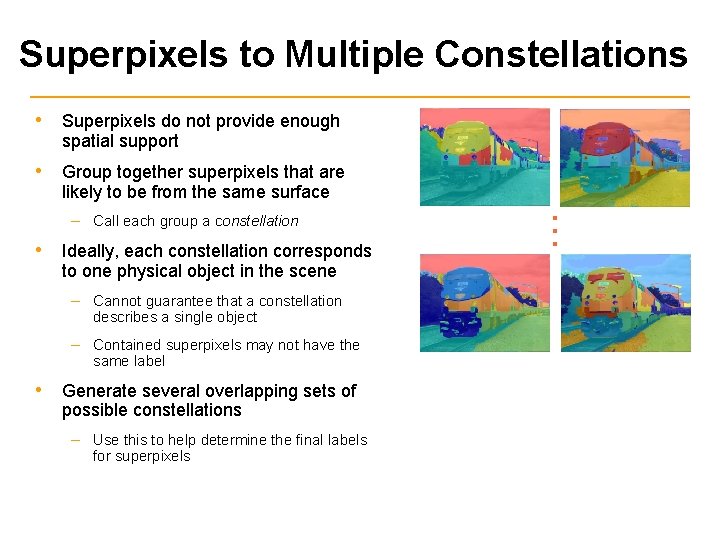
Superpixels to Multiple Constellations • Superpixels do not provide enough spatial support • Group together superpixels that are – Call each group a constellation • Ideally, each constellation corresponds to one physical object in the scene – Cannot guarantee that a constellation describes a single object – Contained superpixels may not have the same label • Generate several overlapping sets of possible constellations – Use this to help determine the final labels for superpixels … likely to be from the same surface
Forming Constellations • Group superpixels that are likely to share a common geometric label • We cannot be completely confident that these constellations are homogenous – Find multiple constellations for each superpixel • Superpixel features allow us to determine whether a pair of superpixels have the same label – Not sufficient to determine the label for the superpixel
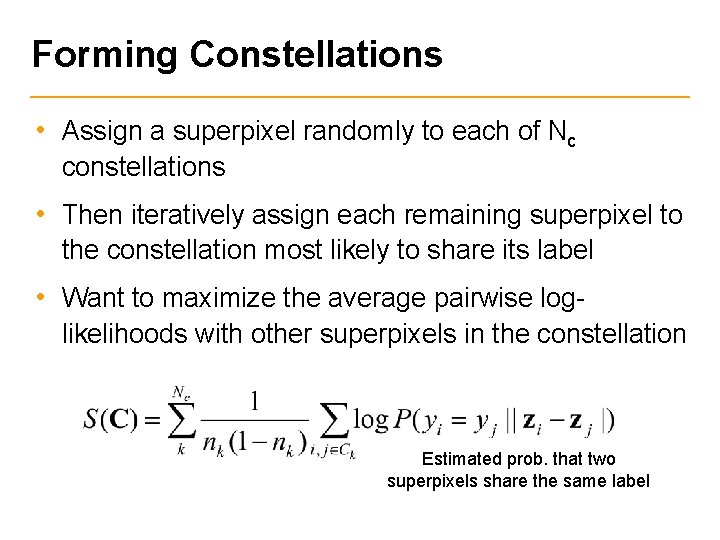
Forming Constellations • Assign a superpixel randomly to each of Nc constellations • Then iteratively assign each remaining superpixel to the constellation most likely to share its label • Want to maximize the average pairwise loglikelihoods with other superpixels in the constellation Estimated prob. that two superpixels share the same label
Forming Constellations • Vary Nc from 3 to 25 to explore – The trade-off of variance from poor spatial support – The bias from risk of mixed labels in a constellation
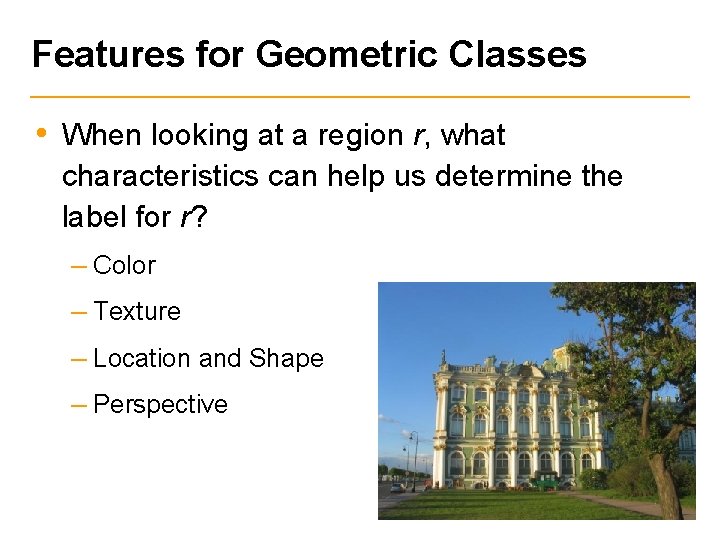
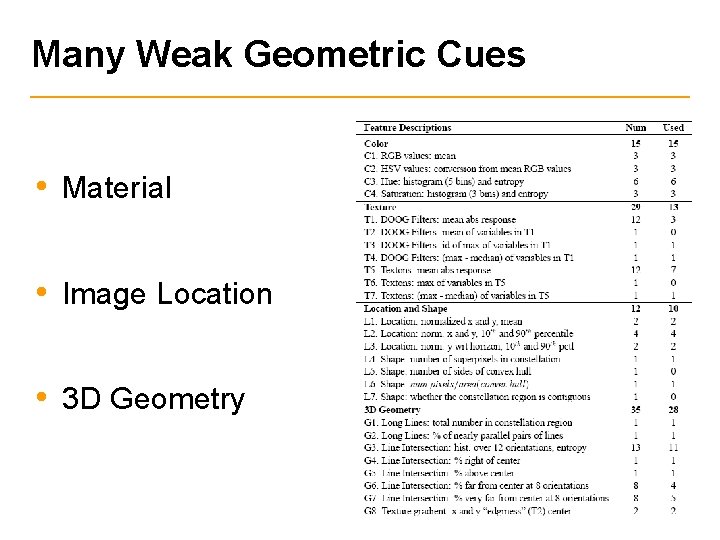
Features for Geometric Classes • When looking at a region r, what characteristics can help us determine the label for r? – Color – Texture – Location and Shape – Perspective
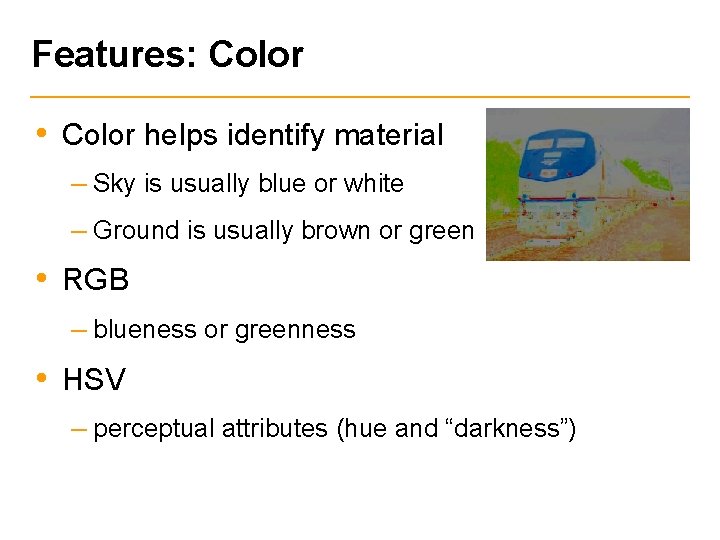
Features: Color • Color helps identify material – Sky is usually blue or white – Ground is usually brown or green • RGB – blueness or greenness • HSV – perceptual attributes (hue and “darkness”)
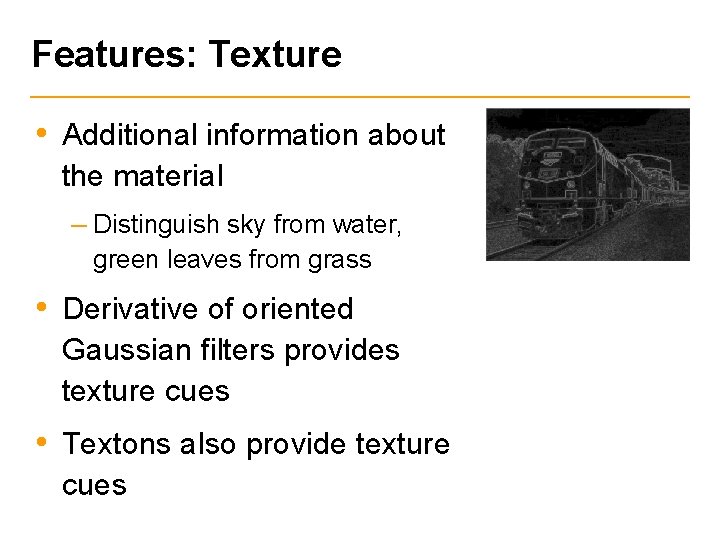
Features: Texture • Additional information about the material – Distinguish sky from water, green leaves from grass • Derivative of oriented Gaussian filters provides texture cues • Textons also provide texture cues
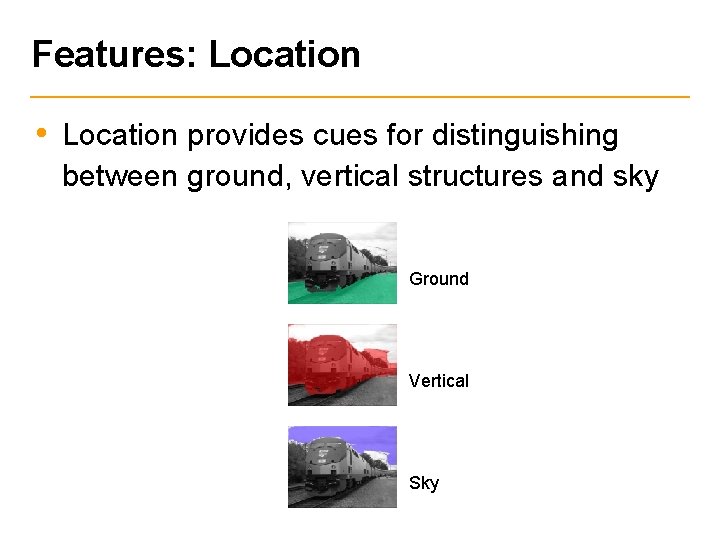
Features: Location • Location provides cues for distinguishing between ground, vertical structures and sky Ground Vertical Sky
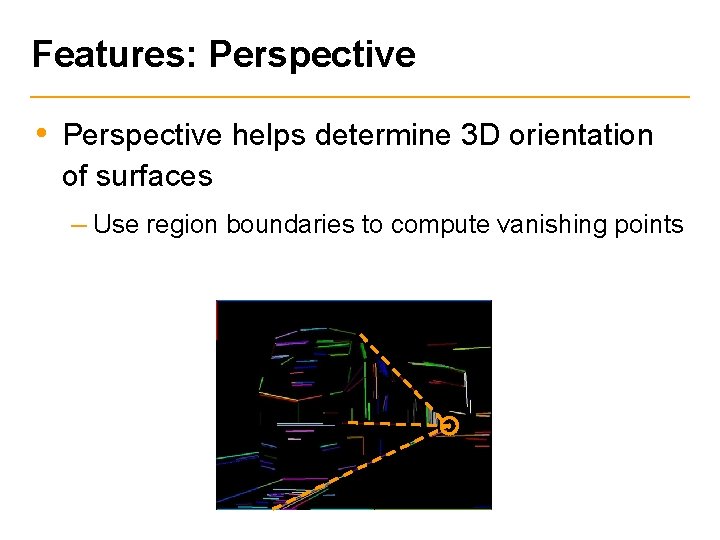
Features: Perspective • Perspective helps determine 3 D orientation of surfaces – Use region boundaries to compute vanishing points
Many Weak Geometric Cues • Material • Image Location • 3 D Geometry
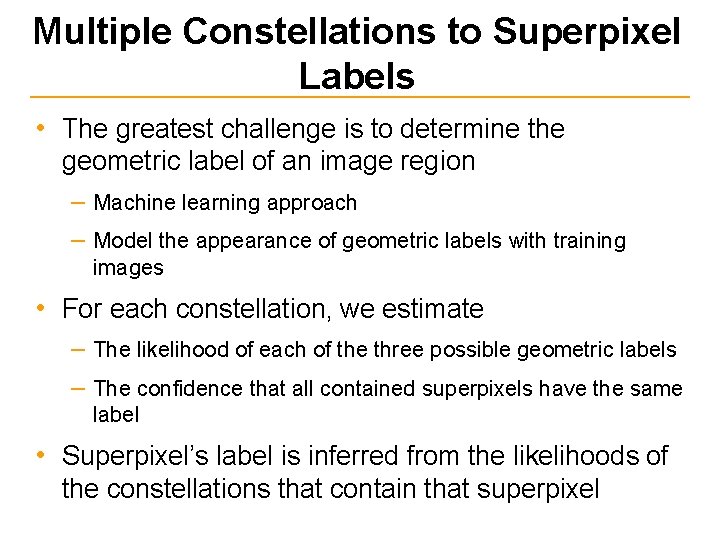
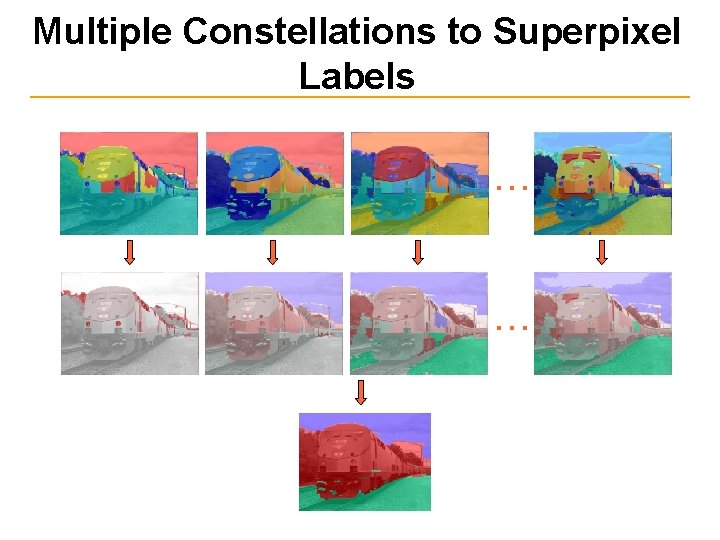
Multiple Constellations to Superpixel Labels • The greatest challenge is to determine the geometric label of an image region – Machine learning approach – Model the appearance of geometric labels with training images • For each constellation, we estimate – The likelihood of each of the three possible geometric labels – The confidence that all contained superpixels have the same label • Superpixel’s label is inferred from the likelihoods of the constellations that contain that superpixel
Multiple Constellations to Superpixel Labels … …
Labeling the Image • Feature descriptors are computed from – Superpixels – Constellations • Geometric classification of regions • Training – Training Data – Superpixel Same-Label Likelihoods – Constellation Label and Homogeneity Likelihoods
Geometric Classification • Goal: obtain the most likely label for each superpixel in the image • Label likelihood – confidence in each geometric label • Homogeneity likelihood – do all superpixels in a constellation share the same label?
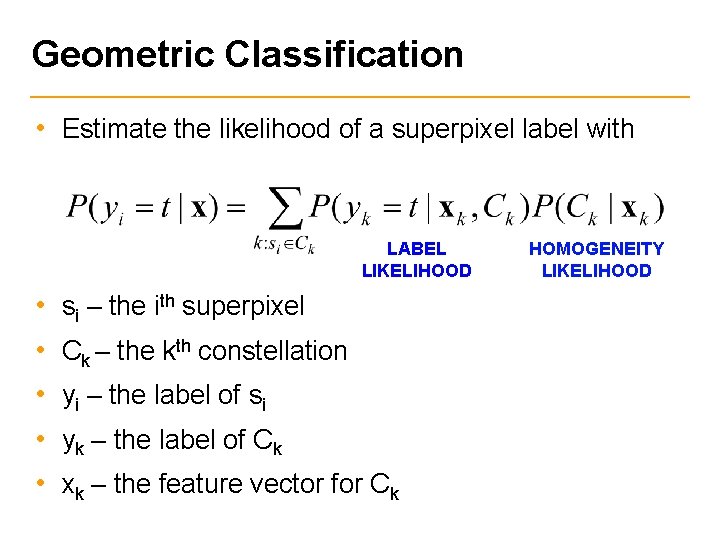
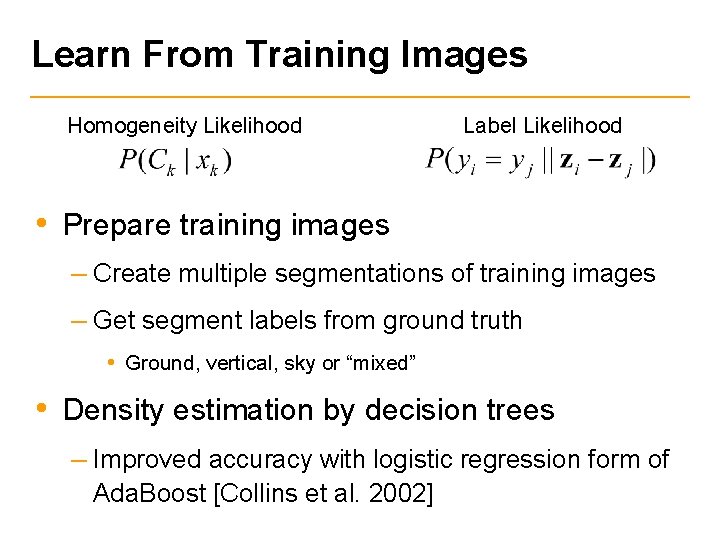
Geometric Classification • Estimate the likelihood of a superpixel label with LABEL LIKELIHOOD • • • si – the ith superpixel Ck – the kth constellation yi – the label of si yk – the label of Ck xk – the feature vector for Ck HOMOGENEITY LIKELIHOOD
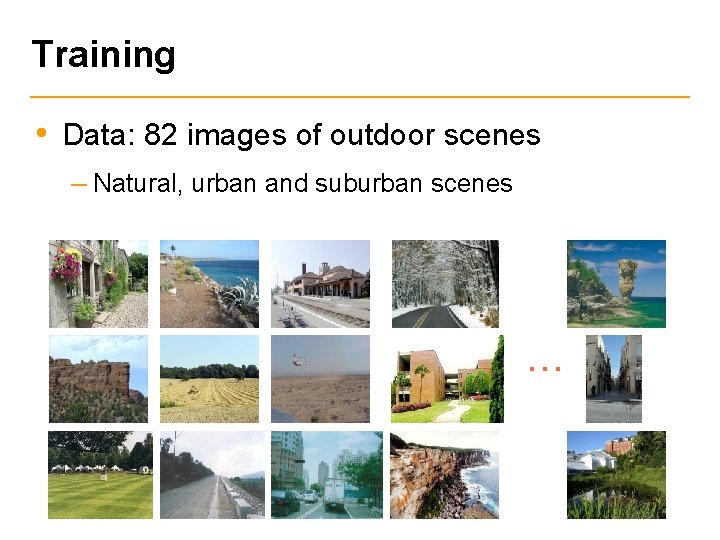
Training • Data: 82 images of outdoor scenes – Natural, urban and suburban scenes …
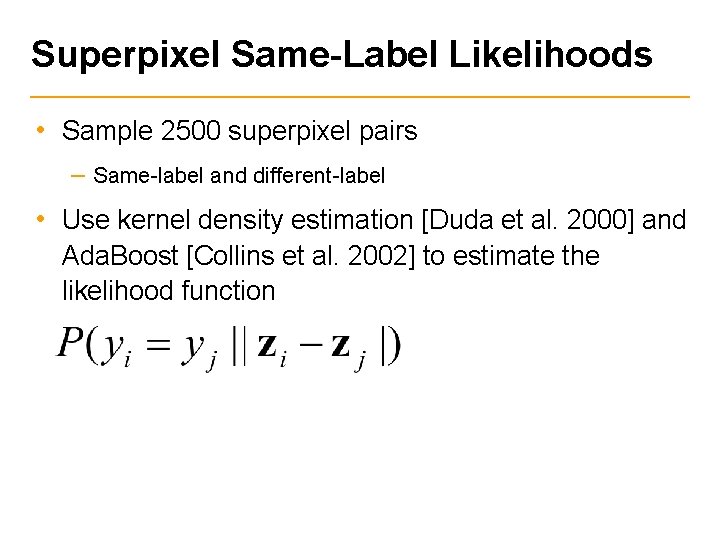
Superpixel Same-Label Likelihoods • Sample 2500 superpixel pairs – Same-label and different-label • Use kernel density estimation [Duda et al. 2000] and Ada. Boost [Collins et al. 2002] to estimate the likelihood function
Learn From Training Images Homogeneity Likelihood Label Likelihood • Prepare training images – Create multiple segmentations of training images – Get segment labels from ground truth • Ground, vertical, sky or “mixed” • Density estimation by decision trees – Improved accuracy with logistic regression form of Ada. Boost [Collins et al. 2002]
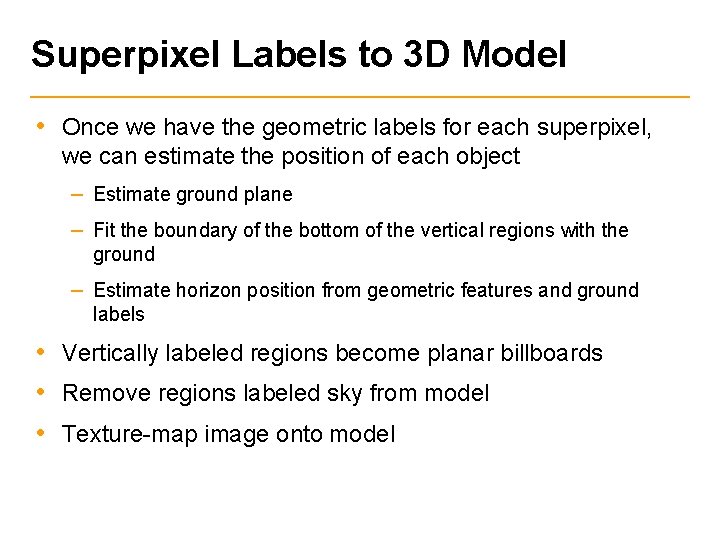
Superpixel Labels to 3 D Model • Once we have the geometric labels for each superpixel, we can estimate the position of each object – Estimate ground plane – Fit the boundary of the bottom of the vertical regions with the ground – Estimate horizon position from geometric features and ground labels • Vertically labeled regions become planar billboards • Remove regions labeled sky from model • Texture-map image onto model
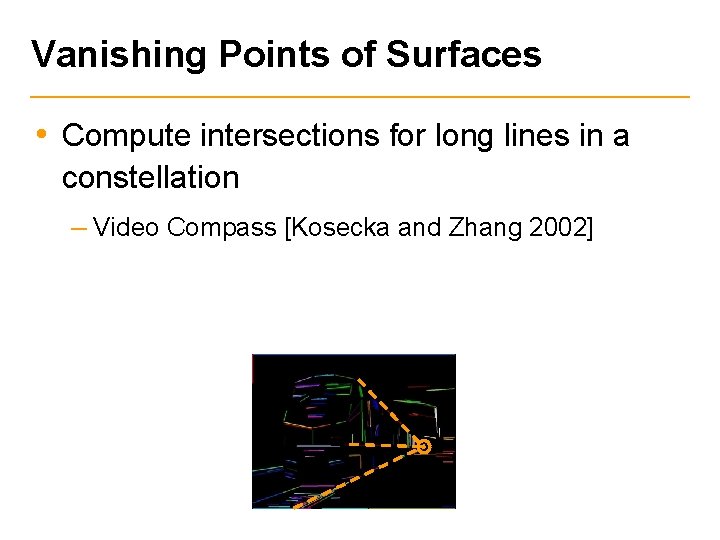
Vanishing Points of Surfaces • Compute intersections for long lines in a constellation – Video Compass [Kosecka and Zhang 2002]
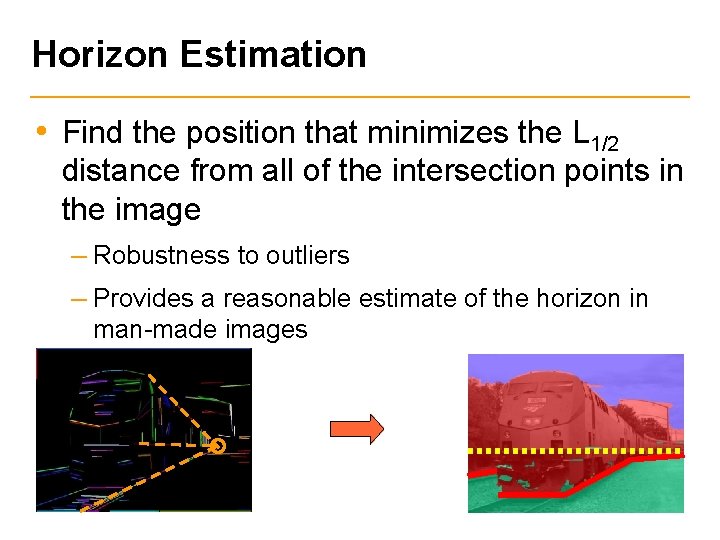
Horizon Estimation • Find the position that minimizes the L 1/2 distance from all of the intersection points in the image – Robustness to outliers – Provides a reasonable estimate of the horizon in man-made images
Creating the 3 D Model • Cutting and folding • Camera parameters
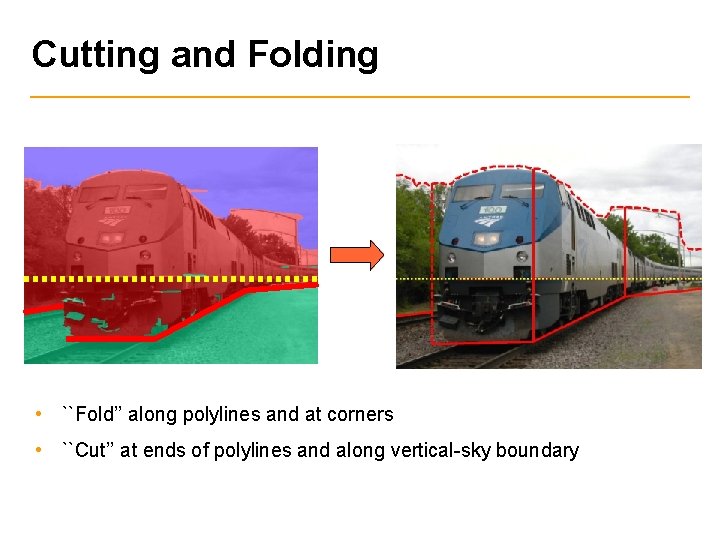
Cutting And Folding • Construct a simple 3 D model – Single ground plane – Simple, piecewise planar objects for vertically labeled regions • Partition vertical regions into a set of objects • Determine where each object intersects the ground plane – There are difficulties, be conservative
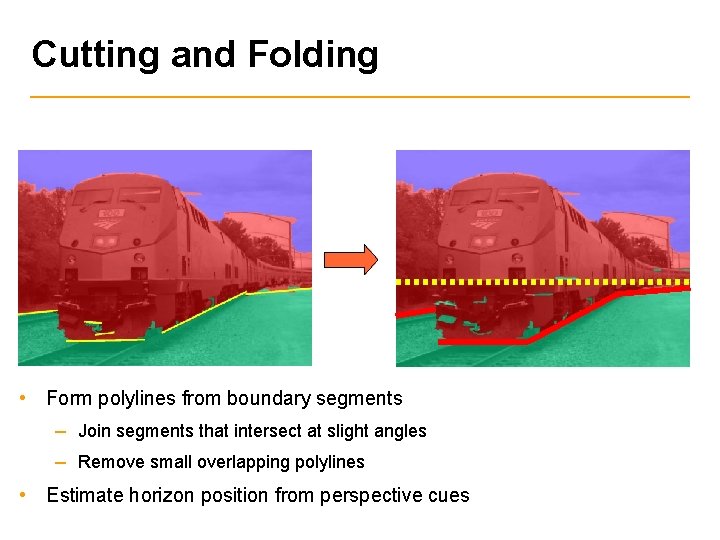
Partitioning Vertically Labeled Regions • Divide vertically labeled pixels into loosely connected regions using the connected components algorithm • For each region, fit a set of lines to the boundary using the Hough transform [Duda et al. 1972] • Form disjoint line segments into a set of polylines
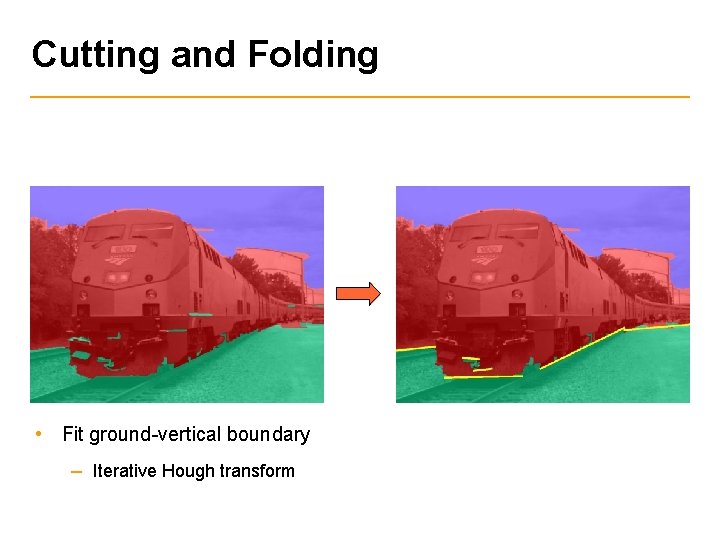
Cutting and Folding • Fit ground-vertical boundary – Iterative Hough transform
Cutting and Folding • Form polylines from boundary segments – Join segments that intersect at slight angles – Remove small overlapping polylines • Estimate horizon position from perspective cues
Cutting and Folding • ``Fold’’ along polylines and at corners • ``Cut’’ at ends of polylines and along vertical-sky boundary
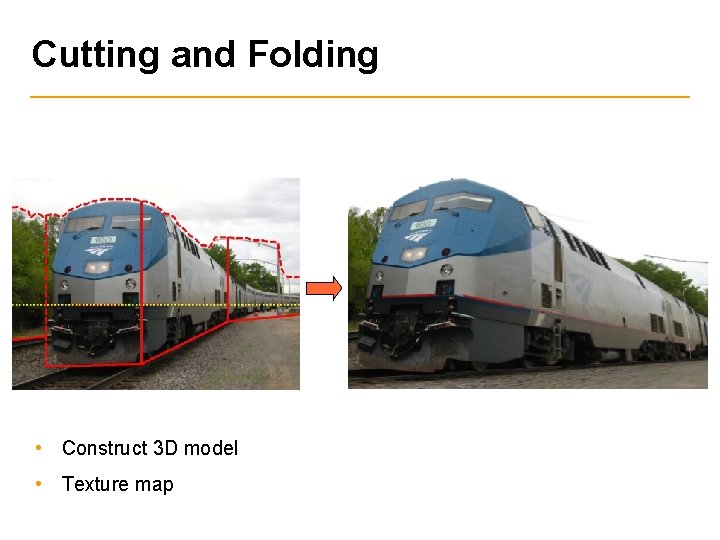
Cutting and Folding • Construct 3 D model • Texture map
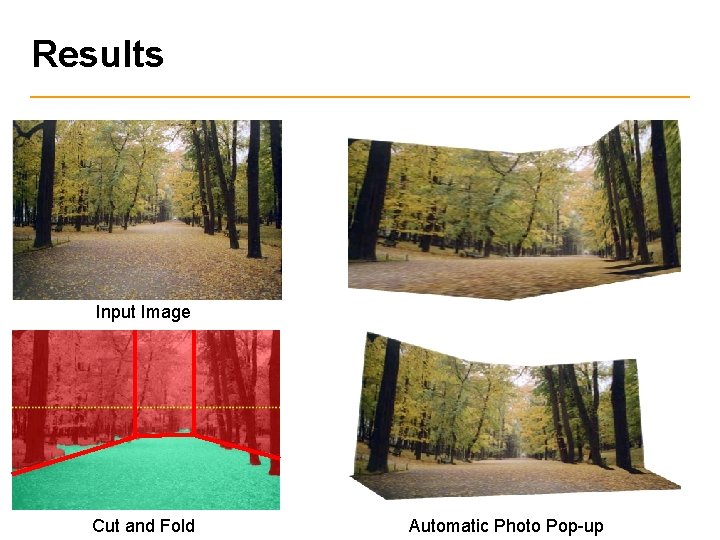
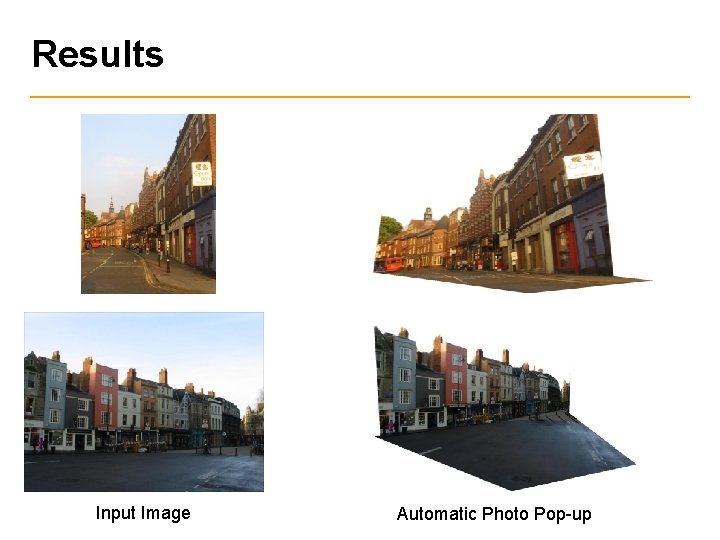
Results Input Image Cut and Fold Automatic Photo Pop-up
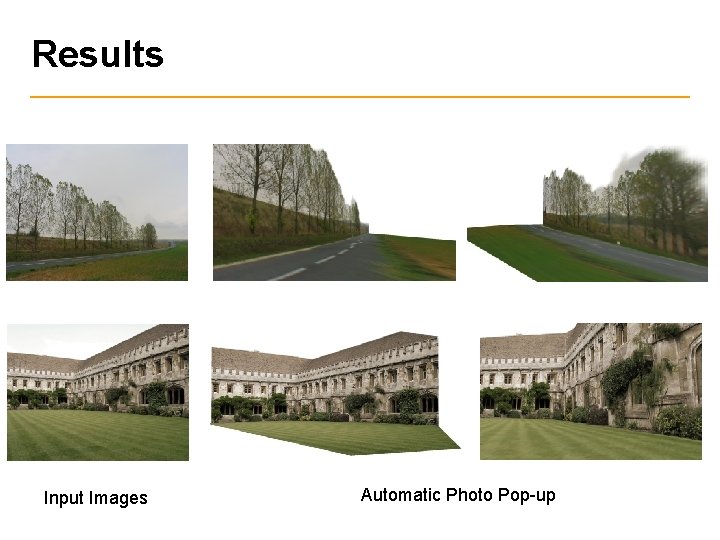
Results Input Image Automatic Photo Pop-up
Results Input Images Automatic Photo Pop-up
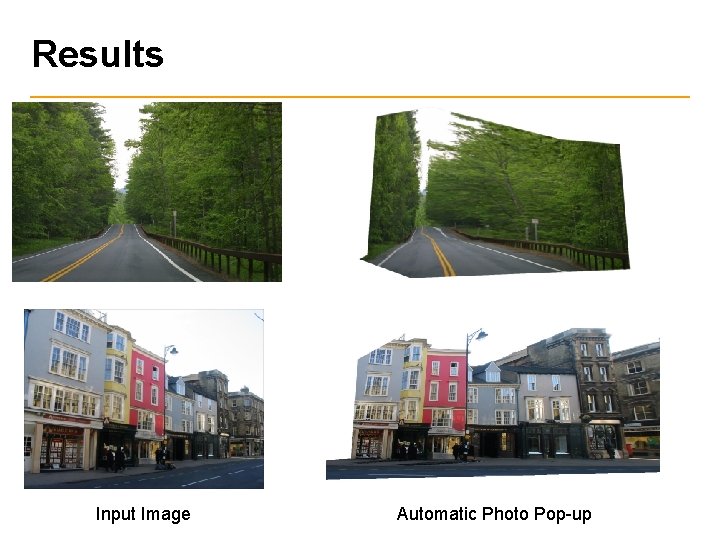
Results Input Image Automatic Photo Pop-up
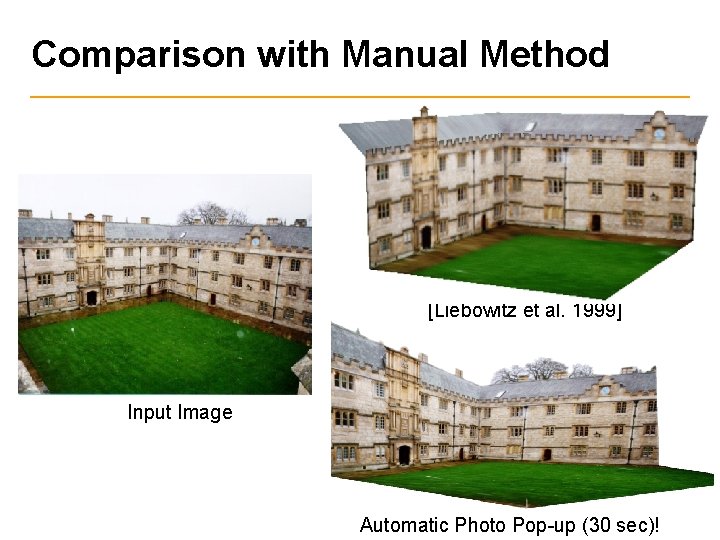
Comparison with Manual Method [Liebowitz et al. 1999] Input Image Automatic Photo Pop-up (30 sec)!
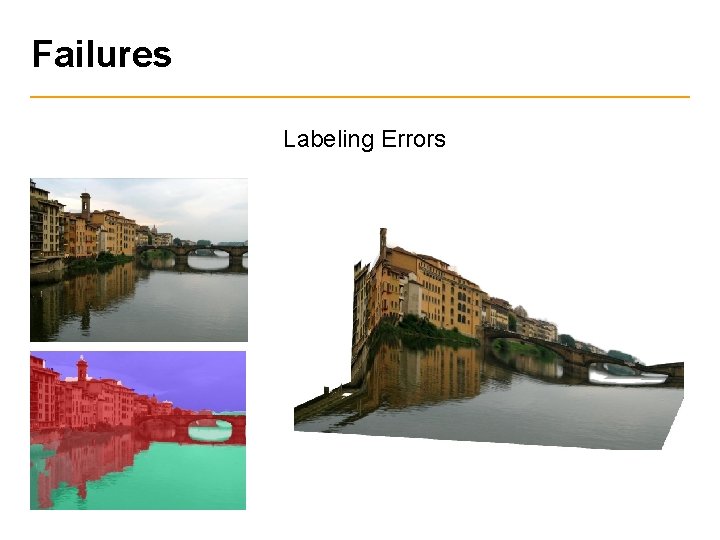
Failures Labeling Errors
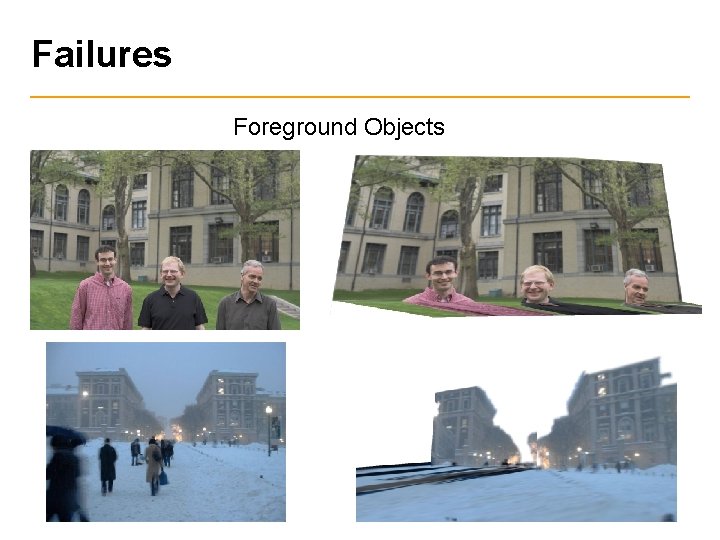
Failures Foreground Objects
The Music Video
Just the first step… • • Richer set of geometric classes (ICCV 05 paper) Segment foreground objects Cleaner segmentation More accurate labeling
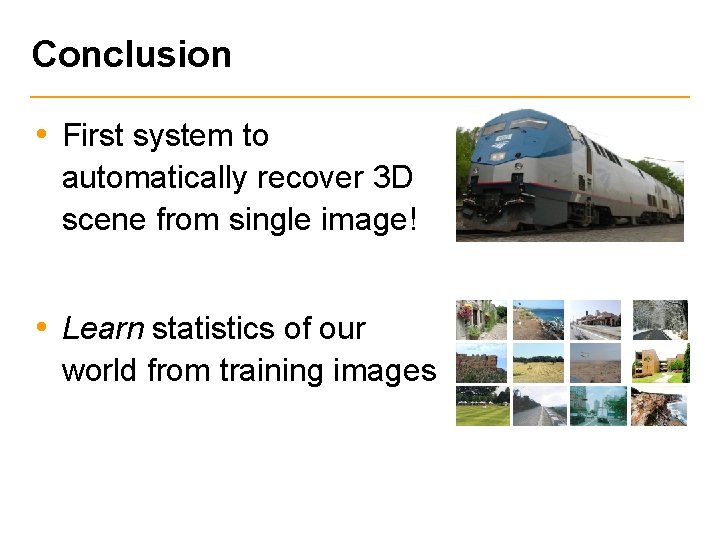
Conclusion • First system to automatically recover 3 D scene from single image! • Learn statistics of our world from training images
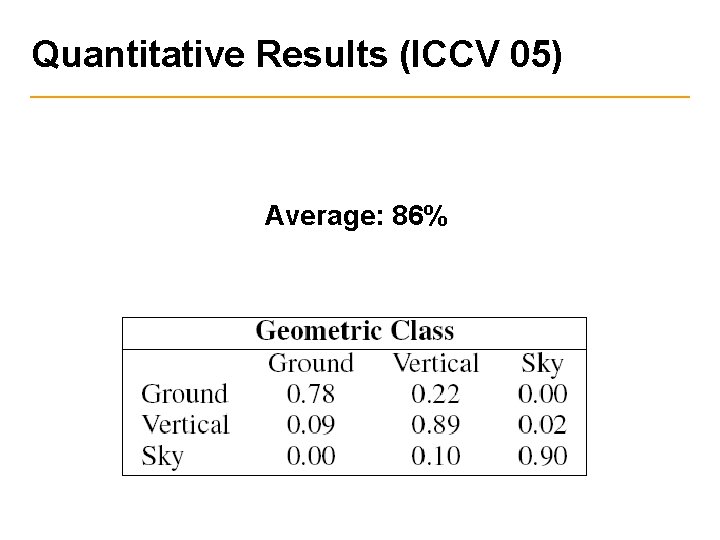
Quantitative Results (ICCV 05) Average: 86%
Questions?