
Automatic Number Plate Recognition ANPR West Midlands Police
Automatic Number Plate Recognition (ANPR) West Midlands Police West Midlands Combined Authority
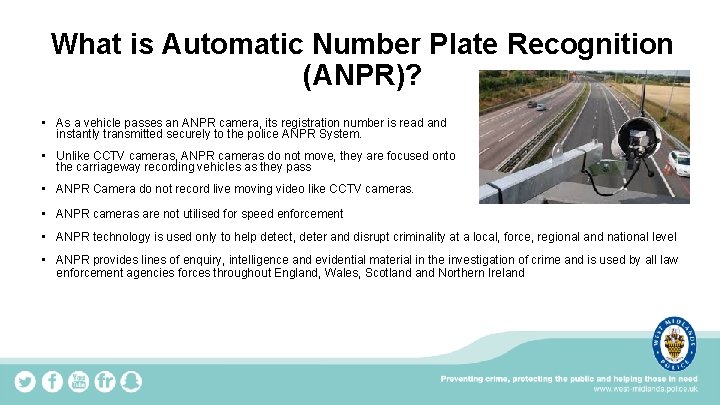
What is Automatic Number Plate Recognition (ANPR)? • As a vehicle passes an ANPR camera, its registration number is read and instantly transmitted securely to the police ANPR System. • Unlike CCTV cameras, ANPR cameras do not move, they are focused onto the carriageway recording vehicles as they pass • ANPR Camera do not record live moving video like CCTV cameras. • ANPR cameras are not utilised for speed enforcement • ANPR technology is used only to help detect, deter and disrupt criminality at a local, force, regional and national level • ANPR provides lines of enquiry, intelligence and evidential material in the investigation of crime and is used by all law enforcement agencies forces throughout England, Wales, Scotland Northern Ireland

ANPR Images ANPR files consist of 3 elements; • Read Data – including time, date and location • Number Plate Image • Overview Image Number Plate Image Sample Overview Image Sample (Occupants not identifiable / No facial recognition)

West Midlands Police (WMP) Use of ANPR Data • There is a strict West Midlands Police policy regarding access to ANPR data • ANPR data is assessed via the police BOF (Back Office Facility). Authorised users can access the BOF following authorisation from their supervisor and the WMP ANPR Manager who reviews all account requests on a case-bycase basis • ANPR data is stored for 12 months • The majority of users can only search ANPR data that is up to 90 days old • ANPR data that is between 91 days and 1 year can only be accessed in connection with Major Investigations, Serious and Complex Investigations or Counter Terrorism Investigations. Access to this ANPR data must be authorised by an Inspector • The BOF ANPR system has a full and robust audit trail in place • The BOF ANPR system is being replaced by the National ANPR Service (NAS) and currently both systems are running parallel with BOF expected to be decommissioned during 2020

West Midlands Combined Authority (WMCA) & West Midlands Police (WMP) • Both organisations utilise ANPR technology but for completely different purposes • Partnership working of 2 public sector departments results in benefits to both organisations but most importantly benefits the people of the West Midlands • Requirement for fewer cameras across the West Midlands saving purchasing and maintenance costs • Multi-use of existing camera police network • Reduction on Privacy Impact as lower requirement for the number of physical cameras located at the roadside

West Midlands Combined Authority (WMCA) Use of ANPR Data • Capture anonymised vehicle data (no number plate) to calculate average full and ‘point to point’ (camera to camera) journey times across Key Routes • Data gives a greater understanding of traffic congestion issues allowing WMCA to inform the public and allow them to make choices on how to make a particular journey – re-mode, re-route, re-time or remove the journey. • The bigger picture on potential increases in road traffic ; population increase of 500, 000 by 2035 or 100 people a day - the equivalent of filling of 84 cars or 1. 5 buses • Closer working ties concerning the highway network are crucial to the success of the Regional Transport Coordination Centre (RTCC), that the WMCA now have in place. Besides day to day traffic management it will be to delivering responses to planned events such Coventry 2021 City of Culture and Birmingham 2022 hosting of the Commonwealth Games

ANPR Data – What Can WMCA See • Data captured by all ANPR Cameras is securely transferred from the cameras to West Midlands Police (WMP) data centres where it is securely processed. • West Midlands Combined Authority (WMCA) • WMCA will not receive any images captured and will not receive specific vehicle registration numbers or any other personal data such as keeper/insured details. WMCA will also not receive information on whether the vehicle is of interest to the police. • Within secure WMP Data Centre, the captured vehicle registration number will be converted though a mathematical process (known as hashing) into non-unique reference number. The same registration number will generate the same ‘hashed ID’ on each occasion that a registration passes a camera allowing a journey to be tracked for journey time analysis. However, it is not possible to identify an actual vehicle from the hashed ID. • Example, registration AB 12 CDE would generate a hashed ID of 1234567890. Each time AB 12 CDE passes a camera, the ID 1234567890 would be sent allowing 1234567890 to be tracked between camera A / B / C for journey time analysis but WMCA would not know the actual vehicle was AB 12 CDE. • Within the secure WMP Data, the registration number will also be used to match against a database to output the vehicle classification and engine type.

ANPR Data – What Can WMCA See • For each read, both WMP and WMCA would receive the date and time of the read and the identification of the camera know as the camera ID. In addition: Org VRM Make Model Colour Class Type WMP AB 12 CDE Ford Fiesta Red Car Petrol WMCA 1234567890 Ford (hashed) Fiesta 1 (Car) 1 (Petrol)
ANPR Data – What Can WMCA NOT See • WMCA will NOT be able to see any of the below: • Images of the driver or other occupants • Images of the vehicle • Images of the registration number plate • The original number plate characters • Any personal information about the vehicle such as keeper or insured details • Any markers or intelligence held about the vehicle by either the Police or DVLA • Any other information held within police systems

Camera Locations • ANPR cameras are mounted in some police patrol vehicles where there are used to alert patrol officers of vehicle of interest within their vicinity • ANPR cameras are also located in fixed locations where they will help to detect, deter and disrupt criminality, following thorough strategic assessment • In line with national policy, we do not disclose details of our fixed camera locations as this information is likely to be of benefit to offenders and if known could reduce the value of ANPR to policing • Law abiding members of the public have nothing to be concerned about regarding the police or WMCA use of ANPR technology • A review of the ANPR locations will take place annually to ensure that their deployment is still appropriate
Location of New Cameras • The location of the new cameras has been selected by WMCA in conjunction with WMP. This is due to the fact WMCA are funding these cameras. • WMCA have identified 23 routes across the region which account for 7% of road but carry 50% of all traffic. This is the Key Route Network (KRN) connecting motorways and large urban economic and housing centres • These routes suffer most congestion at peak times and are also likely to account for those most impacted by development works being carried out. This can also increase the propensity for road traffic collisions attended by WMP • All the new locations across the force area will be subject to the same Strategic Assessment processes establishing the policing purpose for collecting ANPR data at these locations. • WMP will not collect data from any locations where it is established that there is no policing purpose for doing so. • As on previous occasions; this strategic assessment focused on crimes over the past 3 years • All crime types were analysed including; car key burglaries, theft of motor vehicle, theft from motor vehicle, personal robbery, business robbery, domestic burglary, business burglary, cash/valuables in transit robberies and violent offences • Data of road traffic collisions resulting in persons being killed and/or serious injured was also analysed • Criminals don’t stop at NPU or force boundaries so the tactical and operational advantages of these ANPR sites will benefit not only WMP but also regional and national law enforcement agencies
- Slides: 11