
Automatic Multicast Tunneling draftietfmbonedautomulticast12 IETF 83 Paris France

Automatic Multicast Tunneling draft-ietf-mboned-auto-multicast-12 IETF 83 – Paris, France
Summary • • • Document Status Document Changes Protocol Changes Outstanding Issues Next Steps
Document Status • Document reorganized, reformatted, reworded, rewritten and expanded. • Document distributed for a pre-submission review. • Document updated to reflect feedback. • Submitted for publication as Draft 12 in February.
Document Changes • Primary rationale for changes: – To satisfy current IETF Editor guidelines and current practice, with the goal of ensure smooth passage through the RFC approval process. – To shift focus of document to that of implementation. – To add informative content to provide a context for describing normative requirements. – Provide greater detail as required to eliminate ambiguities and address those areas that were lacking definition.
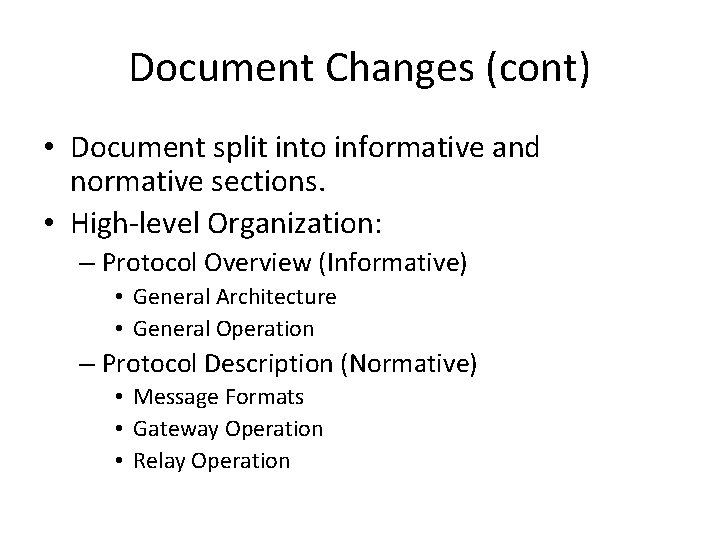
Document Changes (cont) • Document split into informative and normative sections. • High-level Organization: – Protocol Overview (Informative) • General Architecture • General Operation – Protocol Description (Normative) • Message Formats • Gateway Operation • Relay Operation
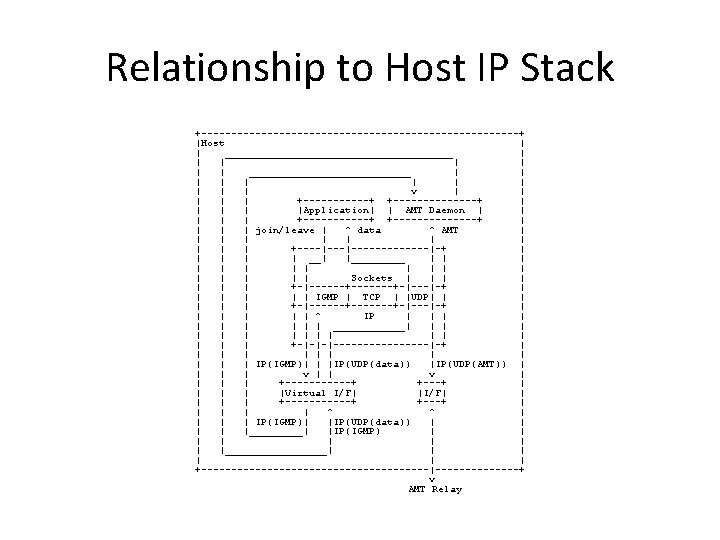
Document Changes (cont) • Renewed emphasis on AMT as a simple encapsulation protocol for exchanging IGMP/MLD messages and multicast data generated “outside” of the protocol. • Group subscription management and multicast forwarding are considered external activities that feed into AMT. • These activities are governed by the IGMPv 3 and MLDv 2 specifications. • The Request->Membership Query exchange is a mechanism for generating general queries.
Document Changes (cont) • Treat relay discovery as a distinct feature of the protocol. – Use of the discovery mechanism is optional. – Gateway implementations may use alternative methods for discovery. – Mention possible requirement for source-specific discovery. Use of global anycast address may return relay without multicast connectivity to desired sources.
Protocol Changes • Backwards compatible. • Request “Protocol” or “P” flag – Indicate to relay whether it should return IGMPv 3 or MLDv 2 general query in Membership Query message. • Membership Query “Limit” or “L” flag – Notifies gateway that the relay is NOT accepting Membership Update messages from new gateway tunnel endpoints. – Typically set when anycast address prefix advertisement has been withdrawn (if applicable).
Outstanding Issues • Source address in IGMP/MLD packet headers. • UDP Checksums in outer-headers. • Global Anycast Address Prefix Allocation
Source Address in IGMP/MLD Packets • Both protocols expect link-local addresses. • IGMP allows for use of the unspecified (0. 0) address as a source address. Hosts and routers accept these messages. • MLD Does not! Hosts and routers must ignore MLD packets that carry an unspecified source address.
Link-Local Addresses for IGMP/MLD • If MLD does not allow use of an unspecified source address, what should gateways and relay insert into the message headers? • Does implementation rely on existing host IP/MLD stack for message processing? – If no, then just ignore it. – If yes, then • Spec simply indicates that recipient may need to regenerate message with valid link-local address. • Where does that come from? Assign special prefix and addresses for AMT virtual/pseudo interfaces?
UDP Checksum Issue • Overview – AMT uses UDP encapsulation. – Relays will use existing functionality to encapsulate multicast packets into Multicast Data messages. – The encapsulation functionality provided by many platforms cannot generate a valid UDP checksum for the outer UDP header. – Workaround for IPv 4 is to set checksum to zero. – This will not work for current IPv 6 as that protocol specification explicitly prohibits the use of zero-checksums. – Workaround for IPv 6 is to relax requirements. • Detailed description of problem may be found in: – draft-ietf-6 man-udpchecksums – draft-ietf-6 man-udpzero
UDP Checksums and AMT • Control messages are not a problem. • Data messages are. • What impact does this have on AMT? – Gateway that relies on host IP stack implementation cannot control handling unless API is provided. – Gateway that operates below or bypasses the IP stack MUST accept Multicast Data messages with zero UDP checksums.
UDP Checksums and AMT (cont) • How to detect when zero-checksum packets are dropped? – Add some form of Keep-Alive/Beacon functionality. Relay periodically sends packets with and without zero-checksums.
UDP Checksums and AMT (cont) • Workaround in case where they are dropped? – Assume existence of relays that can compute UDP checksum. • Use different discovery address to locate nearest relay that does compute checksums. • Result may reduce/eliminate benefits provided by AMT. – Switch to IPv 4 encapsulation if possible. • Only possible in cases where relay has global IPv 4 address and gateway has IPv 4 connectivity. • Flags may be added to Relay Discovery and Relay Advertisement message to negotiate switch to IPv 4.
Next Steps • Wrap this up. • If group determines that additional changes are required, complete those ASAP (like next week). • Review changes. Enlist reviewers today. • Submit Draft 13. • Start process of advancing the document through the RFC approval process (chairs an AD)
- Slides: 17