
Automatic Mixed Precision Floating Point Tuning for GPU
- Slides: 14
Automatic Mixed Precision Floating Point Tuning for GPU Applications Pradeep Venkata Kotipalli 1, Ranvijay Singh 1, Paul Wood 2, Ignacio Laguna 3, Saurabh Bagchi 1 1: Purdue University; 2: Johns Hopkins University; 3: Lawrence Livermore National Laboratory US Department of Energy contract DEAC 5207 NA 27344 1/14
Motivation • Mixed precision computing is an effective solution to increase performance and reduce computation energy of applications with intense floating point operations • Throughput ratio of FP 64: FP 32: FP 16 in modern GPUs is 1: 2: 4 • Scientific and Machine Learning applications rely heavily on GPUs for heavy floating point computations • Balancing the trade off between mixed precision application level error and performance is challenging 2/14
Problem Statement • Identify the optimal precision vector (PV), the precision levels of all the floating point variables in the program • Tradeoff between error and runtime – All variables tuned to the lowest precision level leads to the greatest improvement in performance but results in a high error – All variables tuned to the highest precision level results in zero error but is performance inefficient • Given an error tolerance margin, the task is to find the PV that gives the fastest runtime while staying below the error tolerance 3/14
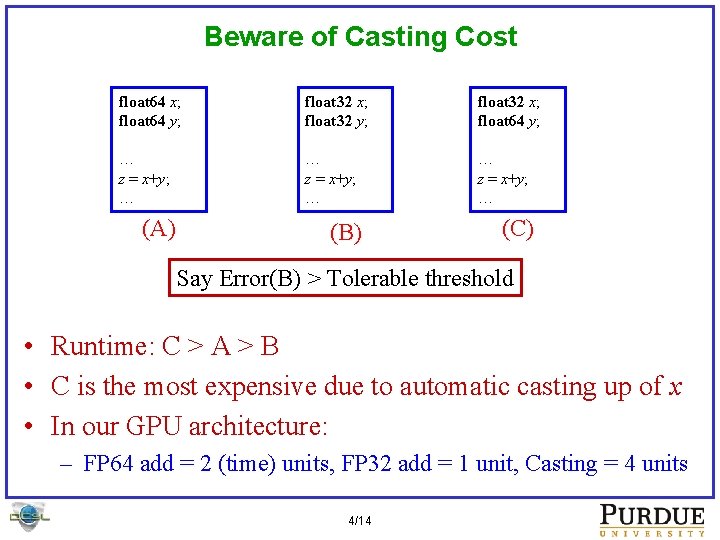
Beware of Casting Cost float 64 x; float 64 y; float 32 x; float 32 y; float 32 x; float 64 y; … z = x+y; … (A) (B) (C) Say Error(B) > Tolerable threshold • Runtime: C > A > B • C is the most expensive due to automatic casting up of x • In our GPU architecture: – FP 64 add = 2 (time) units, FP 32 add = 1 unit, Casting = 4 units 4/14
Our Contributions 1. Developed a casting-aware PV search technique 2. Developed a static performance model which estimates the performance of a PV relative to other PVs without actually executing the program 3. Deployed a Genetic Algorithm (GA) for optimal PV search in discontinuous space and showed that it can tolerate input data dependency 4. Showed that our technique benefits a complex DOE application, LULESH 5/14
Shortcomings of Prior Work • They do not support parallel GPU codes as they rely on serial instrumentation or profiling support that does not cover the GPU programming and execution model • Accuracy-based approaches do not account for the casting effects on performance and tend to increase the runtime • The previous state-of-the-art Precimonious 1 uses delta debugging technique leading to local minima • They do not use static analysis to aid runtime search • Some use hard-to-scale local accuracy models 2 [1] Cindy Rubio-González, C. Nguyen, H. Nguyen, J. Demmel, W. Kahan, K. Sen, D. H. Bailey, C. Iancu, D. Hough. "Precimonious: Tuning assistant for floating-point precision. " In Supercomputing 2013. [2] Wei-Fan Chiang, Mark Baranowski, Ian Briggs, Alexey Solovyev, Ganesh Gopalakrishnan, and Zvonimir Rakamarić, “Rigorous Floating-point Mixedprecision Tuning, ” POPL 2017. 6/14
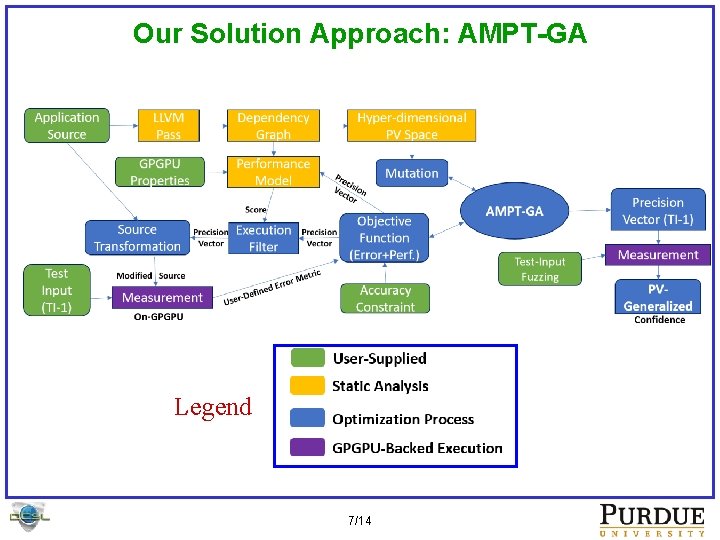
Our Solution Approach: AMPT-GA Legend 7/14
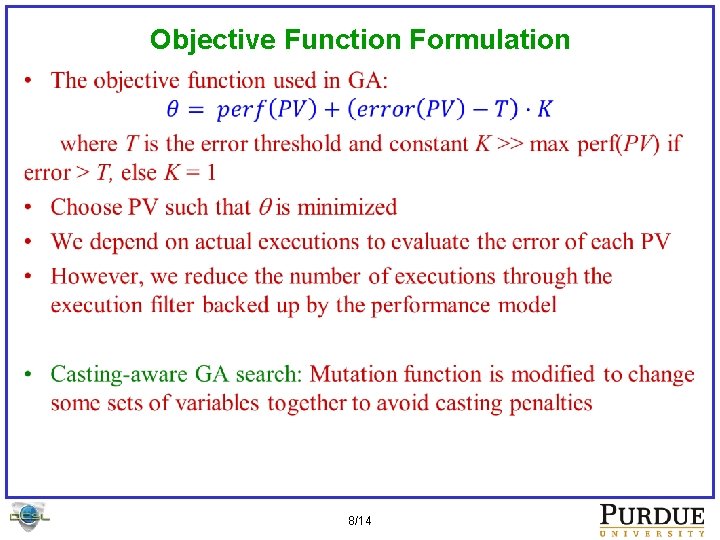
Objective Function Formulation • 8/14
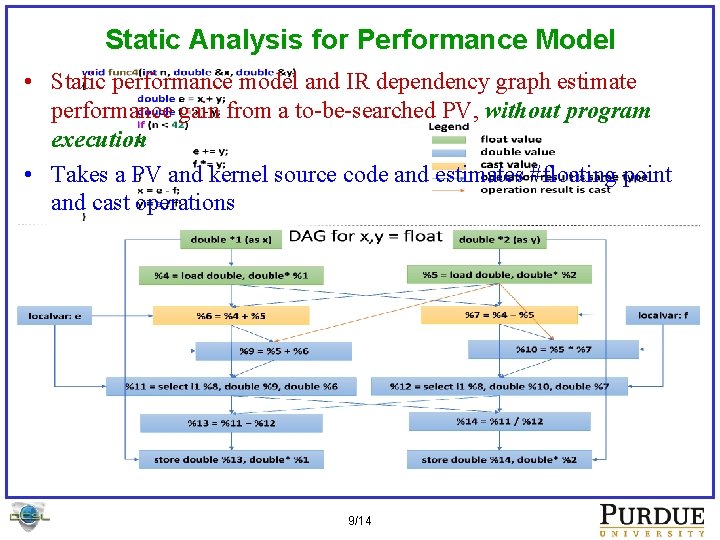
Static Analysis for Performance Model • Static performance model and IR dependency graph estimate performance gain from a to-be-searched PV, without program execution • Takes a PV and kernel source code and estimates #floating point and cast operations 9/14
Evaluation Plan • 1. 2. 3. • 1. Evaluation is meant to answer questions: Does the selected Precision Vector give the lowest runtime? How many program executions are needed to decide optimal PV? What is the efficiency of the approach? (Combines #1 and #2) Target applications LULESH: A proxy app by the US DOE for benchmarking largescale clusters because it is representative of many large codes. It models hydrodynamics equations, which describe motion of materials when subject to forces 2. Three programs from the Rodinia GPU benchmark suite: Lava. MD, Backprop and CFD. • Evaluation done on NVIDIA Tesla P 100 GPU 10/14
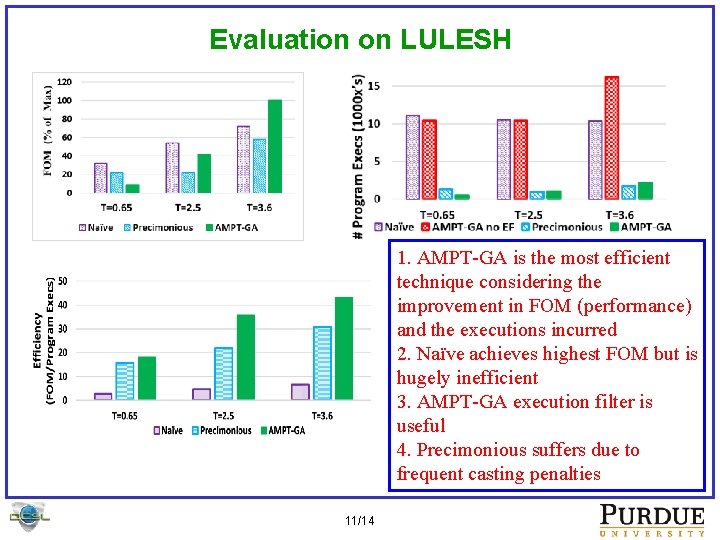
Evaluation on LULESH 1. AMPT-GA is the most efficient technique considering the improvement in FOM (performance) and the executions incurred 2. Naïve achieves highest FOM but is hugely inefficient 3. AMPT-GA execution filter is useful 4. Precimonious suffers due to frequent casting penalties 11/14
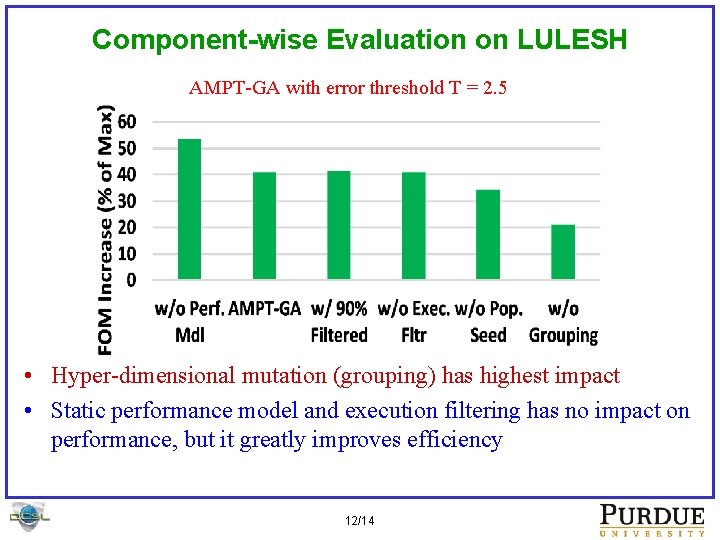
Component-wise Evaluation on LULESH AMPT-GA with error threshold T = 2. 5 • Hyper-dimensional mutation (grouping) has highest impact • Static performance model and execution filtering has no impact on performance, but it greatly improves efficiency 12/14
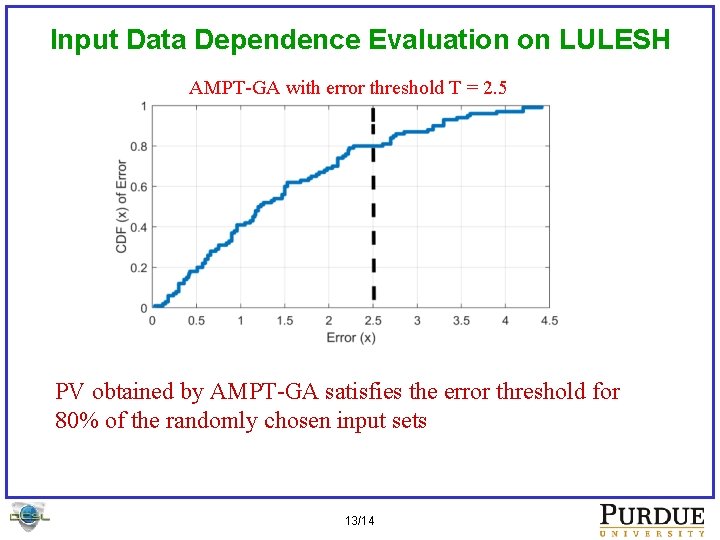
Input Data Dependence Evaluation on LULESH AMPT-GA with error threshold T = 2. 5 PV obtained by AMPT-GA satisfies the error threshold for 80% of the randomly chosen input sets 13/14
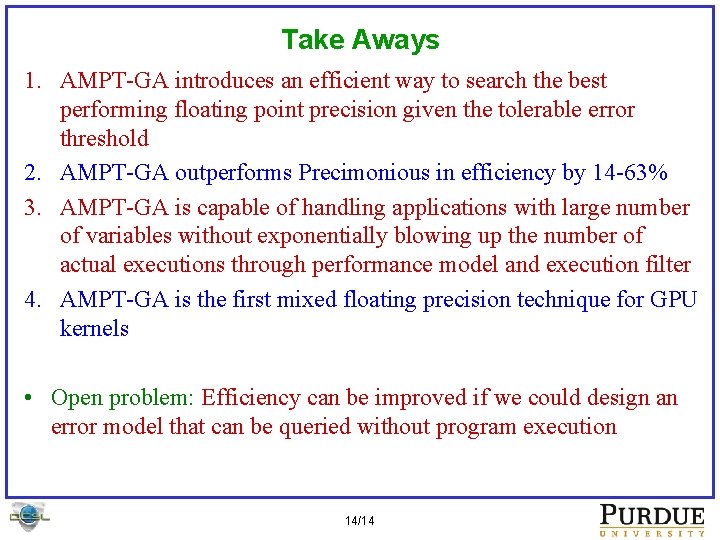
Take Aways 1. AMPT-GA introduces an efficient way to search the best performing floating point precision given the tolerable error threshold 2. AMPT-GA outperforms Precimonious in efficiency by 14 -63% 3. AMPT-GA is capable of handling applications with large number of variables without exponentially blowing up the number of actual executions through performance model and execution filter 4. AMPT-GA is the first mixed floating precision technique for GPU kernels • Open problem: Efficiency can be improved if we could design an error model that can be queried without program execution 14/14