
Automatic Learning of Combat Models for RTS Games
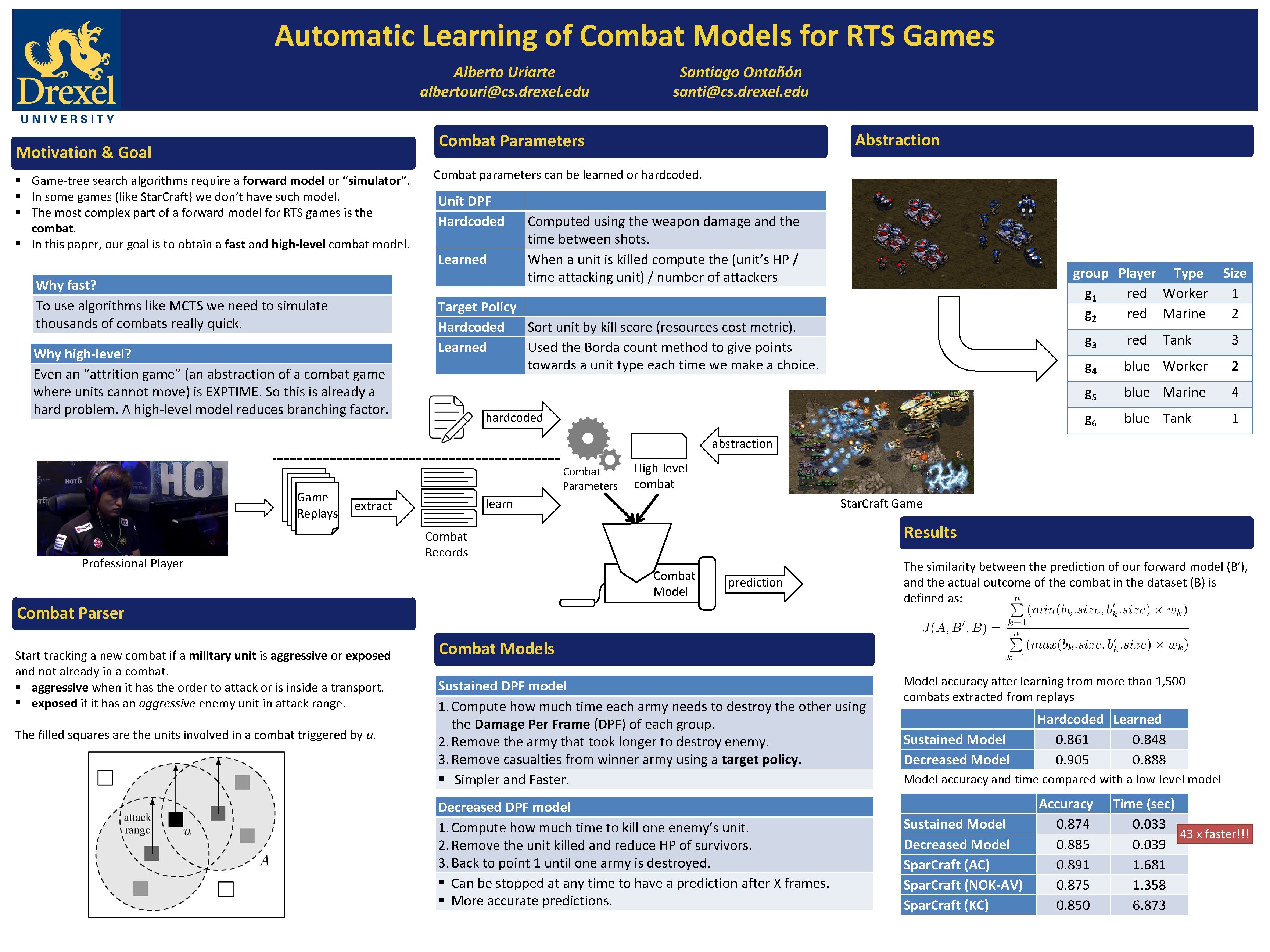
Automatic Learning of Combat Models for RTS Games Alberto Uriarte albertouri@cs. drexel. edu Santiago Ontañón santi@cs. drexel. edu Abstraction Combat Parameters Motivation & Goal § Game-tree search algorithms require a forward model or “simulator”. § In some games (like Star. Craft) we don’t have such model. § The most complex part of a forward model for RTS games is the combat. § In this paper, our goal is to obtain a fast and high-level combat model. Why fast? To use algorithms like MCTS we need to simulate thousands of combats really quick. Why high-level? Even an “attrition game” (an abstraction of a combat game where units cannot move) is EXPTIME. So this is already a hard problem. A high-level model reduces branching factor. Combat parameters can be learned or hardcoded. Unit DPF Hardcoded Learned Computed using the weapon damage and the time between shots. When a unit is killed compute the (unit’s HP / time attacking unit) / number of attackers group Player Type g 1 red Worker g 2 red Marine Target Policy Hardcoded Sort unit by kill score (resources cost metric). Learned Used the Borda count method to give points towards a unit type each time we make a choice. hardcoded Tank Size 1 2 g 3 red 3 g 4 blue Worker 2 g 5 blue Marine 4 g 6 blue Tank 1 abstraction Game Replays Combat Parameters Star. Craft Game learn extract Professional Player High-level combat Results Combat Records Combat Model prediction Combat Parser Start tracking a new combat if a military unit is aggressive or exposed and not already in a combat. § aggressive when it has the order to attack or is inside a transport. § exposed if it has an aggressive enemy unit in attack range. The filled squares are the units involved in a combat triggered by u. The similarity between the prediction of our forward model (B′), and the actual outcome of the combat in the dataset (B) is defined as: Combat Models Sustained DPF model 1. Compute how much time each army needs to destroy the other using the Damage Per Frame (DPF) of each group. 2. Remove the army that took longer to destroy enemy. 3. Remove casualties from winner army using a target policy. § Simpler and Faster. Decreased DPF model 1. Compute how much time to kill one enemy’s unit. 2. Remove the unit killed and reduce HP of survivors. 3. Back to point 1 until one army is destroyed. § Can be stopped at any time to have a prediction after X frames. § More accurate predictions. Model accuracy after learning from more than 1, 500 combats extracted from replays Sustained Model Decreased Model Hardcoded Learned 0. 861 0. 848 0. 905 0. 888 Model accuracy and time compared with a low-level model Sustained Model Decreased Model Spar. Craft (AC) Spar. Craft (NOK-AV) Spar. Craft (KC) Accuracy 0. 874 0. 885 0. 891 0. 875 0. 850 Time (sec) 0. 033 43 x faster!!! 0. 039 1. 681 1. 358 6. 873
- Slides: 1