
Automatic Detection of ADHD subjects using Deep Convolutional
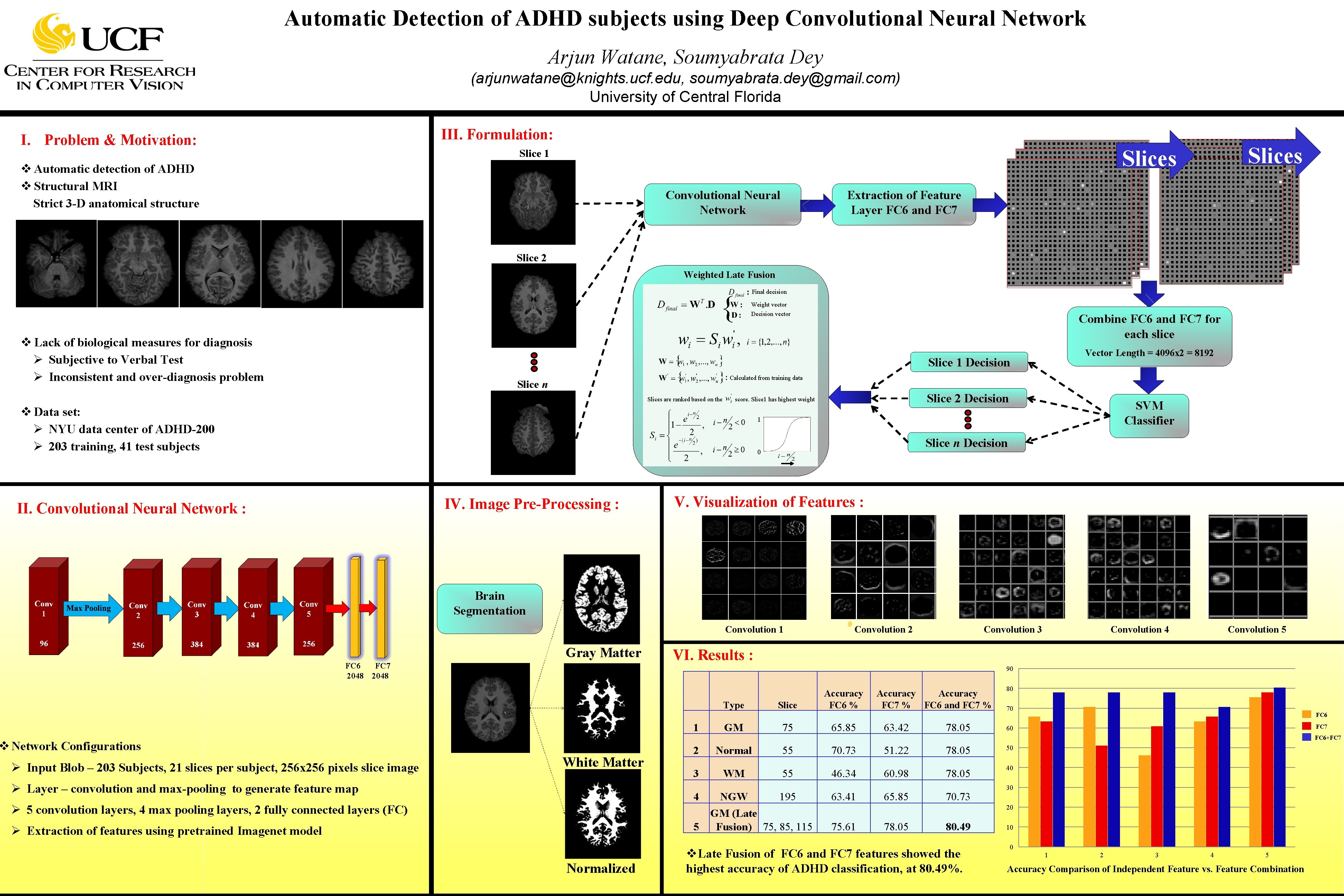
Automatic Detection of ADHD subjects using Deep Convolutional Neural Network Arjun Watane, Soumyabrata Dey (arjunwatane@knights. ucf. edu, soumyabrata. dey@gmail. com) University of Central Florida III. Formulation: I. Problem & Motivation: Slices Slice 1 v Automatic detection of ADHD v Structural MRI Strict 3 -D anatomical structure Convolutional Neural Network Extraction of Feature Layer FC 6 and FC 7 Slice 2 Weighted Late Fusion Final decision Weight vector Decision vector v Lack of biological measures for diagnosis Ø Subjective to Verbal Test Ø Inconsistent and over-diagnosis problem Combine FC 6 and FC 7 for each slice Vector Length = 4096 x 2 = 8192 Slice 1 Decision : Calculated from training data Slice n Slices are ranked based on the Slice 2 Decision score. Slice 1 has highest weight v Data set: Ø NYU data center of ADHD-200 Ø 203 training, 41 test subjects SVM Classifier 1 Slice n Decision 0 IV. Image Pre-Processing : II. Convolutional Neural Network : V. Visualization of Features : Brain Segmentation Convolution 1 Gray Matter FC 6 2048 FC 7 2048 Convolution 3 Convolution 4 Convolution 5 VI. Results : 90 Type 1 GM Slice 75 Accuracy FC 6 % 65. 85 Accuracy FC 7 % FC 6 and FC 7 % 63. 42 78. 05 80 70 FC 6 FC 7 60 FC 6+FC 7 v Network Configurations Ø Input Blob – 203 Subjects, 21 slices per subject, 256 x 256 pixels slice image Convolution 2 White Matter Ø Layer – convolution and max-pooling to generate feature map 2 3 4 Ø 5 convolution layers, 4 max pooling layers, 2 fully connected layers (FC) 5 Ø Extraction of features using pretrained Imagenet model Normalized Normal WM NGW 55 55 195 GM (Late Fusion) 75, 85, 115 70. 73 46. 34 63. 41 51. 22 60. 98 65. 85 78. 05 50 78. 05 40 70. 73 30 20 75. 61 78. 05 80. 49 v. Late Fusion of FC 6 and FC 7 features showed the highest accuracy of ADHD classification, at 80. 49%. 10 0 1 2 3 4 5 Accuracy Comparison of Independent Feature vs. Feature Combination
- Slides: 1