
Automated Theorem Proving Lecture 1 Given program P

![Weakest preconditions • WP(x : = E, B) = B[E/x] • WP(s 1; s](https://slidetodoc.com/presentation_image_h2/69075aea59dfb8b0864f5bafd63ac2ba/image-13.jpg "Weakest preconditions • WP(x : = E, B) = B[E/x] • WP(s 1; s")



- Slides: 34
Automated Theorem Proving Lecture 1
Given program P and specification S, does P satisfy S? Program verification is undecidable!
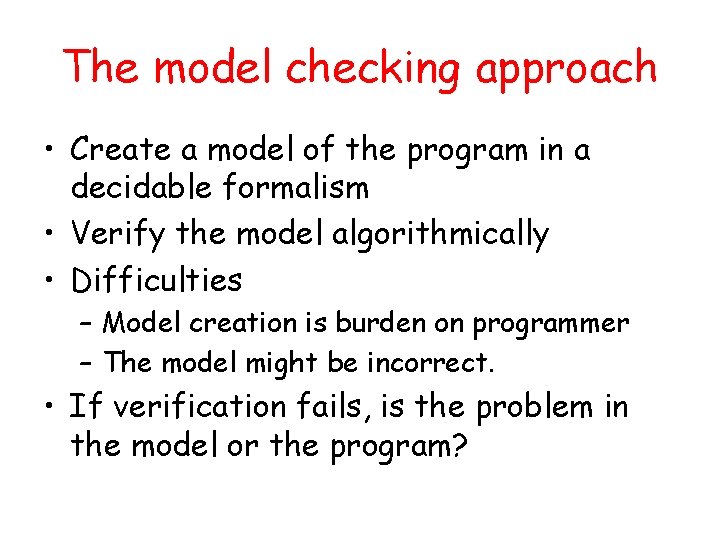
The model checking approach • Create a model of the program in a decidable formalism • Verify the model algorithmically • Difficulties – Model creation is burden on programmer – The model might be incorrect. • If verification fails, is the problem in the model or the program?
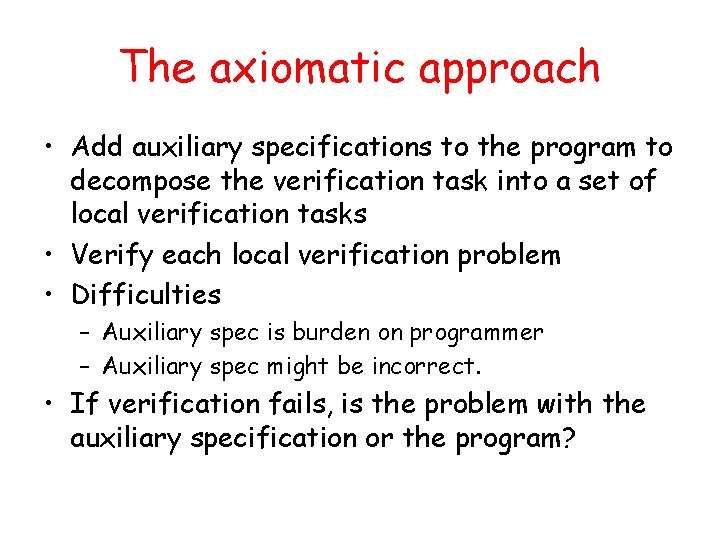
The axiomatic approach • Add auxiliary specifications to the program to decompose the verification task into a set of local verification tasks • Verify each local verification problem • Difficulties – Auxiliary spec is burden on programmer – Auxiliary spec might be incorrect. • If verification fails, is the problem with the auxiliary specification or the program?
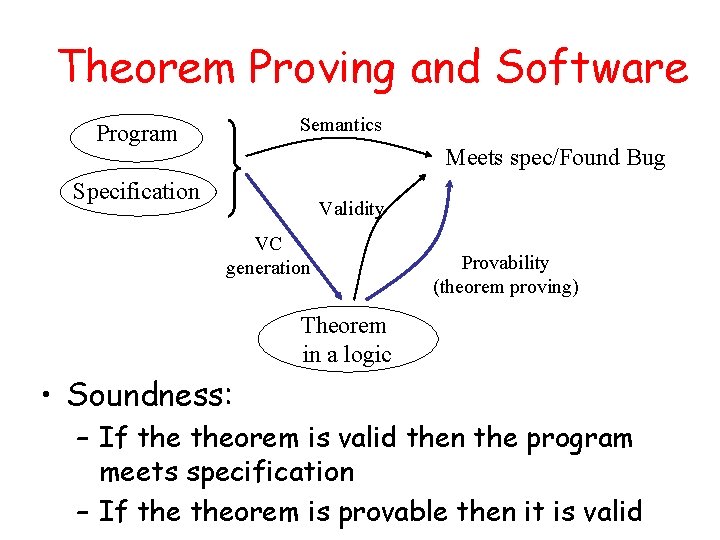
Theorem Proving and Software Semantics Program Meets spec/Found Bug Specification Validity VC generation Provability (theorem proving) Theorem in a logic • Soundness: – If theorem is valid then the program meets specification – If theorem is provable then it is valid
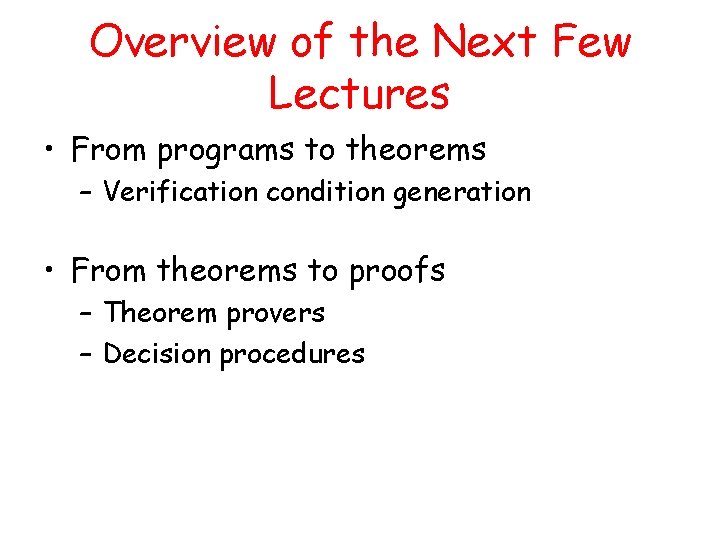
Overview of the Next Few Lectures • From programs to theorems – Verification condition generation • From theorems to proofs – Theorem provers – Decision procedures
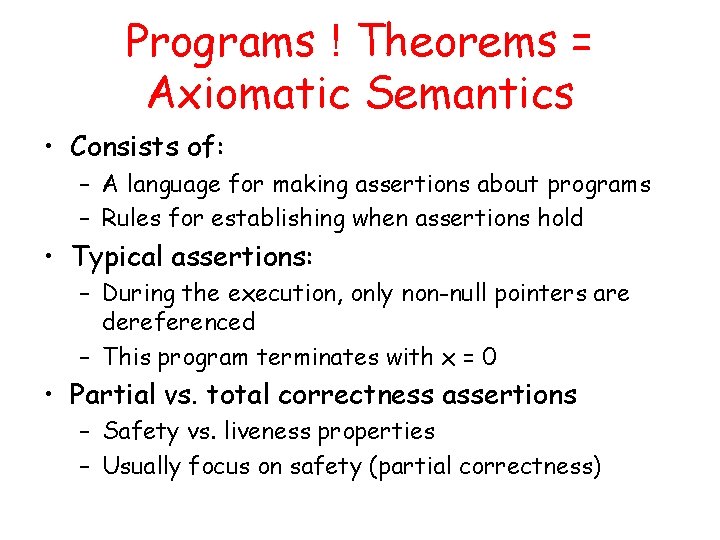
Programs ! Theorems = Axiomatic Semantics • Consists of: – A language for making assertions about programs – Rules for establishing when assertions hold • Typical assertions: – During the execution, only non-null pointers are dereferenced – This program terminates with x = 0 • Partial vs. total correctness assertions – Safety vs. liveness properties – Usually focus on safety (partial correctness)
Hoare Triples • Partial correctness: { A } s { B} – When you start s in any state that satisfies A – If the execution of s terminates – It does so in a state that satisfies B • Total correctness: [ A ] s [ B ] – When you start s in any state that satisfies A – The execution of s terminates and – It does so in a state that satisfies B • Defined inductively on the structure of statements
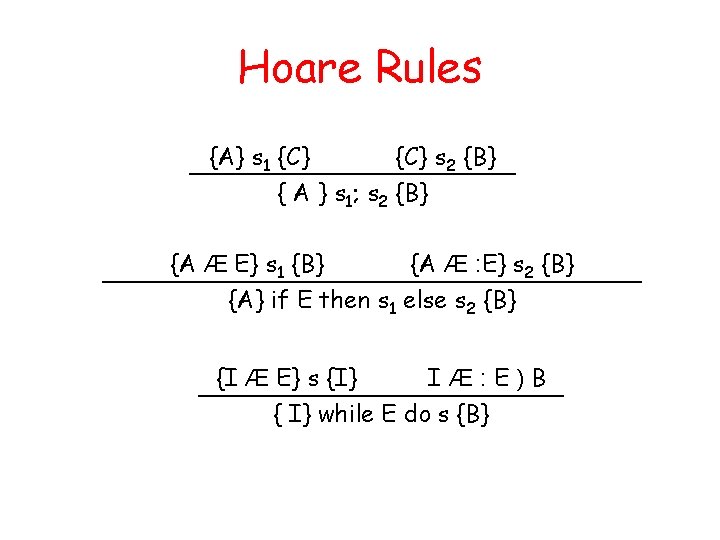
Hoare Rules {A} s 1 {C} s 2 {B} { A } s 1; s 2 {B} {A Æ E} s 1 {B} {A Æ : E} s 2 {B} {A} if E then s 1 else s 2 {B} {I Æ E} s {I} IÆ: E)B { I} while E do s {B}
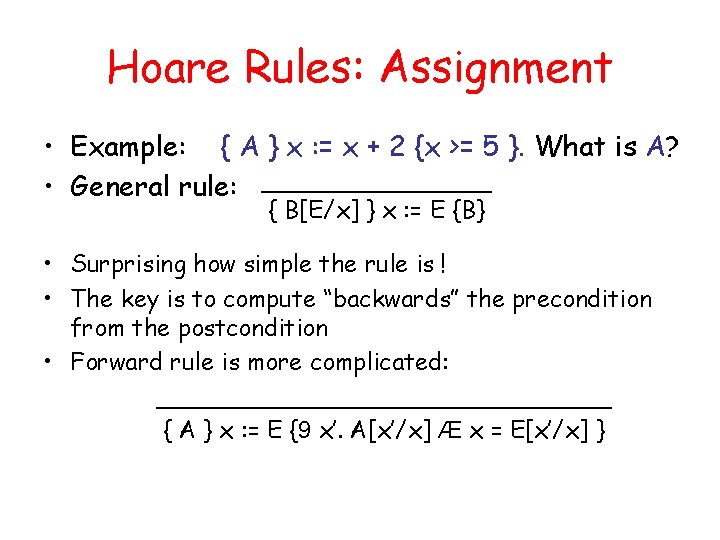
Hoare Rules: Assignment • Example: { A } x : = x + 2 {x >= 5 }. What is A? • General rule: { B[E/x] } x : = E {B} • Surprising how simple the rule is ! • The key is to compute “backwards” the precondition from the postcondition • Forward rule is more complicated: { A } x : = E {9 x’. A[x’/x] Æ x = E[x’/x] }
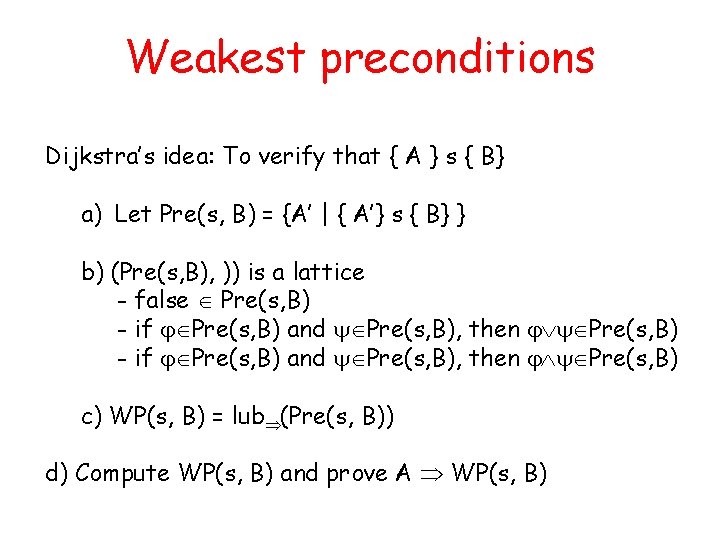
Weakest preconditions Dijkstra’s idea: To verify that { A } s { B} a) Let Pre(s, B) = {A’ | { A’} s { B} } b) (Pre(s, B), )) is a lattice - false Pre(s, B) - if Pre(s, B) and Pre(s, B), then Pre(s, B) c) WP(s, B) = lub (Pre(s, B)) d) Compute WP(s, B) and prove A WP(s, B)
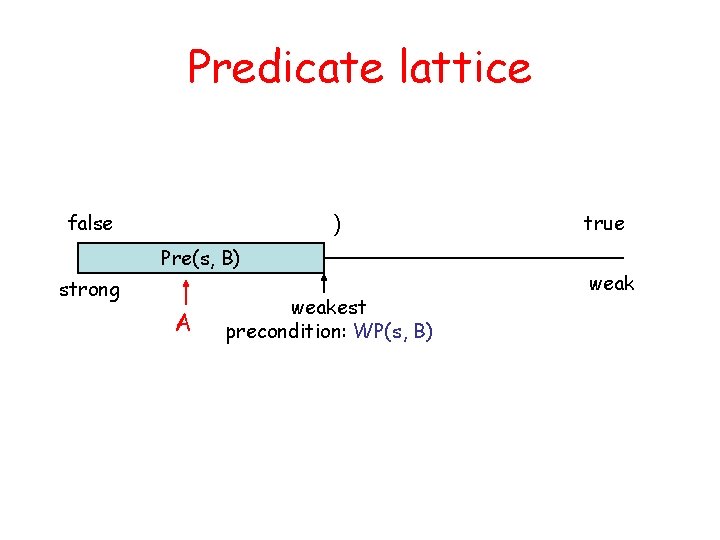
Predicate lattice false ) Pre(s, B) strong A weakest precondition: WP(s, B) true weak
Weakest preconditions • WP(x : = E, B) = B[E/x] • WP(s 1; s 2, B) = WP(s 1, WP(s 2, B)) • WP(if E then s 1 else s 2, B) = E ) WP(s 1, B) Æ : E ) WP(s 2, B) • WP(assert E, B) = E B
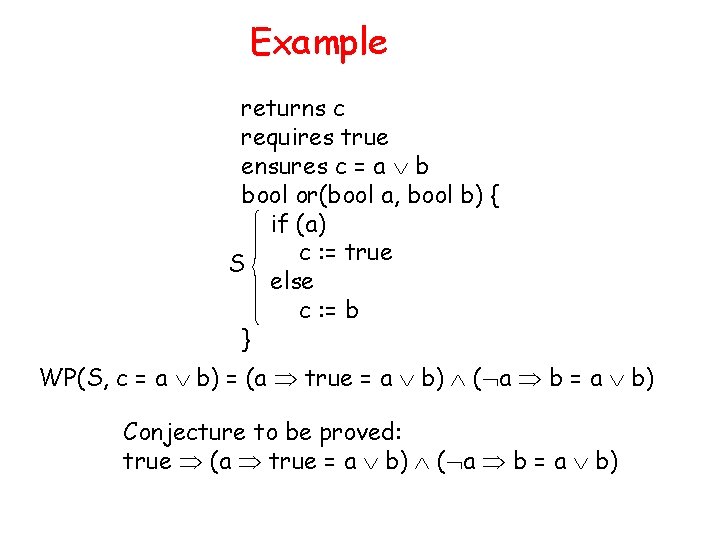
Example returns c requires true ensures c = a b bool or(bool a, bool b) { if (a) c : = true S else c : = b } WP(S, c = a b) = (a true = a b) ( a b = a b) Conjecture to be proved: true (a true = a b) ( a b = a b)
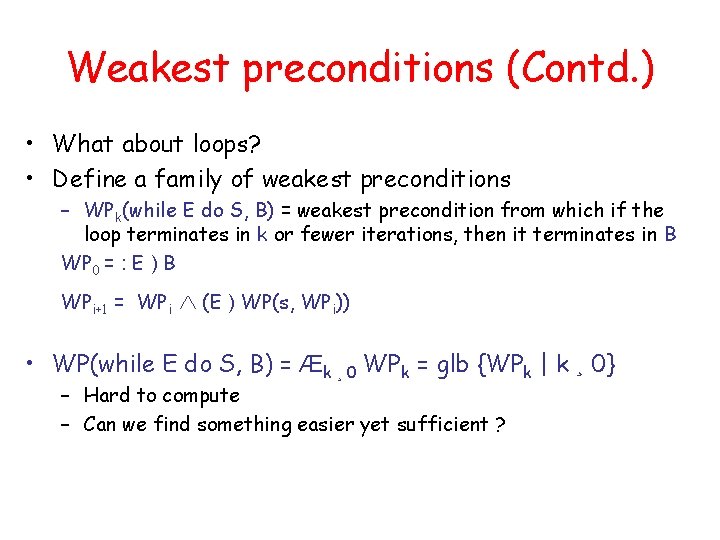
Weakest preconditions (Contd. ) • What about loops? • Define a family of weakest preconditions – WPk(while E do S, B) = weakest precondition from which if the loop terminates in k or fewer iterations, then it terminates in B WP 0 = : E ) B WPi+1 = WPi (E ) WP(s, WPi)) • WP(while E do S, B) = Æk ¸ 0 WPk = glb {WPk | k ¸ 0} – Hard to compute – Can we find something easier yet sufficient ?
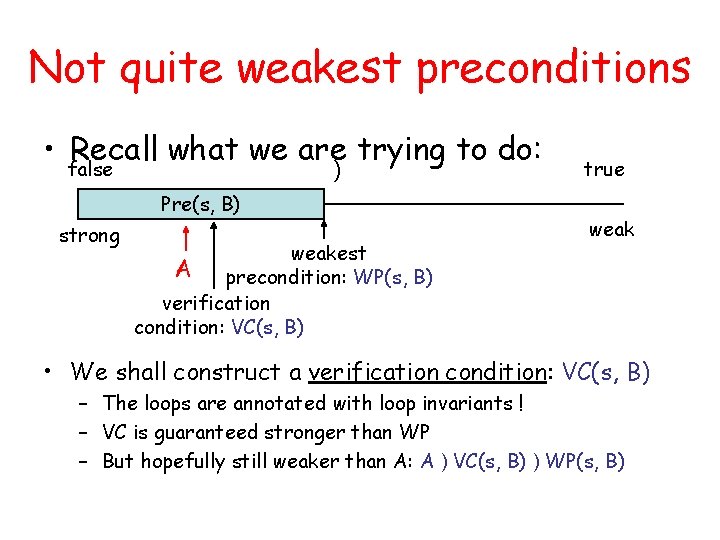
Not quite weakest preconditions • Recall what we are trying to do: false ) Pre(s, B) strong weakest A precondition: WP(s, B) verification condition: VC(s, B) true weak • We shall construct a verification condition: VC(s, B) – The loops are annotated with loop invariants ! – VC is guaranteed stronger than WP – But hopefully still weaker than A: A ) VC(s, B) ) WP(s, B)
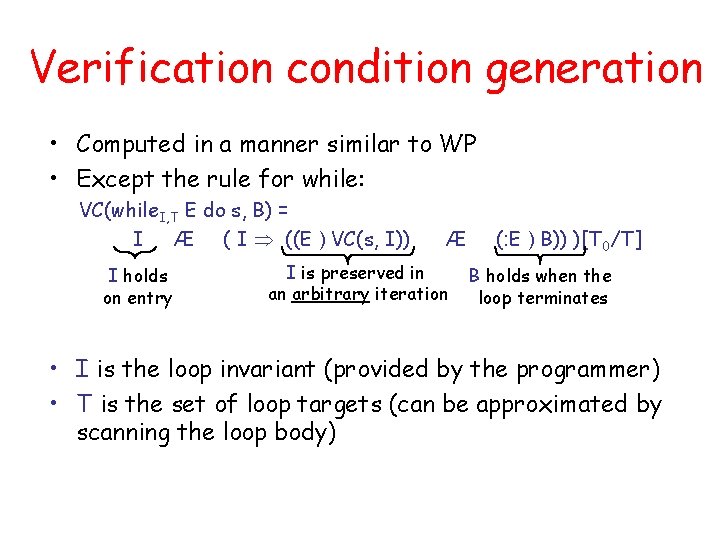
Verification condition generation • Computed in a manner similar to WP • Except the rule for while: VC(while. I, T E do s, B) = I Æ ( I ((E ) VC(s, I)) I holds on entry Æ I is preserved in an arbitrary iteration (: E ) B)) )[T 0/T] B holds when the loop terminates • I is the loop invariant (provided by the programmer) • T is the set of loop targets (can be approximated by scanning the loop body)
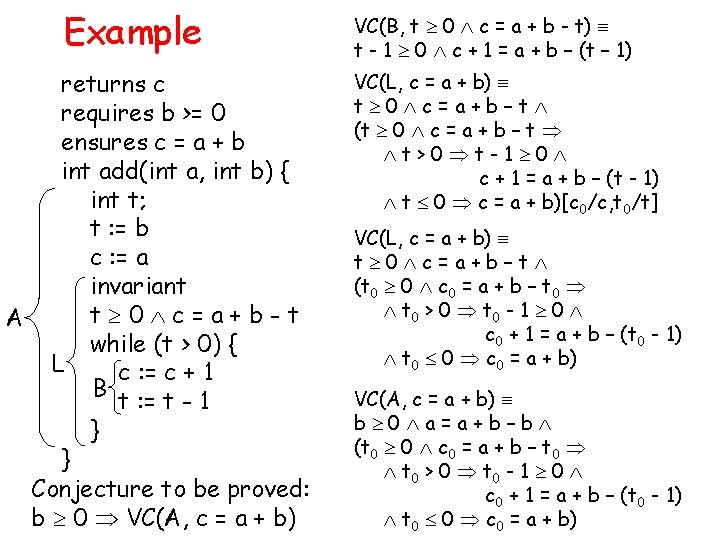
Example returns c requires b >= 0 ensures c = a + b int add(int a, int b) { int t; t : = b c : = a invariant t 0 c=a+b-t A while (t > 0) { L c : = c + 1 B t : = t - 1 } } Conjecture to be proved: b 0 VC(A, c = a + b) VC(B, t 0 c = a + b - t) t - 1 0 c + 1 = a + b – (t – 1) VC(L, c = a + b) t 0 c=a+b–t (t 0 c = a + b – t t>0 t-1 0 c + 1 = a + b – (t - 1) t 0 c = a + b)[c 0/c, t 0/t] VC(L, c = a + b) t 0 c=a+b–t (t 0 0 c 0 = a + b – t 0 > 0 t 0 - 1 0 c 0 + 1 = a + b – (t 0 - 1) t 0 0 c 0 = a + b) VC(A, c = a + b) b 0 a=a+b–b (t 0 0 c 0 = a + b – t 0 > 0 t 0 - 1 0 c 0 + 1 = a + b – (t 0 - 1) t 0 0 c 0 = a + b)
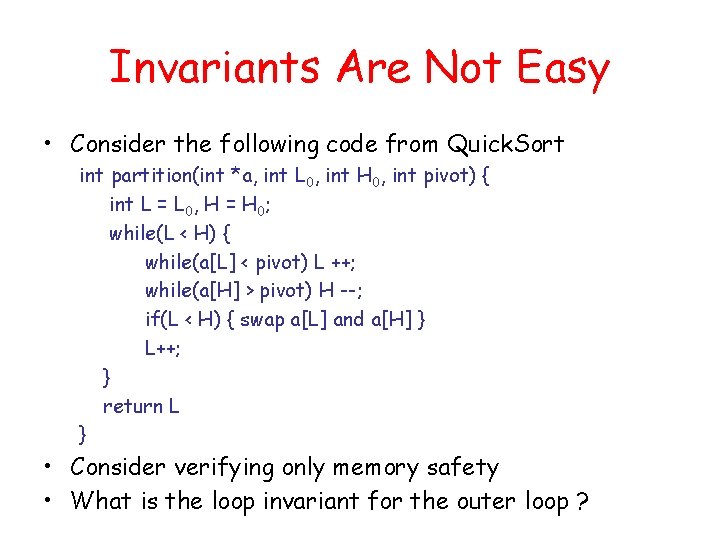
Invariants Are Not Easy • Consider the following code from Quick. Sort int partition(int *a, int L 0, int H 0, int pivot) { int L = L 0, H = H 0; while(L < H) { while(a[L] < pivot) L ++; while(a[H] > pivot) H --; if(L < H) { swap a[L] and a[H] } L++; } return L } • Consider verifying only memory safety • What is the loop invariant for the outer loop ?
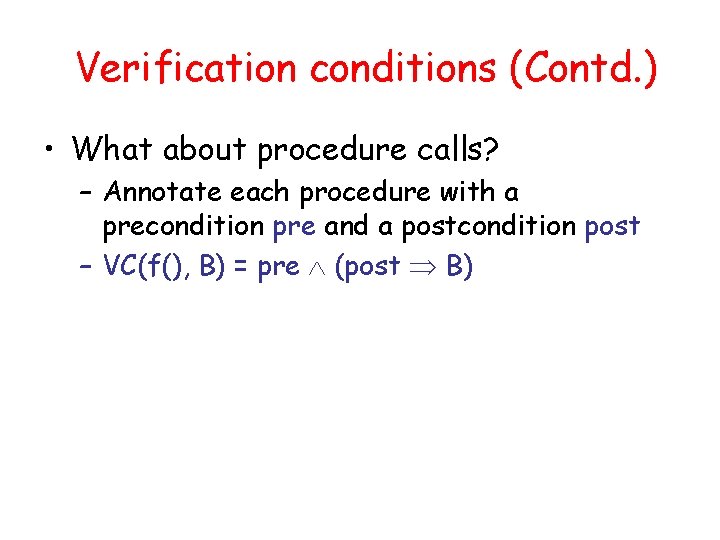
Verification conditions (Contd. ) • What about procedure calls? – Annotate each procedure with a precondition pre and a postcondition post – VC(f(), B) = pre (post B)
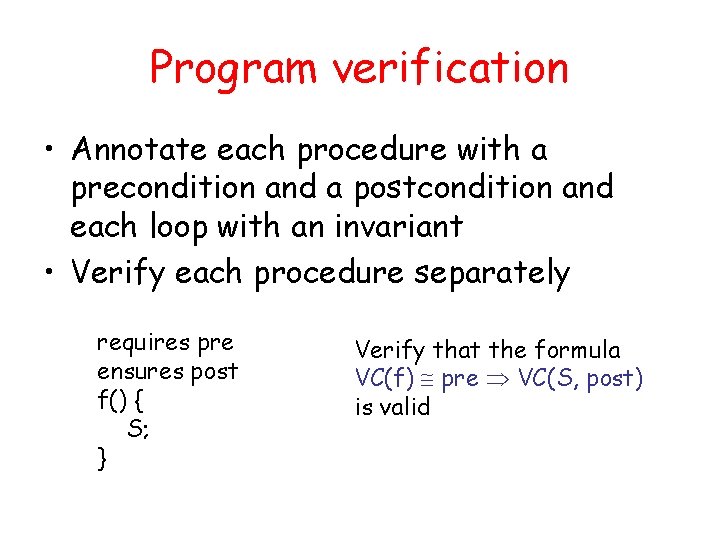
Program verification • Annotate each procedure with a precondition and a postcondition and each loop with an invariant • Verify each procedure separately requires pre ensures post f() { S; } Verify that the formula VC(f) pre VC(S, post) is valid
Proving verification conditions VC(f) pre VC(S, post) • What is the decision procedure for proving validity of VC(f)? • Depends on the logic in which VC(f) is expressed
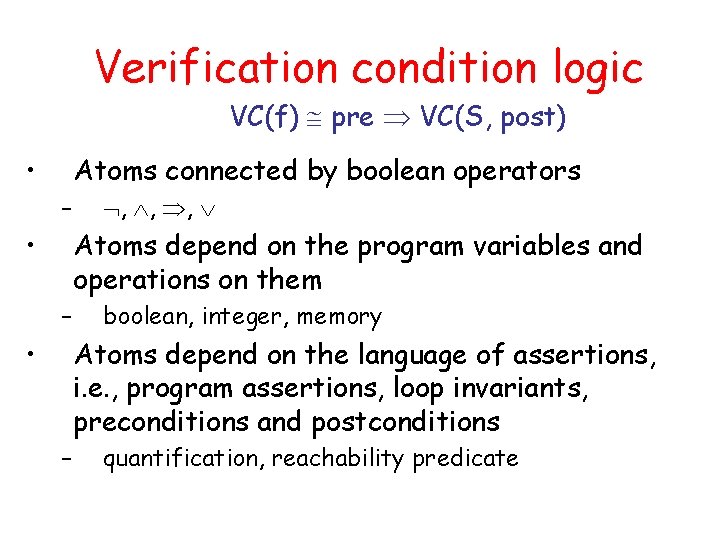
Verification condition logic VC(f) pre VC(S, post) • Atoms connected by boolean operators – • , , , Atoms depend on the program variables and operations on them – • boolean, integer, memory Atoms depend on the language of assertions, i. e. , program assertions, loop invariants, preconditions and postconditions – quantification, reachability predicate
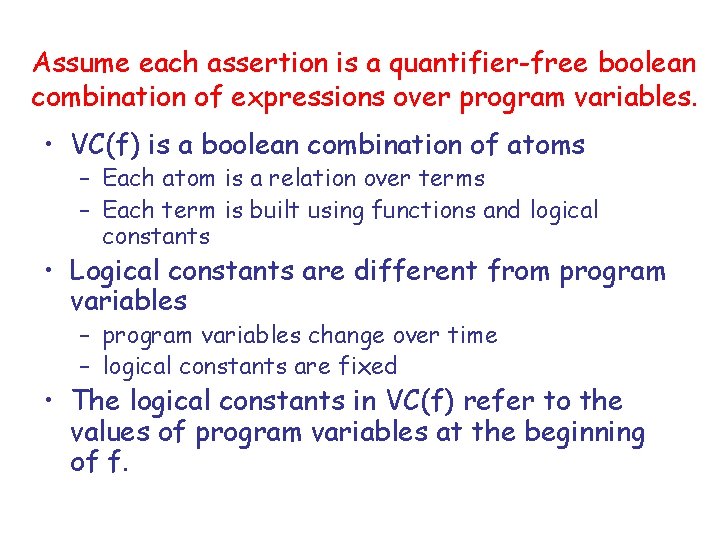
Assume each assertion is a quantifier-free boolean combination of expressions over program variables. • VC(f) is a boolean combination of atoms – Each atom is a relation over terms – Each term is built using functions and logical constants • Logical constants are different from program variables – program variables change over time – logical constants are fixed • The logical constants in VC(f) refer to the values of program variables at the beginning of f.
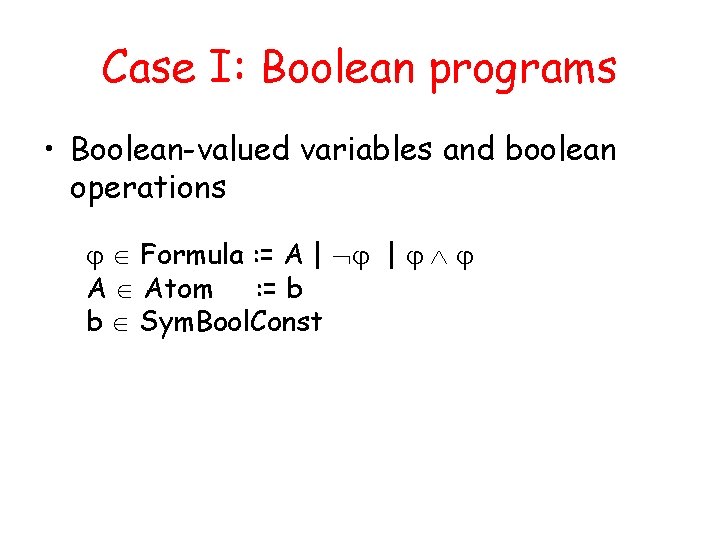
Case I: Boolean programs • Boolean-valued variables and boolean operations Formula : = A | | A Atom : = b b Sym. Bool. Const
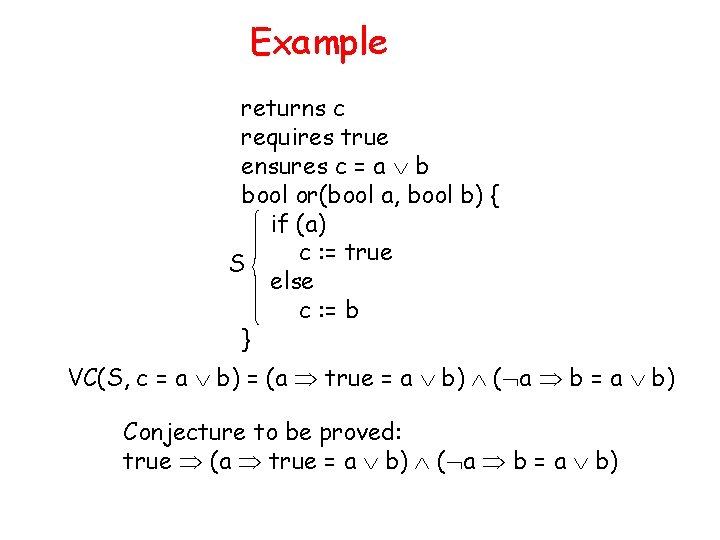
Example returns c requires true ensures c = a b bool or(bool a, bool b) { if (a) c : = true S else c : = b } VC(S, c = a b) = (a true = a b) ( a b = a b) Conjecture to be proved: true (a true = a b) ( a b = a b)
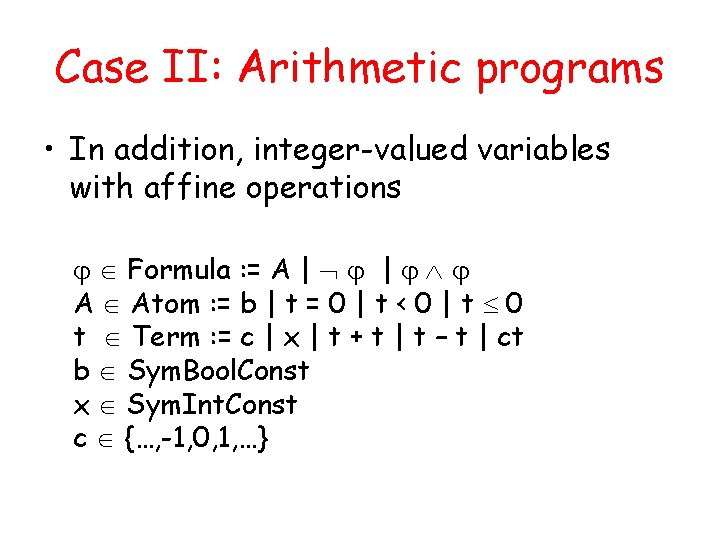
Case II: Arithmetic programs • In addition, integer-valued variables with affine operations Formula : = A | | A Atom : = b | t = 0 | t < 0 | t 0 t Term : = c | x | t + t | t – t | ct b Sym. Bool. Const x Sym. Int. Const c {…, -1, 0, 1, …}
Example returns c requires b >= 0 ensures c = a + b int add(int a, int b) { int t; t : = b c : = a invariant t 0 c=a+b-t A while (t > 0) { L c : = c + 1 B t : = t - 1 } } Conjecture to be proved: b 0 VC(A, c = a + b) VC(B, t 0 c = a + b - t) t - 1 0 c + 1 = a + b – (t – 1) VC(L, c = a + b) t 0 c=a+b–t (t 0 c = a + b – t t>0 t-1 0 c + 1 = a + b – (t - 1) t 0 c = a + b)[c 0/c, t 0/t] VC(L, c = a + b) t 0 c=a+b–t (t 0 0 c 0 = a + b – t 0 > 0 t 0 - 1 0 c 0 + 1 = a + b – (t 0 - 1) t 0 0 c 0 = a + b) VC(A, c = a + b) b 0 a=a+b–b (t 0 0 c 0 = a + b – t 0 > 0 t 0 - 1 0 c 0 + 1 = a + b – (t 0 - 1) t 0 0 c 0 = a + b)
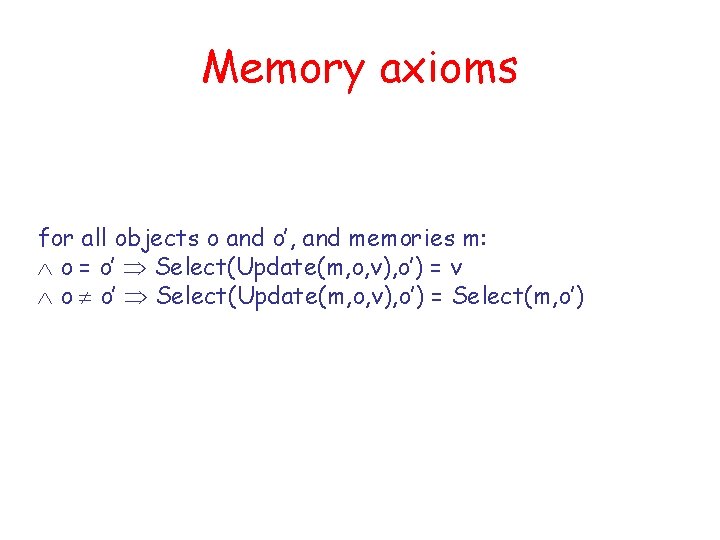
Case III: Memory programs • In addition, a memory with read and write operations – an unbounded set of objects – a finite set of fields in each object – each field contains a boolean value, an integer value, or a reference to an object • For each field f, two operations Select and Update – Select(f, o) is the content of the memory at object o and field f – Update(f, o, v) is a new memory obtained by updating field f of object o to v
Memory axioms for all objects o and o’, and memories m: o = o’ Select(Update(m, o, v), o’) = v o o’ Select(Update(m, o, v), o’) = Select(m, o’)
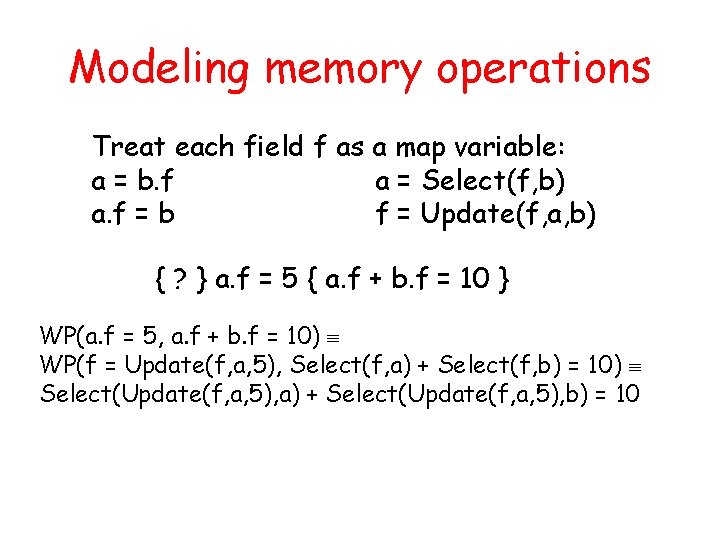
Modeling memory operations Treat each field f as a map variable: a = b. f a = Select(f, b) a. f = b f = Update(f, a, b) { ? } a. f = 5 { a. f + b. f = 10 } WP(a. f = 5, a. f + b. f = 10) WP(f = Update(f, a, 5), Select(f, a) + Select(f, b) = 10) Select(Update(f, a, 5), a) + Select(Update(f, a, 5), b) = 10
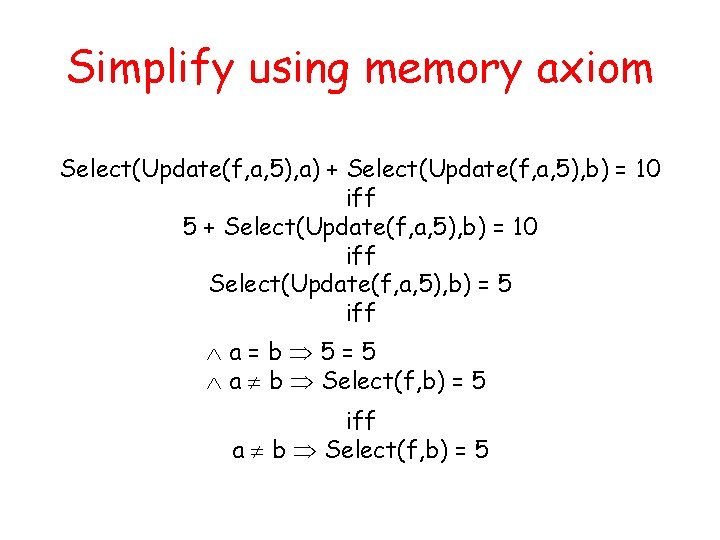
Simplify using memory axiom Select(Update(f, a, 5), a) + Select(Update(f, a, 5), b) = 10 iff 5 + Select(Update(f, a, 5), b) = 10 iff Select(Update(f, a, 5), b) = 5 iff a=b 5=5 a b Select(f, b) = 5 iff a b Select(f, b) = 5
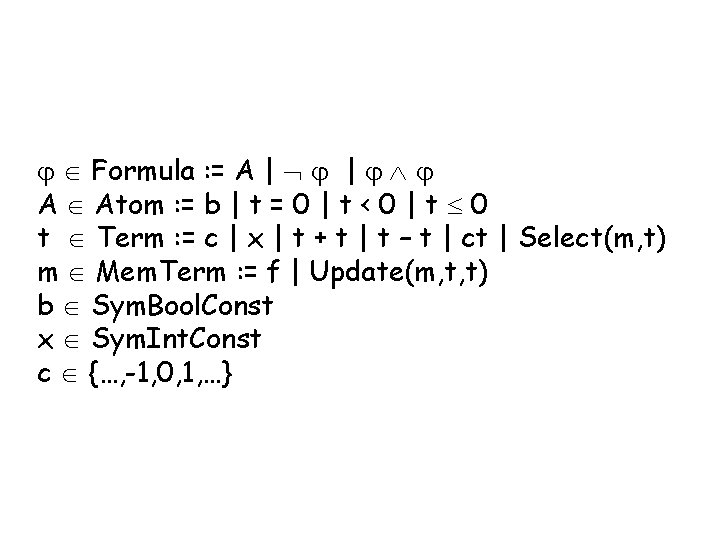
Formula : = A | | A Atom : = b | t = 0 | t < 0 | t 0 t Term : = c | x | t + t | t – t | ct | Select(m, t) m Mem. Term : = f | Update(m, t, t) b Sym. Bool. Const x Sym. Int. Const c {…, -1, 0, 1, …}
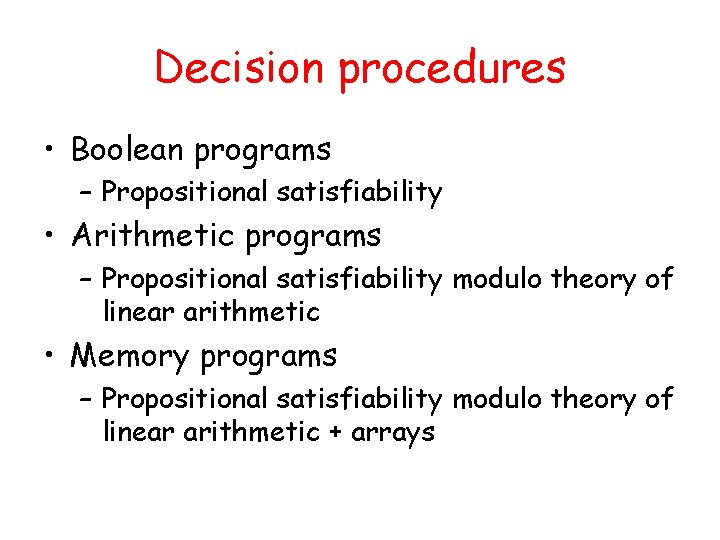
Decision procedures • Boolean programs – Propositional satisfiability • Arithmetic programs – Propositional satisfiability modulo theory of linear arithmetic • Memory programs – Propositional satisfiability modulo theory of linear arithmetic + arrays