
Automated Speach Recognition By Amichai Painsky Automated Speach

Automated Speach Recognition By: Amichai Painsky Automated Speach Recognotion
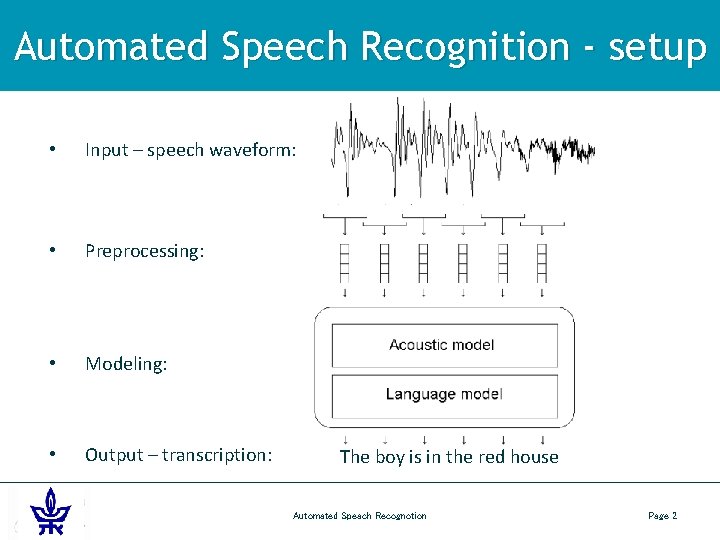
Automated Speech Recognition - setup • Input – speech waveform: • Preprocessing: • Modeling: • Output – transcription: The boy is in the red house Automated Speach Recognotion Page 2
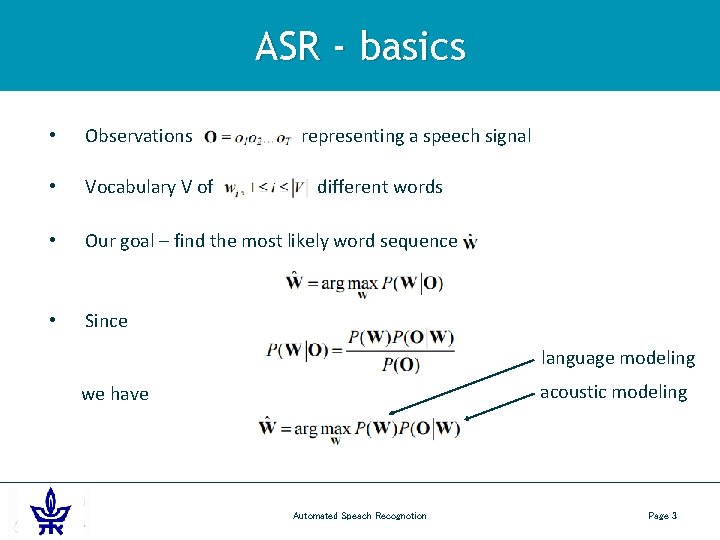
ASR - basics • Observations representing a speech signal • Vocabulary V of different words • Our goal – find the most likely word sequence • Since language modeling acoustic modeling we have Automated Speach Recognotion Page 3
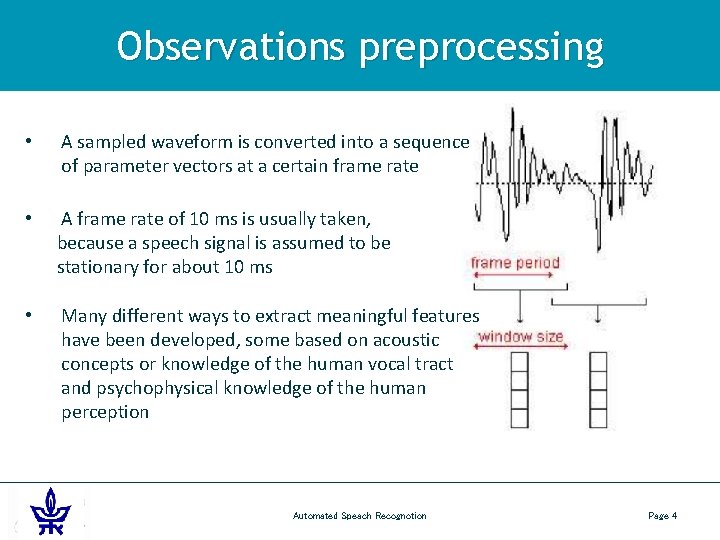
Observations preprocessing • A sampled waveform is converted into a sequence of parameter vectors at a certain frame rate • A frame rate of 10 ms is usually taken, because a speech signal is assumed to be stationary for about 10 ms • Many different ways to extract meaningful features have been developed, some based on acoustic concepts or knowledge of the human vocal tract and psychophysical knowledge of the human perception Automated Speach Recognotion Page 4
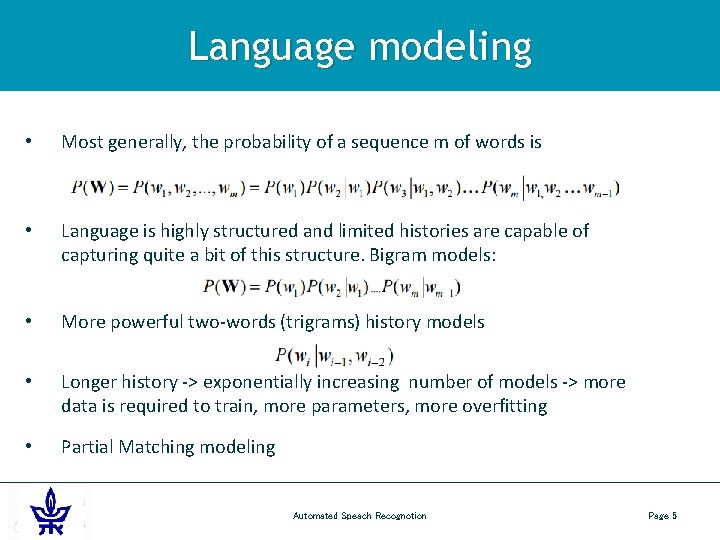
Language modeling • Most generally, the probability of a sequence m of words is • Language is highly structured and limited histories are capable of capturing quite a bit of this structure. Bigram models: • More powerful two-words (trigrams) history models • Longer history -> exponentially increasing number of models -> more data is required to train, more parameters, more overfitting • Partial Matching modeling Automated Speach Recognotion Page 5
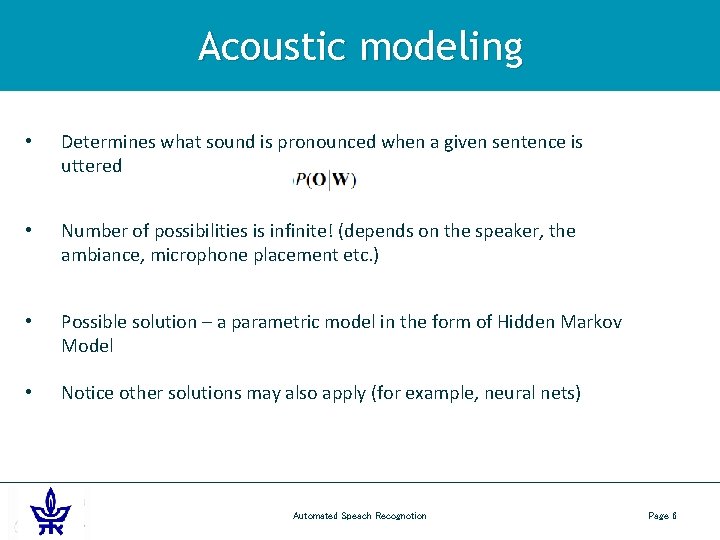
Acoustic modeling • Determines what sound is pronounced when a given sentence is uttered • Number of possibilities is infinite! (depends on the speaker, the ambiance, microphone placement etc. ) • Possible solution – a parametric model in the form of Hidden Markov Model • Notice other solutions may also apply (for example, neural nets) Automated Speach Recognotion Page 6
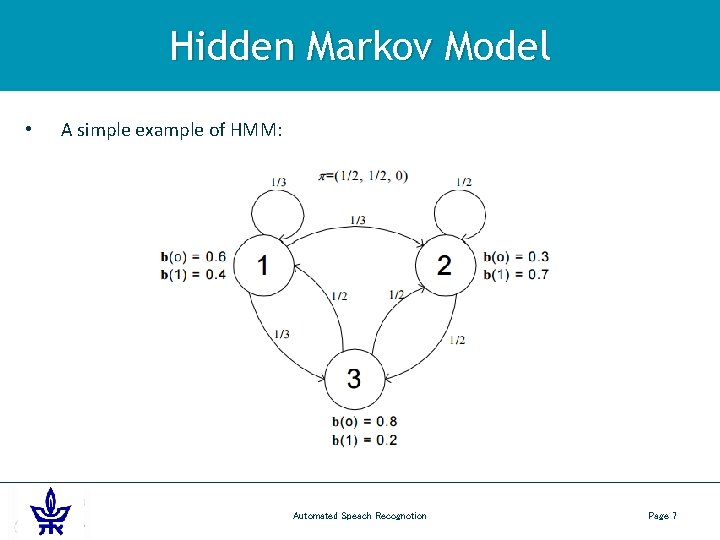
Hidden Markov Model • A simple example of HMM: Automated Speach Recognotion Page 7
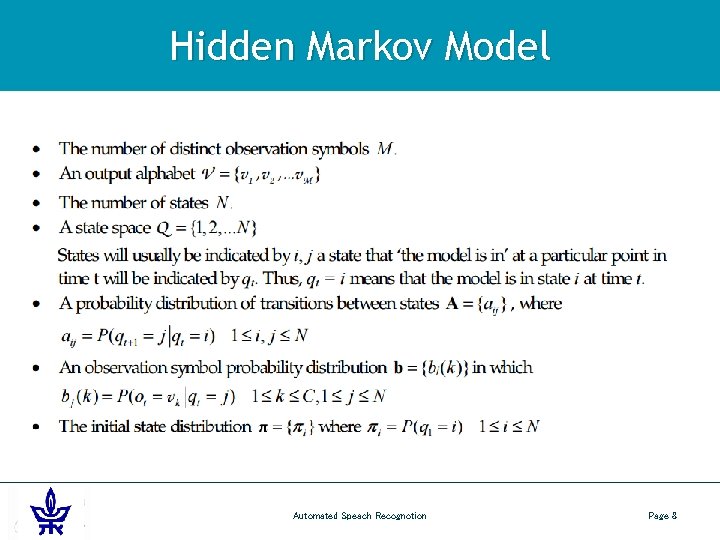
Hidden Markov Model Automated Speach Recognotion Page 8
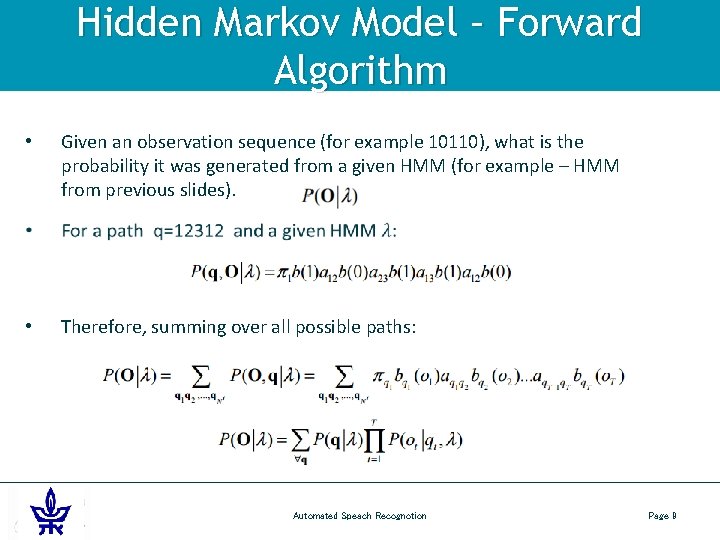
Hidden Markov Model – Forward Algorithm • Given an observation sequence (for example 10110), what is the probability it was generated from a given HMM (for example – HMM from previous slides). • Therefore, summing over all possible paths: Automated Speach Recognotion Page 9
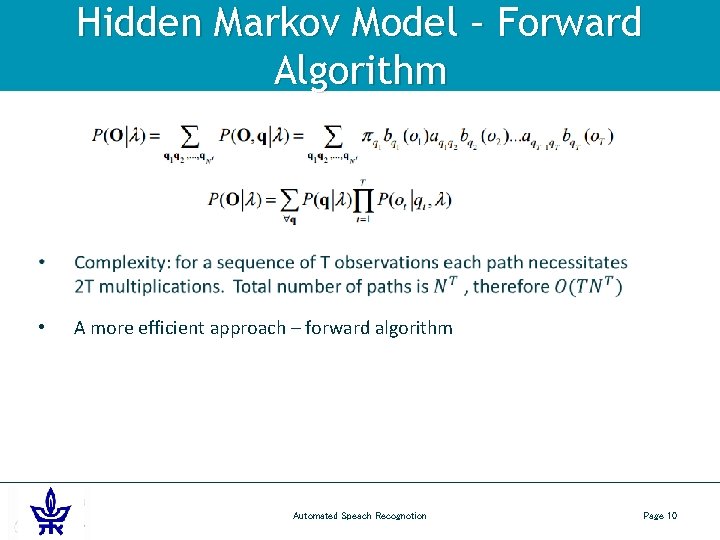
Hidden Markov Model – Forward Algorithm • A more efficient approach – forward algorithm Automated Speach Recognotion Page 10
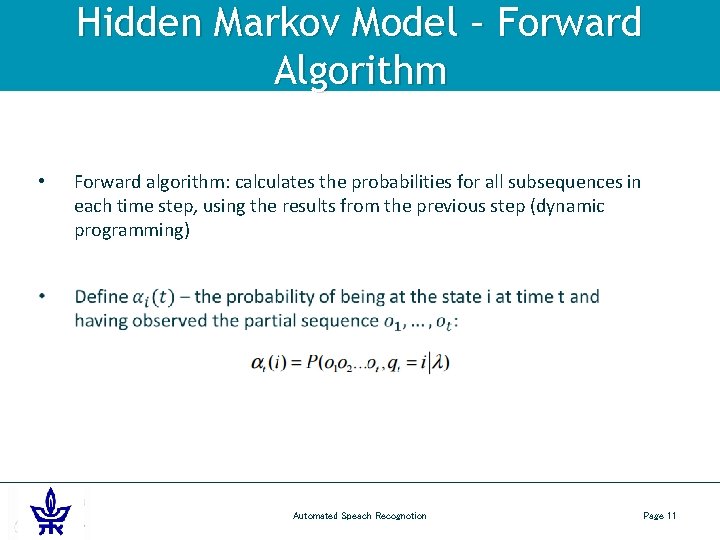
Hidden Markov Model – Forward Algorithm • Forward algorithm: calculates the probabilities for all subsequences in each time step, using the results from the previous step (dynamic programming) Automated Speach Recognotion Page 11
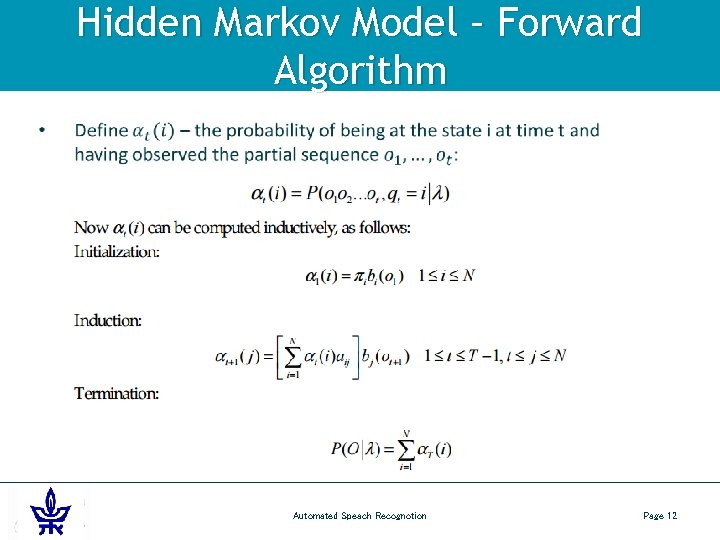
Hidden Markov Model – Forward Algorithm Automated Speach Recognotion Page 12
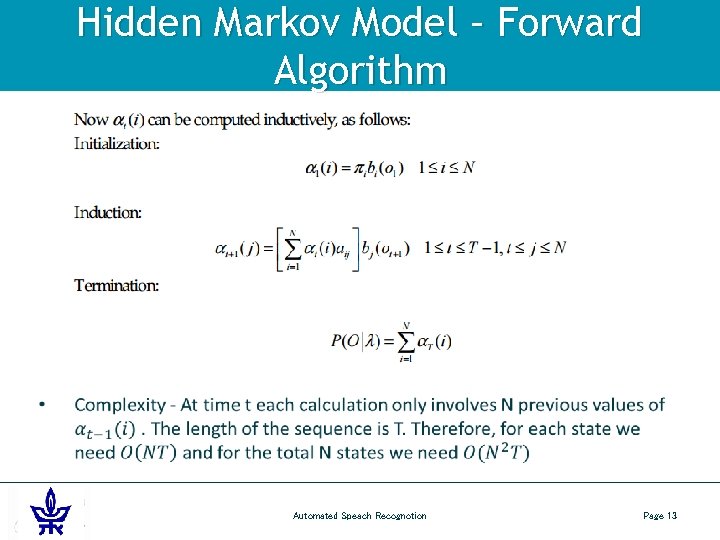
Hidden Markov Model – Forward Algorithm Automated Speach Recognotion Page 13
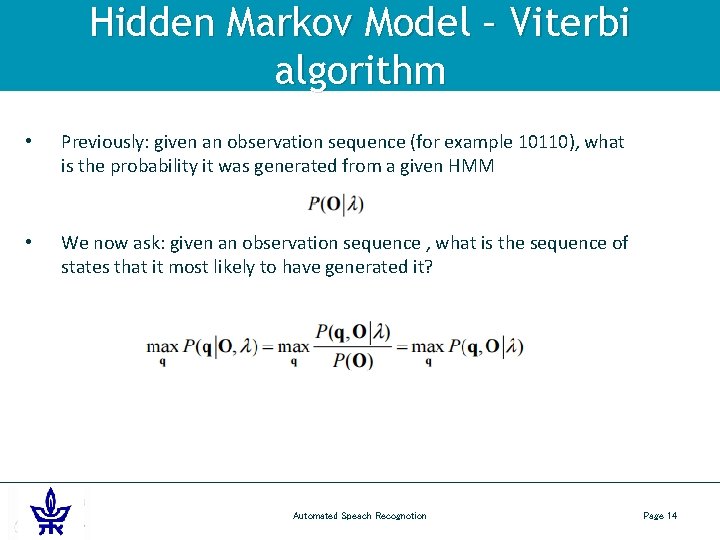
Hidden Markov Model – Viterbi algorithm • Previously: given an observation sequence (for example 10110), what is the probability it was generated from a given HMM • We now ask: given an observation sequence , what is the sequence of states that it most likely to have generated it? Automated Speach Recognotion Page 14
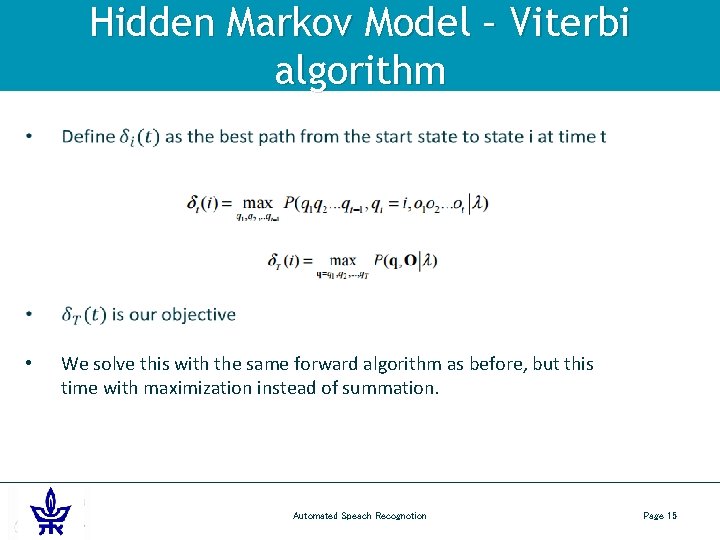
Hidden Markov Model – Viterbi algorithm • We solve this with the same forward algorithm as before, but this time with maximization instead of summation. Automated Speach Recognotion Page 15
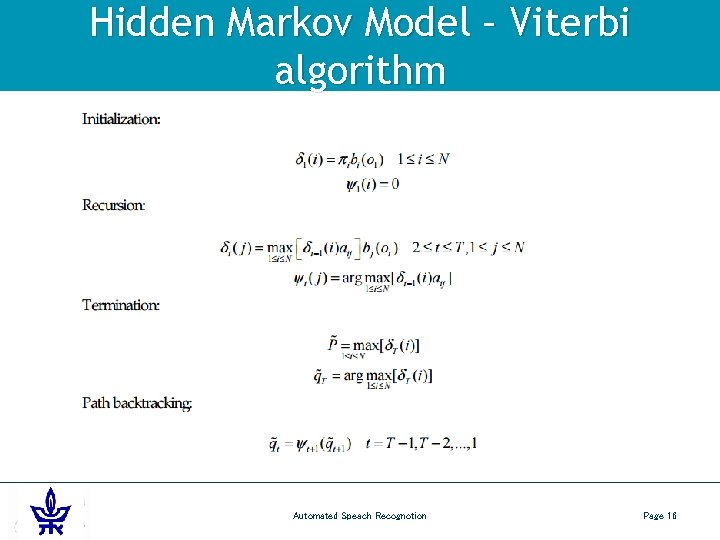
Hidden Markov Model – Viterbi algorithm Automated Speach Recognotion Page 16
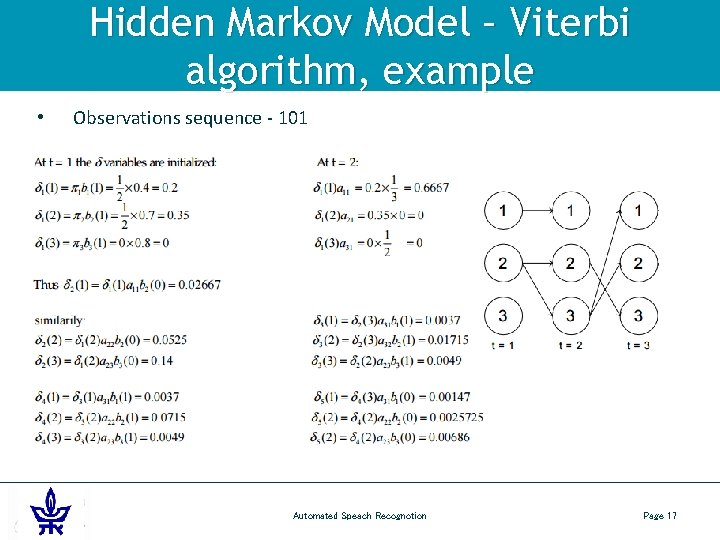
Hidden Markov Model – Viterbi algorithm, example • Observations sequence - 101 Automated Speach Recognotion Page 17
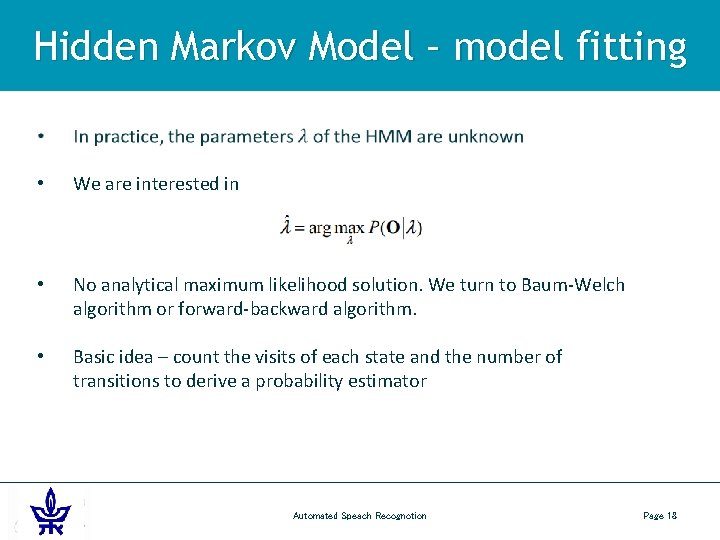
Hidden Markov Model – model fitting • We are interested in • No analytical maximum likelihood solution. We turn to Baum-Welch algorithm or forward-backward algorithm. • Basic idea – count the visits of each state and the number of transitions to derive a probability estimator Automated Speach Recognotion Page 18
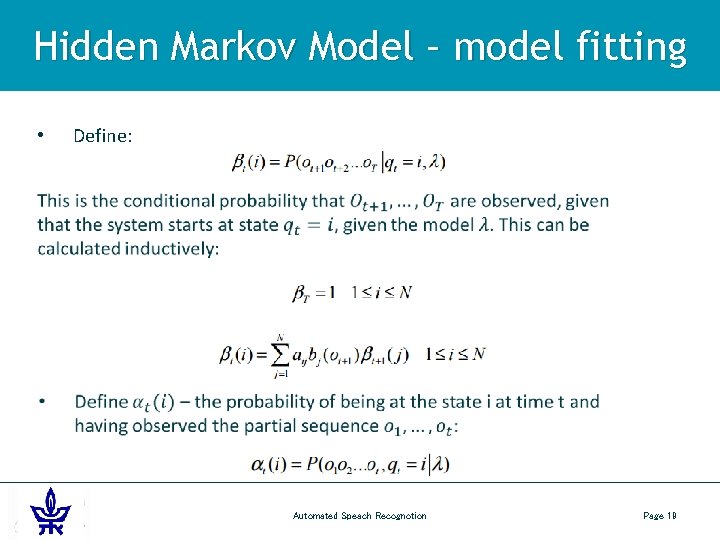
Hidden Markov Model – model fitting • Define: Automated Speach Recognotion Page 19
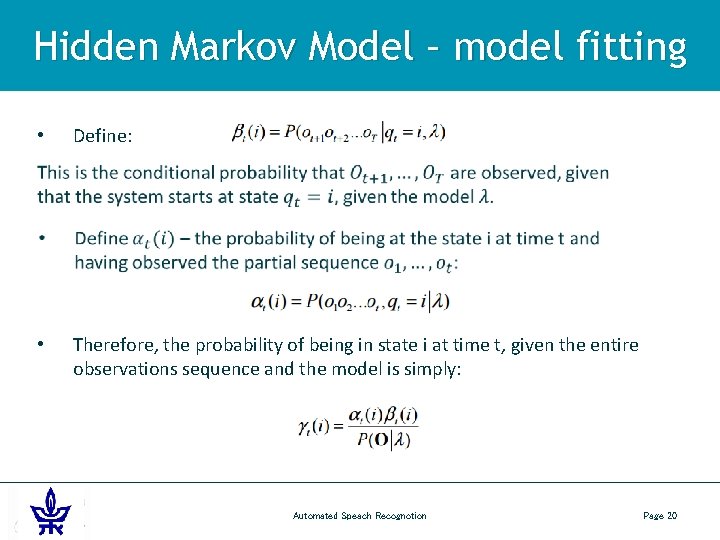
Hidden Markov Model – model fitting • Define: • Therefore, the probability of being in state i at time t, given the entire observations sequence and the model is simply: Automated Speach Recognotion Page 20
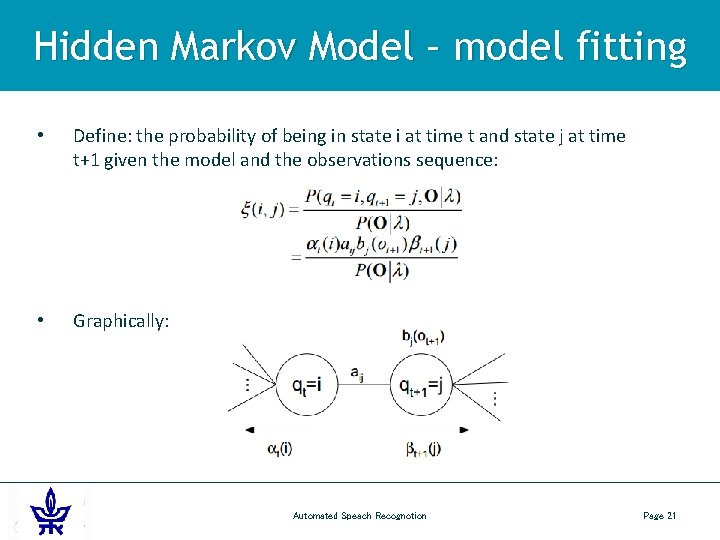
Hidden Markov Model – model fitting • Define: the probability of being in state i at time t and state j at time t+1 given the model and the observations sequence: • Graphically: Automated Speach Recognotion Page 21
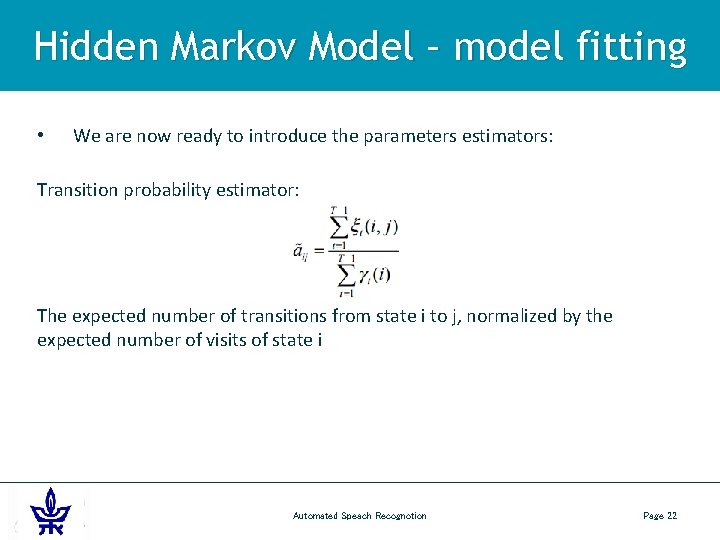
Hidden Markov Model – model fitting • We are now ready to introduce the parameters estimators: Transition probability estimator: The expected number of transitions from state i to j, normalized by the expected number of visits of state i Automated Speach Recognotion Page 22
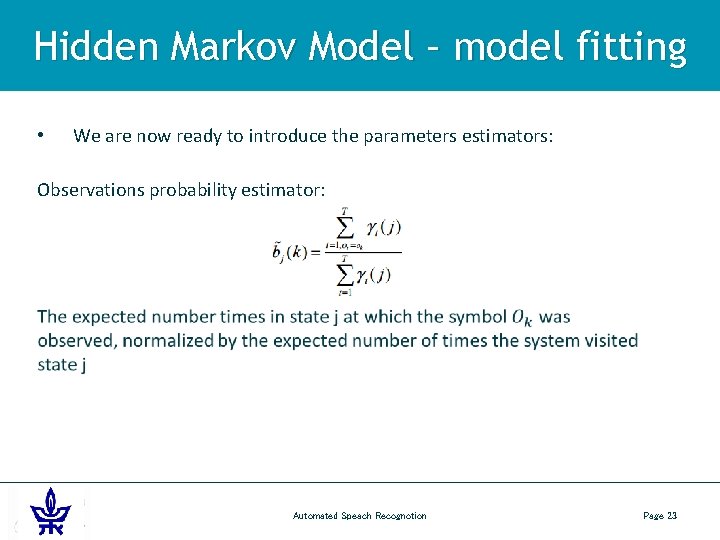
Hidden Markov Model – model fitting • We are now ready to introduce the parameters estimators: Observations probability estimator: Automated Speach Recognotion Page 23
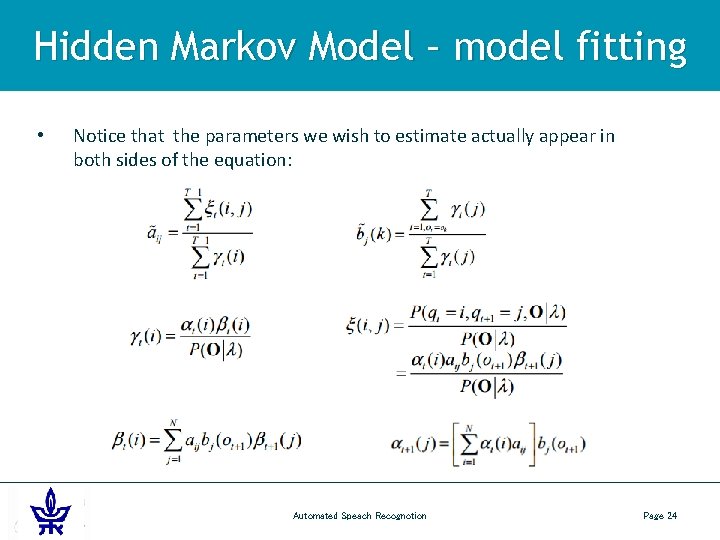
Hidden Markov Model – model fitting • Notice that the parameters we wish to estimate actually appear in both sides of the equation: Automated Speach Recognotion Page 24
Hidden Markov Model – model fitting • Notice that the parameters we wish to estimate actually appear in both sides of the equation • Therefore, we use an iterative procedure: after stating with an initial guess for the parameters we gradually update at each iteration and terminate once the parameters stop changing to a certain limit. Automated Speach Recognotion Page 25
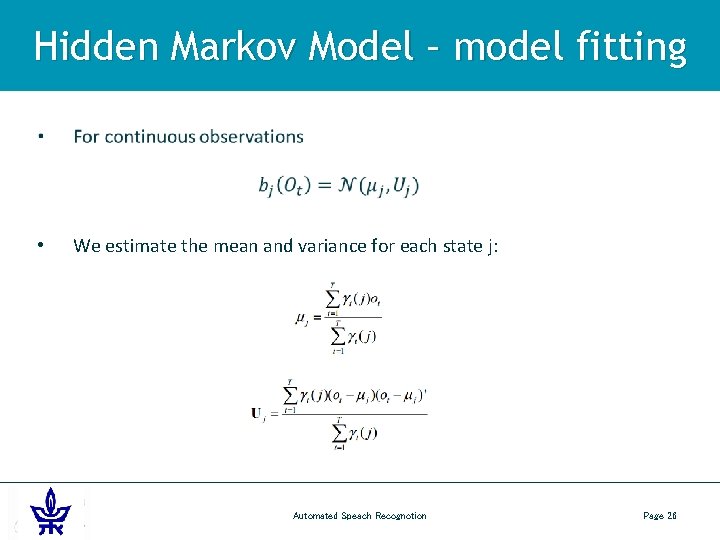
Hidden Markov Model – model fitting • We estimate the mean and variance for each state j: Automated Speach Recognotion Page 26
Conclusions and final remarks • We learned how to: I. Estimate HMM parameters from a sequence of observations II. Determine the probability of observing a sequence given an HMM III. Determine the most likely sequence of states, given an HMM and a sequence of observations • Notice the states may either represent words, syllables, phoneme, etc. This is up for the system architect to decide • For example, words are more informative than syllables, but results with more states and less accurate probability estimation (curse of dimensionality) Automated Speach Recognotion Page 27

Questions? Thank you! Automated Speach Recognotion Page 28
- Slides: 28