
Automated Program Analysis with Software Model Checking CMU
![Examples: EU and AU E[ U ψ] (exists until) A[ U ψ] (all until)](https://slidetodoc.com/presentation_image_h2/877bf27d81b13d9e26667b6f2431ce0e/image-16.jpg "Examples: EU and AU E[ U ψ] (exists until) A[ U ψ] (all until)")
- Slides: 56
Automated Program Analysis with Software Model Checking CMU 15 -819 O Arie Gurfinkel Software Engineering Institute Carnegie Mellon University March, 2016 © 2016 Carnegie Mellon University
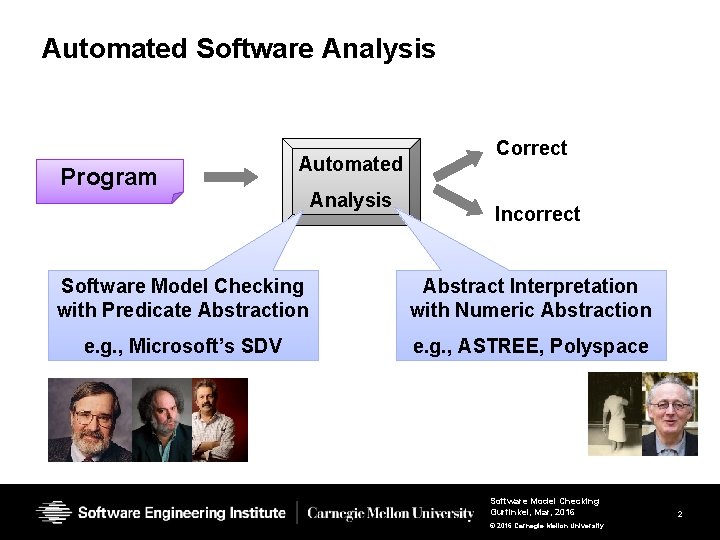
Automated Software Analysis Program Automated Analysis Correct Incorrect Software Model Checking with Predicate Abstraction Abstract Interpretation with Numeric Abstraction e. g. , Microsoft’s SDV e. g. , ASTREE, Polyspace Software Model Checking Gurfinkel, Mar, 2016 © 2016 Carnegie Mellon University 2
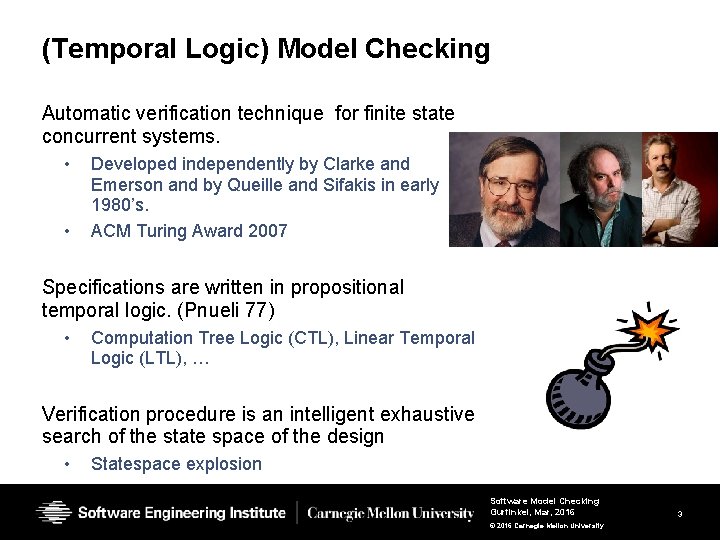
(Temporal Logic) Model Checking Automatic verification technique for finite state concurrent systems. • • Developed independently by Clarke and Emerson and by Queille and Sifakis in early 1980’s. ACM Turing Award 2007 Specifications are written in propositional temporal logic. (Pnueli 77) • Computation Tree Logic (CTL), Linear Temporal Logic (LTL), … Verification procedure is an intelligent exhaustive search of the state space of the design • Statespace explosion Software Model Checking Gurfinkel, Mar, 2016 © 2016 Carnegie Mellon University 3
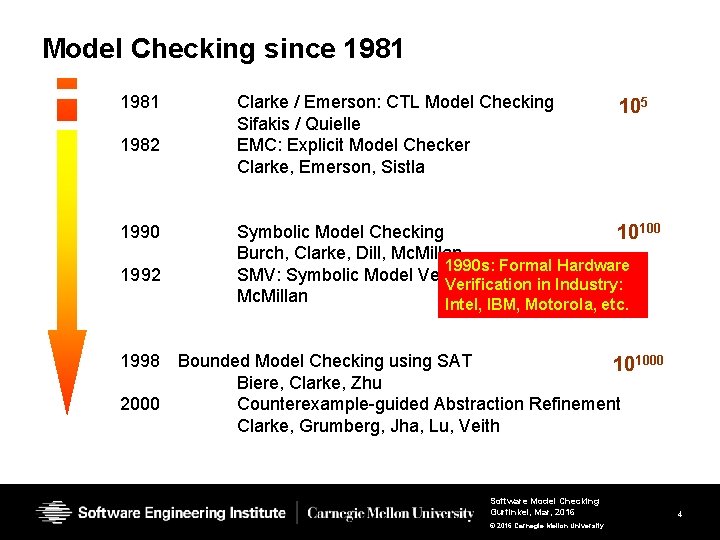
Model Checking since 1981 1982 1990 1992 1998 2000 Clarke / Emerson: CTL Model Checking Sifakis / Quielle EMC: Explicit Model Checker Clarke, Emerson, Sistla 105 Symbolic Model Checking 10100 Burch, Clarke, Dill, Mc. Millan 1990 s: Formal Hardware SMV: Symbolic Model Verifier Verification in Industry: Mc. Millan Intel, IBM, Motorola, etc. Bounded Model Checking using SAT 101000 Biere, Clarke, Zhu Counterexample-guided Abstraction Refinement Clarke, Grumberg, Jha, Lu, Veith Software Model Checking Gurfinkel, Mar, 2016 © 2016 Carnegie Mellon University 4
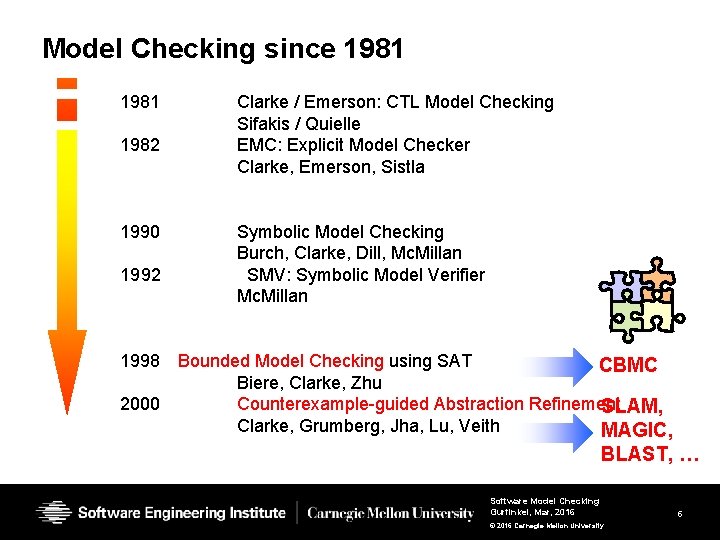
Model Checking since 1981 1982 1990 1992 1998 2000 Clarke / Emerson: CTL Model Checking Sifakis / Quielle EMC: Explicit Model Checker Clarke, Emerson, Sistla Symbolic Model Checking Burch, Clarke, Dill, Mc. Millan SMV: Symbolic Model Verifier Mc. Millan Bounded Model Checking using SAT CBMC Biere, Clarke, Zhu Counterexample-guided Abstraction Refinement SLAM, Clarke, Grumberg, Jha, Lu, Veith MAGIC, BLAST, … Software Model Checking Gurfinkel, Mar, 2016 © 2016 Carnegie Mellon University 5
Temporal Logic Model Checking © 2016 Carnegie Mellon University
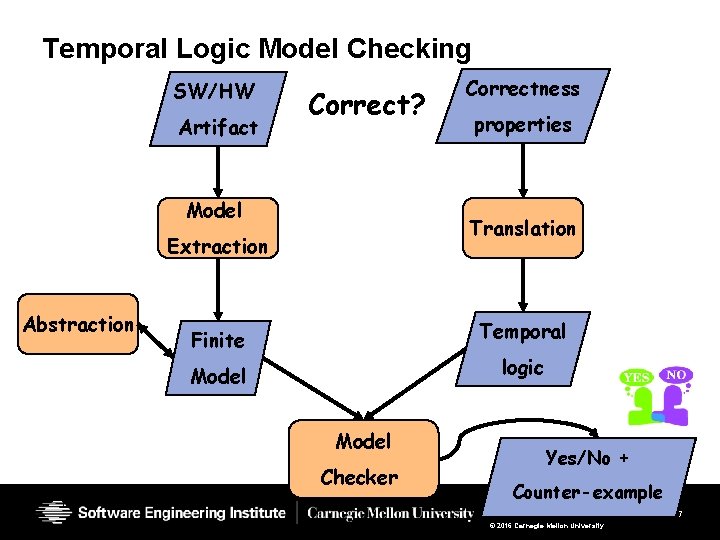
Temporal Logic Model Checking SW/HW Artifact Correct? Model Temporal Finite logic Model Checker 7 properties Translation Extraction Abstraction Correctness Yes/No + Counter-example Software Model Checking Gurfinkel, Mar, 2016 © 2016 Carnegie Mellon University 7
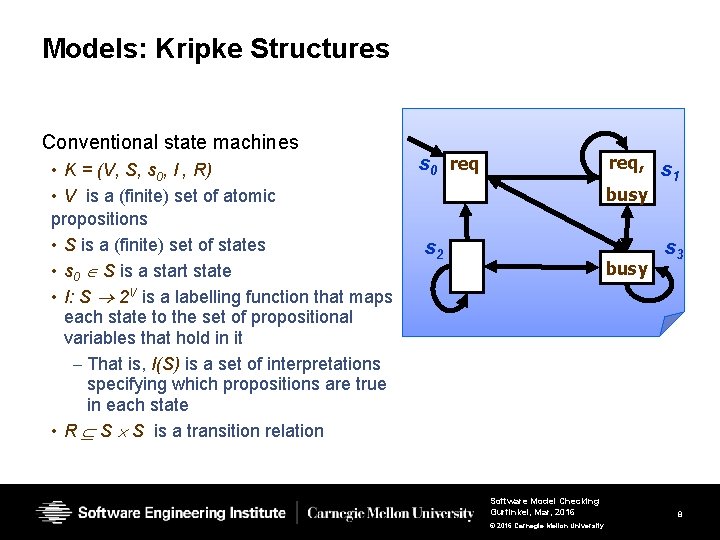
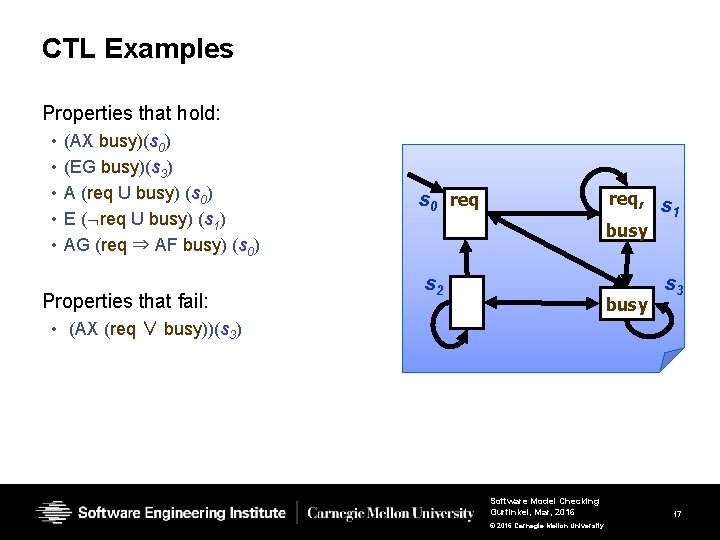
Models: Kripke Structures Conventional state machines • K = (V, S, s 0, I , R) • V is a (finite) set of atomic propositions • S is a (finite) set of states • s 0 S is a start state • I: S 2 V is a labelling function that maps each state to the set of propositional variables that hold in it – That is, I(S) is a set of interpretations specifying which propositions are true in each state • R S S is a transition relation req, s 1 busy s 0 req s 2 busy Software Model Checking Gurfinkel, Mar, 2016 © 2016 Carnegie Mellon University s 3 8
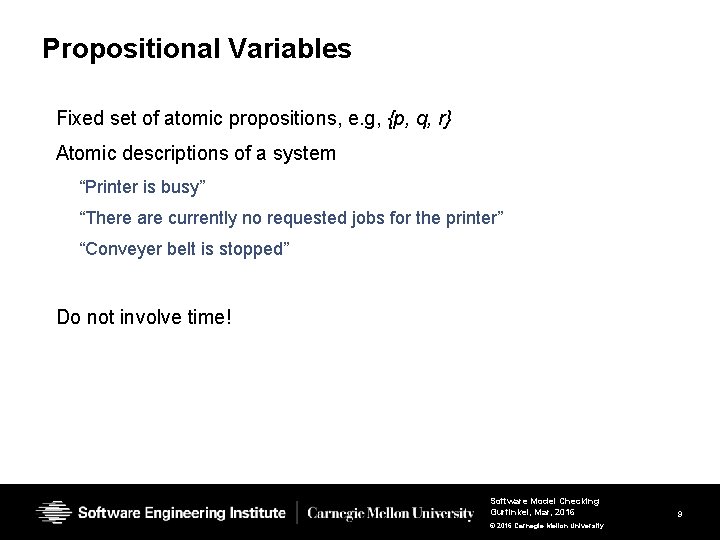
Propositional Variables Fixed set of atomic propositions, e. g, {p, q, r} Atomic descriptions of a system “Printer is busy” “There are currently no requested jobs for the printer” “Conveyer belt is stopped” Do not involve time! Software Model Checking Gurfinkel, Mar, 2016 © 2016 Carnegie Mellon University 9
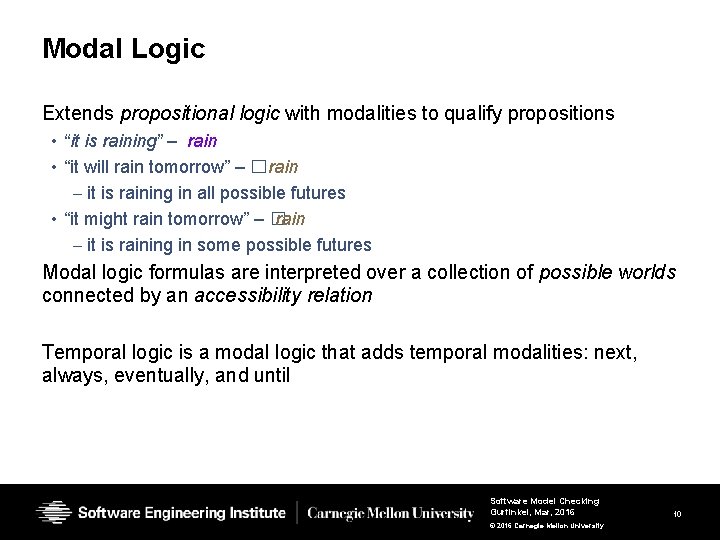
Modal Logic Extends propositional logic with modalities to qualify propositions • “it is raining” – rain • “it will rain tomorrow” – ☐rain – it is raining in all possible futures • “it might rain tomorrow” – � rain – it is raining in some possible futures Modal logic formulas are interpreted over a collection of possible worlds connected by an accessibility relation Temporal logic is a modal logic that adds temporal modalities: next, always, eventually, and until Software Model Checking Gurfinkel, Mar, 2016 © 2016 Carnegie Mellon University 10
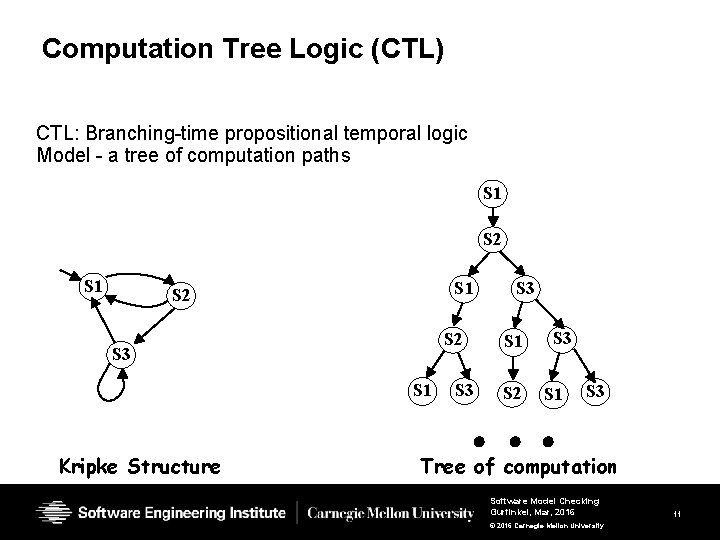
Computation Tree Logic (CTL) CTL: Branching-time propositional temporal logic Model - a tree of computation paths S 1 S 2 S 3 S 1 Kripke Structure S 3 S 1 S 2 S 3 S 1 S 3 Tree of computation Software Model Checking Gurfinkel, Mar, 2016 © 2016 Carnegie Mellon University 11
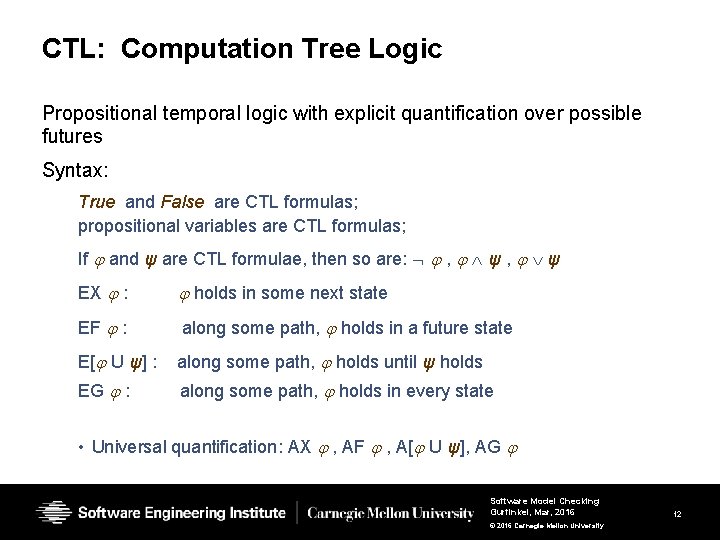
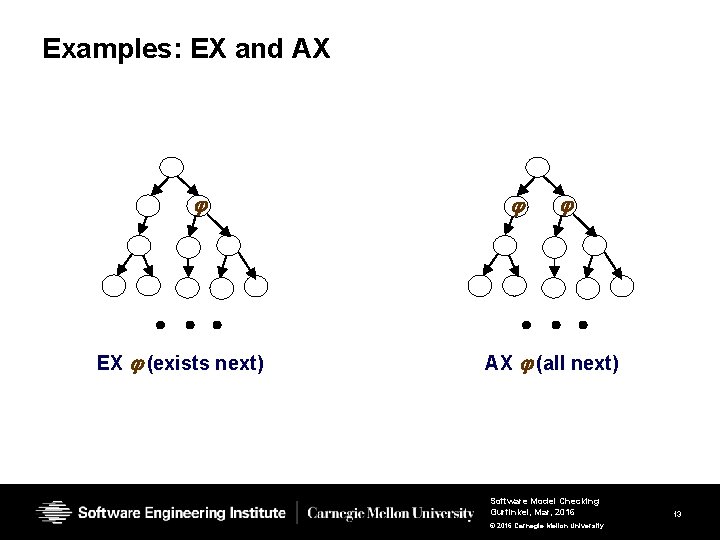
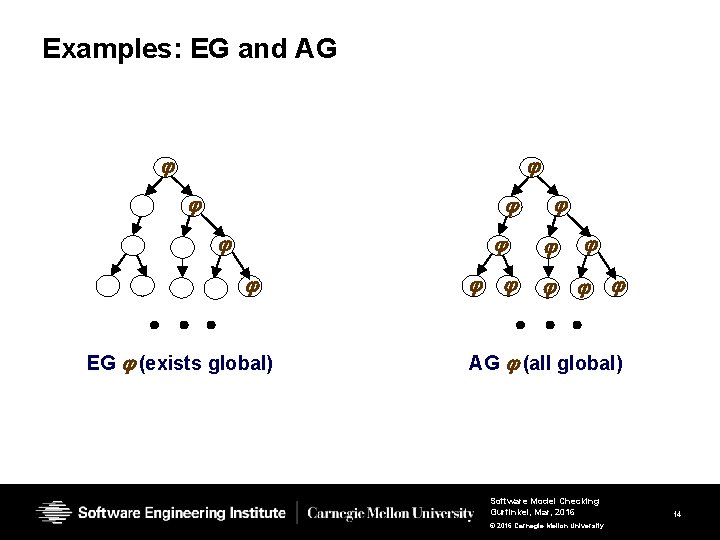
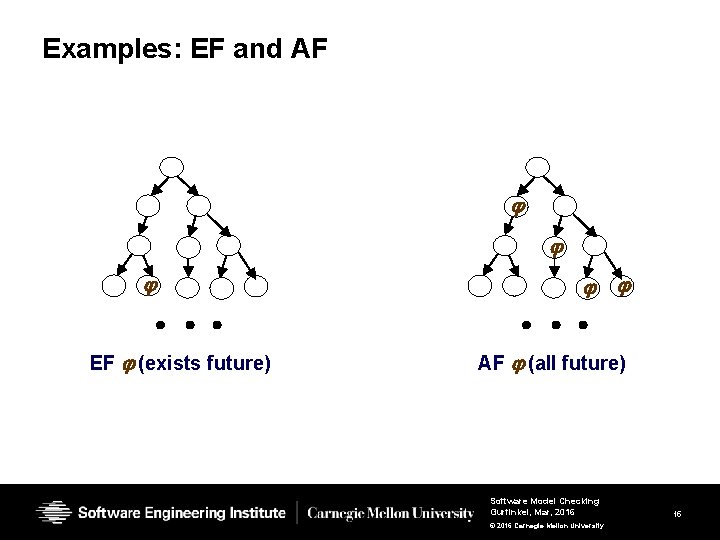
CTL: Computation Tree Logic Propositional temporal logic with explicit quantification over possible futures Syntax: True and False are CTL formulas; propositional variables are CTL formulas; If and ψ are CTL formulae, then so are: , ψ EX : holds in some next state EF : along some path, holds in a future state E[ U ψ] : along some path, holds until ψ holds EG : along some path, holds in every state • Universal quantification: AX , AF , A[ U ψ], AG Software Model Checking Gurfinkel, Mar, 2016 © 2016 Carnegie Mellon University 12
Examples: EX and AX EX (exists next) AX (all next) Software Model Checking Gurfinkel, Mar, 2016 © 2016 Carnegie Mellon University 13
Examples: EG and AG EG (exists global) AG (all global) Software Model Checking Gurfinkel, Mar, 2016 © 2016 Carnegie Mellon University 14
Examples: EF and AF EF (exists future) AF (all future) Software Model Checking Gurfinkel, Mar, 2016 © 2016 Carnegie Mellon University 15
Examples: EU and AU E[ U ψ] (exists until) A[ U ψ] (all until) Software Model Checking Gurfinkel, Mar, 2016 © 2016 Carnegie Mellon University 16
CTL Examples Properties that hold: • • • (AX busy)(s 0) (EG busy)(s 3) A (req U busy) (s 0) E ( req U busy) (s 1) AG (req ⇒ AF busy) (s 0) Properties that fail: req, s 1 busy s 0 req s 2 busy s 3 • (AX (req ∨ busy))(s 3) Software Model Checking Gurfinkel, Mar, 2016 © 2016 Carnegie Mellon University 17
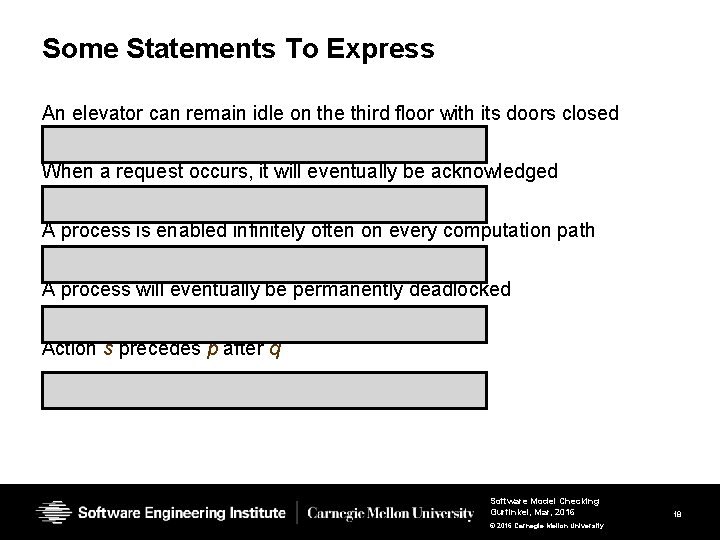
Some Statements To Express An elevator can remain idle on the third floor with its doors closed • EF (state=idle floor=3 doors=closed) When a request occurs, it will eventually be acknowledged • AG (request ⇒ AF acknowledge) A process is enabled infinitely often on every computation path • AG AF enabled A process will eventually be permanently deadlocked • AF AG deadlock Action s precedes p after q • A[¬q U (q ∧ A[¬p U s])] Software Model Checking Gurfinkel, Mar, 2016 © 2016 Carnegie Mellon University 18
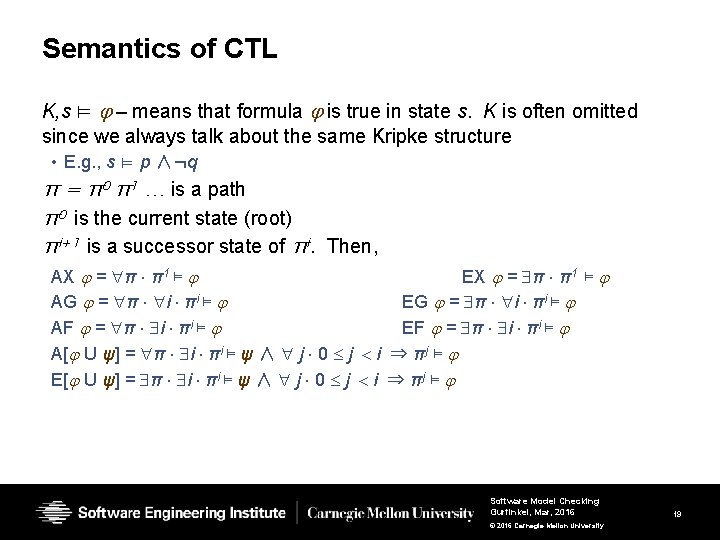
Semantics of CTL K, s ⊨ – means that formula is true in state s. K is often omitted since we always talk about the same Kripke structure • E. g. , s ⊨ p ∧¬q π = π0 π1 … is a path π0 is the current state (root) πi+1 is a successor state of πi. Then, AX = π π1 ⊨ EX = π π1 ⊨ AG = π i πi ⊨ EG = π i πi ⊨ AF = π i πi ⊨ EF = π i πi ⊨ A[ U ψ] = π i πi ⊨ ψ ∧ j 0 j i ⇒ πj ⊨ E[ U ψ] = π i πi ⊨ ψ ∧ j 0 j i ⇒ πj ⊨ Software Model Checking Gurfinkel, Mar, 2016 © 2016 Carnegie Mellon University 19
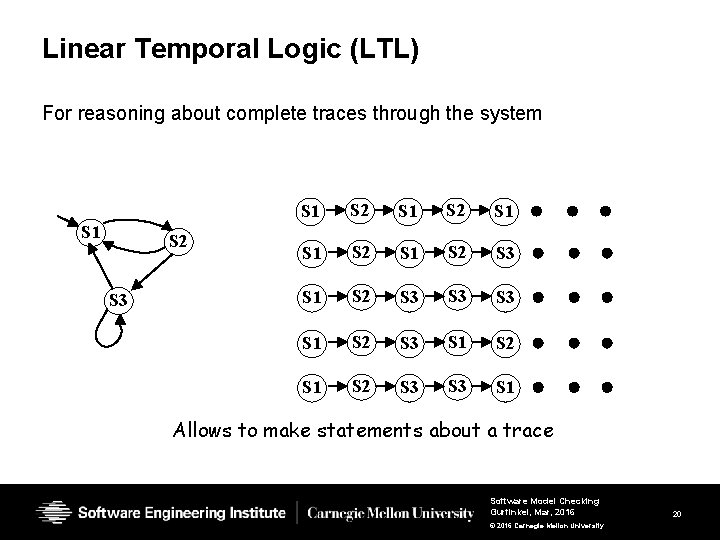
Linear Temporal Logic (LTL) For reasoning about complete traces through the system S 1 S 2 S 3 S 1 S 2 S 1 S 2 S 3 S 3 S 1 S 2 S 3 S 1 Allows to make statements about a trace Software Model Checking Gurfinkel, Mar, 2016 © 2016 Carnegie Mellon University 20
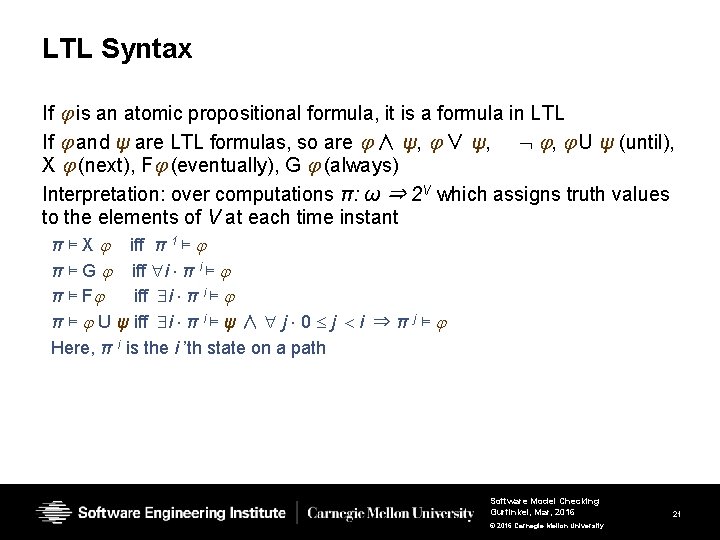
LTL Syntax If is an atomic propositional formula, it is a formula in LTL If and ψ are LTL formulas, so are ∧ ψ, ∨ ψ, , U ψ (until), X (next), F (eventually), G (always) Interpretation: over computations π: ω ⇒ 2 V which assigns truth values to the elements of V at each time instant π ⊨ X iff π 1 ⊨ π ⊨ G iff i π i ⊨ π ⊨ F iff i π i ⊨ π ⊨ U ψ iff i π i ⊨ ψ ∧ j 0 j i ⇒ π j ⊨ Here, π i is the i ’th state on a path Software Model Checking Gurfinkel, Mar, 2016 © 2016 Carnegie Mellon University 21
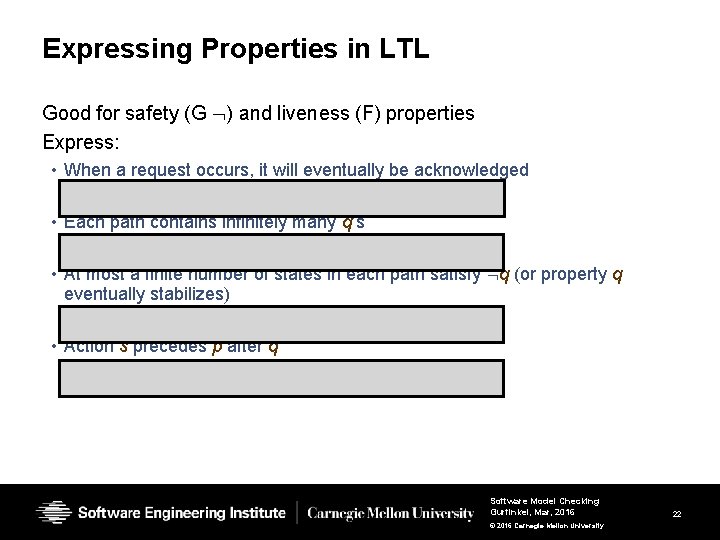
Expressing Properties in LTL Good for safety (G ) and liveness (F) properties Express: • When a request occurs, it will eventually be acknowledged – G (request ⇒ F acknowledge) • Each path contains infinitely many q’s –GFq • At most a finite number of states in each path satisfy q (or property q eventually stabilizes) –FGq • Action s precedes p after q – [¬q U (q ∧ [¬p U s])] Software Model Checking Gurfinkel, Mar, 2016 © 2016 Carnegie Mellon University 22
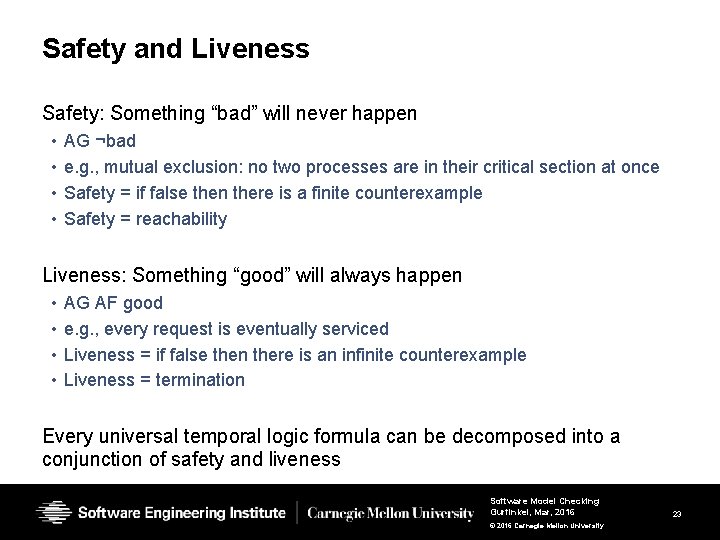
Safety and Liveness Safety: Something “bad” will never happen • • AG ¬bad e. g. , mutual exclusion: no two processes are in their critical section at once Safety = if false then there is a finite counterexample Safety = reachability Liveness: Something “good” will always happen • • AG AF good e. g. , every request is eventually serviced Liveness = if false then there is an infinite counterexample Liveness = termination Every universal temporal logic formula can be decomposed into a conjunction of safety and liveness Software Model Checking Gurfinkel, Mar, 2016 © 2016 Carnegie Mellon University 23
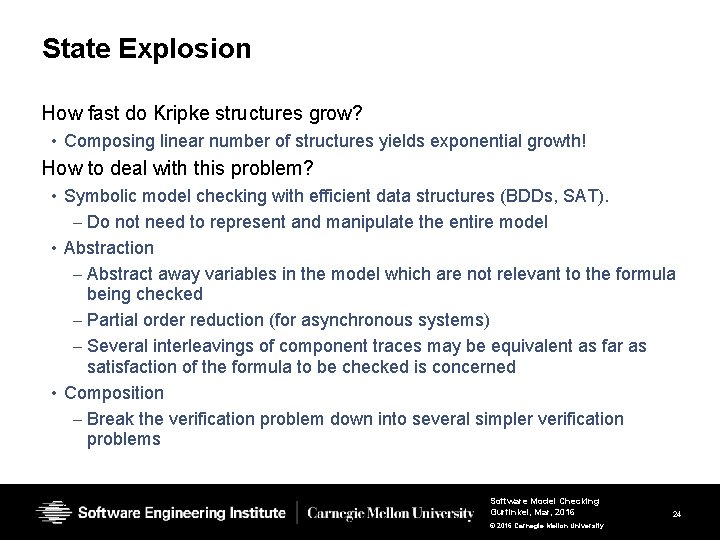
State Explosion How fast do Kripke structures grow? • Composing linear number of structures yields exponential growth! How to deal with this problem? • Symbolic model checking with efficient data structures (BDDs, SAT). – Do not need to represent and manipulate the entire model • Abstraction – Abstract away variables in the model which are not relevant to the formula being checked – Partial order reduction (for asynchronous systems) – Several interleavings of component traces may be equivalent as far as satisfaction of the formula to be checked is concerned • Composition – Break the verification problem down into several simpler verification problems 24 Software Model Checking Gurfinkel, Mar, 2016 © 2016 Carnegie Mellon University 24
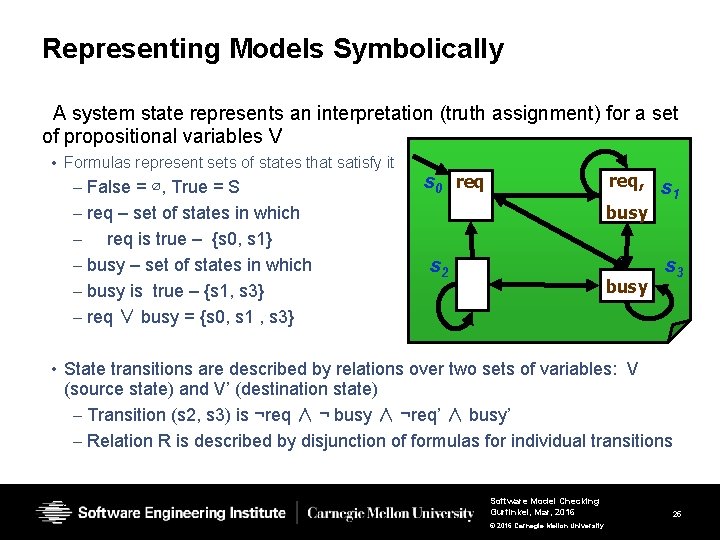
Representing Models Symbolically A system state represents an interpretation (truth assignment) for a set of propositional variables V • Formulas represent sets of states that satisfy it – False = ∅, True = S – req – set of states in which – req is true – {s 0, s 1} – busy – set of states in which – busy is true – {s 1, s 3} – req ∨ busy = {s 0, s 1 , s 3} req, s 1 busy s 0 req s 2 busy s 3 • State transitions are described by relations over two sets of variables: V (source state) and V’ (destination state) – Transition (s 2, s 3) is ¬req ∧ ¬ busy ∧ ¬req’ ∧ busy’ – Relation R is described by disjunction of formulas for individual transitions 25 Software Model Checking Gurfinkel, Mar, 2016 © 2016 Carnegie Mellon University 25
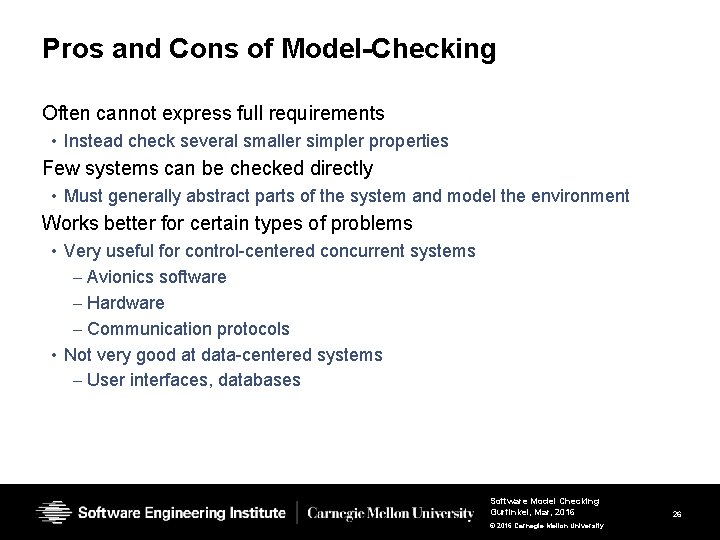
Pros and Cons of Model-Checking Often cannot express full requirements • Instead check several smaller simpler properties Few systems can be checked directly • Must generally abstract parts of the system and model the environment Works better for certain types of problems • Very useful for control-centered concurrent systems – Avionics software – Hardware – Communication protocols • Not very good at data-centered systems – User interfaces, databases Software Model Checking Gurfinkel, Mar, 2016 © 2016 Carnegie Mellon University 26
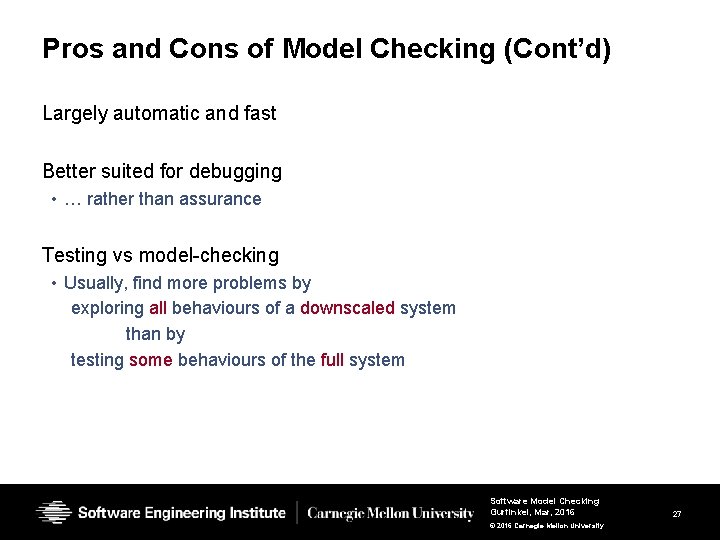
Pros and Cons of Model Checking (Cont’d) Largely automatic and fast Better suited for debugging • … rather than assurance Testing vs model-checking • Usually, find more problems by exploring all behaviours of a downscaled system than by testing some behaviours of the full system Software Model Checking Gurfinkel, Mar, 2016 © 2016 Carnegie Mellon University 27
SAT and SMT © 2016 Carnegie Mellon University
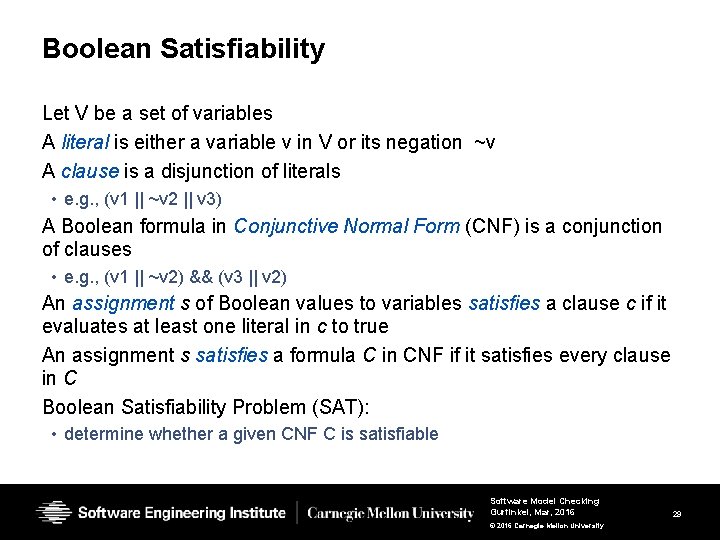
Boolean Satisfiability Let V be a set of variables A literal is either a variable v in V or its negation ~v A clause is a disjunction of literals • e. g. , (v 1 || ~v 2 || v 3) A Boolean formula in Conjunctive Normal Form (CNF) is a conjunction of clauses • e. g. , (v 1 || ~v 2) && (v 3 || v 2) An assignment s of Boolean values to variables satisfies a clause c if it evaluates at least one literal in c to true An assignment s satisfies a formula C in CNF if it satisfies every clause in C Boolean Satisfiability Problem (SAT): • determine whether a given CNF C is satisfiable Software Model Checking Gurfinkel, Mar, 2016 © 2016 Carnegie Mellon University 29
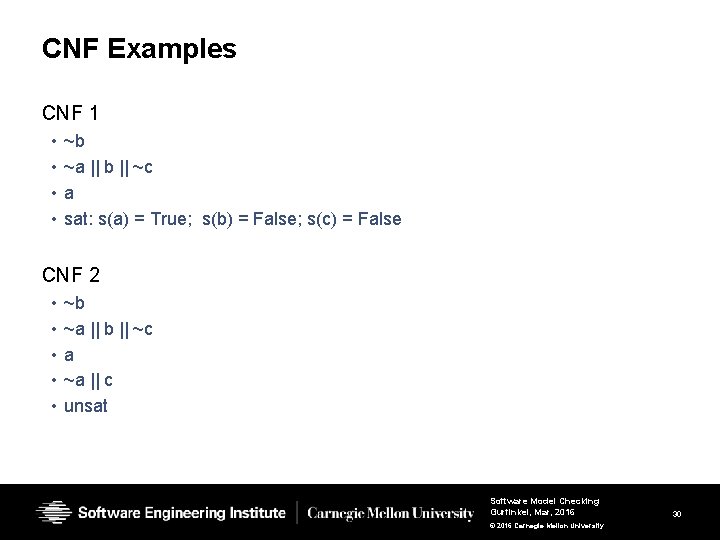
CNF Examples CNF 1 • • ~b ~a || b || ~c a sat: s(a) = True; s(b) = False; s(c) = False CNF 2 • • • ~b ~a || b || ~c a ~a || c unsat Software Model Checking Gurfinkel, Mar, 2016 © 2016 Carnegie Mellon University 30
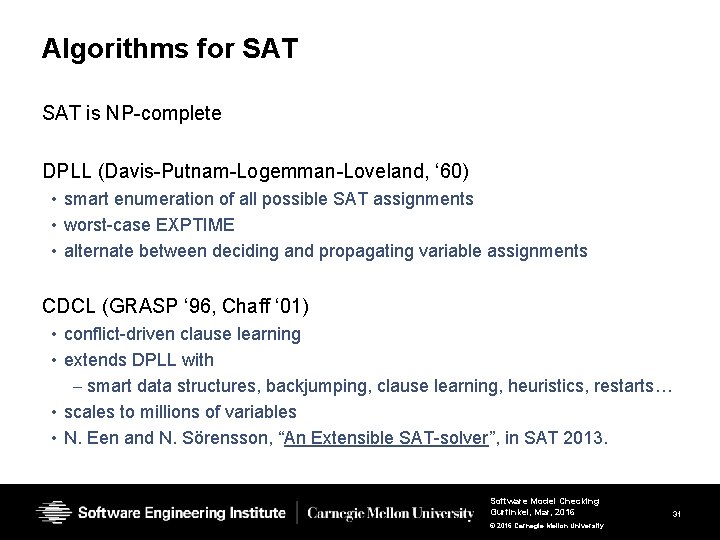
Algorithms for SAT is NP-complete DPLL (Davis-Putnam-Logemman-Loveland, ‘ 60) • smart enumeration of all possible SAT assignments • worst-case EXPTIME • alternate between deciding and propagating variable assignments CDCL (GRASP ‘ 96, Chaff ‘ 01) • conflict-driven clause learning • extends DPLL with – smart data structures, backjumping, clause learning, heuristics, restarts… • scales to millions of variables • N. Een and N. Sörensson, “An Extensible SAT-solver”, in SAT 2013. Software Model Checking Gurfinkel, Mar, 2016 © 2016 Carnegie Mellon University 31
DPLL by Example DPLL Example by Prof. Cesare Tinelli From http: //homepage. cs. uiowa. edu/~tinelli/classes/196/Fall 09/notes/dpll. pdf Software Model Checking Gurfinkel, Mar, 2016 © 2016 Carnegie Mellon University 32
from M. Vardi, https: //www. cs. rice. edu/~vardi/papers/highlights 15. pdf Software Model Checking Gurfinkel, Mar, 2016 © 2016 Carnegie Mellon University 33
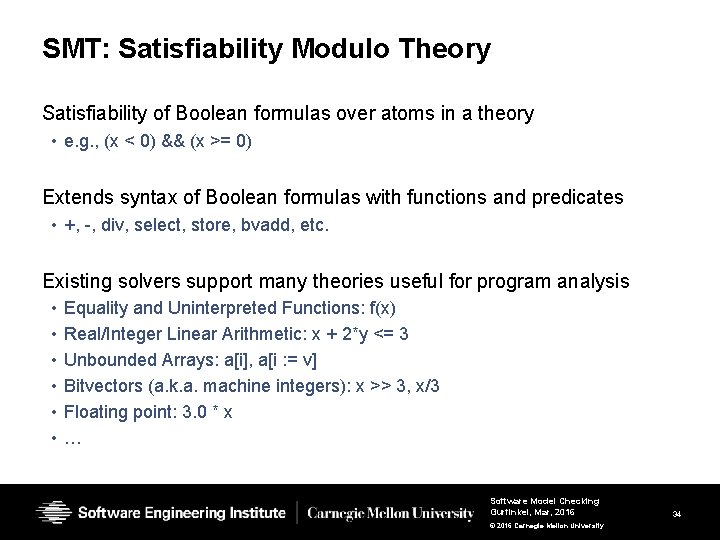
SMT: Satisfiability Modulo Theory Satisfiability of Boolean formulas over atoms in a theory • e. g. , (x < 0) && (x >= 0) Extends syntax of Boolean formulas with functions and predicates • +, -, div, select, store, bvadd, etc. Existing solvers support many theories useful for program analysis • • • Equality and Uninterpreted Functions: f(x) Real/Integer Linear Arithmetic: x + 2*y <= 3 Unbounded Arrays: a[i], a[i : = v] Bitvectors (a. k. a. machine integers): x >> 3, x/3 Floating point: 3. 0 * x … Software Model Checking Gurfinkel, Mar, 2016 © 2016 Carnegie Mellon University 34
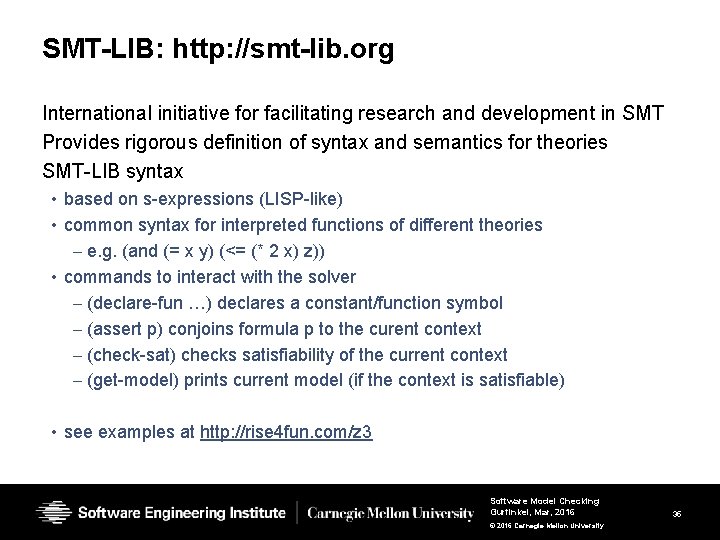
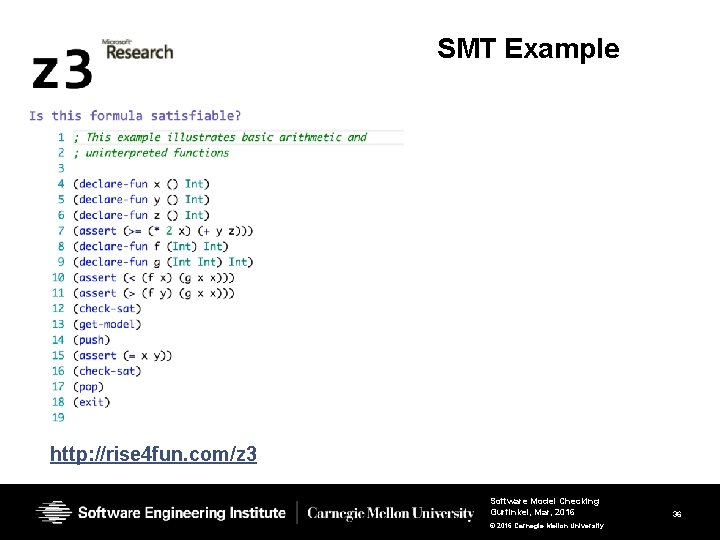
SMT-LIB: http: //smt-lib. org International initiative for facilitating research and development in SMT Provides rigorous definition of syntax and semantics for theories SMT-LIB syntax • based on s-expressions (LISP-like) • common syntax for interpreted functions of different theories – e. g. (and (= x y) (<= (* 2 x) z)) • commands to interact with the solver – (declare-fun …) declares a constant/function symbol – (assert p) conjoins formula p to the curent context – (check-sat) checks satisfiability of the current context – (get-model) prints current model (if the context is satisfiable) • see examples at http: //rise 4 fun. com/z 3 Software Model Checking Gurfinkel, Mar, 2016 © 2016 Carnegie Mellon University 35
SMT Example http: //rise 4 fun. com/z 3 Software Model Checking Gurfinkel, Mar, 2016 © 2016 Carnegie Mellon University 36
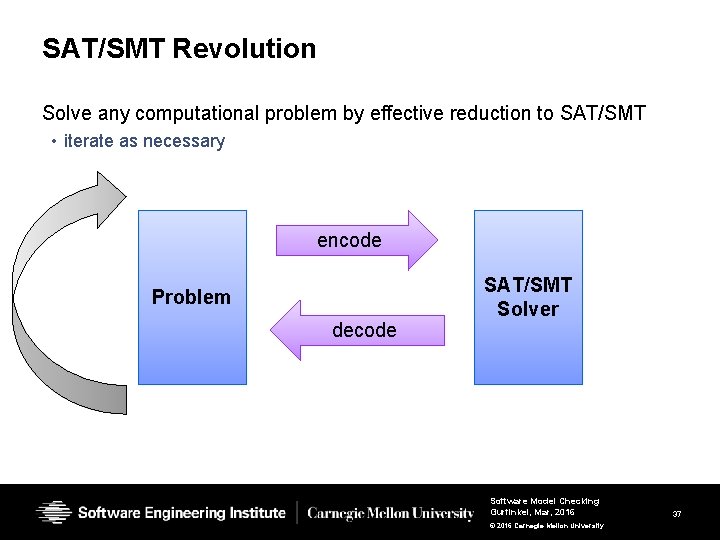
SAT/SMT Revolution Solve any computational problem by effective reduction to SAT/SMT • iterate as necessary encode Problem decode SAT/SMT Solver Software Model Checking Gurfinkel, Mar, 2016 © 2016 Carnegie Mellon University 37
Software Model Checking © 2016 Carnegie Mellon University
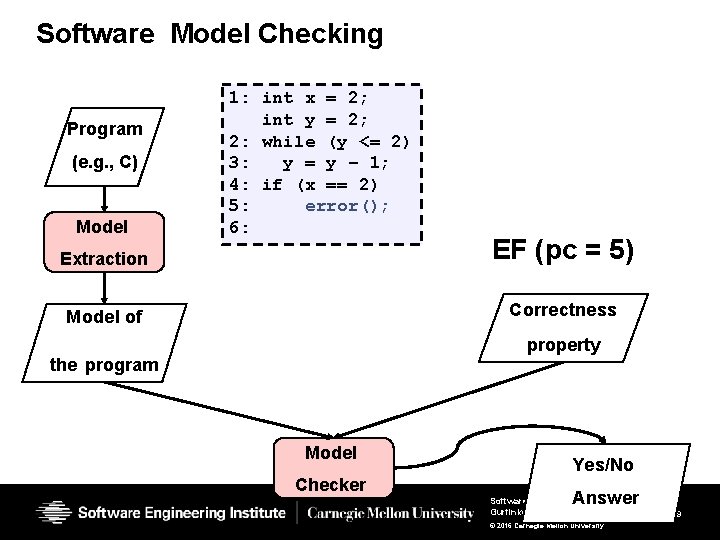
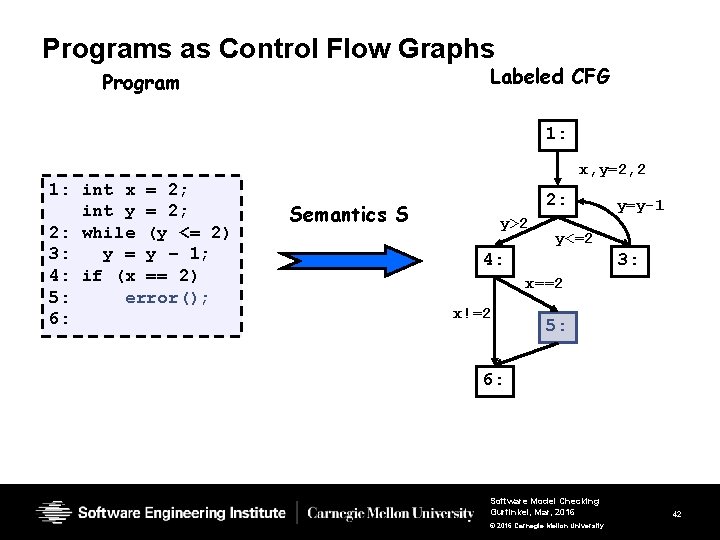
Software Model Checking Program (e. g. , C) Model 1: int x = 2; int y = 2; 2: while (y <= 2) 3: y = y – 1; 4: if (x == 2) 5: error(); 6: Extraction EF (pc = 5) Model of Correctness property the program Model Checker 39 Yes/No Answer Software Model Checking Gurfinkel, Mar, 2016 © 2016 Carnegie Mellon University 39
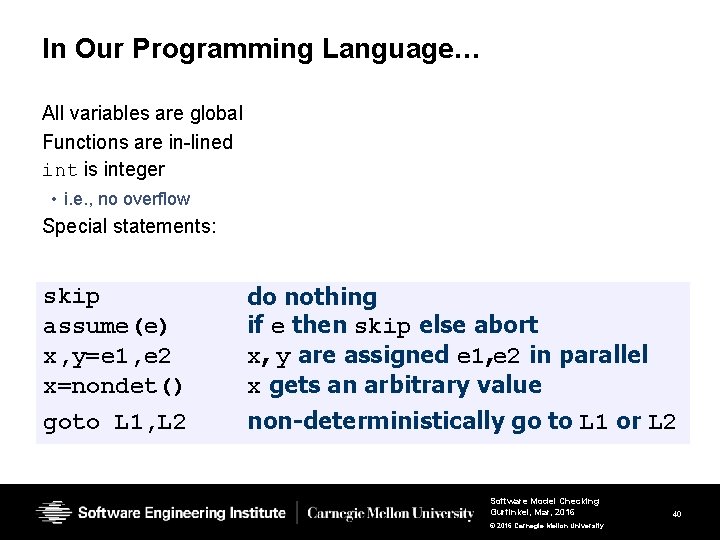
In Our Programming Language… All variables are global Functions are in-lined int is integer • i. e. , no overflow Special statements: skip assume(e) x, y=e 1, e 2 x=nondet() goto L 1, L 2 40 do nothing if e then skip else abort x, y are assigned e 1, e 2 in parallel x gets an arbitrary value non-deterministically go to L 1 or L 2 Software Model Checking Gurfinkel, Mar, 2016 © 2016 Carnegie Mellon University 40
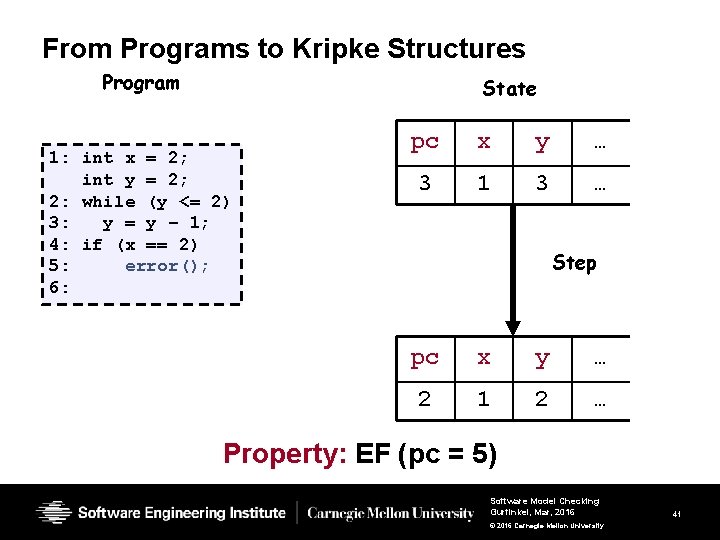
From Programs to Kripke Structures Program State 1: int x = 2; int y = 2; 2: while (y <= 2) 3: y = y – 1; 4: if (x == 2) 5: error(); 6: pc x y … 3 1 3 … Step pc x y … 2 1 2 … Property: EF (pc = 5) 41 Software Model Checking Gurfinkel, Mar, 2016 © 2016 Carnegie Mellon University 41
Programs as Control Flow Graphs Labeled CFG Program 1: x, y=2, 2 1: int x = 2; int y = 2; 2: while (y <= 2) 3: y = y – 1; 4: if (x == 2) 5: error(); 6: 2: Semantics S y>2 y=y-1 y<=2 4: 3: x==2 x!=2 5: 6: 42 Software Model Checking Gurfinkel, Mar, 2016 © 2016 Carnegie Mellon University 42
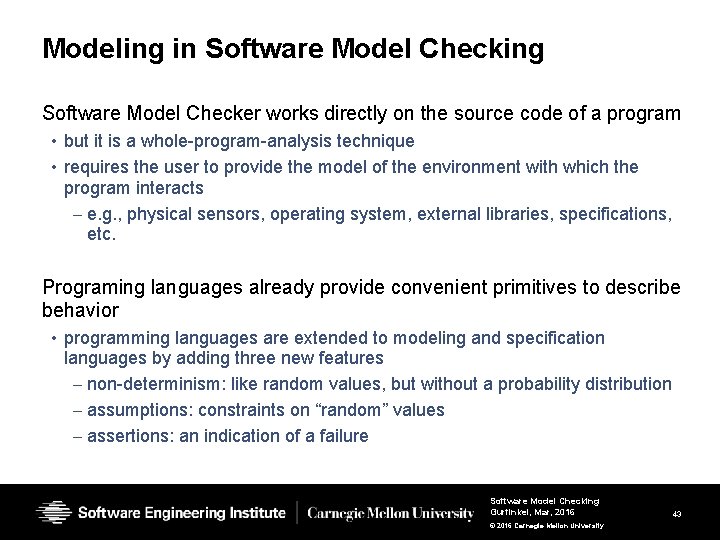
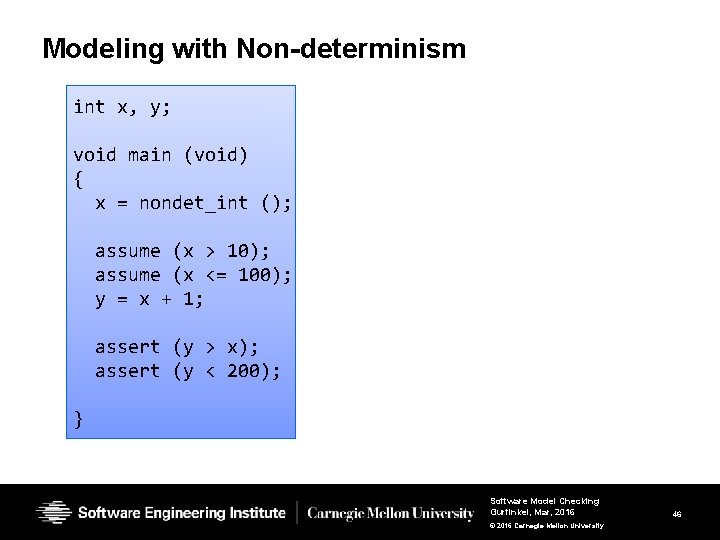
Modeling in Software Model Checking Software Model Checker works directly on the source code of a program • but it is a whole-program-analysis technique • requires the user to provide the model of the environment with which the program interacts – e. g. , physical sensors, operating system, external libraries, specifications, etc. Programing languages already provide convenient primitives to describe behavior • programming languages are extended to modeling and specification languages by adding three new features – non-determinism: like random values, but without a probability distribution – assumptions: constraints on “random” values – assertions: an indication of a failure Software Model Checking Gurfinkel, Mar, 2016 © 2016 Carnegie Mellon University 43
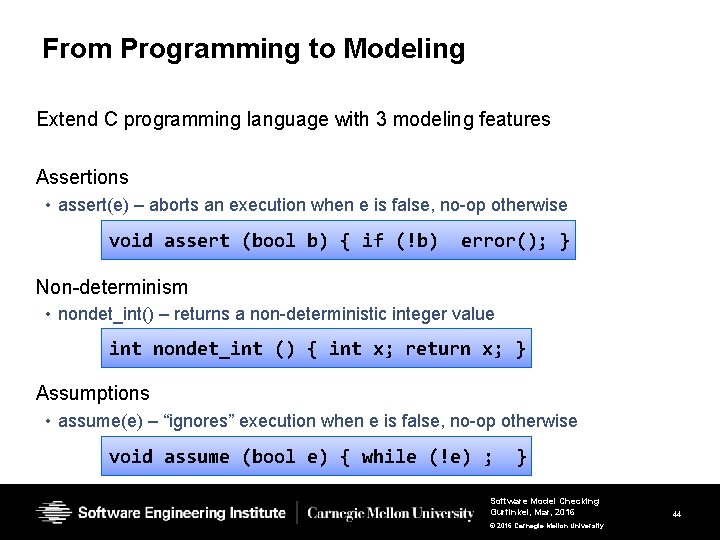
From Programming to Modeling Extend C programming language with 3 modeling features Assertions • assert(e) – aborts an execution when e is false, no-op otherwise void assert (bool b) { if (!b) error(); } Non-determinism • nondet_int() – returns a non-deterministic integer value int nondet_int () { int x; return x; } Assumptions • assume(e) – “ignores” execution when e is false, no-op otherwise void assume (bool e) { while (!e) ; } Software Model Checking Gurfinkel, Mar, 2016 © 2016 Carnegie Mellon University 44
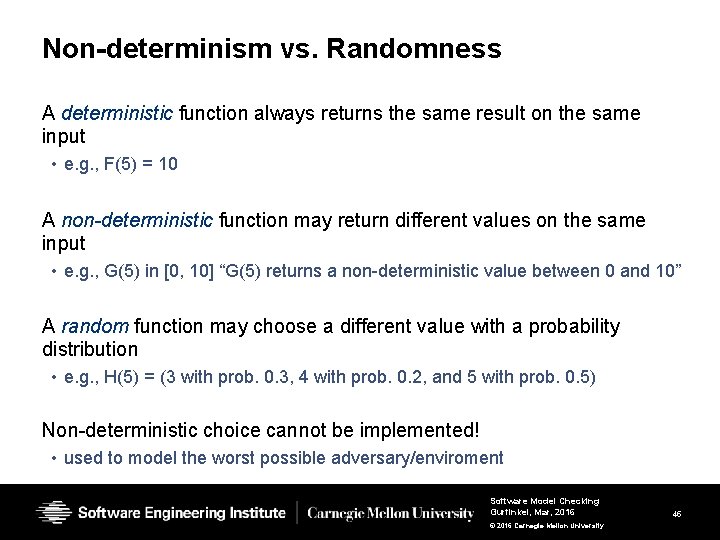
Non-determinism vs. Randomness A deterministic function always returns the same result on the same input • e. g. , F(5) = 10 A non-deterministic function may return different values on the same input • e. g. , G(5) in [0, 10] “G(5) returns a non-deterministic value between 0 and 10” A random function may choose a different value with a probability distribution • e. g. , H(5) = (3 with prob. 0. 3, 4 with prob. 0. 2, and 5 with prob. 0. 5) Non-deterministic choice cannot be implemented! • used to model the worst possible adversary/enviroment Software Model Checking Gurfinkel, Mar, 2016 © 2016 Carnegie Mellon University 45
Modeling with Non-determinism int x, y; void main (void) { x = nondet_int (); assume (x > 10); assume (x <= 100); y = x + 1; assert (y > x); assert (y < 200); } Software Model Checking Gurfinkel, Mar, 2016 © 2016 Carnegie Mellon University 46
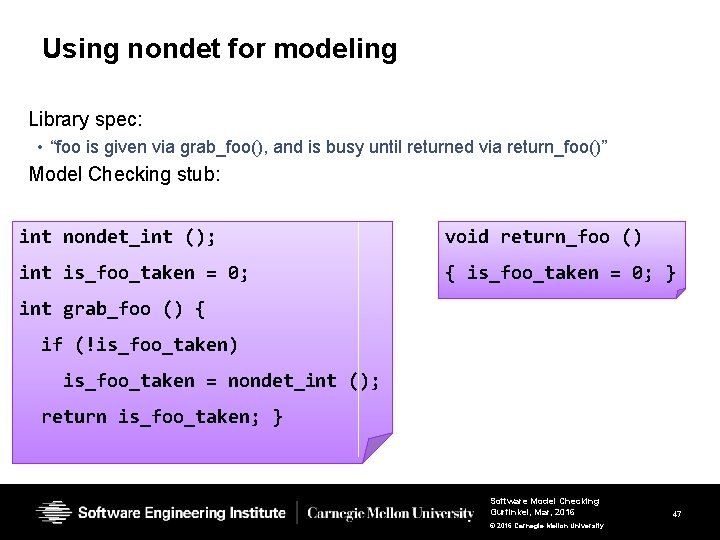
Using nondet for modeling Library spec: • “foo is given via grab_foo(), and is busy until returned via return_foo()” Model Checking stub: int nondet_int (); void return_foo () int is_foo_taken = 0; { is_foo_taken = 0; } int grab_foo () { if (!is_foo_taken) is_foo_taken = nondet_int (); return is_foo_taken; } Software Model Checking Gurfinkel, Mar, 2016 © 2016 Carnegie Mellon University 47
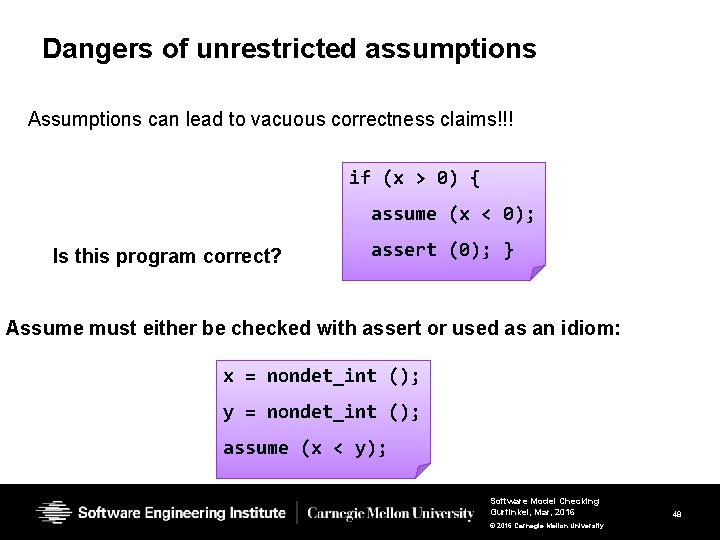
Dangers of unrestricted assumptions Assumptions can lead to vacuous correctness claims!!! if (x > 0) { assume (x < 0); Is this program correct? assert (0); } Assume must either be checked with assert or used as an idiom: x = nondet_int (); y = nondet_int (); assume (x < y); Software Model Checking Gurfinkel, Mar, 2016 © 2016 Carnegie Mellon University 48
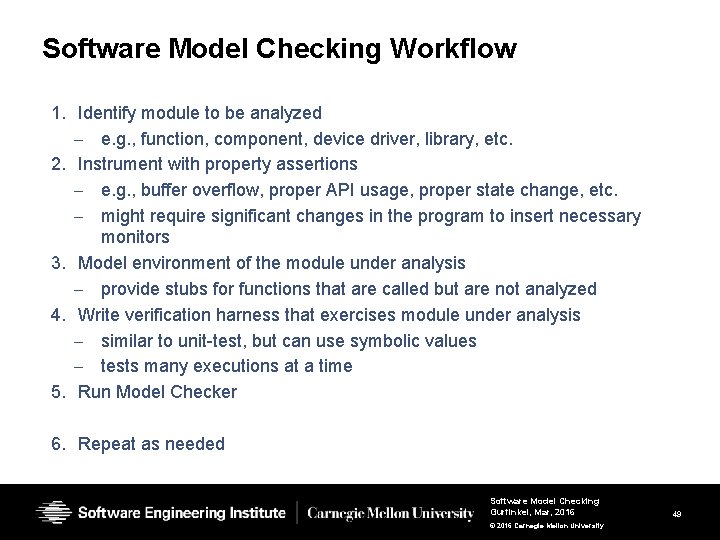
Software Model Checking Workflow 1. Identify module to be analyzed – e. g. , function, component, device driver, library, etc. 2. Instrument with property assertions – e. g. , buffer overflow, proper API usage, proper state change, etc. – might require significant changes in the program to insert necessary monitors 3. Model environment of the module under analysis – provide stubs for functions that are called but are not analyzed 4. Write verification harness that exercises module under analysis – similar to unit-test, but can use symbolic values – tests many executions at a time 5. Run Model Checker 6. Repeat as needed Software Model Checking Gurfinkel, Mar, 2016 © 2016 Carnegie Mellon University 49
Types of Software Model Checking Bounded Model Checking (BMC) • look for bugs (bad executions) up to a fixed bound • usually bound depth of loops and depth of recursive calls • reduce the problem to SAT/SMT Predicate Abstraction with Counter. Example Guided Abstraction Refinement (CEGAR) • Construct finite-state abstraction of a program • Analyze using finite-state Model Checking techniques • Automatically improve / refine abstraction until the analysis is conclusive Interpolation-based Model Checking (IMC) • Iteratively apply BMC with increasing bound • Generalize from bounded-safety proofs • reduce the problem to many SAT/SMT queries and generalize from SAT/SMT reasoning Software Model Checking Gurfinkel, Mar, 2016 © 2016 Carnegie Mellon University 50
Verification Competitions Multitude of events where solvers and analysis engines compete SAT-RACE • competitive event for SAT solvers • http: //baldur. iti. kit. edu/sat-race-2015/ SMT-COMP • competitive event for SMT solvers • http: //www. smtcomp. org SV-COMP • Software Verification Competition – open to all, but most tools are based on Model Checking • http: //sv-comp. sosy-lab. org/2016/ CASC • competitive event for Automated Theorem Proving • http: //www. cs. miami. edu/~tptp/CASC/ Software Model Checking Gurfinkel, Mar, 2016 © 2016 Carnegie Mellon University 51
References Software Model Checking and Program Analysis • Vijay D'Silva, Daniel Kroening, Georg Weissenbacher: A Survey of Automated Techniques for Formal Software Verification. IEEE Trans. on CAD of Integrated Circuits and Systems 27(7): 1165 -1178 (2008) • Ranjit Jhala, Rupak Majumdar: Software model checking. ACM Comput. Surv. 41(4) (2009) Symbolic Execution • Cristian Cadar, Patrice Godefroid, Sarfraz Khurshid, Corina S. Pasareanu, Koushik Sen, Nikolai Tillmann, Willem Visser: Symbolic execution for software testing in practice: preliminary assessment. ICSE 2011: 1066 -1071 SMT and Decision Procedures • Daniel Kroening, Ofer Strichman: Decision Procedures - An Algorithmic Point of View. Texts in Theoretical Computer Science. An EATCS Series, Springer 2008, ISBN 978 -3 -540 -74104 -6, pp. 1 -304 • The SMT-LIB v 2 Language and Tools: A Tutorial, by David R. Cokk Software Model Checking Gurfinkel, Mar, 2016 © 2016 Carnegie Mellon University 52
http: //seahorn. github. io Software Model Checking Gurfinkel, Mar, 2016 © 2016 Carnegie Mellon University 53
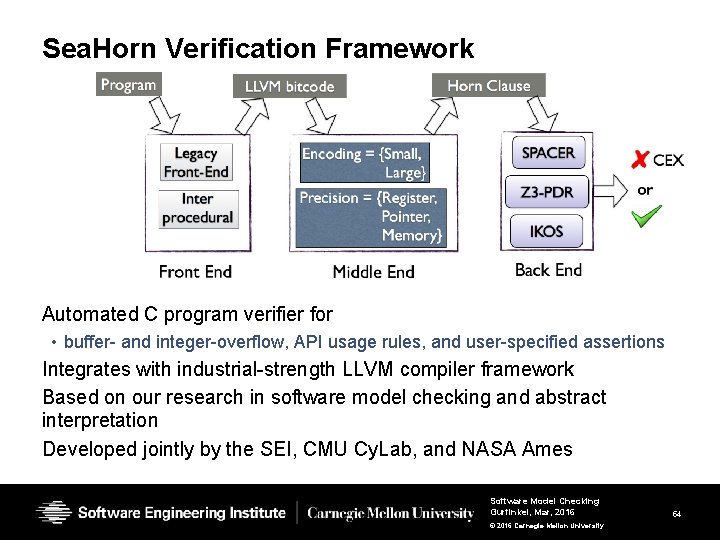
Sea. Horn Verification Framework Automated C program verifier for • buffer- and integer-overflow, API usage rules, and user-specified assertions Integrates with industrial-strength LLVM compiler framework Based on our research in software model checking and abstract interpretation Developed jointly by the SEI, CMU Cy. Lab, and NASA Ames Software Model Checking Gurfinkel, Mar, 2016 © 2016 Carnegie Mellon University 54
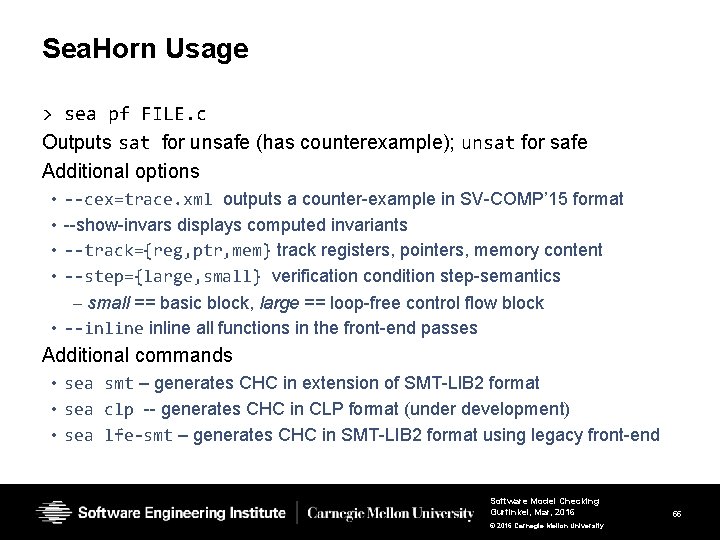
Sea. Horn Usage > sea pf FILE. c Outputs sat for unsafe (has counterexample); unsat for safe Additional options --cex=trace. xml outputs a counter-example in SV-COMP’ 15 format --show-invars displays computed invariants --track={reg, ptr, mem} track registers, pointers, memory content --step={large, small} verification condition step-semantics – small == basic block, large == loop-free control flow block • --inline all functions in the front-end passes • • Additional commands • sea smt – generates CHC in extension of SMT-LIB 2 format • sea clp -- generates CHC in CLP format (under development) • sea lfe-smt – generates CHC in SMT-LIB 2 format using legacy front-end Software Model Checking Gurfinkel, Mar, 2016 © 2016 Carnegie Mellon University 55
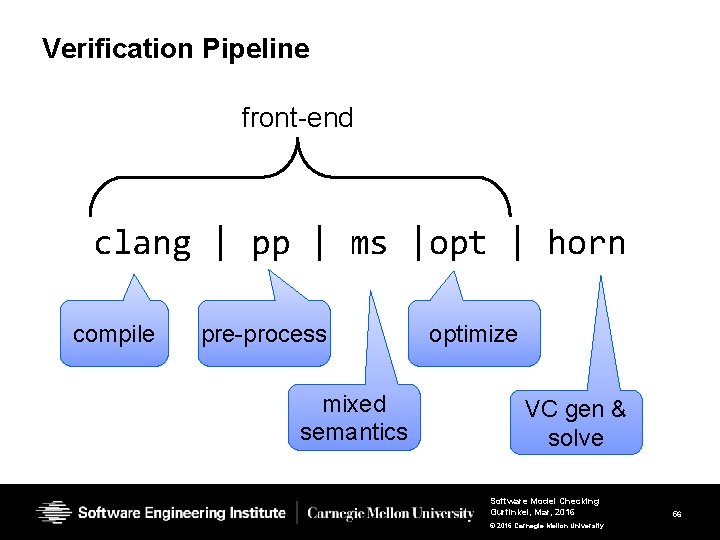
Verification Pipeline front-end clang | pp | ms |opt | horn compile pre-process mixed semantics optimize VC gen & solve Software Model Checking Gurfinkel, Mar, 2016 © 2016 Carnegie Mellon University 56