
Automated NIPT diagnostics pipeline The development of an
- Slides: 1
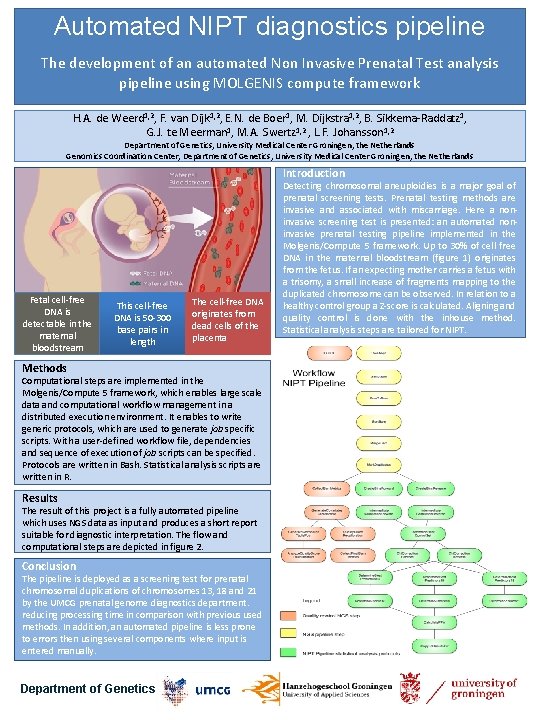
Automated NIPT diagnostics pipeline The development of an automated Non Invasive Prenatal Test analysis pipeline using MOLGENIS compute framework H. A. de Weerd 1, 2, F. van Dijk 1, 2, E. N. de Boer 1, M. Dijkstra 1, 2, B. Sikkema-Raddatz 1, G. J. te Meerman 1, M. A. Swertz 1, 2 , L. F. Johansson 1, 2 Department of Genetics, University Medical Center Groningen, the Netherlands Genomics Coordination Center, Department of Genetics, University Medical Center Groningen, the Netherlands Introduction Figure 1: cell-free Fetal cell-free DNA, originating from dead cells of the Fetal The cell-free DNA This cell-free placenta, in the maternal bloodstream DNA is detectable in the maternal bloodstream DNA is 50 -300 base pairs in length originates from dead cells of the placenta Methods Computational steps are implemented in the Molgenis/Compute 5 framework, which enables large scale data and computational workflow management in a distributed execution environment. It enables to write generic protocols, which are used to generate job specific scripts. With a user-defined workflow file, dependencies and sequence of execution of job scripts can be specified. Protocols are written in Bash. Statistical analysis scripts are written in R. Results The result of this project is a fully automated pipeline which uses NGS data as input and produces a short report suitable for diagnostic interpretation. The flow and computational steps are depicted in figure 2. Conclusion The pipeline is deployed as a screening test for prenatal chromosomal duplications of chromosomes 13, 18 and 21 by the UMCG prenatal genome diagnostics department. reducing processing time in comparison with previous used methods. In addition, an automated pipeline is less prone to errors then using several components where input is entered manually. Department of Genetics Detecting chromosomal aneuploidies is a major goal of prenatal screening tests. Prenatal testing methods are invasive and associated with miscarriage. Here a noninvasive screening test is presented: an automated noninvasive prenatal testing pipeline implemented in the Molgenis/Compute 5 framework. Up to 30% of cell free DNA in the maternal bloodstream (figure 1) originates from the fetus. If an expecting mother carries a fetus with a trisomy, a small increase of fragments mapping to the duplicated chromosome can be observed. In relation to a healthy control group a Z-score is calculated. Aligning and quality control is done with the inhouse method. Statistical analysis steps are tailored for NIPT.