
Automated Macular Pathology Diagnosis in Retinal OCT Images


![Local Descriptor: Alternative: uniform LBP Uniform LBP (LBPu 2) [Ojala, TPAMI’ 01] • Separate](https://slidetodoc.com/presentation_image_h2/b52ba8feaf27ba87c27ed5e8c39b100d/image-27.jpg "Local Descriptor: Alternative: uniform LBP Uniform LBP (LBPu 2) [Ojala, TPAMI’ 01] • Separate")
- Slides: 29
Automated Macular Pathology Diagnosis in Retinal OCT Images Using Multi-Scale Spatial Pyramid with Local Binary Patterns Yu-Ying Liu, James M. Rehg School of Interactive Computing, Georgia Institute of Technology Mei Chen Intel Labs Pittsburgh Hiroshi Ishikawa, Gadi Wollstein, Joel S. Schuman UPMC Eye Center, University of Pittsburgh Medical Center, Department of Bioengineering, University of Pittsburgh
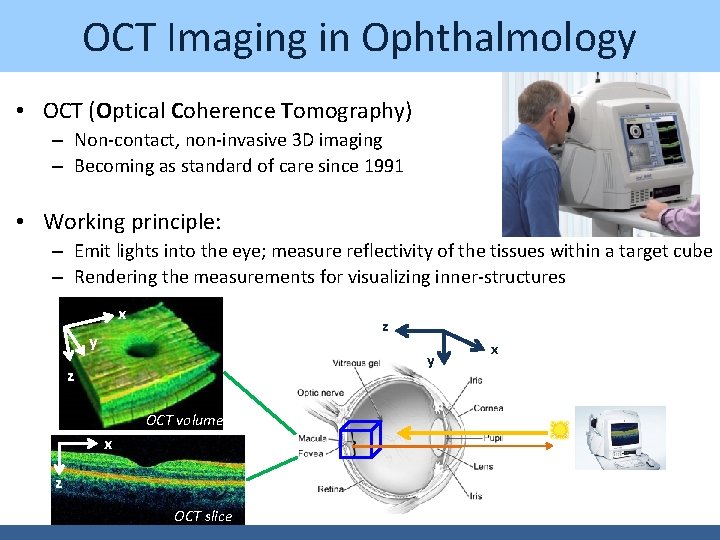
OCT Imaging in Ophthalmology • OCT (Optical Coherence Tomography) – Non-contact, non-invasive 3 D imaging – Becoming as standard of care since 1991 • Working principle: – Emit lights into the eye; measure reflectivity of the tissues within a target cube – Rendering the measurements for visualizing inner-structures x z y y z OCT volume x z OCT slice x
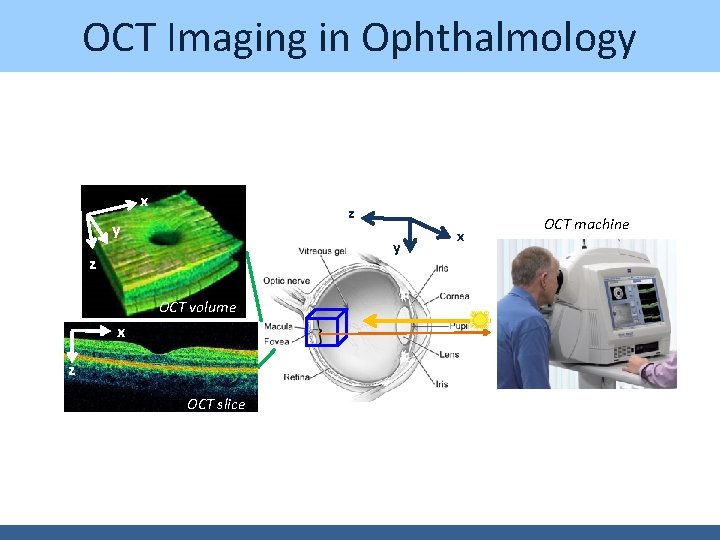
OCT Imaging in Ophthalmology x z y y z OCT volume x z OCT slice x OCT machine
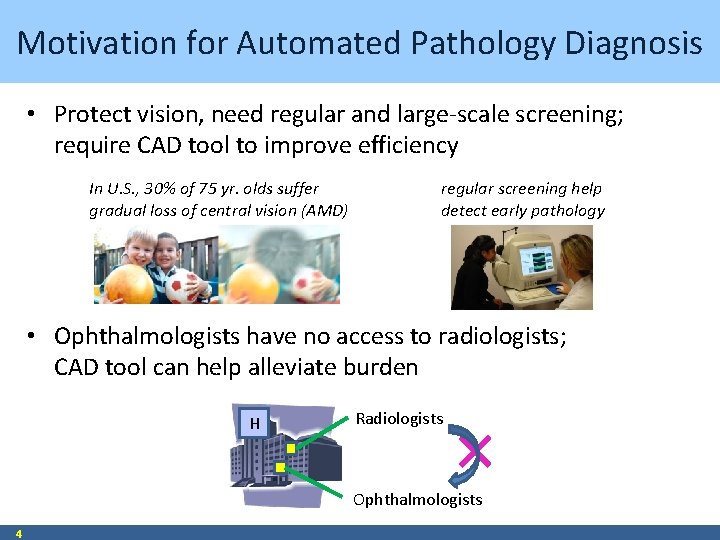
Motivation for Automated Pathology Diagnosis • Protect vision, need regular and large-scale screening; require CAD tool to improve efficiency In U. S. , 30% of 75 yr. olds suffer gradual loss of central vision (AMD) regular screening help detect early pathology • Ophthalmologists have no access to radiologists; CAD tool can help alleviate burden H Radiologists Ophthalmologists 4
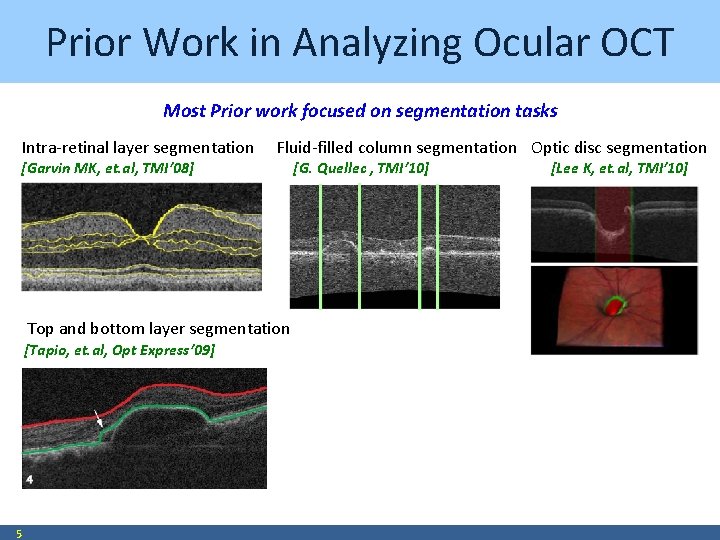
Prior Work in Analyzing Ocular OCT Most Prior work focused on segmentation tasks Intra-retinal layer segmentation [Garvin MK, et. al, TMI’ 08] Fluid-filled column segmentation Optic disc segmentation Top and bottom layer segmentation [Tapio, et. al, Opt Express’ 09] 5 [G. Quellec , TMI’ 10] [Lee K, et. al, TMI’ 10]
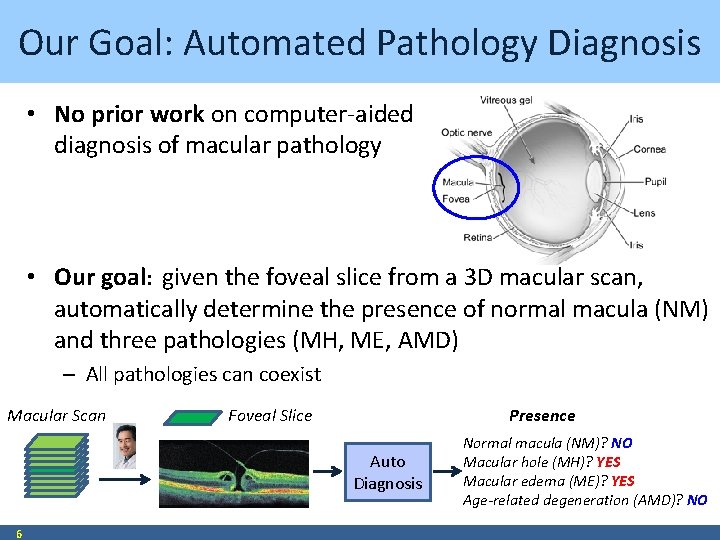
Our Goal: Automated Pathology Diagnosis • No prior work on computer-aided diagnosis of macular pathology • Our goal: given the foveal slice from a 3 D macular scan, automatically determine the presence of normal macula (NM) and three pathologies (MH, ME, AMD) – All pathologies can coexist Macular Scan Foveal Slice Presence Auto Diagnosis 6 Normal macula (NM)? NO Macular hole (MH)? YES Macular edema (ME)? YES Age-related degeneration (AMD)? NO
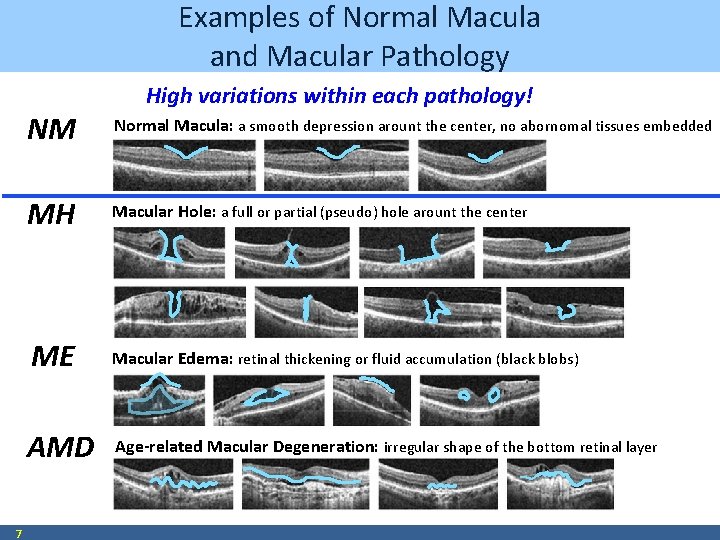
Examples of Normal Macula and Macular Pathology 7 High variations within each pathology! NM Normal Macula: a smooth depression arount the center, no abornomal tissues embedded MH Macular Hole: a full or partial (pseudo) hole arount the center ME Macular Edema: retinal thickening or fluid accumulation (black blobs) AMD Age-related Macular Degeneration: irregular shape of the bottom retinal layer
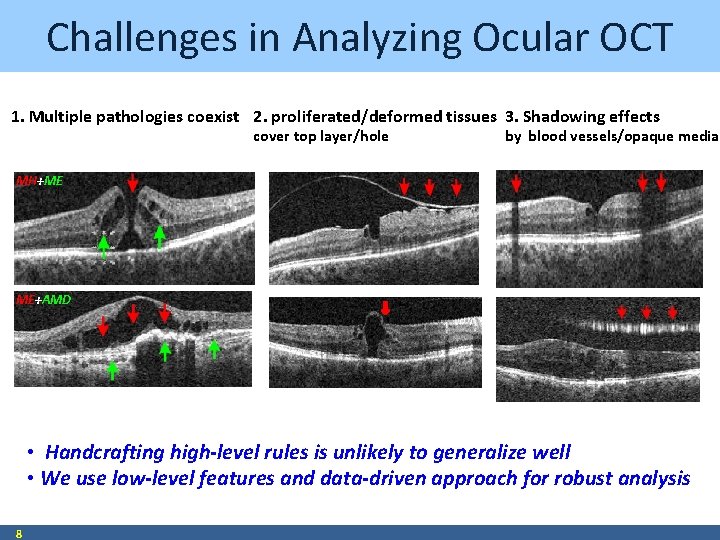
Challenges in Analyzing Ocular OCT 1. Multiple pathologies coexist 2. proliferated/deformed tissues 3. Shadowing effects cover top layer/hole by blood vessels/opaque media MH+ME ME+AMD • Handcrafting high-level rules is unlikely to generalize well • We use low-level features and data-driven approach for robust analysis 8
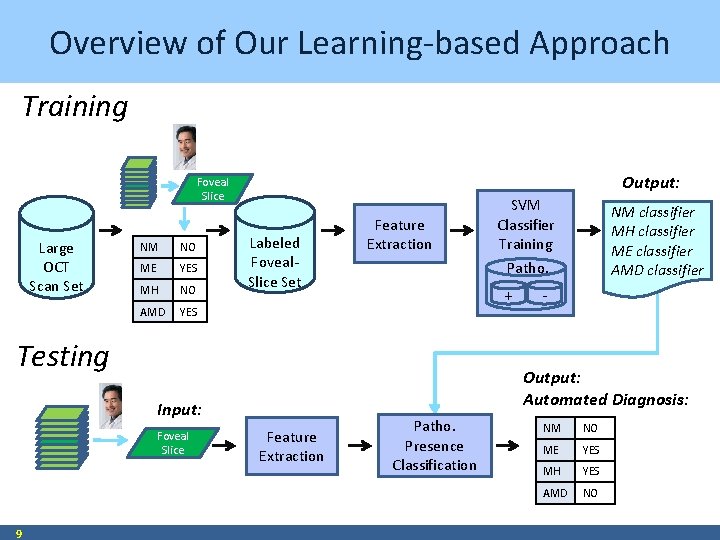
Overview of Our Learning-based Approach Training Output: Foveal Slice Large OCT Scan Set NM NO ME YES MH NO AMD YES Labeled Foveal. Slice Set Feature Extraction + - Output: Automated Diagnosis: Input: 9 NM classifier MH classifier ME classifier AMD classifier Patho. Testing Foveal Slice SVM Classifier Training Feature Extraction Patho. Presence Classification NM NO ME YES MH YES AMD NO
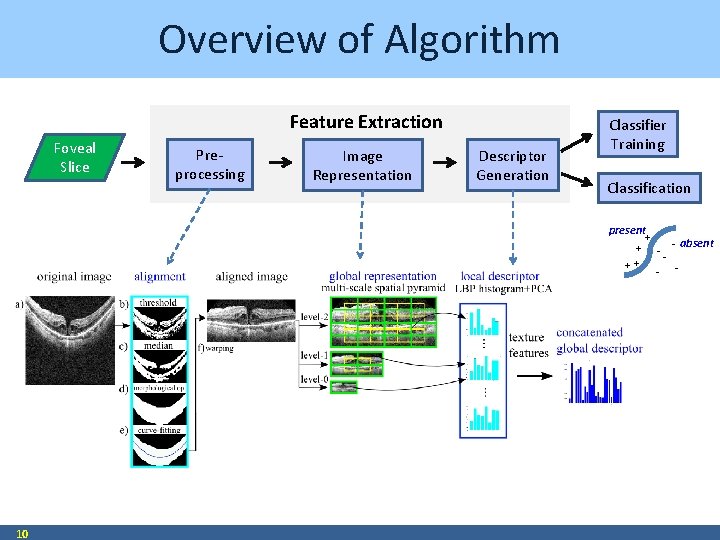
Overview of Algorithm Feature Extraction Foveal Slice Preprocessing Image Representation Descriptor Generation Classifier Training Classification present + + - - absent ++ - - 10
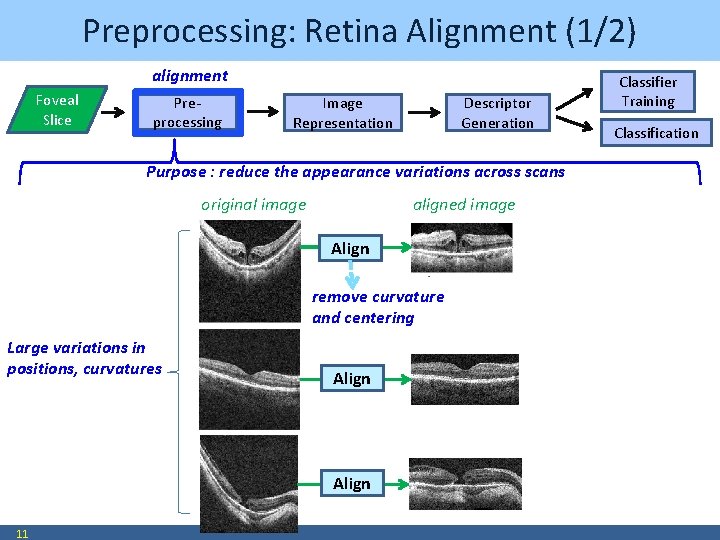
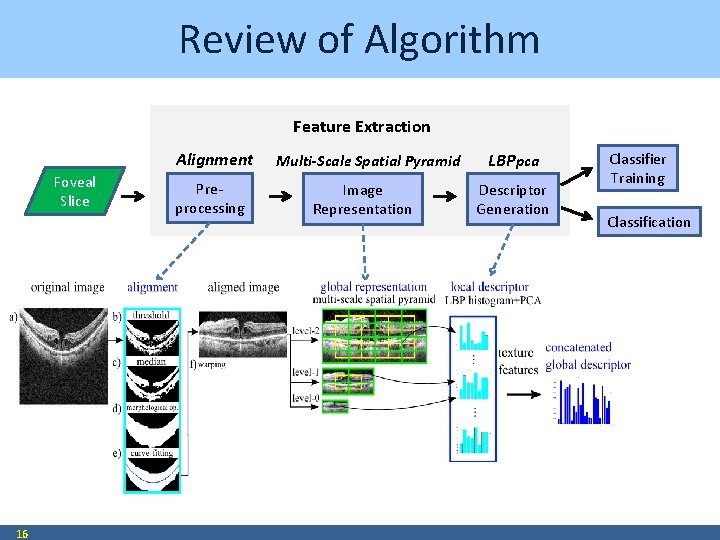
Preprocessing: Retina Alignment (1/2) alignment Foveal Slice Preprocessing Image Representation Descriptor Generation Purpose : reduce the appearance variations across scans original image aligned image Align remove curvature and centering Large variations in positions, curvatures Align 11 Classifier Training Classification
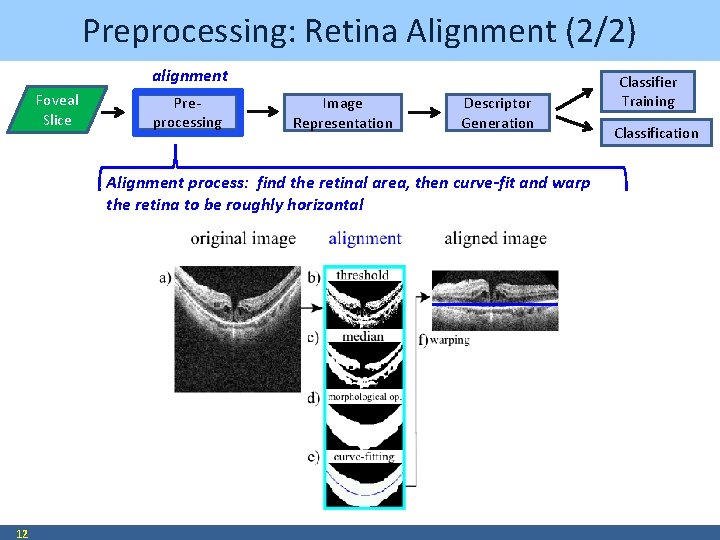
Preprocessing: Retina Alignment (2/2) alignment Foveal Slice Preprocessing Image Representation Descriptor Generation Alignment process: find the retinal area, then curve-fit and warp the retina to be roughly horizontal 12 Classifier Training Classification
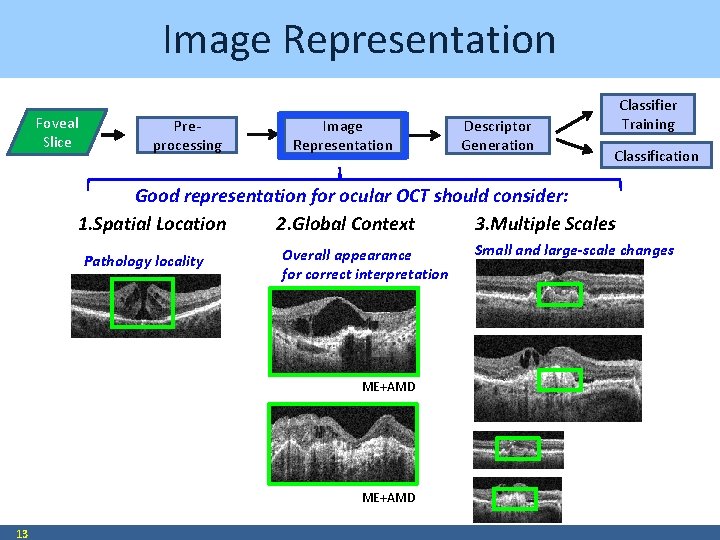
Image Representation Foveal Slice Preprocessing Image Representation Descriptor Generation Classifier Training Classification Good representation for ocular OCT should consider: 1. Spatial Location 2. Global Context 3. Multiple Scales Pathology locality Overall appearance for correct interpretation ME+AMD 13 Small and large-scale changes
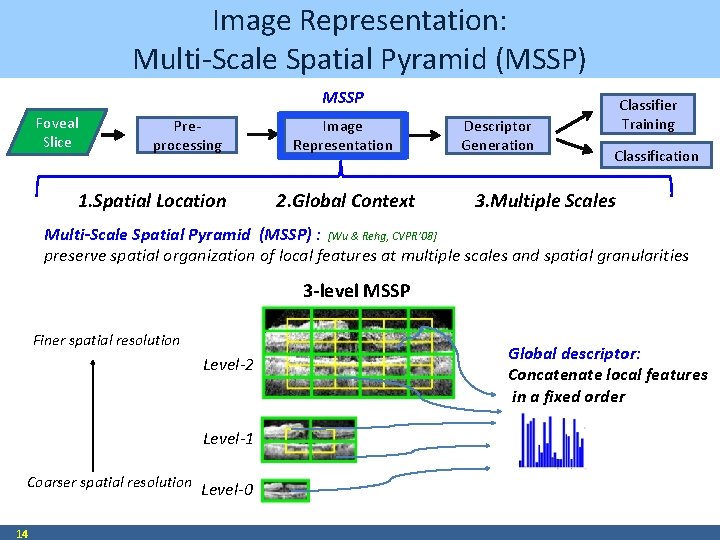
Image Representation: Multi-Scale Spatial Pyramid (MSSP) MSSP Foveal Slice Preprocessing 1. Spatial Location Image Representation 2. Global Context Descriptor Generation Classifier Training Classification 3. Multiple Scales Multi-Scale Spatial Pyramid (MSSP) : [Wu & Rehg, CVPR’ 08] preserve spatial organization of local features at multiple scales and spatial granularities 3 -level MSSP Finer spatial resolution Level-2 Level-1 Coarser spatial resolution Level-0 14 Global descriptor: Concatenate local features in a fixed order
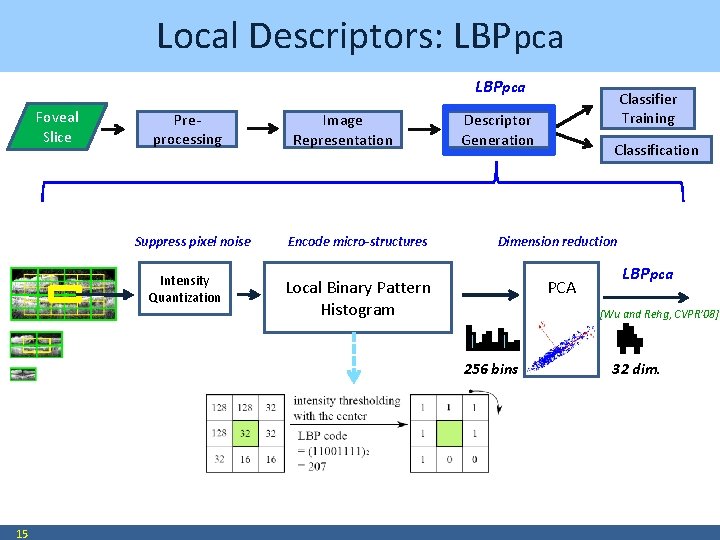
Local Descriptors: LBPpca Foveal Slice Preprocessing Suppress pixel noise Intensity Quantization Image Representation Encode micro-structures Descriptor Generation Classification Dimension reduction Local Binary Pattern Histogram PCA LBPpca [Wu and Rehg, CVPR’ 08] 256 bins 15 Classifier Training 32 dim.
Review of Algorithm Feature Extraction Alignment Foveal Slice 16 Preprocessing Multi-Scale Spatial Pyramid Image Representation LBPpca Descriptor Generation Classifier Training Classification
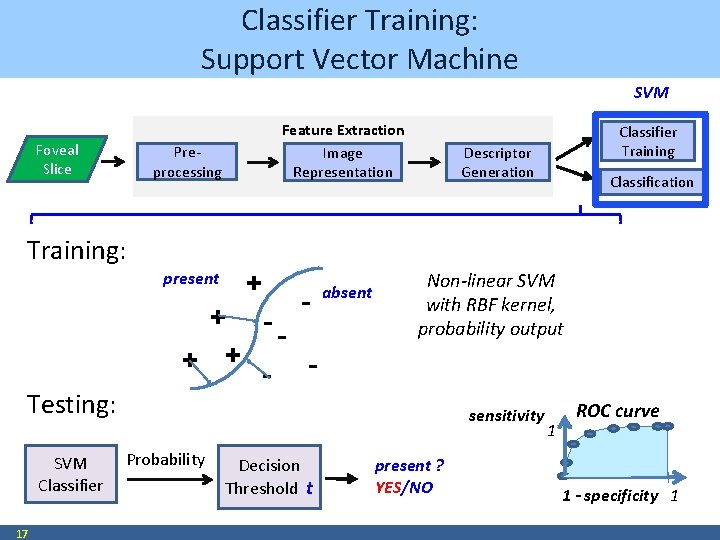
Classifier Training: Support Vector Machine SVM Foveal Slice Preprocessing Training: present Testing: SVM Classifier 17 Feature Extraction Image Representation + - + + + - - absent Descriptor Generation Decision Threshold t Classification Non-linear SVM with RBF kernel, probability output sensitivity Probability Classifier Training present ? YES/NO 1 ROC curve 1 - specificity 1
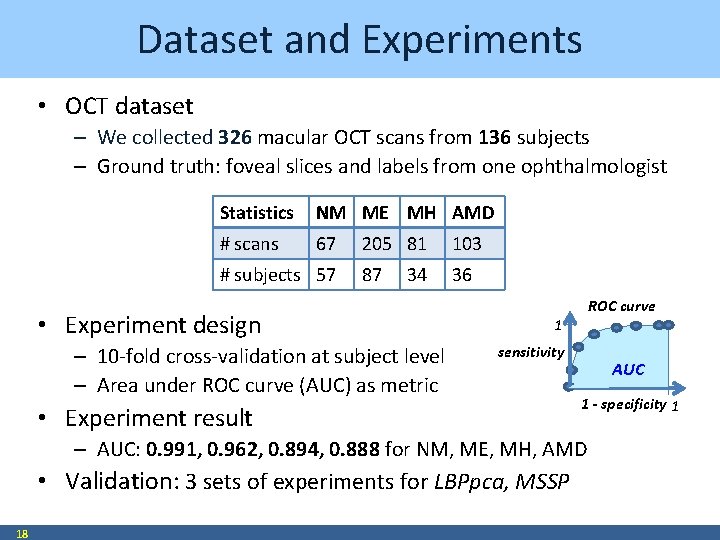
Dataset and Experiments • OCT dataset – We collected 326 macular OCT scans from 136 subjects – Ground truth: foveal slices and labels from one ophthalmologist Statistics NM ME MH AMD # scans 67 # subjects 57 205 81 103 87 36 34 • Experiment design – 10 -fold cross-validation at subject level – Area under ROC curve (AUC) as metric ROC curve 1 sensitivity • Experiment result AUC 1 - specificity 1 – AUC: 0. 991, 0. 962, 0. 894, 0. 888 for NM, ME, MH, AMD • Validation: 3 sets of experiments for LBPpca, MSSP 18
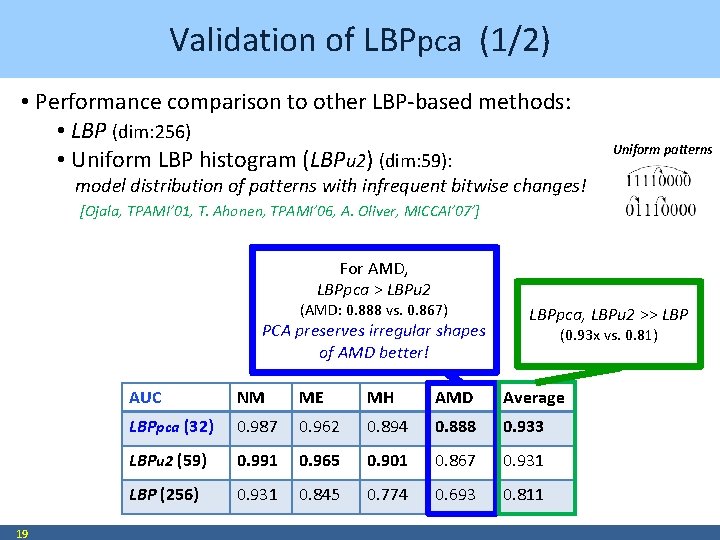
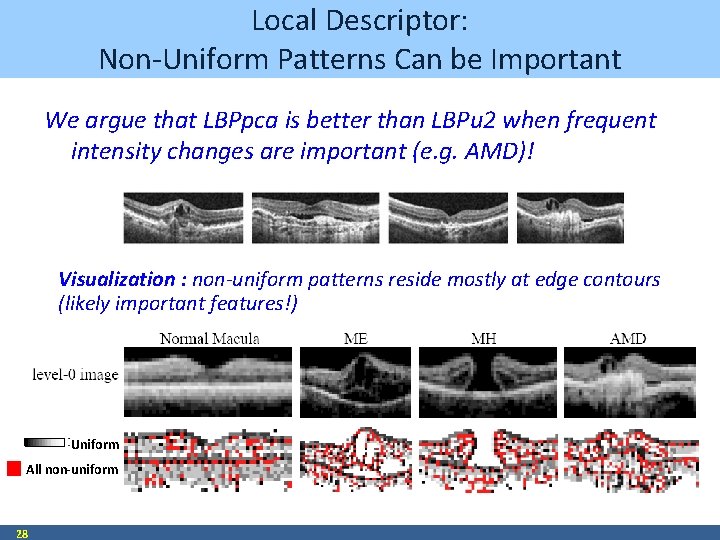
Validation of LBPpca (1/2) • Performance comparison to other LBP-based methods: • LBP (dim: 256) • Uniform LBP histogram (LBPu 2) (dim: 59): Uniform patterns model distribution of patterns with infrequent bitwise changes! [Ojala, TPAMI’ 01, T. Ahonen, TPAMI’ 06, A. Oliver, MICCAI’ 07’] For AMD, LBPpca > LBPu 2 (AMD: 0. 888 vs. 0. 867) PCA preserves irregular shapes of AMD better! 19 LBPpca, LBPu 2 >> LBP (0. 93 x vs. 0. 81) AUC NM ME MH AMD Average LBPpca (32) 0. 987 0. 962 0. 894 0. 888 0. 933 LBPu 2 (59) 0. 991 0. 965 0. 901 0. 867 0. 931 LBP (256) 0. 931 0. 845 0. 774 0. 693 0. 811
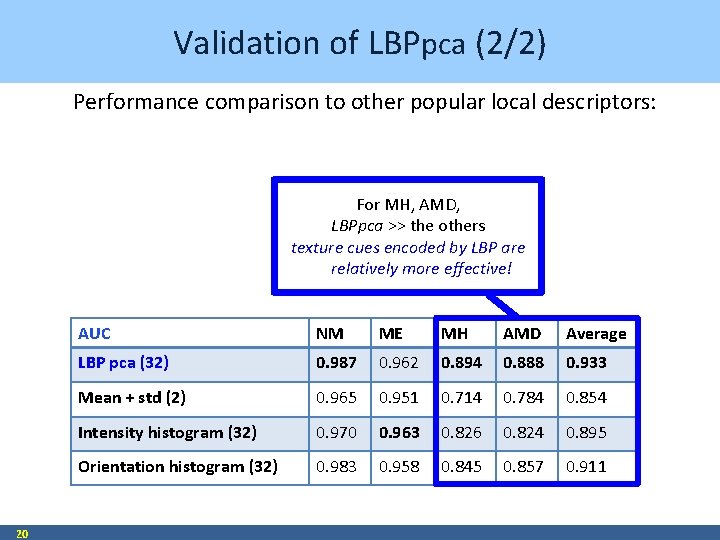
Validation of LBPpca (2/2) Performance comparison to other popular local descriptors: For MH, AMD, LBPpca >> the others texture cues encoded by LBP are relatively more effective! 20 AUC NM ME MH AMD Average LBP pca (32) 0. 987 0. 962 0. 894 0. 888 0. 933 Mean + std (2) 0. 965 0. 951 0. 714 0. 784 0. 854 Intensity histogram (32) 0. 970 0. 963 0. 826 0. 824 0. 895 Orientation histogram (32) 0. 983 0. 958 0. 845 0. 857 0. 911
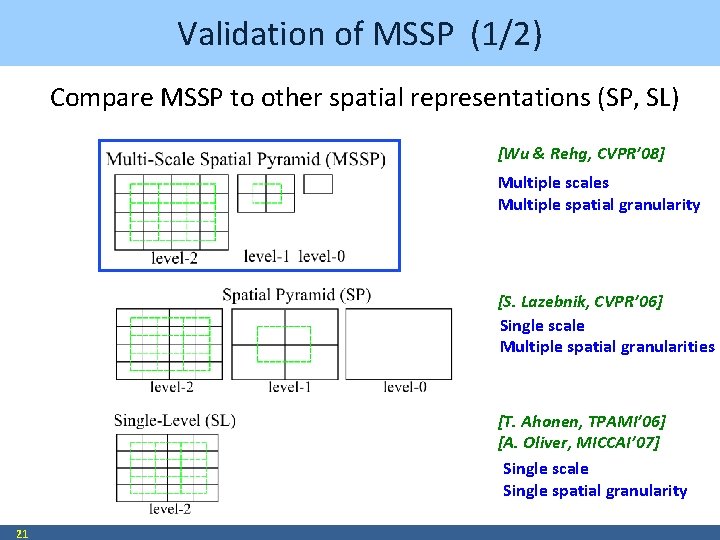
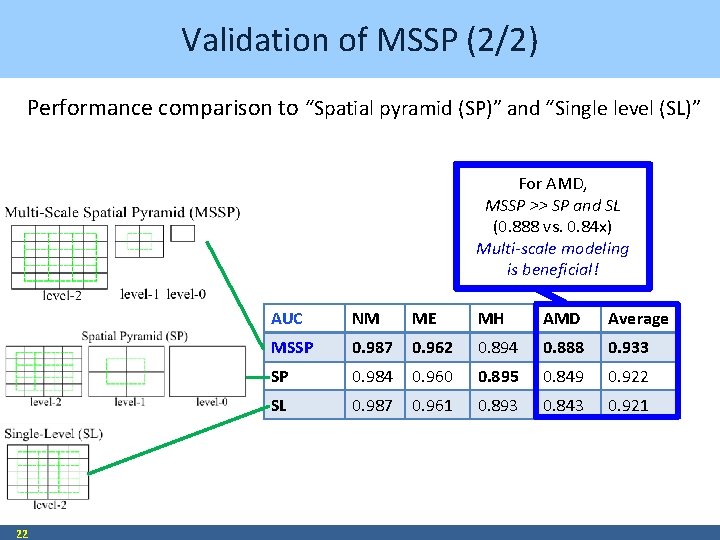
Validation of MSSP (1/2) Compare MSSP to other spatial representations (SP, SL) [Wu & Rehg, CVPR’ 08] Multiple scales Multiple spatial granularity [S. Lazebnik, CVPR’ 06] Single scale Multiple spatial granularities [T. Ahonen, TPAMI’ 06] [A. Oliver, MICCAI’ 07] Single scale Single spatial granularity 21
Validation of MSSP (2/2) Performance comparison to “Spatial pyramid (SP)” and “Single level (SL)” For AMD, MSSP >> SP and SL (0. 888 vs. 0. 84 x) Multi-scale modeling is beneficial! 22 AUC NM ME MH AMD Average MSSP 0. 987 0. 962 0. 894 0. 888 0. 933 SP 0. 984 0. 960 0. 895 0. 849 0. 922 SL 0. 987 0. 961 0. 893 0. 843 0. 921
Conclusion • Addressed a novel problem – Automated macular pathology diagnosis in OCT images • Developed an effective learning-based approach – A large labeled OCT dataset of 326 scans – Promising result: 0. 991, 0. 962, 0. 894, 0. 888 for NM, ME, MH, AMD – Multi-scale global feature representation with LBPpca can effectively encodes the geometry and texture of the retina • Future work – Exploring shape with texture features for better performance 23
Thank You! 24
Reference • Prior work in analyzing ocular OCT images – M. K. Garvin, et. al, “Intraretinal layer segmentation of macular optical coherence tomography images using optimal 3 -D graph search”, TMI 2008 – S. M. Tapio Fabritius, et. al, “Automated segmentation of the macula by optical coherence tomography”, Opt Express 2009 – G. Quellec, “Three-dimensional analysis of retinal layer texture: Identification of fluid-filled regions in SD-OCT of the macula”, TMI 2010 • Local binary patterns (LBP) – T. Ojala, et. al, “Multiresolution gray-scale and rotation invariant texture classification with local binary patterns”, TPAMI 2002 • LBP applications – T. Ahonen, et. al, “Face description with local binary patterns: Application to face recognition”, TPAMI 2006 – A. Oliver, et. al, “False positive reduction in mammographic mass detection using local binary patterns”, MICCAI 2007 – L. Sorensen, et. al, “Texture classification in lung CT using local binary patterns” , MICCAI 2008 • Spatial pyramid – S. Lazebnik, et. al, “Beyond bags of features: Spatial pyramid matching for recognizing natural scene categories”, CVPR 2006 • Multi-scale spatial pyramid (MSSP), LBP+PCA – J. Wu, J. M. Rehg, “Where am I: Place instance and category recognition using spatial PACT”, CVPR 2008 25
Backup Slides
Local Descriptor: Alternative: uniform LBP Uniform LBP (LBPu 2) [Ojala, TPAMI’ 01] • Separate to uniform and non-uniform patterns all patterns (256) uniform (58) non-uniform (198) • LBPu 2: retain distribution of uniform patterns only, since they are majority in pixel counts (>90%) [Ojala, TPAMI’ 01] • Used often in literature [T. Ahonen, TPAMI’ 06, A. Oliver, MICCAI’ 07] 256 bins 27 bin selection & merging 59 bins 58 uni. + 1 non-uni.
Local Descriptor: Non-Uniform Patterns Can be Important We argue that LBPpca is better than LBPu 2 when frequent intensity changes are important (e. g. AMD)! Visualization : non-uniform patterns reside mostly at edge contours (likely important features!) Uniform All non-uniform 28
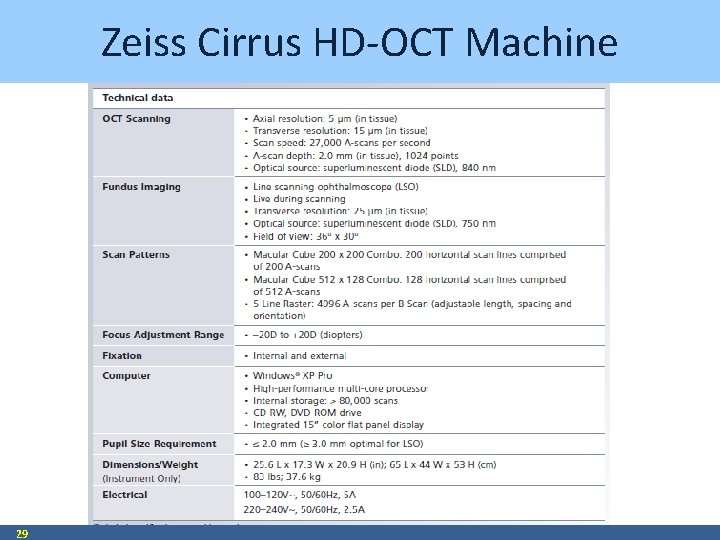
Zeiss Cirrus HD-OCT Machine 29