
Automated Detection of Stereotypical Motor Movements in Children
- Slides: 1
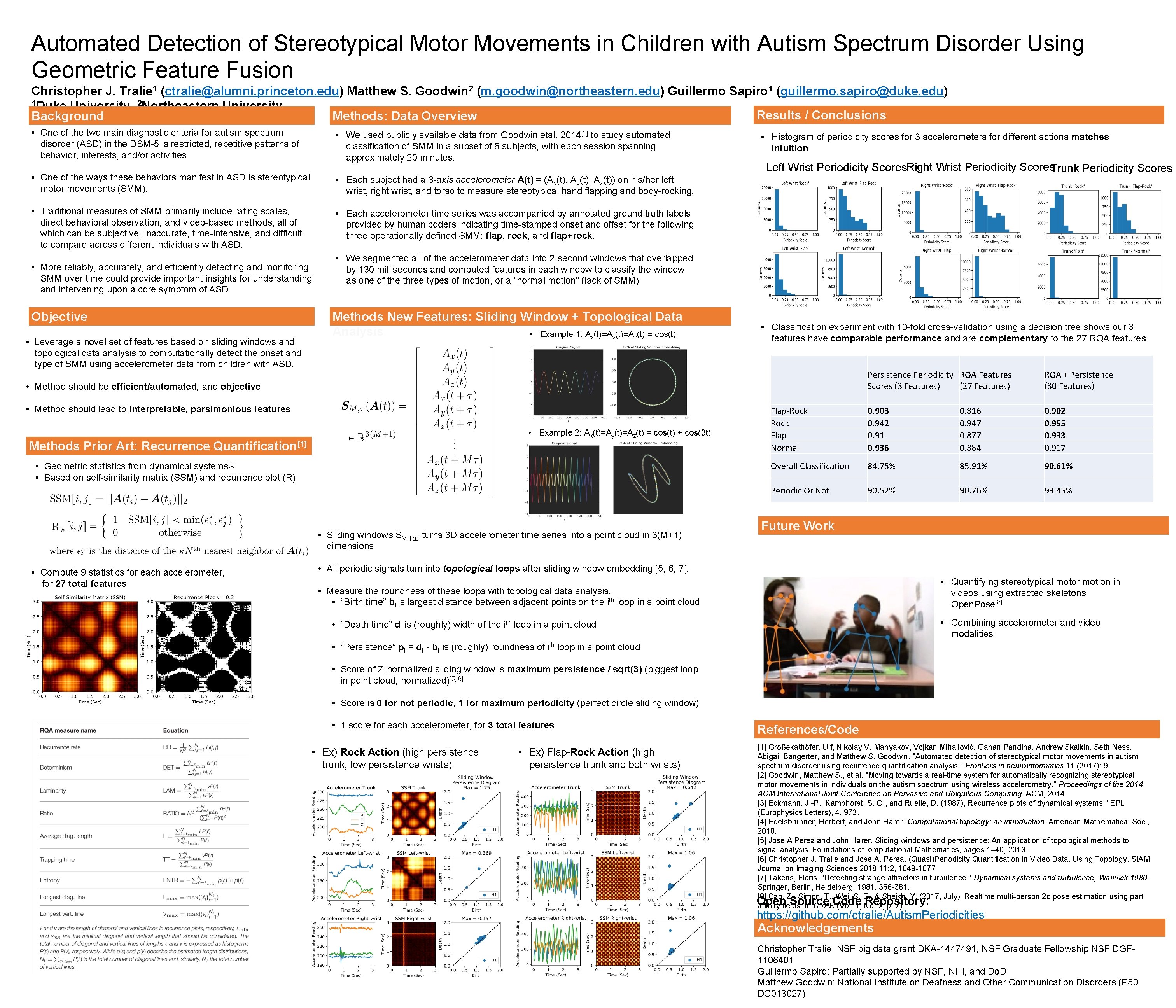
Automated Detection of Stereotypical Motor Movements in Children with Autism Spectrum Disorder Using Geometric Feature Fusion Christopher J. Tralie 1 (ctralie@alumni. princeton. edu) Matthew S. Goodwin 2 (m. goodwin@northeastern. edu) Guillermo Sapiro 1 (guillermo. sapiro@duke. edu) 1 Duke University, 2 Northeastern University Results / Conclusions Background Methods: Data Overview • One of the two main diagnostic criteria for autism spectrum disorder (ASD) in the DSM-5 is restricted, repetitive patterns of behavior, interests, and/or activities • We used publicly available data from Goodwin etal. 2014[2] to study automated classification of SMM in a subset of 6 subjects, with each session spanning approximately 20 minutes. • One of the ways these behaviors manifest in ASD is stereotypical motor movements (SMM). • Each subject had a 3 -axis accelerometer A(t) = (Ax(t), Ay(t), Az(t)) on his/her left wrist, right wrist, and torso to measure stereotypical hand flapping and body-rocking. • Traditional measures of SMM primarily include rating scales, direct behavioral observation, and video-based methods, all of which can be subjective, inaccurate, time-intensive, and difficult to compare across different individuals with ASD. • Each accelerometer time series was accompanied by annotated ground truth labels provided by human coders indicating time-stamped onset and offset for the following three operationally defined SMM: flap, rock, and flap+rock. • More reliably, accurately, and efficiently detecting and monitoring SMM over time could provide important insights for understanding and intervening upon a core symptom of ASD. Objective • Leverage a novel set of features based on sliding windows and topological data analysis to computationally detect the onset and type of SMM using accelerometer data from children with ASD. • Histogram of periodicity scores for 3 accelerometers for different actions matches intuition Left Wrist Periodicity Scores. Right Wrist Periodicity Scores. Trunk Periodicity Scores • We segmented all of the accelerometer data into 2 -second windows that overlapped by 130 milliseconds and computed features in each window to classify the window as one of the three types of motion, or a “normal motion” (lack of SMM) Methods New Features: Sliding Window + Topological Data Analysis • Example 1: Ax(t)=Ay(t)=Az(t) = cos(t) • Classification experiment with 10 -fold cross-validation using a decision tree shows our 3 features have comparable performance and are complementary to the 27 RQA features Persistence Periodicity RQA Features Scores (3 Features) (27 Features) RQA + Persistence (30 Features) Flap-Rock Flap Normal 0. 903 0. 942 0. 91 0. 936 0. 816 0. 947 0. 877 0. 884 0. 902 0. 955 0. 933 0. 917 Overall Classification 84. 75% 85. 91% 90. 61% Periodic Or Not 90. 52% 90. 76% 93. 45% • Method should be efficient/automated, and objective • Method should lead to interpretable, parsimonious features • Example 2: Ax(t)=Ay(t)=Az(t) = cos(t) + cos(3 t) Methods Prior Art: Recurrence Quantification[1] • Geometric statistics from dynamical systems[3] • Based on self-similarity matrix (SSM) and recurrence plot (R) • Sliding windows SM, Tau turns 3 D accelerometer time series into a point cloud in 3(M+1) dimensions • Compute 9 statistics for each accelerometer, for 27 total features Future Work • All periodic signals turn into topological loops after sliding window embedding [5, 6, 7]. • Quantifying stereotypical motor motion in videos using extracted skeletons Open. Pose[8] • Measure the roundness of these loops with topological data analysis. • “Birth time” bi is largest distance between adjacent points on the ith loop in a point cloud • Combining accelerometer and video modalities • “Death time” di is (roughly) width of the ith loop in a point cloud • “Persistence” pi = di - bi is (roughly) roundness of ith loop in a point cloud • Score of Z-normalized sliding window is maximum persistence / sqrt(3) (biggest loop in point cloud, normalized)[5, 6] • Score is 0 for not periodic, 1 for maximum periodicity (perfect circle sliding window) • 1 score for each accelerometer, for 3 total features • Ex) Rock Action (high persistence trunk, low persistence wrists) • Ex) Flap-Rock Action (high persistence trunk and both wrists) References/Code [1] Großekathöfer, Ulf, Nikolay V. Manyakov, Vojkan Mihajlović, Gahan Pandina, Andrew Skalkin, Seth Ness, Abigail Bangerter, and Matthew S. Goodwin. "Automated detection of stereotypical motor movements in autism spectrum disorder using recurrence quantification analysis. " Frontiers in neuroinformatics 11 (2017): 9. [2] Goodwin, Matthew S. , et al. "Moving towards a real-time system for automatically recognizing stereotypical motor movements in individuals on the autism spectrum using wireless accelerometry. " Proceedings of the 2014 ACM International Joint Conference on Pervasive and Ubiquitous Computing. ACM, 2014. [3] Eckmann, J. -P. , Kamphorst, S. O. , and Ruelle, D. (1987), Recurrence plots of dynamical systems, " EPL (Europhysics Letters), 4, 973. [4] Edelsbrunner, Herbert, and John Harer. Computational topology: an introduction. American Mathematical Soc. , 2010. [5] Jose A Perea and John Harer. Sliding windows and persistence: An application of topological methods to signal analysis. Foundations of omputational Mathematics, pages 1– 40, 2013. [6] Christopher J. Tralie and Jose A. Perea. (Quasi)Periodicity Quantification in Video Data, Using Topology. SIAM Journal on Imaging Sciences 2018 11: 2, 1049 -1077 [7] Takens, Floris. "Detecting strange attractors in turbulence. " Dynamical systems and turbulence, Warwick 1980. Springer, Berlin, Heidelberg, 1981. 366 -381. [8] Cao, Z. , Simon, T. , Wei, S. E. , & Sheikh, Y. (2017, July). Realtime multi-person 2 d pose estimation using part Open Source Repository: affinity fields. In CVPRCode (Vol. 1, No. 2, p. 7). https: //github. com/ctralie/Autism. Periodicities Acknowledgements Christopher Tralie: NSF big data grant DKA-1447491, NSF Graduate Fellowship NSF DGF 1106401 Guillermo Sapiro: Partially supported by NSF, NIH, and Do. D Matthew Goodwin: National Institute on Deafness and Other Communication Disorders (P 50 DC 013027)