
Automated Detection and Classification Models SAR Automatic Target

- Slides: 38
Automated Detection and Classification Models SAR Automatic Target Recognition Proposal J. Bell, Y. Petillot
Contents Automated Detection and Classification Models • • • Background ATR on SAR ATR on Sonar Supporting Technologies Initial results on SAR Way forward
ATR Approaches Automated Detection and Classification Models • Image Based techniques – – Based on large training sets Assumes some form of linearity in the imaging process image based only (difficult to fuse with other external data) NN / Pattern Matching for classification • Model Based techniques – – Model can be learned (trained) or imposed (CAD) Can use physics Can use simulation in the loop (test simulation vs data) Can take into account non-linear image formation
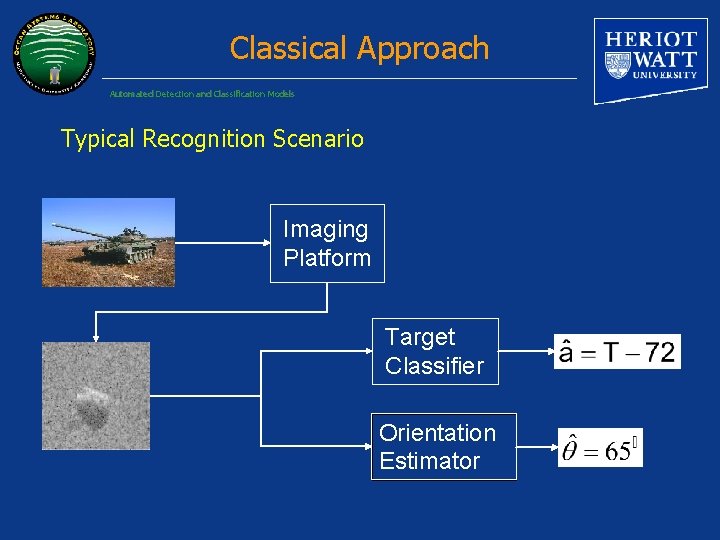
Classical Approach Automated Detection and Classification Models Typical Recognition Scenario Imaging Platform Target Classifier Orientation Estimator
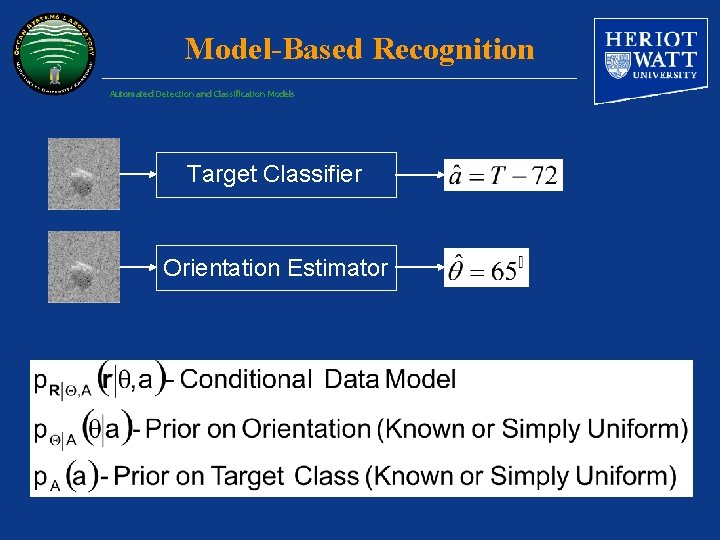
Model-Based Recognition Automated Detection and Classification Models Target Classifier Orientation Estimator
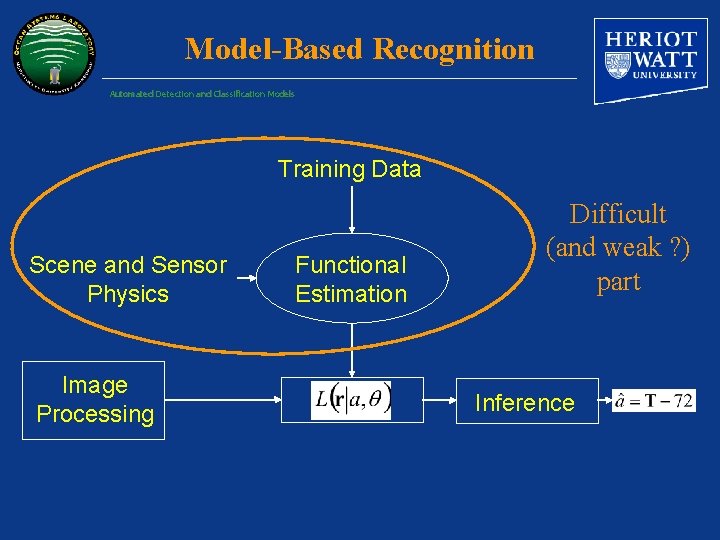
Model-Based Recognition Automated Detection and Classification Models Training Data Scene and Sensor Physics Image Processing Functional Estimation Difficult (and weak ? ) part Inference
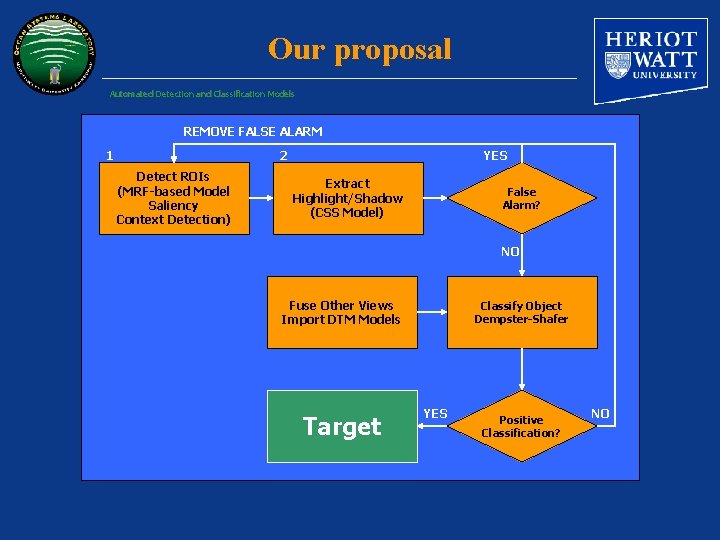
Our proposal Automated Detection and Classification Models REMOVE FALSE ALARM 1 2 Detect ROIs (MRF-based Model Saliency Context Detection) YES Extract Highlight/Shadow (CSS Model) False Alarm? NO Fuse Other Views Import DTM Models Target Classify Object Dempster-Shafer YES Positive Classification? NO
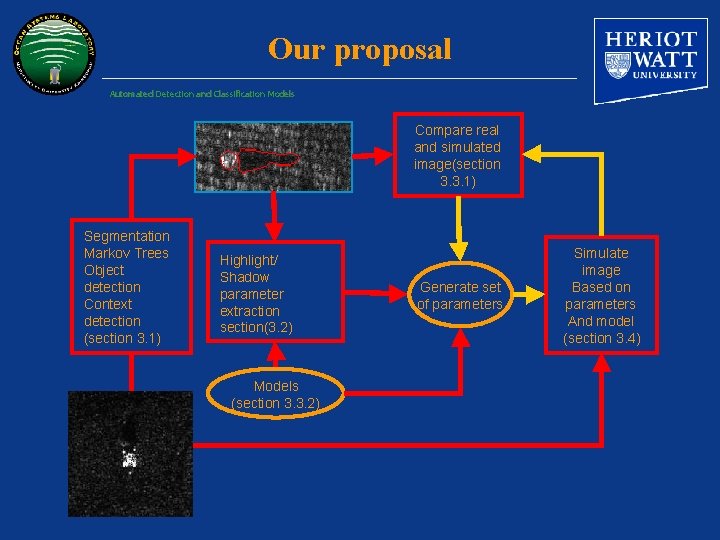
Our proposal Automated Detection and Classification Models Compare real and simulated image(section 3. 3. 1) Segmentation Markov Trees Object detection Context detection (section 3. 1) Highlight/ Shadow parameter extraction section(3. 2) Models (section 3. 3. 2) Generate set of parameters Simulate image Based on parameters And model (section 3. 4)
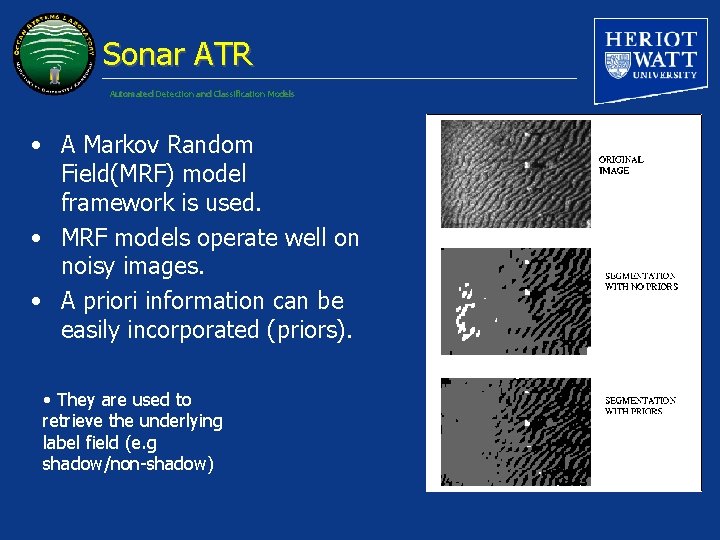
Sonar ATR Automated Detection and Classification Models • A Markov Random Field(MRF) model framework is used. • MRF models operate well on noisy images. • A priori information can be easily incorporated (priors). • They are used to retrieve the underlying label field (e. g shadow/non-shadow)
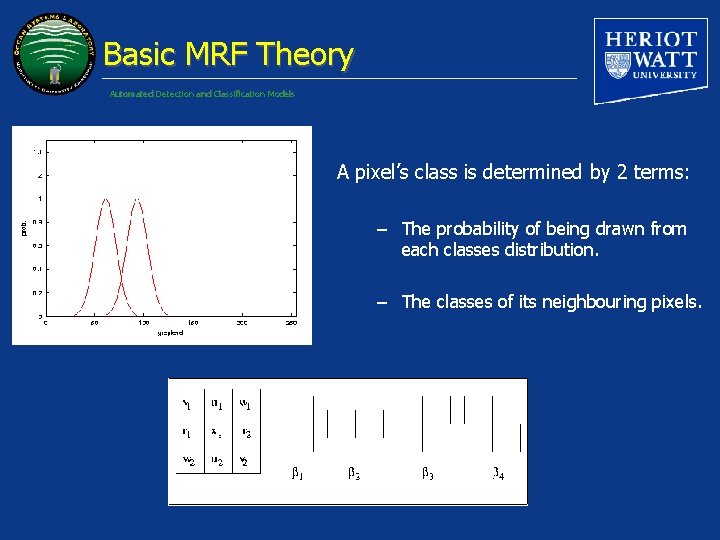
Basic MRF Theory Automated Detection and Classification Models A pixel’s class is determined by 2 terms: – The probability of being drawn from each classes distribution. – The classes of its neighbouring pixels.
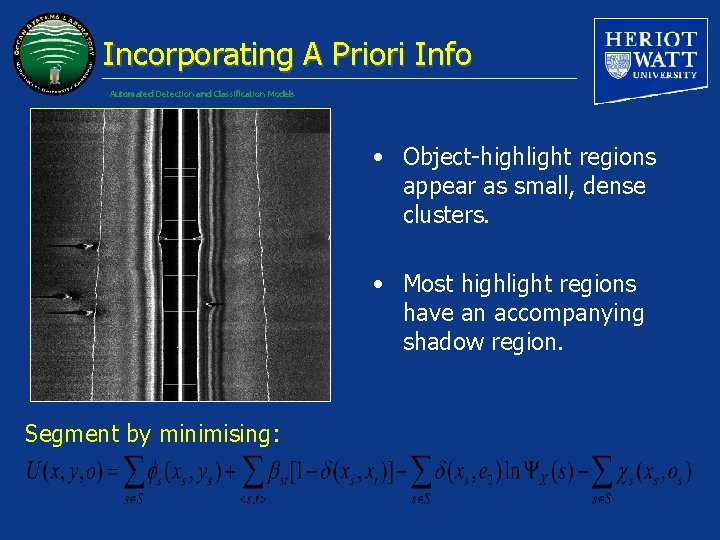
Incorporating A Priori Info Automated Detection and Classification Models • Object-highlight regions appear as small, dense clusters. • Most highlight regions have an accompanying shadow region. Segment by minimising:
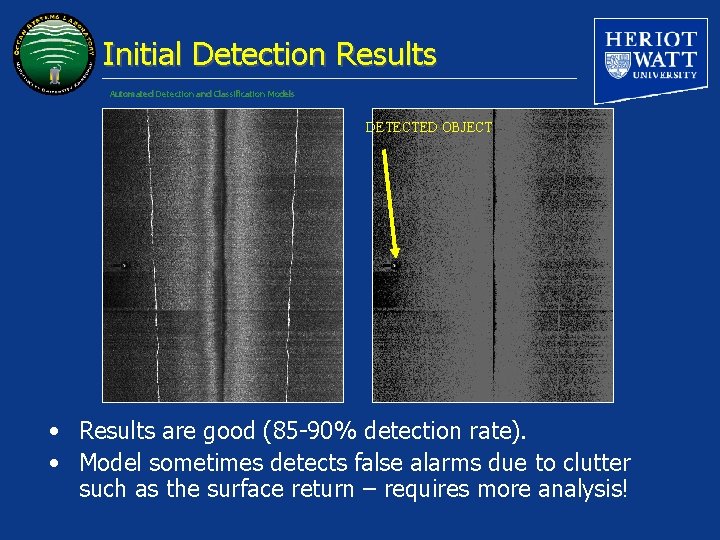
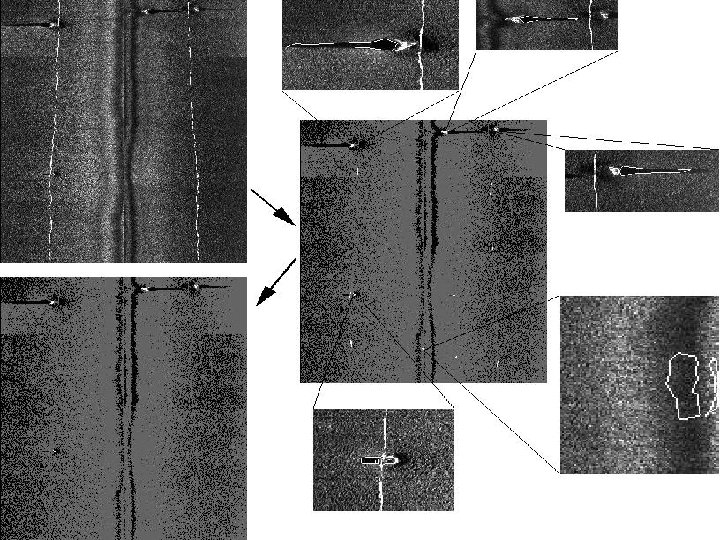
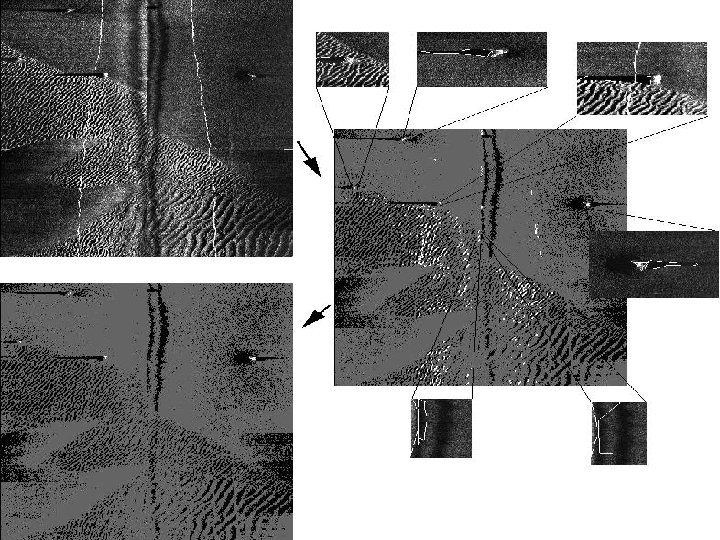
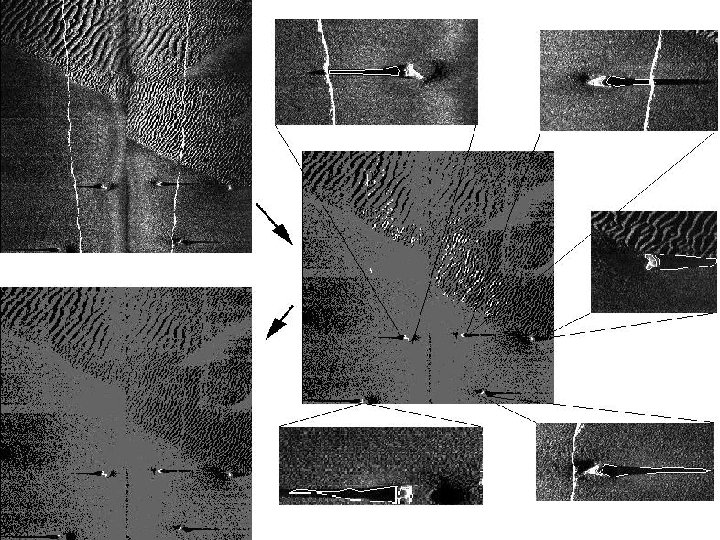
Initial Detection Results Automated Detection and Classification Models DETECTED OBJECT • Results are good (85 -90% detection rate). • Model sometimes detects false alarms due to clutter such as the surface return – requires more analysis!
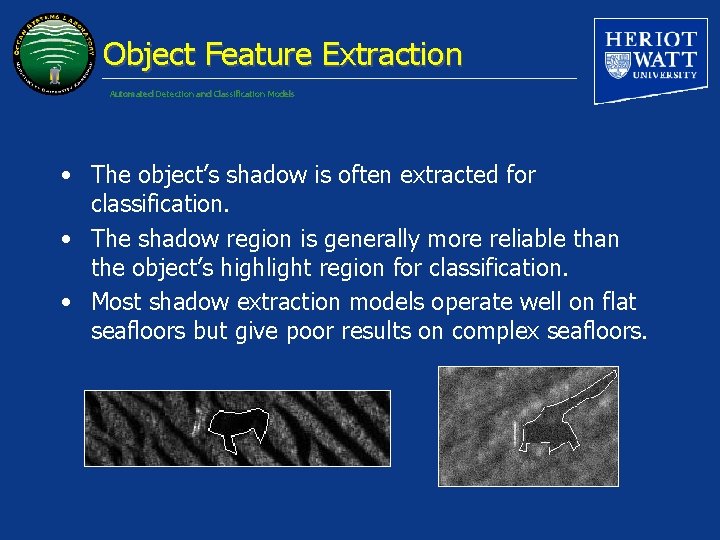
Object Feature Extraction Automated Detection and Classification Models • The object’s shadow is often extracted for classification. • The shadow region is generally more reliable than the object’s highlight region for classification. • Most shadow extraction models operate well on flat seafloors but give poor results on complex seafloors.
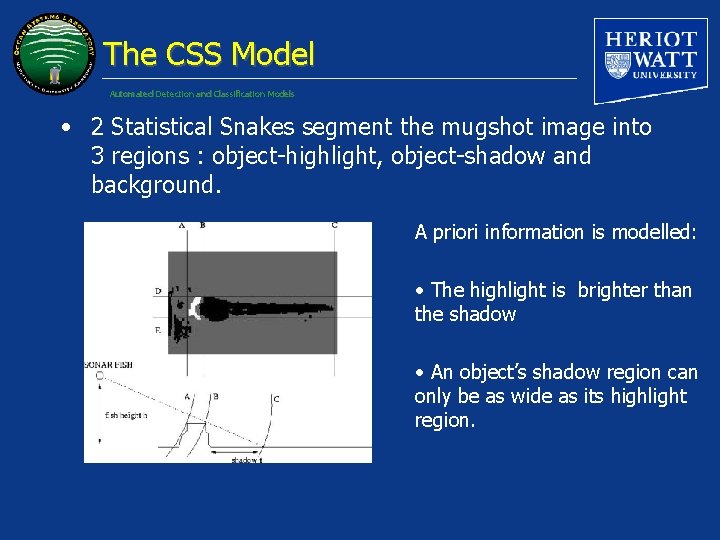
The CSS Model Automated Detection and Classification Models • 2 Statistical Snakes segment the mugshot image into 3 regions : object-highlight, object-shadow and background. A priori information is modelled: • The highlight is brighter than the shadow • An object’s shadow region can only be as wide as its highlight region.
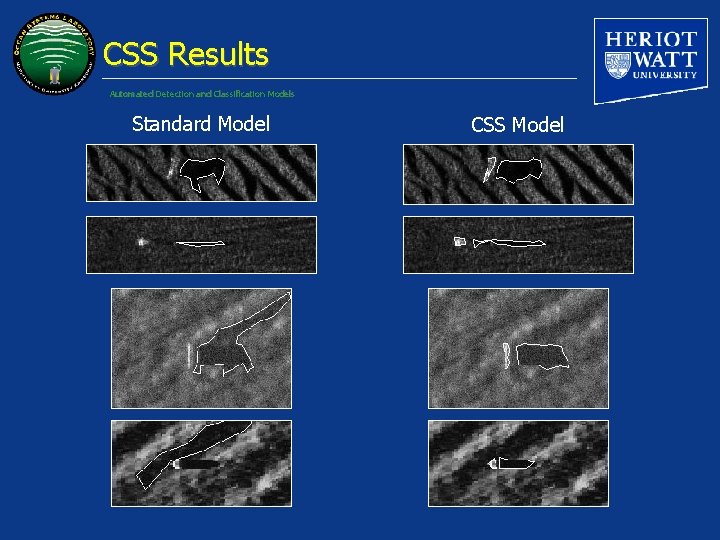
CSS Results Automated Detection and Classification Models Standard Model CSS Model
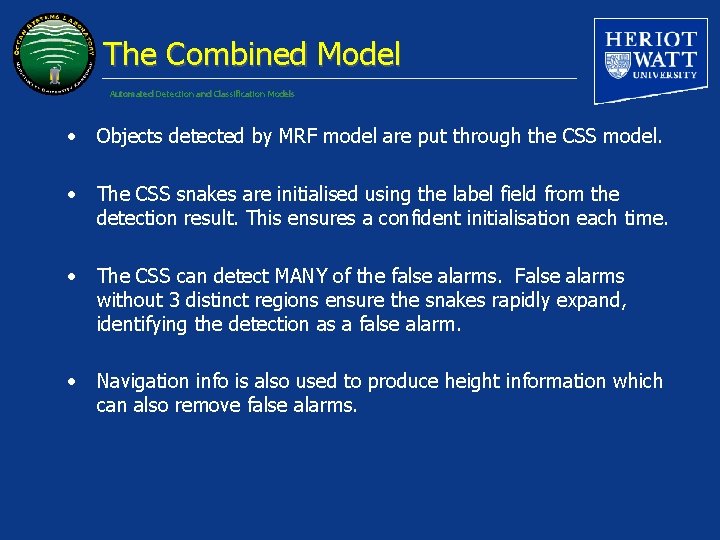
The Combined Model Automated Detection and Classification Models • Objects detected by MRF model are put through the CSS model. • The CSS snakes are initialised using the label field from the detection result. This ensures a confident initialisation each time. • The CSS can detect MANY of the false alarms. False alarms without 3 distinct regions ensure the snakes rapidly expand, identifying the detection as a false alarm. • Navigation info is also used to produce height information which can also remove false alarms.
Results Automated Detection and Classification Models
Results 2 Automated Detection and Classification Models
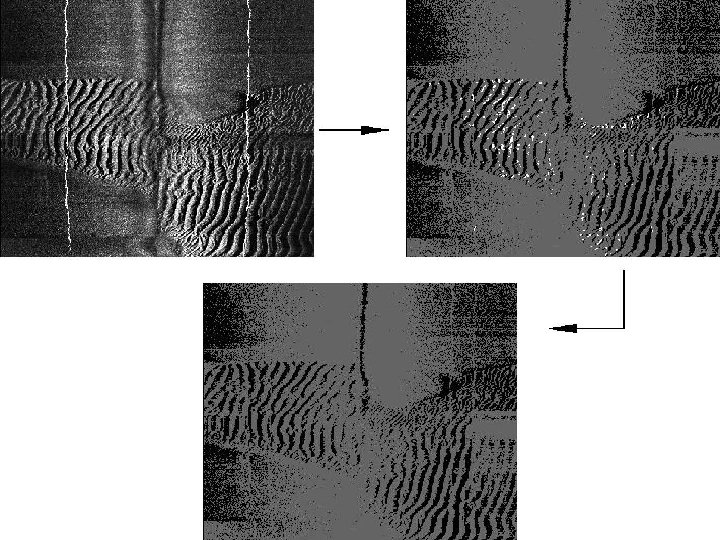
Results 3 Automated Detection and Classification Models
Result 4 Automated Detection and Classification Models
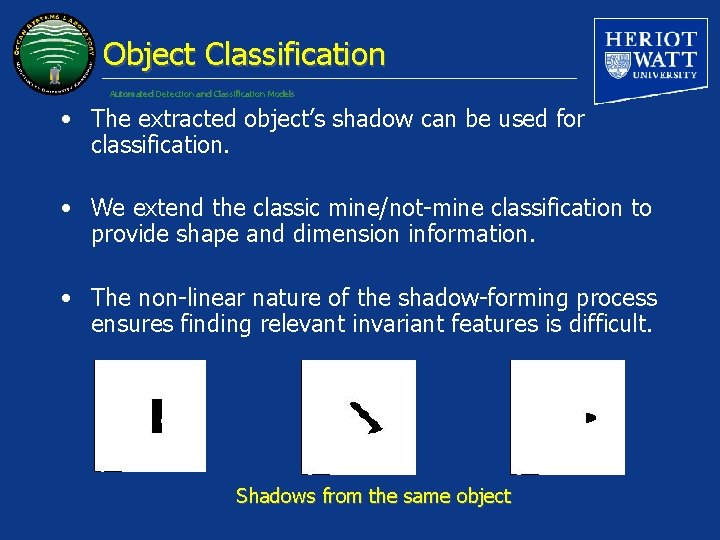
Object Classification Automated Detection and Classification Models • The extracted object’s shadow can be used for classification. • We extend the classic mine/not-mine classification to provide shape and dimension information. • The non-linear nature of the shadow-forming process ensures finding relevant invariant features is difficult. Shadows from the same object
Overview of Object Classification Automated Detection and Classification Models
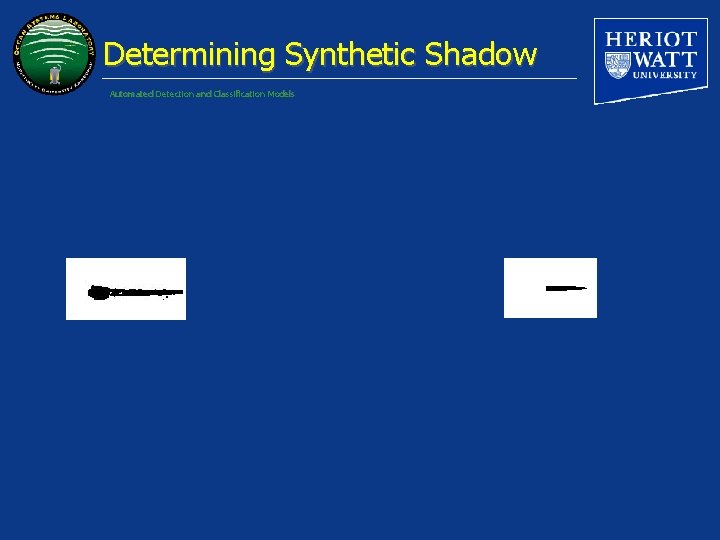
Determining Synthetic Shadow Automated Detection and Classification Models
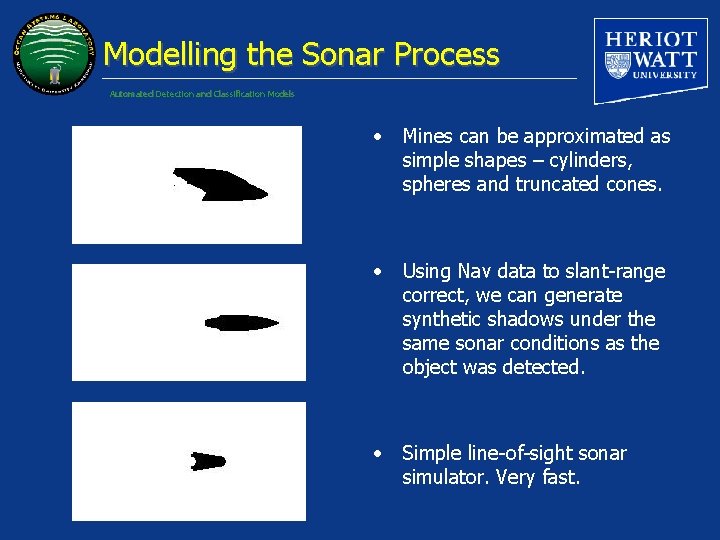
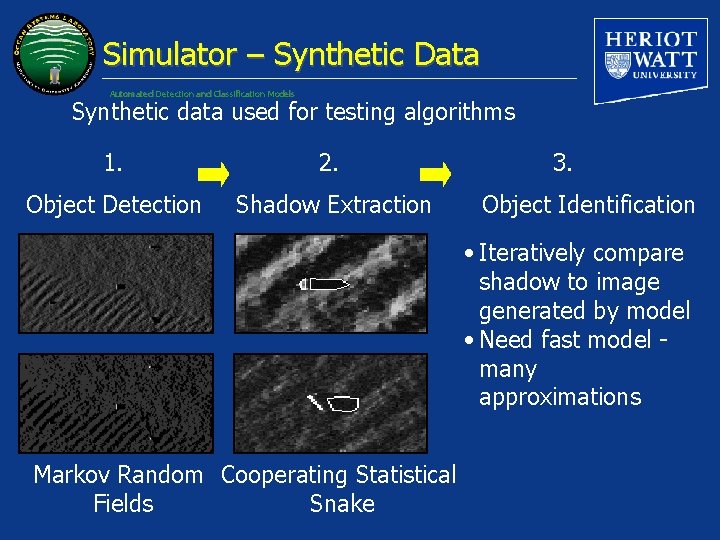
Modelling the Sonar Process Automated Detection and Classification Models • Mines can be approximated as simple shapes – cylinders, spheres and truncated cones. • Using Nav data to slant-range correct, we can generate synthetic shadows under the same sonar conditions as the object was detected. • Simple line-of-sight sonar simulator. Very fast.
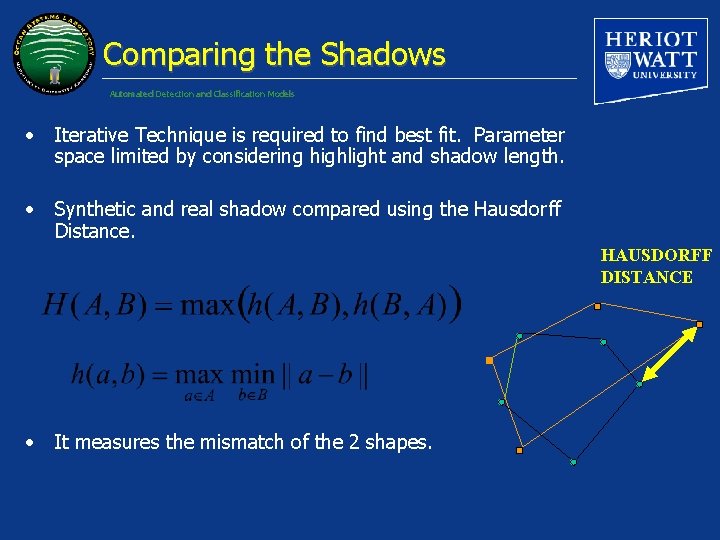
Comparing the Shadows Automated Detection and Classification Models • Iterative Technique is required to find best fit. Parameter space limited by considering highlight and shadow length. • Synthetic and real shadow compared using the Hausdorff Distance. HAUSDORFF DISTANCE • It measures the mismatch of the 2 shapes.
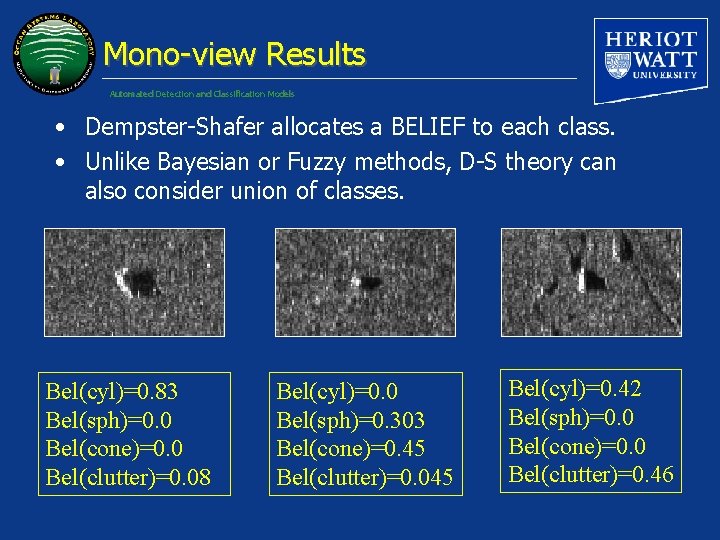
Mono-view Results Automated Detection and Classification Models • Dempster-Shafer allocates a BELIEF to each class. • Unlike Bayesian or Fuzzy methods, D-S theory can also consider union of classes. Bel(cyl)=0. 83 Bel(sph)=0. 0 Bel(cone)=0. 0 Bel(clutter)=0. 08 Bel(cyl)=0. 0 Bel(sph)=0. 303 Bel(cone)=0. 45 Bel(clutter)=0. 045 Bel(cyl)=0. 42 Bel(sph)=0. 0 Bel(cone)=0. 0 Bel(clutter)=0. 46
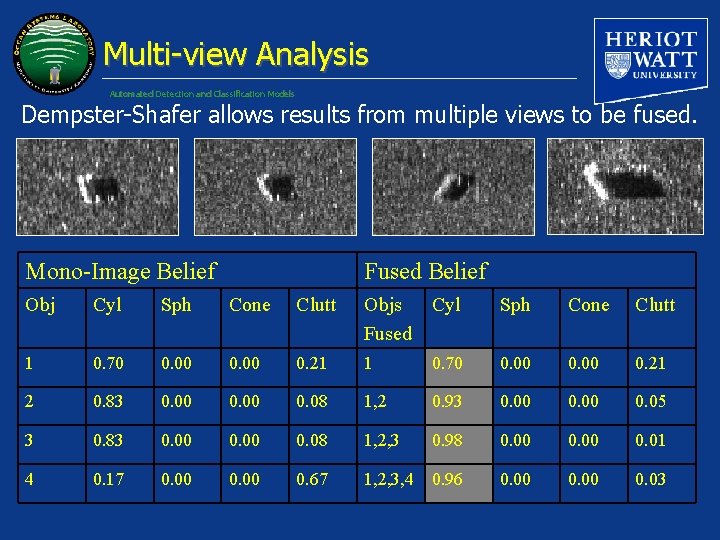
Multi-view Analysis Automated Detection and Classification Models Dempster-Shafer allows results from multiple views to be fused. Mono-Image Belief Fused Belief Obj Cyl Sph Cone Clutt Objs Cyl Fused Sph Cone Clutt 1 0. 70 0. 00 0. 21 2 0. 83 0. 00 0. 08 1, 2 0. 93 0. 00 0. 05 3 0. 83 0. 00 0. 08 1, 2, 3 0. 98 0. 00 0. 01 4 0. 17 0. 00 0. 67 1, 2, 3, 4 0. 96 0. 00 0. 03
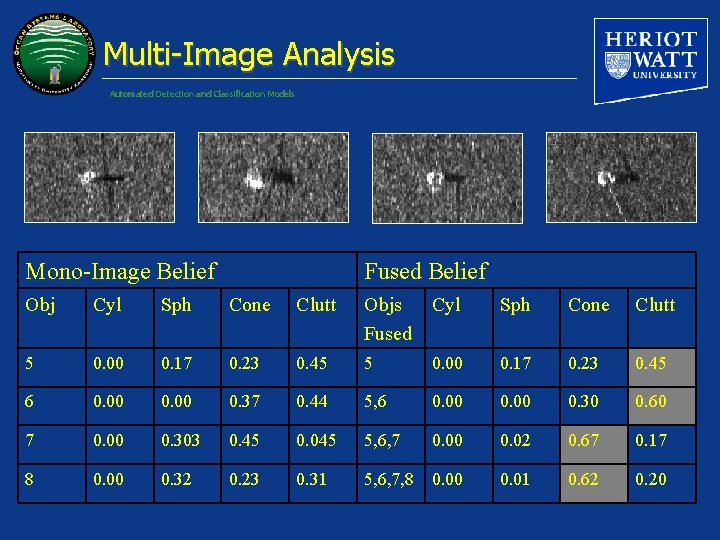
Multi-Image Analysis Automated Detection and Classification Models Mono-Image Belief Fused Belief Obj Cyl Sph Cone Clutt Objs Cyl Fused Sph Cone Clutt 5 0. 00 0. 17 0. 23 0. 45 6 0. 00 0. 37 0. 44 5, 6 0. 00 0. 30 0. 60 7 0. 00 0. 303 0. 45 0. 045 5, 6, 7 0. 00 0. 02 0. 67 0. 17 8 0. 00 0. 32 0. 23 0. 31 5, 6, 7, 8 0. 00 0. 01 0. 62 0. 20
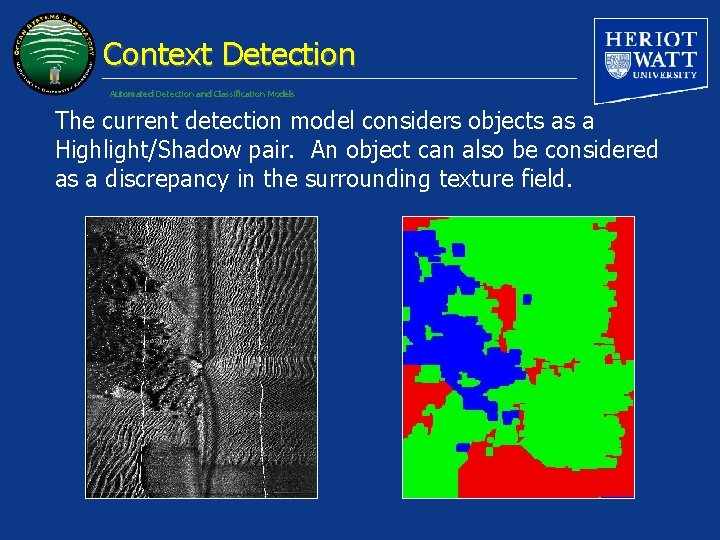
Context Detection Automated Detection and Classification Models The current detection model considers objects as a Highlight/Shadow pair. An object can also be considered as a discrepancy in the surrounding texture field.
The way Forward Automated Detection and Classification Models • Context Detection using segmentation based on – Markov Random Fields – Variational techniques – Saliency • Shape extraction for highlight / shadow – Use of image formation process to force combined meaningful extraction. – Active contours to perform robust extraction (statistical snakes, Mumford-Shah)
The way Forward Automated Detection and Classification Models • Model Based classification – Initial model parameters extracted from segmentation – Model is refined using • A simulator of the image formation + search in parameter space • Direct inference using training and large databases • Active Appearance models trained on large sets • Robustify classification via – Multi view combination – Inclusion of DTM models • via simulator • via statistical priors?
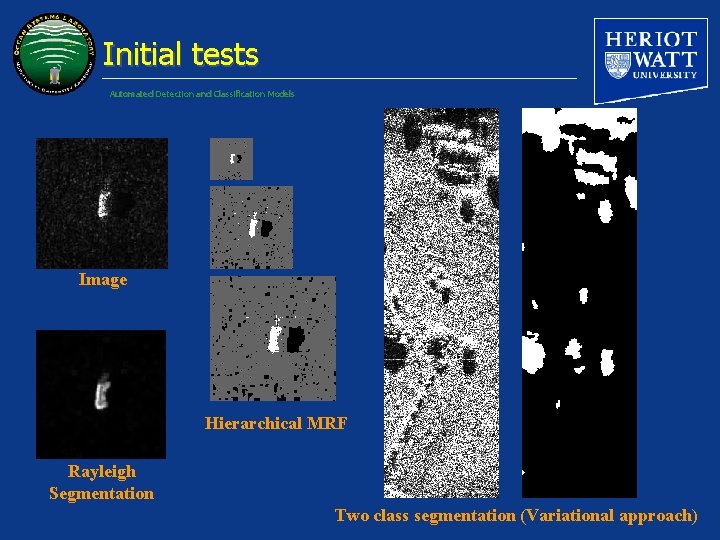
Initial tests Automated Detection and Classification Models Image Hierarchical MRF Rayleigh Segmentation Two class segmentation (Variational approach)
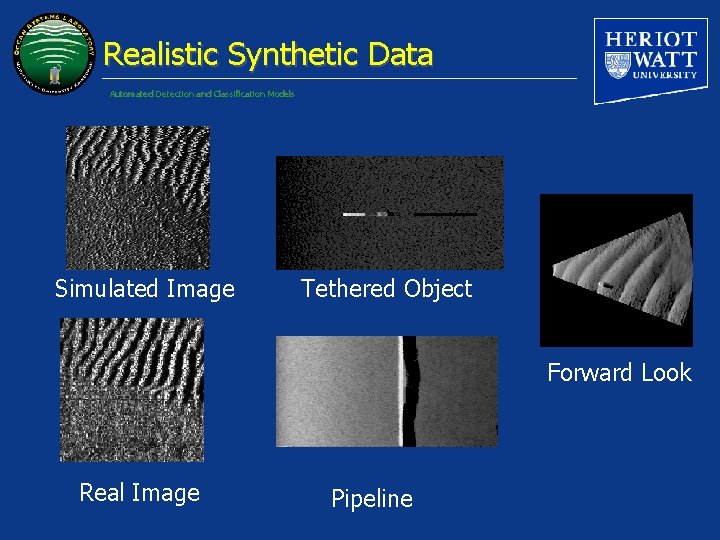
Simulator Automated Detection and Classification Models • 2 complementary techniques for Sonar Simulation • Pseudospectral Time Domain (PSTD) • based on finite difference techniques • accurate research tool • computationally complex • Ray Tracing • combination of computer graphics ray tracing and ray solution to wave equation • operational approach • flexibility to incorporate approximations
Realistic Synthetic Data Automated Detection and Classification Models Simulated Image Tethered Object Forward Look Real Image Pipeline
Simulator – Synthetic Data Automated Detection and Classification Models Synthetic data used for testing algorithms 1. 2. Object Detection Shadow Extraction 3. Object Identification • Iteratively compare shadow to image generated by model • Need fast model many approximations Markov Random Cooperating Statistical Fields Snake
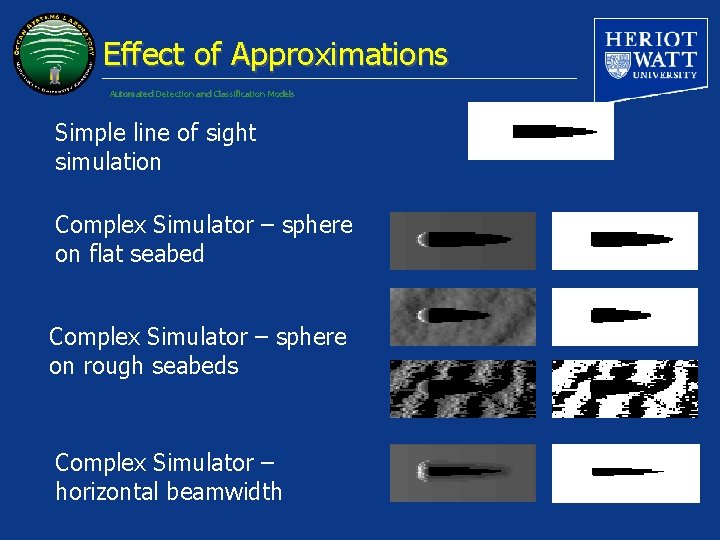
Reduced Simulator Automated Detection and Classification Models • Only need to simulate shadows not full backscatter • Reduce complexity to increase speed • Effect on shadow minimal • Simple line of sight ray based calculation • Height field approximation • Isovelocity conditions • Co-located point source/receiver • No beampatterns or beam spreading
Effect of Approximations Automated Detection and Classification Models Simple line of sight simulation Complex Simulator – sphere on flat seabed Complex Simulator – sphere on rough seabeds Complex Simulator – horizontal beamwidth
Simulation of SAR Automated Detection and Classification Models Amend Sonar Model or Amend existing SAR model e. g. MSTAR Predict-Lite • • • Initially require only shadow Emphasis on computation time Can alter membership functions used during classification to take into account non perfect simulation • Eventually extend model to generate full target signature