
Automata Grammars and Languages Discourse 03 Finite Automata
![Equivalence of NFA and DFA (cont’d) • Thm: [Rabin-Scott Construction]. Let L = L(N)](https://slidetodoc.com/presentation_image_h/34830ddc21c03ddacddf911b1fa66112/image-41.jpg "Equivalence of NFA and DFA (cont’d) • Thm: [Rabin-Scott Construction]. Let L = L(N)")
![Conversion: NFA DFA • Thm 1. 39: [Rabin-Scott Theorem]: There is an algorithm to](https://slidetodoc.com/presentation_image_h/34830ddc21c03ddacddf911b1fa66112/image-51.jpg "Conversion: NFA DFA • Thm 1. 39: [Rabin-Scott Theorem]: There is an algorithm to")
![Applications--Examples -? [0 -9]+ [^0 -9] [. *] g/^[ ]*$/d g/[ ]+/d nonempty digit](https://slidetodoc.com/presentation_image_h/34830ddc21c03ddacddf911b1fa66112/image-65.jpg "Applications--Examples -? [0 -9]+ [^0 -9] [. *] g/^[ ]*$/d g/[ ]+/d nonempty digit")
![Pumping Lemma • Thm [Pumping Lemma for Regular Languages]. Suppose that L is an](https://slidetodoc.com/presentation_image_h/34830ddc21c03ddacddf911b1fa66112/image-88.jpg "Pumping Lemma • Thm [Pumping Lemma for Regular Languages]. Suppose that L is an")
![Pumping Lemma (English) • Thm [Pumping Lemma for Regular Languages]. Suppose that L is](https://slidetodoc.com/presentation_image_h/34830ddc21c03ddacddf911b1fa66112/image-89.jpg "Pumping Lemma (English) • Thm [Pumping Lemma for Regular Languages]. Suppose that L is")
- Slides: 96
Automata, Grammars and Languages Discourse 03 Finite Automata C SC 473 Automata, Grammars & Languages
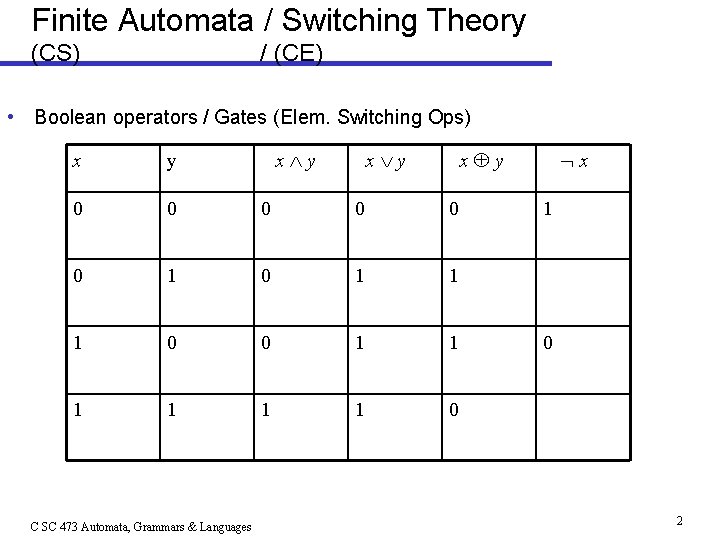
Finite Automata / Switching Theory (CS) / (CE) • Boolean operators / Gates (Elem. Switching Ops) x y x y 0 0 0 1 0 1 1 1 0 C SC 473 Automata, Grammars & Languages x 1 0 2
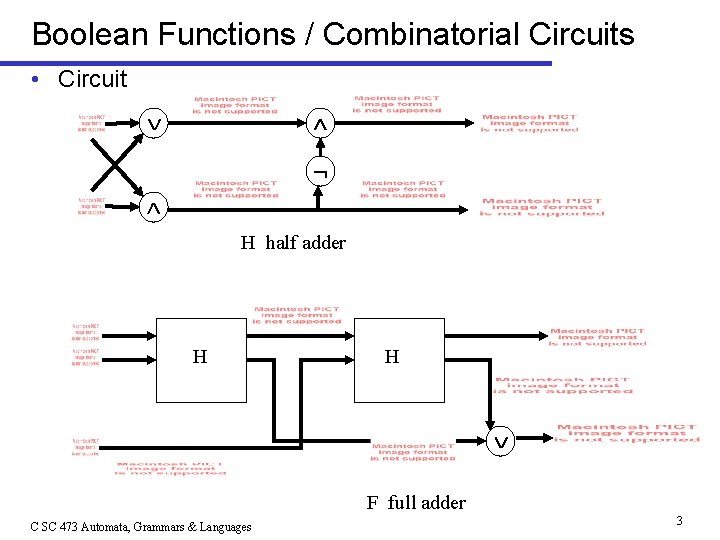
Boolean Functions / Combinatorial Circuits • Circuit H half adder H H F full adder C SC 473 Automata, Grammars & Languages 3
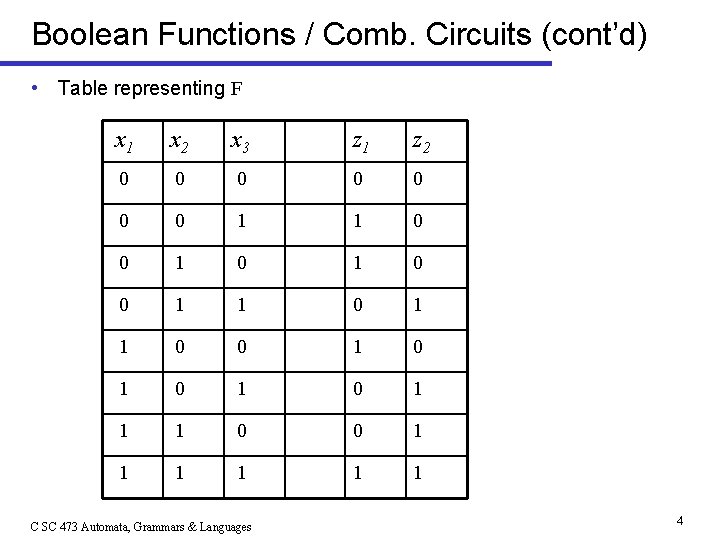
Boolean Functions / Comb. Circuits (cont’d) • Table representing F x 1 x 2 x 3 z 1 z 2 0 0 0 0 1 1 0 0 1 0 1 1 1 0 0 1 1 1 C SC 473 Automata, Grammars & Languages 4
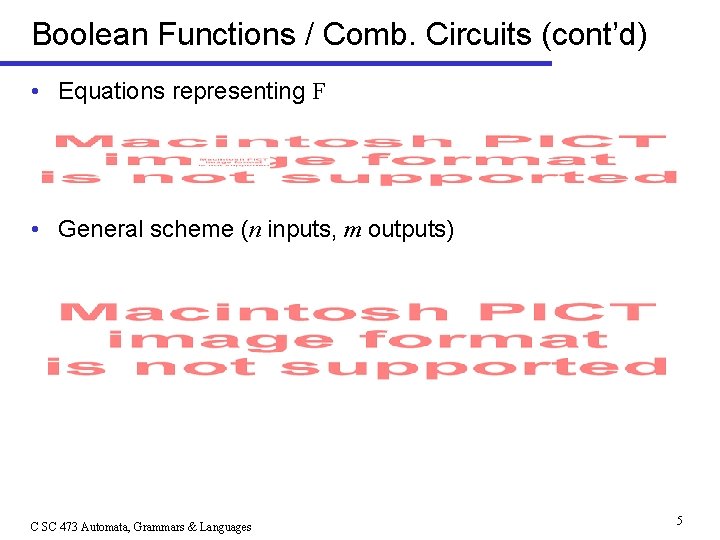
Boolean Functions / Comb. Circuits (cont’d) • Equations representing F • General scheme (n inputs, m outputs) C SC 473 Automata, Grammars & Languages 5
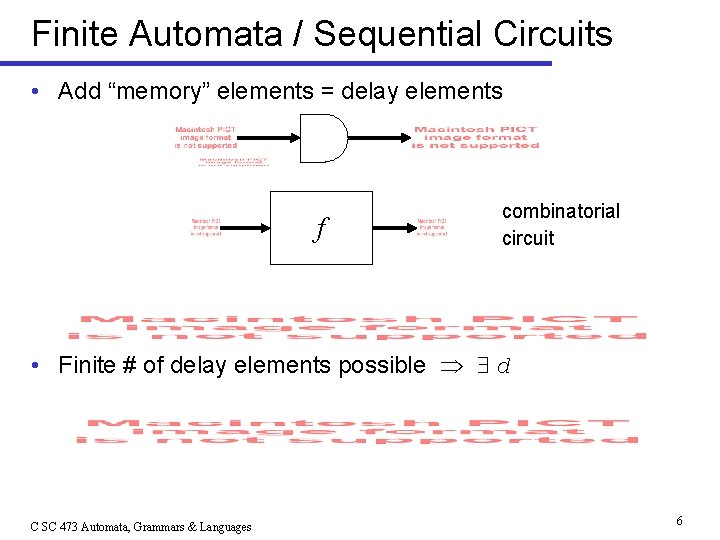
Finite Automata / Sequential Circuits • Add “memory” elements = delay elements f combinatorial circuit • Finite # of delay elements possible d C SC 473 Automata, Grammars & Languages 6
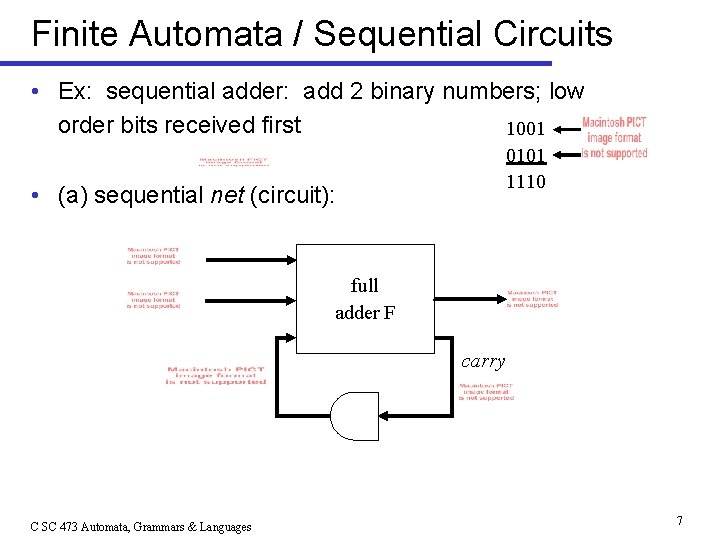
Finite Automata / Sequential Circuits • Ex: sequential adder: add 2 binary numbers; low order bits received first 1001 0101 1110 • (a) sequential net (circuit): full adder F carry C SC 473 Automata, Grammars & Languages 7
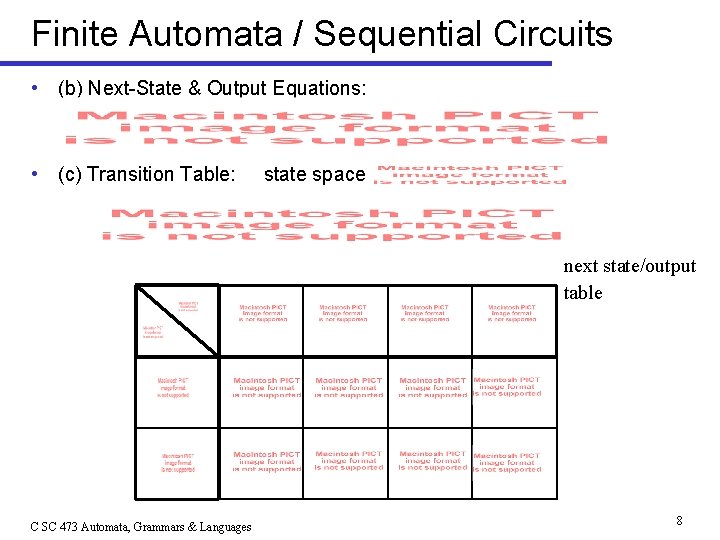
Finite Automata / Sequential Circuits • (b) Next-State & Output Equations: • (c) Transition Table: state space next state/output table C SC 473 Automata, Grammars & Languages 8
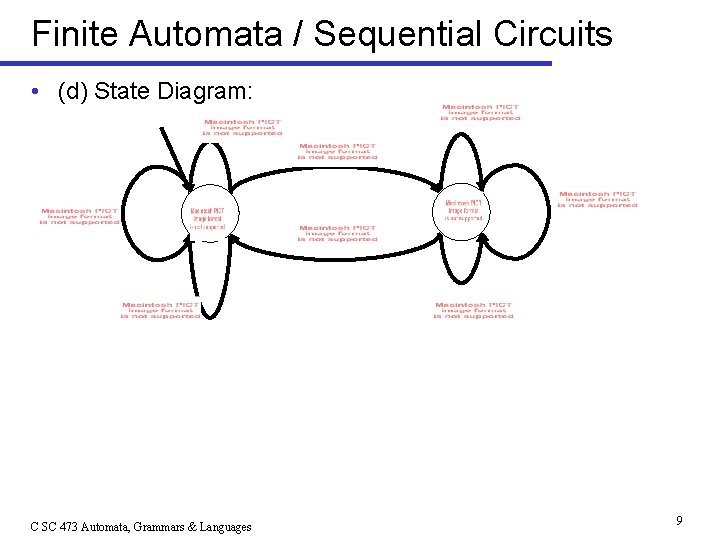
Finite Automata / Sequential Circuits • (d) State Diagram: C SC 473 Automata, Grammars & Languages 9
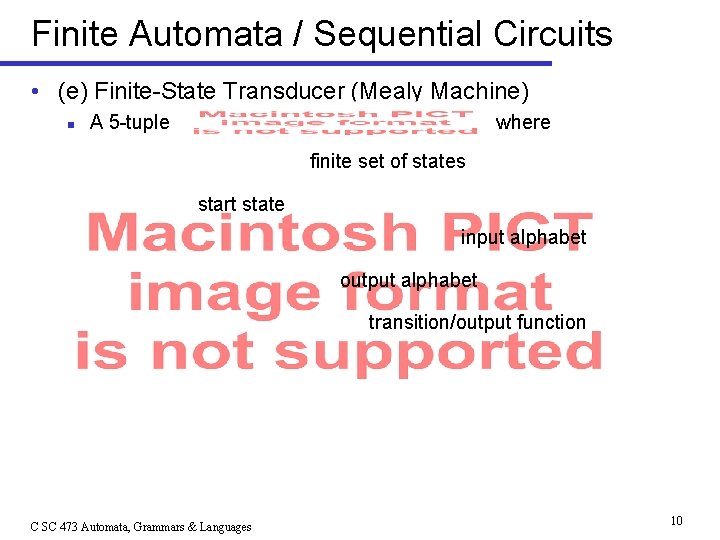
Finite Automata / Sequential Circuits • (e) Finite-State Transducer (Mealy Machine) n A 5 -tuple where finite set of states start state input alphabet output alphabet transition/output function C SC 473 Automata, Grammars & Languages 10
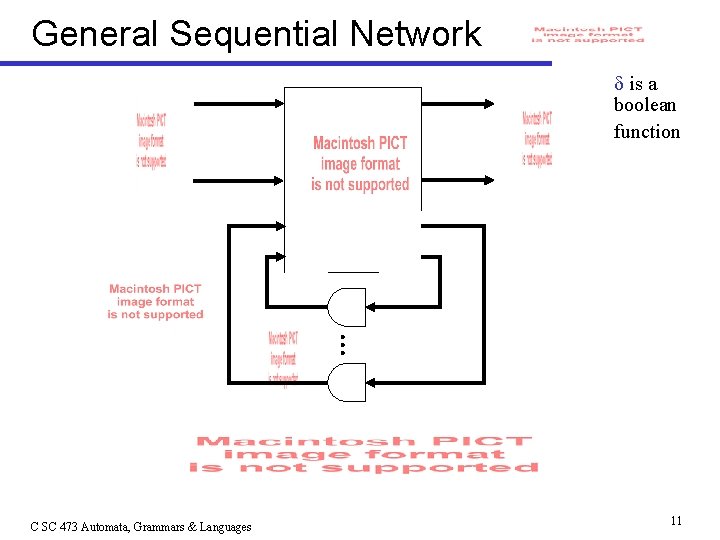
General Sequential Network is a boolean function C SC 473 Automata, Grammars & Languages 11
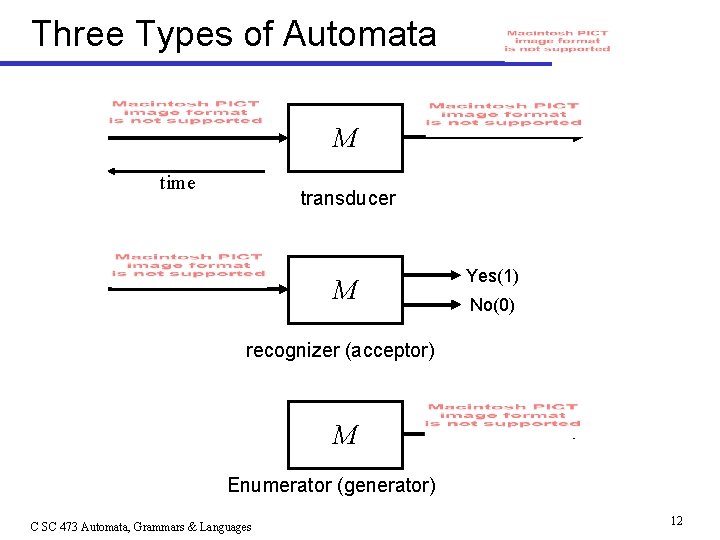
Three Types of Automata M time transducer M Yes(1) No(0) recognizer (acceptor) M Enumerator (generator) C SC 473 Automata, Grammars & Languages 12
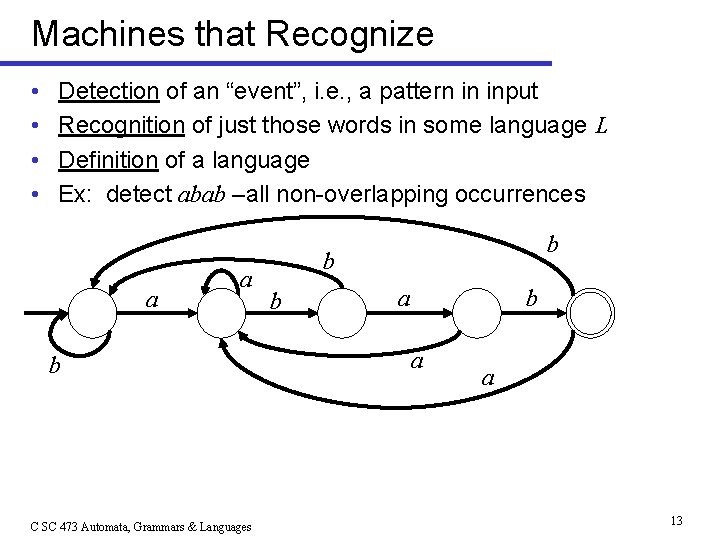
Machines that Recognize • • Detection of an “event”, i. e. , a pattern in input Recognition of just those words in some language L Definition of a language Ex: detect abab –all non-overlapping occurrences a a b C SC 473 Automata, Grammars & Languages b b b a a 13
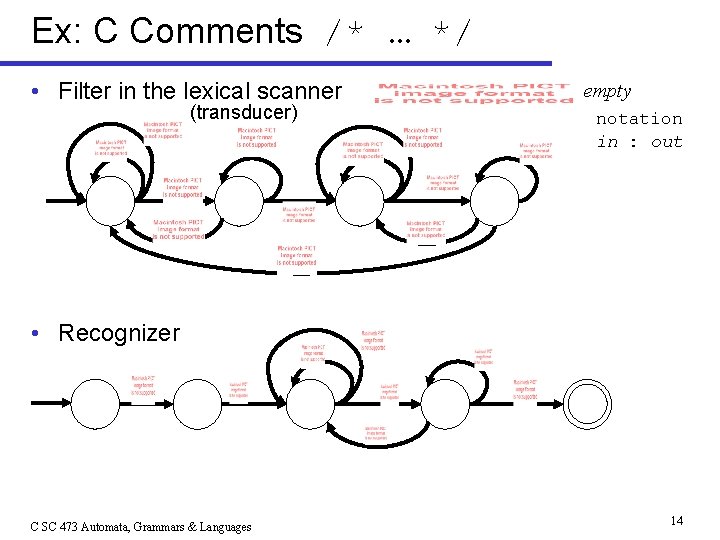
Ex: C Comments /* … */ • Filter in the lexical scanner (transducer) empty notation in : out • Recognizer C SC 473 Automata, Grammars & Languages 14
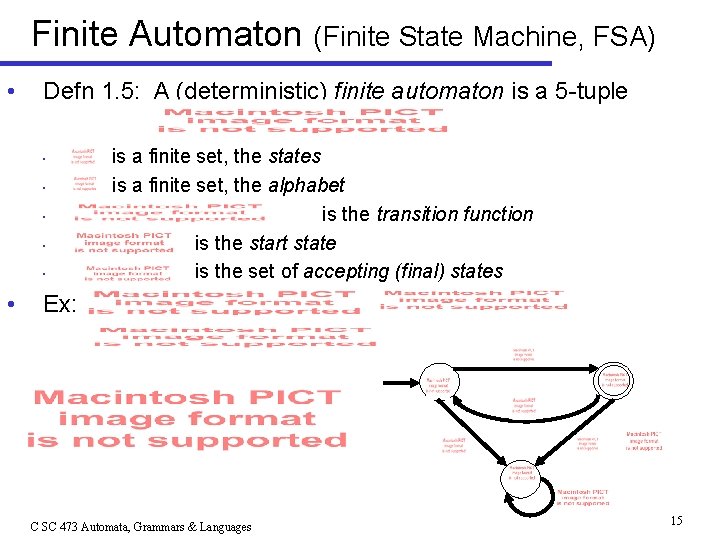
Finite Automaton (Finite State Machine, FSA) • Defn 1. 5: A (deterministic) finite automaton is a 5 -tuple • • • is a finite set, the states is a finite set, the alphabet is the transition function is the start state is the set of accepting (final) states Ex: C SC 473 Automata, Grammars & Languages 15
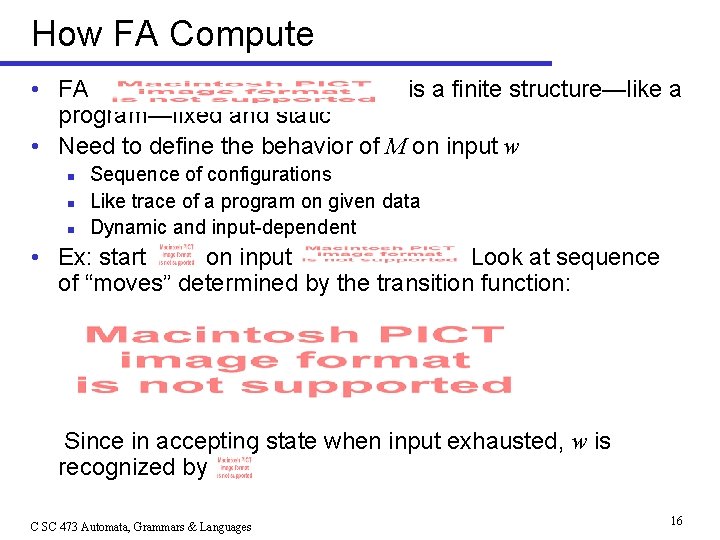
How FA Compute • FA is a finite structure—like a program—fixed and static • Need to define the behavior of M on input w n n n Sequence of configurations Like trace of a program on given data Dynamic and input-dependent • Ex: start on input Look at sequence of “moves” determined by the transition function: Since in accepting state when input exhausted, w is recognized by C SC 473 Automata, Grammars & Languages 16
www. jflap. org JFLAP is a package of graphical tools which can be used as an aid in learning the basic concepts of Formal Languages and Automata Theory. C SC 473 Automata, Grammars & Languages
Info on JFLAP • Website http: //www. jflap. org/ n n Downloads Tutorial • Lectura (linux) install n n cd /usr/local/jflap java -jar JFLAP. jar • X 11 forwarding (graphics) n ssh -X lectura C SC 473 Automata, Grammars & Languages 18
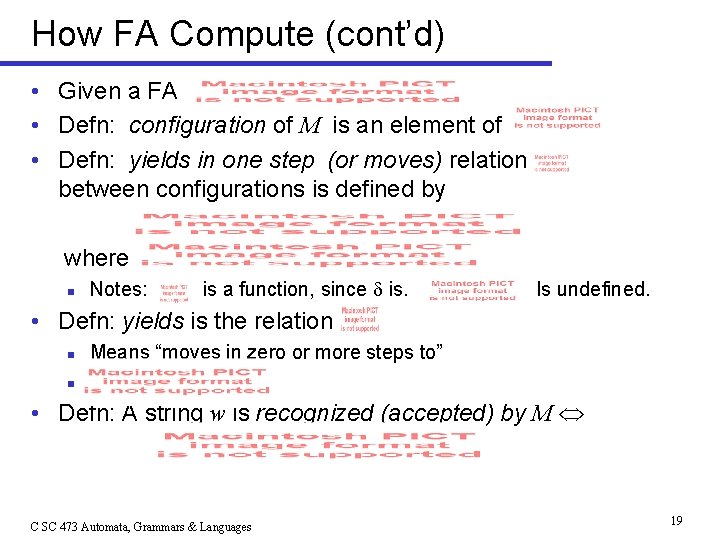
How FA Compute (cont’d) • Given a FA • Defn: configuration of M is an element of • Defn: yields in one step (or moves) relation between configurations is defined by where n Notes: is a function, since is. Is undefined. • Defn: yields is the relation n Means “moves in zero or more steps to” n • Defn: A string w is recognized (accepted) by M C SC 473 Automata, Grammars & Languages 19
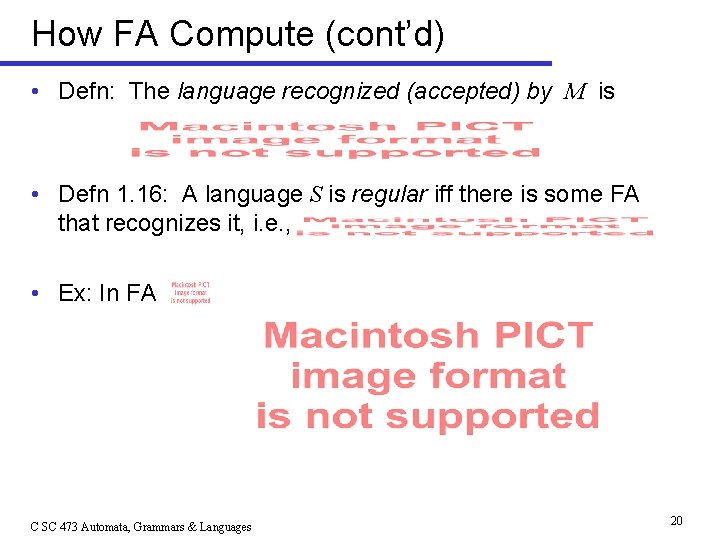
How FA Compute (cont’d) • Defn: The language recognized (accepted) by M is • Defn 1. 16: A language S is regular iff there is some FA that recognizes it, i. e. , • Ex: In FA C SC 473 Automata, Grammars & Languages 20
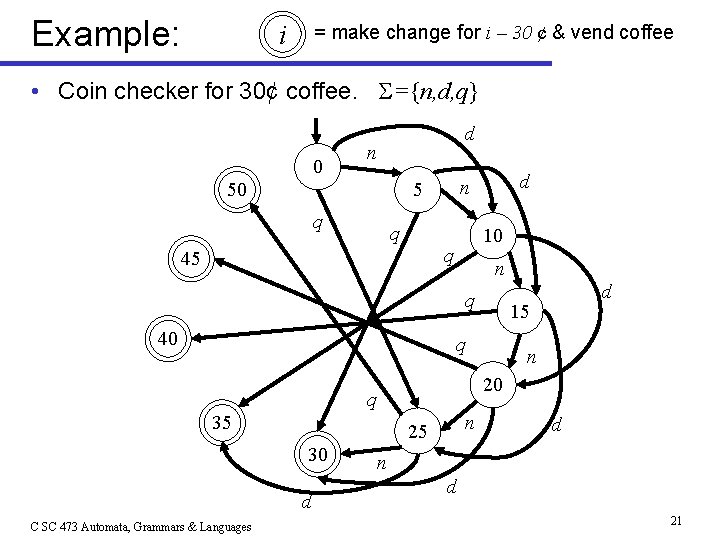
Example: i = make change for i – 30 ¢ & vend coffee • Coin checker for 30¢ coffee. ={n, d, q} 0 d n 50 q q 10 q 45 d n 5 n q 40 15 q 35 C SC 473 Automata, Grammars & Languages n 25 d n 20 q 30 d d n d 21
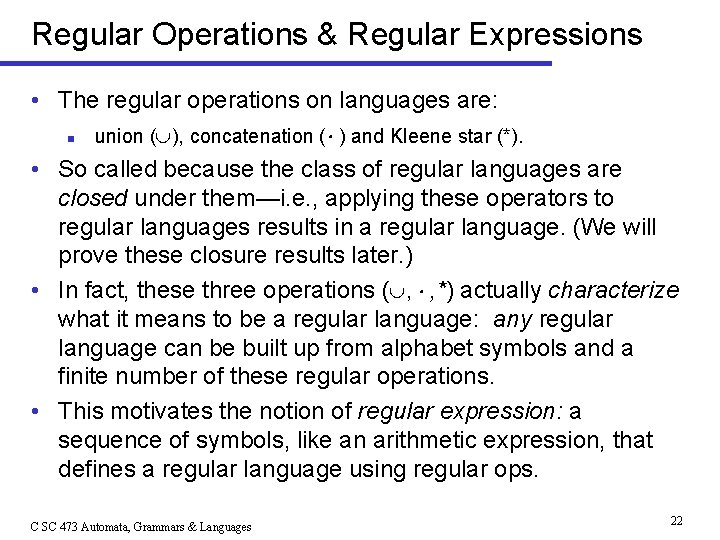
Regular Operations & Regular Expressions • The regular operations on languages are: n union ( ), concatenation ( ) and Kleene star (*). • So called because the class of regular languages are closed under them—i. e. , applying these operators to regular languages results in a regular language. (We will prove these closure results later. ) • In fact, these three operations ( , , *) actually characterize what it means to be a regular language: any regular language can be built up from alphabet symbols and a finite number of these regular operations. • This motivates the notion of regular expression: a sequence of symbols, like an arithmetic expression, that defines a regular language using regular ops. C SC 473 Automata, Grammars & Languages 22
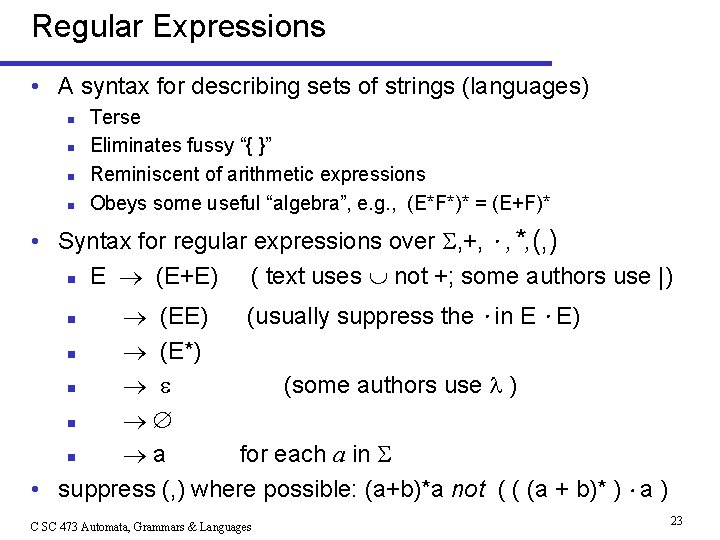
Regular Expressions • A syntax for describing sets of strings (languages) n n Terse Eliminates fussy “{ }” Reminiscent of arithmetic expressions Obeys some useful “algebra”, e. g. , (E*F*)* = (E+F)* • Syntax for regular expressions over , +, , *, (, ) n E (E+E) ( text uses not +; some authors use |) (EE) (usually suppress the in E E) n (E*) n (some authors use ) n n a for each a in • suppress (, ) where possible: (a+b)*a not ( ( (a + b)* ) a ) n C SC 473 Automata, Grammars & Languages 23
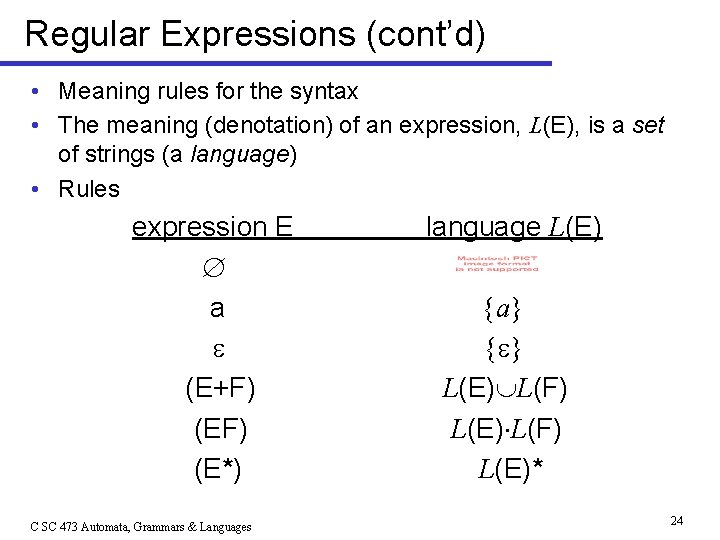
Regular Expressions (cont’d) • Meaning rules for the syntax • The meaning (denotation) of an expression, L(E), is a set of strings (a language) • Rules expression E a (E+F) (E*) C SC 473 Automata, Grammars & Languages language L(E) {a} { } L(E) L(F) L(E)* 24
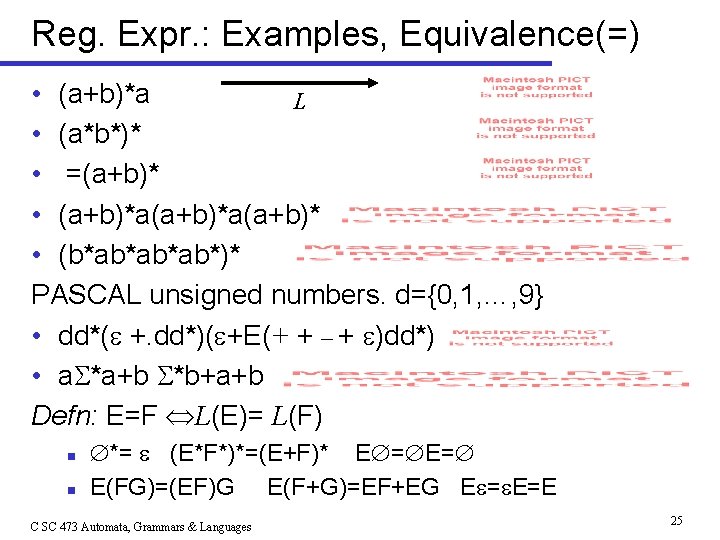
Reg. Expr. : Examples, Equivalence(=) • (a+b)*a L • (a*b*)* • =(a+b)* • (a+b)*a(a+b)* • (b*ab*ab*ab*)* PASCAL unsigned numbers. d={0, 1, …, 9} • dd*( +. dd*)( +E(+ + – + )dd*) • a *a+b *b+a+b Defn: E=F L(E)= L(F) n n *= (E*F*)*=(E+F)* E = E= E(FG)=(EF)G E(F+G)=EF+EG E = E=E C SC 473 Automata, Grammars & Languages 25
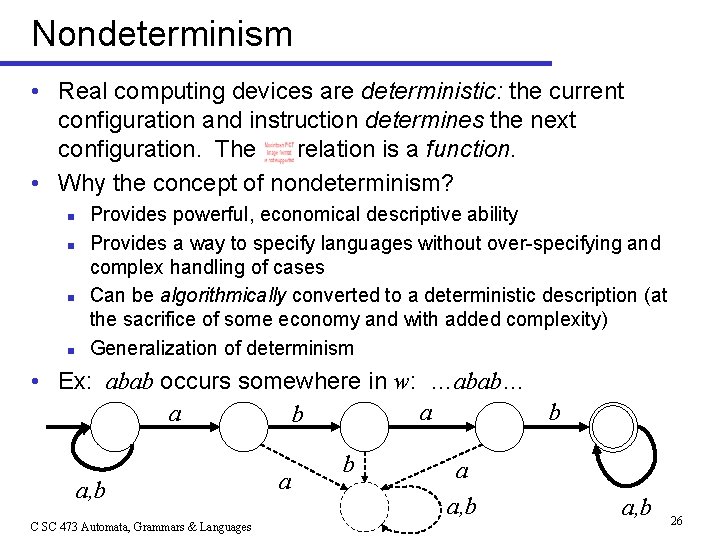
Nondeterminism • Real computing devices are deterministic: the current configuration and instruction determines the next configuration. The relation is a function. • Why the concept of nondeterminism? n n Provides powerful, economical descriptive ability Provides a way to specify languages without over-specifying and complex handling of cases Can be algorithmically converted to a deterministic description (at the sacrifice of some economy and with added complexity) Generalization of determinism • Ex: abab occurs somewhere in w: …abab… a b a, b C SC 473 Automata, Grammars & Languages a b a a, b 26
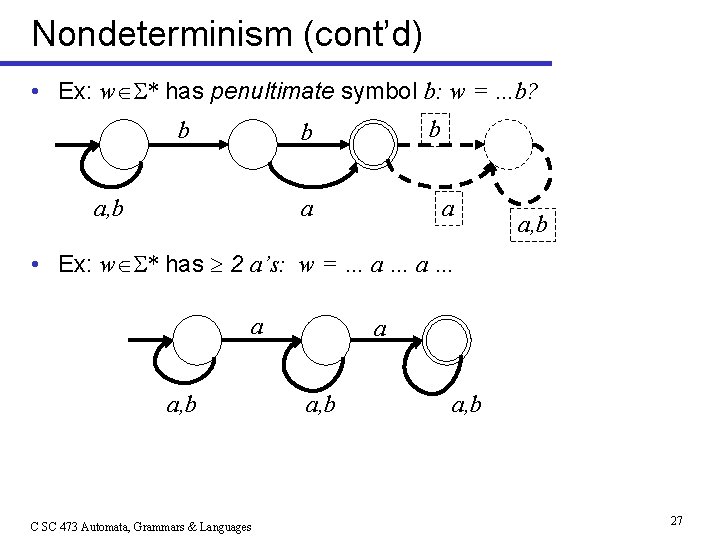
Nondeterminism (cont’d) • Ex: w * has penultimate symbol b: w = …b? b b b a, b a a a, b • Ex: w * has 2 a’s: w = … a … a a, b C SC 473 Automata, Grammars & Languages a a, b 27
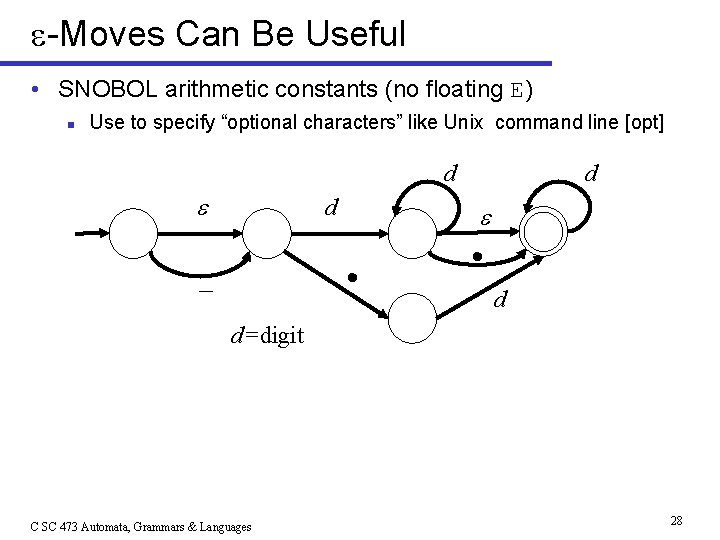
-Moves Can Be Useful • SNOBOL arithmetic constants (no floating E) n Use to specify “optional characters” like Unix command line [opt] d d=digit C SC 473 Automata, Grammars & Languages 28
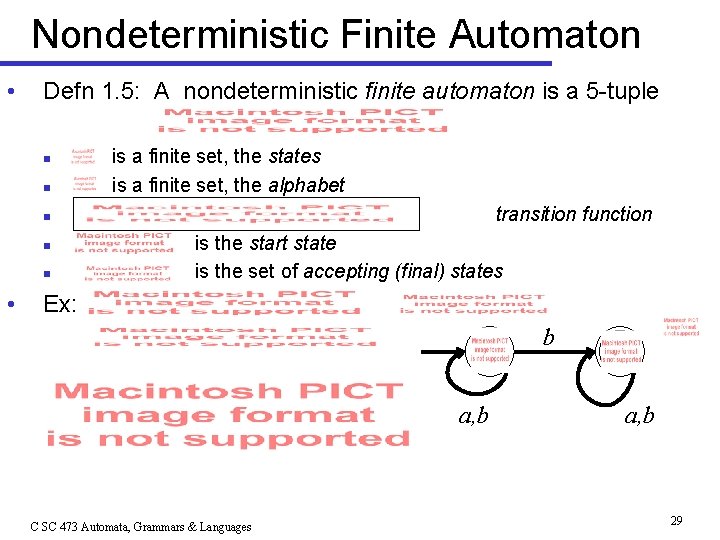
Nondeterministic Finite Automaton • Defn 1. 5: A nondeterministic finite automaton is a 5 -tuple n n is a finite set, the states is a finite set, the alphabet transition function n • is the start state is the set of accepting (final) states Ex: b a, b C SC 473 Automata, Grammars & Languages a, b 29
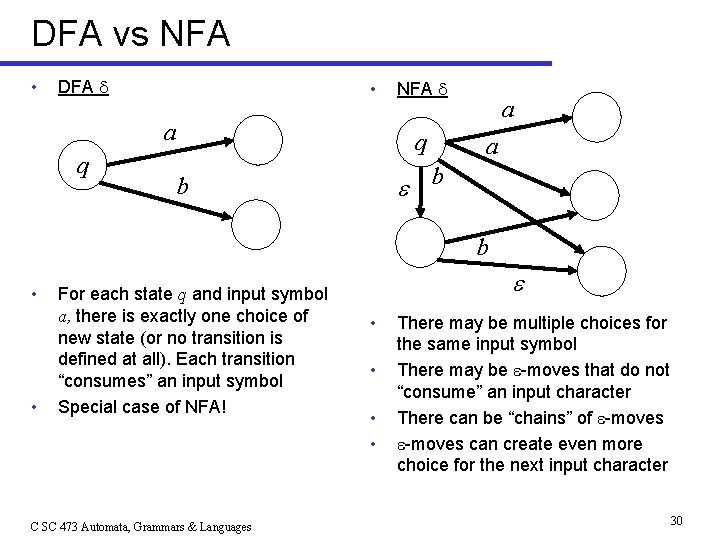
DFA vs NFA • DFA • a q NFA q a a b b b • • For each state q and input symbol a, there is exactly one choice of new state (or no transition is defined at all). Each transition “consumes” an input symbol Special case of NFA! C SC 473 Automata, Grammars & Languages • • There may be multiple choices for the same input symbol There may be -moves that do not “consume” an input character There can be “chains” of -moves can create even more choice for the next input character 30
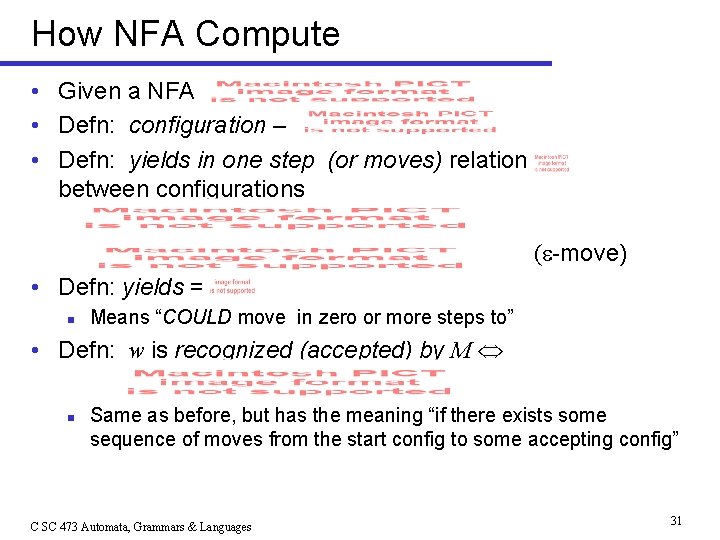
How NFA Compute • Given a NFA • Defn: configuration – • Defn: yields in one step (or moves) relation between configurations ( -move) • Defn: yields = n Means “COULD move in zero or more steps to” • Defn: w is recognized (accepted) by M n Same as before, but has the meaning “if there exists some sequence of moves from the start config to some accepting config” C SC 473 Automata, Grammars & Languages 31
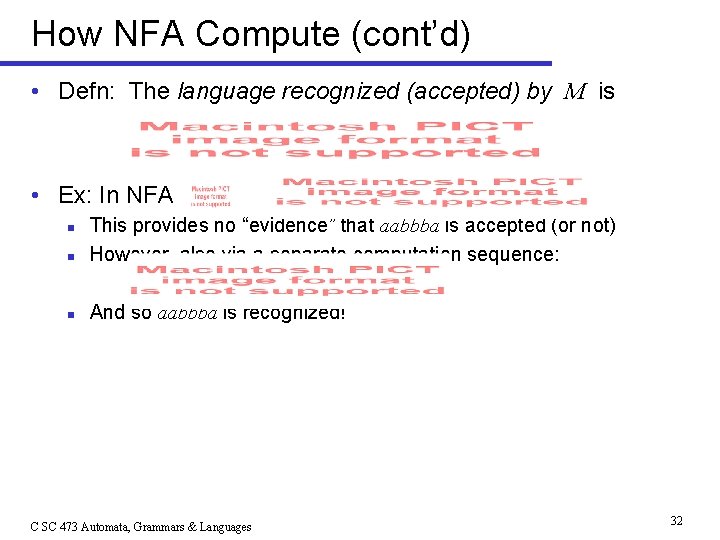
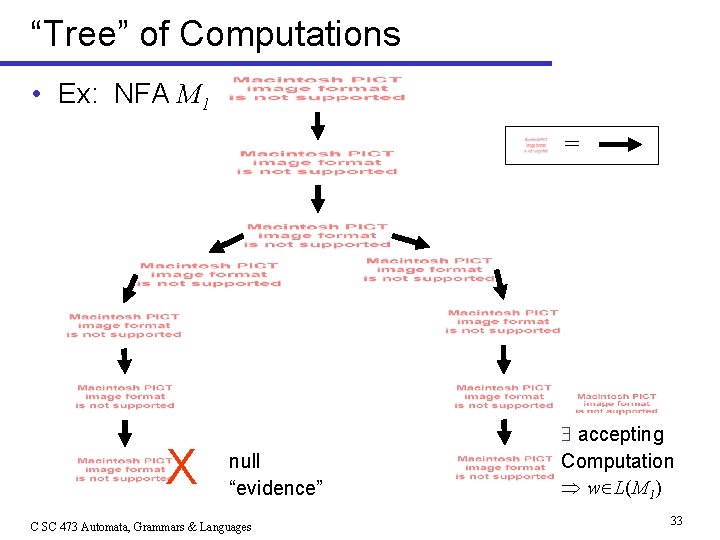
How NFA Compute (cont’d) • Defn: The language recognized (accepted) by M is • Ex: In NFA n This provides no “evidence” that aabbba is accepted (or not) However, also via a separate computation sequence: n And so aabbba is recognized! n C SC 473 Automata, Grammars & Languages 32
“Tree” of Computations • Ex: NFA M 1 = X null “evidence” C SC 473 Automata, Grammars & Languages accepting Computation w L(M 1) 33
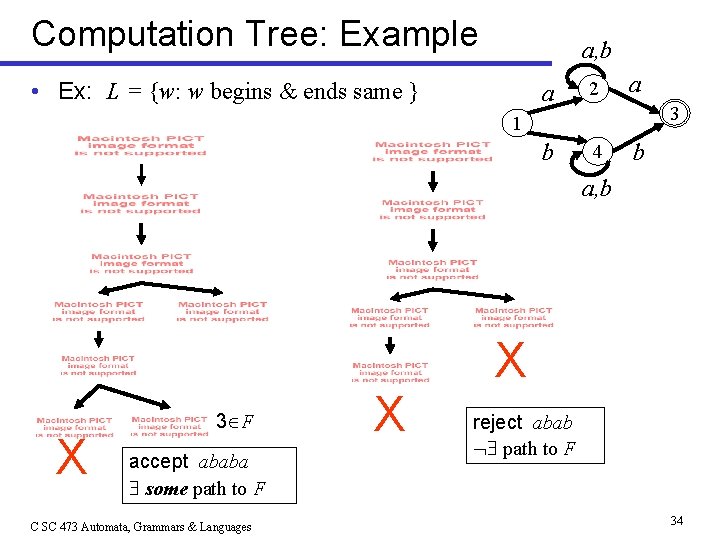
Computation Tree: Example a, b • Ex: L = {w: w begins & ends same } a 2 b 4 a 3 1 b a, b X X 3 F accept ababa some path to F C SC 473 Automata, Grammars & Languages X reject abab path to F 34
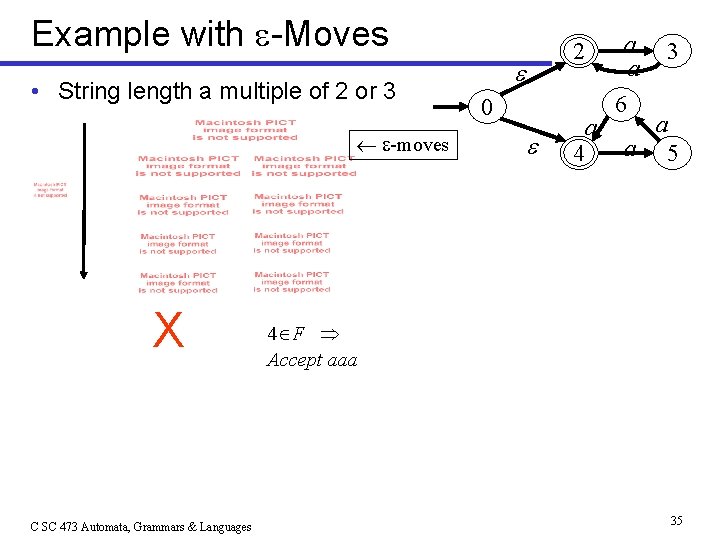
Example with -Moves • String length a multiple of 2 or 3 -moves X C SC 473 Automata, Grammars & Languages 2 0 a 4 a a 3 6 a a 5 4 F Accept aaa 35
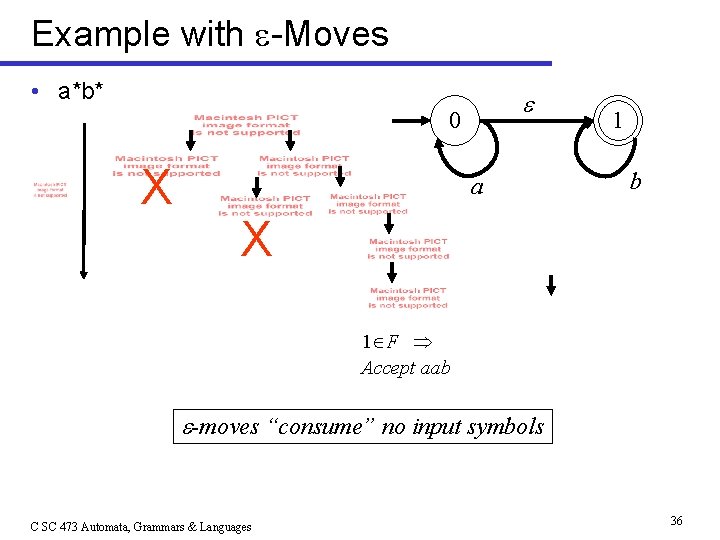
Example with -Moves • a*b* 0 X a 1 b X 1 F Accept aab -moves “consume” no input symbols C SC 473 Automata, Grammars & Languages 36
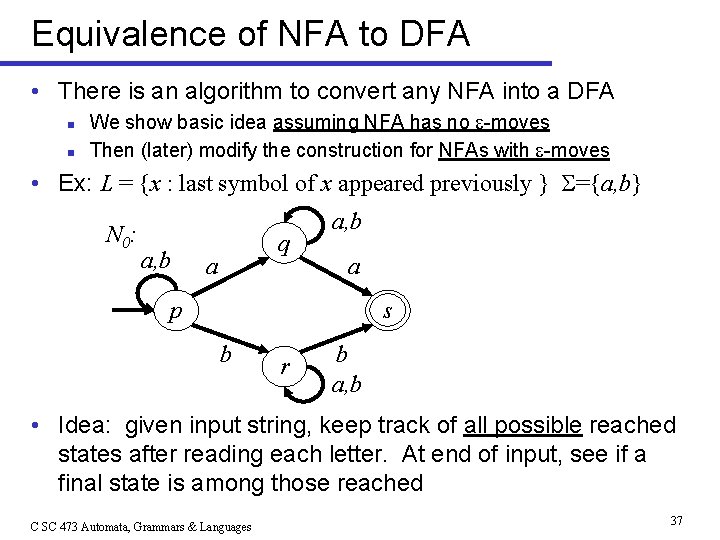
Equivalence of NFA to DFA • There is an algorithm to convert any NFA into a DFA n n We show basic idea assuming NFA has no -moves Then (later) modify the construction for NFAs with -moves • Ex: L = {x : last symbol of x appeared previously } ={a, b} N 0: a, b q a a, b a p s b r b a, b • Idea: given input string, keep track of all possible reached states after reading each letter. At end of input, see if a final state is among those reached C SC 473 Automata, Grammars & Languages 37
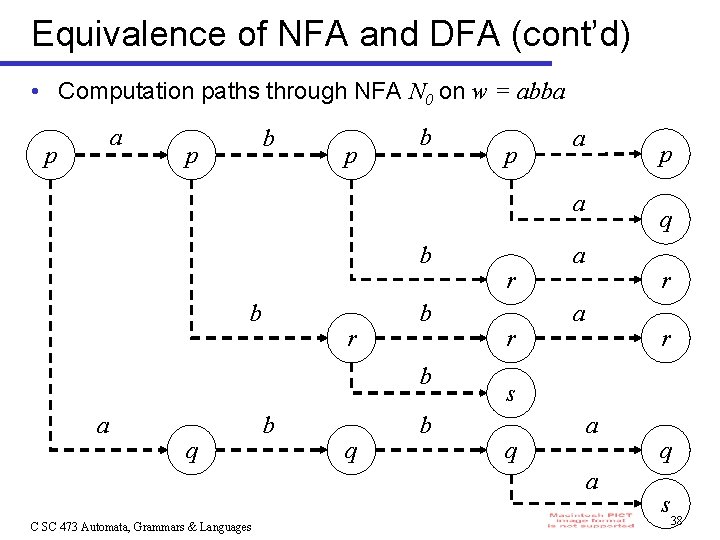
Equivalence of NFA and DFA (cont’d) • Computation paths through NFA N 0 on w = abba a p b p a p a b b r b b a q b r r q a r s q a a C SC 473 Automata, Grammars & Languages q s 38
Equivalence of NFA and DFA (cont’d) • Idea: keep a list of all possible states reachable by each prefix of w (“parallel worlds”). For NFA N 0: C SC 473 Automata, Grammars & Languages 39
Equivalence of NFA and DFA (cont’d) • Equivalent DFA M will have: n State set P (Q) n Alphabet n Start state “set” {q 0} n Accepting states {X Q : X F } n Deterministic transition function : P (Q) • Ex: For NFA N 0: C SC 473 Automata, Grammars & Languages 40
Equivalence of NFA and DFA (cont’d) • Thm: [Rabin-Scott Construction]. Let L = L(N) for some NFA N with no -moves. There is an algorithm to constuct a DFA M equivalent to N, i. e. with L(M) = L(N). Pf: Given N we construct a DFA M and then verify that it recognizes the same set as N. Construction: Given NFA construct where C SC 473 Automata, Grammars & Languages 41
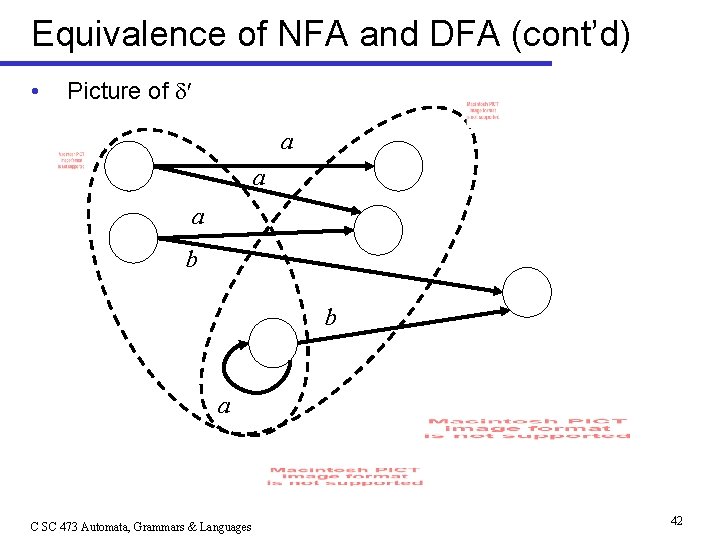
Equivalence of NFA and DFA (cont’d) • Picture of a a a b b a C SC 473 Automata, Grammars & Languages 42
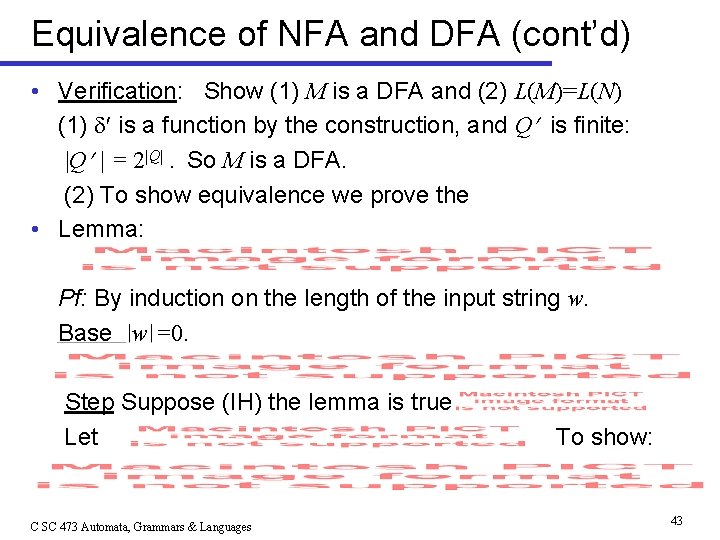
Equivalence of NFA and DFA (cont’d) • Verification: Show (1) M is a DFA and (2) L(M)=L(N) (1) is a function by the construction, and Q is finite: |Q | = 2|Q|. So M is a DFA. (2) To show equivalence we prove the • Lemma: Pf: By induction on the length of the input string w. Base |w|=0. Step Suppose (IH) the lemma is true Let C SC 473 Automata, Grammars & Languages To show: 43
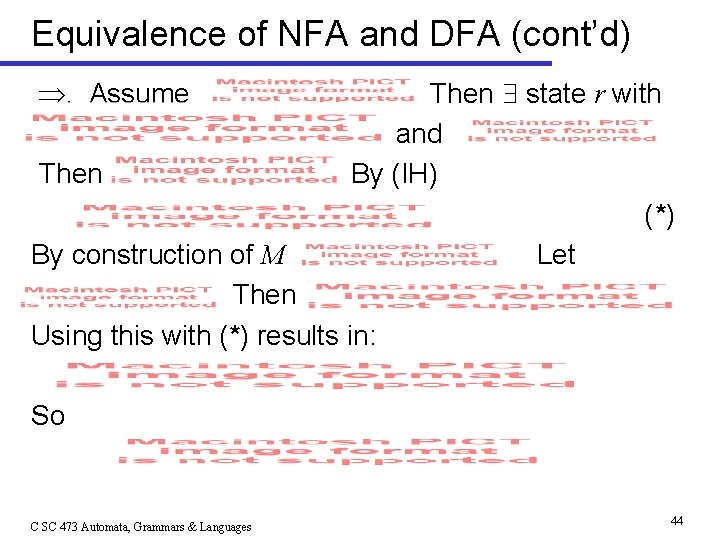
Equivalence of NFA and DFA (cont’d) . Assume Then state r with and By (IH) (*) Let By construction of M Then Using this with (*) results in: So C SC 473 Automata, Grammars & Languages 44
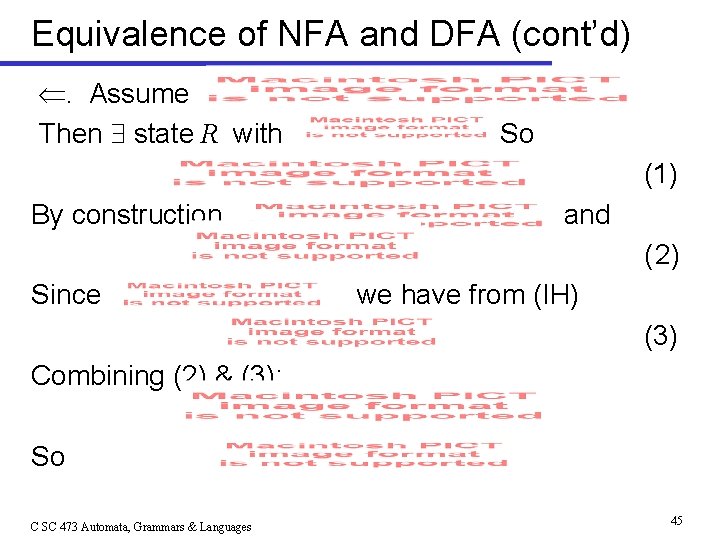
Equivalence of NFA and DFA (cont’d) . Assume Then state R with So (1) By construction and (2) Since we have from (IH) (3) Combining (2) & (3): So C SC 473 Automata, Grammars & Languages 45
Equivalence of NFA and DFA (cont’d) We now finish the verification proof. Let From the Lemma That is, C SC 473 Automata, Grammars & Languages for some 46
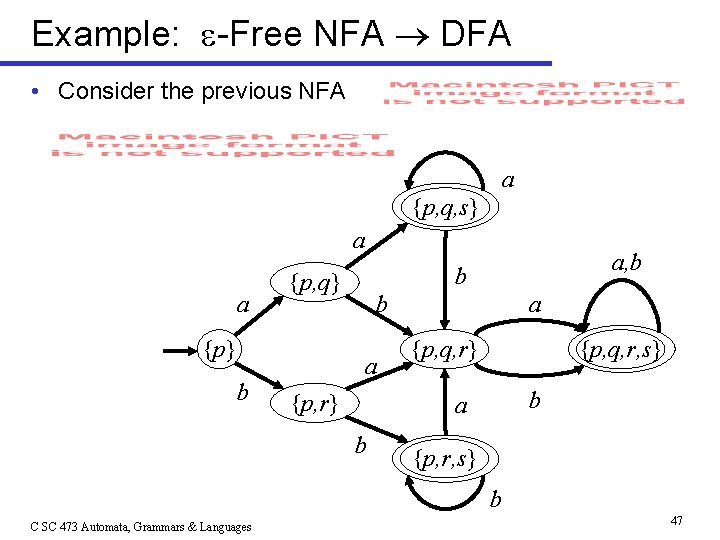
Example: -Free NFA DFA • Consider the previous NFA a {p, q, s} a a b b {p, q} {p} a, b b a {p, r} a {p, q, r} {p, q, r, s} b a b {p, r, s} b C SC 473 Automata, Grammars & Languages 47
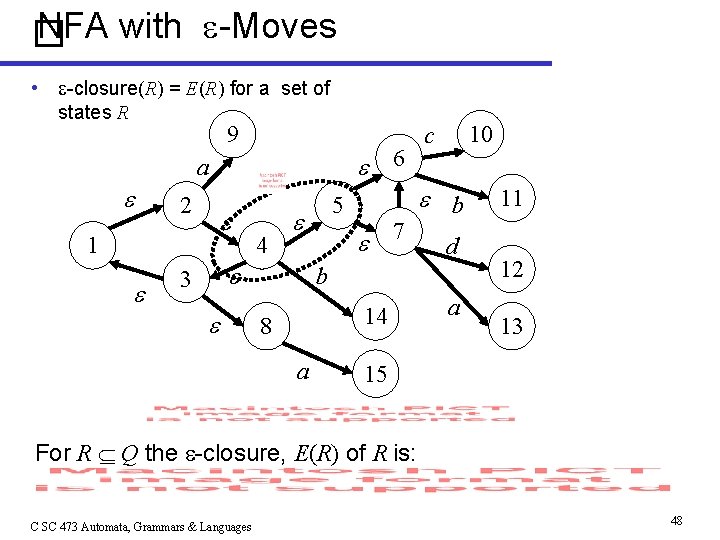
NFA with -Moves � • -closure(R) = E(R) for a set of states R 9 a 2 1 4 3 5 6 7 10 c b d b 14 8 a a 11 12 13 15 For R Q the -closure, E(R) of R is: C SC 473 Automata, Grammars & Languages 48
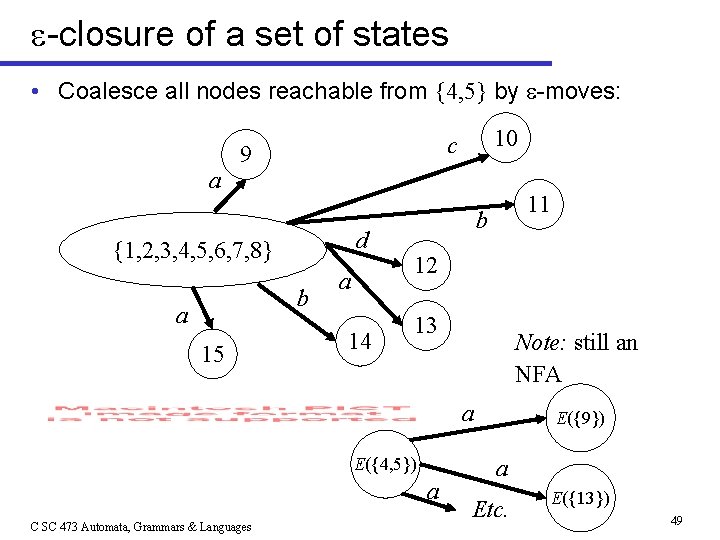
-closure of a set of states • Coalesce all nodes reachable from {4, 5} by -moves: a 9 d {1, 2, 3, 4, 5, 6, 7, 8} b a 15 10 c a 14 11 b 12 13 Note: still an NFA a E({4, 5}) a C SC 473 Automata, Grammars & Languages E({9}) a Etc. E({13}) 49
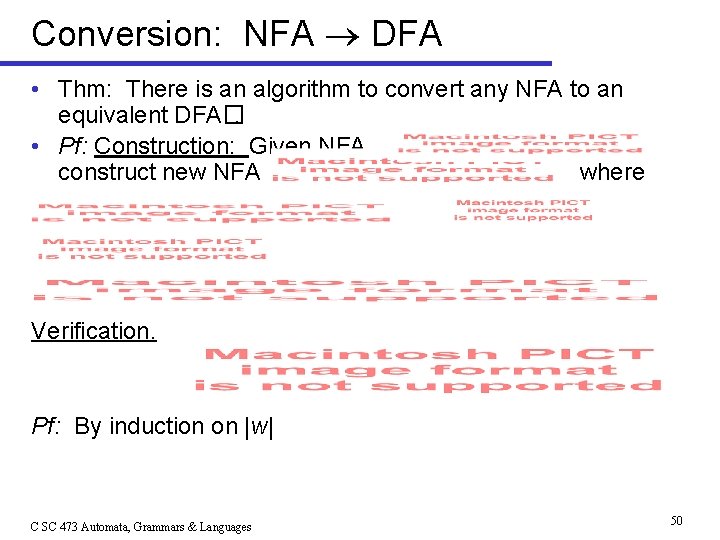
Conversion: NFA DFA • Thm: There is an algorithm to convert any NFA to an equivalent DFA�. • Pf: Construction: Given NFA construct new NFA where Verification. Pf: By induction on |w| C SC 473 Automata, Grammars & Languages 50
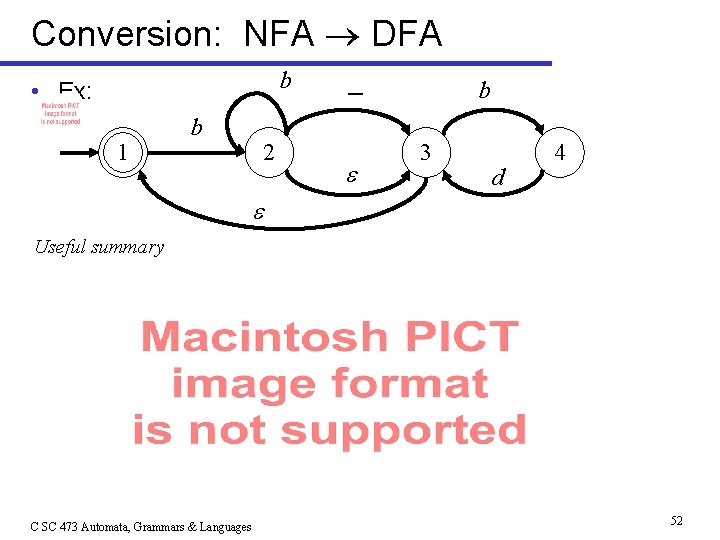
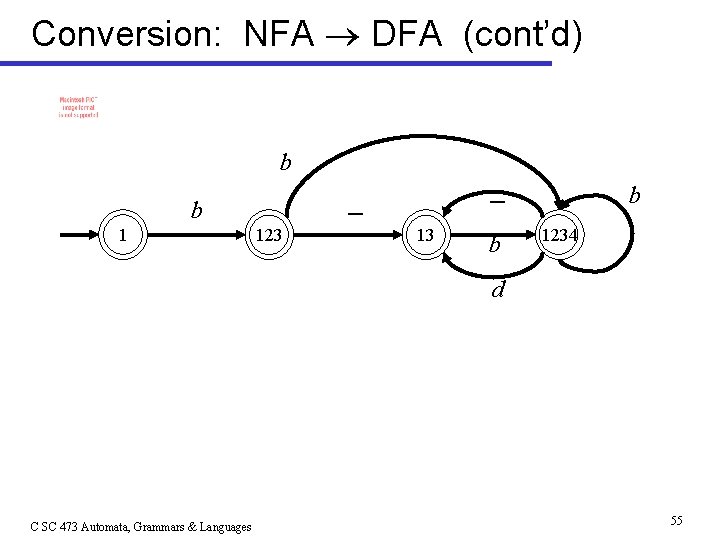
Conversion: NFA DFA • Thm 1. 39: [Rabin-Scott Theorem]: There is an algorithm to convert any NFA into an equivalent DFA. • Corollary 1. 40: A language is regular some NFA recognizes it. • Ex: Start with an NFA N 1 as follows: b 1 b 2 b 3 d 4 C SC 473 Automata, Grammars & Languages 51
Conversion: NFA DFA b • Ex: 1 b 2 b 3 d 4 Useful summary C SC 473 Automata, Grammars & Languages 52
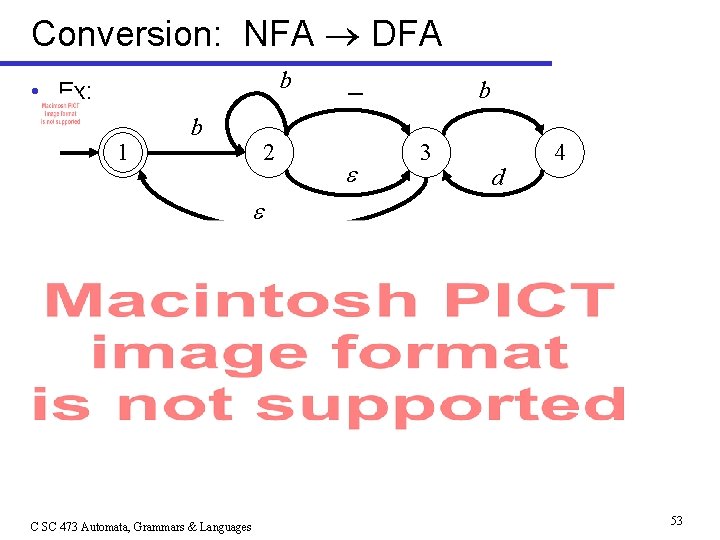
Conversion: NFA DFA b • Ex: 1 b 2 b 3 d 4 C SC 473 Automata, Grammars & Languages 53
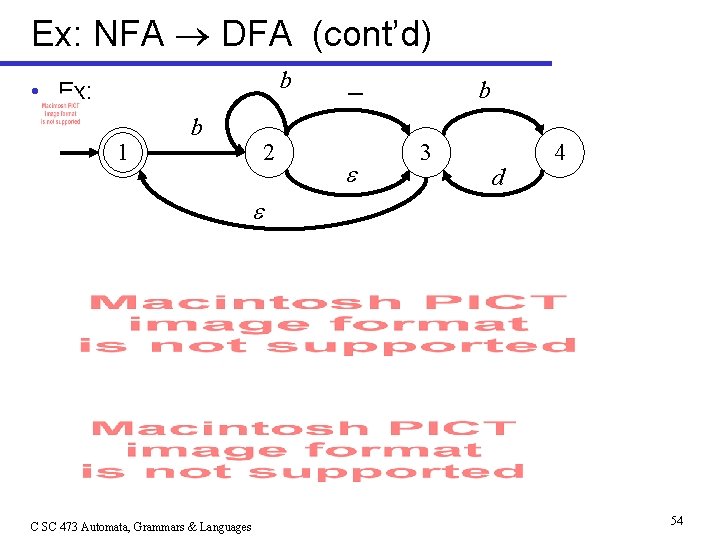
Ex: NFA DFA (cont’d) b • Ex: 1 b 2 b 3 d 4 C SC 473 Automata, Grammars & Languages 54
Conversion: NFA DFA (cont’d) b b 1 123 13 b b 1234 d C SC 473 Automata, Grammars & Languages 55
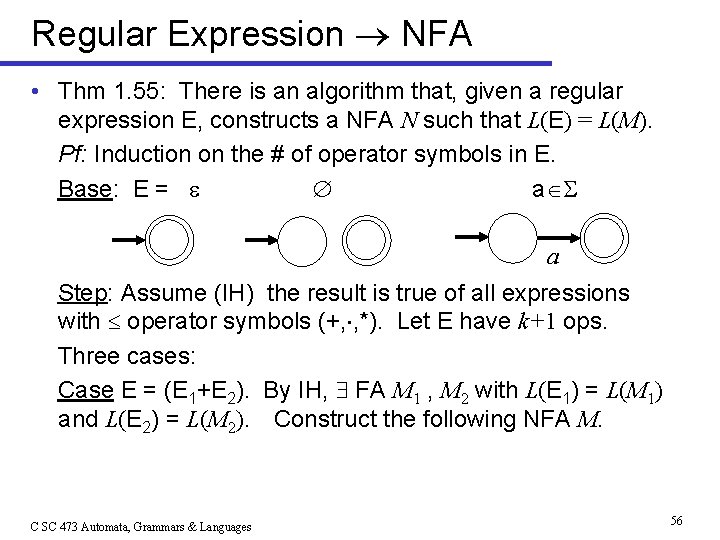
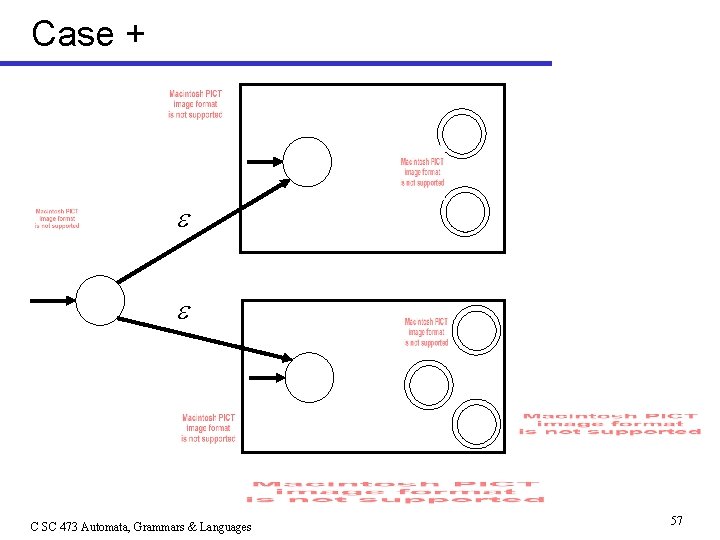
Regular Expression NFA • Thm 1. 55: There is an algorithm that, given a regular expression E, constructs a NFA N such that L(E) = L(M). Pf: Induction on the # of operator symbols in E. Base: E = a a Step: Assume (IH) the result is true of all expressions with operator symbols (+, , *). Let E have k+1 ops. Three cases: Case E = (E 1+E 2). By IH, FA M 1 , M 2 with L(E 1) = L(M 1) and L(E 2) = L(M 2). Construct the following NFA M. C SC 473 Automata, Grammars & Languages 56
Case + C SC 473 Automata, Grammars & Languages 57
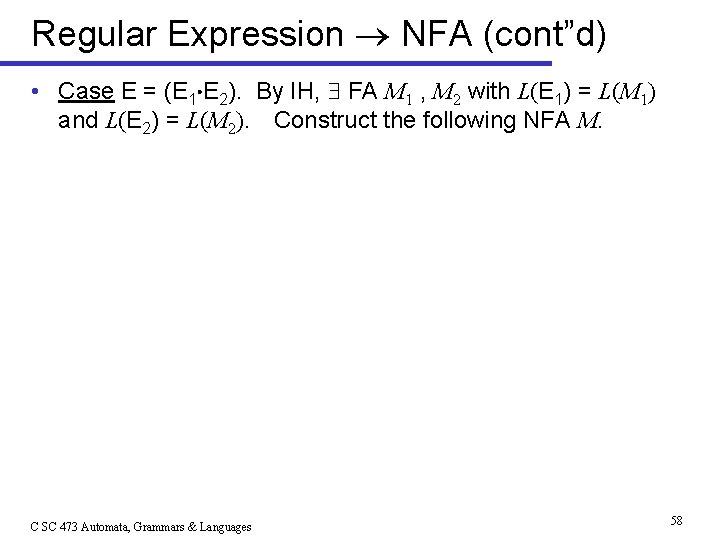
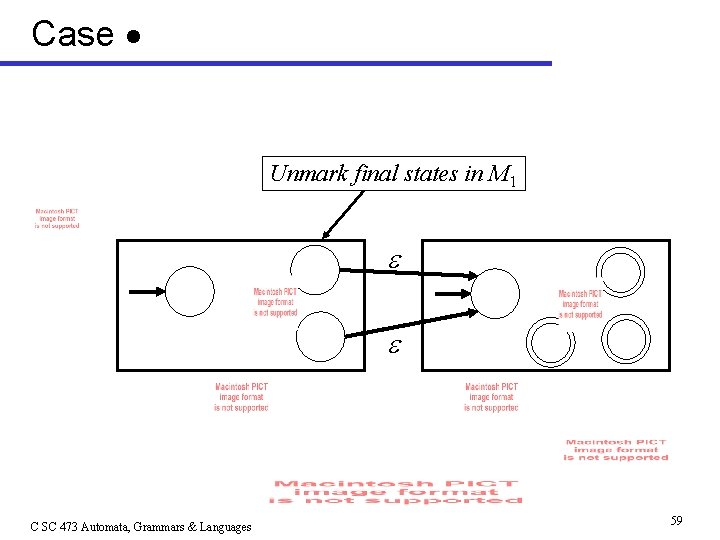
Regular Expression NFA (cont”d) • Case E = (E 1 E 2). By IH, FA M 1 , M 2 with L(E 1) = L(M 1) and L(E 2) = L(M 2). Construct the following NFA M. C SC 473 Automata, Grammars & Languages 58
Case Unmark final states in M 1 C SC 473 Automata, Grammars & Languages 59
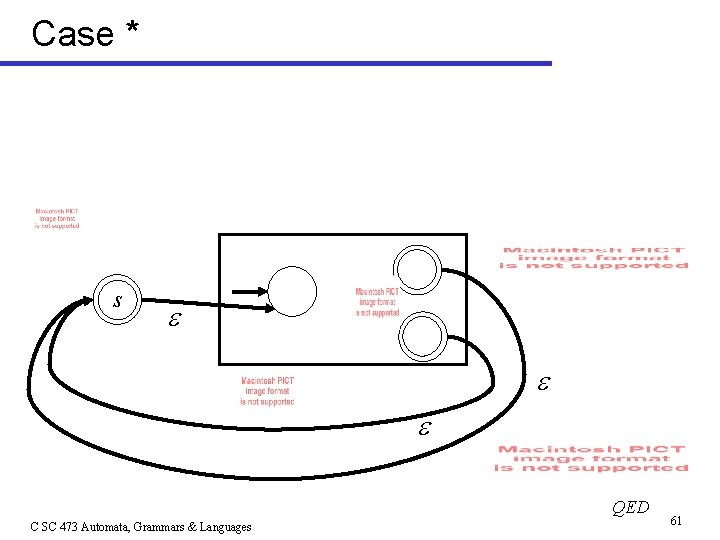
Regular Expression NFA (cont”d) • Case E = (E 1)*. By IH, FA M 1 with L(E 1) = L(M 1). Construct the following NFA M. C SC 473 Automata, Grammars & Languages 60
Case * s QED C SC 473 Automata, Grammars & Languages 61
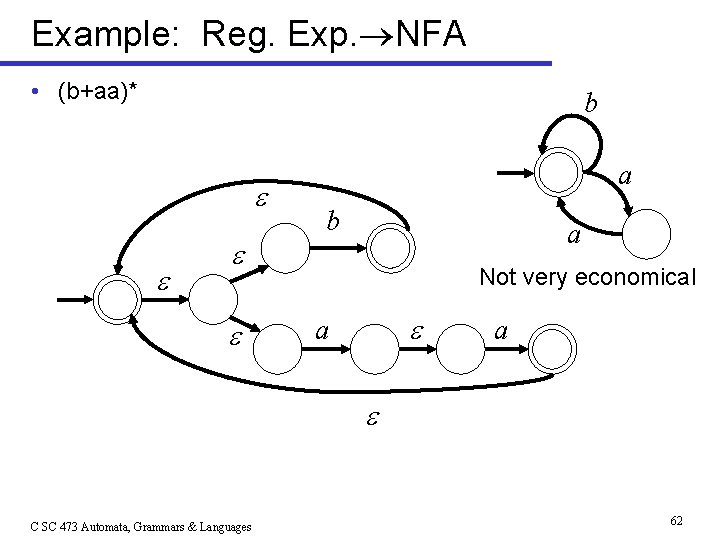
Example: Reg. Exp. NFA • (b+aa)* b a b a Not very economical a a C SC 473 Automata, Grammars & Languages 62
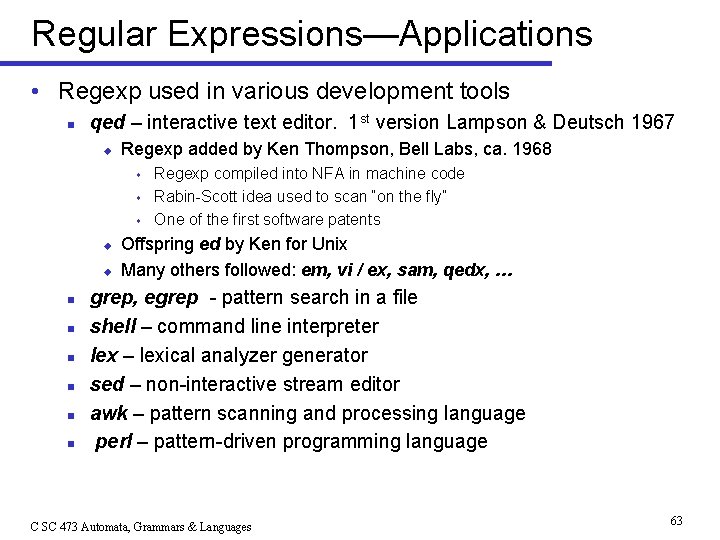
Regular Expressions—Applications • Regexp used in various development tools n qed – interactive text editor. 1 st version Lampson & Deutsch 1967 u Regexp added by Ken Thompson, Bell Labs, ca. 1968 s s s u u n n n Regexp compiled into NFA in machine code Rabin-Scott idea used to scan “on the fly” One of the first software patents Offspring ed by Ken for Unix Many others followed: em, vi / ex, sam, qedx, … grep, egrep - pattern search in a file shell – command line interpreter lex – lexical analyzer generator sed – non-interactive stream editor awk – pattern scanning and processing language perl – pattern-driven programming language C SC 473 Automata, Grammars & Languages 63
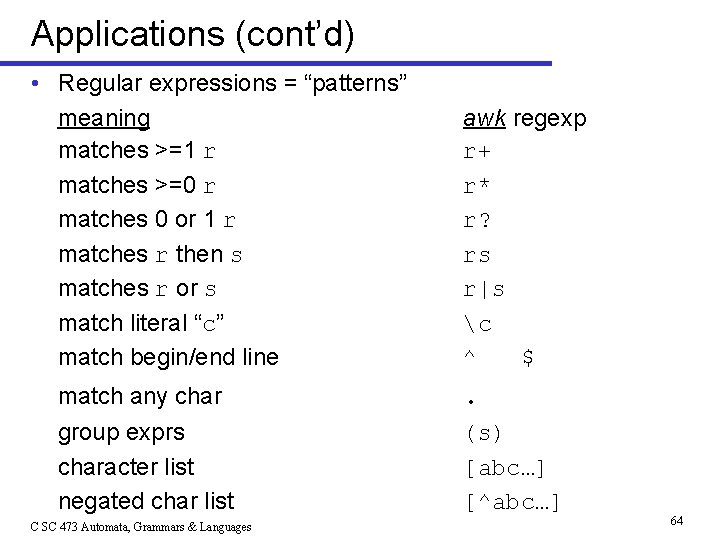
Applications (cont’d) • Regular expressions = “patterns” meaning matches >=1 r matches >=0 r matches 0 or 1 r matches r then s matches r or s match literal “c” match begin/end line match any char group exprs character list negated char list C SC 473 Automata, Grammars & Languages awk regexp r+ r* r? rs r|s c ^ $ . (s) [abc…] [^abc…] 64
Applications--Examples -? [0 -9]+ [^0 -9] [. *] g/^[ ]*$/d g/[ ]+/d nonempty digit strings, optional sign any char except digit reference citations in a paper delete blank lines delete lines with a blank Ex: match is always (1) leftmost and (2) longest file: abcddddef vi: s/d*/x/ xabcddddef s/d+/x/ abcxef Ex: csh: sort roll[1 -5] | egrep “C SC|MATH” | pr C SC 473 Automata, Grammars & Languages 65
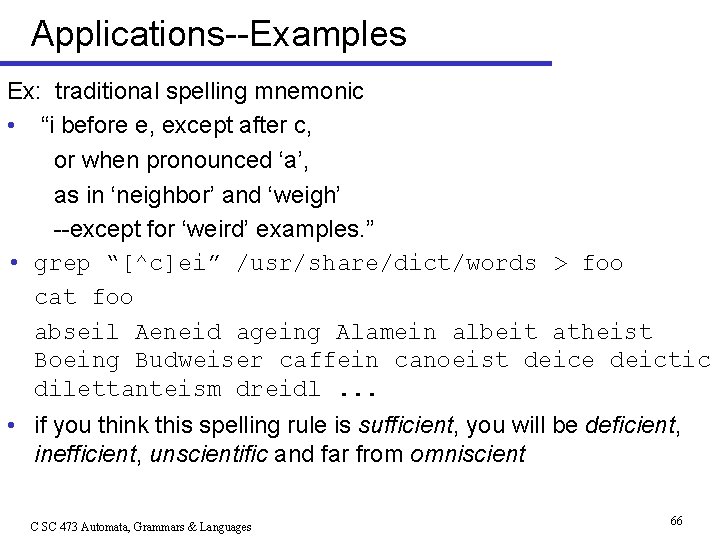
Applications--Examples Ex: traditional spelling mnemonic • “i before e, except after c, or when pronounced ‘a’, as in ‘neighbor’ and ‘weigh’ --except for ‘weird’ examples. ” • grep “[^c]ei” /usr/share/dict/words > foo cat foo abseil Aeneid ageing Alamein albeit atheist Boeing Budweiser caffein canoeist deice deictic dilettanteism dreidl. . . • if you think this spelling rule is sufficient, you will be deficient, inefficient, unscientific and far from omniscient C SC 473 Automata, Grammars & Languages 66
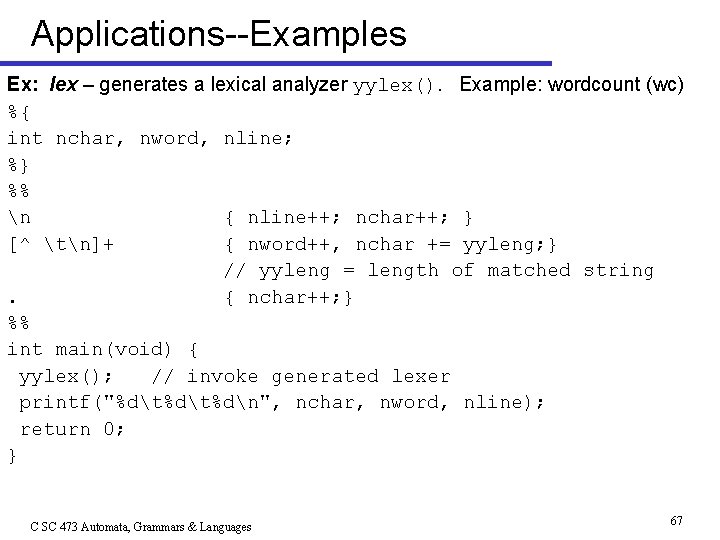
Applications--Examples Ex: lex – generates a lexical analyzer yylex(). Example: wordcount (wc) %{ int nchar, nword, nline; %} %% n { nline++; nchar++; } [^ tn]+ { nword++, nchar += yyleng; } // yyleng = length of matched string. { nchar++; } %% int main(void) { yylex(); // invoke generated lexer printf("%dt%dn", nchar, nword, nline); return 0; } C SC 473 Automata, Grammars & Languages 67
L Regular L Denoted by a Reg. Expr. • We’ve defined “regular” as meaning: recognized by a DFA (equiv. to rec. by an NFA) • This equivalence result is known as “Kleene’s Theorem” • We’ve already shown the direction—we constructed an NFA from a regular expression (Using Rabin-Scott we could convert this NFA to a DFA. ) • Now we show the direction: given a DFA M construct a regular expr. E with L(M) = L(E). • Thm (Kleene): There is an algorithm that, given a DFA M , computes a regular expression E such that L(M) = L(E). • Pf: Given the graph of the DFA, use the “node elimination algorithm” to gradually eliminate all nodes in favor of expressions on the edges of the graph. C SC 473 Automata, Grammars & Languages 68
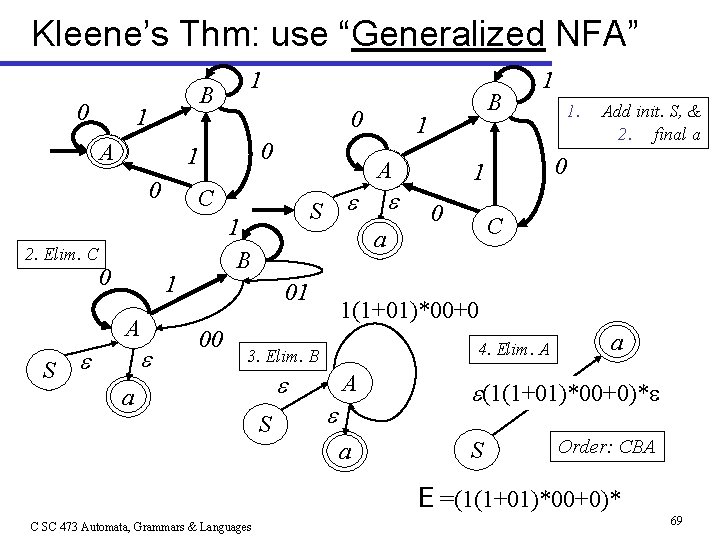
Kleene’s Thm: use “Generalized NFA” 0 B 1 A 0 0 1 0 0 A a 01 00 1 S 1 B 1 S 1 Add init. S, & 2. final a 0 1. C 1(1+01)*00+0 4. Elim. A 3. Elim. B a B A C 2. Elim. C S 1 a A (1(1+01)*00+0)* a S Order: CBA E =(1(1+01)*00+0)* C SC 473 Automata, Grammars & Languages 69
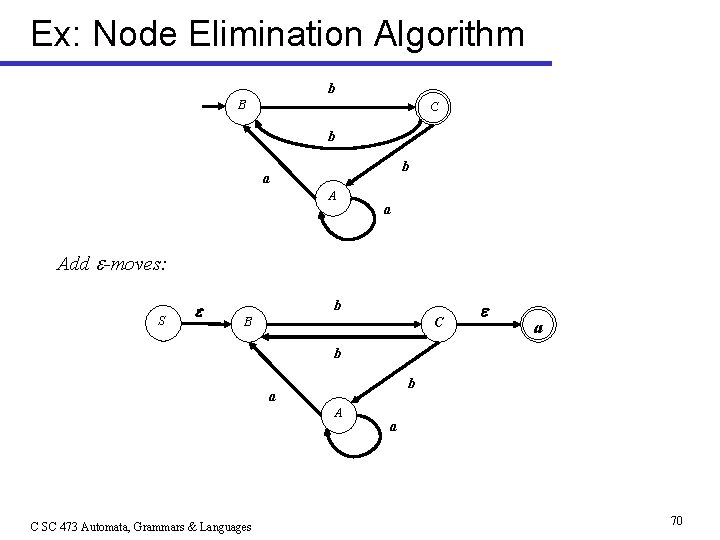
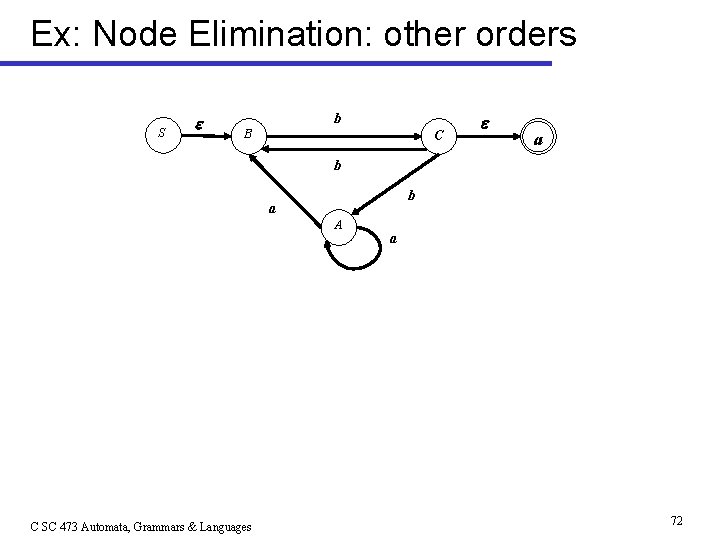
Ex: Node Elimination Algorithm b B C b b a Add -moves: S b C B a b b a A C SC 473 Automata, Grammars & Languages a 70
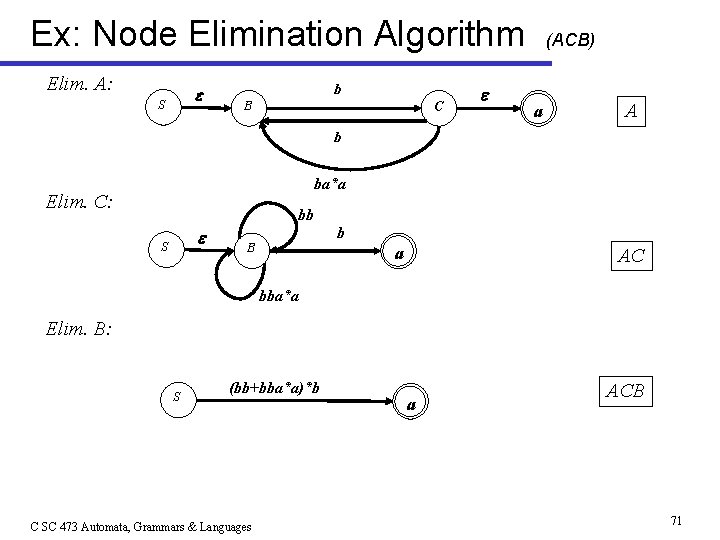
Ex: Node Elimination Algorithm Elim. A: S b C B (ACB) a A b ba*a Elim. C: bb S b B a AC bba*a Elim. B: S (bb+bba*a)*b C SC 473 Automata, Grammars & Languages a ACB 71
Ex: Node Elimination: other orders S b C B a b b a A C SC 473 Automata, Grammars & Languages a 72
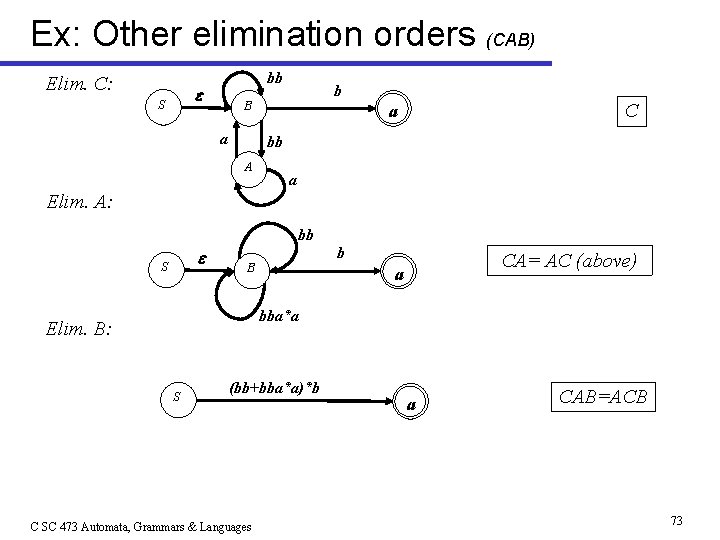
Ex: Other elimination orders (CAB) Elim. C: bb S b B a C a bb A a Elim. A: bb S b B CA= AC (above) a bba*a Elim. B: S (bb+bba*a)*b C SC 473 Automata, Grammars & Languages a CAB=ACB 73
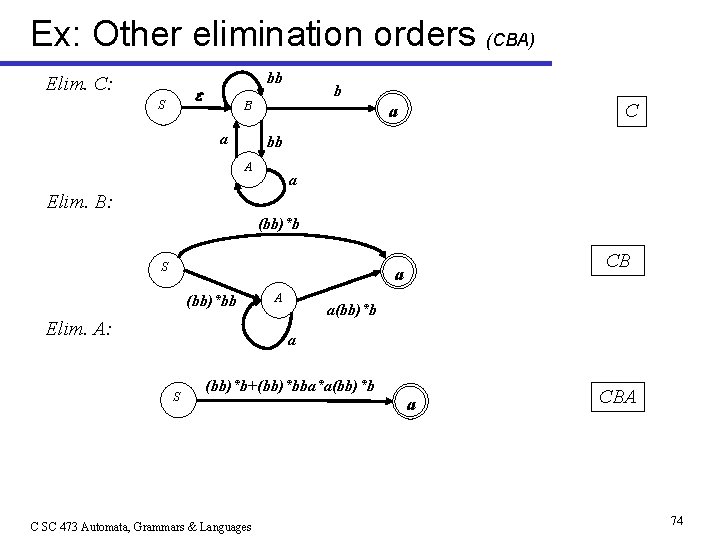
Ex: Other elimination orders (CBA) Elim. C: bb S b B a C a bb A a Elim. B: (bb)*b S CB a (bb)*bb Elim. A: A a(bb)*b a S (bb)*b+(bb)*bba*a(bb)*b C SC 473 Automata, Grammars & Languages a CBA 74
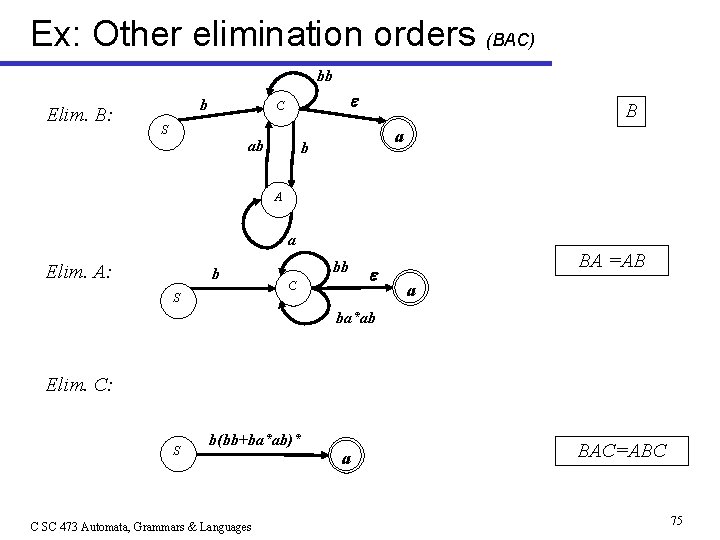
Ex: Other elimination orders (BAC) bb Elim. B: b C B S ab a b A a Elim. A: b S bb C BA =AB a ba*ab Elim. C: S b(bb+ba*ab)* C SC 473 Automata, Grammars & Languages a BAC=ABC 75
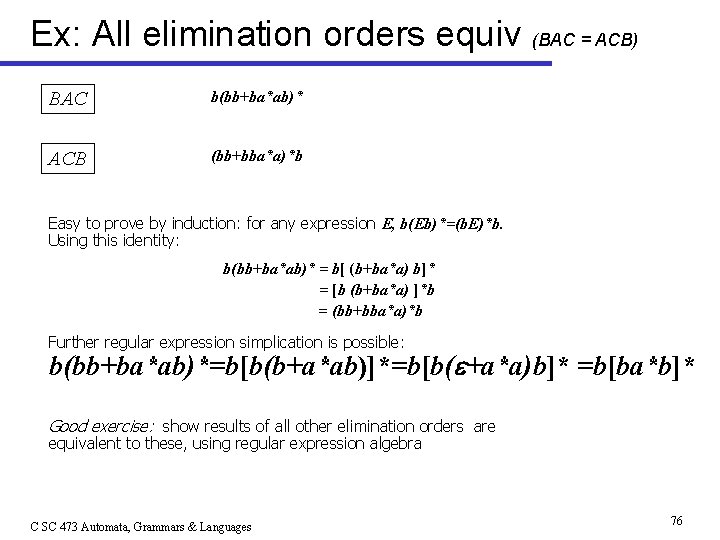
Ex: All elimination orders equiv (BAC = ACB) BAC b(bb+ba*ab)* ACB (bb+bba*a)*b Easy to prove by induction: for any expression E, b(Eb)*=(b. E)*b. Using this identity: b(bb+ba*ab)* = b[ (b+ba*a) b]* = [b (b+ba*a) ]*b = (bb+bba*a)*b Further regular expression simplication is possible: b(bb+ba*ab)*=b[b(b+a*ab)]*=b[b( +a*a)b]* =b[ba*b]* Good exercise: show results of all other elimination orders are equivalent to these, using regular expression algebra C SC 473 Automata, Grammars & Languages 76
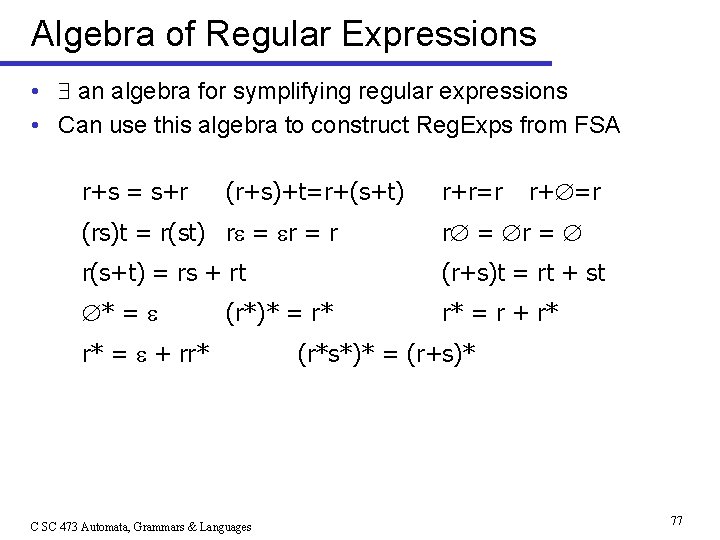
Algebra of Regular Expressions • an algebra for symplifying regular expressions • Can use this algebra to construct Reg. Exps from FSA r+s = s+r (r+s)+t=r+(s+t) r+r=r r+ =r (rs)t = r(st) r = r r = r(s+t) = rs + rt (r+s)t = rt + st * = r* = r + r* (r*)* = r* r* = + rr* C SC 473 Automata, Grammars & Languages (r*s*)* = (r+s)* 77
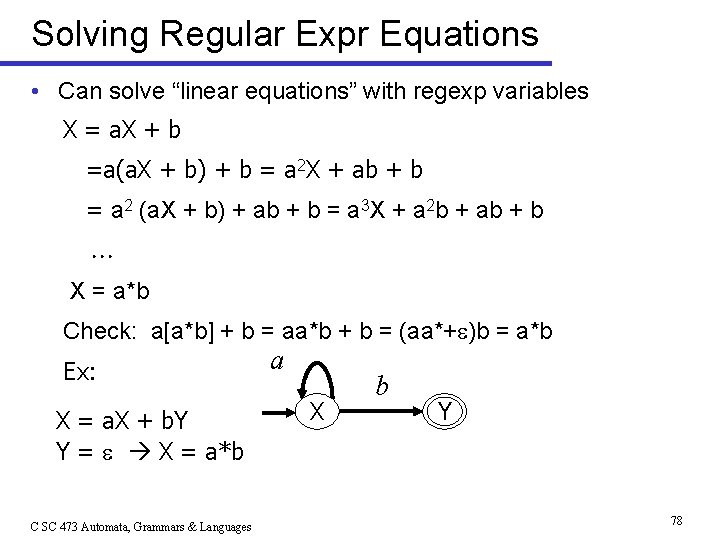
Solving Regular Expr Equations • Can solve “linear equations” with regexp variables X = a. X + b =a(a. X + b) + b = a 2 X + ab + b = a 2 (a. X + b) + ab + b = a 3 X + a 2 b + ab + b X = a*b Check: a[a*b] + b = aa*b + b = (aa*+ )b = a*b Ex: X = a. X + b. Y Y = X = a*b C SC 473 Automata, Grammars & Languages a X b Y 78
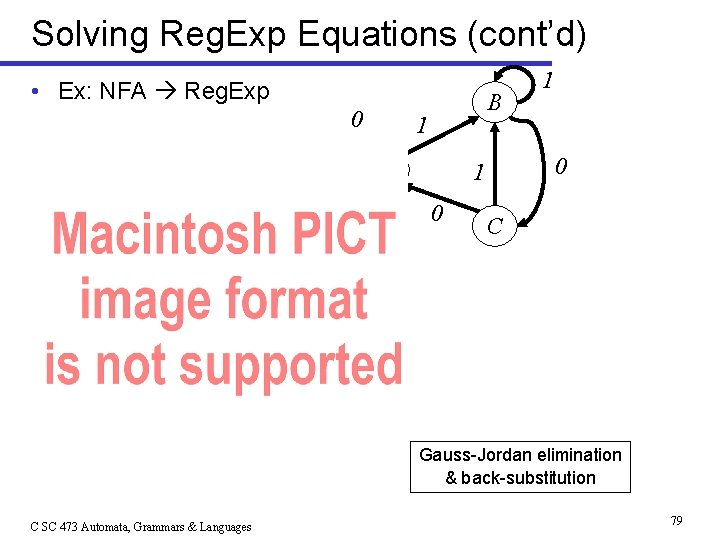
Solving Reg. Exp Equations (cont’d) • Ex: NFA Reg. Exp 0 B 1 A 0 1 C Gauss-Jordan elimination & back-substitution C SC 473 Automata, Grammars & Languages 79
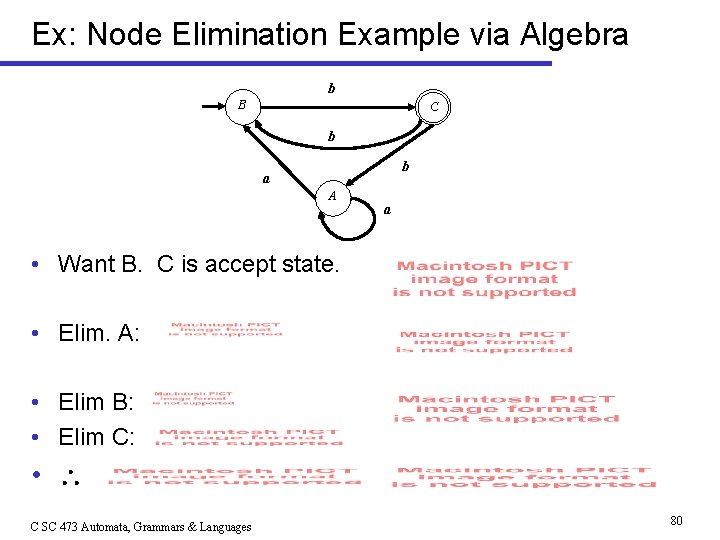
Ex: Node Elimination Example via Algebra b B C b b a A a • Want B. C is accept state. • Elim. A: • Elim B: • Elim C: • C SC 473 Automata, Grammars & Languages 80
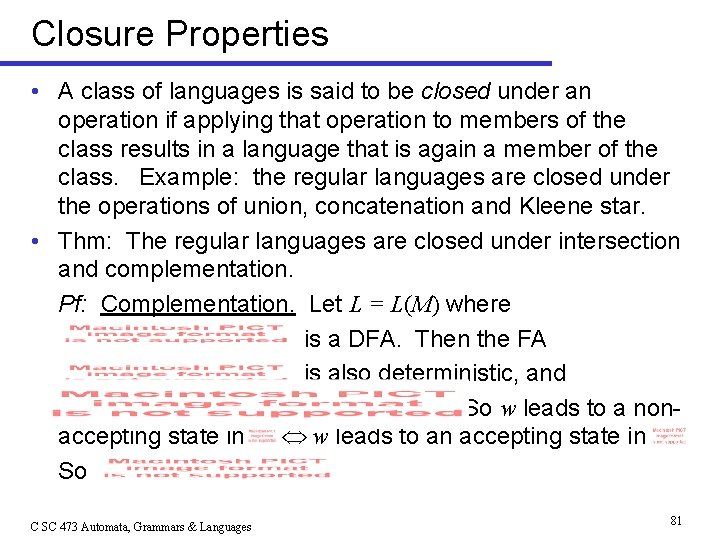
Closure Properties • A class of languages is said to be closed under an operation if applying that operation to members of the class results in a language that is again a member of the class. Example: the regular languages are closed under the operations of union, concatenation and Kleene star. • Thm: The regular languages are closed under intersection and complementation. Pf: Complementation. Let L = L(M) where is a DFA. Then the FA is also deterministic, and So w leads to a nonaccepting state in w leads to an accepting state in So C SC 473 Automata, Grammars & Languages 81
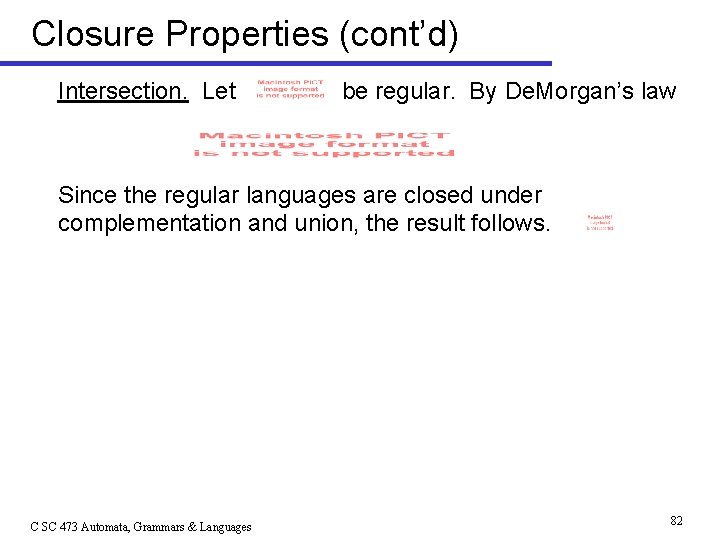
Closure Properties (cont’d) Intersection. Let be regular. By De. Morgan’s law Since the regular languages are closed under complementation and union, the result follows. C SC 473 Automata, Grammars & Languages 82
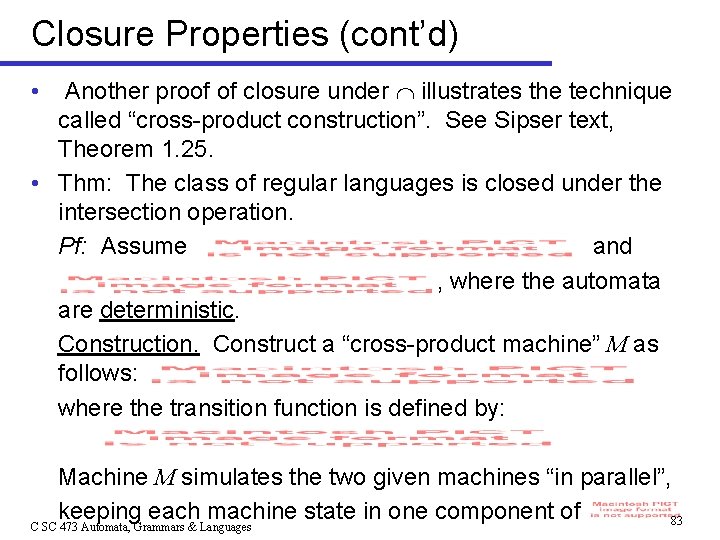
Closure Properties (cont’d) Another proof of closure under illustrates the technique called “cross-product construction”. See Sipser text, Theorem 1. 25. • Thm: The class of regular languages is closed under the intersection operation. Pf: Assume and , where the automata are deterministic. Construction. Construct a “cross-product machine” M as follows: where the transition function is defined by: • Machine M simulates the two given machines “in parallel”, keeping each machine state in one component of 83 C SC 473 Automata, Grammars & Languages
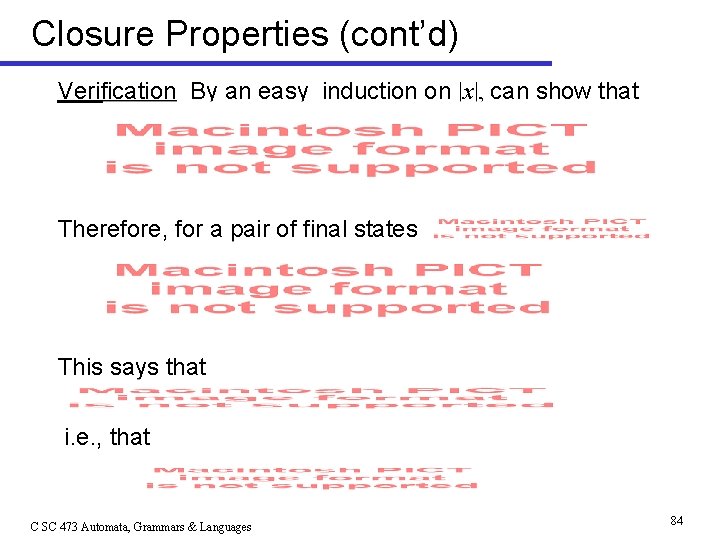
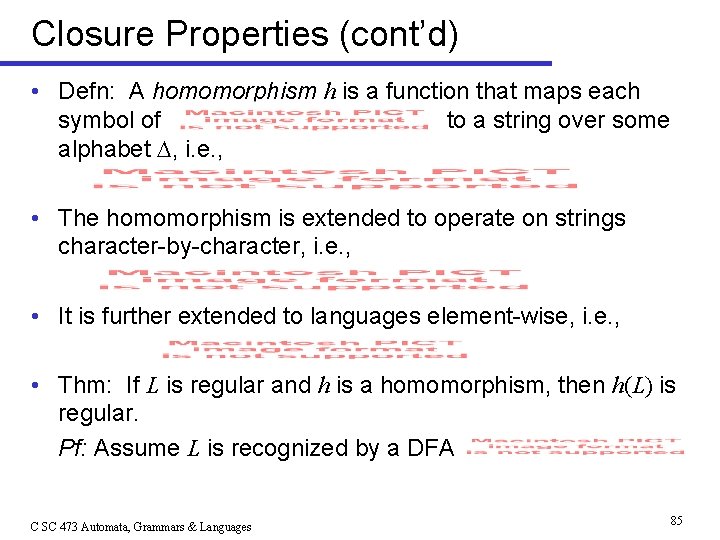
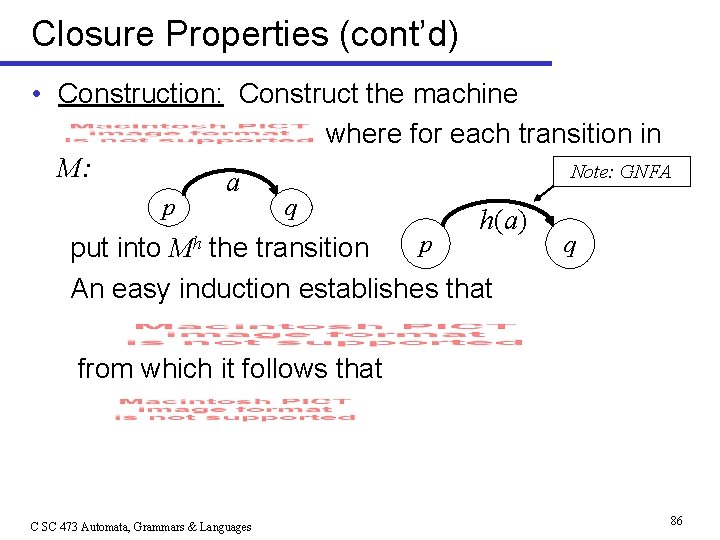
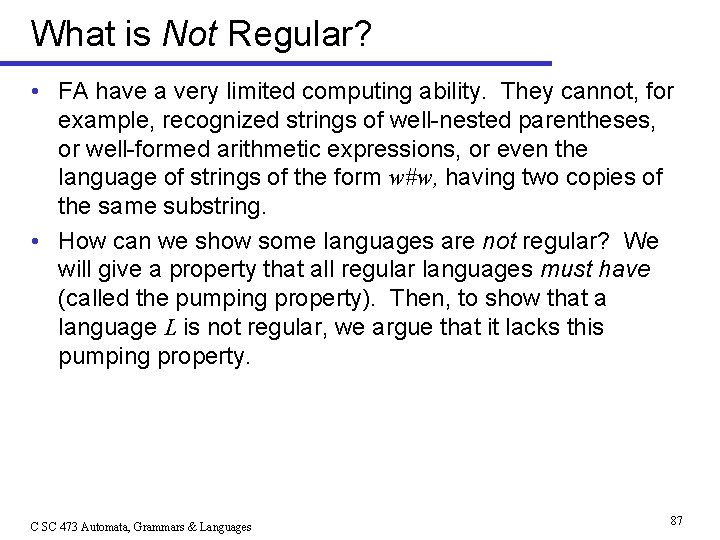
Closure Properties (cont’d) Verification By an easy induction on |x|, can show that Therefore, for a pair of final states This says that i. e. , that C SC 473 Automata, Grammars & Languages 84
Closure Properties (cont’d) • Defn: A homomorphism h is a function that maps each symbol of to a string over some alphabet , i. e. , • The homomorphism is extended to operate on strings character-by-character, i. e. , • It is further extended to languages element-wise, i. e. , • Thm: If L is regular and h is a homomorphism, then h(L) is regular. Pf: Assume L is recognized by a DFA C SC 473 Automata, Grammars & Languages 85
Closure Properties (cont’d) • Construction: Construct the machine where for each transition in M: Note: GNFA a p q h(a) p q put into Mh the transition An easy induction establishes that from which it follows that C SC 473 Automata, Grammars & Languages 86
What is Not Regular? • FA have a very limited computing ability. They cannot, for example, recognized strings of well-nested parentheses, or well-formed arithmetic expressions, or even the language of strings of the form w#w, having two copies of the same substring. • How can we show some languages are not regular? We will give a property that all regular languages must have (called the pumping property). Then, to show that a language L is not regular, we argue that it lacks this pumping property. C SC 473 Automata, Grammars & Languages 87
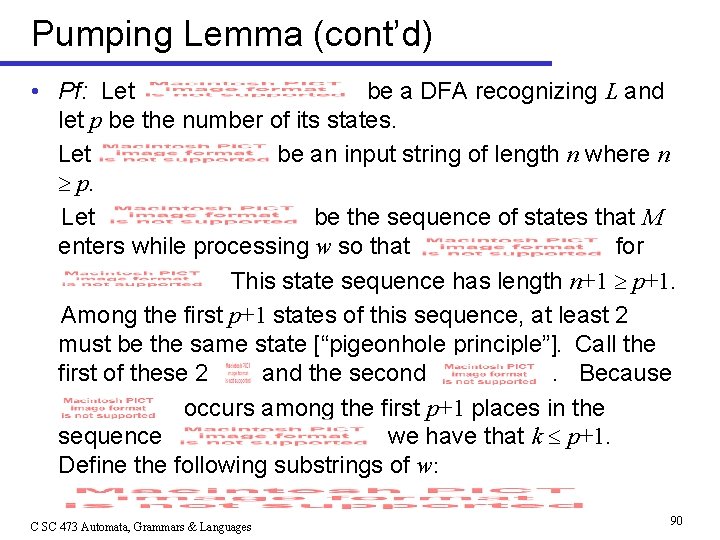
Pumping Lemma • Thm [Pumping Lemma for Regular Languages]. Suppose that L is an infinite¹ regular language. Then ¹All finite languages are regular, so only infinite languages are of interest. C SC 473 Automata, Grammars & Languages 88
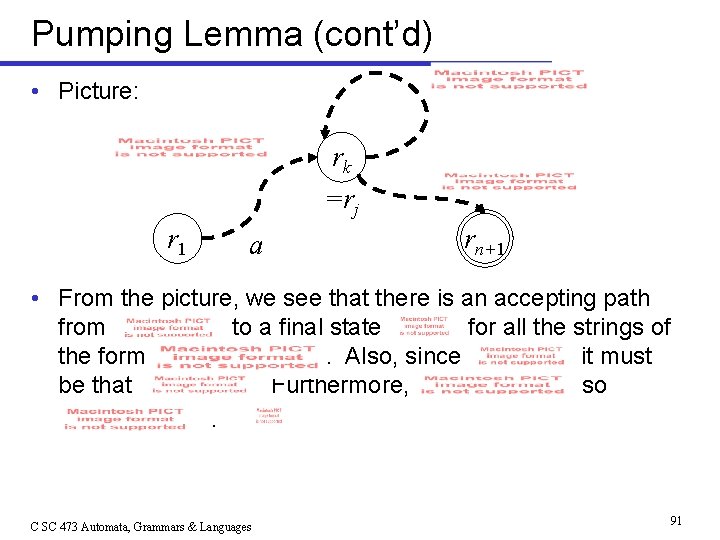
Pumping Lemma (English) • Thm [Pumping Lemma for Regular Languages]. Suppose that L is an infinite¹ regular language. Then there is some number p (called the pumping length) such that: if w is any string in L with |w| p, then w can be factored into 3 substrings, w = xyz, that satisfy the following 3 conditions: (i) y [y is not empty] (ii) |xy| p [the prefix and pumped part are short] (iii) for every i 0, xyiz L [“pumped up” and “pumped down” (i = 0) versions of the string must also be in L] ¹All finite languages are regular, so only infinite languages are of interest. C SC 473 Automata, Grammars & Languages 89
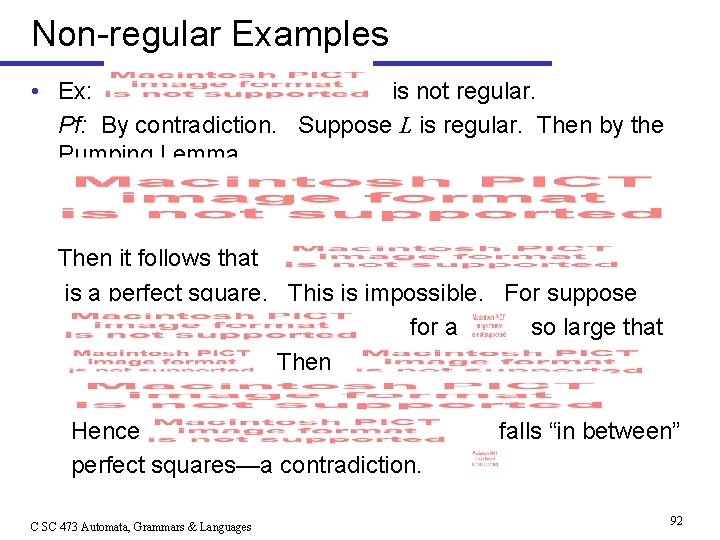
Pumping Lemma (cont’d) • Pf: Let be a DFA recognizing L and let p be the number of its states. Let be an input string of length n where n p. Let be the sequence of states that M enters while processing w so that for This state sequence has length n+1 p+1. Among the first p+1 states of this sequence, at least 2 must be the same state [“pigeonhole principle”]. Call the first of these 2 and the second. Because occurs among the first p+1 places in the sequence we have that k p+1. Define the following substrings of w: C SC 473 Automata, Grammars & Languages 90
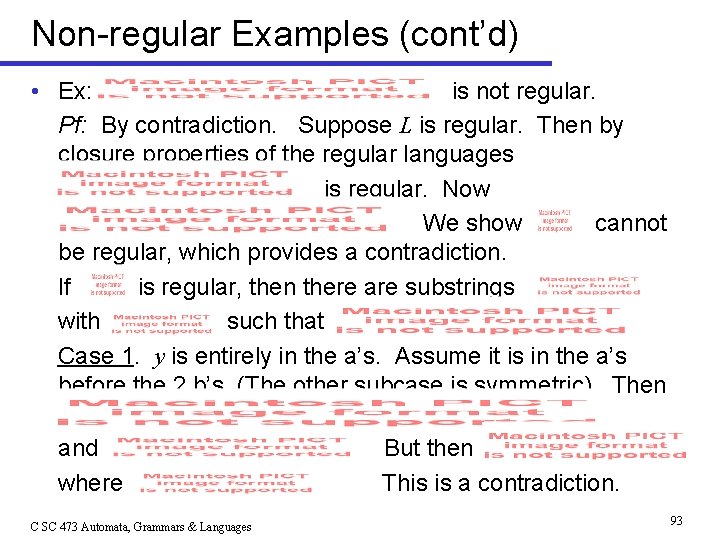
Pumping Lemma (cont’d) • Picture: rk =rj r 1 a rn+1 • From the picture, we see that there is an accepting path from to a final state for all the strings of the form. Also, since it must be that Furthermore, so. C SC 473 Automata, Grammars & Languages 91
Non-regular Examples • Ex: is not regular. Pf: By contradiction. Suppose L is regular. Then by the Pumping Lemma, Then it follows that is a perfect square. This is impossible. For suppose for a so large that Then Hence perfect squares—a contradiction. C SC 473 Automata, Grammars & Languages falls “in between” 92
Non-regular Examples (cont’d) • Ex: is not regular. Pf: By contradiction. Suppose L is regular. Then by closure properties of the regular languages is regular. Now We show cannot be regular, which provides a contradiction. If is regular, then there are substrings with such that Case 1. y is entirely in the a’s. Assume it is in the a’s before the 2 b’s (The other subcase is symmetric). Then and where C SC 473 Automata, Grammars & Languages But then This is a contradiction. 93
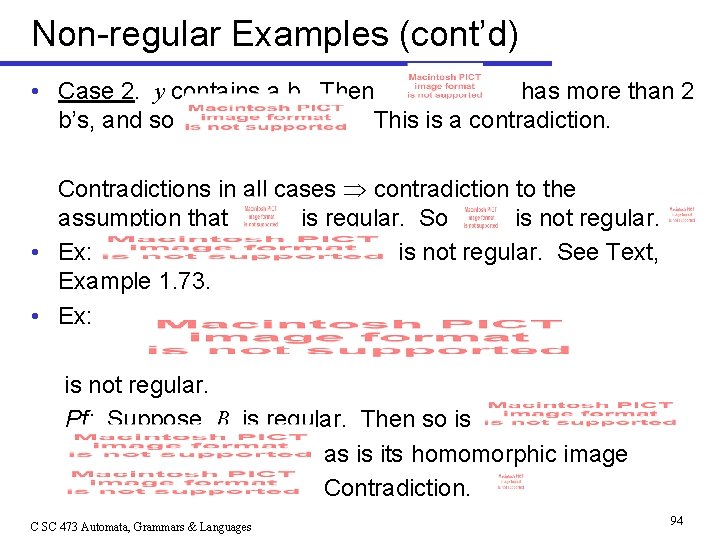
Non-regular Examples (cont’d) • Case 2. y contains a b. Then has more than 2 b’s, and so This is a contradiction. Contradictions in all cases contradiction to the assumption that is regular. So is not regular. • Ex: is not regular. See Text, Example 1. 73. • Ex: is not regular. Pf: Suppose B is regular. Then so is as is its homomorphic image Contradiction. C SC 473 Automata, Grammars & Languages 94
Decision Problems • For a property/predicate P the decision problem for P is: n n • • Given: x Question: Is P(x) true? Ex: Given DFA M, is it true that L(M) = ? Thm: For DFA M all the following decision problems are solvable, i. e. there exists an algorithm to decide the question for any input: Given Question M, w w L(M) ? M L(M) = * ? M, M L(M) L(M ) ? M, M L(M) = L(M ) ? C SC 473 Automata, Grammars & Languages 95
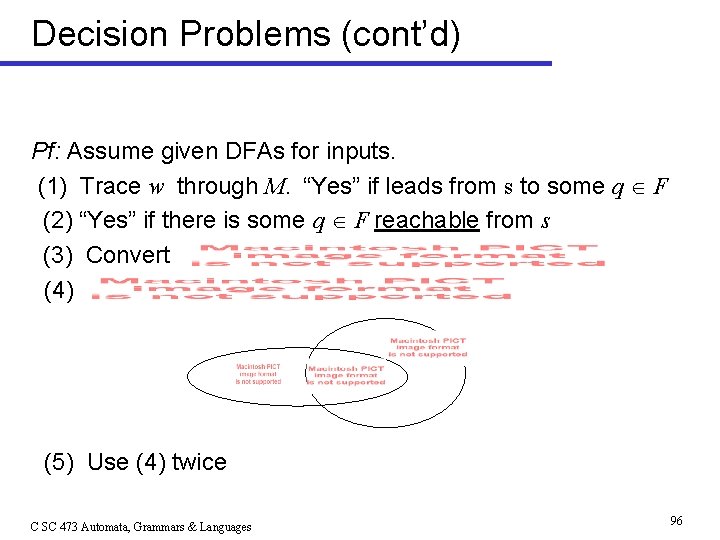
Decision Problems (cont’d) Pf: Assume given DFAs for inputs. (1) Trace w through M. “Yes” if leads from s to some q F (2) “Yes” if there is some q F reachable from s (3) Convert (4) (5) Use (4) twice C SC 473 Automata, Grammars & Languages 96