
Autologous Blood Donation Contents Introduction Categories Advantages and

Autologous Blood Donation
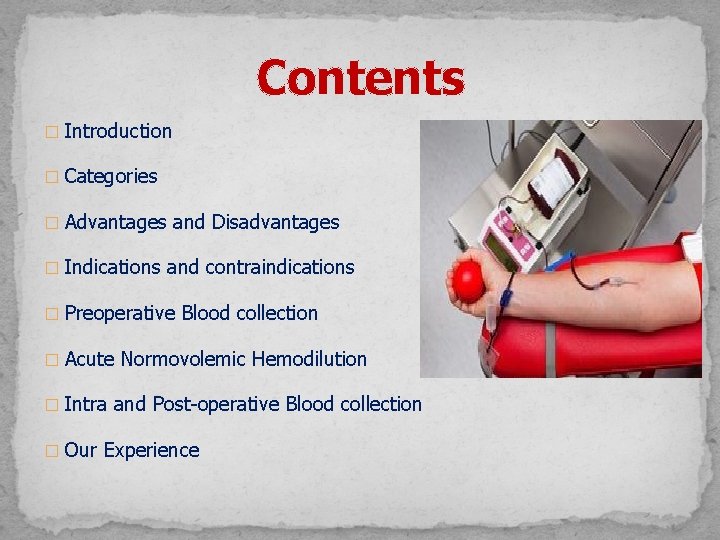
Contents � Introduction � Categories � Advantages and Disadvantages � Indications and contraindications � Preoperative Blood collection � Acute Normovolemic Hemodilution � Intra and Post-operative Blood collection � Our Experience
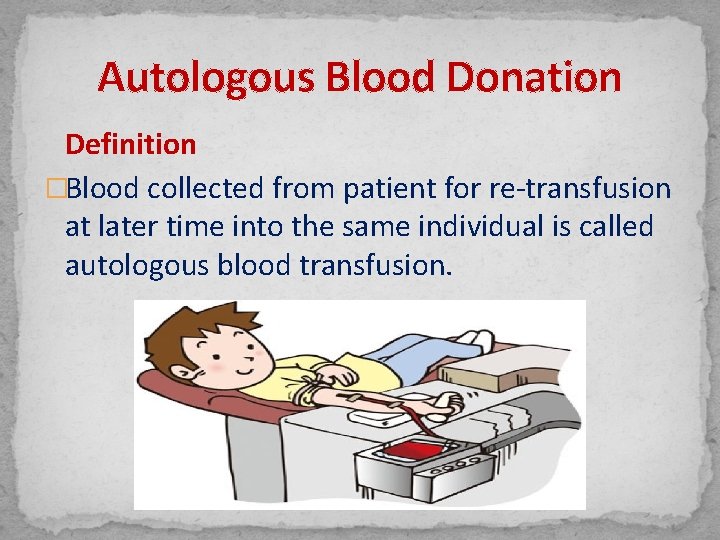
Autologous Blood Donation Definition �Blood collected from patient for re-transfusion at later time into the same individual is called autologous blood transfusion.
Why autologous donation? �Safest blood. �Shortage of blood. �As a part of blood sparing strategy. �Individuals with rare blood groups/ irregular antibodies. �Patient’s apprehensions. �Jehova’s witnesses( JW). Currently, there are more than 7. 5 million JW globally and around 37, 913 in India, and their number is rapidly increasing. [3, 4]
Advantages �Prevents transfusion-transmitted disease. �Prevents red cell allo-immunization. �Supplements the blood supply. �Prevents some adverse transfusion reactions. �Provides compatible blood for patients with allo-antibodies. �Provides reassurance to patients concerned about blood risks.
CONCERNS �Does NOT eliminate risk of bacterial contamination. �Does NOT eliminate risk of ABO incompatibility error. �May results in wastage of blood. �May subjects patients to peri-operative anemia and increased likelihood of transfusion. �Is more costly in case of intra-operative and post operative collection.
Types of Autologous Transfusion Preoperative collection �Blood is collected and stored prior to anticipated need. Peri-operative collection and administration �Acute normovolemic hemodilution: Blood is collected at the start of surgery and then infused during or after the procedure �Intraoperative collection: Shed blood is recovered from the surgical field or circulatory device then infused. �Postoperative collection: Blood is collected from the drainage devices and reinfused to the patient.
Pre-operative Autologous Donation �Blood is drawn and stored before anticipated need. �Two or more units blood are drawn and stored prior to anticipated need. �Should be stable patients who are scheduled for a surgical procedure in which blood transfusion is probable.
Indications of Pre-operative Autologous donation � Major Orthopedic surgeries: Most common � � (Hip & Knee replacement surgeries) Cardiovascular surgeries: (Valve surgery & ? CP bypass surgery) Obstetric surgeries (hysterectomy, ovarian tumour etc. ) Radical prostectomy, mastectomy Gatro-surgery (Gall bladder, Gastectomy, OLT, splenectomy
Contraindications / Exclusion criteria • Hb < 11 gm%. • IHD, Scheduled surgery to correct aortic stenosis • Uncontrolled hypertension ( BP > 180/100). • Myocardial infarction or cerebrovascular accident within 6 months of donation. • • • Restrictive/obstructive lung disease. Impaired renal function. Coagulation disorders, Hypovolemia. Active bacterial infection. Uncontrolled Seizure Disorder
�Autologous blood should not be collected for procedures that seldom (less than 10% of cases) require transfusion, such as cholecystectomy, herniorrhaphy, vaginal hysterectomy, and uncomplicated obstetric delivery.
Pre-requisites for Pre-operative Autologous Blood Donation. Request from attending Physician �Written request from the Clinician is required and kept by the collecting facility. Request includes : �Patient’s name, �No. of units and kind of component requested i. e. whole blood, packed cells etc. , �Anticipated surgical date & surgical procedure, �Clinician’s comment on patient’s ailment and clearance that blood donation would not affect his physical condition & physician’s signature.
Information to the Donor �General information about blood donation and regarding any special fee charged for the procedure etc.
Donor Selection Criteria �Age – No age limits exist. �Weight – Donors weighing 60 kg or more can donate 450 ml of blood and donors weighing less than 60 kg may donate proportionately smaller volume of blood but no more than 8 -9 ml/kg body weight. Note: In pediatric patient of 8 years of age the weight should be 27 kg and no more than 10% of the patients blood volume should be drawn at each phlebotomy. �Hemoglobin and hematocrit – Hemoglobin should not be less than 11. 0 gm/dl and hematocrit not less than 33%.
Blood Tests: �ABO & Rh testing �Test for Transfusion Transmitted Disease Frequency of donation: �A sufficient number of units should be drawn to avoid exposure to allogenic blood �Difference between two collections, >72 hours �The last collection should be >72 hours before surgery
Iron Therapy �Oral iron may be prescribed to accelerate the restoration of hemoglobin to predonation levels. �Erythropoietins along with iron can also be prescribed to these patients but it is expensive.
Labeling of Blood Unit � Units should be clearly labeled with: - a) Donor’s name. b) Identifying numbers, i. e. donor number. c) Collection & Expiration date. d) Patient’s signature. � The units should be clearly marked “FOR AUTOLOGOUS USE ONLY”. It should also be labeled as Autologous Donor Blood. � A biohazard label must be applied if the donor tests positive for HCV, HBs. Ag, Hepatitis B core antibodies, HIV I & II & VDRL. � In no circumstance the blood should be used for another patient (Cross Over).
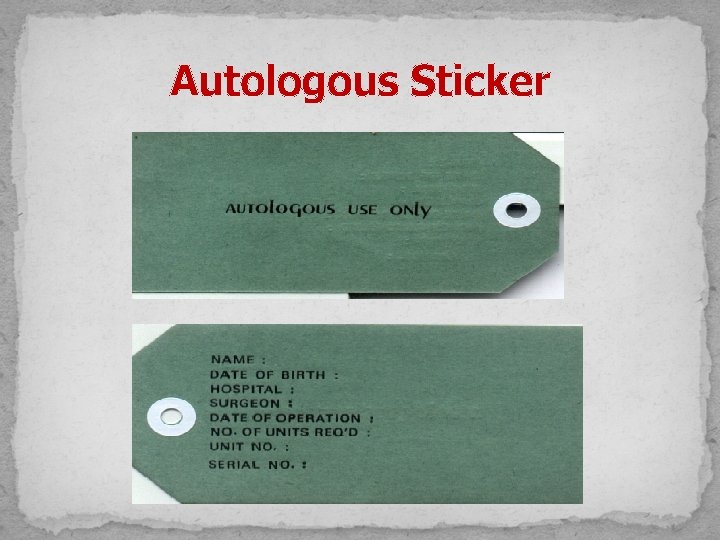
Autologous Sticker
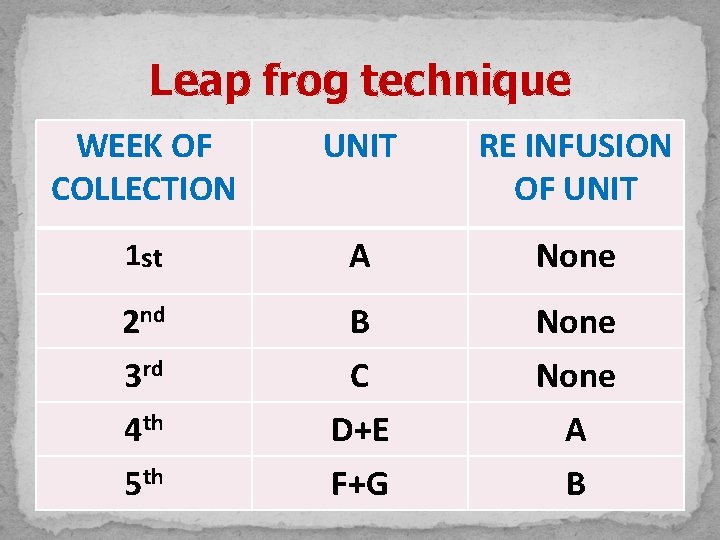
Leap frog technique WEEK OF COLLECTION UNIT RE INFUSION OF UNIT 1 st A None 2 nd 3 rd 4 th 5 th B C D+E F+G None A B
Acute Normovolemic Hemodilution Definition: It is the removal whole blood from a patient just before the surgery and transfused immediately after the surgery. It is also known as ‘preoperative hemodilution’.
Acute normovolemic hemodilution �Patients who are not anemic can have about one quarter of their blood volume withdrawn (not exceeding 20 ml/kg) �ANH is simpler, less expensive and available to patients undergoing surgery at short notice.
Indication �Patients who can tolerate rapid withdrawal of one or several units of blood (not exceeding 20 ml/kg) before the period of blood loss.
Benefits �Lowering blood viscosity improves tissue perfusion and oxygenation. �Reduce red cell loss at intraoperative hemorrhage. �Provide fresh whole blood with coagulation factors and functional platelets. �Reduce the need for allogenic blood, there by avoiding Transfusion Transmitted Diseases & immune mediated reactions.
Patient eligibility �Attending anesthetist should determine the patient’s suitability to undergo ANH. �Patient should have near normal O 2 transport capacity. �Free from cardiovascular, respiratory and cerebrovascular diseases. �Hb level >11 g/dl �Should obtain valid consent
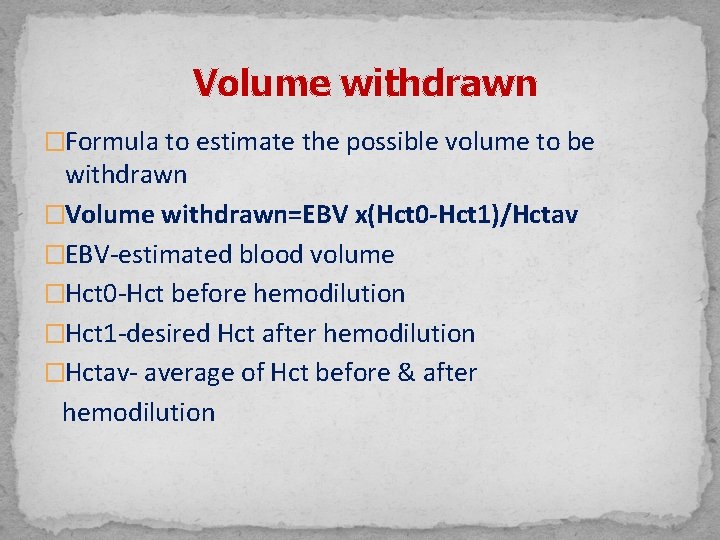
Volume withdrawn �Formula to estimate the possible volume to be withdrawn �Volume withdrawn=EBV x(Hct 0 -Hct 1)/Hctav �EBV-estimated blood volume �Hct 0 -Hct before hemodilution �Hct 1 -desired Hct after hemodilution �Hctav- average of Hct before & after hemodilution
Volume replacement �Crystalloid, 3 ml for every 1 ml and colloid, 1 ml for every 1 ml should be given simultaneously as blood is withdrawn. �Monitoring –continuous monitoring of hemodynamic variables
Labeling & Storage �With proper identification and message “For autologous use only”. �Keep the blood in the same operating room as the patient to preserve the platelet function. �If it is anticipated that more than 6 hrs will elapse before transfusion store at 2 -6 degree C.
Documentation �Written protocol describing policies & procedure, approved by transfusion committee. �Anaesthetist must note on the anaesthesia record , the amount of blood withdrawn, the amount and type of fluid infused , amount of blood returned, along with patient’s vital signs
Procedure �Blood collected in ordinary blood bags with 2 phlebotomies & minimum of 2 units are collected �The blood is then stored at room temp. and reinfused in operating room after major blood loss. �Carried out usually by anesthetists in consultation with surgeons
�Blood units are re-infused in reverse order of collection. �Theme behind: Patient losses diluted blood during surgery and replaced later with autologous blood. �Withdrawal of whole blood and replacement of with crystalloid/ colloid solution decreases arterial O 2 content but compensatory hemo-dynamic mechanisms and existence of surplus O 2 delivery capacity mechanism make ANH safe
�Drop in red cell number lowers blood viscosity, decreasing peripheral resistance and increasing cardiac output. �Administrative costs are minimized and there is no inventory or testing cost �This also eliminates the possibility of administrative or clerical error �Usually employed for procedures with an anticipated blood loss is one liter or more than 20% of blood volume.
�Decision about ANH should be based on surgical procedure, preoperative blood volume and hematocrit, target hemodilution hematocrit, physiologic variables �Careful monitoring of patient’s circulating volume and perfusion status �Blood must be collected in an aseptic manner �Units must be properly labeled and stored
Intra-operative Blood Collection Definition: Whenever there is blood loss and collected inside the body cavity, it is transfused back to the patient.
�Oxygen transport properties of recovered cell are equivalent to stored allogenic red cells �Contraindicated when pro-coagulant materials are applied. �Micro aggregate filter(40 micron) are used as recovered blood contain tissue debris, blood clots, bone fragments

�Hemolysis of red cells can occur during suctioning from surface (vacuum not more than 150 torr is recommended) �Indications: Blood collected in thoracic or abdominal cavity due to organ rupture or surgical procedures. �Contraindications: Malignant neoplasm, infection and contaminants in operative field. �Blood is defibrinated but it does not coagulate
Two types of procedures are available �One is simpler canisters type in which salvaged blood is anticoagulated and aspired, using vacuum supply into a liner bag (capacity 1900 ml) contained in reusable canister and integal filter �Other is more automated, based on centrifuge assisted, semi-continuous flow technology �Process result in 225 ml unit of saline suspended red cells with Hct 50 -60%
Postoperative Blood Collection �Recovery of blood from surgical drain followed by re-infusion with or without processing. �Shed blood is collected into sterile canister and re-infused through a micro-aggregate filter. �Recovered blood is diluted, partially hemolysed and de-fibrinated and may contain high concentrate of cytokines
�Upper limit on the volume(1400 ml) of unprocessed blood can re-infused �Transfusion should be within 6 hours of initiating collection. �Infusion of potentially harmful material in recovered blood, free Hb, red cell stroma, marrow, fat, toxic irrigant, tissue debris, fibrin degradation activated coagulation factors and complement.
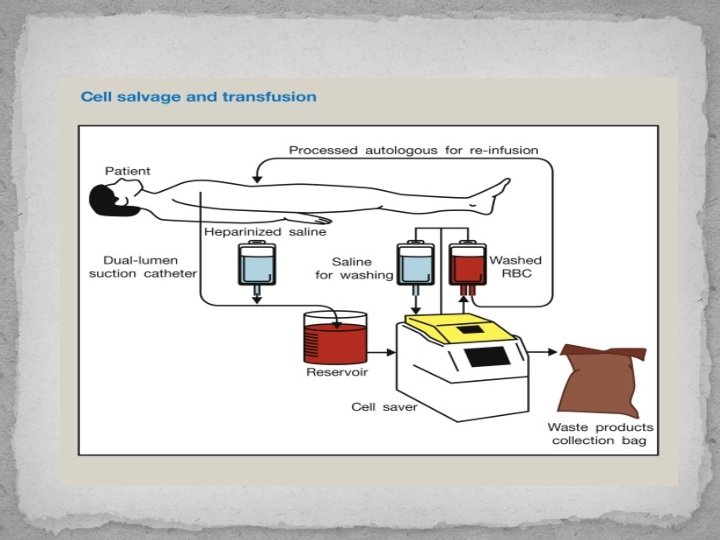
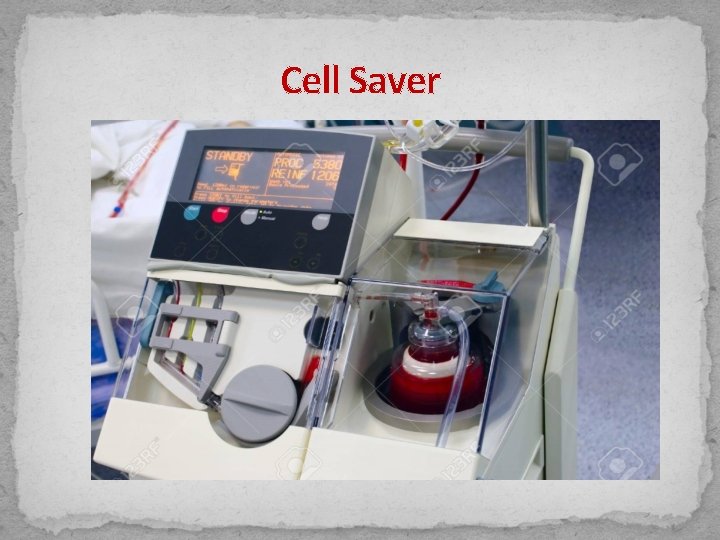
Cell Saver
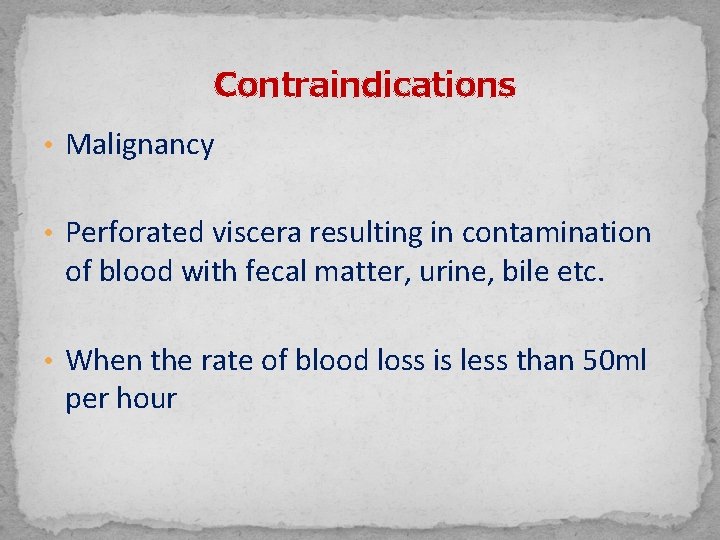
Contraindications • Malignancy • Perforated viscera resulting in contamination of blood with fecal matter, urine, bile etc. • When the rate of blood loss is less than 50 ml per hour
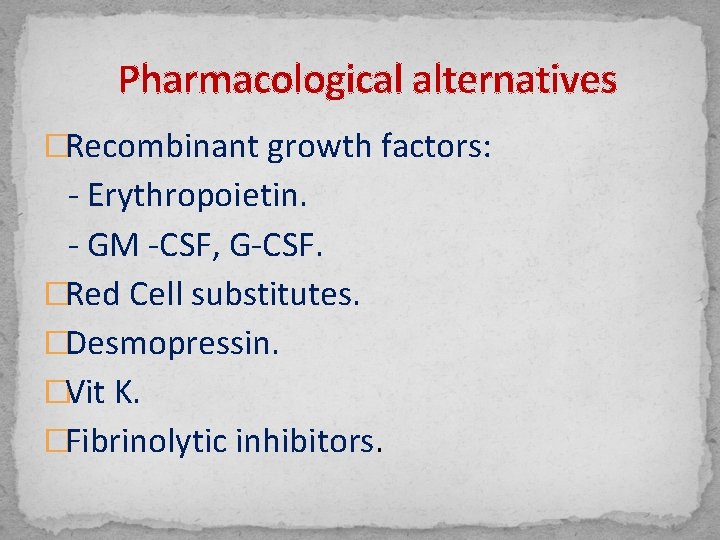
Pharmacological alternatives �Recombinant growth factors: - Erythropoietin. - GM -CSF, G-CSF. �Red Cell substitutes. �Desmopressin. �Vit K. �Fibrinolytic inhibitors.
Summary �Each type of autologous transfusion has potential risks and benefits. �However, when feasible, the patient should have the option to use his or her own blood. �SOPs at each step. �Separate inventory to avoid mix-ups.
Summary cont. . �Separate tags/ green labels to ensure that the right unit goes to right patient. �X-match & Issue. �Discarding unused unit and not used as allogenic because of different criteria and chances of clerical error.
References Technical Manual, AABB. 18 th edition. 2. R. K Saran. Transfusion Medicine Technical Manual. 2 nd Edition 2003 3. Chua R, Tham KF. Will “no blood” kill Jehovah Witnesses? Singapore Med J. 2006; 47: 994 1001. 4. Jehovah's Witness Statistics. 2013. Available from: http: //www. jwfacts. com/images/2013 -publisherreport. pdf. 1.

Thank You
- Slides: 46