
Auto Tutor Benjamin Kempe Tutoring Research Group University

Auto. Tutor Benjamin Kempe Tutoring Research Group, University of Memphis www. autotutor. org
Auto. Tutor: Introduction • content: course in computer literacy at University of Memphis • interface: agent, question and elaborate responses, graphical display • Simulating unskilled human tutoring • use of LSA • working system
Curriculum Script • ideal complete answer: set of good answers or aspects written in English • anticipated bad answers • dialog moves: elaborations, hints, prompts
Curriculum Script: answer aspects Tutor: Why do computers need operating systems? Good-Answer-1: The operating system helps load application programs. Good-Answer-2: The operating system coordinates communications between the software and the peripherals. Good-Answer-3: The operating system allows communication between the user and the hardware. Good-Answer-4: The operating system helps the computer hardware run efficiently.
Language Extraction • lexicon with 10000 words • assigning syntactic classes and frequency of usage with 93% accuracy
Latent Semantic Analysis • relevance between two bags of words: Assertions and content of curriculum script • LSA space: 30 articles about hardware, operating systems and Internet and curriculum script • 2. 3 MB corpus, 200 dimensions
Topic Selection • structure of the curriculum • difficulty level • Assertion quality score Q(Ti) +maximum match between Assertion and good answers aspects -maximum match between Assertion and bad answers • student ability = Q(Ti)
Dialog Move Generator • short feedback and contribution • Production rules according to quality of Assertions, global parameters, coverage of topic IF [(student ability = LOW) & (student verbosity = HIGH) & (Q(Ti) = LOW)] THEN [select HINT]
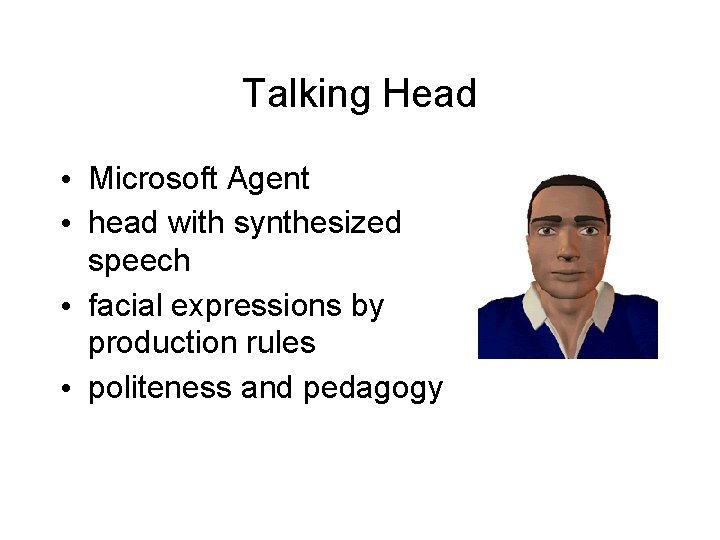
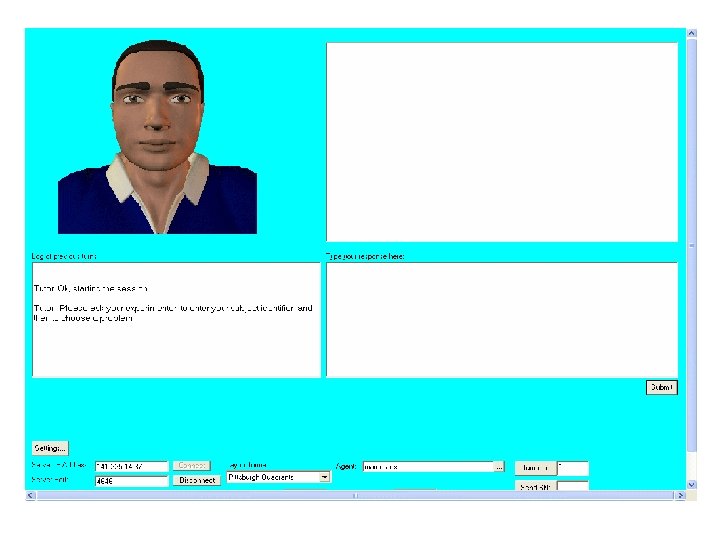
Talking Head • Microsoft Agent • head with synthesized speech • facial expressions by production rules • politeness and pedagogy
Evaluation: LSA in Auto. Tutor • 192 answers to questions • rated by two intermediate and two accomplished experts • Assertions that match good aspects • threshold of. 55 • correlation – LSA/experts: . 49 – intermediate: . 51 – accomplished: . 78
Evaluation: Assertion Quality
Example: multiple answering Tutor: How does CPU speed affect program speed? Student: a program's commands are executed faster Tutor: That is right! Tutor: See if you know the answer to this. Tutor: A fast CPU will make your programs run? Student: faster! Tutor: OK Tutor: run faster. Tutor: Let's see. . . Tutor: How can a faster CPU help you in the future? Student: the programs run faster Tutor: Perfect answer!
Example: confusion with “how” Tutor: When users buy a computer, they definitely will consider how fast Student: how fast it is Tutor: Wait a minute, answer my question and then we'll do yours. Tutor: Let me repeat. Tutor: When users buy a computer, they definitely will consider how fast Student: they will consider how fast the cpu ist Tutor: Wait a minute, answer my question and then we'll do yours. Tutor: Let me repeat. . Tutor: Okay, Tutor: When users buy a computer, they definitely will consider how fast Student: the cpu is Tutor: Alright Tutor: how fast the CPU is.
Example: use of “not” Tutor: How can you transfer regular photos onto a computer disk? Student: it is not possible to transfer regular photos onto a computer disk with a scanner Tutor: Um, yes, that is right!. . . Tutor: You need a modem to connect to the Internet if you have a dial up connection. Tutor: How is the Internet accessed when users do not have a direct connection? Student: it is not accessed by a modem Tutor: Yeah, that's right!
Summary • LSA: evaluating student‘s ability as well as intermediate experts • not implemented: student asks questions • LSA use in talking head • full natural language answers are more effective for learning
- Slides: 16