
Auto LRS Automatic LearningRate Schedule by Bayesian Optimization

Auto. LRS: Automatic Learning-Rate Schedule by Bayesian Optimization on the Fly Yuchen Jin, Tianyi Zhou, Liangyu Zhao, Yibo Zhu, Chuanxiong Guo, Marco Canini, Arvind Krishnamurthy 1

Learning rate (LR) • Learning rate is a parameter that determines the step size at each iteration of the optimization problem. • The success of training DNNs largely depends on the LR schedule. [Stanford CS 231 n] 2
Tuning the learning rate (LR) schedule is nontrivial Widely-used tuning strategies: • Pre-defined LR schedules • Limited number of choices, e. g. , step decay & cosine decay • Optimization methods with adaptive LR (such as Adam and Ada. Delta) • Still require a global learning rate schedule: Adam's default LR performs poorly in training BERT and Transformer Both strategies introduce new hyper-parameters that have to be tuned separately for different tasks, datasets, and batch sizes. 3
Can we automatically tune the LR over the course of training without human involvement? 4
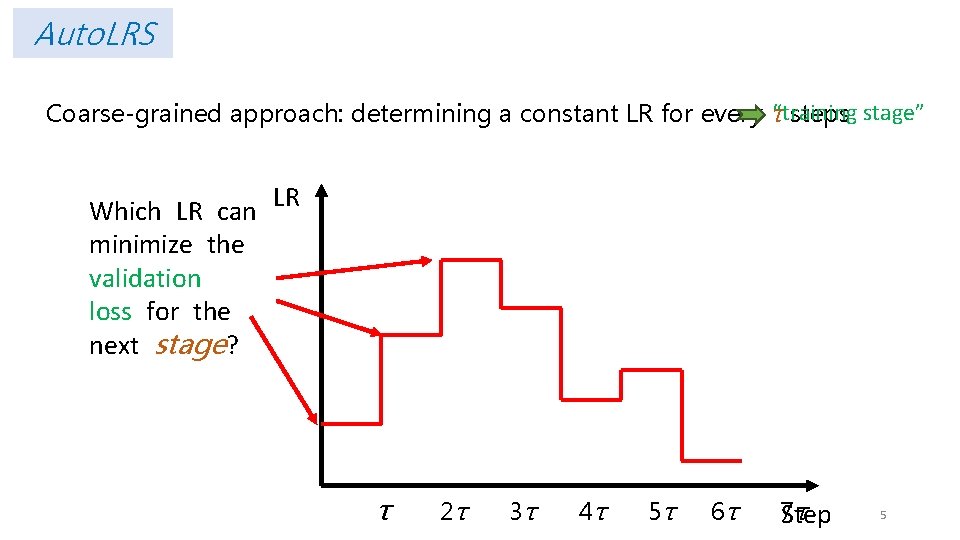
Auto. LRS Coarse-grained approach: determining a constant LR for every τ“training steps stage” Which LR can LR minimize the validation loss for the next stage? τ 2τ 3τ 4τ 5τ 6τ 7 τ Step 5
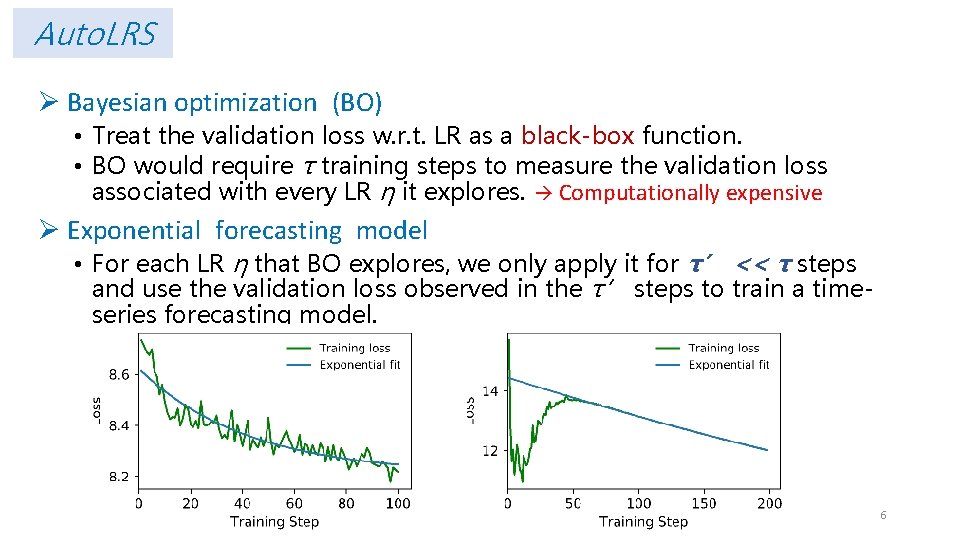
Auto. LRS Ø Bayesian optimization (BO) • Treat the validation loss w. r. t. LR as a black-box function. • BO would require τ training steps to measure the validation loss associated with every LR η it explores. Computationally expensive Ø Exponential forecasting model • For each LR η that BO explores, we only apply it for τ’ << τ steps and use the validation loss observed in the τ’ steps to train a timeseries forecasting model. 6
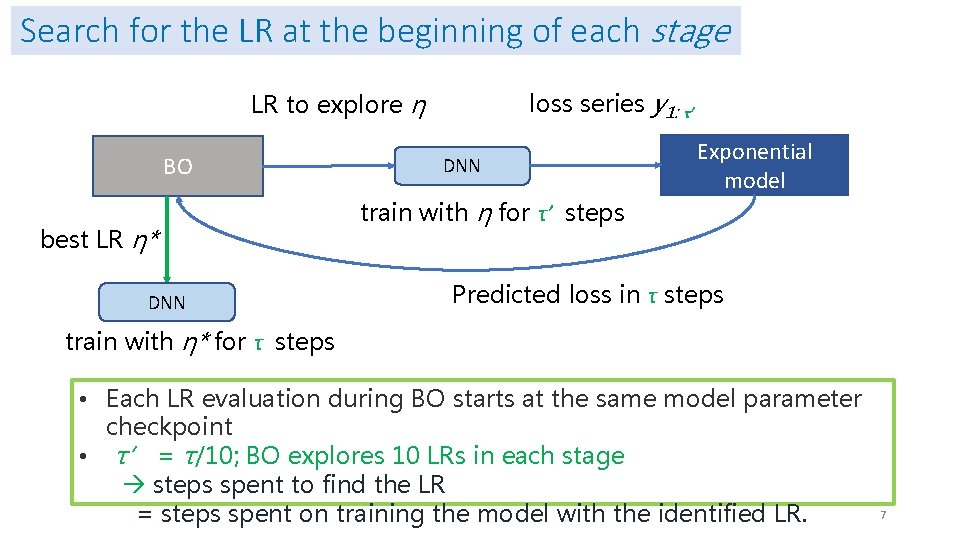
Search for the LR at the beginning of each stage loss series y 1: τ’ LR to explore η BO best LR η* DNN train with η for τ’ steps Exponential model Predicted loss in τ steps train with η* for τ steps • Each LR evaluation during BO starts at the same model parameter checkpoint • τ’ = τ/10; BO explores 10 LRs in each stage steps spent to find the LR = steps spent on training the model with the identified LR. 7
Experiments • Models: Res. Net-50, Transformer, BERT Pre-training • Baselines: • LR schedule adopted in each model’s original paper • Highly hand-tuned Cyclical Learning Rate (CLR) [1] • Highly hand-tuned Stochastic Gradient Descent with Warm Restarts (SGDR) [1] Leslie N Smith. Cyclical learning rates for training neural networks. WACV’ 17. [2] Ilya Loshchilov and Frank Hutter. SGDR: stochastic gradient descent with warm restarts. ICLR’ 17. [2] 8
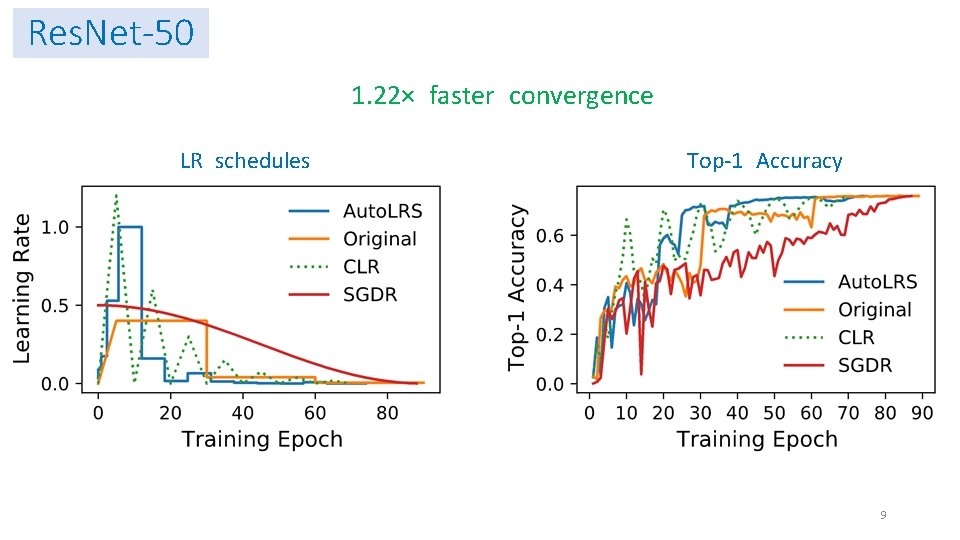
Res. Net-50 1. 22× faster convergence LR schedules Top-1 Accuracy 9
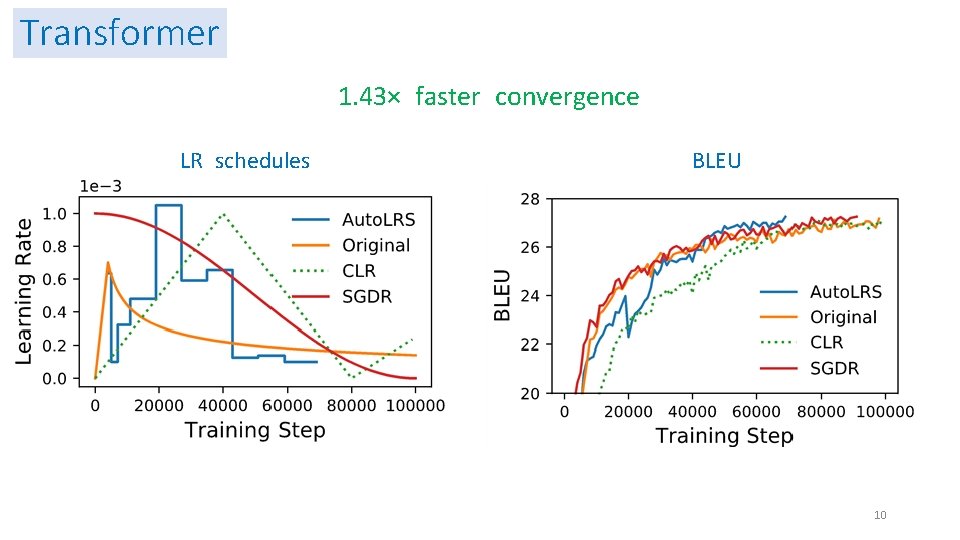
Transformer 1. 43× faster convergence LR schedules BLEU 10
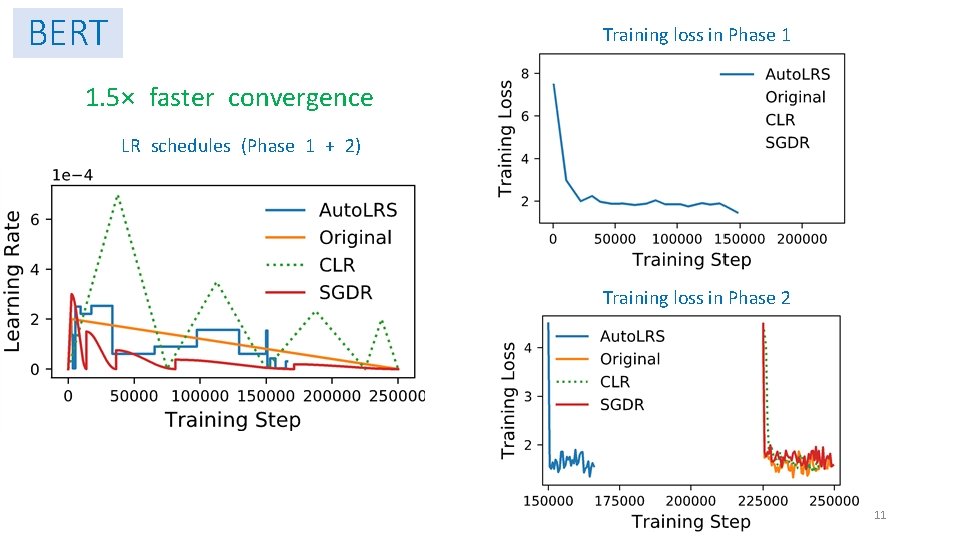
BERT Training loss in Phase 1 1. 5× faster convergence LR schedules (Phase 1 + 2) Training loss in Phase 2 11
Auto. LRS Summary Aid ML practitioners with automatic and efficient LR schedule search for the DNNs • We perform LR search for each training stage and solve it by Bayesian optimization. • We train a light-weight exponential forecasting model from the training dynamics of BO exploration. • Auto. LRS achieves a speedup of 1. 22 x, 1. 43 x, and 1. 5 x on training Res. Net-50, Transformer, and BERT compared to their highly handtuned LR schedules. Give it a try: https: //github. com/Yuchen. Jin/autolrs 12
- Slides: 12